
Piazza Navona — The Baroque Square on the Roman Stadium
Piazza Navona is the great Baroque square of Rome, built on a Roman stadium. Its fountains and palaces make it one of the most beautiful squares in Europe.
The square is long and oval, with three fountains and a church and palaces around its edges, and it is one of the most visited places in Rome. It is not a square that was planned as a square: it is the shape of a Roman stadium, the Stadium of Domitian, built in the year 86, and the houses and palaces of the square were built on the ruins of the stadium, following its long oval shape. The square is the centre of Baroque Rome, with the fountains of Bernini and the church of Borromini, and it is a place where the history of Rome is visible in the stones, from the Roman stadium below to the Baroque palaces above.
Quick Facts
- Square: Piazza Navona, in the historic centre of Rome, in the Italian region of Lazio.
- Shape: a long oval, about 240 m long, following the shape of the Stadium of Domitian beneath it.
- Stadium beneath: the Stadium of Domitian, dedicated in the year 86; the arena is now the square itself.
- Fountain in the middle: the Four Rivers, by Bernini, 1651, with river figures around an obelisk.
- Church: Sant’Agnese in Agone, by Francesco Borromini, built on the site where Saint Agnes was martyred, on the western side of the square.
- Palace: Palazzo Pamphilj, built for Pope Innocent the Tenth, now the Embassy of Brazil, on the western side of the square.
- Inscribed: inside the Historic Centre of Rome (91), listed 1980, extended 1990.
- Other museum: Palazzo Braschi, on the southern side, holds the Museum of Rome, with paintings and prints of the city.
- Tongue: Italian; the cafes and shops of the square speak English too.
- Nearest separate World Heritage property: Villa Adriana at Tivoli (907), listed 1999; the villa of Hadrian, about 25 km east.
Geography of Piazza Navona
Piazza Navona lies in the historic centre of Rome, on the flat land between the Tiber river and the hills of the Quirinal and the Capitoline, in the heart of the city that the Romans built. The square is about 240 m long and about 50 m wide, and it is shaped like a long oval, with the ends rounded, because it follows the shape of the Stadium of Domitian, which stood on this site in the first century. The stadium was about 275 m long and 106 m wide, with an arena 240 m by 65 m in the middle, and the houses and palaces of the square were built on the ruins of the stadium, with the arena becoming the open space of the square and the stands becoming the buildings around it. The shape of the square is the shape of the stadium, and the visitor who walks its length is walking the length of the arena where the Romans watched the games.
The square is surrounded by buildings on every side, with the church of Sant’Agnese in Agone and the Palazzo Pamphilj on the western side, and the Palazzo Braschi on the southern side, and the houses and restaurants on the northern and eastern sides. The buildings are three and four storeys high, with ochre and yellow facades, and they close in the square, so that the sky above it is a long strip of blue, and the fountains are the focus of the space. The square is paved with stone, and it is closed to cars, so that the only sounds are the water of the fountains and the voices of the people, and the cafes put their tables out on the pavement in the summer, with umbrellas and chairs and the smell of coffee.
The Tiber river runs to the west of the square, about 500 m away, and the Pantheon stands about 300 m to the east, and the Campo de’ Fiori, the flower market, is about 400 m to the south. The square is in the middle of the historic centre, and it is one of the places that every visitor to Rome comes to, because it is on the way from the Pantheon to the Vatican, and because it is one of the most beautiful squares in the city. The streets around it are narrow and winding, with shops and restaurants and small hotels, and the square is a place to stop and rest, with the fountains and the cafes and the artists who paint portraits and sell their work on the pavement.
The climate of Rome is Mediterranean, with hot dry summers and mild wet winters, and the square is at its best in the spring and the autumn, when the weather is warm and the crowds are thinner. In July and August the square is hot, with the sun beating down on the stone and the temperature above 30 degrees, and the fountains are the coolest place in the square, with the spray of the water and the shade of the buildings. In winter the square is mild, with rain in November and December, and the Christmas market fills the square with stalls and lights and the smell of roast chestnuts. The square is beautiful in every season, but it is most beautiful in the late afternoon, when the sun is low and the facades turn gold and the water of the fountains catches the light.
The stadium beneath the square is still there, under the houses and the pavement, and parts of it can be seen in the basements of the buildings around the square. The Stadium of Domitian was built for athletic games, not for gladiatorial combat, and it was the first permanent stadium for athletics in Rome, with room for about 30,000 spectators. The stadium was used for the games of the Capitoline festival, and it was restored by later emperors, and it fell into ruin after the fall of Rome, when the stones were taken for building and the arena was filled with houses. The shape of the stadium survived, because the houses were built on the foundations of the stands, and the arena became a market place, and then a square, and the name of the square, Navona, comes from the Latin word for the games, agones, which became in agonis, and then Navona.
The square is about 25 km from Villa Adriana, the villa of the Emperor Hadrian at Tivoli, which is the nearest separate World Heritage property, and about 33 km from the Etruscan necropolises of Cerveteri, which are the next nearest. The square itself lies inside the Historic Centre of Rome, ref 91, which was inscribed in 1980 and extended in 1990, and which covers the whole historic centre, from the Colosseum to the Vatican. The inscription is one of the largest in the world, and it includes the monuments of ancient Rome and the churches and palaces of the Renaissance and the Baroque, and Piazza Navona is named in the text of the inscription, as one of the great squares of the Baroque city.
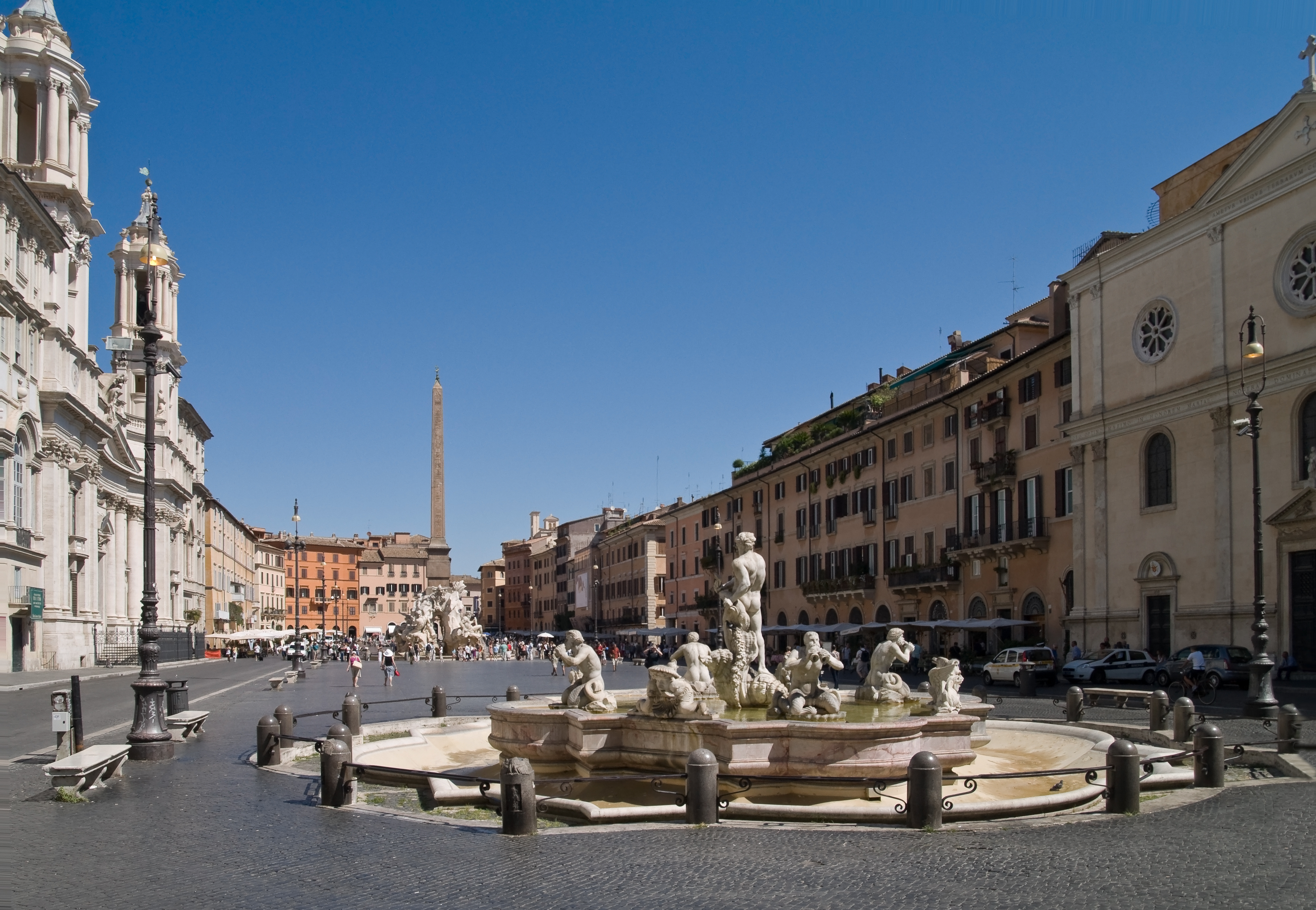
Piazza Navona , Rome — CC BY-SA 3
History of Piazza Navona
The history of Piazza Navona begins with the Stadium of Domitian, which was dedicated in the year 86, in the reign of the Emperor Domitian. The stadium was built for the athletic games, the agones, which were part of the Capitoline festival, and it was a building of stone and concrete, with stands on three sides and an arena in the middle, and it could hold about 30,000 spectators. The stadium was the first permanent stadium for athletics in Rome, and it was used for running and wrestling and boxing, and for the musical competitions that were part of the festival. The stadium was restored by later emperors, and it was used until the fall of Rome, when the games stopped and the building fell into ruin.
After the fall of Rome the stadium was abandoned, and the stones were taken for building, and the arena was filled with houses and gardens and a market. The shape of the stadium survived, because the houses were built on the foundations of the stands, and the open space in the middle, the arena, became a market place, where the people of the neighbourhood bought and sold food and goods. The market was called the Campus Agonis, the field of the games, and the name became in agonis, and then Navona, so that the square still carries the name of the games that were held there two thousand years ago. The square was a market for centuries, and it was one of the liveliest places in Rome, with stalls and crowds and the noise of trade.
The square became a great square in the 17th century, when Pope Innocent the Tenth, who was born in the Palazzo Pamphilj on the square, decided to make it the centre of Baroque Rome. The pope rebuilt the palace of his family, the Palazzo Pamphilj, and he commissioned the Fountain of the Four Rivers from Gian Lorenzo Bernini, the greatest sculptor of the age, and he rebuilt the church of Sant’Agnese in Agone, on the site where Saint Agnes was martyred, with Francesco Borromini as the architect. The fountain was finished in 1651, and it is the masterpiece of the square, with four great figures for the four rivers of the known world, the Nile, the Danube, the Ganges and the Rio de la Plata, and an obelisk in the middle, and the water falling into the basin below. The church was finished after the death of the pope, and it is the masterpiece of Borromini, with a facade of curved stone and a dome that rises above the square.
The square was the scene of festivals and of markets and of the famous flooding, when the square was flooded with water in the summer, so that the people of Rome could bathe and swim in the square, and the carriages could drive through the water. The flooding was done by blocking the drains of the fountains and letting the water run out over the pavement, and it was a popular spectacle in the 17th and 18th centuries, when the square became a lake and the people came to watch and to swim. The flooding stopped in the 19th century, when the square was paved and the drains were changed, but the memory of it survives in the paintings of the time, which show the square full of water, with the fountains rising out of it and the carriages driving through it.
In the 19th and 20th centuries the square became a place for artists and for tourists, with the cafes and the restaurants and the painters who set up their easels on the pavement. The square is still a market in December, when the Christmas market fills it with stalls selling sweets and toys and nativity figures, and it is still a place for festivals, with the feast of Saint Agnes in January and the summer festivals that fill the square with music. The square is one of the most visited places in Rome, and it is a place where the history of the city is visible, from the Roman stadium below to the Baroque palaces above, and the fountains in the middle.
Today Piazza Navona is one of the great squares of Europe, and it is a place that belongs to the people of Rome as much as to the visitors. The cafes put their tables out on the pavement, and the artists paint portraits, and the children play in the fountains, and the square is full of life from morning to night. The square is a World Heritage Site, as part of the Historic Centre of Rome, and it is protected by law, so that the buildings and the fountains are kept as they are, and the square will look the same in a hundred years as it does today.
Travel to Piazza Navona
Piazza Navona is in the historic centre of Rome, and it is reached on foot from every part of the old city. The nearest metro station is Barberini, on line A, about 15 minutes away on foot, and the nearest bus stop is on the Corso del Rinascimento, a few minutes from the square. The square is closed to cars, and the streets around it are narrow, so the best way to reach it is to walk, from the Pantheon, which is about 300 m to the east, or from the Campo de’ Fiori, which is about 400 m to the south, or from the Piazza del Popolo, which is about a kilometre to the north. The walk through the old city is part of the pleasure of the visit, with the narrow streets and the small squares and the shops and the cafes.
Visitors who come to Rome by air arrive at Fiumicino airport, about 30 km to the west, or at Ciampino airport, about 15 km to the south-east, and the train from Fiumicino to Rome Termini takes about 30 minutes, and the bus from Ciampino to Termini takes about 40 minutes. From Termini the metro runs to Barberini, and the walk from there to the square takes about 15 minutes, through the streets of the old city. Visitors who come by train arrive at Termini, the main station of Rome, and the journey from the station to the square is the same, by metro and on foot.
The square is open at all hours, because it is a public square, and it is free to visit, with no ticket and no opening hours. The church of Sant’Agnese in Agone is open in the day, and it is free to enter, and the Palazzo Braschi, on the southern side, holds the Museum of Rome, which is open from Tuesday to Sunday, with a ticket, and which holds paintings and prints of the city. The fountains are the centre of the square, and they are best seen in the morning, when the light is on the water, and in the evening, when the square is lit and the cafes are full.
The best time to visit Piazza Navona is in the spring and the autumn, when the weather is warm and the crowds are thinner, and the square is at its best in the late afternoon, when the sun is low and the facades turn gold. Summer is hot and crowded, with the square full of visitors and the cafes full, and winter is mild and quiet, with the Christmas market in December filling the square with stalls and lights. A visit to the square takes about an hour, with time to walk around the fountains and to sit in a cafe, and a day in the historic centre, with the Pantheon and the Campo de’ Fiori and the square, is a good way to see the heart of Rome.
Notable Places in Piazza Navona
The Fountain of the Four Rivers is the centre of the square, and it is the masterpiece of Gian Lorenzo Bernini, finished in 1651. The fountain is a great rock in the middle of a basin, with four figures for the four rivers of the known world, the Nile, with its head covered, because its source was unknown, the Danube, the Ganges, and the Rio de la Plata, and an Egyptian obelisk rising from the rock, with a dove on top, the symbol of the Pamphilj family. The fountain is one of the most famous fountains in the world, and it is the symbol of Baroque Rome, with the movement of the water and the figures and the obelisk, and it is the first thing that visitors see when they enter the square.
The Fountain of Neptune stands at the northern end of the square, and the Fountain of the Moor stands at the southern end, and they are the two other fountains of the square. The Fountain of Neptune was built in the 16th century, and the figure of Neptune was added in the 19th century, and the fountain shows the god of the sea with horses and dolphins. The Fountain of the Moor was built in the 16th century, and the figure of the Moor wrestling with a dolphin was carved by Bernini, and the fountain is smaller than the Fountain of the Four Rivers, but it is no less beautiful, with the water falling into the basin and the figures in the middle.
The church of Sant’Agnese in Agone stands on the western side of the square, on the site where Saint Agnes was martyred in the fourth century, in the stadium that stood here. The church was built by Francesco Borromini, the great architect of the Baroque, and it has a facade of curved stone and a dome that rises above the square, and it is one of the most beautiful churches in Rome. The church is open in the day, and it is free to enter, and the interior is rich with marble and frescoes, and the crypt holds the remains of the stadium, with the rooms where the Christians were kept before their martyrdom.
The Palazzo Pamphilj stands beside the church, on the western side of the square, and it was built for Pope Innocent the Tenth, who was born in the palace, and it is now the Embassy of Brazil. The palace has a gallery with frescoes by Pietro da Cortona, the Allegory of the Life of Aeneas, and it is open to visitors on some days, with the frescoes and the rooms of the palace. The palace is the largest building on the square, and it is the reason the square became the centre of Baroque Rome, because the pope lived here and made the square his own.
The Palazzo Braschi stands on the southern side of the square, and it holds the Museum of Rome, with paintings and prints and sculptures of the city, from the Middle Ages to the present day. The museum is the best place to go to understand the history of Rome, with the views of the city and the portraits of the popes and the prints of the squares and the streets, and it is open from Tuesday to Sunday, with a ticket. The stadium of Domitian can be seen in the basement of the buildings around the square, with the remains of the arena and the stands, and the Stadium of Domitian site, on the northern side, is open to visitors, with the ruins and a model of the stadium.

Allegory of the Ganges river in the Fountain of the four rivers on Piazza Navona in Rome — CC BY-SA 3
Frequently Asked Questions
When is the best time of year for Piazza Navona?
Spring and autumn, for warm weather and thinner crowds. Late afternoon light turns the facades gold.
How do I reach Piazza Navona from the Pantheon?
Walk west about 300 m through the old city streets. The walk takes about five minutes.
What is the Fountain of the Four Rivers?
Bernini’s fountain of 1651, with four river figures, the Nile, Danube, Ganges and Rio de la Plata, around an obelisk.
Is Piazza Navona a UNESCO World Heritage Site?
Yes. The square lies inside the Historic Centre of Rome, ref 91, inscribed 1980 and extended 1990.
What stood on the site of the square before the Baroque?
The Stadium of Domitian, dedicated in the year 86, for athletic games. The square follows its oval shape.
How long should I stay in Piazza Navona?
An hour for the fountains and a cafe. A day in the historic centre adds the Pantheon and Campo de’ Fiori.
Verified
- Piazza Navona is a square in the historic centre of Rome, at 41.8987° N, 12.4732° E, Wikidata Q463400, confirmed against the registry.
- The Stadium of Domitian, dedicated in the year 86, measured about 275 m by 106 m, with room for about 30,000.
- Bernini finished the Four Rivers fountain in 1651; the obelisk above it carries the Pamphilj dove.
- The church of Sant’Agnese in Agone was built by Francesco Borromini, and the Palazzo Pamphilj, built for Pope Innocent the Tenth, is now the Embassy of Brazil.
- The square stands inside ref 91, listed 1980 and extended 1990; the inscription names Piazza Navona.
- Villa Adriana, ref 907, was listed in 1999; the villa at Tivoli lies about 25 km east.
- Italy holds 62 World Heritage properties, confirmed against the corpus counts of 23 November 2026.
Sources
- UNESCO World Heritage Centre, Historic Centre of Rome, ref 91, https://whc.unesco.org/en/list/91/
- UNESCO World Heritage Centre, Villa Adriana, ref 907, https://whc.unesco.org/en/list/907/
- Piazza Navona, Wikipedia
- Stadium of Domitian, Wikipedia
- Fountain of the Four Rivers, Wikipedia
Unverified
- The exact capacity of the Stadium of Domitian, which is given as about 30,000 by most sources and as 15,000 by a minority reading.
- The opening hours of the Museum of Rome in Palazzo Braschi, which vary by season and should be checked before visiting.
- The days on which the Palazzo Pamphilj is open to visitors, which change and should be checked before visiting.
Illustrations
- Hero: Piazza Navona. Free image: https://upload.wikimedia.org/wikipedia/commons/8/87/Piazza_Navona_in_Rome_13.jpg — CC BY-SA 4.
- In body, Piazza Navona: Piazza Navona , Rome. Free image: https://upload.wikimedia.org/wikipedia/commons/2/25/Piazza_Navona_1.jpg — CC BY-SA 3.
- In body, Piazza Navona: Allegory of the Ganges river in the Fountain of the four rivers on Piazza Navona in Rome. Free image: https://upload.wikimedia.org/wikipedia/commons/2/20/Piazza_Navona_Gange_fontana_dei_Fiumi_Roma.jpg — CC BY-SA 3.