
Rome: The Eternal City on the Tiber, Capital of Italy
Rome is the capital of Italy, the Eternal City on the River Tiber. Three thousand years of history stand side by side in its streets.
Rome is the only city in the world that contains another country inside it, because Vatican City stands within its boundary as the smallest state on earth. The city was the centre of the Roman Republic and then of the Roman Empire, and it later became the heart of the Catholic Church, so its stones carry two empires at once. A visitor can eat breakfast beside a temple two thousand years old, walk past a Baroque fountain at noon, and dine in a medieval lane in the evening, and the city never feels like a museum.
The Romans called their city the Eternal City because it never stopped rebuilding itself, layer upon layer, for nearly three thousand years. The Forum is not a fenced-off ruin outside the city, because it stands in the middle of the traffic, and Romans still walk to work past columns that stood there under the emperor Augustus. Rome is a living city first and a monument second, and that is what makes it different from every other ancient city.
Quick Facts About Rome
| Fact | Detail |
|---|---|
| Name | Rome, Roma in Italian, capital of Italy |
| Role | Capital of Italy; capital of the Lazio region; centre of the Roman Catholic Church |
| Location | Central Italy, in Lazio, on the Tiber river, about 25 km from the Tyrrhenian Sea |
| Founded | According to legend, 21 April 753 BC, by Romulus |
| Area | About 1,287 square kilometres |
| Population | About 2.75 million (2025); metropolitan area about 4.2 million |
| Language | Italian |
| Time zone | CET, UTC plus one hour, with summer time CEST |
| Hills | The seven hills: Palatine, Capitoline, Aventine, Caelian, Esquiline, Viminal and Quirinal |
| UNESCO | Historic Centre of Rome, ref 91, inscribed 1980 and extended 1990, criteria i, ii, iii, iv, vi |
| Vatican City | Independent state inside Rome since the Lateran Treaty of 1929 |
| Coordinates | 41.89° N, 12.48° E |
| Wikidata | Q220, capital of Italy |
Geography of Rome
Seven Hills and the Tiber River
The city stands on the Tiber river in central Italy, about 25 km inland from the Tyrrhenian Sea, and its geography begins with the seven hills. The Palatine, the Capitoline, the Aventine, the Caelian, the Esquiline, the Viminal and the Quirinal are low hills of soft volcanic rock, and the first settlements grew on their tops above the marshy river plain. The Palatine was the home of the emperors, and the Capitoline was the home of the temples, and the two hills together were the heart of the ancient city.
The Tiber is the river that made the city possible, because it carried trade from the sea and water from the Apennine hills to the city. The river bends through the city in a great loop, and the island in the middle of the bend, the Tiber Island, was the first crossing point and the site of the earliest bridges. The old city grew on the east bank of the river, and the district of Trastevere grew on the west bank, and the bridges between them are still the main crossings of the centre.
The river also brought floods, and Rome lived with the Tiber’s moods for centuries, because the low ground beside the river flooded almost every winter. The great embankment walls of the nineteenth century finally tamed the river, and the wide stone quays now hold the water back from the streets. The bridges of Rome are part of its geography, from the ancient Ponte Fabricio to the modern bridges of the twentieth century, and each one joins a different pair of districts.
The city covers about 1,287 square kilometres, which makes it one of the largest municipalities in Europe, and the built-up area spreads far beyond the ancient walls. The historic centre is small and walkable, and it holds most of the monuments, while the modern districts stretch out along the consular roads that leave the city in every direction. The green belt of parks and the hills to the east give Rome a rural edge that surprises visitors who know only the crowded centre.
The Historic Centre and the Modern Districts
The historic centre is a maze of narrow streets, small squares and sudden views, and it holds three thousand years of building in a single walk. The ancient Forum and the Colosseum stand at the south-east edge of the centre, and the Pantheon, Piazza Navona and the Trevi Fountain stand in the middle of it, while the Vatican and Saint Peter’s Basilica stand across the river to the west. The centre is best explored on foot, because the streets are too narrow for cars and the monuments appear without warning around corners.
Around the centre stand the districts that grew in the nineteenth and twentieth centuries, and they show a different Rome of wide avenues and apartment blocks. The districts of Prati near the Vatican, Testaccio by the old slaughterhouse, and San Lorenzo by the university each have their own character, and they are where most Romans live and eat. The EUR district to the south is a planned quarter of white marble buildings from the fascist era, and it now holds offices, museums and a lake.
The city is ringed by the Aurelian Walls, built in the third century, and by the great ring road that follows their line. The walls still stand for much of their length, and their gates are the old entrances to the city, from Porta del Popolo in the north to Porta San Paolo in the south. Beyond the walls, the consular roads run out to the sea, to the Alban Hills and to the Apennines, and the suburbs and the new towns follow those roads.
Rome is also a city of water, because the aqueducts, the fountains and the river are part of its geography. The ancient aqueducts brought water from the hills, and the Renaissance popes rebuilt them to feed the great Baroque fountains of the centre. The Trevi Fountain, the fountains of Piazza Navona and the fountains of Saint Peter’s Square all run on water that has flowed into Rome for centuries, and the drinking fountains of the streets still offer the same water to passers-by.
Climate and the Roman Year
The city enjoys a Mediterranean climate, with hot dry summers and mild wet winters, and the heat of July and August is the hardest season for walking. Summer days here are long and bright, and the stone of the monuments holds the heat into the evening, while the fountains and the shaded lanes give the only relief. Winter days are often sunny and cool, and the city is at its most comfortable from October to May, when the light is soft and the crowds are thinner.
Rain falls mostly from November to March, and it usually arrives in short showers that clear quickly, leaving the streets shining and the air clean. Snow is rare in Rome, and it falls only once in several years, but when it does the city stops to look, because the Colosseum under snow is a sight that Romans remember. The spring brings the wisteria to the walls of Trastevere and the roses to the municipal rose garden, and the autumn brings the harvest festivals of the Alban Hills.
The Roman year is marked by festivals that fill the squares, from the Easter ceremonies of the Vatican to the summer concerts in the parks. The feast of Saints Peter and Paul on 29 June is the festival of the city itself, and the summer brings open-air cinema and theatre to the ruins. Christmas in Rome is a quiet season of lights and nativity scenes, and the New Year brings crowds to the Circus Maximus, where the city gathers to watch the fireworks.
The best light in Rome comes in the late afternoon, when the sun turns the travertine stone of the monuments to gold. The photographers call it the golden hour, and it is the hour when the Pantheon, the Forum and the Vatican look their best. The city rewards the visitor who walks in the morning and the evening, and rests in the heat of the afternoon, because Rome was built for the Mediterranean sun and its rhythms still follow it.
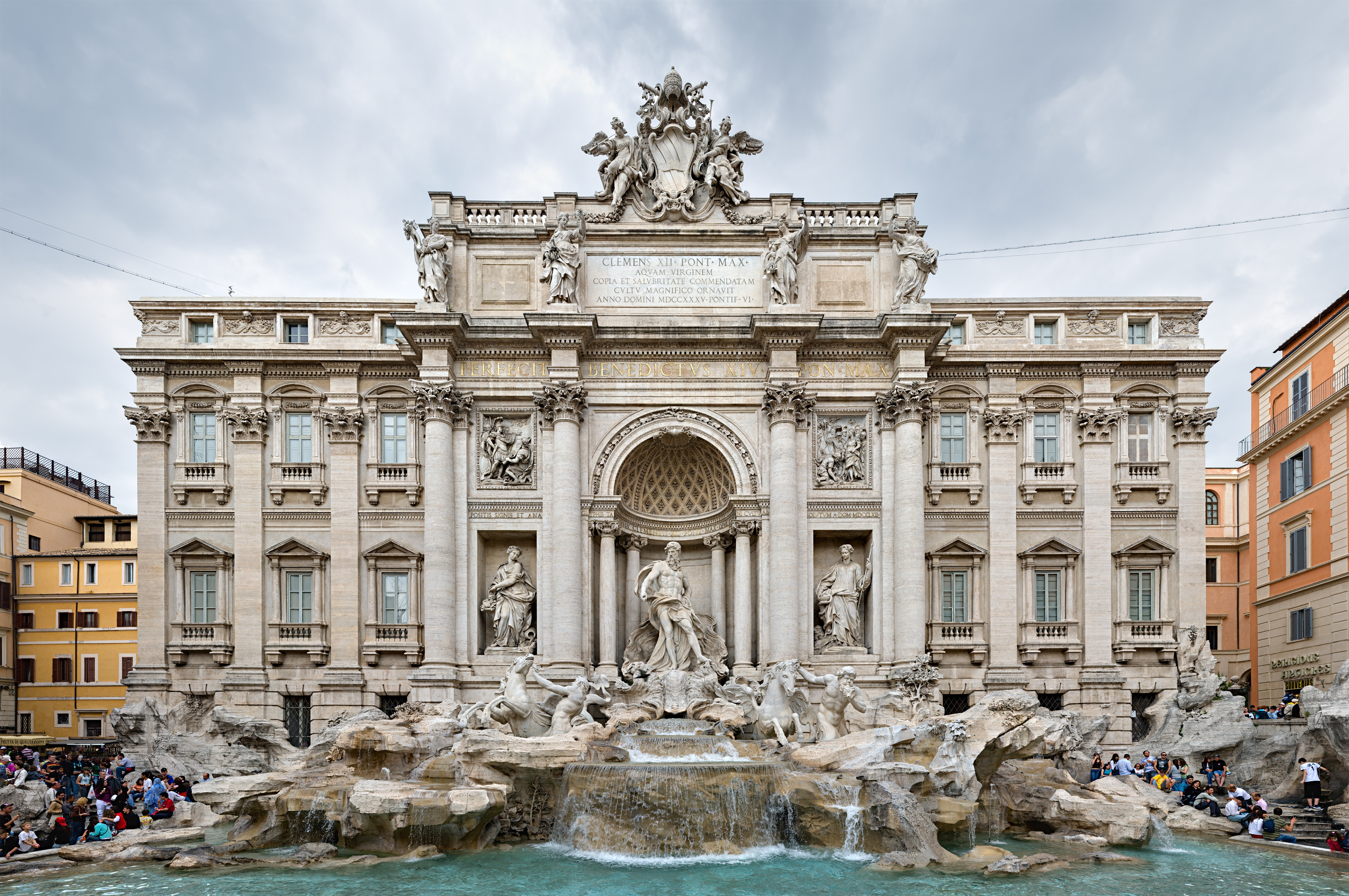
the Trevi Fountain in Rome — CC BY 3

a bridge over the Tiber River in Rome — CC BY-SA 4

the Circus Maximus in Rome — CC BY-SA 4
History of Rome
Founding, Republic and Empire
Rome was founded, according to legend, on 21 April 753 BC by the twins Romulus and Remus, who were said to have been raised by a she-wolf on the banks of the Tiber. The legend is a story rather than a fact, but archaeology shows that settlements stood on the Palatine hill by the eighth century BC, and the city grew from those hilltop villages into a single town. The early city was ruled by kings, and then by the Republic, which governed Rome for nearly five hundred years through its Senate and its citizen assemblies.
The Republic built an empire by war and by alliance, and by the first century BC the city ruled the whole Mediterranean world. The Forum became the centre of that empire, with its temples, its law courts and its triumphal arches, and the city filled with the monuments of victorious generals. Julius Caesar rebuilt the Forum and planned a new city, and his heir Augustus turned Rome from a city of brick into a city of marble, as he himself boasted.
The Empire that followed Augustus made the city the largest in the ancient world, with a population that may have reached a million people. The emperors built the Colosseum, the great baths, the aqueducts and the triumphal columns that still stand today, and the city became the model for every town in the empire. The Palatine hill held the imperial palaces, and the name of the hill gave the word palace to the languages of Europe.
The Empire in the west fell in the fifth century, and Rome was sacked by the Visigoths in 410 and by the Vandals in 455, but the city never died. The population fell, the aqueducts broke, and the great buildings were stripped for stone, yet the churches and the papacy kept the city alive. The ruins of the Forum became a cattle pasture, and the Colosseum became a quarry, but the name of Rome never lost its power.
The Papal City and the Renaissance
The popes made the city their own, and the medieval and Renaissance popes rebuilt it as the capital of the Catholic world. The Vatican hill across the river became the home of the papacy, and Saint Peter’s Basilica rose over the tomb of the apostle, first as a Constantinian church and then as the great Renaissance basilica of the sixteenth century. The popes built palaces, churches and fountains, and they called the greatest artists of the age to Rome.
The Renaissance turned Rome into a city of art, because Michelangelo painted the Sistine Chapel, Raphael painted the Vatican rooms, and Bramante and Bernini rebuilt Saint Peter’s and its square. The Baroque popes of the seventeenth century gave the city its fountains and its squares, and Bernini and Borromini filled the centre with churches and palaces that still define it. Piazza Navona, the Trevi Fountain and the Spanish Steps all belong to this age of papal building.
The city that the popes built was also a city of pilgrims, because Rome drew travellers from all of Europe to its shrines and its relics. The pilgrim routes joined the great basilicas, and the hostels, the markets and the workshops of the centre lived on the pilgrim trade. The Jubilee years brought crowds that filled the city, and the popes built new streets and new fountains to receive them.
The papal state lasted until 1870, when the armies of the new Kingdom of Italy took Rome and made it the capital of a united Italy. The pope kept the Vatican as his own small territory, and the Lateran Treaty of 1929 made Vatican City an independent state inside Rome. The city became a national capital for the first time in fourteen centuries, and it began to grow beyond its old walls.
Capital of Italy and the Modern City
The city became the capital of Italy in 1871, and the new government built ministries, barracks and whole new districts for the capital of a modern state. The embankment walls tamed the Tiber, the railway brought the country to the city, and the population grew from about two hundred thousand to more than a million within a lifetime. The city spread along the consular roads, and the old centre was cut through by new avenues that joined the railway station to the river.
The twentieth century brought war and dictatorship, and Rome was bombed and occupied during the Second World War before being liberated in June 1944. The city escaped the worst destruction, and its monuments survived the war almost intact, which is why the historic centre still looks as it did a century ago. The post-war years brought a new boom, and the films of Fellini and the scooters of the fifties made Rome a symbol of the sweet life.
The city hosted the Summer Olympic Games in 1960, and the Games brought new roads, new stadiums and a new confidence to Rome. The Jubilee of 2000 brought millions of pilgrims and a great programme of restoration, and the city cleaned its monuments and rebuilt its piazzas for the new century. The metro grew slowly, and the traffic grew fast, but the centre kept its character, because the monuments and the walls stopped the city from rebuilding itself.
Today the city is the capital of a republic, the home of the papacy and one of the most visited cities in the world. The city lives with the weight of its own history, because every building project meets the ruins of an older city underneath, and every road runs over an ancient one. The metro digs slowly, because each station becomes an archaeological site, and the city accepts that delay as the price of living in Rome. The Eternal City is still writing its history, and the latest chapter is being written in the streets today.
Timeline
- 21 April 753 BC — Rome is founded, according to legend, by Romulus
- 509 BC — The Roman Republic is established after the kings are expelled
- 44 BC — Julius Caesar is assassinated and the Republic gives way to Empire
- 27 BC — Augustus becomes the first emperor and rebuilds Rome in marble
- AD 70-80 — The Colosseum is built under Vespasian and Titus
- About AD 118-125 — The Pantheon is rebuilt under Hadrian
- AD 410 — The Visigoths sack Rome
- AD 455 — The Vandals sack Rome
- 1506-1626 — The new Saint Peter’s Basilica is built in the Vatican
- 1508-1512 — Michelangelo paints the ceiling of the Sistine Chapel
- 1732-1762 — The Trevi Fountain is built
- 1870 — Rome becomes part of the Kingdom of Italy
- 1871 — Rome becomes the capital of a united Italy
- 1929 — The Lateran Treaty creates Vatican City as an independent state
- 1944 — Rome is liberated during the Second World War
- 1960 — Rome hosts the Summer Olympic Games
- 1980 — The Historic Centre of Rome is inscribed on the UNESCO World Heritage List
- 1990 — The UNESCO inscription is extended to the walls of Urban the Eighth and the properties of the Holy See
- 2000 — The Jubilee brings millions of pilgrims and a great restoration of the city
Travel to Rome
Getting There and Getting Around
Rome is served by Fiumicino airport on the coast to the south-west, and by Ciampino airport to the south-east, and both airports are joined to the city by train and by bus. The Leonardo Express train runs from Fiumicino to Termini station in the centre, and the regional trains and the buses offer slower and cheaper journeys. Termini is the main station of Rome, and it handles the high-speed trains to Florence and Venice as well as the local trains and the metro.
The historic centre of Rome is best explored on foot, because the streets are narrow and the monuments are close together. The metro has three lines, and they serve the main stations and the outer districts, but the centre itself is served by buses and trams rather than by the underground. A travel pass covers the metro, the buses and the trams, and the buses are the best way to cross the centre, because they run along the avenues that the metro does not reach.
Taxis are plentiful in Rome, and the official white taxis wait at the ranks in the main squares and at the stations. Walking is still the best way to see the city, because the distances in the centre are short and the streets are full of surprises. The city is also good for cycling along the river and in the parks, and the bike lanes of the Tiber embankment offer a quiet route through the centre.
A One-Day Itinerary
A day here should begin at the Colosseum, because the great amphitheatre is at its best in the morning light and the crowds are thinner early in the day. The Colosseum and the Roman Forum stand together, and they need at least half a day, because the Forum is a whole city of ruins and the Palatine hill above it holds the palaces of the emperors. The view from the Palatine over the Forum and the Circus Maximus is the finest in Rome, and it shows the whole ancient city at a glance.
The middle of the day belongs to the centre, and the walk from the Forum to the Pantheon passes through the lanes that hold the best of Baroque Rome. The Pantheon is the best-preserved temple of the ancient world, and its dome still holds the record as the largest unreinforced concrete dome in the world. Piazza Navona and the Trevi Fountain lie a short walk away, and both are at their best in the afternoon, when the light fills the squares.
The evening belongs to Trastevere, across the river, where the lanes are full of restaurants and the church of Santa Maria in Trastevere glows with its golden mosaics. Dinner in Trastevere is the right end to a day in Rome, because the district keeps the feel of a village inside the city. The walk back across the Tiber Island, with the lights on the river, is the last sight of the day, and it is one that stays in the memory.
The Vatican, the Squares and the Hills
The Vatican deserves a day of its own, because Saint Peter’s Basilica, the Vatican Museums and the Sistine Chapel are among the greatest sights in the world. The basilica is free to enter, and its dome can be climbed for the finest view over Rome, while the museums hold the collections of the popes and the ceiling that Michelangelo painted. The square in front of the basilica is one of the great public spaces of Europe, and it is worth a slow walk in the evening when the colonnade is lit.
The squares of Rome are the living rooms of the city, and each one has its own character and its own fountain. Piazza Navona was built over the stadium of Domitian, and its long shape still shows the running track, while the Spanish Steps join the square below with the church above in a single sweep of stone. The Trevi Fountain is the most famous fountain in Rome, and the custom of throwing a coin into its water is said to promise a return to the city.
The hills give the best views of Rome, and the Janiculum hill across the river offers a panorama of the whole city from the Vatican to the Alban Hills. The Aventine hill holds the keyhole that frames Saint Peter’s dome in a perfect view, and the Capitoline hill holds the museums and the square that Michelangelo designed. The Pincio terrace above Piazza del Popolo is the classic viewpoint at sunset, and it shows the domes and the towers of Rome spread out below in the golden light.

St Peter’s Basilica and the Sant’Angelo bridge by night — CC0

the Fountain of the Four Rivers in Piazza Navona, Rome — CC BY-SA 4

the Spanish Steps and the Trinità dei Monti, Rome — CC BY-SA 4
Notable Places in Rome
The Colosseum is the first place in Rome, and it is the largest amphitheatre ever built, raised in AD 70 to 80 under the emperors Vespasian and Titus. The great oval held tens of thousands of spectators for gladiatorial games, and its arches and vaults became the model for stadiums around the world. The Colosseum stands at the edge of the Forum, and it is the symbol of the city, inscribed by UNESCO in 1980 as part of the Historic Centre.
The Roman Forum and the Palatine hill are the second place, and they are the heart of the ancient city. The Forum holds the temples, the law courts and the triumphal arches of the Republic and the Empire, and the Palatine above it holds the palaces of the emperors. The Arch of Titus, the Temple of Antoninus and Faustina and the Curia are the monuments that tell the story of Rome in stone.
The Pantheon is the third place, and it is the best-preserved building of ancient Rome, rebuilt under Hadrian about AD 118 to 125. Its great dome opens to the sky through a single round hole, and the rain falls through it onto the marble floor, while the light moves across the interior through the day. The Pantheon became a church in the seventh century, and that change saved it from the fate of the other temples of the city.
Saint Peter’s Basilica and the Vatican are the fourth place, and they are the centre of the Catholic world. The basilica was built between 1506 and 1626, and its dome by Michelangelo dominates the skyline of Rome, while the Sistine Chapel holds the ceiling that Michelangelo painted between 1508 and 1512. The Trevi Fountain completes the visit, because it is the most famous fountain in the world, built between 1732 and 1762, and its waters promise every visitor a return to Rome.

the east end of the Roman Forum — CC BY-SA 4

the ruins on the Palatine Hill, Rome — CC BY-SA 2

the facade of the Pantheon, Rome — CC0

the ceiling of the Sistine Chapel, Vatican City — CC0

Saint Peter’s Square in Vatican City, seen from the air — CC BY 2
Frequently Asked Questions
What is Rome famous for?
Rome is famous for the Colosseum, the Roman Forum, the Pantheon, the Vatican and Saint Peter’s Basilica. It is also famous as the capital of the Roman Empire, the heart of the Catholic Church, and the city that gave the world Roman law, Roman roads and the Latin language.
Where is Rome?
Rome stands in central Italy, in the Lazio region, on the Tiber river about 25 km from the Tyrrhenian Sea. It is the capital of Italy and the largest city in the country, built on the seven hills beside the river.
When is the best time to visit Rome?
Spring and autumn are the best times, because the weather is mild and the crowds are smaller than in summer. Rome can be visited in any month, but July and August are hot, and the city is most comfortable from October to May.
How many days do you need in Rome?
Three days are enough to see the Colosseum, the Forum, the Pantheon, the Trevi Fountain and the Vatican at a comfortable pace. A longer stay allows time for Trastevere, the Aventine hill, the Appian Way and the museums, and Rome rewards a slow visit.
Is Vatican City part of Rome?
No, Vatican City is an independent state inside Rome, created by the Lateran Treaty of 1929. It is the smallest state in the world, and it is the home of the pope, Saint Peter’s Basilica and the Vatican Museums.
What is the Historic Centre of Rome?
The Historic Centre of Rome is the UNESCO World Heritage property inscribed in 1980 and extended in 1990, and it covers the ancient centre, the properties of the Holy See and Saint Paul Outside the Walls. It is listed under criteria i, ii, iii, iv and vi, and it holds the Colosseum, the Forum, the Pantheon and the great churches of papal Rome.
Verified
The legendary founding on 21 April 753 BC, the Colosseum built in AD 70 to 80, the Pantheon rebuilt under Hadrian about AD 118 to 125, Saint Peter’s Basilica built between 1506 and 1626, the Sistine Chapel ceiling painted between 1508 and 1512, the Trevi Fountain built between 1732 and 1762, Rome becoming the capital of a united Italy in 1871, the Lateran Treaty of 1929, the 1960 Olympic Games, the UNESCO inscription of the Historic Centre of Rome in 1980 and its extension in 1990 under criteria i, ii, iii, iv and vi, and the population of about 2.75 million in 2025 were checked against the sources below. The Wikidata entry Q220 for Rome, at 41.89° N, 12.48° E, was verified through the Wikidata API on 22 November 2026.
Sources
- UNESCO World Heritage Centre, Historic Centre of Rome, ref 91, inscribed 1980 and extended 1990, criteria i, ii, iii, iv, vi — https://whc.unesco.org/en/list/91/
- Turismo Roma, official tourism portal of the city of Rome — https://www.turismoroma.it/en
- Rome, capital of Italy, Q220 — https://en.wikipedia.org/wiki/Rome
- Colosseum, built AD 70-80 under Vespasian and Titus — https://en.wikipedia.org/wiki/Colosseum
- Pantheon, Rome, rebuilt under Hadrian about AD 118-125 — https://en.wikipedia.org/wiki/Pantheon,_Rome
- Wikidata Q220 (Rome, coordinates 41.8931/12.4828) — verified through the Wikidata API, 22 November 2026
Unverified
- The population of about 2.75 million in 2025 and the metropolitan figure of about 4.2 million are estimates that vary by source — this article uses approximate figures and records the variation here.
- The founding of Rome on 21 April 753 BC is a legend recorded by Roman writers, and the archaeological record supports settlement on the Palatine in the eighth century BC rather than a single date — this article presents the date as legend.
- The population of ancient Rome at its height is debated, and published estimates range widely — this article says only that it may have reached a million people.
- The exact year of the Pantheon rebuilding is given as about AD 118 to 125, and the precise dates of the work are still debated — this article uses the approximate range.
Illustrations
- Hero: the Colosseum in Rome. Free image: https://upload.wikimedia.org/wikipedia/commons/5/5b/Colosseum_of_Rome%2C_Italy.jpg — CC0.
- In body, the Trevi Fountain: the Trevi Fountain in Rome. Free image: https://upload.wikimedia.org/wikipedia/commons/7/7e/Trevi_Fountain%2C_Rome%2C_Italy_2_-_May_2007.jpg — CC BY 3.
- In body, St Peter’s Basilica: St Peter’s Basilica and the Sant’Angelo bridge by night. Free image: https://upload.wikimedia.org/wikipedia/commons/3/36/Saint_Peter%27s_Basilica%2C_Sant%27Angelo_bridge%2C_by_night%2C_Rome%2C_Italy.jpg — CC0.
- In body, Roman Forum, Rome: the east end of the Roman Forum. Free image: https://upload.wikimedia.org/wikipedia/commons/f/f2/Roman_Forum_east_end.jpg — CC BY-SA 4.
- In body, Palatine Hill, Rome: the ruins on the Palatine Hill, Rome. Free image: https://upload.wikimedia.org/wikipedia/commons/d/d1/Ruins_on_Palatine_Hill%2C_Rome%2C_Italy.jpg — CC BY-SA 2.
- In body, Pantheon, Rome: the facade of the Pantheon, Rome. Free image: https://upload.wikimedia.org/wikipedia/commons/c/c7/Fa%C3%A7ade_of_the_Pantheon%2C_Rome%2C_Italy.jpg — CC0.
- In body, Piazza Navona, Rome: the Fountain of the Four Rivers in Piazza Navona, Rome. Free image: https://upload.wikimedia.org/wikipedia/commons/0/04/Rome_%28IT%29%2C_Piazza_Navona%2C_Fontana_dei_Quattro_Fiumi_–2013–_3930.jpg — CC BY-SA 4.
- In body, Spanish Steps, Rome: the Spanish Steps and the Trinità dei Monti, Rome. Free image: https://upload.wikimedia.org/wikipedia/commons/1/1b/Rome_Trinita_dei_Monti_2020_P12_Spanish_Steps.jpg — CC BY-SA 4.
- In body, Sistine Chapel, Vatican: the ceiling of the Sistine Chapel, Vatican City. Free image: https://upload.wikimedia.org/wikipedia/commons/9/9c/Vatican_Sistine_Chapel_Ceiling_%289808850053%29.jpg — CC0.
- In body, Tiber River, Rome: a bridge over the Tiber River in Rome. Free image: https://upload.wikimedia.org/wikipedia/commons/3/3c/Bridge_over_the_Tiber_river_-_Rome.jpg — CC BY-SA 4.
- In body, Circus Maximus, Rome: the Circus Maximus in Rome. Free image: https://upload.wikimedia.org/wikipedia/commons/2/2b/Circo_M%C3%A1ximo%2C_Roma%2C_Italia%2C_2022-09-15%2C_DD_105.jpg — CC BY-SA 4.
- In body, Vatican City: Saint Peter’s Square in Vatican City, seen from the air. Free image: https://upload.wikimedia.org/wikipedia/commons/0/0f/Saint_Peter%27s_Square_airview.jpg — CC BY 2.