
Roman Forum and Palatine Hill: The Heart of Ancient Rome
The Roman Forum was the civic heart of ancient Rome for over a thousand years. Broken columns still stand where senators debated and crowds gathered.
Quick Facts about the Roman Forum and Palatine Hill
- Location: A low valley between the Palatine Hill and the Capitoline Hill in central Rome, Italy, beside the Colosseum
- Coordinates: 41.8922° N, 12.4852° E
- Wikidata: Q180212 (Roman Forum, instance of forum and archaeological site)
- What it is: The central public square of ancient Rome, joined with the neighbouring Palatine Hill into one archaeological park
- First laid out: 7th century BC, after the Cloaca Maxima drained the marshy valley
- Key monuments: Arch of Septimius Severus, Arch of Titus, Temple of Saturn, Temple of Vesta, Curia Julia, Basilica of Maxentius
- Palatine palaces: House of Augustus, Domus Flavia, Domus Augustana, Farnese Gardens
- UNESCO: Part of the Historic Centre of Rome, inscribed in 1980 as reference 91, under criteria (i), (ii), (iii), (iv) and (vi)
- Tickets: One combined ticket covers the Roman Forum, the Palatine Hill and the Colosseum; check the official site of the Colosseum Archaeological Park before visiting
Geography of the Roman Forum and Palatine Hill
A valley between two hills
The Roman Forum occupies a long, narrow valley that was once marshland, squeezed between the Palatine Hill to the south and the Capitoline Hill to the north-west. In the 7th century BC, Rome’s early Etruscan rulers built the Cloaca Maxima, one of the oldest drainage systems in the world, to dry out this valley and turn it into a public square. The drain still runs beneath the modern city, a hidden piece of engineering that made everything above it possible. Without that single act of drainage, the political centre of the Roman world would have remained a swamp.
The ground of the Roman Forum is uneven, paved in places with great basalt slabs worn smooth by centuries of feet, and in other places left as bare earth and grass between broken walls. Its main axis follows the Via Sacra, the sacred road along which victorious generals marched in triumph after their campaigns abroad. Walking that road today means following the same line that triumphal processions took, past temples and arches that were built to be seen from exactly that angle. The valley floor sits low, so the surrounding hills frame every view and make the ruins feel enclosed, almost like a room with stone walls for a ceiling of sky.
To the north of the Roman Forum, beyond the Via dei Fori Imperiali, lies a separate group of squares built by the emperors from Caesar to Trajan. These Imperial Fora were grander and more formal than the old Republican square, each one a self-contained monument to the emperor who paid for it. They are visible from the modern boulevard, and parts of them can be entered on special visits. Their presence shows how the centre of power shifted, stone by stone, away from the crowded old square toward new spaces designed for imperial display.
The Palatine Hill above the square
The Palatine Hill rises directly south of the Roman Forum, a flat-topped hill with steep sides that overlooks the square below and the Tiber to the west. From its summit, a visitor can see the whole of the Roman Forum spread out like a map, the Colosseum to the east, and the rooftops of modern Rome in every direction. That high, defensible position explains why the hill was settled first, long before the valley below was drained. According to Roman legend, Romulus founded the city on the Palatine in 753 BC, and archaeologists have found traces of huts from the 8th century BC on the hill, which suggests that the legend preserves a real memory of early settlement.
The hill itself is one of the seven hills of Rome, but it is the one that gave the world a word for royal residence. Augustus, the first emperor, built his house there in the late 1st century BC, and later emperors followed him, covering the hill with palaces. The English word palace, and the French word palais, both descend from the name Palatine, because the first great royal residence of Europe stood on this hill. That single fact captures the scale of the place: a neighbourhood that became a synonym for power in languages spoken far beyond Italy.
Vegetation softens the Palatine today in a way the Roman Forum below does not enjoy. Pine trees shade the paths, and the Farnese Gardens, laid out in the 16th century, bring ordered greenery and sweeping views over the square. Birds nest in the ruined walls, and in spring the grass between the stones turns bright green. The contrast between the two parts of the park is part of its character: the Roman Forum feels like a street of broken public buildings, while the Palatine feels like a garden that happens to contain the remains of emperors’ homes.
Climate and the shape of a visit
Rome has a Mediterranean climate, with hot, dry summers and mild, wetter winters, and most rain falls between October and March. Summer daytime temperatures often pass 30 degrees Celsius, and the Roman Forum offers almost no shade, with stone and baked earth radiating heat back at visitors by midday. A summer visit at noon can be punishing, and the heat changes how the place should be approached. Morning light is softer, the crowds are thinner, and the stone has not yet stored the full heat of the day.
Winter brings a different mood to the Roman Forum and the Palatine Hill. Temperatures stay mild by northern European standards, but rain can make the ancient paving slippery, and some areas may close after heavy downpours. The low winter sun slants across the ruins and throws long shadows from the columns, which photographers prize. Spring and autumn remain the most comfortable seasons, with warm sunshine and manageable crowds, and the light in April and October is particularly kind to the honey-coloured stone.
The site is reached most easily from the Colosseo metro station on line B, which stands beside the Colosseum a few minutes’ walk from the main entrance on Via dei Fori Imperiali. That boulevard, built in the Mussolini era, runs from Piazza Venezia to the Colosseum and cuts across the ancient centre, so it is both a useful approach and a reminder of how modern politics reshaped the ancient landscape. From Termini, Rome’s main station, the journey to Colosseo station takes only two stops. Buses and trams serve the surrounding streets, but walking is the best way to explore the historic centre once you arrive.
The Tiber and the wider city
The Tiber flows to the west of the Palatine Hill, and its presence shaped the Roman Forum in ways that are easy to miss among the ruins. The river brought trade, water and floods in equal measure, and the early city depended on its wharves for grain and building stone from upstream. Floods regularly threatened the low valley, which is one reason the Cloaca Maxima mattered so much: the drain carried water away from the square and toward the river, keeping the public space usable after heavy rain. The relationship between river and square lasted for the whole life of the ancient city.
Standing on the Palatine Hill, the wider geography of ancient Rome becomes clear in a way that no map can quite match. The Capitoline Hill rises to the north-west, the Aventine Hill lies to the south across the valley, and the ground between them holds the Circus Maximus, the long racing track that once filled with crowds. The Roman Forum sits at the centre of this arrangement, not by accident but because the hills around it created a natural basin where a city could grow. Modern Rome has grown far beyond those hills, yet the ancient core still reads as a distinct place, with the ruins marking where the city began.
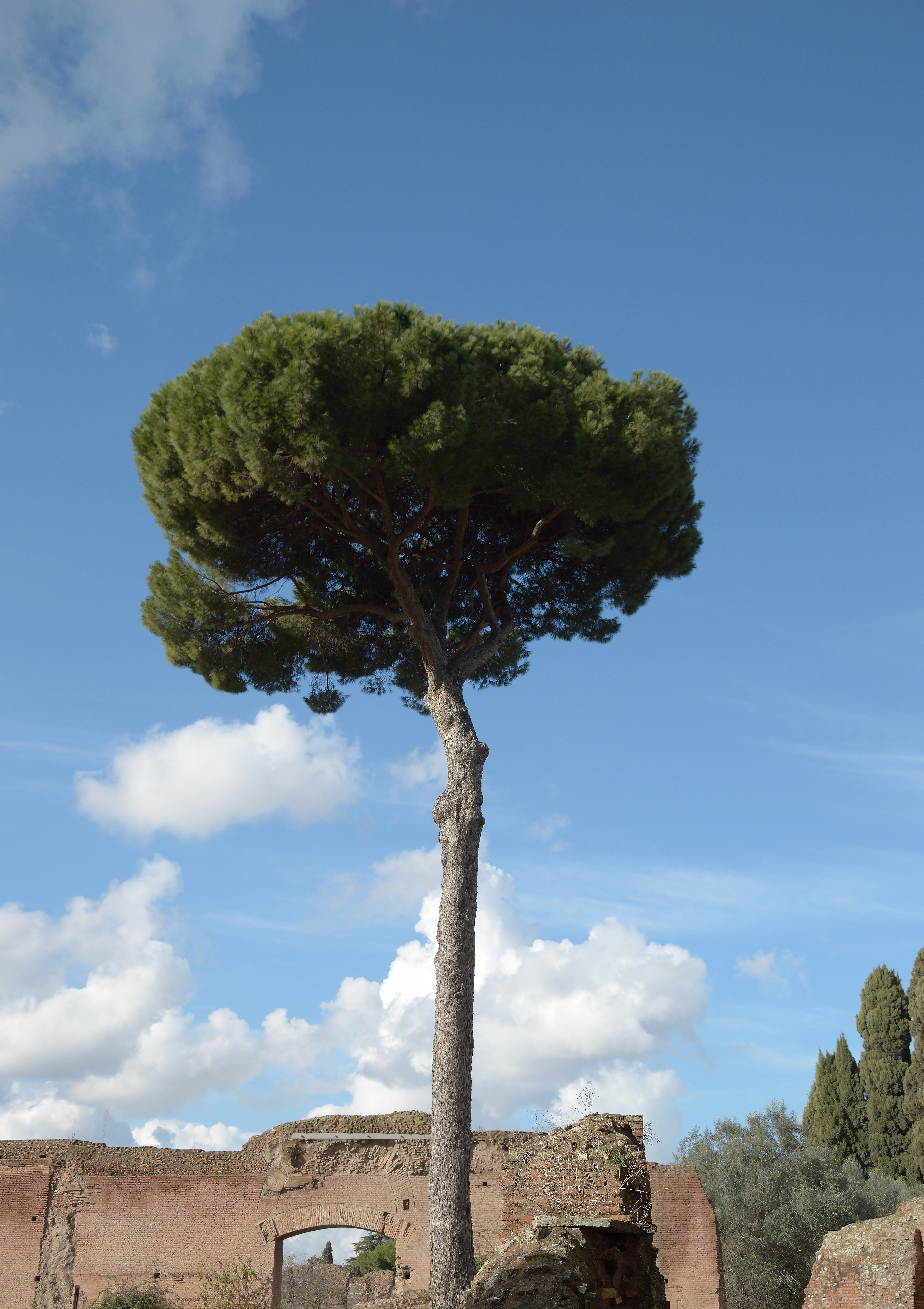
Pine trees and ruins on Palatine Hill in Rome — CC BY-SA 4
History of the Roman Forum and Palatine Hill
From marsh to meeting place
The story of the Roman Forum begins in the 7th century BC, when the Etruscans who ruled early Rome drained the valley between the hills and created a level open space for the whole community. Markets gathered there, festivals were held on its ground, and citizens argued politics in the open air. By the 6th century BC, the first public buildings rose around its edges, including the Temple of Saturn and the Temple of Vesta, which fixed the square as the religious as well as the civic heart of the city. Nothing about the site was planned in a single campaign; it grew by addition, with each generation building beside, and sometimes on top of, the work of its predecessors.
The Temple of Saturn, first built in 498 BC, held the state treasury of Rome, which made the Roman Forum a place where money and power met in the most literal sense. Beside it stood the Temple of Vesta, a small round shrine where the sacred fire of the city burned without interruption, tended by the Vestal Virgins. If that fire went out, Romans believed the city itself was in danger, so the shrine was guarded with a seriousness that seems strange today and entirely natural in its own time. The Curia, the meeting house of the Senate, stood nearby, and the open square in front of it was where politicians addressed crowds and where public business was done in full view.
For centuries, the Roman Forum was the stage on which the Republic played out its crises. Generals returned in triumph along the Via Sacra, prisoners and spoils were displayed, and orators such as Cicero spoke from the Rostra, the platform decorated with the prows of captured ships. The assassination of Julius Caesar in 44 BC happened not in the square itself but in a hall nearby, yet its consequences flooded back into the Roman Forum: his body was brought to the square, Mark Antony spoke over it, and the crowd’s reaction helped ignite the civil wars that ended the Republic. The square absorbed these shocks and kept its role, because Rome had no other place where the whole city could gather and watch power change hands.
The Palatine becomes the home of emperors
While the Roman Forum belonged to the public life of Rome, the Palatine Hill belonged to its private power. In the Republic, wealthy aristocrats built large houses on the hill, drawn by its views and its prestige. Augustus changed that pattern when he built his own house there in the late 1st century BC, modest by later standards but symbolically enormous: the ruler of Rome now lived on the hill where the city was said to have begun. His house, with its painted rooms and its temple of Apollo beside it, set a precedent that no later emperor could ignore.
Domitian, emperor in the late 1st century AD, transformed the hill completely. His architects built the Domus Flavia, a palace for public ceremony, and the Domus Augustana, a palace for private life, with gardens, fountains and vast reception rooms. The scale was deliberate: the emperor’s home had to look like the centre of the world, because for practical purposes it was.
Later emperors added their own wings and gardens, and the hill became a small city of palaces, where courtiers, guards and servants lived alongside the imperial family. Walking its paths today, a visitor passes through rooms that once held the daily business of an empire stretching from Britain to Syria.
The connection between the hill and the square below was physical as well as political. Stairways and ramps linked the palaces to the Roman Forum, and the emperor could descend from his private world into the public one in minutes. That short walk mattered: it meant the ruler was never far from the Senate house, the law courts and the temples, and it meant the people of Rome could see the imperial residence looming over their daily business. Power in Rome was never abstract, and on the Palatine it was built into the landscape itself.
Decline, ruin and rediscovery
After the fall of the Western Roman Empire in the 5th century AD, the Roman Forum was slowly abandoned. Its marble was stripped for new buildings, its columns were carried away, and its temples were converted into Christian churches or left to collapse. The Temple of Antoninus and Faustina became the church of San Lorenzo in Miranda, and the Temple of Romulus became the church of Santi Cosma e Damiano, which is why parts of those buildings survive in recognisable form. Other structures vanished so completely that their foundations were only identified centuries later.
The Palatine Hill suffered a different fate. With the emperors gone, its palaces fell into ruin, and the hill became grazing land. Romans called it Campo Vaccino, the field of cows, and cattle wandered among the broken walls where emperors had once dined.
Earth and vegetation buried the ruins, and for centuries the hill looked like a green mound with occasional fragments of brick poking through the grass. In the 16th century, the Farnese family laid out formal gardens on part of the hill, which preserved some of the ruins beneath their terraces and gave later archaeologists a starting point.
Systematic excavation began in the 19th century, when archaeologists cleared the earth and rubble from the Roman Forum and the Palatine Hill and revealed the scale of what had been lost. The work continues today, and new discoveries still emerge from the ground, including houses, frescoes and inscriptions that change how historians understand the site. The Column of Phocas, raised in 608 AD, was the last monument built in the Roman Forum, and it stands as a quiet marker of the end of the square’s ancient life. In 1980, UNESCO inscribed the Historic Centre of Rome, reference 91, which includes the Roman Forum and the Palatine Hill, under criteria (i), (ii), (iii), (iv) and (vi), recognising the site as part of a historic centre of outstanding universal value.
Timeline
- 753 BC: According to legend, Romulus founds Rome on the Palatine Hill
- 7th century BC: The Cloaca Maxima drains the valley, creating the open square
- 498 BC: The Temple of Saturn is built, one of the first temples in the Roman Forum
- 44 BC: Julius Caesar is assassinated; the Curia Julia is built in the years that follow
- 29 BC: Augustus completes the Curia Julia and builds his house on the Palatine Hill
- AD 81: The Arch of Titus is raised to celebrate the victory in Jerusalem
- AD 203: The Arch of Septimius Severus is built at the western end of the square
- AD 308–312: The Basilica of Maxentius, the largest building in the square, is constructed
- AD 608: The Column of Phocas is erected, the last monument added to the Roman Forum
- 16th century: The Farnese family lays out the Farnese Gardens on the Palatine Hill
- 19th century: Systematic archaeological excavation begins across the site
- 1980: UNESCO inscribes the Historic Centre of Rome, reference 91

The House of the Vestal Virgins in the Roman Forum — CC BY-SA 2
Travel to the Roman Forum and Palatine Hill
When to go
April to June and September to October are the finest months for the Roman Forum, when the sun is warm, the air is clear, and the crowds are thinner than in midsummer. May brings flowers across Rome, and September and October offer soft golden light that suits the stone. July and August are intensely hot, with daytime temperatures often above 30 degrees Celsius, and the site has almost no shade, so visitors in those months should arrive early in the morning or late in the afternoon and carry water. The Palatine Hill is kinder in the heat, because its pines and gardens give shade that the square below lacks.
Tickets and how long to allow
The Roman Forum, the Palatine Hill and the Colosseum share one ticket, valid for 24 hours, and buying it online in advance is the simplest way to avoid the long queues at the ticket office, especially in summer and at weekends. Different ticket types exist, including standard entry, guided tours and special visits to restricted areas such as the House of Augustus and the House of Livia on the Palatine Hill. Prices and opening hours change with the season, and reduced fares exist for students and European Union citizens, so check the official site of the Colosseum Archaeological Park before travelling.
Allow at least half a day for the Roman Forum and the Palatine Hill together, with about two hours for the square and one to two hours for the hill, not counting the Colosseum. A good route starts on the Palatine Hill, passes through the Farnese Gardens and the House of Augustus, then descends along the Via Sacra through the Roman Forum, past the Arch of Titus and the Arch of Septimius Severus, and ends at the Capitoline Hill. Beginning on the hill gives the whole site in one sweeping view before the walk among the ruins at ground level. Comfortable shoes are essential, because the ancient paving is uneven and the site covers a large area.
Getting there and eating nearby
Colosseo metro station on line B stands beside the Colosseum, a few minutes on foot from the entrance on Via dei Fori Imperiali, and it is the easiest way to reach the site from elsewhere in Rome. From Termini station, the ride is two stops. Buses and trams serve the surrounding streets, but the historic centre rewards walking, and the boulevard from Piazza Venezia to the Colosseum runs alongside the Roman Forum for its whole length.
The streets immediately around the Colosseum are full of restaurants aimed at tourists, with prices to match, but a short walk north-east into Monti, one of the oldest quarters of Rome, finds local trattorias and wine bars at fairer prices. Monti’s narrow lanes hold craft shops and small eateries that make a good lunch stop after the morning among the ruins. The walk from the square to the Trevi Fountain takes about fifteen minutes through the historic centre, and it passes some of the liveliest streets in Rome. Roman classics to look for are carbonara, cacio e pepe and amatriciana, along with pizza al taglio, pizza sold by the slice, which suits a quick meal between sights.
Notable Places in the Roman Forum and Palatine Hill
- Arch of Septimius Severus — A triumphal arch raised in AD 203 to celebrate the emperor’s victories in Parthia, standing at the western end of the Roman Forum.
- Arch of Titus — An arch built in AD 81 to mark the victory in Jerusalem, standing at the eastern end of the square on the Via Sacra.
- Temple of Saturn — One of the oldest temples in Rome, first built in 498 BC, which held the treasury of the Roman state.
- Temple of Vesta and House of the Vestals — A small round temple where the sacred fire of Rome was kept burning by the Vestal Virgins, beside the house where they lived.
- Curia Julia — The Senate house, begun under Julius Caesar and completed in 29 BC under Augustus.
- Basilica of Maxentius — The largest building in the Roman Forum, built in AD 308–312, with soaring vaults and a vast open interior.
- House of Augustus — The first emperor’s residence on the Palatine Hill, with painted rooms that survive in remarkable condition.
- Domus Flavia and Domus Augustana — The ceremonial and private palaces of Domitian on the Palatine Hill, with gardens, fountains and reception halls.
- Farnese Gardens — Formal 16th-century gardens on the Palatine Hill, offering the finest viewpoint over the Roman Forum below.
Frequently Asked Questions about the Roman Forum
Where is the Roman Forum and how do I reach it?
The Roman Forum lies in the valley between the Palatine Hill and the Capitoline Hill in central Rome, at 41.8922° N, 12.4852° E. Colosseo metro station on line B stands beside the Colosseum, a few minutes on foot from the main entrance on Via dei Fori Imperiali. The site is also about ten minutes on foot from Piazza Venezia.
When was the Roman Forum built?
The square took shape in the 7th century BC, when the Cloaca Maxima drained the marshy valley between the two hills. Its first temples, including the Temple of Saturn of 498 BC, appeared in the 6th and 5th centuries BC. Building continued for more than a thousand years, until the Column of Phocas was raised in AD 608.
What is the connection between the Palatine Hill and the word palace?
According to legend, Romulus founded Rome on the Palatine Hill in 753 BC, and archaeologists have found 8th-century BC huts there. Augustus built his house on the hill, and later emperors covered it with palaces. The English word palace and the French word palais both come from the name Palatine.
Is the Roman Forum part of a UNESCO World Heritage site?
The Roman Forum and the Palatine Hill lie inside the Historic Centre of Rome, inscribed by UNESCO in 1980 as reference 91, under criteria (i), (ii), (iii), (iv) and (vi). The UNESCO citation names the complex of the Roman and Imperial Forums among the monuments of outstanding artistic value in the historic centre. The property also covers the Holy See’s extraterritorial properties and the Basilica of Saint Paul Outside the Walls.
Do I need a visa to visit the Roman Forum?
Italy is part of the Schengen Area, so visitors from the European Union travel there without a visa, and many other nationalities can enter visa-free for short stays of up to 90 days in any 180-day period. Travellers from countries that need a Schengen visa should apply at an Italian consulate before departure, since the visa covers the whole Schengen Area. Check the current rules with the Italian foreign ministry, because entry conditions can change.
Can one ticket cover the Roman Forum, the Palatine Hill and the Colosseum?
One combined ticket covers all three, and it is valid for 24 hours. Buying the ticket online in advance avoids the longest queues, and special visits to the House of Augustus and the House of Livia need separate booking. Prices and opening hours vary by season, so confirm them on the official site of the Colosseum Archaeological Park.
Verified
The Roman Forum occupies the valley between the Palatine Hill and the Capitoline Hill in central Rome, and the Palatine Hill stands to its south. The Cloaca Maxima drained the valley in the 7th century BC, and the Temple of Saturn was first built in 498 BC. The Curia Julia was completed in 29 BC under Augustus, the Arch of Titus was raised in AD 81, and the Arch of Septimius Severus was built in AD 203.
The Basilica of Maxentius dates from AD 308–312, and the Column of Phocas, raised in AD 608, was the last monument added to the Roman Forum. The Farnese Gardens were laid out on the Palatine Hill in the 16th century, and systematic excavation began in the 19th century. The Historic Centre of Rome was inscribed by UNESCO in 1980 as reference 91, under criteria (i), (ii), (iii), (iv) and (vi).
Wikidata Q180212 is labelled Roman Forum, with instance of forum and archaeological site, and coordinates 41.8922° N, 12.4852° E, matching the registry. The English word palace descends from the name Palatine, because the imperial residence stood on that hill. Verified 22 November 2026.
Sources
- UNESCO, Historic Centre of Rome, reference 91, inscribed 1980, criteria (i), (ii), (iii), (iv) and (vi): https://whc.unesco.org/en/list/91/
- Parco archeologico del Colosseo (Colosseum Archaeological Park), official site: https://colosseo.it/en/
- Wikidata, Q180212 Roman Forum, instance of and coordinates, checked 22 November 2026: https://www.wikidata.org/wiki/Q180212
- TheTerraAtlas registry, entity TA-L4-foro-romano-y-monte-palatino, coordinates and UNESCO status
- TheTerraAtlas Vietnamese article foro-romano-y-monte-palatino.vi.md, facts and sources checked 18 November 2026
Unverified
- Ticket prices and seasonal opening hours for the Roman Forum, the Palatine Hill and the Colosseum, which change by season and must be checked on the official site of the Colosseum Archaeological Park.
- Opening conditions for the House of Augustus and the House of Livia, which are restricted areas and need separate booking.
- The exact date of 21 April 753 BC for the founding of Rome, which is a legendary date rather than an archaeologically verified one.
- The exact height of Trajan’s Column and the exact area of the Roman Forum, which need confirmation from an official source before publication.
Illustrations
- Hero: Roman Forum and Palatine Hill. Free image: https://upload.wikimedia.org/wikipedia/commons/f/f4/Roman_Forum_from_Palatine_Hill_9-9-16.jpg — CC BY-SA 4.0.
- In body, view: The House of the Vestal Virgins in the Roman Forum. Free image: https://upload.wikimedia.org/wikipedia/commons/4/4a/House_of_the_Vestal_Virgins%2C_Roman_Forum._Viewed_from_the_Palatine_Hill.Rome.–Flickr-_Andy_Montgomery.jpg — CC BY-SA 2.
- In body, ruins: Pine trees and ruins on Palatine Hill in Rome. Free image: https://upload.wikimedia.org/wikipedia/commons/2/26/Pinus_pinea_and_ruins_on_Palatine_Hill.jpg — CC BY-SA 4.