
Colosseum Rome: The Arena, the Hypogeum and Two Thousand Years of History
Colosseum Rome is the largest ancient amphitheatre ever built. This guide explains its arena, hypogeum, history and how to visit it.
The Colosseum stands in a low valley east of the Roman Forum, and it has watched the Roman Empire rise to its height and fall away. The Romans called it the Amphitheatrum Flavium, the amphitheatre of the Flavian dynasty, and the name Colosseum comes from the colossal statue of the emperor Nero that once stood nearby. It is the largest ancient amphitheatre ever built, and the largest ancient amphitheatre still standing in the world. A visitor who stands under its travertine arches, nearly 50 metres high, and looks down at the arena floor understands why people queue every day to enter it, not only to take photographs, but to touch a piece of history that few places have kept so completely.
What makes the Colosseum different from a simple ruin is the sense that it is still alive. The outer wall rises in three tiers of arches, each with a different order of columns, and the top tier was added after the opening. Below the arena floor lies the hypogeum, a maze of tunnels, cages and lifts where wild animals and gladiators waited for their turn in the light. Above the seats, a great canvas awning called the velarium could be stretched out to shade the crowd, worked by sailors from the Roman fleet.
The Colosseum Rome is therefore a machine as much as a monument, and this article explains how it was built, how it worked, how it fell into ruin, and how to see it today.
Quick Facts About Colosseum Rome
| Item | Detail |
|---|---|
| Name | Colosseum, in Italian Colosseo, originally Amphitheatrum Flavium |
| Location | Piazza del Colosseo, east of the Roman Forum, Rome, Italy |
| Coordinates | 41.89027778° N, 12.49222222° E |
| Construction | Begun about 70–72 under the emperor Vespasian |
| Inauguration | Year 80 under the emperor Titus |
| Size | 189 metres long, 156 metres wide, outer wall about 48 metres high |
| Arena | Oval, about 83–87 metres long and 48–55 metres wide |
| Capacity | Estimated 50,000–80,000 spectators, see History |
| Material | Travertine, tuff and Roman concrete faced with brick |
| Entrances | About 80 arches on the ground floor |
| UNESCO | Part of the Historic Centre of Rome, inscribed 1980 |
| Other honour | One of the New7Wonders of the World, 2007 |
| Wikidata | Q10285, verified through the Wikidata API on 22 November 2026 |
Geography of Colosseum Rome
The Colosseum Rome stands in a low valley between three hills of ancient Rome, the Palatine, the Esquiline and the Caelian, just east of the Roman Forum. The site was not chosen by chance. Before the amphitheatre was built, this valley held an artificial lake in the gardens of the Domus Aurea, the lavish palace of the emperor Nero. Vespasian ordered the lake drained and built the amphitheatre on its bed, and the choice was a political statement in stone, giving back to the people of Rome the land that Nero had taken for himself.
A visitor who knows this story sees the building differently, because the Colosseum is a gift built on the ruins of a tyrant’s pleasure ground.
Today the area around the Colosseum Rome is the archaeological heart of the city. A few minutes on foot to the west lie the Roman Forum and the Palatine Hill, and to the south lie the Caelian Hill and the church of San Giovanni in Laterano. The nearest metro station is Colosseo on line B, directly in front of the amphitheatre, and line C also serves the area at Colosseo–Fori Imperiali. The road called Via dei Fori Imperiali runs straight from the Colosseum to Piazza Venezia, and it is the finest walking axis of ancient Rome.
The whole district is compact, and the best way to see it is on foot, because the streets are narrow and many are closed to cars.
The valley floor where the Colosseum Rome stands is low and flat, and the building dominates it from every side. The outer wall is an ellipse 189 metres long and 156 metres wide, and it rises about 48 metres at its highest point. The southern half of the outer wall collapsed in the great earthquake of 1349, so the building now shows its inner structure on one side and its full facade on the other. This half-ruined state is part of its beauty, because it lets a visitor see the bones of the building, the concrete core, the brick facing and the travertine shell, all in one view.
The Arch of Constantine stands beside the amphitheatre, inaugurated in 315 to celebrate the victory of the emperor Constantine, and it frames the view from the south.
The Roman Forum, which shares a ticket with the Colosseum Rome, lies in the valley to the west, between the Palatine and the Capitoline hills. The Forum was the political, religious and commercial centre of ancient Rome, and its ruins stretch along the Via Sacra toward the Arch of Titus and the Arch of Septimius Severus. The Palatine Hill rises above the Forum, and according to legend Romulus founded the city there. The Farnese Gardens on the hill give a view down over the Forum and across to the Colosseum, and they are one of the calmest places in the archaeological park.
A visitor who walks from the Colosseum through the Forum to the Palatine crosses two thousand years of history in a single morning.
The Tiber River flows west of the historic centre, and the Colosseum Rome stands about a kilometre east of it, on the far side of the Forum. The river shaped the early city, and the hills around the valley gave Rome its natural defences. The seven hills are the reason the city grew where it did, and the Colosseum valley is the low ground between three of them. The climate of Rome is Mediterranean, with hot summers and mild winters, and the best months for the Colosseum are April to May and September to October, when the light is warm and the crowds are thinner.
In summer the stone reflects the heat, and the shade of the arches is the coolest place in the area.
The Monti district, just north of the Colosseum Rome, is the oldest neighbourhood of the city, and it is the best place to eat after a visit. Its narrow streets hold family-run restaurants, wine bars and gelato shops, and they are far cheaper than the tourist restaurants on the square in front of the amphitheatre. The district was once the Suburra, the crowded quarter of ancient Rome, and its street plan still follows the ancient roads. A visitor who walks north from the Colosseum into Monti leaves the crowds behind within a few minutes, and finds the Rome where Romans still live and eat.
The Colosseum Rome is the centre of the Parco archeologico del Colosseo, the archaeological park that joins the amphitheatre, the Roman Forum and the Palatine Hill. The park is the most visited archaeological site in Italy, and its ticket covers all three areas. The park also includes the Domus Aurea, the palace of Nero whose lake once filled the valley, and the imperial fora along Via dei Fori Imperiali. A single ticket therefore opens a whole city of ruins, and a visitor should plan at least half a day for the park, not only an hour for the amphitheatre.
The Colosseum is the gate to this larger world, and it is best seen as the first stop on a longer walk.
The stone of the Colosseum Rome was quarried near Tivoli, east of the city, and carried to Rome on the river and by road. Travertine forms the outer shell, while the inner structure is Roman concrete faced with brick and the harder-wearing tuff. The builders used an estimated 100,000 cubic metres of travertine, held together with iron clamps, and the holes left by later looters who stole the clamps can still be seen in the stone. The ellipse of the building was a deliberate choice, because it gave every spectator a clear view of the arena and let the crowd move in and out through the numbered arches without crossing the seats.
The same geometry also spread the weight of the stone evenly, which is one reason the northern half still stands at its full height.
The best views of the Colosseum Rome come from the ground around it, not only from inside. The Oppian Hill, north-east of the amphitheatre, holds the buried remains of the Domus Aurea, the palace of Nero, and its park gives a wide view across the valley to the outer wall. From the south, near the Arch of Constantine, the full ellipse rises against the Caelian Hill, and the missing southern wall shows the concrete core of the building. From the west, along Via dei Fori Imperiali, the amphitheatre closes the view at the end of the road, and the evening light turns the travertine a deep gold.
A visitor should walk once around the outside before going in, because the building looks different from each side.
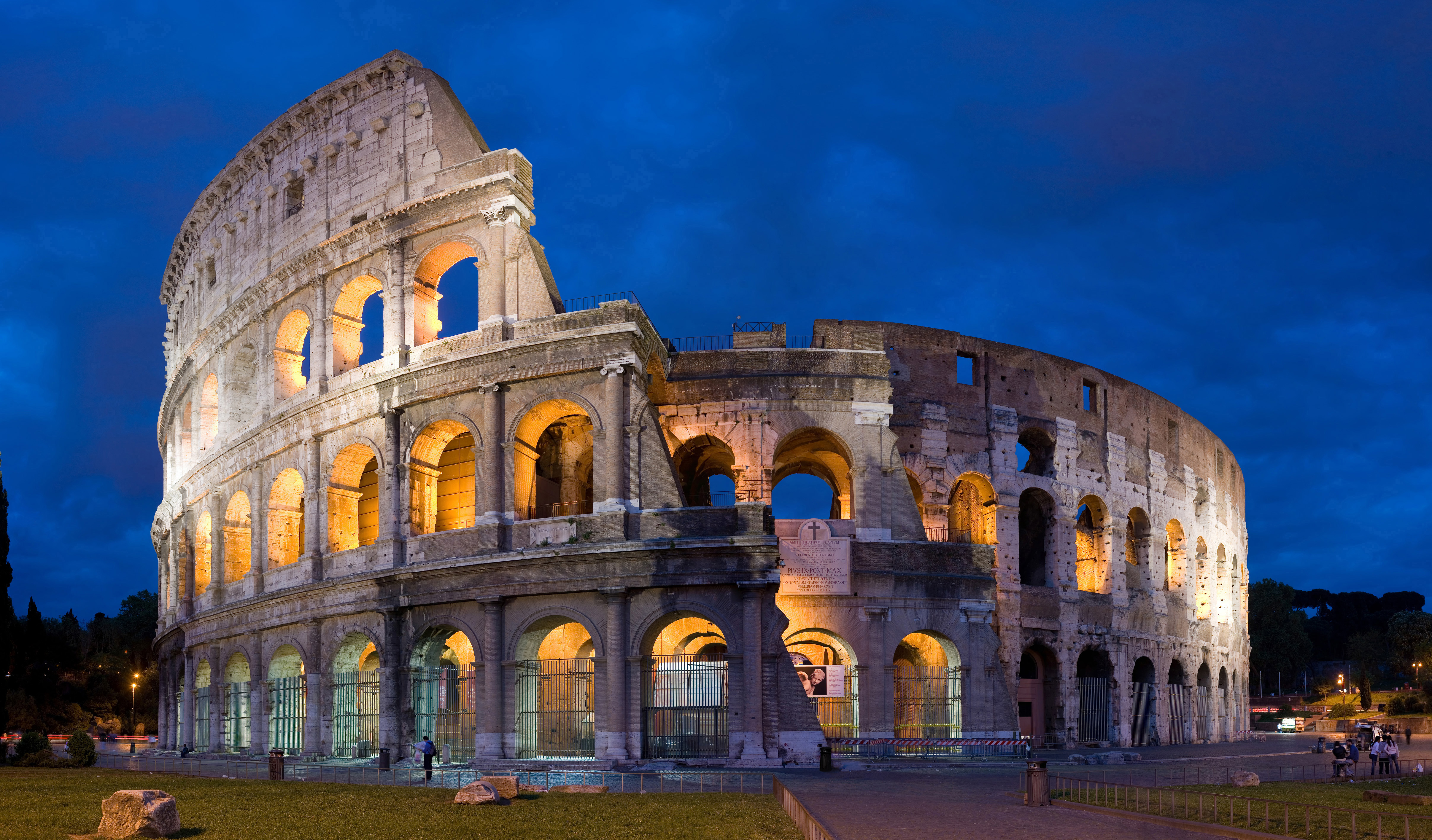
A 4×4 segment panorama of the Colosseum at dusk — CC BY-SA 2
History of Colosseum Rome
After the death of Nero in the year 68, the Roman Empire went through a year of chaos, with four emperors taking power in turn. Vespasian, the founder of the Flavian dynasty, needed a building that would show the new dynasty belonged to the people, not to a tyrant. He chose the most sensitive piece of land in the city, the lake in the palace of Nero, and he built a public amphitheatre on it. The message could not have been clearer, and the Colosseum Rome has carried it ever since.
Construction began about 70–72, and Vespasian died in 79, when the building was almost finished.
His son, the emperor Titus, inaugurated the Colosseum Rome in the year 80 with 100 days of games in a row, according to the historian Cassius Dio. His younger brother Domitian then finished the top tier and built the hypogeum, the system of tunnels under the arena floor. The building was therefore the work of three emperors, and each one added a layer to it. The 100 days of games at the opening set the pattern for the life of the amphitheatre, and the crowd that filled it was the largest audience in the ancient world.
The Colosseum was not only a place of entertainment, it was the stage where the emperor showed his power to the people.
The Arena, the Hypogeum and the Velarium
The capacity of the Colosseum Rome is still debated, and the numbers in the sources do not agree. Modern estimates usually give about 50,000 people, while an ancient list of Roman buildings records 87,000, although many scholars think that figure counts the length of seating rather than the number of people. This article uses the range of 50,000–80,000 that general sources give, and notes that the exact figure is still open. The crowd entered through about 80 arches on the ground floor, each numbered, and each spectator held a ticket of pottery or metal that marked the seating area by social rank.
Senators sat nearest the arena, and women and the poor sat at the highest tier.
Below the wooden arena floor lay the hypogeum, a two-storey maze of tunnels, lifts, pulleys and animal cages, where wild beasts and gladiators waited for their turn to rise suddenly onto the floor through trapdoors. The system was built under Domitian, after Titus had inaugurated the building, and it turned the arena into a stage of surprises. Above the crowd, the velarium, a huge canvas awning, could be stretched out to shade the spectators from the sun, and it was worked by a team of sailors from the Roman fleet. The arena itself was an oval about 83–87 metres long and 48–55 metres wide, and its wooden floor could be flooded in the early years for mock sea battles, although that practice ended when the hypogeum was built.
The games themselves were a mixture of spectacle and power. Gladiators, often slaves, prisoners of war or condemned men, fought in pairs with different weapons and armour, and the crowd knew the famous fighters by name. The beast hunts, called venationes, brought animals from across the empire, from lions and elephants to bears and crocodiles, and Cassius Dio records that 9,000 wild animals were killed during the 100 days of games at the opening. Executions took place at midday, and the afternoon belonged to the gladiators.
The games were paid for by the emperor, and they were free for the people, which is why the amphitheatre was a political building as much as a place of entertainment. The crowd itself was part of the show, and its cheers and its judgement decided whether a defeated gladiator lived or died.
In recent decades, archaeologists have excavated the hypogeum and rebuilt a section of the wooden arena floor, so that visitors can now stand in the middle of the amphitheatre and look up at the stands as a gladiator once did. The restoration of the outer wall has cleaned the travertine and strengthened the arches, and the underground passages have been opened to guided tours. The Colosseum Rome is therefore still changing, and each generation of archaeologists learns more about how the building worked. The work is slow, because every stone must be recorded before it is moved, and the building is both a monument and an excavation site.
From Arena to Quarry, Then to Symbol
The gladiator fights ended in the fifth century, and the last recorded fight took place in 435, while the beast hunts continued until the early sixth century. After that, the amphitheatre was slowly abandoned, and earthquakes damaged it, above all the great earthquake of 1349, which brought down the southern half of the outer wall. Through the Middle Ages and the Renaissance, the Colosseum was treated as a convenient quarry, and travertine from its walls was taken to build many structures in Rome, including St. Peter’s Basilica. The building that had been a symbol of imperial power became a source of cheap stone, and for centuries nobody protected it.
The turning point came in the 18th century, when Pope Benedict XIV declared the Colosseum a sacred place in 1749, ending the demolition and opening the way for restoration. In 1980, the Colosseum, together with the whole historic centre of Rome, was inscribed by UNESCO on the World Heritage List. In 2007, it was voted one of the New7Wonders of the World. Today, the Colosseum, the Roman Forum and the Palatine Hill form the Parco archeologico del Colosseo, the most visited monument in Italy.
The Colosseum Rome has therefore lived three lives, as an arena, as a quarry and as a symbol, and each life has left its mark on the stone.
The Colosseum Rome and the City Around It
The Colosseum Rome did not stand alone in the ancient city, and its neighbours explain how Rome worked. The Ludus Magnus, the great gladiator school, stood to the east, and its ruins can still be seen from the street. The Meta Sudans, a great fountain, stood to the west, and the Arch of Constantine stands to the south, marking the route of triumphal processions. The imperial fora stretched along the road to Piazza Venezia, and each emperor added a forum of his own.
A visitor who walks the Via dei Fori Imperiali from the Colosseum to Piazza Venezia passes the fora of Caesar, Augustus, Nerva and Trajan, and the column of Trajan still tells the story of his wars in Dacia in a spiral of carved reliefs. The Colosseum is the southern gate of this imperial city, and the walk north from it is a walk through the power of Rome.
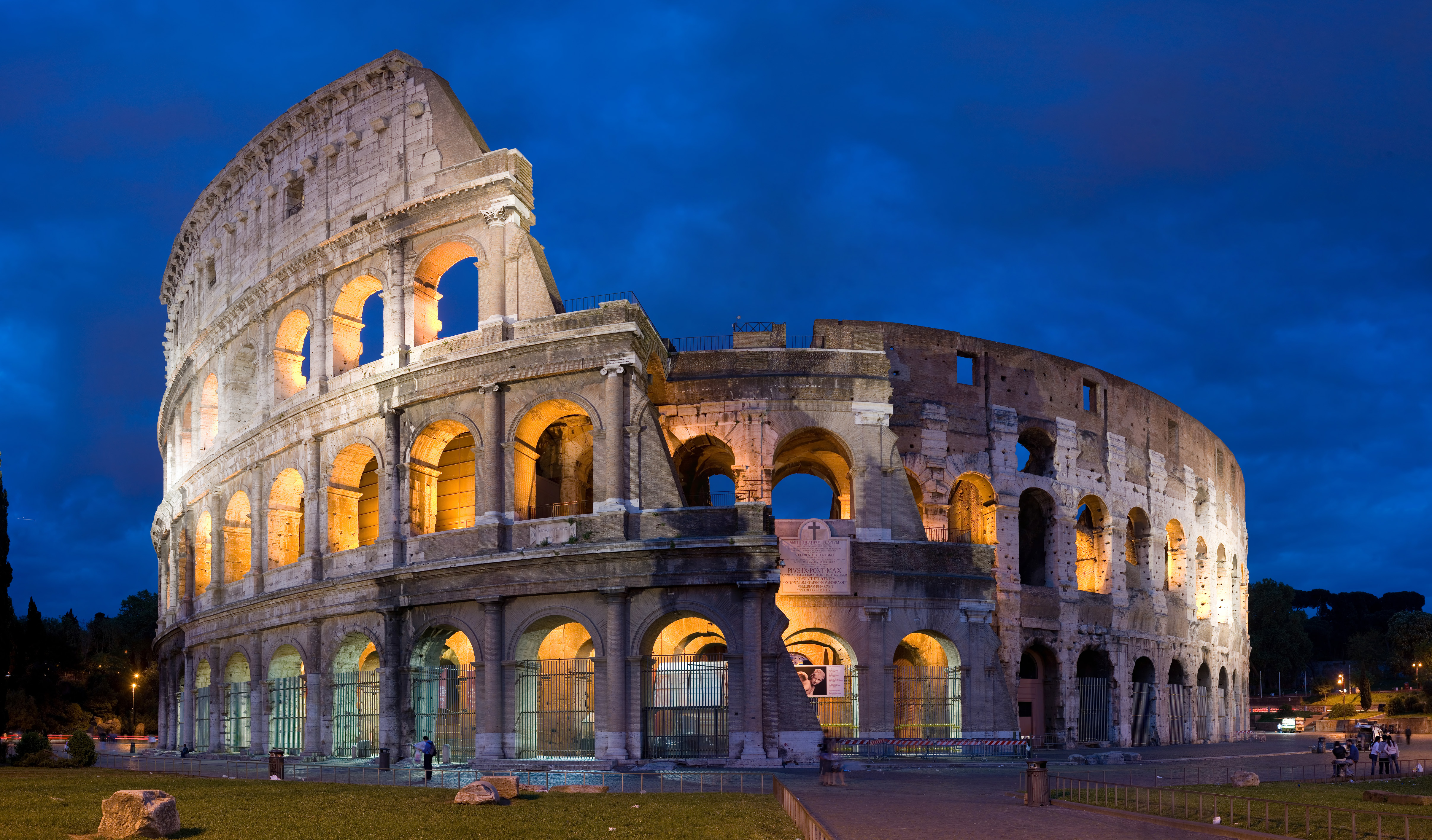
A 4×4 segment panorama of the Coliseum at dusk — CC BY-SA 2
Travel to Colosseum Rome
Rome is beautiful all year, but the Colosseum is most pleasant in spring, in April and May, and in autumn, in September and October, when the weather is mild and the afternoon light turns the travertine gold. Summer is the busiest season, with the longest queues and the strongest sun, so a summer visit should be booked for the early morning or the late afternoon. Winter is quieter, and a misty morning over the amphitheatre has a beauty of its own. Tickets are sold for fixed time slots, and they often sell out weeks ahead in the high season, so book on the official ticketing site, ticketing.colosseo.it, well before the visit.
Check the official price table there before travelling, because fares and ticket types can change.
The standard ticket covers the Colosseum, the Roman Forum and the Palatine Hill, and the Full Experience ticket adds the arena floor and the hypogeum, with a longer validity. The hypogeum can only be visited with a special guided tour, and the number of places is limited, so it should be booked early. The Colosseum alone needs about one to one and a half hours, and the Forum and the Palatine together need at least half a day. A guided tour is worth considering, because a guide can explain the lifts that carried animals, the trapdoors under the arena floor and the way 50,000 people entered and left within minutes.
The Colosseum opens daily in the morning and closes around sunset, with the hours changing by season, and the last entry is about an hour before closing. It is closed on 25 December and 1 January. The official site lists the hours for the current season.
The Colosseo metro station on line B stands directly in front of the amphitheatre, and line C also serves the area at Colosseo–Fori Imperiali. Many bus and tram lines stop at Piazza del Colosseo. The historic centre of Rome is small, and walking is the best way to see it: from the Colosseum it is about 10 minutes on foot to the Roman Forum, and about 20 minutes along Via dei Fori Imperiali to Piazza Venezia. The area around the Colosseum has many restaurants for tourists, but a short walk north into Monti finds local restaurants with fresh pasta, wood-fired pizza and gelato.
The Colosseum Rome rewards a visitor who arrives early, books ahead and walks the district slowly.
Notable Places Near Colosseum Rome
- The arena — the oval floor where gladiators and wild animals once faced each other, partly restored so visitors can stand in the middle of the amphitheatre.
- The hypogeum — the two-storey maze under the arena floor, with tunnels, animal cages and ancient lifts, visited only on a special tour.
- The stands and the tiers of arches — three tiers of arches outside, with Doric, Ionic and Corinthian columns, and a view from the top tier over the Roman Forum and the Palatine.
- The Roman Forum — the political, religious and commercial centre of ancient Rome, beside the Colosseum and on the same ticket.
- The Palatine Hill — one of the seven hills of Rome, where legend says Romulus founded the city, with ruins of imperial palaces and the Farnese Gardens.
- The Arch of Constantine — beside the Colosseum, inaugurated in 315 to celebrate the victory of the emperor Constantine.
- Via dei Fori Imperiali — the walking avenue from the Colosseum to Piazza Venezia, lined with the ruins of the imperial fora.
- Trevi Fountain — the Baroque fountain about 25 minutes on foot through the historic centre.
- Piazza Navona — the Baroque square with three fountains, about 30 minutes on foot from the amphitheatre.
Frequently Asked Questions About Colosseum Rome
When was Colosseum Rome built?
Construction began about 70–72 under the emperor Vespasian, and the amphitheatre was inaugurated in the year 80 under the emperor Titus. The emperor Domitian later finished the top tier and built the hypogeum under the arena floor.
How many people could Colosseum Rome hold?
The estimate is about 50,000–80,000 spectators, depending on the method of counting. Modern estimates usually use about 50,000, while the figure of 87,000 in an ancient Roman list may count the length of seating rather than the number of people.
How much is a ticket for Colosseum Rome?
Ticket types and prices change, so check the official price table on ticketing.colosseo.it before travelling. The standard ticket covers the Colosseum, the Roman Forum and the Palatine Hill, and the Full Experience ticket adds the arena floor and the hypogeum.
What is the hypogeum and can visitors enter it?
The hypogeum is the two-storey system of tunnels under the arena floor, where wild animals were kept and gladiators prepared, with lifts and trapdoors that brought them up onto the floor. Today it can only be visited on a special tour with a Full Experience ticket, and places are limited, so book ahead.
What time does Colosseum Rome open?
The amphitheatre opens each morning and closes near sunset, so its hours move with the seasons. The last entry is about an hour before closing, and the site is shut on 25 December and 1 January. Look up the hours for the season of your visit on the official site.
How long should a visit to Colosseum Rome take?
About one to one and a half hours for the Colosseum alone, and at least half a day if the Roman Forum and the Palatine Hill are added, since all three share one ticket. A tour of the hypogeum and the arena floor adds about 45 minutes to an hour.
Verified
Construction began about 70–72 and the amphitheatre opened in 80, measuring 189 by 156 metres with an outer wall about 48 metres high and room for 50,000 to 80,000 spectators. UNESCO listed the Historic Centre of Rome, including the Colosseum, in 1980 as reference 91, with an extension in 1990. Wikidata records the Colosseum as Q10285, an amphitheatre at 41.89027778° N, 12.49222222° E. Verified 22 November 2026.
Sources
- Construction begun about 70–72, inaugurated in 80, Vespasian and Titus, size 189 by 156 metres, outer wall about 48 metres high, capacity 50,000–80,000, largest ancient amphitheatre: Wikipedia “Colosseum” — https://en.wikipedia.org/wiki/Colosseum
- Modern capacity estimate about 50,000, and the figure of 87,000 possibly counting seat length: https://www.romanmythology.com/places/colosseum/
- 100 days of games at the inauguration, 9,000 wild animals, the amphitheatre built on the lake of Nero: https://localcooltour.com/en/tourist-attraction/colosseum-rome/266151
- About 80 entrances, about 50,000 spectators, built in just over five years: https://colosseo-roma.it/en/explore/coliseum/10-things-to-know-about-the-colosseum/
- Historic Centre of Rome inscribed in 1980, extended in 1990, reference 91, including the Colosseum: UNESCO — https://whc.unesco.org/en/list/91/
- Official site of the Parco archeologico del Colosseo: https://colosseo.it/en/
- Coordinates 41.89027778° N, 12.49222222° E, Wikidata Q10285, GeoNames 6269248: TheTerraAtlas registry, verified against the Wikidata API on 22/11/2026 (instance of amphitheatre, Q839954, among others)
- Focus keyword “colosseum rome” and related keywords: batch-eu3-en-keywords.json, key “TA-L4-colosseum” (9 measured keywords, highest volume 27,100 shared by four forms, standard form “colosseum rome”)
Unverified
- Ticket prices and seasonal opening hours — the official ticketing site blocks automated access, so prices were not checked directly on 22/11/2026; the figures of 18 and 24 euros in secondary sources are not repeated here, and the official price table on ticketing.colosseo.it should be checked before travelling.
- The exact capacity of the Colosseum — sources give a range of 50,000–80,000, and the figure of 87,000 in an ancient list most likely does not count people; this article gives the range and the reason it is still open.
- Annual visitor numbers for the Colosseum — sources give different figures, from about 7 million to more than 14 million visits a year depending on the year and the method, so no figure is given here.
- The last recorded gladiator fight in 435 and the end of beast hunts in 523 — taken from secondary sources, not checked against academic sources.
- The declaration by Pope Benedict XIV in 1749 that the Colosseum was a sacred place, and its link to Christian martyrs — still debated among historians; this article records only the declaration.
- The opening date of the line C station Colosseo–Fori Imperiali in December 2025 — taken from secondary sources, not checked on the official metro site.
Illustrations
- Hero: A view of Colosseum Rome. Free image: https://upload.wikimedia.org/wikipedia/commons/e/ee/Colosseum_and_Via_Sacra_%28Rome%29.jpg — CC BY-SA 4.0.
- In body, Colosseum Rome: A 4×4 segment panorama of the Coliseum at dusk. Free image: https://upload.wikimedia.org/wikipedia/commons/5/53/Colosseum_in_Rome%2C_Italy_-_April_2007.jpg — CC BY-SA 2.
- In body, Colosseum Rome: A 4×4 segment panorama of the Colosseum at dusk. Free image: https://upload.wikimedia.org/wikipedia/commons/d/d8/Colosseum_in_Rome-April_2007-1-_copie_2B.jpg — CC BY-SA 2.