
Palatine Hill Rome: Where the City Began and Emperors Ruled
Palatine Hill Rome rises above the Roman Forum, where Rome began. Its ruined palaces and gardens hold the story of emperors from Augustus to Domitian.
The Palatine is the most central of the seven hills of Rome, Italy, and it is the hill most closely tied to the founding of the city. According to legend, Romulus founded Rome here in 753 BC, and archaeologists have found the remains of eighth-century BC huts on its slopes that match the date of that legend. Later the hill became the address of emperors, and its Latin name, Mons Palatinus, gave English the word palace and French the word palais.
What makes Palatine Hill Rome different from the Forum below it is the character of the place. The Forum was public ground, a square of temples, law courts and markets where the whole city gathered. The Palatine was the ground of power, a hill of walled palaces, private gardens and guarded doors, where emperors lived above the noise of the city they ruled.
Quick Facts About Palatine Hill Rome
| Fact | Detail |
|---|---|
| Name | Palatine Hill, Latin Mons Palatinus, Italian Palatino |
| Location | Central Rome, south of the Roman Forum, Italy |
| Coordinates | 41.8883° N, 12.4869° E |
| Height | About 51 m above sea level, about 40 m above the Forum |
| Perimeter | About 1,740 m, area about 10 hectares |
| Legendary founding | Romulus founded Rome here in 753 BC |
| Main buildings | House of Augustus, House of Livia, Domus Flavia, Domus Augustana, Stadium of Domitian, Farnese Gardens, Palatine Museum |
| UNESCO World Heritage | Historic Centre of Rome, inscribed 1980, extended 1990, reference 91, criteria (i), (ii), (iii), (iv), (vi) |
| Ticket | One combined ticket with the Colosseum and the Roman Forum |
| Wikidata | Q200642 |
Geography of Palatine Hill Rome
The Hill in the Centre of the Seven Hills
Palatine Hill Rome has the shape of an irregular quadrilateral, with a perimeter of about 1,740 metres and an area of about 10 hectares. Its top is fairly flat, with two low summits joined by a shallow saddle: the Palatium in the south and the Cermalus in the north-west. Steep slopes fall away to the north towards the Forum and to the south towards the Circus Maximus, giving the hill a natural defensive position that the first settlers understood at once.
Height was the hill’s great advantage in the ancient world. From a summit about 51 metres above sea level, a watcher could follow movement across the Forum valley and along the Tiber to the west. The ground was high enough to defend and close enough to water and to the valley floor to live on, which is why the first settlement chose it and why emperors later chose it for their palaces.
The hill stands between the Capitoline to the north-west, the Forum directly below it to the north, the Circus Maximus to the south and the Colosseum to the east. Its main entrances open from Via dei Fori Imperiali and from the side of the Colosseum, and the Colosseo station on Metro line B leaves a visitor a few minutes’ walk from the archaeological area. Once inside, the paths that link the Colosseum, the Forum and the Palatine are stone-paved and walkable, though the climb to the hilltop has steep stretches and steps.
Views Across Ancient Rome
No other point on Palatine Hill Rome gives so complete a view of the ancient centre as the top of the hill. To the north lies the Roman Forum, to the east the Colosseum, to the south the long hollow of the Circus Maximus, and to the west the Tiber and the Capitoline Hill. A visitor who climbs here first gains a map of the whole archaeological park in a single glance, and the ruins below begin to make sense as parts of one city.
The Farnese Gardens hold the finest viewpoint on the hill, with terraces, trees and fountains looking straight down over the Forum. Late afternoon light slants across the ruins and the cypresses, and the gardens become one of the most photographed places in Rome. Many visitors come to the Palatine in the morning for the palaces and return to the gardens at the end of the day, when the crowds thin and the light turns gold.
The slopes of the hill are greener than the Forum floor, with pines, cypresses and wildflowers growing among the broken walls. Birds nest in the ruins, and in spring the grass between the stones is thick with poppies. This green, half-wild character is part of the hill’s appeal, because it feels less like a museum and more like a place where a city grew, fell and was slowly reclaimed by plants.
The Lupercal Cave
At the north-west foot of Palatine Hill Rome lies the Lupercal, the cave where, according to legend, a she-wolf suckled the twins Romulus and Remus after they were set adrift on the Tiber. The story is one of the most famous in Roman mythology, and the cave has been searched for by antiquarians for centuries. In 2007 archaeologists announced that they might have found it beneath the House of Augustus, a richly decorated underground chamber that drew worldwide attention.
Scholars remain divided about whether the chamber found in 2007 is truly the Lupercal. Some argue that its decoration and position fit the sacred cave, while others point out that no firm evidence links it to the legend. The debate is a reminder that the Palatine is both a real archaeological site and a landscape of myth, and that the two do not always line up neatly.
Whether or not the cave is the Lupercal, the legend itself belongs to this hill in the mind of Rome. The she-wolf and the twins appear on the city’s emblem, on coins, on fountains and in the Capitoline Museums nearby. A visitor who stands on the Palatine is standing where Romans believed their city began, and that belief shaped two thousand years of history even when the facts behind it stayed uncertain.
Gardens, Slopes and the Green Hilltop
The Farnese Gardens, laid out from 1550 by Cardinal Alessandro Farnese to designs by Jacopo Vignola, turned part of the ruined hill into a Renaissance garden. Terraces, fountains, aviaries and flower beds rose over the remains of the palace of Tiberius, and the garden became one of the first private botanical gardens in Europe. Today its geometric hedges and shaded walks offer the calmest corner of the archaeological park.
The gardens matter because they show how Palatine Hill Rome was reused after the empire fell. For centuries the palaces stood as quarries, their marble stripped for new churches and palaces across Rome, and the hill became pasture and woodland. The Farnese garden was the first deliberate act of turning ruin into beauty, and it set the tone for the hill’s later life as a place to walk, look and remember rather than to govern from.
Water has always shaped the hill’s edges, with the Tiber to the west and the springs and drains of the ancient city below it. The Velabrum valley at its foot was once marshy ground that flooded when the river rose, and the Cloaca Maxima, Rome’s great drain, ran nearby. This low, wet ground is where the twins were said to have come ashore, and it explains why the earliest settlement climbed to the dry hilltop above it.

the House of Livia on the Palatine Hill in Rome — CC BY-SA 2

the Circus Maximus and the Domus Augustana seen from the Palatine Hill — CC BY 4

the Colosseum seen from the Palatine Hill — CC0
History of Palatine Hill Rome
Romulus and the Founding Legend
According to Roman legend, the twins Romulus and Remus were the sons of the war god Mars and the vestal Rhea Silvia. They were set adrift on the Tiber as infants, washed ashore at the foot of the Palatine, and suckled by a she-wolf before a shepherd found them. Grown to manhood, the brothers quarrelled over who would name and rule a new city, and Romulus killed Remus, then founded Rome on the Palatine in 753 BC and became its first king.
Archaeology gives the legend a real foundation. Excavations on the Palatine have uncovered the post-holes and floors of huts dating to the eighth century BC, the same period the legend claims for the founding. These early dwellings, known as the huts of Romulus, show that the hill was one of the first inhabited places in Rome. The legend may embroider the facts, but the settlement it describes was real.
The huts were simple structures of wattle and timber with thatched roofs, and traces of them survive in the bedrock of the hill. Later Romans treated one hut as a sacred relic, repairing and rebuilding it for centuries as a monument to their origins. That care tells us how seriously Romans took the idea that their city began on this particular hill.
Aristocrats of the Republic
During the Republic, Palatine Hill Rome became the quarter of the wealthy, with large houses, temples and gardens crowding its summit. The Temple of Magna Mater, the Great Mother goddess, was built here in 191 BC, and its festivals drew crowds from across the city. The hill was already a symbol of wealth and standing long before any emperor lived on it.
Augustus was born on the Palatine in 63 BC, and after he became Rome’s first emperor he chose to live there for the rest of his life. His house was modest compared with the palaces that followed, but its painted rooms survive as some of the finest wall painting from the ancient world. Beside it stood the House of Livia, his wife, whose frescoes of a garden full of birds, trees and fruit are among the best preserved in Rome.
The Temple of Apollo, which Augustus built beside his house and dedicated in 28 BC, joined religion to imperial power in a single building. Its library and porticoes made it a centre of learning as well as worship, and its white marble shone above the Forum. The temple announced that the emperor’s home was also a sacred place, and that the Palatine was the centre of the Roman world.
The Palaces of the Emperors
Under Domitian, who ruled from 81 to 96, the hill was transformed by the building of the Domus Flavia and the Domus Augustana. The Domus Flavia was the public palace, where the emperor received guests, held banquets and conducted the business of the empire in halls lined with marble columns. The Domus Augustana was the private residence, with its own stadium, baths and inner gardens, set in the southern half of the hill.
The architect Rabirius reshaped the entire hilltop to raise this palace complex, levelling ground and building vast substructures to support it. The Stadium of Domitian, a long rectangular court beside the private palace, was used for the emperor’s exercise and private displays. From the Domus Flavia, a visitor could look down over the Forum and feel the scale of imperial power in a single view.
Later emperors added to the hill, and in the early third century Septimius Severus built the Septizodium at its southern foot, a great nymphaeum that faced the Appian Way and greeted travellers arriving from the south. The palace complex grew until it covered much of the hill, and the word palatine itself became a synonym for imperial residence across Europe. When people in later centuries spoke of a palace, they were speaking, without knowing it, of this hill.
Abandonment and the Farnese Gardens
After the fall of the empire, the palaces of the Palatine were abandoned, and their marble and stone were carried away to build churches and palaces elsewhere in Rome. For centuries the hill was a ruin overgrown with trees, where cattle grazed among broken columns and antiquarians came to dig. The great halls stood open to the sky, and the gardens of the emperors returned to scrub and woodland.
In 1550 Cardinal Alessandro Farnese bought part of the hill and built the Farnese Gardens over the remains of the palace of Tiberius. Designed by Jacopo Vignola, the gardens had terraces, fountains, an aviary and flower beds, and they turned a stretch of ruin into a Renaissance showpiece. The garden is still one of the most beautiful places on the hill, and its terraces give the finest view down over the Forum.
Systematic excavation of Palatine Hill Rome began in the nineteenth century and continues today, with major discoveries including the houses of Augustus and Livia and the possible Lupercal of 2007. Each generation of archaeologists has added detail to the picture of the hill, from the eighth-century huts to the imperial palaces. The Palatine is still an active dig, and parts of it open and close as new work proceeds.
UNESCO and the Archaeological Park
In 1980 UNESCO inscribed the Historic Centre of Rome on the World Heritage List, and the Palatine stands inside that property as one of its great archaeological areas. The inscription was extended in 1990, and the property now carries reference number 91 under criteria (i), (ii), (iii), (iv) and (vi). The listing recognises nearly three thousand years of history layered into a single city centre, from the Forum and the Colosseum to the Renaissance palaces and Baroque squares.
Today the Palatine, the Forum and the Colosseum form a single archaeological park, visited by millions of people each year. The park protects the ruins while keeping them open, a balance that is never easy in a living city. Restoration work moves from one building to the next, and houses that were closed for years, like those of Augustus and Livia, now open in timed slots so that their frescoes survive the crowds.
The Palatine’s place in the UNESCO property is different from that of a single monument, because the hill is a landscape of power rather than one building. Its value lies in the sequence: huts, temples, houses, palaces and gardens, each layer built over the last. A walk across the hilltop is a walk through the whole history of Rome, from its legendary founding to its imperial height and its long afterlife as a ruin and a garden.
Timeline
| Date | Event |
|---|---|
| 753 BC | According to legend, Romulus founded Rome on the Palatine |
| 8th century BC | The first huts were built on the hill, their traces still visible today |
| 191 BC | The Temple of Magna Mater was built on the Palatine |
| 63 BC | Augustus was born on the Palatine |
| 28 BC | The Temple of Apollo of Augustus was dedicated on the hill |
| 81–96 | Domitian built the Domus Flavia and the Domus Augustana |
| Early 3rd century | Septimius Severus built the Septizodium at the southern foot of the hill |
| 1550 | Cardinal Alessandro Farnese bought land and laid out the Farnese Gardens |
| 1980 | UNESCO inscribed the Historic Centre of Rome, including the Palatine, as World Heritage |
| 1990 | The Historic Centre of Rome inscription was extended |
| 2007 | Archaeologists announced the possible discovery of the Lupercal beneath the House of Augustus |

the ruins of the Domus Augustana on the Palatine Hill — CC BY-SA 4

the House of Augustus on the Palatine Hill, Rome — CC BY-SA 2

the Domus Flavia on the Palatine Hill, Rome — CC BY 2

the remains of the Temple of Apollo on the Palatine Hill, Rome — CC BY 2
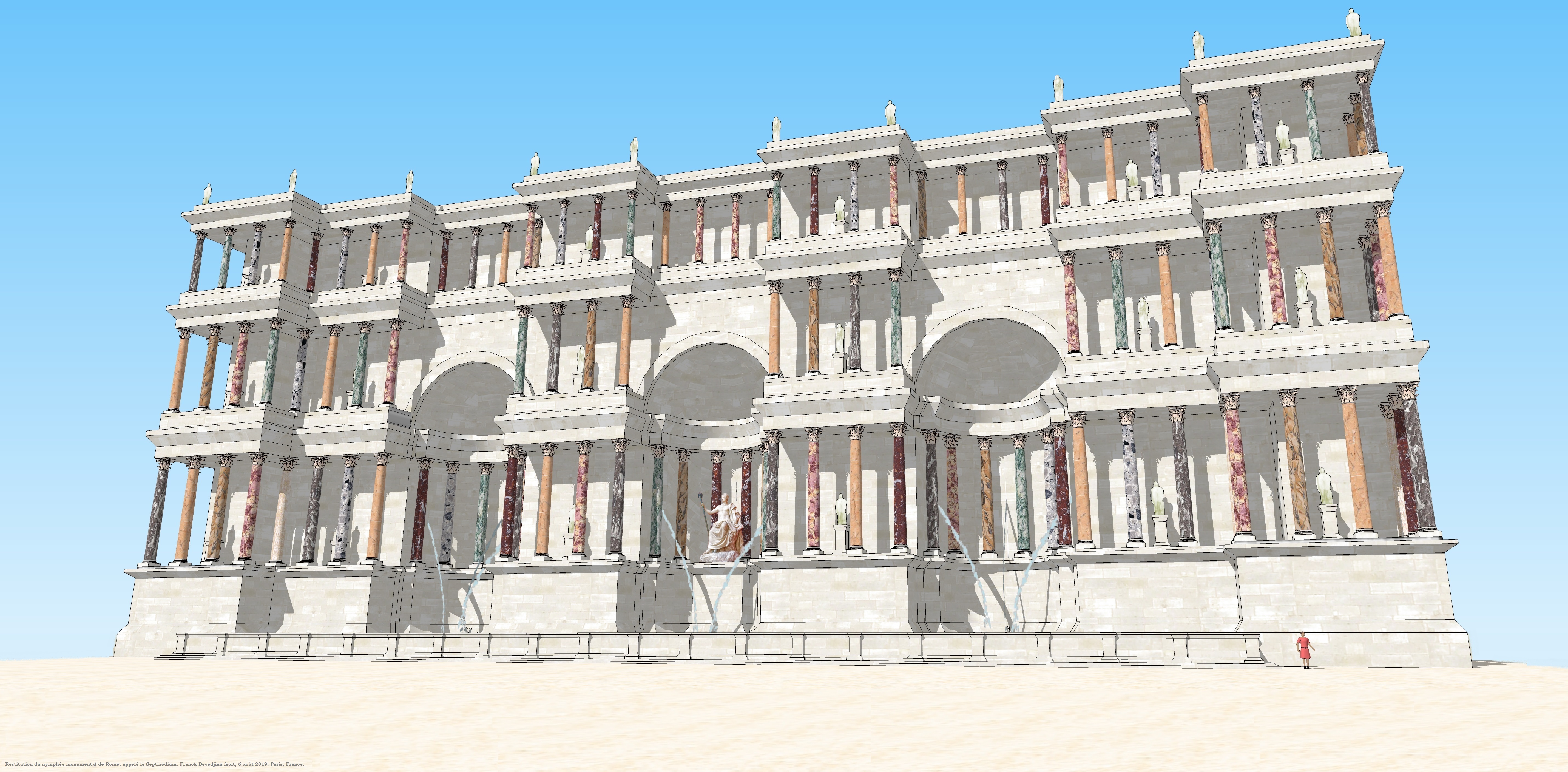
the Septizodium in Rome — CC BY-SA 4
Travel to Palatine Hill Rome
When to Visit
Palatine Hill Rome is open all year, but spring from April to June and autumn from September to October are the best seasons, with mild weather, good light and manageable crowds. Summer from July to August is very hot and very busy, so an early morning visit is the best way to avoid both the heat and the longest queues. Winter is quieter, and the low sun gives the ruins a sharp, clear light that photographers love.
Mornings suit the hill well, because the sun rises over the Colosseum and lights the Forum from the east, while the Palatine itself stays in softer light. Late afternoon is the best time for the Farnese Gardens, when the sun slants across the Forum and the terraces glow. A visitor who plans the day around light rather than crowds will enjoy the hill far more.
Tickets and Entry
Palatine Hill Rome uses one combined ticket with the Colosseum and the Roman Forum, so a single ticket covers all three sites on the same day. Booking online in advance is wise, above all in the high season, because the queues at the ticket offices can be long. Ticket prices and opening hours change with the season, so they should be checked on the official booking site before travelling rather than trusted from a guidebook.
The Houses of Augustus and Livia open in timed slots with limited numbers in each group, and a separate reservation is needed for them. The Palatine Museum on the hilltop is included in the visit and holds finds excavated on the hill, from early pottery to imperial sculpture. A visitor should allow extra time for the museum, since it gives context to the ruined walls outside.
How Long to Spend
Palatine Hill Rome alone takes about one to two hours, depending on whether a visitor enters the Houses of Augustus and Livia and the museum. The hill is part of a single archaeological complex with the Colosseum and the Forum, however, so at least half a day should be allowed for all three. Many visitors start at the Colosseum in the morning, cross the Forum at midday and finish on the Palatine in the afternoon, when the light is at its best.
A slower visit repays the effort, because the Palatine rewards walking rather than rushing. The Stadium of Domitian and the southern gardens are quieter than the main paths, and they give a sense of the private life of the emperors that the crowded Forum cannot. Bringing water and a hat in summer is wise, since shade is scarce on the hilltop and there are few places to buy drinks inside the park.
Getting There
The Colosseo station on Metro line B stands beside the Colosseum and is the easiest way to reach Palatine Hill Rome. From the station, the entrances on Via dei Fori Imperiali and from the Colosseum side are a few minutes’ walk away. Buses and trams also serve the area, with stops at Piazza Venezia and along Via dei Fori Imperiali.
Inside the archaeological park, visitors move entirely on foot, along stone paths that link the Colosseum, the Forum and the Palatine. The climb to the hilltop has steep stretches, steps and gravel paths, and some areas are uneven underfoot. Travellers with limited mobility should note that parts of the hill are not fully accessible, and that the ground is rough in places.
Eating Nearby
There are few places to eat inside the archaeological park, so visitors should eat before entering or carry water and a snack. The streets around the Colosseum and Via dei Fori Imperiali hold many restaurants and cafes, though prices in this tourist area are high and quality is uneven. The Monti quarter near the Colosseum is one of the best eating areas close to the hill, with small restaurants, wine bars and bakeries in narrow streets.
Trastevere, across the Tiber, is a good choice for dinner after a day among the ruins, with family-run restaurants in cobbled lanes. Roman dishes such as carbonara, amatriciana and Roman-style pizza are easy to find in both quarters. A visitor who walks a few streets away from the main sights will usually eat better and pay less.
Notable Places on Palatine Hill Rome
The House of Augustus was the home of Rome’s first emperor, a two-storey house built around a courtyard and decorated with fine wall paintings that survive to this day. Its frescoes show landscapes, mythology and painted architecture, and the rooms give a sense of how Augustus lived before the great palaces rose around him. Entry is in timed slots with limited numbers, so a reservation is needed.
The House of Livia stands near the House of Augustus and belonged to Livia, the wife of Augustus. Its frescoes are among the best preserved on the hill, painting a garden of trees, birds and fruit on the walls of an interior room so that the space feels like open air. The house opens in timed slots, like that of Augustus, and the two houses together are the finest interiors on the Palatine.
The Domus Flavia was the public wing of the palace built by Domitian, where the emperor received guests, held banquets and ran the business of the empire. Its great hall, marble columns and courtyards show the scale of imperial power, and from its terrace a visitor looks down over the Roman Forum. The building makes clear how the Palatine changed from a quarter of aristocratic houses into the seat of an empire.
The Domus Augustana was the emperor’s private residence, in the southern half of the hill, with baths, inner gardens and the long rectangular Stadium of Domitian beside it. The stadium was used for the emperor’s exercise and private displays, and the area is quieter than the main paths, which makes it a good place to walk and imagine the daily life of the court.
The Farnese Gardens on Palatine Hill Rome are the Renaissance garden laid out from 1550 over the palace of Tiberius, with terraces, fountains and rows of trees. Their upper terrace gives the best view on the hill, looking straight down over the Forum towards the Capitoline, and it is one of the most photographed viewpoints in Rome. The gardens are counted among the first private botanical gardens in Europe.
The Palatine Museum stands on the hilltop and displays finds excavated on the Palatine, from early pottery to imperial sculpture. The museum is small, but it is worth half an hour after a walk through the ruins outside, because it turns broken walls into a story with objects, dates and faces. Its collection covers the whole history of the hill, from the first settlement to the empire.
The Temple of Apollo was built by Augustus beside his house and dedicated in 28 BC, joining his home to a sanctuary of the god he claimed as his patron. Its library and porticoes made it a centre of learning as well as worship, and its marble shone above the Forum below. Only foundations and fragments survive, but the site marks the moment when the emperor’s house became a sacred place.
The Septizodium was built by Septimius Severus in the early third century at the southern foot of the hill, a great fountain facade that faced the Appian Way. It greeted travellers arriving in Rome from the south with a wall of columns and water, and it was one of the last great additions to the imperial palace complex. Its foundations are still visible from the Circus Maximus side of the hill.

the Farnese Gardens on the Palatine Hill, Rome — CC BY 2.5
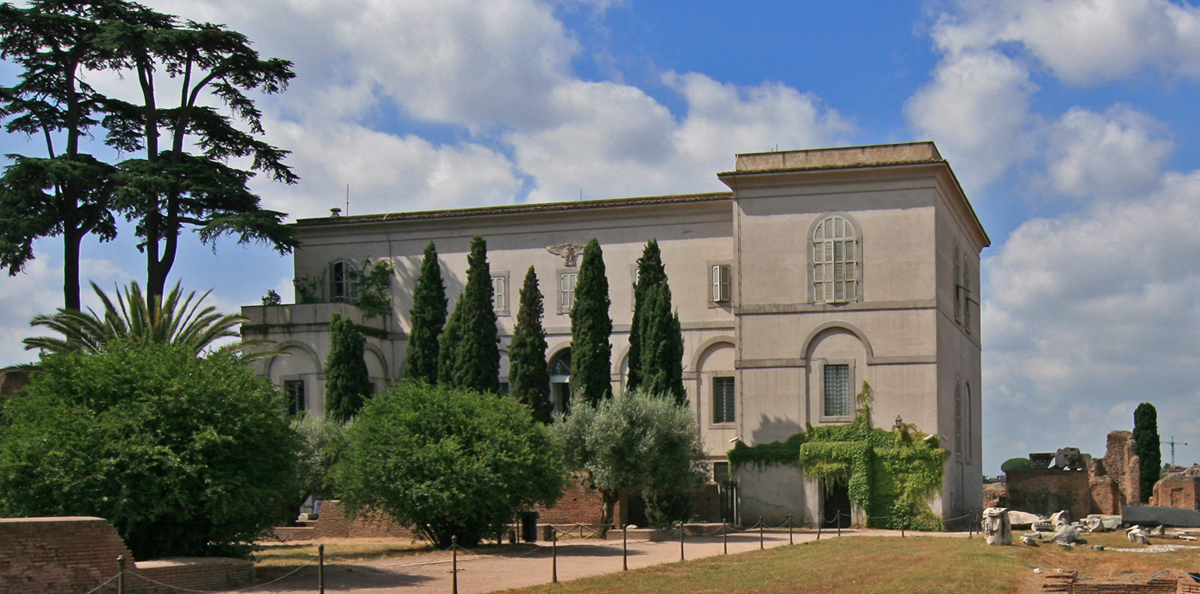
the Palatine Museum in Rome — Public domain

the House of the Vestal Virgins in the Roman Forum, seen from the Palatine Hill — CC BY-SA 2
Frequently Asked Questions About Palatine Hill Rome
How is Palatine Hill Rome different from the Roman Forum?
The two belong to one archaeological park, yet they are different places with different characters. The Forum is the valley square where Rome did its public business, with temples, law courts and markets, while the Palatine is the hill above it where emperors built their palaces and lived. Their Wikidata entries are separate too, with the Palatine at Q200642 and the Forum at Q180212.
What should I see first on Palatine Hill Rome?
Begin with the Houses of Augustus and Livia, whose frescoes are the finest interiors on the hill, then cross to the Domus Flavia and the Domus Augustana to grasp the scale of the imperial palace. Finish in the Farnese Gardens, where the terrace looks down over the Forum and gives the best view in the whole archaeological park.
Does one ticket cover Palatine Hill Rome, the Colosseum and the Forum?
Yes, a single combined ticket covers all three sites on the same day, and the Houses of Augustus and Livia need a separate timed reservation. Prices and hours change with the season, so check the official booking site before travelling rather than relying on a printed guide.
How long does a visit to Palatine Hill Rome take?
The hill alone takes about one to two hours, depending on whether you enter the houses and the museum. Allow at least half a day for the full complex of the Colosseum, the Forum and the Palatine, since the three sites share one ticket and stand side by side.
Was the Lupercal cave really found under Palatine Hill Rome?
In 2007 archaeologists announced that a richly decorated chamber beneath the House of Augustus might be the Lupercal, the cave of the she-wolf and the twins. Scholars still disagree, and the discovery remains an announcement rather than a settled conclusion, though the legend itself has belonged to this hill for more than two thousand years.
Is Palatine Hill Rome part of a UNESCO World Heritage property?
Yes, the hill stands inside the Historic Centre of Rome, inscribed by UNESCO in 1980 and extended in 1990 under reference number 91. The property covers the whole historic centre within the seventeenth-century walls, and the Palatine is one of its great archaeological areas, listed under criteria (i), (ii), (iii), (iv) and (vi).
Verified
The facts in this article were checked against the sources listed below on 22 November 2026. Palatine Hill Rome stands at 41.8883° N, 12.4869° E, rises about 51 metres above sea level and about 40 metres above the Forum, and has a perimeter of about 1,740 metres with two summits, the Palatium and the Cermalus. Romulus is said to have founded Rome here in 753 BC, and eighth-century BC huts have been found on the hill.
Augustus was born on the hill in 63 BC, dedicated the Temple of Apollo in 28 BC, and lived beside the House of Livia, while Domitian, who ruled from 81 to 96, built the Domus Flavia and the Domus Augustana with the Stadium of Domitian. The Farnese Gardens were laid out from 1550 to designs by Jacopo Vignola, and in 2007 archaeologists announced the possible discovery of the Lupercal beneath the House of Augustus. The Historic Centre of Rome was inscribed by UNESCO in 1980 and extended in 1990, under reference 91 and criteria (i), (ii), (iii), (iv) and (vi).
The Wikidata entry Q200642 for the Palatine, described as the centremost of the seven hills of Rome, was verified through the Wikidata API on 22 November 2026, and its coordinates match the registry exactly. Every figure in this article comes from the sources below, and anything that could not be confirmed sits in the Unverified section rather than in the body of the text.
Sources
- UNESCO World Heritage Centre, Historic Centre of Rome, reference 91, inscribed 1980, extended 1990, criteria (i), (ii), (iii), (iv), (vi) — https://whc.unesco.org/en/list/91/
- Encyclopaedia Britannica, Palatine Hill: height 40 m above the Forum, 51 m above sea level, perimeter 1,740 m — https://www.britannica.com/print/article/439237
- Perseus Digital Library, Palatinus Mons: height, perimeter, two summits Palatium and Cermalus — http://www.perseus.tufts.edu/hopper/text?doc=Perseus:text:1999.04.0054:id=palatinus-mons
- Wikipedia, Palatine Hill: Domus Flavia and Domus Augustana under Domitian, Stadium of Domitian, Lupercal announcement 2007, Farnese Gardens from 1550 — https://en.wikipedia.org/wiki/Palatine_Hill
- Rome sightseeing guide, Palatine Hill: Farnese Gardens from 1550, houses of Augustus and Livia — https://www.romesightseeing.net/palatine-hill/
- Wikidata API, Q200642: instance of hill, archaeological site and national museum, coordinates 41.8883° N, 12.4869° E — checked 22 November 2026
- TheTerraAtlas registry: Mont Palatin, parent Rome, canonical URL /en/europe/italy/rome/mont-palatin/
Unverified
- Ticket prices and opening hours — prices and hours change with the season and must be checked on the official booking site before travelling; this article gives no figures.
- The Lupercal discovery of 2007 — the announcement that a chamber beneath the House of Augustus might be the Lupercal is still disputed among scholars.
- The area of the hill as about 10 hectares — the figure is a conversion from 25 acres in older topographical sources, and modern sources vary slightly.
- The year 28 BC for the dedication of the Temple of Apollo — the commonly given date, not checked against an original archaeological source.
- The exact number of visitors to the archaeological park each year — this article says only that millions visit, without a fixed figure.
Illustrations
- Hero: the Palatine Hill seen from the Circus Maximus in Rome. Free image: https://upload.wikimedia.org/wikipedia/commons/0/09/Palatine_Hill_from_Circus_Maximus_Rome.jpg — CC0.
- In body, the Domus Augustana: the ruins of the Domus Augustana on the Palatine Hill. Free image: https://upload.wikimedia.org/wikipedia/commons/e/eb/Ruins_of_the_Domus_Augustana_on_Palatine_Hill..jpg — CC BY-SA 4.
- In body, the House of Livia: the House of Livia on the Palatine Hill in Rome. Free image: https://upload.wikimedia.org/wikipedia/commons/7/71/House_of_Livia%2C_Palatine_Hill%2C_Rome_%2820163232204%29.jpg — CC BY-SA 2.
- In body, House of Augustus, Palatine Hill: the House of Augustus on the Palatine Hill, Rome. Free image: https://upload.wikimedia.org/wikipedia/commons/8/83/House_of_Augustus%2C_Palatine_Hill%2C_Rome_%2820062210353%29.jpg — CC BY-SA 2.
- In body, Domus Flavia, Palatine Hill: the Domus Flavia on the Palatine Hill, Rome. Free image: https://upload.wikimedia.org/wikipedia/commons/3/30/Domus_Flavia%2C_Palatine_Hill_%2832512975198%29.jpg — CC BY 2.
- In body, Farnese Gardens, Palatine Hill: the Farnese Gardens on the Palatine Hill, Rome. Free image: https://upload.wikimedia.org/wikipedia/commons/7/77/Farnese-gaerten.jpg — CC BY 2.5.
- In body, Temple of Apollo, Palatine Hill: the remains of the Temple of Apollo on the Palatine Hill, Rome. Free image: https://upload.wikimedia.org/wikipedia/commons/c/c1/Remains_of_Temple_Apollo_Palatinus.jpg — CC BY 2.
- In body, Septizodium, Palatine Hill: the Septizodium in Rome. Free image: https://upload.wikimedia.org/wikipedia/commons/5/5e/SEPTIZODIUM_Rome.jpg — CC BY-SA 4.
- In body, Palatine Museum, Rome: the Palatine Museum in Rome. Free image: https://upload.wikimedia.org/wikipedia/commons/7/79/Museo_Palatino_Roma.jpg — Public domain.
- In body, Circus Maximus from the Palatine Hill: the Circus Maximus and the Domus Augustana seen from the Palatine Hill. Free image: https://upload.wikimedia.org/wikipedia/commons/0/09/0_Circus_Maximus_et_Domus_Augustana_-_Rome.JPG — CC BY 4.
- In body, Roman Forum from the Palatine Hill: the House of the Vestal Virgins in the Roman Forum, seen from the Palatine Hill. Free image: https://upload.wikimedia.org/wikipedia/commons/4/4a/House_of_the_Vestal_Virgins%2C_Roman_Forum._Viewed_from_the_Palatine_Hill.Rome.–Flickr-_Andy_Montgomery.jpg — CC BY-SA 2.
- In body, Colosseum seen from the Palatine Hill: the Colosseum seen from the Palatine Hill. Free image: https://upload.wikimedia.org/wikipedia/commons/7/74/Colosseum_from_the_Palatine_Hill_-Rome%2C_Italy-_DSC01449.jpg — CC0.