
Cancun — A Planned Resort City on a Caribbean Island
Cancún is a resort city on the Caribbean coast of the Yucatán Peninsula. Its island hotels, white beaches and Maya ruins draw millions each year.
Cancún is the most populous city in the state of Quintana Roo, on the north-east coast of the Yucatán Peninsula, and it is a city that was planned before it was lived in. In nineteen seventy the island that is now the Hotel Zone had only three residents, the caretakers of a coconut plantation, and the fishing village of Puerto Juárez nearby had only one hundred and seventeen people. An all inclusive trip to Cancun is the way most travellers meet the city, with the flight, the hotel and the beach arranged as one package, yet the city behind the hotels is a real Mexican city, and the Maya world stands a short drive inland. This guide explains where Cancún stands, how it grew from an empty island into the busiest resort in Mexico, and how a traveller plans an all inclusive trip to Cancun, with the island, the lagoon and the ruins beyond it.
Quick Facts
- Name: Cancún, the most populous city in the state of Quintana Roo, in south-east Mexico, and the seat of the municipality of Benito Juárez.
- Position: On the north-east coast of the Yucatán Peninsula, on the Caribbean Sea, just north of the Riviera Maya.
- Coordinates: Twenty-one degrees ten minutes north and eighty-six degrees forty-nine minutes west, by the city Wikidata item Q8969.
- Name: The name comes from the Maya words kàan kun, said to mean nest of snakes, and the island was first known to its Maya inhabitants as Nizuc.
- Founded: The resort was started on the twenty-third of January nineteen seventy, as a government project to bring tourism to the coast.
- Visitors: A record twenty-one million tourists visited Cancún in two thousand and twenty-three.
- Hotel Zone: A narrow island of hotels, beaches and lagoons, the main area for tourism, joined to the mainland city by two causeways.
- Climate: Tropical wet and dry, hot all year, with an annual mean temperature of about twenty-seven degrees, a dry season from November to April and a rainy season from late August to November.
- Sea: The sea is warm in every month, about twenty-six degrees in winter and about twenty-nine degrees in summer.
- Nearest World Heritage: The Pre-Hispanic City of Chichen-Itza, ref 483, about one hundred and eighty-nine kilometres west in a straight line.
- Hurricanes: The hurricane season runs from June to November, and the city has been struck by Gilbert in nineteen eighty-eight, Wilma in two thousand and five and Dean in two thousand and seven.
- Economy: All-inclusive resorts, day trips to the Maya ruins and the cenotes, diving on the reef, and the services of a large city.
Geography of Cancun
Cancún stands on the north-east coast of the Yucatán Peninsula, where the flat limestone plain meets the Caribbean Sea, and the city is built in two parts. The Hotel Zone is a long narrow island, shaped like the number seven, that runs between the sea and the Nichupté Lagoon, and the mainland city, known as El Centro, stands across the lagoon to the west. The island is the resort, with the hotels, the beaches, the restaurants and the nightclubs in a single line, and the mainland is the city, with the markets, the neighbourhoods and the daily life of the people who work in the hotels. The two parts are joined by causeways, and the traveller crosses from one to the other in a few minutes.
The beaches of Cancún face the Caribbean Sea, and they are white sand with turquoise water, protected in part by the Mesoamerican Barrier Reef offshore. The northern beaches of the Hotel Zone face the bay and the island of Isla Mujeres, and the water there is calmer, while the eastern beaches face the open sea and the waves are stronger. The sea is warm in every month, about twenty-six degrees in winter and about twenty-nine degrees in summer, and the trade winds keep the air moving, so the heat of the afternoon is softened by the breeze. The lagoon behind the island is a system of shallow water and mangroves, and it is the nursery of the fish and the birds of the coast, as well as the playground of the jet skis and the tour boats.
The land behind Cancún is the limestone plain of the Yucatán, a flat land with no rivers on the surface, because the rain sinks through the porous rock into the underground rivers. The cenotes are the windows into this underground world, natural sinkholes of clear water where the Maya drew their water, and they lie inland from the coast, within an hour of the city. The jungle of the interior is low and dry, with the ruins of the Maya cities standing in clearings, and the coast south of Cancún runs down the Riviera Maya to Tulum and the reserve of Sian Ka’an. The geography of Cancún is the geography of the whole peninsula in miniature, with the island, the lagoon, the cenote and the ruin all within a day of each other.
The climate of Cancún is tropical wet and dry, with little difference in temperature between the months, and a clear division between the dry and the rainy seasons. The city is hot all year, with an annual mean temperature of about twenty-seven degrees, and the sea breezes keep the daytime temperatures from rising above thirty-six degrees on most afternoons. The annual rainfall is about one thousand three hundred and forty millimetres, falling on about one hundred and fifteen days a year, and the rainy season runs from late August through November, while the dry season runs from November through April. The hurricane season runs from June through November, and the city lies in one of the main hurricane paths of the Caribbean.
The best months for an all inclusive trip to Cancun are December to April, when the air is drier, the rain is rare and the sea is calm, though the resorts are busiest at Christmas and Easter. The summer months are hotter and wetter, with short showers and a higher chance of tropical storms, and the seaweed season brings the brown sargassum to the beaches in the summer. The sargassum first arrived in large amounts in two thousand and fifteen, and by two thousand and twenty-one it had become an annual occurrence at many Caribbean beach destinations, including Cancún. The hotels clear the beaches each morning, yet the traveller who comes in summer should expect the seaweed and plan the swimming for the early hours.
The nearest World Heritage site to Cancún is the Pre-Hispanic City of Chichen-Itza, ref 483, inscribed in nineteen eighty-eight with criteria one, two and three, about one hundred and eighty-nine kilometres west of the city in a straight line. Chichen Itza was a Maya city of the Classic period, built near the cenotes that gave it its name, at the edge of the well of the Itzaes, and its pyramid of Kukulkan is the most famous building of the Maya world. The site is the day trip that every visitor to Cancún is offered, and the drive west from the coast to the ruins crosses the whole of the northern Yucatán. The reserve of Sian Ka’an, ref 410, lies about two hundred and twenty-two kilometres south of Cancún, and it is the second nearest World Heritage site, a wild coast of lagoons and reef.
The islands near Cancún are part of its geography, and the traveller can reach them by ferry in less than an hour. Isla Mujeres, the island of women, lies off the north coast, with a small town, a turtle farm and a reef for snorkelling, and Cozumel lies across the strait to the south, with the diving walls of the reef and the town of San Miguel. The Hotel Zone juts into the Caribbean Sea and is surrounded by ocean, so the daytime temperatures there are about one or two degrees cooler than at the airport inland, and the wind is stronger. The island, the lagoon and the mainland city together make Cancún a place of three landscapes, and the traveller who stays only on the island sees only one of them.

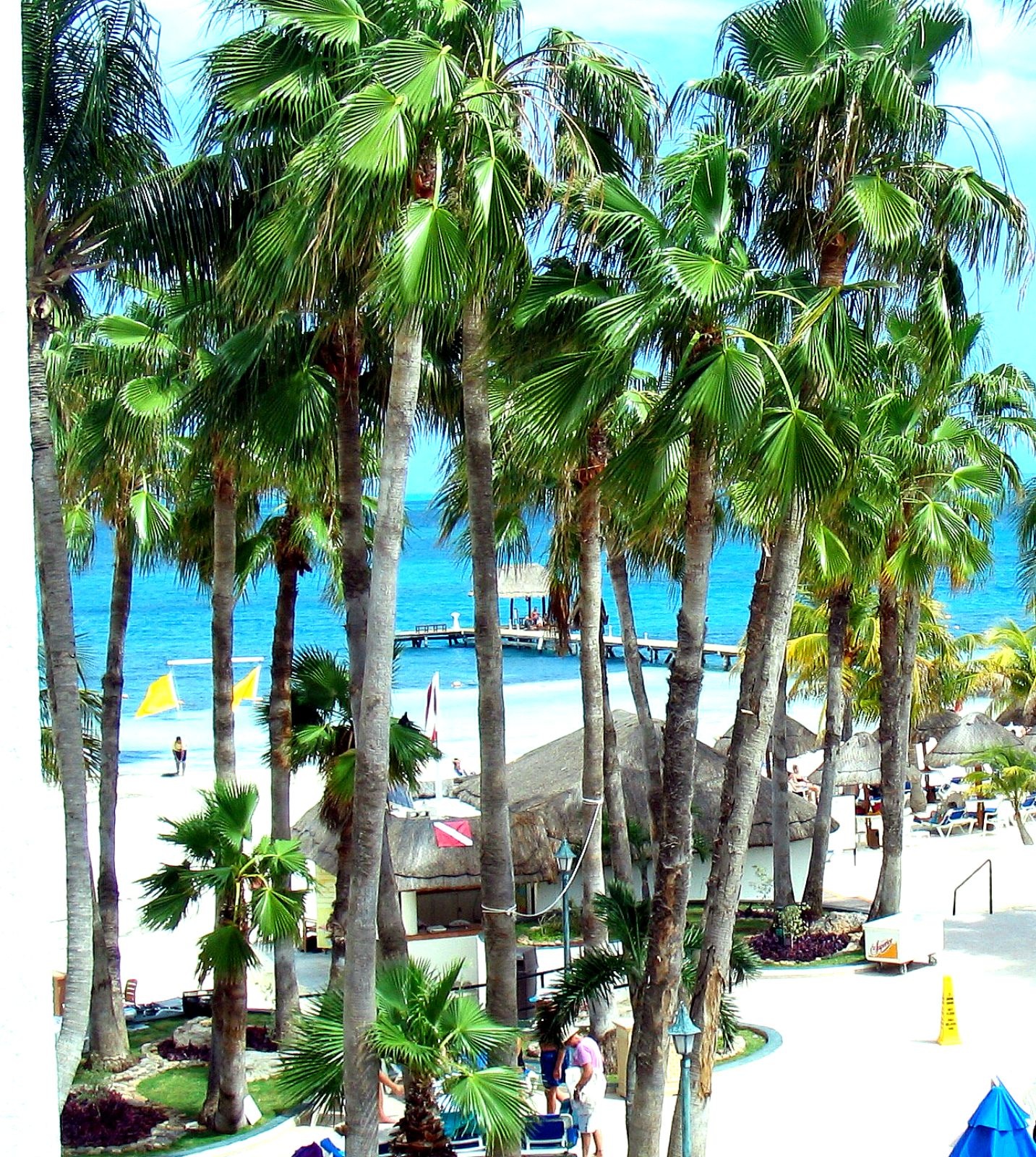
Shows the beach, the sea and the hotels of the resort strip — CC BY-SA 4

Palancar Beach on Cozumel — CC BY 3

Mercado 28, the market of El Centro in Cancún — CC BY 2

The coral of the Mesoamerican Barrier Reef off Cancún — CC BY-SA 4
History of Cancun
Cancún began as an island of coconut palms and a fishing village, with a Maya past and almost no present. The island was known to its Maya inhabitants as Nizuc, meaning promontory or point of grass, and the name Cancún first appears on maps of the eighteenth century, from the Maya words kàan kun, said to mean nest of snakes. After the Spanish conquest of Yucatán from Spain, much of the Maya population died or left, and only small settlements remained on Isla Mujeres and Cozumel. The coast was a quiet place of fishermen and coconut workers for centuries, and the island of Cancún had no town, no road and no reason for a traveller to come.
The resort was born in the nineteen sixties, when the Mexican government looked for new places to bring tourism to a coast that had no other industry. In nineteen sixty-seven the government allocated a fund of two million dollars, administered by the Bank of Mexico, to study the feasibility of new recreational zones, and the work was entrusted to a Bank of Mexico agency. The federal government financed the first nine hotels, because private investors were unwilling to gamble on an unknown coast, and the development of the area as a resort was started on the twenty-third of January nineteen seventy. On that day the island of Cancún had only three residents, all caretakers of the coconut plantation, and some one hundred and seventeen people lived in the nearby fishing village of Puerto Juárez.
The city began as a tourism project in nineteen seventy-four, as an Integrally Planned Center, a pioneer of the National Fund for Tourism Development, and it grew faster than the planners expected. From nineteen seventy to nineteen eighty the population grew by about sixty-two per cent a year on average, and the growth of Cancún outpaced the rest of Quintana Roo for the rest of the century. The mainland city was built on a master plan of superblocks, great trapezoids with a central open area and U-shaped residential streets, and the island was built as a single line of hotels. The city became one of the two most famous resorts in Mexico, along with Acapulco, and most of its people came from Yucatán and other Mexican states, with a growing number from the rest of the Americas and Europe.
The city has had its storms, and the hurricanes are part of its history. Hurricane Gilbert made a devastating direct hit on Cancún in September nineteen eighty-eight, and the tourist hotels had to be rebuilt, and the storm was the second most intense hurricane ever observed in the Atlantic basin. Hurricane Wilma made landfall on the Yucatán Peninsula on the twenty-first of October two thousand and five, as a powerful storm of the fourth category, with winds above two hundred and forty kilometres per hour, and its eye passed just to the west of Cancún.
Hurricane Dean made landfall in two thousand and seven as a storm of the fifth category at Majahual, about three hundred and ten kilometres south of Cancún, and stripped the sand from miles of beach. In each case the authorities were well prepared, and the hotels were rebuilt, yet the storms are the reminder that the resort stands on a hurricane coast.
Cancún has also been a stage for the world, and the North-South Summit was held there on the twenty-second and twenty-third of October nineteen eighty-one, at the hotel that is now gone, with the leaders of the north and the south meeting in the young resort. The city has grown beyond the plan, and the municipal authorities have struggled to provide public services for the constant influx of people, while limiting the irregular settlements that occupied an estimated ten to fifteen per cent of the mainland area in two thousand and six. The city has also faced the troubles of the drug trade, with violence in the urban core, yet the Hotel Zone has largely avoided the worst of it, and the resort remains the engine of the state.
Today Cancún is the most populous city in Quintana Roo, and in two thousand and twenty-three a record twenty-one million tourists visited the city, more than the planners of nineteen seventy ever imagined. The city is young, built in a single lifetime, and its history is the history of a plan that worked, with the island, the lagoon and the mainland city all built in fifty years. An all inclusive trip to Cancun is a holiday in a city that was invented as a holiday, and the traveller who looks past the hotels finds a Maya coast, a lagoon and a Mexican city that are older than the resort by centuries.
Travel to Cancun
The transfer from the airport shapes the first hour of a Cancún holiday, and the road north from the terminal reaches the Hotel Zone in under half an hour, with the lagoon on one side and the sea on the other. An all inclusive trip to Cancun usually arrives on a shuttle booked with the hotel, and the driver waits at the terminal with the resort name on a board, so the traveller walks straight from the plane to the beach. The ADO bus is the cheaper way into town, running from the airport to the mainland bus station, where the local buses continue to the Hotel Zone for a small fare. Travellers who take the bus should carry small notes and keep the luggage close, because the station is busy and the island buses fill fast in the evening.
The Hotel Zone is a strip shaped like a seven between the Nichupté Lagoon and the Caribbean Sea, lined with hotels, beaches and nightclubs. Its northern beaches face the lagoon and stay calm, while the eastern beaches face the sea and take the swell and wind. A bus route runs the length of the strip, so a traveller can ride end to end without a car, and the sea washes the beaches of Punta Cana in the Dominican Republic.
The beaches are the reason to come, with white sand and turquoise water, and the reef offshore gives snorkelling and diving in warm water. The lagoon behind the island gives jet skis, kayaks and sunset cruises, and the nightclubs of the Hotel Zone are among the liveliest in the Caribbean. The traveller who stays in the Hotel Zone can spend the whole holiday on the island, yet the best advice is to leave it at least once, for the city, the ruins or the cenotes, because the island is only one part of Cancún.
The day trips are the second half of the holiday, and they are the reason an all inclusive trip to Cancun is more than a beach. Chichen Itza lies about two hours by road to the west, and the pyramid of Kukulkan is the sight that every visitor should see once. The cenotes inland are the natural wonder of the peninsula, with the clear water of Ik Kil near Chichen Itza as the most famous, and the ruins of Tulum stand on a cliff above the sea to the south.
Isla Mujeres lies a short ferry ride to the north, with a small town and a reef for snorkelling, and Cozumel lies across the strait, with the diving walls of the reef. The traveller should book the day trips through the hotel or a licensed operator, and should start early, because the ruins are cooler and quieter in the morning.
Sargassum sets the real calendar of Cancún, and the brown seaweed arrives in the warm months, so the beach in summer can change from clear turquoise to a weed line overnight. An all inclusive trip to Cancun in December to April escapes the worst of it, with dry air, calm seas and the cleanest sand, though the resorts are busiest at Christmas and Easter. March brings the spring-break crowds, with the Hotel Zone at its loudest and the prices at their highest, while the low season from May to November is quieter, cheaper and greener. Travellers who want the cleanest beach with the fewest crowds should aim for late November or early December, when the seaweed has thinned and the winter rush has not yet begun.
Cancún is a city as well as a resort, and the traveller should see the mainland city at least once, for the markets, the food and the daily life of the people who work in the hotels. The city has its troubles, and the traveller should use the hotel transport at night and stay in the busy areas, yet the Hotel Zone is generally calm and the resorts have their own security. The food is one of the great pleasures of Cancún, and the traveller should eat the seafood of the coast, the tacos of the mainland city and the fruit of the markets, because the resort buffet is only one taste of Yucatán. An all inclusive trip to Cancun works best when the traveller treats the hotel as a base and the peninsula as the holiday.
Shows the hotels along the beach of the Hotel Zone, with the sea in front and the buildings behind the sand — CC BY 3
Notable Places in Cancun
The Hotel Zone — The Island of Hotels
The Hotel Zone is the main area for tourism in Cancún, a narrow island of hotels, beaches and lagoons between the Caribbean Sea and the Nichupté Lagoon. The island is shaped like the number seven, and the hotels stand in a line along the beach, with the lagoon behind them and the sea in front. The beaches of the northern bay are calmer, and the beaches of the eastern shore face the open sea, and the island is joined to the mainland city by causeways. Come in the morning, when the beach is quiet and the light is soft, and walk the sand from the bay toward the eastern shore.
The Nichupté Lagoon — The Water Behind the Island
The Nichupté Lagoon is the system of shallow water and mangroves behind the Hotel Zone, and it is the nursery of the fish and the birds of the coast. The lagoon is the playground of the jet skis, the kayaks and the sunset cruises, and the mangroves shelter the wildlife that the hotels displaced. The lagoon is best seen from the water, on a boat or a kayak, and the sunset over the mangroves is one of the quiet sights of Cancún. Come in the late afternoon, when the light is low on the water and the boats return to the marinas.
Isla Mujeres — The Island Across the Bay
Isla Mujeres lies off the north coast of Cancún, a short ferry ride from the Hotel Zone, and it is a small island with a town, a turtle farm and a reef for snorkelling. The island was one of the small settlements that survived after the Spanish conquest, when the Maya population of the coast died or left, and it is quieter and smaller than Cancún. The northern beach of the island is calm and shallow, and the southern point has a sculpture park and a view of the open sea. Come for a day, with a golf cart to drive the island, and swim in the morning, when the water is clearest.
Chichen Itza — The Pyramid Inland
The day trip to Chichen Itza starts before dawn in Cancún, with the buses leaving the Hotel Zone while the island is still dark and the road west crossing the jungle as the sun rises. Travellers reach the ruins in the cool of the morning, walk the great plaza while the crowds are still thin, and then stop at a cenote on the way back to swim in the clear water. The evening light show is the other way to see the pyramid, with the stones lit after dark and the story of the Maya told in sound and colour. Book the early departure and the licensed guide together, because the midday heat and the tour buses make the afternoon visit a different and harder trip.
The Cenotes — The Clear Water Underground
The cenotes are the natural sinkholes of the Yucatán, windows into the underground rivers of the limestone plain, and they lie within an hour of Cancún. The cenote of Ik Kil, near Chichen Itza, is the most famous, a deep round pool with vines hanging from the rim and clear water below, and the cenotes near Valladolid and Tulum are quieter. The Maya drew their water from the cenotes, and the travellers now swim in them, in water that is cool and clear even on the hottest day. Come in the morning, when the light falls into the pool, and swim with a life jacket, because the water is deep.

Shows the clear water of a natural sinkhole, ringed by rock and plants — CC BY 2

The Nichupté Lagoon behind the Hotel Zone — CC BY 2

The beach at Isla Mujeres across the bay — CC BY-SA 2

The pyramid of Kukulcán at Chichen Itza — CC BY-SA 4

The Maya ruins at Tulum on the Caribbean coast — CC BY 2
Verified
- Cancún is Wikidata item Q8969, the most populous city in the state of Quintana Roo, on the north-east coast of the Yucatán Peninsula, at twenty-one degrees ten minutes north and eighty-six degrees forty-nine minutes west, checked 26/11/2026.
- The resort was started on the twenty-third of January 1970, when the island had only three residents, and some one hundred and seventeen people lived in Puerto Juárez, checked 26/11/2026.
- In 1967 the Mexican government allocated a fund of two million dollars to study new recreational zones, and the federal government financed the first nine hotels, checked 26/11/2026.
- From 1970 to 1980 the population grew by about sixty-two per cent a year on average, and the city began as an Integrally Planned Center in 1974, checked 26/11/2026.
- A record twenty-one million tourists visited Cancún in 2023, checked 26/11/2026.
- Cancún has a tropical wet and dry climate, with an annual mean temperature of about twenty-seven degrees, annual rainfall of about one thousand three hundred and forty millimetres on about one hundred and fifteen days, and a hurricane season from June to November, checked 26/11/2026.
- Hurricane Gilbert struck Cancún in September 1988, Hurricane Wilma made landfall on the twenty-first of October 2005 with winds above two hundred and forty kilometres per hour, and Hurricane Dean struck in 2007, checked 26/11/2026.
- Sargassum first arrived in large amounts in 2015, and by 2021 it had become an annual occurrence at Caribbean beach destinations including Cancún, checked 26/11/2026.
- The Pre-Hispanic City of Chichen-Itza, ref 483, was inscribed in 1988 with criteria (i), (ii) and (iii), and lies about one hundred and eighty-nine kilometres west of Cancún in a straight line, checked 26/11/2026.
- Sian Ka’an, ref 410, was inscribed in 1987 with criteria (vii) and (x), and lies about two hundred and twenty-two kilometres south of Cancún in a straight line, checked 26/11/2026.
Sources
- Cancún — Wikipedia (https://en.wikipedia.org/wiki/Canc%C3%BAn) — founding 1970, population growth, climate, hurricanes, sargassum, visitors 2023; checked 26/11/2026.
- Pre-Hispanic City of Chichen-Itza — UNESCO (https://whc.unesco.org/en/list/483/) — ref 483, criteria (i), (ii) and (iii); checked 26/11/2026.
- Sian Ka’an — UNESCO (https://whc.unesco.org/en/list/410/) — ref 410, criteria (vii) and (x); checked 26/11/2026.
- Wikidata API — Q8969 (https://www.wikidata.org/wiki/Q8969) — city, coordinates; checked 26/11/2026.
Unverified
- The room rates and the package prices of the resorts in the Hotel Zone change with the season, and the article gives no fixed price, so the traveller should check the resort directly before booking.
- The sargassum forecast for any given summer has not been checked against a source from two thousand and twenty-six, so the traveller should check the current beach reports before going.
- The ferry timetable to Isla Mujeres and Cozumel changes with the season, and the article gives no fixed timetable, so the traveller should check the ferry operator before planning.
- The exact population of the city of Cancún has not been checked against a census from two thousand and twenty-six, so the article gives no figure for it.
Illustrations
- Hero — Cancún beach and the turquoise sea. Placement: opening of the article. Shows the white sand beach of the Hotel Zone, the turquoise water and the palm trees. Free image: Cancun-beach-Mexico-2016-Luka-Peternel.jpg (https://upload.wikimedia.org/wikipedia/commons/7/73/Cancun-beach-Mexico-2016-Luka-Peternel.jpg) — Wikimedia Commons, CC BY-SA 4.
- In-body — The Hotel Zone from the beach. Placement: Travel section. Shows the hotels along the beach of the Hotel Zone, with the sea in front and the buildings behind the sand. Free image: Cancun Hotel Zone at VCI – panoramio.jpg (https://upload.wikimedia.org/wikipedia/commons/1/19/Cancun_Hotel_Zone_at_VCI_-_panoramio.jpg) — Wikimedia Commons, CC BY 3.
- In-body — A cenote in Yucatán. Placement: Notable Places section, cenotes entry. Shows the clear water of a natural sinkhole, ringed by rock and plants. Free image: Cenote Ik Kil, Yucatan, Dec 2011 – 01.jpg (https://upload.wikimedia.org/wikipedia/commons/e/e2/Cenote_Ik_Kil%2C_Yucatan%2C_Dec_2011_-_01.jpg) — Wikimedia Commons, CC BY 2.
- In-body — Beach view from the Hotel Zone. Placement: Geography section. Shows the beach, the sea and the hotels of the resort strip. Free image: Beach Cancun.JPG (https://upload.wikimedia.org/wikipedia/commons/e/e2/Beach_Cancun.JPG) — Wikimedia Commons, CC BY-SA 4.
- In-body — The Nichupté Lagoon. Placement: Notable Places section. Shows the Nichupté Lagoon behind the Hotel Zone. Free image: Nichupte_Lagoon_%2813061048535%29.jpg (https://upload.wikimedia.org/wikipedia/commons/b/b1/Nichupte_Lagoon_%2813061048535%29.jpg) — Wikimedia Commons, David Stanley, CC BY 2.
- In-body — Isla Mujeres. Placement: Notable Places section. Shows the beach at Isla Mujeres across the bay. Free image: Hermosa_Caleta_beach_Isla_Mujeres_QR_01.jpg (https://upload.wikimedia.org/wikipedia/commons/e/ed/Hermosa_Caleta_beach_Isla_Mujeres_QR_01.jpg) — Wikimedia Commons, Bernard DUPONT, CC BY-SA 2.
- In-body — Chichen Itza. Placement: Notable Places section. Shows the pyramid of Kukulcán at Chichen Itza. Free image: Chichen_Itza_2.jpg (https://upload.wikimedia.org/wikipedia/commons/b/b9/Chichen_Itza_2.jpg) — Wikimedia Commons, Daniel Schwen, CC BY-SA 4.
- In-body — Tulum. Placement: Notable Places section. Shows the Maya ruins at Tulum on the Caribbean coast. Free image: Ruins_at_Tulum%2C_QR_Mexico_2023.jpg (https://upload.wikimedia.org/wikipedia/commons/3/39/Ruins_at_Tulum%2C_QR_Mexico_2023.jpg) — Wikimedia Commons, Erik Cleves Kristensen, CC BY 2.
- In-body — Cozumel. Placement: Geography section. Shows Palancar Beach on Cozumel. Free image: Palancar_Beach_Cozumel_Mexico_%28125160707%29.jpeg (https://upload.wikimedia.org/wikipedia/commons/4/40/Palancar_Beach_Cozumel_Mexico_%28125160707%29.jpeg) — Wikimedia Commons, Dronepicr, CC BY 3.
- In-body — El Centro. Placement: Geography section. Shows Mercado 28, the market of El Centro in Cancún. Free image: Mercado_28%2C_Canc%C3%BAn_2014.jpg (https://upload.wikimedia.org/wikipedia/commons/5/56/Mercado_28%2C_Canc%C3%BAn_2014.jpg) — Wikimedia Commons, David Stanley, CC BY 2.
- In-body — The Mesoamerican Barrier Reef. Placement: Geography section. Shows the coral of the Mesoamerican Barrier Reef off Cancún. Free image: Mesoamerican_Barrier_Reef_Banner.jpg (https://upload.wikimedia.org/wikipedia/commons/a/ad/Mesoamerican_Barrier_Reef_Banner.jpg) — Wikimedia Commons, M.Gray97, CC BY-SA 4.