Mexico — All-Inclusive Resorts, Ancient Cities and a Country of Layers
Mexico is a large country between the United States and Central America. Its resorts, ruins and food draw travellers from every part of the world.
Mexico is the northernmost country in Latin America, a land of deserts, high plateaus, jungles and two long coasts, and it holds more of the past in plain sight than any other country in the Americas. All inclusive trips to Mexico are the way most visitors first meet it, flying into the resorts of the Riviera Maya or the Pacific coast, yet the holiday that begins at a beach resort can end at a Maya pyramid, a silver-mining town or a market in the capital. This guide explains where Mexico stands, how its civilisations rose and fell before the country existed, and how a traveller plans all inclusive trips to Mexico, with the beach as the base and the country as the reward.
Quick Facts
- Name: Mexico, officially the United Mexican States, a federal republic of thirty-two states, in North America.
- Position: Between the United States to the north and Guatemala and Belize to the south-east, with the Pacific Ocean to the west, the Gulf of Mexico to the east and the Caribbean Sea to the south-east.
- Coordinates: Twenty-three degrees north and one hundred and two degrees west, by the country Wikidata item Q96.
- Capital: Mexico City, the capital and the largest city, built on the site of Tenochtitlan, the Aztec capital.
- Area: Nearly two million square kilometres, the thirteenth largest country in the world by land area.
- Population: Around one hundred and thirty-one million people as of two thousand and twenty-five, the tenth most populous country in the world, and home to the largest number of native Spanish speakers.
- Languages: Spanish is the language of government and daily life, and dozens of indigenous languages are spoken across the country.
- Heritage: Thirty-five World Heritage sites, the most of any country in the Americas and the seventh most in the world.
- Visitors: The sixth most visited country in the world as of two thousand and twenty-two, with more than forty-two million international arrivals in that year.
- Nearest World Heritage: The Historic Centre of Zacatecas, ref 676, about sixty-four kilometres south-west of the geographic centre of the country in a straight line.
- Resort coasts: The Riviera Maya on the Caribbean, the Pacific coast of Jalisco and Nayarit, and the Baja California peninsula.
- Climate: Desert in the north, temperate on the high plateau, and tropical on the southern coasts, so the weather depends on where the traveller goes.
Geography of Mexico
Mexico covers nearly two million square kilometres, and its shape is a long bridge between two continents, narrowing from the wide desert border with the United States to the thin waist of the south-east. The country has two great mountain chains, the Sierra Madre Occidental in the west and the Sierra Madre Oriental in the east, and between them lies the high central plateau where the capital stands. The coasts run for thousands of miles on two oceans, the Pacific to the west and the Gulf of Mexico and the Caribbean to the east, and the Yucatán Peninsula juts into the Caribbean as a flat limestone shelf. The geography makes Mexico many countries in one, and the traveller who stays only on the beach sees only one of them.
The north of Mexico is desert and mountain, a dry land of cactus, canyons and border cities that feels closer to the south-west of the United States than to the tropics. The Copper Canyon in Chihuahua is a vast system of deep canyons, and the Baja California peninsula runs far down the Pacific, with desert on one side and the Sea of Cortez on the other. The central plateau is cooler and drier, with the cities of Mexico City, Guadalajara, Puebla and Guanajuato standing on high ground, and the volcanoes Popocatepetl and Iztaccihuatl rising above the valley of the capital. The south is tropical, with the jungles of Chiapas and the low limestone plain of the Yucatán, where the rain falls on porous rock and the rivers run underground.
The Riviera Maya is the coast that most travellers know, a strip of Caribbean shore in the state of Quintana Roo, running south from Cancún past Playa del Carmen to Tulum and the reserve of Sian Ka’an. The sea here is the turquoise water of the Caribbean, and the coast is protected by the Mesoamerican Barrier Reef, which runs along the shore and shelters the beaches. Inland from the beach, the limestone of the Yucatán is full of cenotes, natural sinkholes of clear water where the Maya drew their water and where travellers now swim. The reef and the cenotes are the two natural wonders of the Riviera Maya, and they are the reason the all-inclusive resorts cluster on this coast above all others.
The Pacific coast is the other Mexico of the beach holiday, with a different sea and a different mood. Puerto Vallarta and the Riviera Nayarit face the open Pacific, with surf, sunsets and fishing villages, and the southern coast of Oaxaca has quieter beaches and a stronger indigenous culture. The Baja California peninsula has the desert meeting the sea, with the resort of Los Cabos at its tip and the whale-watching waters of the Sea of Cortez. All inclusive trips to Mexico divide roughly between the calm Caribbean water of the Riviera Maya and the wilder Pacific surf, and the choice between them is the first choice of the holiday.
The climate of Mexico changes with the altitude and the coast, and there is no single Mexican weather. The high plateau is mild all year, with cool nights and warm days, and the desert north is hot in summer and cold at night in winter. The Caribbean coast is hot and humid, with a dry season from November to April and a rainy season from May to October, and the hurricane season runs from June to November. The best months for all inclusive trips to Mexico are November to April, when the Caribbean is drier and the highland cities are clear, though the resorts are busiest at Christmas and Easter.
The nearest World Heritage site to the geographic centre of Mexico is the Historic Centre of Zacatecas, ref 676, inscribed in nineteen ninety-three with criteria two and four, about sixty-four kilometres south-west of the centre in a straight line. Zacatecas was founded in fifteen forty-six after the discovery of a rich silver lode, and its cathedral, built between seventeen thirty and seventeen sixty, is a masterpiece of the Mexican Baroque. The city stands on the steep slopes of a narrow valley, and its pink stone buildings are the monument of the silver wealth that built colonial Mexico. Mexico has thirty-five World Heritage sites in all, from the Maya city of Chichen Itza to the silver town of Guanajuato, and no other country in the Americas has as many.
The land around the resorts is not empty, and the traveller who drives inland from the Riviera Maya reaches Maya country within an hour. The Yucatán is dotted with the ruins of the Maya world, with Chichen Itza to the west, Uxmal to the south-west, and Tulum on the cliff above the sea. The jungle of the south holds Palenque, and the highlands hold the colonial cities of the silver road. Mexico is a country where the beach, the ruin and the colonial city are all within a day of each other, and the geography is the reason a beach holiday here can become a journey through three thousand years.

Shows the clear water of a natural sinkhole in the limestone, ringed by plants and rock — CC BY 2
History of Mexico
People have lived in Mexico for at least eleven thousand years, and the country is one of the cradles of civilisation, where farming, cities and writing grew without contact with the old world. The Olmecs of the Gulf coast built the first great culture, and after them came the Maya of the south-east, the Zapotecs of Oaxaca, the city of Teotihuacan in the valley of Mexico, and the Purépecha of the west. The Maya built cities of stone pyramids and carved the calendar into their monuments, and Teotihuacan, at its height, was one of the largest cities in the world, with the Pyramid of the Sun rising above a grid of streets. These civilisations rose and fell long before the Spanish arrived, and their ruins are the oldest layer of Mexico.
The Spanish conquest began in fifteen twenty-one, when an alliance of indigenous peoples and soldiers from Spain defeated the Aztec Empire and took its capital, Tenochtitlan. The colony of New Spain was built on the ruins of the Aztec city, with Mexico City as its capital, and the colony became the centre of the Spanish empire in the Americas, rich in silver from Zacatecas and Guanajuato. The silver mines made Mexico one of the richest places on earth, and the wealth built the cathedrals, the universities and the colonial cities that still stand. The society that grew was a mix of Spanish, indigenous and African peoples, and the mixture is the root of modern Mexican culture, its food, its music and its festivals.
The war of independence began in eighteen ten and ended in eighteen twenty-one, when Mexico became an independent country, first as an empire and then as a republic. The nineteenth century was a century of loss and upheaval, and in eighteen forty-eight Mexico lost nearly half its territory in the war with the United States. The liberal reforms of the Constitution of eighteen fifty-seven led to civil war and to French intervention from France, and the Second Mexican Empire under the Emperor Maximilian was overthrown by the republican forces led by Benito Juárez. The late nineteenth century brought the long dictatorship of Porfirio Díaz, whose railways and mines modernised the country at the cost of deep social unrest.
The Mexican Revolution of nineteen ten to nineteen twenty overthrew Díaz and remade the country, and the Constitution of nineteen seventeen gave land to the peasants, rights to the workers and the oil to the nation. The twentieth century brought rapid industrialisation and growth in the nineteen forties to the nineteen seventies, and then the opening to the world, marked by the signing of the North American Free Trade Agreement in nineteen ninety-four. The same century brought the unrest of Chiapas and the long conflict with the drug syndicates, and the country still struggles with poverty, corruption and crime. Mexico is a country whose history is never far from the surface, and the traveller sees it in the Zócalo of the capital, in the murals of the government palaces and in the ruins that stand beside the motorways.
The resorts are the newest layer of this history, and they are younger than the Revolution. Cancún was a planned city, built by the government from nineteen seventy to bring tourism to a coast that had only three residents, and the Riviera Maya grew after it, with Playa del Carmen and Tulum following the same road south. The all-inclusive resort is a Mexican invention in its modern form, a way of selling the beach, the food and the entertainment as one package, and it made the Caribbean coast one of the most visited shores in the world. The country that built pyramids and silver cities now builds resorts, and the beach holiday is the latest chapter of a very old story.
Today Mexico is a federal republic of thirty-two states, a newly industrialised country with the thirteenth largest economy in the world, and a regional power whose culture reaches far beyond its borders. The food of Mexico, its music, its films and its festivals are known across the world, and the country is the sixth most visited in the world. All inclusive trips to Mexico are the front door of this country, and the traveller who steps through it finds a place that is far larger, older and more varied than the resort strip suggests.
Travel to Mexico
Most travellers reach Mexico by air, landing at the international airports of Cancún, Mexico City, Puerto Vallarta, Guadalajara or Los Cabos. Cancún is the gateway for the Riviera Maya, and the transfer from the airport to the resorts of Playa del Carmen and Tulum takes less than an hour by road. All inclusive trips to Mexico usually begin with the flight and the resort booked as one package, and the package covers the room, the meals, the drinks and most of the activities, with premium restaurants and spa treatments as extras. The traveller should check what is included before booking, and should compare the beach, the reef and the distance from the airport, because a resort near Cancún is a different holiday from a resort near Tulum.
The Riviera Maya is the heart of the all-inclusive holiday, with the resorts running along the coast from Cancún to Tulum, and the town of Playa del Carmen as the lively centre between them. Travellers who compare the Caribbean coasts often weigh the Riviera Maya against Punta Cana in the Dominican Republic, the other great all-inclusive coast of the region.
The beaches are white sand and turquoise water, and the reef offshore gives snorkelling and diving in warm water. The cenotes inland are the natural wonder of the coast, and the day trips to Chichen Itza, to the ruins of Tulum on the cliff above the sea, and to the reserve of Sian Ka’an are the excursions that make the holiday more than a beach. The town of Playa del Carmen has the pedestrian street of Fifth Avenue, with restaurants, shops and bars, and the traveller who stays there can walk out of the resort and into a Mexican town.
Beyond the Riviera Maya, the Pacific resorts offer a different holiday, with the surf and the sunsets of Puerto Vallarta and the Riviera Nayarit, and the desert coast of Los Cabos. The Pacific resorts are better for whale watching in winter, for surfing and for deep-sea fishing, and the towns behind them are older and more Mexican than the planned resorts of the Caribbean. All inclusive trips to Mexico on the Pacific coast suit the traveller who wants the ocean wilder and the towns more lived in, and the Caribbean coast suits the traveller who wants calm water and the reef.
The two coasts of Mexico keep different calendars, and all inclusive trips to Mexico divide between the calm Caribbean water of the Riviera Maya and wild Pacific surf. November to April suits the Caribbean best, with dry air and clear seas, while the Pacific coast is finest from December to March, when the whales arrive and the surf settles. The highland cities run on festivals rather than weather, and the Day of the Dead in early November fills cemeteries and plazas with marigolds, music and food, before the Christmas crowds arrive. Travellers who want the festivals without peak prices should come in late November or February, when the coasts are dry and the highland squares are quieter.
Mexico is a large country, and the traveller should plan the journey with care, because the distances are long and the regions are different. The government travel advisories for Mexico change, and the resort areas of the Riviera Maya and the Pacific coast are generally calmer than some inland regions, yet the traveller should read the current advisory for the exact destination before booking. The resorts have their own security and medical posts, and the traveller should use the hotel transport at night and avoid driving alone on unfamiliar roads. The food is one of the great pleasures of Mexico, and the traveller should eat in the markets and the small restaurants as well as in the resort, because the tacos, the moles and the fresh fish of the coast are the taste of the country.

Shows the white sand and turquoise water of the Riviera Maya resort coast — CC BY-SA 4
Notable Places in Mexico
Chichen Itza — The Maya City of the Pyramid
Chichen Itza is the most famous Maya city in Mexico, a pre-Hispanic city in the state of Yucatán, about two hours by road west of Cancún. Its pyramid, El Castillo, is the Temple of Kukulkan, a stepped pyramid whose stairways and terraces are a calendar in stone, and the Great Ball Court, the Temple of the Warriors and the observatory called the Caracol stand around it. The city was inscribed as a World Heritage site in nineteen eighty-eight, ref 483, with criteria one, two and three, and it is the most visited archaeological site in the country. Come early in the morning, before the heat and the crowds, and walk from the pyramid to the sacred cenote, with a guide who can read the carvings.

The Temple of the Warriors at Chichen Itza — cloud2023, CC BY 2
The Riviera Maya — The Resort Coast
The Riviera Maya is the strip of Caribbean coast from Cancún south to Tulum, and it is the coast that most travellers picture when they think of Mexico. The beaches are white sand and turquoise water, the reef offshore is the Mesoamerican Barrier Reef, and the towns of Playa del Carmen and Tulum give the coast its life. The cenotes inland are the hidden wonder of the coast, sinkholes of clear water where the Maya drew their water and where travellers now swim. Come for the beach and stay for the cenotes, and take the day trip south to Sian Ka’an, where the coast is still wild.

The ruins of Tulum above the Caribbean — Dronepicr, CC BY 3

The beach at Playa del Carmen — Adam Jones, CC BY-SA 2
Mexico City and the Zócalo — The Capital on the Lake
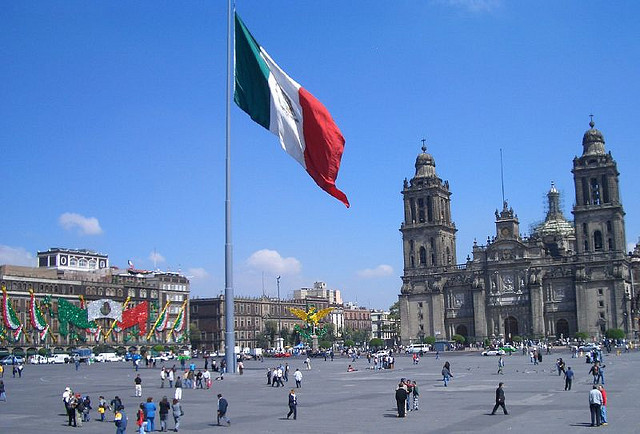
Mexico City is the capital and the largest city, built on the site of Tenochtitlan, the Aztec capital, on a high plateau in the valley of Mexico. The Zócalo, the great square, is flanked by the cathedral and the National Palace, whose murals tell the history of the country, and the canals of Xochimilco, south of the centre, are the last remnant of the lake city of the Aztecs. The historic centre and Xochimilco were inscribed as a World Heritage site in nineteen eighty-seven, and the city is one of the largest metropolitan areas in the world. Come for the museums and the food, and take the boat ride on the canals of Xochimilco in the afternoon.

Trajineras on the canals of Xochimilco — Luis Alvaz, CC BY-SA 4

The Metropolitan Cathedral on the Zocalo — Daniel Case, CC BY-SA 3
Guanajuato — The Silver City in the Valley
Guanajuato is a colonial city in the hills of central Mexico, built on the silver wealth of the sixteenth century, with narrow streets, tunnels and Baroque churches. The city was inscribed as a World Heritage site in nineteen eighty-eight, ref 482, with criteria one, two, four and six, and its churches of La Compañía and La Valenciana are masterpieces of the Mexican Baroque. The city became the largest silver-extraction centre in the world in the eighteenth century, and its wealth built the theatre, the market and the great houses that still stand. Come in the evening, when the light is low on the coloured houses, and walk the alleyways from the main square to the viewpoint above the city.

The coloured houses of Guanajuato — MongeNajera, CC BY-SA 3
Sian Ka’an — The Wild Coast South of Tulum
Sian Ka’an is a biosphere reserve on the Caribbean coast of Quintana Roo, south of Tulum, and it is one of the largest protected areas in Mexico, with more than five hundred thousand hectares of forest, lagoon, mangrove and reef. The name means origin of the sky in the Maya language, and the reserve protects the Mesoamerican Barrier Reef, the cenotes and the petenes, the tree islands that rise from the flooded marshes. The reserve was inscribed as a World Heritage site in nineteen eighty-seven, ref 410, with criteria seven and ten, and it is the wild counterpoint to the resorts of the Riviera Maya. Come with a guide and a boat, and take the lagoon trip to see the birds, the manatees and the reef.

Shows the stepped pyramid of Kukulkan and the grass plaza in front of it — CC BY-SA 4

Forest and lagoon in the Sian Ka’an reserve — Kanché A.C., CC BY-SA 4
Verified
- Mexico is Wikidata item Q96, a country in North America, at twenty-three degrees north and one hundred and two degrees west, checked 26/11/2026.
- Mexico covers nearly two million square kilometres, the thirteenth largest country in the world, with a population of around one hundred and thirty-one million as of two thousand and twenty-five, checked 26/11/2026.
- Mexico has thirty-five World Heritage sites, the most of any country in the Americas and the seventh most in the world, checked 26/11/2026.
- The Historic Centre of Zacatecas, ref 676, was inscribed in 1993 with criteria (ii) and (iv), founded in 1546, and lies about sixty-four kilometres south-west of the geographic centre of Mexico in a straight line, checked 26/11/2026.
- The Pre-Hispanic City of Chichen-Itza, ref 483, was inscribed in 1988 with criteria (i), (ii) and (iii), checked 26/11/2026.
- The Historic Town of Guanajuato and Adjacent Mines, ref 482, was inscribed in 1988 with criteria (i), (ii), (iv) and (vi), checked 26/11/2026.
- Sian Ka’an, ref 410, was inscribed in 1987 with criteria (vii) and (x), and covers more than five hundred thousand hectares, checked 26/11/2026.
- Spanish colonisation began in 1521, the war of independence ran from 1810 to 1821, Mexico lost nearly half its territory in 1848, the Revolution ran from 1910 to 1920, and the North American Free Trade Agreement was signed in 1994, checked 26/11/2026.
- Mexico was the sixth most visited country in the world as of 2022, with more than forty-two million international arrivals in that year, checked 26/11/2026.
- Cancún was built as a planned resort city from 1970, when the island had only three residents, checked 26/11/2026.
Sources
- Mexico — Wikipedia (https://en.wikipedia.org/wiki/Mexico) — area, population, history, heritage count, visitors; checked 26/11/2026.
- Cancún — Wikipedia (https://en.wikipedia.org/wiki/Canc%C3%BAn) — planned city from 1970, Riviera Maya, climate, hurricanes; checked 26/11/2026.
- Pre-Hispanic City of Chichen-Itza — UNESCO (https://whc.unesco.org/en/list/483/) — ref 483, criteria (i), (ii) and (iii); checked 26/11/2026.
- Historic Town of Guanajuato and Adjacent Mines — UNESCO (https://whc.unesco.org/en/list/482/) — ref 482, criteria (i), (ii), (iv) and (vi); checked 26/11/2026.
- Sian Ka’an — UNESCO (https://whc.unesco.org/en/list/410/) — ref 410, criteria (vii) and (x); checked 26/11/2026.
- List of World Heritage Sites in Mexico — Wikipedia (https://en.wikipedia.org/wiki/List_of_World_Heritage_sites_in_Mexico) — Zacatecas ref 676, inscribed 1993, criteria (ii) and (iv); checked 26/11/2026.
- Wikidata API — Q96 (https://www.wikidata.org/wiki/Q96) — country, coordinates; checked 26/11/2026.
Unverified
- The room rates and the package prices of the resorts on the Riviera Maya and the Pacific coast change with the season, and the article gives no fixed price, so the traveller should check the resort directly before booking.
- The government travel advisories for Mexico change, and the article gives no fixed safety rating for any region, so the traveller should read the current advisory for the exact destination before going.
- The number of cenotes open to visitors on the Riviera Maya changes, and the opening hours of Chichen Itza and the other archaeological sites change with the season, so the traveller should check before the visit.
- The exact altitude of Mexico City and the exact length of the Copper Canyon have not been checked against a source in this round, so the article gives no figure for either.
Illustrations
- Hero — The Zócalo of Mexico City. Placement: opening of the article. Shows the great square of the capital, the cathedral and the flag, with the historic centre around it. Free image: Plaza de la Constitucion Ciudad de Mexico City.jpg (https://upload.wikimedia.org/wikipedia/commons/f/f8/Plaza_de_la_Constitucion_Ciudad_de_Mexico_City.jpg) — Wikimedia Commons, CC BY-SA 2.
- In-body — Chichen Itza and El Castillo. Placement: Notable Places section, Chichen Itza entry. Shows the stepped pyramid of Kukulkan and the grass plaza in front of it. Free image: Chichen Itza 2.jpg (https://upload.wikimedia.org/wikipedia/commons/b/b9/Chichen_Itza_2.jpg) — Wikimedia Commons, CC BY-SA 4.
- In-body — Cancún beach. Placement: Travel section. Shows the white sand and turquoise water of the Riviera Maya resort coast. Free image: Cancun-beach-Mexico-2016-Luka-Peternel.jpg (https://upload.wikimedia.org/wikipedia/commons/7/73/Cancun-beach-Mexico-2016-Luka-Peternel.jpg) — Wikimedia Commons, CC BY-SA 4.
- In-body — A cenote in Yucatán. Placement: Geography section, Riviera Maya. Shows the clear water of a natural sinkhole in the limestone, ringed by plants and rock. Free image: Cenote Ik Kil, Yucatan, Dec 2011 – 01.jpg (https://upload.wikimedia.org/wikipedia/commons/e/e2/Cenote_Ik_Kil%2C_Yucatan%2C_Dec_2011_-_01.jpg) — Wikimedia Commons, CC BY 2.
– In body, Tulum: The ruins of Tulum above the Caribbean. Free image: https://upload.wikimedia.org/wikipedia/commons/9/97/Tulum_Maya_Ruins_%28213574097%29.jpeg — Dronepicr, CC BY 3.
– In body, Xochimilco: Trajineras on the canals of Xochimilco. Free image: https://upload.wikimedia.org/wikipedia/commons/0/05/Trajineras_en_canal_de_Xochimilco_01.jpg — Luis Alvaz, CC BY-SA 4.
– In body, Guanajuato: The coloured houses of Guanajuato. Free image: https://upload.wikimedia.org/wikipedia/commons/4/4f/Guanajuato_Mexico_1.jpg — MongeNajera, CC BY-SA 3.
– In body, Sian Ka’an: Forest and lagoon in the Sian Ka’an reserve. Free image: https://upload.wikimedia.org/wikipedia/commons/9/9b/Reserva_de_la_Biosfera_Sian_Ka%27an.jpg — Kanché A.C., CC BY-SA 4.
– In body, Playa del Carmen: The beach at Playa del Carmen. Free image: https://upload.wikimedia.org/wikipedia/commons/f/f7/Beach_Scene_with_Seagulls_-Playa_del_Carmen–Quintana_Roo–Mexico-_01.jpg — Adam Jones, CC BY-SA 2.
– In body, The Temple of the Warriors: The Temple of the Warriors at Chichen Itza. Free image: https://upload.wikimedia.org/wikipedia/commons/d/d8/Temple_of_Warriors_Chichen_Itza_Yucatan_2023.jpg — cloud2023, CC BY 2.
– In body, The Metropolitan Cathedral: The Metropolitan Cathedral on the Zocalo. Free image: https://upload.wikimedia.org/wikipedia/commons/c/ca/Mexico_City_Metropolitan_Cathedral_from_southwest.jpg — Daniel Case, CC BY-SA 3.