
Tuscany in Italy: The Renaissance Heartland of Hills, Wine and Medieval Towns
Tuscany in Italy is the cradle of the Renaissance. Its cypress hills, medieval towns and Chianti vineyards draw travellers worldwide.
Tuscany in Italy sits in the centre of the country, between the Apennine mountains and the Tyrrhenian Sea, and its capital is Florence. The region gave the world the Renaissance, the modern Italian language and some of the most painted landscapes on earth, yet it also keeps working farms, fishing ports and quiet hill towns far from the crowds. This guide covers the land first, then the long story that shaped it, the eight World Heritage sites it holds, and the practical facts that help a first visit run smoothly.
Quick Facts About Tuscany in Italy
| Item | Detail |
|---|---|
| Name | Tuscany, Toscana in Italian, a region of central Italy |
| Location | Central Italy, on the Tyrrhenian Sea |
| Coordinates | 43.45° N, 11.2° E, from Wikidata |
| Wikidata | Q1273, verified through the Wikidata API on 22 November 2026 |
| Type | Region of Italy |
| Capital | Florence |
| Area | 22,987 square kilometres |
| Population | 3,659,222 people in 2026 |
| Ranking | Ninth most populous and fifth largest region of Italy |
| Borders | Liguria, Emilia-Romagna, Umbria, Marche, Lazio and the Tyrrhenian Sea |
| Highest point | Monte Prado, 2,054 metres, in the Apennines |
| Main river | The Arno, flowing through Florence and Pisa to the sea |
| UNESCO | Eight World Heritage sites, the most of any Italian region |
Geography of Tuscany in Italy
Tuscany in Italy borders Liguria to the north-west, Emilia-Romagna to the north, Umbria and Marche to the east, Lazio to the south-east and the Tyrrhenian Sea to the west. The Apennine range runs along the eastern and northern edges of the region, and its highest summit is Monte Prado, at 2,054 metres above the sea. The Arno is the main river of Tuscany in Italy, rising in the Apennines, passing through Florence and Pisa, and reaching the Tyrrhenian Sea near the coast west of Pisa.
The land of Tuscany in Italy changes character from north to south and from the mountains to the sea. The gentle hills of Chianti and the Val d’Orcia fill the centre and the south with vineyards, olive groves and rows of dark cypress trees, while the coastal plains of the Maremma and the Versilia stretch along the west. Inland valleys hold wheat fields and farmhouses of pale stone, and the high ground of the Apennines stays wooded and cool. No other Italian region packs so many different landscapes into a single drive of a few hours.
The climate of Tuscany in Italy is Mediterranean, with hot dry summers and mild winters that bring most of the rain. Summer temperatures in the valleys and on the coast often pass 30 degrees Celsius, while the Apennine slopes stay noticeably cooler and attract walkers escaping the heat. Winter is quiet and damp rather than harsh, and snow falls mainly on the high Apennine ridges. Spring and autumn give the softest light and the most comfortable days for walking through towns and vineyards.
In the far south of Tuscany in Italy rises Monte Amiata, an extinct volcano that reaches 1,738 metres and stands alone above the surrounding hills. Its slopes hold beech and chestnut woods, old mining villages and the hot springs of Bagni San Filippo, where warm water flows over white limestone terraces. The mountain marks the southern edge of the region and divides the Val d’Orcia from the Maremma, and its summit gives views across three regions on a clear day.
The coast of Tuscany in Italy runs along the Tyrrhenian Sea from the border with Liguria down to Lazio. The Versilia in the north holds long sandy beaches backed by the Apuan Alps, and the Maremma in the south keeps wilder shores, pine woods and marshland where cattle and horses still graze. Elba, the largest island of the Tuscan Archipelago, lies off the coast, and Napoleon spent his first exile there in 1814. Smaller islands such as Giglio and Capraia complete an archipelago that most visitors never reach, although ferries run to them from the mainland ports.
Rivers other than the Arno also shape the region, and each one waters a different corner of Tuscany in Italy. The Ombrone crosses the Maremma on its way to the sea near Grosseto, and the Serchio runs through the green valley north of Lucca. The Arno itself has flooded Florence more than once in history, and the great flood of 1966 damaged thousands of works of art and books in the city. Modern defences now guard the river, yet the memory of that flood still shapes how Florentines talk about their river.
More than 120 nature reserves protect the wild corners of Tuscany in Italy, from Apennine beech forest to coastal pine woods and marshes. The Maremma Regional Park guards a stretch of coast where dunes, pine forest and marshland survive almost untouched, and the Apuan Alps Regional Park protects marble mountains above the Versilia beaches. Wolves and wild boar live in the Apennine forests, and the marshes of the Maremma shelter herons, flamingos and many migrating birds. These protected areas give walkers a quieter Tuscany away from the famous towns.
The towns of Tuscany in Italy sit where the land allowed them to grow, and each one keeps the shape of its site. Florence stands on the Arno where the river could be crossed, Siena rises on three hills in the centre of the region, and Pisa grew near the coast as a port. Lucca rests on the plain of the Serchio behind walls that still stand complete, and Livorno serves as the modern port of the region. Hill towns such as San Gimignano, Montepulciano and Cortona crown ridges that were easy to defend in the Middle Ages and are now prized for their views.
The Apuan Alps rise sharply above the Versilia coast, and their white marble has been quarried since Roman times. Michelangelo travelled to these mountains to choose blocks for his sculptures, and the quarries above Carrara still cut the stone today. The peaks look snow-capped from the beaches even in summer, although the white slopes are marble dust and bare rock rather than snow. Walking trails cross the range, and the marble villages of the valleys keep a rough working character that contrasts with the polished towns of Chianti.
South of Siena the land turns to the Crete Senesi, a country of pale clay hills scored by gullies and bare ridges. The Val d’Orcia runs through this country, and its farmhouses stand alone on hilltops among wheat fields and cypress rows. Rain carves the soft clay into deep channels called biancane and calanchi, and the bare grey earth gives the valley a lunar look in dry summers. The villages of Pienza, San Quirico d’Orcia and Montalcino perch above the valley floor, and the old pilgrim road of the Via Francigena still crosses it on foot.
The Tuscan Archipelago counts seven main islands off the coast of Tuscany in Italy, and Elba is by far the largest. Giglio and Capraia hold small fishing villages and clear water, while Montecristo and Pianosa are protected and hard to visit, with access limited and controlled. Giannutri and Gorgona are smaller still, and the whole archipelago is a national park that guards the sea, the cliffs and the maquis scrub. Ferries from Piombino reach Elba in about an hour, and the island mixes beaches, mining history and the villas where Napoleon lived during his exile.
Farming still defines the look of rural Tuscany in Italy, and the fields follow the seasons in plain sight. Vineyards cover the slopes of Chianti, Montalcino and Montepulciano, olive groves climb the terraces around Lucca and the Chianti hills, and wheat turns the Val d’Orcia gold in early summer. Sunflowers fill whole fields in July, and the harvest of grapes in September and October brings workers and festivals to the wine villages. The landscape that painters loved is not a museum piece but a working countryside, and its beauty comes from crops that are still grown and sold.

01845 ITA Tuscany Sorano panoramic view S V-P — CC BY-SA 4

Abandoned farm, Val d’Orcia, Tuscany — CC BY-SA 4

Chianti road in Tuscany — CC BY 2
History of Tuscany in Italy
Tuscany in Italy takes its name from the Etruscans, called Tusci in Latin, who built the first great civilisation of the region. Etruscan culture grew from the tenth century before Christ and reached its height in the seventh and sixth centuries before Christ, with cities such as Arezzo, Volterra and Cortona. The Etruscans mined metal, drained marshland, built roads and made art of remarkable skill, and their tombs still hold painted chambers that show how they feasted, hunted and honoured the dead. Rome absorbed the Etruscans by the first century before Christ, yet the Etruscan language, art and town plans left a mark that survived the conquest.
The Romans founded Lucca, Pisa, Siena and Florence in Tuscany in Italy, and they joined the region with roads, aqueducts and public buildings. Florence began as a settlement for retired soldiers on the Arno, and its grid of streets still follows the Roman plan in the centre of the modern city. Pisa became a port and a naval base, while Siena and Lucca grew as road towns on the routes north and south. Roman peace brought trade, farming and law to the whole region, and the Latin spoken here later became the base of the Italian language.
After the Roman Empire fell in the fifth century, the land passed to the Goths, then to Byzantine rule, and from 572 the Lombards arrived and made Lucca the capital of their duchy of Tuscia. The centuries that followed were unsettled, with dukes, bishops and counts fighting over towns and valleys, and the old Roman roads fell into disrepair. Pilgrims later gave the region new life, and the Via Francigena carried travellers from France to Rome through Lucca, Siena and the Val d’Orcia. Hostels, churches and markets grew along the pilgrim road, and towns that served the travellers grew rich.
The communes of the Middle Ages turned Tuscany in Italy into a patchwork of proud and rival cities. Pisa ruled the sea and traded across the Mediterranean, Siena grew rich on banking, and Lucca prospered from banking and silk. Florence rose more slowly, yet its wool trade and its banks eventually made it the richest city of the region. The struggle between the Guelphs, who backed the Pope, and the Ghibellines, who backed the Holy Roman Emperor, divided the cities in the twelfth and thirteenth centuries and filled the chronicles with sieges, exiles and shifting alliances.
In 1260 Florence and Siena met at Montaperti, one of the most famous battles of medieval Italy, and Siena won a victory that its people still remember. The Black Death reached Tuscany in Italy in 1348 and killed about 70 percent of the population of the region, while Florence lost between a third and three quarters of its people in the first year of the plague. Whole villages emptied, fields went untilled, and the survivors rebuilt a society that was smaller, richer per head and more open to new ideas. The hardship of the plague years helped clear the way for the changes that followed.
The Renaissance began in Florence, and from 1434 the Medici family guided the city without a formal title, spending their banking fortune on artists, scholars and buildings. Botticelli, Leonardo da Vinci and Michelangelo all worked under Medici patronage, and the churches, palaces and squares they filled still define Florence today. Lorenzo de’ Medici, who ruled from 1469 to 1492, gathered poets, philosophers and artists at his court and made Florence the centre of learning in Europe. The ideas born in his circle spread across Italy and then across the continent, and the age took its name from that rebirth of classical art and thought.
Florence used its wealth to gather the region under its rule, and the map of Tuscany in Italy took shape through purchase, marriage and war. The city took Arezzo in 1384, bought Pisa in 1405 and bought Livorno in 1421 to gain a port on the sea. Siena held out longest and fell only in 1555, while Lucca stayed an independent republic until 1847. Each conquered town kept its own pride, its own food and its own dialect, and the rivalry between Florence and Siena still colours football matches, festivals and jokes today.
Cosimo I de’ Medici became the first Grand Duke of Tuscany in 1569, and his family ruled the region until the line died out in 1737. The Habsburg-Lorraine rulers of Austria then took the grand duchy and governed it until the unification of Italy in the nineteenth century. Tuscany joined the new Kingdom of Italy in 1861, and Florence served as the capital of the kingdom from 1865 to 1871, before the capital moved to Rome. The years as capital brought new streets, new ministries and new railways, and the city grew beyond its medieval walls for the first time.
The rivalry between the communes also raised the towers of San Gimignano, the most famous skyline of Tuscany in Italy. Wealthy families built towers to show their power, and at the height of the fashion the town held 72 of them. Only 14 towers survive today, and the tallest, the Torre Grossa, rises 54 metres above the streets. Walking between them still feels like entering a medieval Manhattan, and the town owes its survival to the fact that it lost importance early and was never rebuilt in a later style.
Florence also gave Italy its language, and the poet Dante Alighieri, born in the city in 1265, wrote his Divine Comedy in the Tuscan dialect rather than in Latin. His choice lifted the speech of Florence into a literary language, and later writers followed him until Tuscan became the base of modern Italian. Dante was exiled from Florence in 1302 and died in Ravenna in 1321, never returning to the city that shaped him. His house and his memory are still honoured in Florence, and the dialect he wrote in is the Italian that visitors hear today.
The twentieth century kept Tuscany in Italy at the centre of Italian art and culture while wine and tourism became its great industries. Chianti, Brunello di Montalcino and Vino Nobile di Montepulciano carried the name of the region into restaurants around the world, and visitors arrived in ever larger numbers to see Florence, Siena and the hill towns. UNESCO listed the historic centre of Florence in 1982, the first of eight World Heritage sites in the region, and Montecatini Terme joined the list in 2021 as part of the Great Spa Towns of Europe. The region now balances farming, craft, art and tourism, and the hills that fed the Renaissance still feed the people who live among them.

Tuscany Panorama (6088400578) — CC BY 2

Cathedral of Santa Maria del Fiore Opera Duomo Florence Italy 20240517 112535722 — CC BY 2

Exterior of the Leaning Tower (Pisa) at night — CC BY 4

Italy Siena Piazza del Campo BW 2021-09-23 15-11-48 1 — CC BY-SA 4
UNESCO World Heritage Sites in Tuscany in Italy
Tuscany in Italy holds eight World Heritage sites, more than any other region of Italy, and seven of them lie entirely inside the region. The historic centre of Florence was listed in 1982 under reference 174, and the Piazza del Duomo in Pisa followed in 1987 under reference 395, with its cathedral, baptistery and leaning tower in white marble. San Gimignano joined the list in 1990 under reference 550, a medieval town that keeps 14 of its original 72 towers, and Siena followed in 1995 under reference 717, with its shell-shaped Piazza del Campo. Pienza was listed in 1996 under reference 789 as an ideal Renaissance town rebuilt by Pope Pius the Second, and the Val d’Orcia followed in 2004 under reference 1026 as a cultural landscape of hills, wheat fields and cypress rows.
The Medici Villas and Gardens were listed in 2013 under reference 175, a single entry that covers 12 villas and two gardens around Florence, including the Boboli Gardens behind the Pitti Palace. Montecatini Terme became the eighth site in 2021 under reference 1613, as one of eleven spa towns in the transnational Great Spa Towns of Europe entry. Together the eight sites cover the whole story of the region, from Etruscan roots through the medieval communes and the Renaissance to the spa culture of the nineteenth century. A traveller who visits all eight will have crossed the region from the Apennines to the sea and from the Arno valley to the southern hills.
Travel to Tuscany in Italy
The best months for trips to Tuscany in Italy are April to June and September to October, when the sun is warm, the hills are green or turning gold, and the crowds thin out. September and October bring the grape harvest, with wine festivals in Chianti and Montalcino, while spring fills the valleys with wild flowers and mild days. July and August are hot, with temperatures often above 30 degrees, and Florence fills with visitors, although the beaches of the Versilia and the Maremma are at their liveliest. Winter is quiet and good for museums, and the hot springs at Saturnia and Montecatini Terme feel best when the air is cold.
A first visit to Tuscany in Italy needs at least five to seven days, because the region is wide and its towns deserve slow days. Three days belong to Florence, with the cathedral, the Uffizi, the statue of David and the Oltrarno quarter across the Arno. Two more days suit Siena and San Gimignano, with the Piazza del Campo, the cathedral of Siena and the medieval towers. The remaining days can go to the Val d’Orcia with Pienza and Montalcino, or to Chianti with its vineyards and castles.
With only three days, stay in Florence and add a single day trip to Siena or San Gimignano by train or bus.
The main airports of Tuscany in Italy are Amerigo Vespucci Airport in Florence, about 8 kilometres from the centre, and Galileo Galilei Airport in Pisa, about 3 kilometres from the centre of Pisa. Santa Maria Novella station in Florence is one of the busiest stations in Italy, with high-speed trains to Rome in about 1 hour 30 minutes, to Milan in about 2 hours and to Bologna in about 40 minutes. Trains also link Florence with Siena, Pisa, Lucca and Arezzo, and these lines make easy day trips without a car. In the countryside a car is the most flexible choice, because many hill towns and wine estates sit far from bus and train lines, and drivers should expect narrow winding rural roads and restricted traffic zones in historic centres, where cameras record entry all day.
The food of Tuscany in Italy is plain, hearty and built on unsalted bread, olive oil, beans and beef. The most famous dish is bistecca alla fiorentina, a thick cut of Chianina beef grilled over charcoal and usually shared by two people, served with white beans and vegetables. Ribollita and pappa al pomodoro, two bread soups, show how Tuscan cooks turned stale bread into comfort food. The wines carry the region abroad: Chianti is the best known red, joined by Brunello di Montalcino, Vino Nobile di Montepulciano and the white Vernaccia di San Gimignano.
Olive oil from Lucca and Chianti is prized around the world, and many estates welcome visitors for tastings if they book ahead in the busy season.
The Chianti road between Florence and Siena, the Chiantigiana, is the classic drive of Tuscany in Italy, passing vineyards, castles and villages such as Greve in Chianti. South of Siena the Val d’Orcia offers the most photographed views in the region, with cypress rows, wheat hills and stone farmhouses around Pienza, San Quirico d’Orcia and Montalcino. Wine estates open their cellars for tours and tastings, and booking ahead is wise in the high season. A slow drive with stops for lunch, a tasting and a walk through one hill town gives more than a rushed tour of five towns in a day.
Notable Places in Tuscany in Italy
- Florence — the capital and the cradle of the Renaissance, a World Heritage site since 1982
- Siena — a medieval city with the shell-shaped Piazza del Campo, listed since 1995
- San Gimignano — the town of towers, listed since 1990, with 14 towers still standing
- Pienza — the ideal Renaissance town of Pope Pius the Second, listed since 1996
- Pisa and the Piazza del Duomo — the leaning tower and the white marble cathedral, listed since 1987
- Val d’Orcia — the valley of cypress rows and wheat hills, listed since 2004
- Medici Villas and Gardens — 12 villas and two gardens around Florence, listed since 2013
- Montecatini Terme — the spa town, listed since 2021 as part of the Great Spa Towns of Europe
- Lucca — a city with complete Renaissance walls and the Guinigi Tower, topped by oak trees
- Chianti — the most famous wine country of the region, between Florence and Siena
- Montalcino and Montepulciano — two wine towns of the south, home of Brunello and Vino Nobile
- Elba — the largest island of the Tuscan Archipelago, where Napoleon was exiled in 1814
- Maremma and Versilia — the coasts of the region, with beaches, pine woods and seaside towns

San Gimignano Towers from the Square — CC BY-SA 2
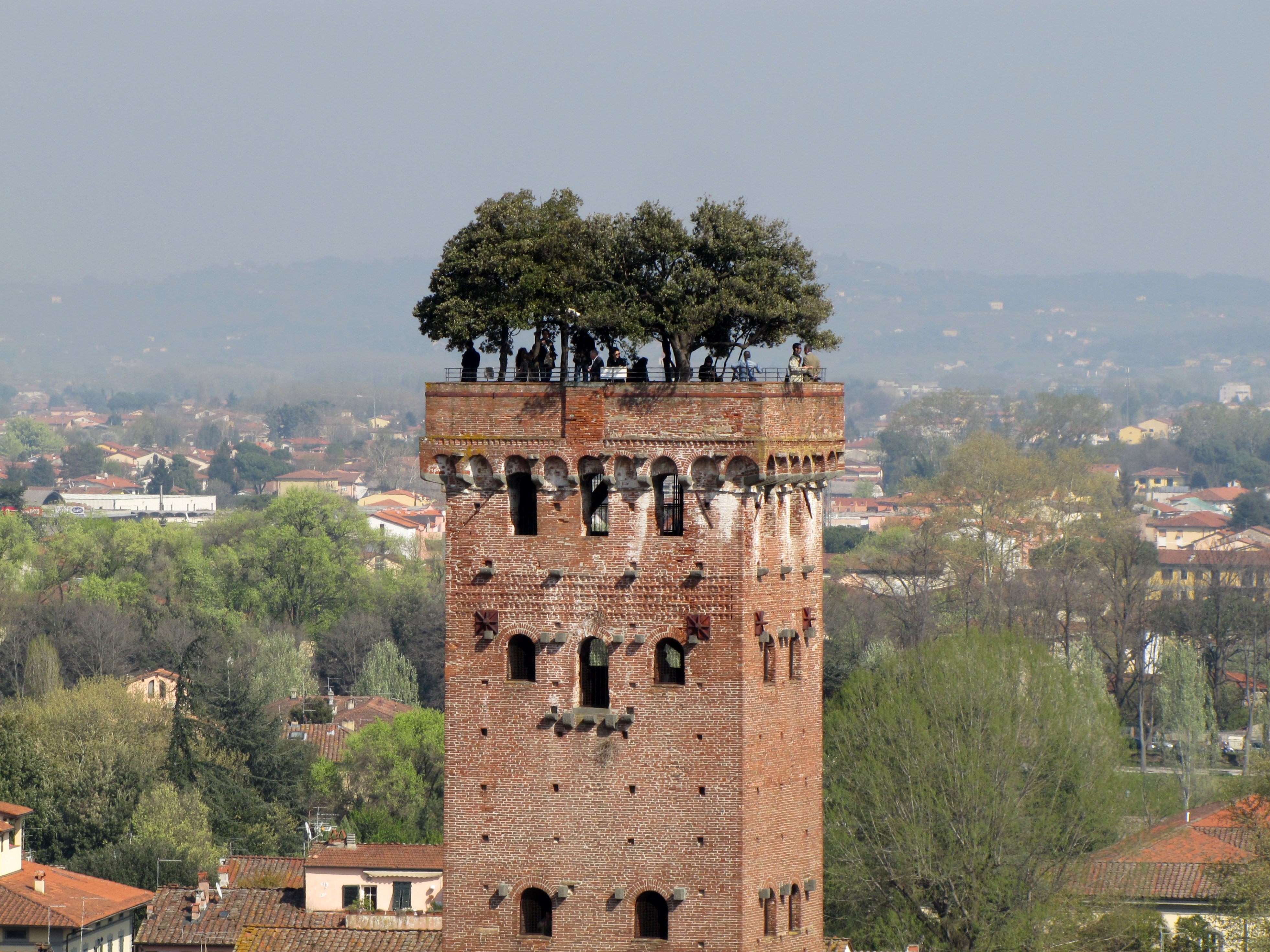
Torre Guinigi, Guinigi Tower, Lucca — CC BY-SA 3

2014 Elba island Sunset — CC BY-SA 4
Frequently Asked Questions About Tuscany in Italy
Where is Tuscany in Italy and what makes it special?
The region lies in central Italy with Florence as its capital, and it is known as the birthplace of the Renaissance and of modern Italian. Travellers come for the cypress-covered hills, the medieval hill towns, the wines of Chianti and Montalcino, and eight World Heritage sites, the most of any Italian region.
How many UNESCO World Heritage sites does Tuscany in Italy have?
The region holds eight: Florence in 1982, Pisa in 1987, San Gimignano in 1990, Siena in 1995, Pienza in 1996, the Val d’Orcia in 2004, the Medici Villas and Gardens in 2013, and Montecatini Terme in 2021. Seven sit wholly inside Tuscany, while Montecatini Terme belongs to a shared entry with ten other European spa towns.
How many days should a first trip to Tuscany in Italy take?
Five to seven days works well for a first visit: three days in Florence, two days for Siena and San Gimignano, and the rest for the Val d’Orcia, Chianti or the coast. A shorter visit of three days should centre on Florence with one day trip, while a week or more allows a slow drive through the wine country and the Maremma.
When is the best season for Tuscany in Italy?
April to June and September to October give the kindest weather, with warm sun, green or golden hills and fewer visitors than summer. The grape harvest in September and October fills the wine villages with festivals, while winter is quieter, cheaper and better for museums and hot springs.
What should visitors eat and drink in Tuscany in Italy?
Try bistecca alla fiorentina, the thick grilled Chianina steak, and the bread soups ribollita and pappa al pomodoro. The wines to look for are Chianti, Brunello di Montalcino, Vino Nobile di Montepulciano and the white Vernaccia di San Gimignano, with olive oil from Lucca and Chianti alongside them.
Is a car needed for travelling around Tuscany in Italy?
A car is the easiest way to reach hill towns and wine estates in the countryside, since many sit far from train and bus lines. Trains link Florence with Siena, Pisa, Lucca and Arezzo for day trips, so visitors who stay in the cities and take one or two guided tours can manage without driving.
Verified
The population of 3,659,222 people in 2026, the area of 22,987 square kilometres, the capital Florence, the ranking as the ninth most populous and fifth largest region of Italy, the eight World Heritage sites with their years and reference numbers, the Etruscan and Medici history with its dates, and the travel facts about airports, train times and distances were checked against the sources below. The coordinates 43.45° N, 11.2° E and the Wikidata identifier Q1273 were verified through the Wikidata API. Verified 22 November 2026.
Sources
- Wikipedia, “Tuscany” — https://en.wikipedia.org/wiki/Tuscany
- UNESCO World Heritage Centre, World Heritage List for Italy — https://whc.unesco.org/en/list/?search=&search_by_country=it&type=&media=®ion=&order=alpha
- Wikidata, Q1273 Tuscany, verified through the Wikidata API on 22 November 2026
- TheTerraAtlas keyword file batch-eu4-en-keywords.json, entry TA-L3-tuscany, focus keyword “tuscany in italy”
Unverified
- Ticket prices and seasonal opening hours for the Uffizi, the Galleria dell’Accademia and other museums in Florence — check each site before visiting, since prices change by season and ticket type.
- Prices and opening hours for wine estates in Chianti, Montalcino and Montepulciano, including booking rules — check the official site of each estate before going.
- Dates of the Palio horse race in Siena in July and August, including ticket rules — check the latest information before the trip, since the schedule can change.
- Driving distances and times between places in the region, especially along the Chiantigiana road — general estimates only, depending on the route and traffic.
Illustrations
- Hero: 01665 ITA Tuscany Pitigliano S from viewpoint V-P. Free image: https://upload.wikimedia.org/wikipedia/commons/c/c4/01665_ITA_Tuscany_Pitigliano_S_from_viewpoint_V-P.jpg — CC BY-SA 4.
- In body, panorama: Tuscany Panorama (6088400578). Free image: https://upload.wikimedia.org/wikipedia/commons/4/49/Tuscany_Panorama_%286088400578%29.jpg — CC BY 2.
- In body, view: 01845 ITA Tuscany Sorano panoramic view S V-P. Free image: https://upload.wikimedia.org/wikipedia/commons/3/35/01845_ITA_Tuscany_Sorano_panoramic_view_S_V-P.jpg — CC BY-SA 4.
- In body, Geography of Tuscany in Italy: Abandoned farm, Val d’Orcia, Tuscany. Free image: https://upload.wikimedia.org/wikipedia/commons/5/56/Abandoned_farm%2C_Val_d%27Orcia%2C_Tuscany.jpg — CC BY-SA 4.
- In body, Geography of Tuscany in Italy: Chianti road in Tuscany. Free image: https://upload.wikimedia.org/wikipedia/commons/8/82/Chianti_road_in_Tuscany.jpg — CC BY 2.
- In body, History of Tuscany in Italy: Cathedral of Santa Maria del Fiore Opera Duomo Florence Italy 20240517 112535722. Free image: https://upload.wikimedia.org/wikipedia/commons/d/d9/Cathedral_of_Santa_Maria_del_Fiore_Opera_Duomo_Florence_Italy_20240517_112535722.jpg — CC BY 2.
- In body, History of Tuscany in Italy: Exterior of the Leaning Tower (Pisa) at night. Free image: https://upload.wikimedia.org/wikipedia/commons/2/28/Exterior_of_the_Leaning_Tower_%28Pisa%29_at_night.jpg — CC BY 4.
- In body, History of Tuscany in Italy: Italy Siena Piazza del Campo BW 2021-09-23 15-11-48 1. Free image: https://upload.wikimedia.org/wikipedia/commons/2/26/Italy_Siena_Piazza_del_Campo_BW_2021-09-23_15-11-48_1.jpg — CC BY-SA 4.
- In body, Notable Places in Tuscany in Italy: San Gimignano Towers from the Square. Free image: https://upload.wikimedia.org/wikipedia/commons/c/c9/San_Gimignano_Towers_from_the_Square.jpg — CC BY-SA 2.
- In body, Notable Places in Tuscany in Italy: Torre Guinigi, Guinigi Tower, Lucca. Free image: https://upload.wikimedia.org/wikipedia/commons/9/99/Torre_Guinigi%2C_Guinigi_Tower%2C_Lucca.jpg — CC BY-SA 3.
- In body, Notable Places in Tuscany in Italy: 2014 Elba island Sunset. Free image: https://upload.wikimedia.org/wikipedia/commons/1/10/2014_Elba_island_Sunset.JPG — CC BY-SA 4.