
Munster is a Westphalian city in north-west Germany, founded as a monastery in 793. Its town hall saw the Peace of Westphalia sworn in 1648.
Quick Facts
- Setting: A city on the Aa river in the Westphalian Lowland, North Rhine-Westphalia, Germany.
- Founded: 793, as a monastery by the missionary Liudger.
- Population: 306,368 on 31 December 2025.
- Area: 303.3 square kilometres.
- Famous for: The Peace of Westphalia of 1648, the Anabaptist cages of 1536 and more than 500,000 bicycles.
- University: The University of Munster, founded in 1780, with about 55,000 students at the city universities.
- Coordinates: 51.9625° N, 7.6256° E.
- Wikidata: Q2742.
Geography of Munster
A lowland city on the Aa
Munster stands on the small river Aa in the Westphalian Lowland, a flat landscape of fields, woods and scattered farms in the north-west of Germany. The city lies about 60 metres above sea level, with no hills inside the built-up area, and the land rises only gently towards the Baumberge hills to the west. The Aa flows through the city centre from the south, passes the old town in a shallow valley and joins the Ems river to the north. The flat ground is the reason the bicycle became the main way of moving around Munster, because no slope stands in the way of a ride across town.
The Promenade is the green ring that follows the line of the medieval city wall around the old town, and it is one of the most unusual streets in Germany. The wall was demolished in the 18th century and replaced by a wide path lined with lime trees, and today the ring is closed to cars and open only to walkers and cyclists. The full loop is about four and a half kilometres long, and it passes the Schloss, the Aasee park and the old town gates. Students ride it on their way to lectures, families walk it on Sundays, and in autumn the lime trees turn the whole ring gold.
The ring is also the route of the cycling events that fill the city each summer. The Promenade shows how Munster turned a defensive wall into a park, and it is the clearest sign of the relaxed pace of the city.
The city covers 303.3 square kilometres, which makes it one of the largest German cities by area, although much of that land is farmland, forest and park. The built-up centre is compact, and the old town sits inside the line of the former city wall, now a green ring road called the Promenade. The Aasee, a long artificial lake south-west of the centre, is the main open water in the city, with lawns, sailing boats and a zoo on its shore. The lake was created by damming the Aa, and its park is the most used green space in Munster.
Munster has a temperate oceanic climate, with mild winters, cool summers and rain spread through the year. January temperatures average around 2 degrees, July around 18 degrees, and the city receives about 750 millimetres of rain a year. The wind from the west brings changeable weather, so a sunny morning can turn into a wet afternoon. Cyclists dress for rain all year round, and the city keeps its cycle paths clear in winter.
Cycling weather through the seasons
The best months for cycling in Munster are May to September, when the days are long and the rain is lighter, and the Aasee park fills with swimmers, rowers and picnics. Autumn brings golden leaves to the Promenade and the Schlossgarten, and the rain returns with the west wind. Winter is rarely cold enough for snow to stay, but the mornings are dark and damp, and the bicycle lights come on early. Spring is the season of the city festivals, when the cafes put their tables outside and the students return to the university.
Munster is the centre of a region of about 1.5 million people, and it is the administrative capital of the Munster region of North Rhine-Westphalia. The city is about 55 kilometres north-east of Dortmund and about 65 kilometres north of Essen, and the Dutch border lies about 70 kilometres to the west. Trains link Munster with Hamburg, Berlin, Cologne and the Netherlands, and the airport at Munster Osnabruck serves holiday flights to the Mediterranean. The city has no motorway through its centre, which keeps the old town quiet and safe for walkers and cyclists.
The nearest World Heritage property to Munster is the Zollverein Coal Mine Industrial Complex in Essen, reference 975, about 66 kilometres to the south-west in a straight line. The complex was inscribed by UNESCO in 2001 under criteria (ii)(iii) as an outstanding example of industrial architecture of the Modern Movement. Cologne Cathedral, reference 292, lies about 150 kilometres to the south, so it is not the nearest property. Germany as a whole holds 55 World Heritage properties, the fourth most of any country in the world after Italy, China and France.
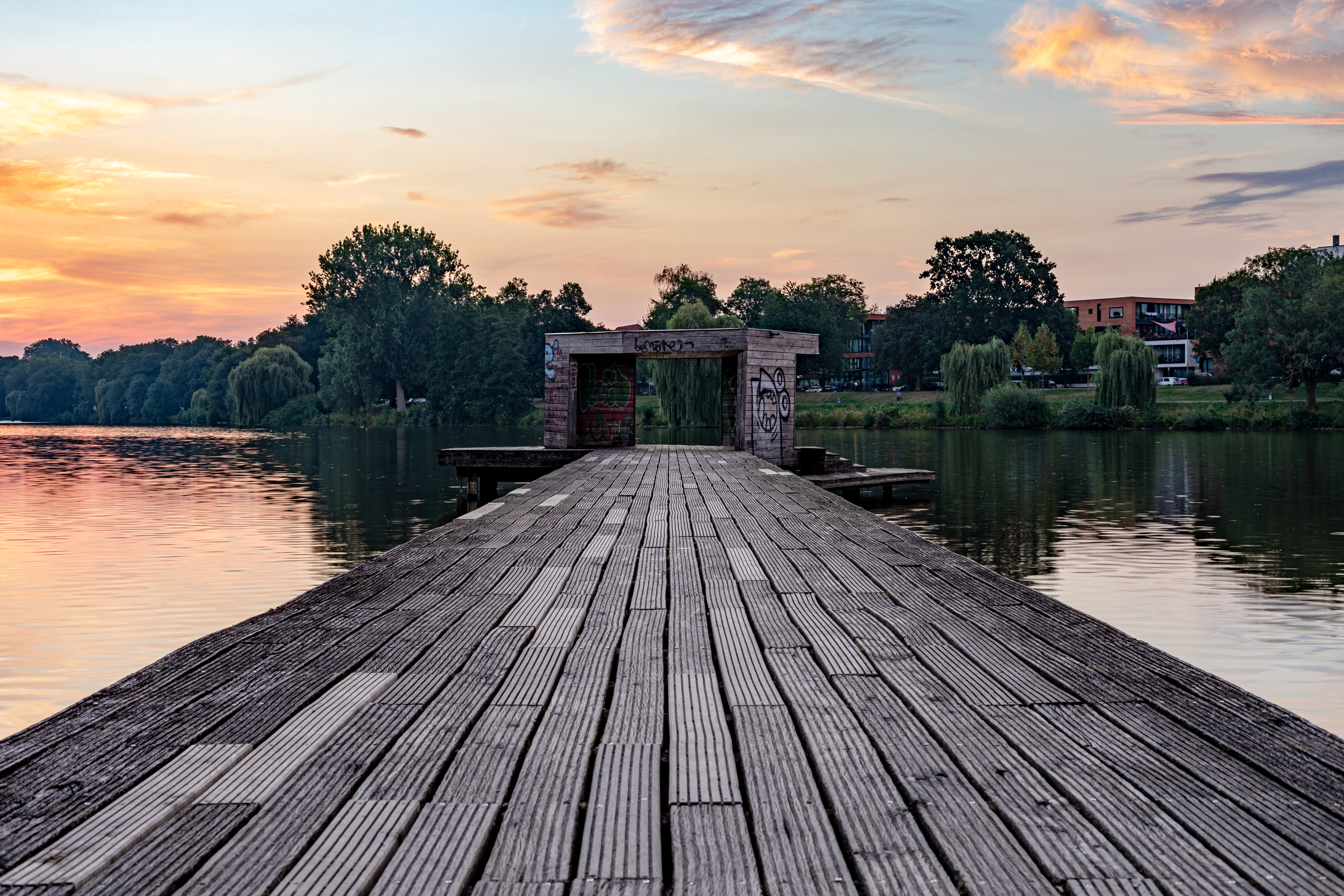
Sculpture Pier at Aasee lake in Münster — CC BY-SA 4
History of Munster
From monastery to Hanseatic city
Munster began in 793, when the Frisian missionary Liudger founded a monastery on the Aa and built a church on the site of the present cathedral. The settlement grew around the monastery, and by the 12th century it had become a market town with a bishop who ruled the surrounding land as a prince. The city joined the Hanseatic League in the Middle Ages and traded cloth, grain and beer with the Netherlands and England. The Prinzipalmarkt, the main market street, was built with arcaded houses for merchants, and the gabled facades that stand there today follow the medieval pattern.
The prince-bishops of Munster ruled the city for centuries, and their power shaped its streets, churches and palaces. The cathedral of Saint Paul, founded with the monastery, was rebuilt in the 13th century in a mix of Romanesque and Gothic styles, and it still dominates the old town. The city walls were built in the 13th and 14th centuries, and the gates and towers guarded the trade routes to the Netherlands. Munster grew rich on trade, and its merchants built the tall gabled houses that line the Prinzipalmarkt to this day.
The Anabaptist kingdom and the Peace of Westphalia
In 1534 a radical Anabaptist movement led by the Dutch preacher Jan van Leiden seized power in Munster and declared the city a New Jerusalem. The rebels abolished private property, introduced polygamy and prepared for the end of the world, while the prince-bishop laid siege to the city. The siege lasted until 1535, when the bishop army retook the city and executed the Anabaptist leaders. Their bodies were hung in iron cages from the tower of Saint Lamberti Church in 1536, and the three cages still hang there today as a reminder of that bloody episode.
The most famous event in the history of Munster came a century later, when the city hosted the negotiations that ended the Thirty Years War. From 1643 onwards, diplomats from across Europe met in Munster and in nearby Osnabruck, travelling between the two cities for years of talks. The Treaty of Munster between Spain and the Dutch Republic was sworn on 15 May 1648 in the Peace Hall of the historic town hall, recognising the independence of the Netherlands. The wider Peace of Westphalia was proclaimed on 24 October 1648, ending both the Thirty Years War and the Eighty Years War, and it became a foundation of modern diplomacy.
Prussia, war and rebuilding
In 1815 the prince-bishopric of Munster was annexed by Prussia, and in 1816 the city became the capital of the Prussian province of Westphalia. The University of Munster was founded in 1780, and it grew into one of the largest universities in Germany. The prince-bishop palace, the Schloss, was built in the 18th century and later became the main building of the university. The city expanded beyond its walls in the 19th century, with railways, factories and new suburbs, and the population passed 100,000 around 1900.
The Second World War destroyed about 90 percent of the old town, above all the Prinzipalmarkt with its merchant houses. After the war the city rebuilt the old town faithfully in its historic form, restoring the gabled houses, the arcades and the historic town hall. The reconstruction took decades, and the result is an old town that looks medieval but is largely a careful post-war rebuilding. In 2004 Munster won the LivCom award as the most liveable city in the world in its population group of 200,000 to 750,000 people.
Today Munster is a university city with about 55,000 students, a centre of science, administration and services for a region of about 1.5 million people. The bicycle remains the symbol of the city, with more than 500,000 bicycles for about 306,000 residents, and the city claims the title of bicycle capital of Germany. The Peace Hall still stands in the town hall, and the cages still hang on Saint Lamberti tower, so the two most dramatic moments of the history of Munster face each other across the Prinzipalmarkt.
Travel to Munster
Arriving and getting around
Munster is best reached by train, with direct services from Hamburg, Berlin, Cologne, Dortmund and Amsterdam. The main station stands just south-east of the old town, a ten-minute walk from the Prinzipalmarkt, and the city is a stop on the line between the Ruhr and the North Sea coast. The airport at Munster Osnabruck lies about 25 kilometres north of the city and serves holiday flights to the Mediterranean and the Canary Islands. Drivers use the motorways around the city, but the centre itself is closed to through traffic, so parking is in garages at the edge of the old town.
The bicycle is the natural way to see Munster, and visitors can hire one at the station, where a large bicycle garage holds thousands of bikes. The city has about 500 kilometres of cycle paths, and the Promenade ring around the old town is reserved for cyclists and walkers. Buses run from the station to the suburbs, the university and the Aasee, and a day ticket covers the whole city network. Walking is easy in the compact old town, where the cathedral, the town hall and the Prinzipalmarkt stand within a few hundred metres of each other.
The best time to visit Munster is from May to September, when the weather is warmest and the Aasee park and the cafes are at their best. The Christmas market in late November and December fills the Prinzipalmarkt with stalls and lights, and the Send fair in spring and autumn brings a funfair to the Schlossplatz. The university term keeps the city lively from October to July, with concerts, theatre and student bars. Winter is quiet, with short days and frequent rain, but the museums and the old town are open all year.
Visitors should allow two days for Munster, with one day for the old town and a second day for the Aasee, the Schloss and the museums. The city is a good base for day trips to Osnabruck, where the other half of the Peace of Westphalia was negotiated, and to the Baumberge hills. Accommodation ranges from hotels on the Prinzipalmarkt to guesthouses near the Aasee, and the city is quieter at weekends when the students leave.
Notable Places in Munster
Prinzipalmarkt and the historic town hall
The Prinzipalmarkt is the heart of Munster, a long market street lined with gabled merchant houses and arcades. The houses were rebuilt after the war in their historic form, with stepped gables and arcades that shelter shoppers from the rain. The historic town hall stands on the street, and its Peace Hall is where the Treaty of Munster was sworn in 1648. The hall is open to visitors, with portraits of the negotiators and the original furniture of the peace talks.
The cathedral of Saint Paul stands at the west end of the old town, a large church founded in 793 and rebuilt in the 13th century. Its astronomical clock from 1540 shows the planets, the calendar and the phases of the moon, and the figures move at noon. The cathedral treasury holds gold work and relics from the Middle Ages. The Domplatz in front of the cathedral hosts a market on Wednesdays and Saturdays, with stalls selling flowers, cheese and Westphalian ham.
Saint Lamberti and the cages
The church of Saint Lamberti stands on the north side of the Prinzipalmarkt, and its tall tower carries the three iron cages of 1536. The cages once held the bodies of the executed Anabaptist leaders, and they have hung on the tower ever since as a warning. A night watchman still blows a horn from the tower every half hour between nine in the evening and midnight, a tradition that goes back centuries. The church itself was rebuilt in the 19th century in the Gothic style, and its interior is plain and bright.
The Schloss, the former palace of the prince-bishops, stands south of the old town in a large park. The palace was built in the 18th century and now houses the main administration of the University of Munster. The Schlossgarten behind the palace is a botanical garden with lawns, ponds and old trees, and it is a favourite place for students to sit in summer. The Aasee lies a short walk to the south-west, with sailing boats, a lakeside path and the all-weather zoo on its far shore.
Museums and the Aasee
The LWL Museum of Art and Culture on the Domplatz shows Westphalian art from the Middle Ages to the present, with paintings, sculpture and applied art. The Picasso Museum in the old town holds the largest collection of Picasso lithographs in Germany, with more than 800 works. The Museum of Natural History at the Aasee has exhibitions on the wildlife of Westphalia and a planetarium. The Kiepenkerl statue near the old town honours the travelling pedlars who once carried goods through Westphalia on their backs.

Prinzipalmarkt (Münster, Germany) at night, southward view — CC BY-SA 3
Frequently Asked Questions
Is Munster worth visiting for a weekend?
Yes, Munster is a good weekend city, because the old town is compact and the Peace Hall, the cathedral and the Prinzipalmarkt can all be seen in one day. A second day gives time for the Aasee, the Schlossgarten and the museums, and the city is quiet enough to enjoy without crowds.
Why is Munster called the bicycle capital of Germany?
Munster is called the bicycle capital because it has more than 500,000 bicycles for about 306,000 residents, and cycling is the main way of getting around the flat city. The city has about 500 kilometres of cycle paths, a large bicycle garage at the station and a ring road reserved for cyclists.
What happened in Munster in 1648?
The Peace Hall in the town hall is where the Spanish and Dutch envoys swore their treaty on 15 May 1648, and the wider settlement followed in October of the same year. The hall is open to visitors, with portraits of the diplomats and the furniture of the talks still in place. The cages on Saint Lamberti tower, from a century earlier, stand a short walk away, so the two dramatic moments of the city can be seen in one morning.
What are the cages on Saint Lamberti tower?
The three iron cages on the tower of Saint Lamberti Church have hung there since 1536, after the bodies of the executed Anabaptist leaders were placed in them. The Anabaptist rebellion of 1534 to 1535 had seized the city, and the cages remain as a reminder of that episode.
How do I get to Munster from Cologne?
Trains run directly from Cologne to Munster in about one and a half hours, with services through Dusseldorf and the Ruhr. The main station is a ten-minute walk from the old town, and the journey is the easiest way to reach the city without a car.
When is the best time to visit Munster?
June and September suit cycling best, with long days and the Aasee park at its greenest, while the Christmas market draws crowds in late November and December. The university term runs from October to July, so the city stays lively through the winter. Munster is a year-round city, and the museums, the cathedral and the cafes are open in every season.
Verified
- Munster was founded in 793 as a monastery by the missionary Liudger; the city joined the Hanseatic League in the Middle Ages. Source: Wikipedia, checked 23 November 2026.
- The Anabaptist rebellion lasted from 1534 to 1535, and the iron cages were hung on the tower of Saint Lamberti Church in 1536. Source: Wikipedia, checked 23 November 2026.
- The Treaty of Munster was sworn on 15 May 1648 in the Peace Hall of the historic town hall, and the Peace of Westphalia was proclaimed on 24 October 1648. Source: Wikipedia, checked 23 November 2026.
- The population was 306,368 on 31 December 2025; the area is 303.3 square kilometres. Source: Wikipedia and citypopulation.de, checked 23 November 2026.
- Munster won the LivCom award in 2004 as the most liveable city in its population group of 200,000 to 750,000 people. Source: Wikipedia, checked 23 November 2026.
- The nearest World Heritage property is the Zollverein Coal Mine Industrial Complex in Essen, reference 975, inscribed in 2001 under criteria (ii)(iii), about 66 kilometres south-west of Munster in a straight line. Source: whc.unesco.org/en/list/975/, checked 23 November 2026.
- Germany holds 55 World Heritage properties, the fourth most of any country after Italy, China and France. Source: UNESCO World Heritage List, checked 23 November 2026.
- Coordinates 51.9625° N, 7.6256° E; Wikidata Q2742. Source: Wikidata API, checked 23 November 2026.
Sources
- Wikipedia, Munster — https://en.wikipedia.org/wiki/Munster, checked 23 November 2026.
- Wikidata, Q2742 — https://www.wikidata.org/wiki/Q2742, checked 23 November 2026.
- UNESCO, Zollverein Coal Mine Industrial Complex in Essen — https://whc.unesco.org/en/list/975/, checked 23 November 2026.
- citypopulation.de, Munster — https://citypopulation.de/en/germany/nordrheinwestfalen/05515__münster/, checked 23 November 2026.
Unverified
- The exact number of bicycles in Munster today (more than 500,000 is the figure commonly cited by the city).
- The length of the cycle path network (about 500 kilometres, per city sources).
Illustrations
- Hero: . Free image: https://upload.wikimedia.org/wikipedia/commons/2/23/Munster_01.jpg — CC BY-SA 4.
- In body, Prinzipalmarkt: Prinzipalmarkt (Münster, Germany) at night, southward view. Free image: https://upload.wikimedia.org/wikipedia/commons/7/72/Prinzipalmarkt_%28M%C3%BCnster%29.jpg — CC BY-SA 3.
- In body, Aasee: Sculpture Pier at Aasee lake in Münster. Free image: https://upload.wikimedia.org/wikipedia/commons/d/d9/M%C3%BCnster%2C_Aasee%2C_Pier_–2020–_9215-7.jpg — CC BY-SA 4.