
Germany Places to Go: Castles, Rivers and Cities Across the Country
Germany places to go range from Baltic beaches to Alpine peaks. This guide covers the land, the past and fifty-five UNESCO sites.
Germany places to go fill a country that is larger and more varied than its neighbours often assume, with a Baltic and North Sea coast in the north, forested uplands in the centre and the Alps in the south. About 83.5 million people live here, in sixteen federal states that keep their own dialects, cuisines and festivals, and the capital Berlin is only one of many cities worth a trip. The country holds 55 World Heritage sites, the third highest total in the world, from the cathedral of Aachen to the fairytale palaces of King Ludwig II. Castles, river valleys, medieval towns, beer halls and Christmas markets all belong to the same journey, and the railways link them with an ease that makes a first trip simple to plan.
The history of Germany runs from Roman legions on the Rhine through the Holy Roman Empire, the Reformation, the Prussian unification, two world wars and the division and reunification of the twentieth century. That past is visible everywhere, in the Roman walls of Trier, the Gothic towers of Cologne, the half-timbered streets of Quedlinburg and the line where the Berlin Wall once stood. This guide covers the geography that shapes the country, the history that made it, the World Heritage sites, and the practical facts for planning a first visit.
Quick Facts About Germany Places to Go
| Fact | Detail |
|---|---|
| Name | Germany (Deutschland in German) |
| Role | Federal republic in Central Europe, member of the European Union |
| Location | Central Europe, bordered by Denmark, Poland, Czechia, Austria, Switzerland, France, Luxembourg, Belgium and the Netherlands |
| Area | 357,022 square kilometres |
| Population | 83,467,117 people (estimate for the fourth quarter of 2025); 82,719,540 people in the 2022 census |
| Capital | Berlin, the largest city and the political centre |
| States | 16 federal states |
| Language | German |
| Currency | Euro |
| Highest point | Zugspitze, 2,962 metres, in the Bavarian Alps |
| UNESCO | 55 World Heritage sites (52 cultural, 3 natural), third in the world |
| Coordinates | 51° N, 10° E |
| Wikidata | Q183 |
Geography of Germany Places to Go
The North German Plain and the Coasts
Germany places to go begin in the north, where the North German Plain stretches from the Dutch border to Poland in a flat landscape of farms, heath and marsh. The plain meets the sea on two coasts, the North Sea in the west and the Baltic in the east, and the two seas give the north a character of their own. The North Sea coast is a world of tidal flats, dikes and islands, where the Wadden Sea, the largest tidal flat system on earth, runs along the shore and the Frisian Islands lie offshore. The Baltic coast is gentler, with sandy beaches, lagoons and the white chalk cliffs of Rügen, and the old Hanseatic ports of Lübeck, Wismar and Stralsund still show the brick Gothic of the medieval sea trade.
The great northern ports grew from the rivers that cross the plain, and Hamburg, Bremen and Lübeck all stand where a river meets the sea. Hamburg, on the Elbe about a hundred kilometres from the open water, is the largest port in Germany, and its red-brick warehouse district of Speicherstadt, inscribed by UNESCO in 2015, still loads and unloads the goods of the world. Bremen, on the Weser, keeps its old town hall and its Roland statue as a reminder of the days when the Hanseatic League ruled the trade of the north. The rivers also carry the rain of the plain to the sea, and the flat land, the wide skies and the wind off the water make the north feel closer to Denmark and the Netherlands than to the mountains of the south.
The climate of the north is maritime, with mild winters, cool summers and rain in every season, and the wind from the sea keeps the air fresh even in the cities. The heath of Lüneburg blooms purple in late summer, and the lakes of Mecklenburg, a maze of water and forest east of Hamburg, draw sailors and walkers through the warm months. The north is the quietest part of Germany for most visitors, and the towns of the Baltic coast, with their beaches and their brick churches, reward travellers who look beyond the famous cities of the south.
The Central Uplands and the Great Rivers
South of the plain, Germany places to go rise into the central uplands, a broken country of forested hills, river valleys and small towns that covers much of the middle of the country. The Black Forest, the Bavarian Forest and the Harz are the best known of these ranges, and each has its own character, from the dark fir woods and cuckoo clocks of the Black Forest to the granite tors and the witches’ legends of the Harz. The hills are not high, and few rise above a thousand metres, yet they dominate the landscape, and the valleys between them carry the rivers that have shaped German history. Forest covers about a third of the country, above all in these uplands, and the woods are managed, walked and loved in a way that is distinctively German.
The Rhine is the great river of the west, and its middle valley, a 65-kilometre stretch of castles, vineyards and riverside towns, is one of the most visited landscapes in Germany. The river enters the country from Switzerland, passes the industrial cities of the Ruhr, and then runs between steep slate hills where the castles of robber barons once taxed the passing ships. The Lorelei rock, the vineyards of the Rheingau and the towns of Bacharach, St Goar and Boppard give the valley its romance, and the river cruise is still the classic way to see it. The Moselle, the Main and the Neckar join the Rhine from the east, and each brings its own wine country, from the steep Riesling slopes of the Moselle to the old university town of Heidelberg on the Neckar.
The Elbe runs through the east, from the Czech border past Dresden and Magdeburg to Hamburg and the sea, and its valley holds some of the finest Baroque and medieval towns in the country. Dresden, the Florence of the Elbe, was rebuilt after the war, and its Frauenkirche, its Zwinger palace and its river terraces are the heart of the city. The Danube, the second river of the south, rises in the Black Forest and flows east through Ulm, Regensburg and Passau on its way to Vienna and the Black Sea. Regensburg, with its stone bridge from the twelfth century and its medieval old town, is the best preserved of the Danube cities, and its streets still follow the plan of the Roman fort that founded it.
The Alps and the South
The south of Germany rises to the Alps, and the Zugspitze, at 2,962 metres, is the highest point in the country, standing on the border with Austria above the resort town of Garmisch-Partenkirchen. The Bavarian Alps hold the lakes, the meadows and the mountain villages that draw walkers in summer and skiers in winter, and the view from the summit of the Zugspitze takes in the peaks of four countries. The foothills below the Alps are a gentler country of lakes and castles, and the fairytale palaces of King Ludwig II, Neuschwanstein, Linderhof, Schachen and Herrenchiemsee, stand in that landscape, inscribed by UNESCO in 2025 as the newest World Heritage site in Germany.
Bavaria is the largest of the sixteen states, and its culture, from the beer halls of Munich to the painted houses of the Alpine villages, is the image of Germany that most of the world knows. Munich, the state capital, holds the Marienplatz, the Viktualienmarkt and the great beer halls, and its Oktoberfest, held from late September into early October, is the largest beer festival in the world. The state also holds the Romantic Road, the old route from Würzburg to Füssen that passes Rothenburg ob der Tauber, the best preserved medieval town in the country, and the Wies Church, a Rococo pilgrimage church in a green meadow. The south is warmer and sunnier than the north, and the summers there are the warmest in Germany.
The climate of Germany is temperate, with warm summers and cold winters, and the west feels the Atlantic while the east feels the continent. Summer days usually reach between 20 and 25 degrees Celsius, and winter days hover around freezing, with snow in the southern mountains and rain in the lowlands. The forests, the rivers and the mountains give the country a variety that rewards slow travel, and the best way to understand the geography is to cross it by train, from the flat north through the forested centre to the Alps in the south.

Aerial view of the Drachenburg Castle in the Siebengebirge Uplands in Königswinter, Germany (51122621705) — CC BY 2
History of Germany Places to Go
Romans, Tribes and Charlemagne
The land that is now Germany has been inhabited since the Stone Age, and the first Neanderthal fossil was found in the Neander Valley near Düsseldorf. The Romans called the land Germania, and in the year 9 the Roman legions were destroyed by Arminius in the Battle of the Teutoburg Forest, an event that stopped Rome from conquering the land east of the Rhine. The Roman frontier, the Limes, ran along the Rhine and the Danube, and its remains are a World Heritage site today. The cities that the Romans founded on the Rhine, Cologne, Trier and Mainz, still carry their Roman street plans and their Roman walls, and Trier, with its Roman monuments, cathedral and Church of Our Lady, is the oldest city in Germany.
In the year 800 Charlemagne, the king of the Franks, was crowned emperor in Rome, and his palace chapel at Aachen became the centre of his empire. Charlemagne is buried in the cathedral of Aachen, and the chapel he built in the eighth century is the oldest part of the first World Heritage site in Germany, inscribed in 1978. In 962 the German kingdom became the heart of the Holy Roman Empire, which lasted for more than 800 years, and its emperors were crowned in Aachen and buried in Speyer, where the great Romanesque cathedral holds the tombs of four emperors. The empire was never a single state, but a mosaic of princes, bishops and free cities, and that mosaic shaped the map of Germany for centuries.
The free cities of the Hanseatic League grew rich on the trade of the Baltic and the North Sea, and Lübeck, Hamburg and Bremen built the brick churches, the town halls and the warehouses that still define the north. In 1356 the Golden Bull laid down the rules for electing the emperor by seven electors, and the political structure of the empire was fixed in law. The towns of the south grew rich on the trade with Italy, and the merchants of Augsburg and Nuremberg built the houses and the churches that make those cities worth a visit today.
Reformation, Printing and the Thirty Years’ War
In 1517 Martin Luther nailed his 95 theses to the door of the church in Wittenberg, and the Protestant Reformation that followed changed Europe. Luther translated the Bible into German at the Wartburg in 1521 and 1522, and the castle where he worked is a World Heritage site today. At the same time, Johannes Gutenberg invented the printing press with movable type in Mainz, and the press spread the new ideas across Europe faster than any army could. In 1555 the Peace of Augsburg recognised Lutheranism, and the religious wars that followed lasted until the Peace of Westphalia in 1648, which ended the Thirty Years’ War and fixed the map of Germany for the next century and a half.
The centuries that followed were the age of the small German states, of Baroque palaces, of music and of philosophy, and the towns of the south and centre filled with the churches and the gardens of that age. The palace of Sanssouci at Potsdam, built by Frederick the Great, and the garden kingdom of Dessau-Wörlitz show the taste of the enlightened princes, and the classical town of Weimar, where Goethe and Schiller lived, became the centre of German letters. The beer purity law of 1516, which ruled that beer could be made only from water, malt, hops and yeast, is still honoured by the brewers of the country, and the more than 1,500 breweries of Germany are the legacy of that law.
The Holy Roman Empire dissolved in 1806, and the German Confederation that followed in 1815 kept the mosaic of states in place for another half century. The modern German state was born when Prussia united the German states and founded the German Empire in 1871, with Berlin as its capital. The empire quickly became an industrial and military power, with the steelworks of the Ruhr, the shipyards of the north and the chemical works of the Rhine, and its cities grew into the great industrial centres of Europe. The empire fell after the First World War, and the Weimar Republic that followed was a democracy under strain from the first day.
War, Division and Reunification
In 1933 Adolf Hitler came to power, and the Nazi regime brought the Second World War and the crime of the Holocaust. The war destroyed the cities of Germany, above all Dresden, Hamburg and Berlin, and the country that emerged from the ruins was divided into two states, the Federal Republic of Germany in the west and the German Democratic Republic in the east. Berlin was divided as well, by the wall built in 1961, and the wall became the symbol of the Cold War in Europe. The Federal Republic became a founding member of the European Economic Community, while the German Democratic Republic belonged to the Warsaw Pact, and the two Germanys lived separate lives for a generation.
On 9 November 1989 the Berlin Wall fell, and on 3 October 1990 the two Germanys were reunified, with Berlin once again the capital of a united Germany. The Brandenburg Gate, built between 1788 and 1791, stands where the wall once ran, and it has become the symbol of the reunified country. The years since reunification have rebuilt the east, restored the old towns of Dresden, Leipzig and Weimar, and made Berlin the capital of a country that is once again at the centre of Europe. The history of Germany places to go is written in the streets of those cities, and the visitor who walks them walks through the whole story.
The Germany places to go of today belong to a country that is the largest economy in Europe, with its industry in the Rhine and Ruhr, its car makers in Stuttgart and Munich, and its ports on the North Sea and the Baltic. The sixteen states keep their own governments, their own festivals and their own food, and the traveller who crosses the country meets a different Germany in each of them. The castles, the cathedrals and the Christmas markets draw the visitors, yet the modern country behind them is one of engineers, brewers, winemakers and musicians, and the journey through it is a journey through the whole of modern Europe.
The Germany places to go of the present day also include the memorials and the museums that remember the difficult chapters of the past, above all the Holocaust Memorial in Berlin and the documentation centres of Nuremberg and Munich. Those places are visited quietly, and they are part of the history that the country teaches its own children.

The land that is now Germany has been inhabited since the Stone Age, and the first Neanderthal fossil was found in the Neander Valley near Düsseldorf — CC BY-SA 4

In 1517 Martin Luther nailed his 95 theses to the door of the church in Wittenberg, and the Protestant Reformation that followed changed Europe — CC BY-SA 4

In 1933 Adolf Hitler came to power, and the Nazi regime brought the Second World War and the crime of the Holocaust — CC BY-SA 4
UNESCO World Heritage Sites in Germany Places to Go
Germany places to go include 55 World Heritage sites, 52 cultural and 3 natural, the third highest total in the world after Italy and China. The figure was verified on the UNESCO website (https://whc.unesco.org/en/statesparties/de) on 22 November 2026, and the list runs from the cathedral of Aachen, inscribed in 1978, to the palaces of King Ludwig II, inscribed in 2025. The sites cover the whole history of the country, from Roman walls to Bauhaus schools, and a traveller could spend a lifetime visiting them all. The selection below follows the order of inscription, and it gives the reference number of each site as listed by UNESCO.
The earliest sites are the cathedrals of the age of Charlemagne and the empire. Aachen Cathedral, inscribed in 1978 as reference 3, is the first site in Germany, and its Palatine Chapel from the eighth century holds the tomb of Charlemagne. Speyer Cathedral, inscribed in 1981 as reference 168, is the largest surviving Romanesque church, and four Holy Roman emperors are buried there.
The Hanseatic City of Lübeck, inscribed in 1987 as reference 272, keeps its red-brick old town and its Holsten Gate, and the Palaces and Parks of Potsdam and Berlin, inscribed in 1990 as reference 532, hold the palace of Sanssouci and the royal parks of Frederick the Great. The Town of Bamberg, inscribed in 1993 as reference 624, keeps its old town, its cathedral and its island town hall, and the Collegiate Church, Castle and Old Town of Quedlinburg, inscribed in 1994 as reference 535, holds more than 1,300 half-timbered houses from six centuries.
The later decades added the great churches, towns and industrial sites of the country. Cologne Cathedral, inscribed in 1996 as reference 292, is the largest Gothic church in northern Europe, begun in 1248 and finished in 1880, with two towers 157 metres high.
The Bauhaus and its Sites in Weimar, Dessau and Bernau, inscribed in 1996 as reference 729, are the school of modern design that shaped the twentieth century, and the Luther Memorials in Eisleben and Wittenberg, inscribed in 1996 as reference 783, mark the places where Luther was born, died and nailed his theses. The Museum Island in Berlin, inscribed in 1999 as reference 896, holds five museums on an island in the Spree, including the Pergamon Museum with the Ishtar Gate and the Pergamon Altar. Wartburg Castle, inscribed in 1999 as reference 897, is the castle where Luther translated the Bible into German in 1521 and 1522.
The mines and the rivers tell the industrial and the landscape story of Germany. The Mines of Rammelsberg and the Historic Town of Goslar, inscribed in 1992 as reference 623, are a silver mine worked for more than 1,000 years. The Zollverein Coal Mine Industrial Complex in Essen, inscribed in 2001 as reference 975, was the largest coal mine in Europe and is now a centre of culture and design.
The Upper Middle Rhine Valley, inscribed in 2002 as reference 1066, is a 65-kilometre stretch of castles, vineyards and riverside towns. The Old Town of Regensburg with Stadtamhof, inscribed in 2006 as reference 1155, is a medieval old town with a stone bridge from the twelfth century. The natural sites are the Wadden Sea, inscribed in 2009 as reference 1314, the largest tidal flat system in the world, shared with the Netherlands and Denmark, and the Messel Pit Fossil Site, inscribed in 1995 as reference 720, where the plants and animals of the Eocene are preserved in perfect detail.
The newest site is the Palaces of King Ludwig II of Bavaria, inscribed in 2025 as reference 1726, with Neuschwanstein, Linderhof, Schachen and Herrenchiemsee. Neuschwanstein, built from 1869, is the fairytale castle that inspired the castle of the famous animated film, and it is the most visited castle in Germany. The four palaces show the dream world of a king who built in stone the castles he imagined in music and legend, and their inscription as the 55th site in Germany closes a list that began nearly fifty years earlier with the chapel of Charlemagne.

Speyer Cathedral, inscribed in 1981 as reference 168, is the largest surviving Romanesque church, and four Holy Roman emperors are buried there — CC BY-SA 4
Travel to Germany Places to Go
Getting There and Getting Around
Germany places to go are reached through the international airports of Frankfurt, Munich and Berlin, with Frankfurt as the main gateway and direct flights from many European cities and connections from Asia. From Frankfurt, high-speed trains reach the large cities, and domestic flights link Berlin, Munich and Hamburg with the rest of the country. The train is the most important way to travel inside Germany, with the high-speed ICE network joining the large cities and the regional trains serving the small towns. The motorways, the Autobahn, are famous for the stretches with no speed limit, and a hire car suits the wine valleys, the Black Forest and the Alpine foothills.
The cities are well served by trams, underground trains and buses, and the historic centres are best explored on foot. Berlin is the largest city and the hub of the rail network, while Munich is the gateway to Bavaria and the Alps. The Romantic Road, the Rhine Valley and the Moselle are best travelled slowly, by river cruise or by car, with stops in the small towns along the way. Rail passes and regional day tickets make the trains good value for visitors who plan to cover several cities, and the stations sit in the centre of most towns, so the train is often faster door to door than the car.
When to Go and What to Know
The best month to visit Germany places to go depends on the trip, and the country changes with the seasons more than most of Europe. Spring and autumn suit travellers who want Germany places to go without the summer crowds, with green valleys in May and the wine harvest in September.
May and June bring green valleys, long evenings and the first beer gardens, while September and October bring the wine harvest on the Rhine and the Moselle and the Oktoberfest in Munich. December is the month of the Christmas markets, with the markets of Nuremberg, Dresden and Cologne among the oldest and most beautiful in Europe, opening from late November with mulled wine, gingerbread, crafts and warm lights on the squares. Summer is the busiest season, and the castles, the river cruises and the Alpine lakes fill up in July and August, so book ahead for those months.
The euro is the currency, and credit cards are widely accepted in hotels, large restaurants and shops, though small eateries, markets and traditional restaurants often take cash or a domestic debit card only. German is the official language, and English is widely spoken in the cities, the hotels and the tourist sights, though a few words of German are welcomed everywhere. The food changes by region, from sausages and beer in Bavaria to fish on the northern coasts, and the Christmas markets, the beer gardens and the wine festivals are the best places to taste it. For the latest travel advice, the official Germany Travel (https://www.germany.travel/en/home.html) portal lists the current events, routes and opening times.

Lookout in Alps (Germany) 02 — CC0

Germany places to go are reached through the international airports of Frankfurt, Munich and Berlin, with Frankfurt as the main gateway and direct flights from many European cities and connections from Asia — CC BY-SA 4
Notable Places in Germany Places to Go
The Germany places to go below cover the sights that first-time visitors ask for most, from the capital to the castles of the south.
- Brandenburg Gate, Berlin — the symbol of a united Germany, built between 1788 and 1791, standing where the Berlin Wall once ran.
- Neuschwanstein Castle, Bavaria — the fairytale castle of King Ludwig II, built from 1869, and the most visited castle in Germany.
- Cologne Cathedral — the Gothic cathedral with two towers 157 metres high, looking out over the Rhine and the most visited sight in Germany.
- Upper Middle Rhine Valley — the river stretch with castles, vineyards and the towns of Bacharach and Boppard.
- Rothenburg ob der Tauber — the best preserved medieval town in Germany, with its walls and the Plönlein square.
- Heidelberg Castle and Old Town — the ruined castle on the hill above the Neckar, with the oldest university in Germany, founded in 1386.
- Munich and Marienplatz — the capital of Bavaria, with the neo-Gothic town hall, the Viktualienmarkt and the Oktoberfest.
- Dresden and the Frauenkirche — the Baroque city on the Elbe, rebuilt after the war, with the Zwinger palace and the church rebuilt from the rubble.
- Hamburg and the Speicherstadt — the largest port in Germany, with the red-brick warehouse district inscribed by UNESCO in 2015 and the modern HafenCity.
- Wartburg Castle, Eisenach — the castle where Martin Luther translated the Bible, looking out over the Thuringian Forest.
- Town of Bamberg — the old town with its cathedral, its island town hall on the Regnitz and its traditional smoked-beer breweries.
- The Black Forest — the forested mountains of the south-west, with the town of Triberg, the cuckoo clocks and the Black Forest gateau.
- Museum Island, Berlin — five museums on an island in the Spree, the cultural centre of the capital.

01-01-2014 – Messeturm – trade fair tower – Frankfurt- Germany – 01 — CC BY-SA 3

The symbol of a united Germany, built between 1788 and 1791, standing where the Berlin Wall once ran — CC BY-SA 3
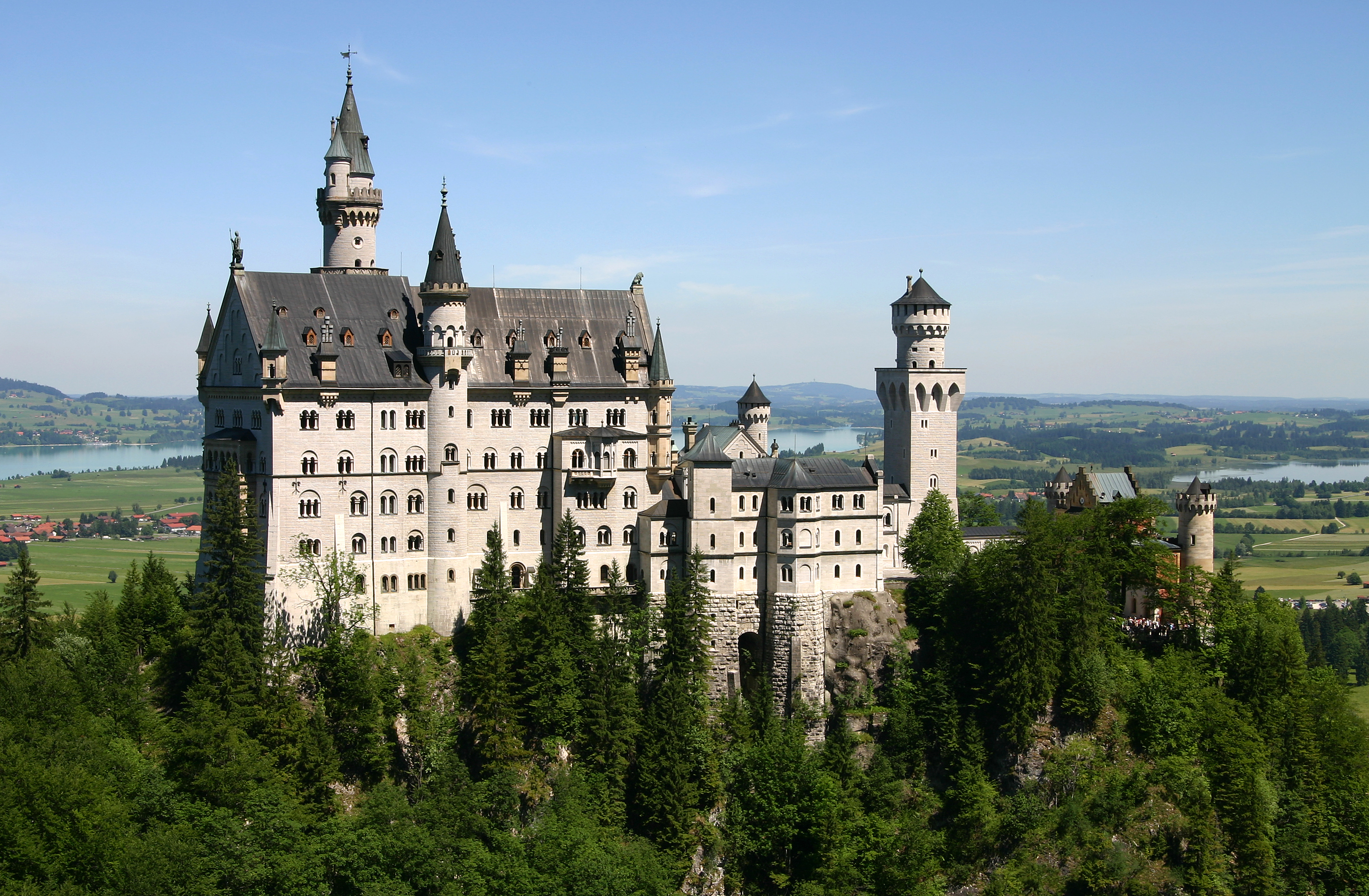
The fairytale castle of King Ludwig II, built from 1869, and the most visited castle in Germany — CC BY-SA 3

The best preserved medieval town in Germany, with its walls and the Plönlein square — CC BY-SA 4
Frequently Asked Questions About Germany Places to Go
What are the best Germany places to go for a first trip?
Berlin, Munich, the Rhine Valley and Neuschwanstein make the classic first route, with the capital, the Bavarian beer halls, the river castles and the fairytale palace in a single journey. Add Cologne for the cathedral, Dresden for the Baroque city on the Elbe and Rothenburg for the medieval town if the trip allows a few more days.
What is the best month to visit Germany places to go?
May, June, September and October suit most trips, with warm weather, long days and fewer crowds than July and August. December suits the Christmas markets of Nuremberg, Dresden and Cologne, while late September brings the Oktoberfest in Munich and the wine harvest on the Rhine and the Moselle.
Do Vietnamese citizens need a visa for Germany places to go?
Yes. Germany was one of the five countries that signed the original Schengen Agreement in 1985, together with France, Belgium, the Netherlands and Luxembourg, so Vietnamese travellers need a Schengen visa, which allows stays of up to 90 days in any 180-day period across the whole Schengen Area. Apply at the German embassy or consulate, since Germany issues the visa for trips where it is the main destination, and the passport must remain valid for at least three months after the planned departure from the area.
How many days do I need for Germany places to go?
A week covers Berlin, Munich and one river valley at a comfortable pace, with two or three days in each place. Two weeks allow the Rhine, the Romantic Road, Dresden and Hamburg as well, and the country rewards slow travel, since the small towns between the famous cities are often the best part of the trip.
What is the most visited sight among Germany places to go?
Cologne Cathedral is the most visited sight in Germany, with its two towers 157 metres high standing over the Rhine. Neuschwanstein Castle is the most visited castle, and the Brandenburg Gate in Berlin is the most photographed symbol of the country.
When is Oktoberfest among Germany places to go?
Oktoberfest is held in Munich from late September into early October, and it began in 1810 as a royal wedding celebration before becoming the annual beer festival of the city. Book accommodation months ahead, since the festival draws millions of visitors to Munich and the beer halls fill up early in the day.
Verified
The population estimate of 83,467,117 people for the fourth quarter of 2025, the 2022 census figure of 82,719,540 people, the area of 357,022 square kilometres, the capital Berlin, the sixteen federal states, the highest point of the Zugspitze at 2,962 metres, the forest cover of about a third of the country, the total of 55 World Heritage sites with 52 cultural and 3 natural sites, the ranking as third in the world, the inscription years and reference numbers of Aachen in 1978 as reference 3, Speyer in 1981 as reference 168, Lübeck in 1987 as reference 272, Potsdam and Berlin in 1990 as reference 532, Bamberg in 1993 as reference 624, Quedlinburg in 1994 as reference 535, Rammelsberg and Goslar in 1992 as reference 623, Cologne in 1996 as reference 292, the Bauhaus sites in 1996 as reference 729, the Luther memorials in 1996 as reference 783, the Museum Island in 1999 as reference 896, Wartburg in 1999 as reference 897, the Zollverein in 2001 as reference 975, the Upper Middle Rhine Valley in 2002 as reference 1066, Regensburg in 2006 as reference 1155, the Wadden Sea in 2009 as reference 1314, the Messel Pit in 1995 as reference 720, and the palaces of King Ludwig II in 2025 as reference 1726 were checked against the sources below. The Battle of the Teutoburg Forest in the year 9, the coronation of Charlemagne in 800, the Holy Roman Empire from 962, the Golden Bull of 1356, the theses of Luther in 1517, the Peace of Augsburg in 1555, the Peace of Westphalia in 1648, the dissolution of the empire in 1806, the German Confederation of 1815, the founding of the German Empire in 1871, the rise of Hitler in 1933, the building of the Berlin Wall in 1961, the fall of the wall on 9 November 1989, the reunification on 3 October 1990, the building of the Brandenburg Gate between 1788 and 1791, the building of Neuschwanstein from 1869, the founding of Heidelberg University in 1386, the start of Oktoberfest in 1810 and the beer purity law of 1516 were also checked against the sources below. The coordinates 51° N, 10° E and the Wikidata identifier Q183 were verified through the Wikidata API. Verified 22 November 2026.
Sources
- Wikipedia, “Germany” — https://en.wikipedia.org/wiki/Germany
- Wikipedia, “History of Germany” — https://en.wikipedia.org/wiki/History_of_Germany
- UNESCO World Heritage Centre, Germany — https://whc.unesco.org/en/statesparties/de
- Germany Travel, official tourism portal — https://www.germany.travel/en/home.html
- Wikipedia, “List of World Heritage Sites in Germany” — https://en.wikipedia.org/wiki/List_of_World_Heritage_Sites_in_Germany
- Wikidata, Q183 Germany, verified through the Wikidata API on 22 November 2026
- TheTerraAtlas keyword file batch-eu5-en-keywords.json, entry TA-L2-germany, focus keyword “germany places to go”
Unverified
- The exact number of breweries in Germany in 2026 — the article states only that there are more than 1,500, since counts vary by source.
- Current ticket prices for Neuschwanstein Castle, the Cologne Cathedral tower and the Museum Island museums — check the official price lists before travelling.
- Current ICE train timetables and prices — check the railway timetables before travelling, since schedules and fares change.
- Exact dates of the Christmas markets and of Oktoberfest in 2026 — dates are set each year, so check the official calendars before going.
- Current Schengen visa rules for Vietnamese citizens — check the German embassy or the visa centre for the rules in force, since visa policy can change.
Illustrations
- Hero: Hexenbuche mit Kreuzberg. Free image: https://upload.wikimedia.org/wikipedia/commons/1/17/Hexenbuche_mit_Kreuzberg.jpg — CC BY-SA 4.
- In body, The North German Plain and the Coasts: 01-01-2014 – Messeturm – trade fair tower – Frankfurt- Germany – 01. Free image: https://upload.wikimedia.org/wikipedia/commons/6/60/01-01-2014_-Messeturm–trade_fair_tower-_Frankfurt-Germany-_01.jpg — CC BY-SA 3.
- In body, The Central Uplands and the Great Rivers: Aerial view of the Drachenburg Castle in the Siebengebirge Uplands in Königswinter, Germany (51122621705). Free image: https://upload.wikimedia.org/wikipedia/commons/3/32/Aerial_view_of_the_Drachenburg_Castle_in_the_Siebengebirge_Uplands_in_K%C3%B6nigswinter%2C_Germany_%2851122621705%29.jpg — CC BY 2.
- In body, The Alps and the South: Lookout in Alps (Germany) 02. Free image: https://upload.wikimedia.org/wikipedia/commons/a/a5/Lookout_in_Alps_%28Germany%29_02.jpg — CC0.
- In body, Romans, Tribes and Charlemagne: The land that is now Germany has been inhabited since the Stone Age, and the first Neanderthal fossil was found in the Neander Valley near Düsseldorf. Free image: https://upload.wikimedia.org/wikipedia/commons/6/67/Trier_Porta-Nigra-Platz_3.jpg — CC BY-SA 4.
- In body, Reformation, Printing and the Thirty Years’ War: In 1517 Martin Luther nailed his 95 theses to the door of the church in Wittenberg, and the Protestant Reformation that followed changed Europe. Free image: https://upload.wikimedia.org/wikipedia/commons/0/0a/00_3419_Wittenberg_-Lutherstadt%28Stadtkirche%29.jpg — CC BY-SA 4.
- In body, War, Division and Reunification: In 1933 Adolf Hitler came to power, and the Nazi regime brought the Second World War and the crime of the Holocaust. Free image: https://upload.wikimedia.org/wikipedia/commons/b/ba/Berlin_Wall_%2C_East_Side_Gallery_%28_Ank_Kumar%2C_Infosys_Limited%29_03.jpg — CC BY-SA 4.
- In body, Speyer Cathedral: Speyer Cathedral, inscribed in 1981 as reference 168, is the largest surviving Romanesque church, and four Holy Roman emperors are buried there. Free image: https://upload.wikimedia.org/wikipedia/commons/6/6b/Aerial_image_of_the_Speyer_Cathedral_%28view_from_the_southwest%29.jpg — CC BY-SA 4.
- In body, Getting There and Getting Around: Germany places to go are reached through the international airports of Frankfurt, Munich and Berlin, with Frankfurt as the main gateway and direct flights from many European cities and connections from Asia. Free image: https://upload.wikimedia.org/wikipedia/commons/3/30/ICE_Klasse_412_in_Fulda-20250525-RM-154301.jpg — CC BY-SA 4.
- In body, Brandenburg Gate, Berlin: The symbol of a united Germany, built between 1788 and 1791, standing where the Berlin Wall once ran. Free image: https://upload.wikimedia.org/wikipedia/commons/3/39/Brandenburg_Gate_-Brandenburger_Tor–Berlin–Germany-_01.jpg — CC BY-SA 3.
- In body, Neuschwanstein Castle, Bavaria: The fairytale castle of King Ludwig II, built from 1869, and the most visited castle in Germany. Free image: https://upload.wikimedia.org/wikipedia/commons/a/ae/Castle_Neuschwanstein.jpg — CC BY-SA 3.
- In body, Rothenburg ob der Tauber: The best preserved medieval town in Germany, with its walls and the Plönlein square. Free image: https://upload.wikimedia.org/wikipedia/commons/2/29/Rothenburg_ob_der_Tauber%2C_Weisser_Turm%2C_Georgengasse.JPG — CC BY-SA 4.