
Goslar
Goslar is a thousand-year-old town at the foot of the Harz mountains. More than 1,500 timber-framed houses line its streets. The old town and the Rammelsberg mine form a UNESCO World Heritage property, and the imperial palace recalls the German emperors who held court here.
Quick Facts
- Town: Goslar, a historic town in Lower Saxony, Germany
- Setting: North-western foot of the Harz mountains
- Coordinates: 51.9060° N, 10.4292° E (Wikidata Q3896)
- Population: About 50,000 residents
- Famous for: The old town, the Rammelsberg mine, the Kaiserpfalz imperial palace, the Upper Harz Water Management System
- World Heritage: Mines of Rammelsberg, Historic Town of Goslar and Upper Harz Water Management System, inscribed 1992 and extended 2010, ref 623, criteria (i)(ii)(iv)
- Highest peak nearby: Brocken, 1,141 metres, the highest mountain in northern Germany
- Nearest city: Hanover, about 70 km to the north-west (straight-line)
- Best months: May to October for walking; winter for snow in the Harz
Geography of Goslar
Goslar stands at the north-western foot of the Harz mountains in the state of Lower Saxony, in northern Germany, about 70 km south-east of Hanover when measured in a straight line. The coordinates of Goslar are 51.9060° north and 10.4292° east, and the town lies where the flat land of northern Germany rises into the Harz, so the hills begin almost at the edge of the old town. Goslar is a natural base for the Harz, and the town’s railway station links it with Hanover, Brunswick and the other cities of Lower Saxony, with the train from Hanover taking about an hour.
The land of Goslar is a valley ringed by low hills and mountains, with an average elevation of about 250 metres above sea level. The Rammelsberg mountain, south of the town, rises to about 635 metres and holds the silver and copper mine that made Goslar rich, while the Harz range to the south holds the Brocken, at 1,141 metres the highest mountain in northern Germany. The river Gose, a small stream that gave Goslar its name, flows through the town and into the Oker, a tributary of the Aller, and the Oker flows past the eastern edge of Goslar towards Vienenburg and Bad Harzburg. The Upper Harz Water Management System, built from the sixteenth to the nineteenth centuries to serve the mines, covers a wide area of ponds, ditches and tunnels across the Harz.
The climate of Goslar is a temperate continental climate, and snow is the feature that sets it apart from the lowland towns around it. The yearly mean temperature is about 9 degrees Celsius, with July the warmest month at about 18 degrees and January the coldest at about 1 degree, and yearly rainfall is about 700 mm. Snow falls often on the Harz in winter, and the high ground around Goslar turns white while the town below stays clear, so the winter months give the town a different character from the summer. Skiing and winter walking draw visitors to the Harz from December to March, while the summer months suit the walking trails that lead from Goslar up towards the Brocken.
Goslar spreads between the Harz slopes to the south and the flat plain to the north, with the old town in the middle and newer quarters around it. The railway station sits on the eastern edge of the old town, and the main roads run north towards Hanover and south into the Harz. The Oker river flows through the town, and the Kaiserpfalz stands on a hill to the south of the old town, with the Rammelsberg mine beyond it on the eastern slope.
The Harz National Park, formed in 2006 by joining two older parks, protects the ancient forests, bogs and mountain tops of the Harz, with wild animals such as lynx and eagle owls. The park’s trails run from Goslar through forest and moorland, and the Brocken Railway, a steam train, carries visitors from the Harz towns up to the summit of the Brocken, with a wide view over the whole range. The steam railway climbs through pine forest and moorland to the bare summit, where the weather can change in minutes, and the Oker valley gives easy cycling between Goslar and the neighbouring towns, with flat paths beside the river.
The hills around Goslar also hold short walks with views over the old town and the Harz, and the forest paths above the town give quiet routes away from the crowds.

Goslar Rammelsberg mine headframe — CC BY-SA 4
History of Goslar
The history of Goslar begins in the tenth century, when the town was founded beside the discovery of silver on the Rammelsberg. Legend says that silver was found on the Rammelsberg around 968, when a knight of King Otto I found silver ore while hunting, and the discovery turned Goslar from a small settlement into an important mining and trading centre of the Holy Roman Empire. The mines of the Rammelsberg were worked from the eleventh century until the 1980s, and they produced silver, copper, lead and tin across a thousand years of continuous use. The Upper Harz Water Management System, built from the sixteenth to the nineteenth centuries, drove the mines and the smelting works with water power, and it stands as one of the oldest industrial water systems in Europe.
In the eleventh century King Henry III built the Kaiserpfalz imperial palace at Goslar, making the town one of the most important seats of power in the empire. The palace was built from about 1040 to 1050, and the German emperors visited it often through the eleventh and twelfth centuries, when Goslar served as one of the capitals of the Holy Roman Empire. In 1290 Goslar became a free imperial city, with self-rule and a thriving trade, and the town joined the Hanseatic League, the great trading network of northern Europe. The wealth of the mines made Goslar one of the richest cities in Germany in the Middle Ages, and the town hall, with its Huldigungssaal of 1505, and the many timber-framed houses still show that wealth today.
The Rammelsberg mine worked without a break for more than 1,000 years, from the tenth century to 1988, when the mine finally closed. Through those centuries the mine produced silver, copper, lead and zinc, and it shaped the economy of the Harz and of Germany, while the water system grew with it, adding ponds, channels and underground shafts. The Cistercian monastery of Walkenried, part of the same UNESCO property, bears witness to the first attempts to mine non-ferrous ores in Europe in a systematic way, and to the water systems built for that purpose. The town’s crafts, its guilds and its trade all grew from the mine, and Goslar’s streets still follow the plan of the medieval mining town.
The water system that served the mines ranks among the great technical works of early modern Europe, and it grew with the mines across four centuries. Dozens of ponds, hundreds of kilometres of ditches and tens of kilometres of underground drains carried water to the mines, the stamping mills and the smelting works, and the system still shapes the landscape of the Upper Harz today. The miners, the water masters and the mining officials formed a skilled community, and the town of Goslar grew rich on the order and the knowledge that the mines demanded. The Cistercian monks of Walkenried played a part in the early water works, and the town’s later engineers carried the tradition forward into the industrial age.
In the twentieth century the Harz was cut in two, and Goslar stood close to the border with East Germany, which ran through the mountains just east of the town. The Brocken, the highest peak of the Harz, lay in a restricted military zone for decades, and the border shaped the life of the whole region until it opened in 1989. After the mine closed in 1988, Goslar turned towards tourism and culture, and the old town and the Rammelsberg mine were inscribed by UNESCO as a World Heritage property in 1992 under ref 623. In 2010 the property was extended to include the Upper Harz Water Management System, recognising the full value of the mining heritage of the region.
In 1866, after the Austro-Prussian War, Goslar had become part of the Kingdom of Prussia, and later part of Lower Saxony when the state was formed in 1946. Today Goslar is a town of about 50,000 people, and it draws visitors from across the world to its old town, its mine and its palace, while the Harz around it draws walkers, skiers and lovers of wild nature.
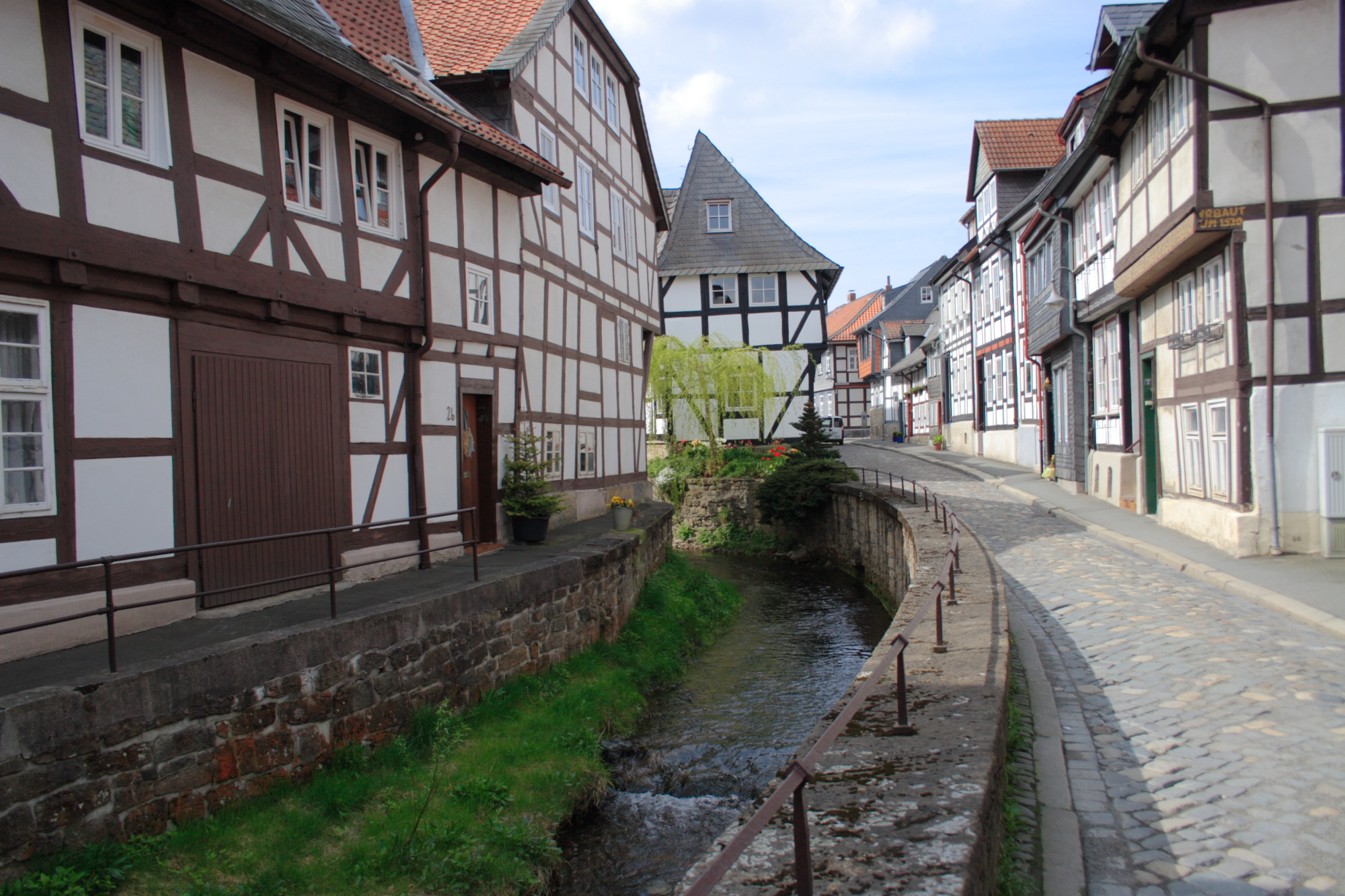
Old Town of Goslar — CC BY-SA 3
Travel to Goslar
Travel in Goslar suits every kind of visitor, and a stay of two to three days gives enough time for the old town, the Rammelsberg mine and the Kaiserpfalz, together with a walk in the Harz National Park. Many visitors join Goslar with Hanover in the same journey, since the train between the two cities takes about an hour, and the best months for walking are May to October, when the weather is warm and the mountain trails are open. Autumn brings gold and red leaves to the Harz, while winter brings snow and skiing, so Goslar rewards a visit in every season, and visitors should check the weather before setting out for the high ground.
The old town is the most important sight of any visit to Goslar, with more than 1,500 timber-framed houses and the Marktplatz at its heart. Visitors can walk the old town, admire the timber-framed houses of the fifteenth to nineteenth centuries, visit the town hall with its Huldigungssaal and the market church of Saints Cosmas and Damian, and sit in a cafe on the square. The old town of Goslar survives almost whole, and it gives one of the clearest pictures of a medieval German town anywhere in the country.
The Rammelsberg mine is a sight no visitor should miss, with guided tours that take visitors down into the mine to explore more than 1,000 years of mining history. Visitors can ride the mine train into the tunnels, see the old mining machines and learn about the lives of the miners across the centuries. The Rammelsberg museum shows the history of mining and smelting in the Harz, with tools, models and records of the mine’s long life. Visitors should check opening hours and ticket prices on the official website before visiting, since the mine tours run at set times.
The Kaiserpfalz imperial palace is an important historic sight of Goslar, with Romanesque architecture from the eleventh century and a fine view over the town and the Harz. Inside the palace stand nineteenth-century murals that tell the history of the German empire, and beside it stands the Ulrichskapelle, an octagonal chapel of the twelfth century with an unusual design. Visitors should allow time for the palace and for the story of Goslar as a seat of the Holy Roman Empire. The Harz National Park lies close by, and many visitors join Goslar with a climb of the Brocken, at 1,141 metres, by foot or by the steam train of the Brocken Railway.
The food of Goslar reflects the cooking of Lower Saxony, with roast pork, sausages and sweet pastries, and the restaurants around the Marktplatz serve local dishes with Harz beer. Visitors should try the local food and sit in a cafe on the square to feel the mood of the old town, and should try the cakes and pastries that the bakeries of Goslar are known for. From Goslar visitors can easily join a trip to Hanover, the capital of Lower Saxony, or to Berlin, the capital of Germany, and those who want to explore Lower Saxony further can visit the other historic towns of the region, with their old towns and timber-framed houses.
Notable Places in Goslar
Old Town of Goslar
The old town of Goslar ranks among the best preserved old towns in Germany, with more than 1,500 timber-framed houses from the fifteenth to nineteenth centuries. The old town was inscribed by UNESCO as a World Heritage property in 1992, together with the Rammelsberg mine, recognising the architecture and history of the town. The Marktplatz is the centre of the old town, with the town hall, the market church of Saints Cosmas and Damian and the fountain, and the town hall holds the Huldigungssaal of 1505, with wall paintings that tell the history of Goslar. Visitors can walk the old town in a few hours, and the medieval mood of the streets survives almost whole.
Rammelsberg Mine
The Rammelsberg mine ranks among the oldest mines in Europe, worked without a break for more than 1,000 years, from the tenth century to 1988. The mine produced silver, copper, lead and zinc, and it shaped the economy of the Harz and of Germany across the centuries.
In 1992 the Rammelsberg mine, together with the old town of Goslar, was inscribed by UNESCO as a World Heritage property under ref 623. Visitors can tour the mine with guides, ride the train into the tunnels and see the old mining machines, and the museum shows the history of mining and smelting in the Harz. The mine is a rare sight, giving visitors a deep view of the industrial history of Germany.
Kaiserpfalz Imperial Palace
The Kaiserpfalz imperial palace ranks among the most important Romanesque palaces in Germany, built from about 1040 to 1050 under King Henry III. The palace was a place where the German emperors often stayed in the eleventh and twelfth centuries, and it served as a centre of power of the Holy Roman Empire. Inside the palace stand nineteenth-century murals that tell the history of the German empire, and the Ulrichskapelle beside it is an octagonal chapel of the twelfth century with a striking design. From the palace visitors can look over the town of Goslar and the Harz mountains, and the palace marks the role of Goslar in the history of the German empire.
Market Church of Saints Cosmas and Damian
The market church of Saints Cosmas and Damian is the main church of Goslar, standing on the Marktplatz, with Gothic architecture from the twelfth century. The church is dedicated to the twin saints Cosmas and Damian, the patron saints of physicians, and it has served as the religious centre of the town since the Middle Ages. Inside the church stand valuable works of art, including the altar and wall paintings, and the church still serves the community of Goslar today. The square around the church, with the town hall and the fountain, forms a fine setting for the festivals and markets of the town, and visitors should step inside to see the Gothic architecture and the art.
Harz National Park and the Brocken
The Harz National Park ranks among the most important national parks in Germany, with ancient forests, bogs and the Brocken at 1,141 metres, the highest mountain in northern Germany. From Goslar visitors can take the steam train of the Brocken Railway up to the summit of the Brocken, a rare experience with a wide view over the whole Harz range.
The Brocken is the highest mountain in northern Germany, and it carries many legends of witches in German folk culture. The national park holds many walking and cycling trails through forest, bog and natural sights, and in winter the Harz ranks among the important ski areas of northern Germany. Visitors should give at least a day to the national park when they come to Goslar.
Frequently Asked Questions
How many days should a visit to Goslar last?
A visit to Goslar usually lasts two to three days, with enough time for the old town, the Rammelsberg mine and the Kaiserpfalz imperial palace, together with a walk in the Harz National Park. Visitors can join Goslar with Hanover and Berlin in a longer journey through northern Germany. The best months run from May to October, when the weather is warm and the mountain trails are open.
What is special about the old town of Goslar?
Walk the old town early in the morning, when the lanes are quiet and the light falls on the timber fronts. The Marktplatz gives the best first view, and the side streets off it hold the finest houses, so a slow loop of the centre takes about two hours. The tourist office offers guided walks, and the town museum gives the background that makes the houses come alive.
How long did the Rammelsberg mine work?
Take the guided tour, since the mine can only be seen with a guide, and the underground train ride is the heart of the visit. The museum shows the tools, the models and the water system that kept the mine working, and the surface buildings show how a mining town looked in the nineteenth century. Allow half a day, and wear a jacket, since the tunnels stay cool even in summer.
When was the Kaiserpfalz imperial palace built?
Go to the Kaiserpfalz in the late afternoon, when the light falls through the tall windows of the great hall. The murals of the hall tell the story of the emperors in pictures, and the small Ulrichskapelle holds the heart of Henry the Third, buried there after his death in 1056. The palace garden gives a quiet view back over the roofs of the old town.
How long does the train from Goslar to Hanover take?
The train from Goslar to Hanover takes about an hour, with trains running often through the day. Hanover is the capital of Lower Saxony, with sights such as the Herrenhausen Gardens and the New Town Hall. Visitors can join Goslar with Hanover in a journey through Lower Saxony.
Which season is best for a visit to Goslar?
Summer, from May to October, is the best time for a visit to Goslar, when the weather is warm and the walking trails on the Harz are open. Autumn is fine, with gold and red leaves on the Harz, while winter suits skiing and winter sports. Visitors should check the weather before visiting, above all for trips to the high mountains.
Verified
- Goslar is a town at the north-western foot of the Harz in Lower Saxony; coordinates 51.9060° N, 10.4292° E; GeoNames 10942643; Wikidata Q3896 (P31 large independent city of Lower Saxony, Hanseatic city, urban municipality in Germany; P17 Germany). Source: Wikidata API, checked 23 November 2026.
- The old town of Goslar and the Rammelsberg mine were inscribed by UNESCO as a World Heritage property in 1992, ref 623, criteria (i)(ii)(iv); the property was extended in 2010 to include the Upper Harz Water Management System. Source: whc.unesco.org/en/list/623/, checked 23 November 2026.
- The Rammelsberg mine worked continuously for more than 1,000 years and closed in 1988; the mines were worked from the eleventh century until the 1980s. Sources: UNESCO brief synthesis for ref 623 and Wikipedia, checked 23 November 2026.
- The Kaiserpfalz was built from about 1040 to 1050 under King Henry III; the old town holds some 1,500 timber-framed houses from the fifteenth to nineteenth centuries; the Brocken rises to 1,141 metres and is the highest mountain in northern Germany. Sources: UNESCO brief synthesis for ref 623 and Wikipedia, checked 23 November 2026.
- Germany holds 55 World Heritage properties. Source: UNESCO World Heritage Centre, checked 23 November 2026.
- The nearest separate World Heritage property to Goslar is the Cathedral of Saint Mary and Church of Saint Michael at Hildesheim, ref 187, about 43 km away in a straight line from the registry coordinates; the Collegiate Church, Castle and Old Town of Quedlinburg, ref 535, lies about 51 km away. Distances computed by haversine from the registry coordinates, 23 November 2026.
- The Harz National Park was formed in 2006 by joining two older parks; Goslar became a free imperial city in 1290; Goslar became part of the Kingdom of Prussia in 1866. Sources: Wikipedia, checked 23 November 2026.
Sources
- Wikipedia — Goslar (https://en.wikipedia.org/wiki/Goslar)
- Wikipedia — Rammelsberg (https://en.wikipedia.org/wiki/Rammelsberg)
- UNESCO — Mines of Rammelsberg, Historic Town of Goslar and Upper Harz Water Management System (https://whc.unesco.org/en/list/623/)
- Wikipedia — Brocken (https://en.wikipedia.org/wiki/Brocken)
- UNESCO — Germany, World Heritage List (https://whc.unesco.org/en/statesparties/de)
- Wikidata — Q3896 Goslar (https://wikidata.org/wiki/Q3896)
Unverified
- The exact year of the founding of Goslar needs further checking; some sources give about 922, linked with King Henry I.
- The year silver was found on the Rammelsberg is legend, given as about 968 and linked with King Otto I, and needs further checking.
- The exact current population of Goslar by census after 2021 needs an official check; the figure of about 50,000 is an estimate.
- Current opening hours and ticket prices for the Rammelsberg mine and the Kaiserpfalz should be checked on the official websites before visiting.
Illustrations
- Hero: Goslar. Free image: https://upload.wikimedia.org/wikipedia/commons/6/6f/MJK_85421_Bergstra%C3%9Fe_60_%28Goslar%29.jpg — CC BY-SA 4.0.
- In body, old town: Old Town of Goslar. Free image: https://upload.wikimedia.org/wikipedia/commons/f/f2/Old_Town_of_Goslar.jpg — CC BY-SA 3.
- In body, view: Goslar Rammelsberg mine headframe. Free image: https://upload.wikimedia.org/wikipedia/commons/c/c0/Goslar_Rammelsberg_mine_headframe.jpg — CC BY-SA 4.