
Copenhagen: Denmark’s Royal Capital on the Øresund
Copenhagen is the capital of Denmark, on the Øresund strait. Its coloured houses, canals and bicycles give the city its calm charm.
The city is a royal capital with more than 850 years of history, yet it feels younger than most capitals in Europe. Its people ride bicycles in every season, swim in the harbour in summer, and eat in restaurants that have changed the cooking of the whole Nordic region. The harbour fronts are lined with the coloured houses of Nyhavn, the spires of old churches rise over the rooftops, and the amusement gardens of Tivoli glow in the centre of the city. Copenhagen is a place where design, daily life and the sea sit close together.
The name of the city in Danish is København, which means the harbour of the merchants, and the name still fits. Copenhagen began as a fishing village of the Vikings, grew into the capital of a kingdom that once ruled Denmark, Norway and Sweden, and became a model for the world in cycling, in clean water and in living well. Its palaces still house the royal family, its parliament still meets in the castle on the harbour island, and its streets still follow the plan that rose from the ashes of two great fires.
Quick Facts About Copenhagen
| Fact | Detail |
|---|---|
| Name | Copenhagen (København) |
| Role | Capital and largest city of Denmark |
| Location | On the eastern coast of Zealand, on the Øresund strait facing Sweden |
| Population | About 667,099 (city, January 2025); metropolitan area about 1.4 million |
| Area | 90.9 square kilometres (city) |
| Elevation | About 14 metres above sea level on average |
| Cycle lanes | More than 350 kilometres of separate cycle paths |
| UNESCO | No World Heritage property inside the city; Amalienborg on the Tentative List since 1993 |
| Coordinates | 55.6761° N, 12.5689° E |
| Wikidata | Q1748, city and capital |
Geography of Copenhagen
Two Islands on the Øresund
Copenhagen lies on the eastern side of Zealand, the largest island of Denmark, at the narrowest point of the Øresund, the strait that divides Denmark from Sweden. The city spreads across two islands, Zealand in the west and Amager in the east, joined by bridges across the harbour. The airport of Kastrup stands on Amager, about 8 kilometres south of the centre, and the Øresund Bridge, opened in 2000, carries road and rail across the strait to Malmö in Sweden. The bridge itself is 7,845 metres long, and its roadway and railway run from the Swedish coast to an artificial island, Pepparholm, before diving into the Drogden Tunnel to Amager.
The sea is never far away in Copenhagen, and the harbour, the canals and the beaches are part of the daily life of the city.
The land of Copenhagen is low and flat, with an average height of only about 14 metres above the sea. The flat ground makes the bicycle the natural way to travel, and the city has built more than 350 kilometres of cycle paths, separated from the traffic, that carry riders in every season. The harbour water is clean enough to swim in, and the open-air pools at Islands Brygge fill with bathers on warm days, while Amager Strandpark, with its artificial white sand, gives the city a beach only a few minutes by bicycle from the centre. The flat land also means that the towers of the city, the spire of the Church of Our Saviour, the Round Tower and the towers of Christiansborg, can be seen from far away, rising over a city of low rooftops.
The climate of Copenhagen is mild and maritime, with cool summers and damp winters. Summer temperatures usually sit between 17 and 22 degrees Celsius, and the days in June last 17 to 18 hours, so the cafes put their tables outside and the city lives outdoors. Winter temperatures sit between 0 and 5 degrees, the days are short, and the rain and light snow come and go. The sea air keeps the extremes away, and the city is at its best in the long light of late spring and early autumn, when the parks are green and the harbour is busy with boats.
Districts of the City
Copenhagen is divided into ten districts, and the central one, Indre By, is the old town, with its stone streets, its squares and its canals. The old town holds the main shopping street, the palaces and the oldest churches, and its lanes still follow the medieval plan that survived the fires. To the east lies Christianshavn, the canal district, with its own harbour, its houseboats and the free town of Christiania, while the west holds Nørrebro and Vesterbro, districts of cafes, markets and nightlife that draw a younger crowd. Østerbro, to the north, is quieter, with parks, embassies and the statue of the Little Mermaid on the shore at Langelinie.
Inside the ring of Copenhagen lies Frederiksberg, a separate town entirely surrounded by the capital, with its own town hall, its own gardens and its own streets. The districts of Copenhagen each keep a distinct temper, and the city is small enough that a bicycle ride of twenty minutes can take a visitor from the coloured houses of Nyhavn to the beach at Amager or to the market halls of Nørrebro. The harbour is the spine of the city, and the harbour buses carry passengers on the water from the south of the city to the north, past the opera house, the palaces and the old warehouses that have become homes and restaurants.
The Harbour, the Lakes and the Coast
The harbour of Copenhagen was once a place of shipyards, warehouses and fishing boats, and it has become a place of homes, of offices and of baths. The water is clean enough to swim in, and the harbour baths at Islands Brygge and the diving tower at the harbour are free for everyone in summer. The opera house stands on the island of Holmen, across the water from the palace of Amalienborg, and the harbour buses carry passengers past the old warehouses, the new housing and the houseboats that line the quays. The city has turned its face back to the water, and the harbour is now the living room of Copenhagen in the long evenings of summer.
Inland, the city holds the Lakes, three long stretches of water that divide the centre from the districts of Nørrebro and Østerbro, with paths for walking and cycling along their banks. The parks of Copenhagen give the city its green heart, from the King’s Garden beside Rosenborg Castle to the gardens of Frederiksberg, with their lawns, their lakes and their palace. Amager Strandpark, with its sand and its shallow water, is the beach of the city, and the coast of the Øresund runs north from the centre past the Little Mermaid, the citadel and the villas of the northern suburbs. The sea, the lakes and the parks together make Copenhagen a city where nature is never far from the street.
Copenhagen in Denmark and Scandinavia
Copenhagen is the capital of Denmark and the main gateway into Scandinavia, and its airport is the busiest in northern Europe. The city stands at the meeting point of Denmark and Sweden, and the Øresund region, with Copenhagen on one side and Malmö on the other, is a single urban area across a national border. The trains cross the bridge in about 35 minutes, and many people live on one side of the strait and work on the other. The ferries and the flights from Copenhagen join the city to Oslo in Norway, to Stockholm in Sweden, and to Bergen on the Norwegian coast, while the trains run south through Denmark to the rest of Europe.
The position of Copenhagen has made it a trading city since the days of the Vikings, when the harbour gave access to both the North Sea and the Baltic. The city is the largest in Denmark, and it holds the parliament, the government and the royal family, while the second city, Aarhus, lies on the mainland of Jutland to the west. The islands and the peninsulas of Denmark surround the capital, and the castles, the cathedrals and the Viking sites of the country are all within a short journey. Copenhagen is a capital on its own, and it is also the door to Denmark, to Norway and to the north of Europe, with Amsterdam and the Low Countries a short flight to the south.

Roof, Attics and “Dragon Spire” of the Old Stock Exchange of Copenhagen, Denmark — CC0
History of Copenhagen
From Viking Fishing Village to Capital
The history of Copenhagen began as a fishing village of the Vikings in the tenth century, near the place that is now Gammel Strand. The village stood on a natural harbour on the Øresund, where the trade between the North Sea and the Baltic passed, and its name, København, means the harbour of the merchants. In 1167 Bishop Absalon of Roskilde built a fortress on a small island in the harbour, to guard the town against pirates, and that fortress is the beginning of Christiansborg Castle today. The year 1167 is taken as the founding year of Copenhagen, and the town received its first urban privileges in 1254.
The turning point came in the early fifteenth century, when King Erik of Pomerania moved the court to Copenhagen and made the town the capital of Denmark. In 1445 King Christopher III confirmed the town as the capital, and from that time Copenhagen became the seat of power for the kingdom of Denmark, and later for the Kalmar Union of Denmark, Norway and Sweden. The town grew around its harbour and its castle, and its merchants traded with the ports of the Baltic and the North Sea. The Reformation reached Denmark in the sixteenth century, and the churches of Copenhagen became Protestant, while the university and the schools of the city grew with the new learning.
War, Fire and Rebuilding
The centuries that followed were full of change and of trouble. In 1658 and 1659 the armies of Sweden laid siege to Copenhagen, and the city held out through the resistance of its people. Two great fires, in 1728 and in 1795, burned most of the old town, and the city was rebuilt to a new plan, with rows of neoclassical town houses that still line the streets of the centre. In 1807, during the Napoleonic Wars, the British fleet bombarded Copenhagen and destroyed much of the city, seizing the Danish fleet at the same time, and the town recovered only slowly through the nineteenth century.
The nineteenth century was also the golden age of Danish culture, and Copenhagen was its centre. The writer Hans Christian Andersen lived for many years at Nyhavn, and the philosopher Søren Kierkegaard wrote his great works in the city.
The century also gave Denmark its painters of the Golden Age, among them Christoffer Wilhelm Eckersberg and Christen Købke, who painted the streets, the harbour and the light of Copenhagen. In 1864 Denmark lost the duchies of Schleswig and Holstein in war with Prussia and Austria, and the defeat turned the country inward, toward its farms, its schools and its co-operatives. The city kept its role as the capital, and its harbour, its shipyards and its breweries, among them Carlsberg, founded in 1847, gave work to a growing population.
Tivoli Gardens opened in 1843, and the Little Mermaid, the small bronze statue on the shore at Langelinie, was raised in 1913, after the tale of Andersen. In 1849 Denmark became a constitutional monarchy, and the parliament took its seat at Christiansborg Castle.
Late in the century the city grew beyond its old walls, with new districts such as Nørrebro, Vesterbro and Østerbro, and in 1962 the street of Strøget became one of the longest pedestrian streets in Europe.
Copenhagen in the Modern Age
The twentieth century brought occupation and renewal to Copenhagen. Denmark was occupied by Germany from 1940 to 1945, and the capital was the centre of the resistance, while the rescue of the Danish Jews in 1943 remains one of the proudest stories of the war. In 1971 a group of people took over an abandoned barracks at Christianshavn and founded the free town of Christiania, a social experiment that still exists today, with its street art, its self-built houses and its own way of life. After the war Copenhagen grew into a modern city, with a driverless metro opened in 2002 and the circle line, Cityringen, opened in 2019.
In 2000 the Øresund Bridge joined Copenhagen to Malmö, turning the region into a single urban area across the strait, and the city became a model for the world in cycling and in sustainable living.
After the war Denmark built a welfare state, and Copenhagen grew with new housing, new schools and new suburbs along the fingers of the railway lines. The Finger Plan of 1947 laid out five corridors of growth from the centre, with green wedges between them, and the plan still shapes the city today. The harbour, once a place of shipyards and warehouses, now holds homes, offices and baths. The new districts were built with schools, shops and parks, and the city grew outward without losing its centre.
On heritage, Copenhagen holds no World Heritage property inside its own boundaries. Denmark counts 13 properties on the World Heritage List, but all of them lie elsewhere, among them Roskilde Cathedral from 1995, Kronborg Castle from 2000, the par force hunting landscape of North Zealand from 2015 and the Viking-Age ring fortresses from 2023. The district of Amalienborg has stood on the Tentative List of UNESCO since 1993, but it has not yet been formally nominated.
Copenhagen today is a royal capital that lives by the bicycle, by the harbour and by the sea, and its history is still written in its streets.
Timeline
- Tenth century — A Viking fishing village forms near Gammel Strand.
- 1167 — Bishop Absalon builds a fortress; the founding year of Copenhagen.
- 1254 — Copenhagen receives its first urban privileges.
- Early fifteenth century — King Erik of Pomerania moves the court to Copenhagen.
- 1445 — King Christopher III confirms Copenhagen as the capital.
- 1658–1659 — Swedish armies besiege Copenhagen; the city holds out.
- 1728 and 1795 — Two great fires burn the old town; the city is rebuilt.
- 1807 — The British fleet bombards Copenhagen in the Napoleonic Wars.
- 1843 — Tivoli Gardens open.
- 1849 — Denmark becomes a constitutional monarchy; parliament sits at Christiansborg.
- 1864 — Denmark loses Schleswig and Holstein in war with Prussia and Austria.
- 1913 — The Little Mermaid is raised on the shore at Langelinie.
- 1940–1945 — Denmark is occupied in the Second World War.
- 1947 — The Finger Plan lays out five corridors of growth from the centre.
- 1971 — The free town of Christiania is founded at Christianshavn.
- 1993 — Amalienborg is placed on the Tentative List of UNESCO.
- 2000 — The Øresund Bridge to Malmö is opened.
- 2002 — The Copenhagen metro begins running.
- 2019 — The Cityringen circle line of the metro opens.
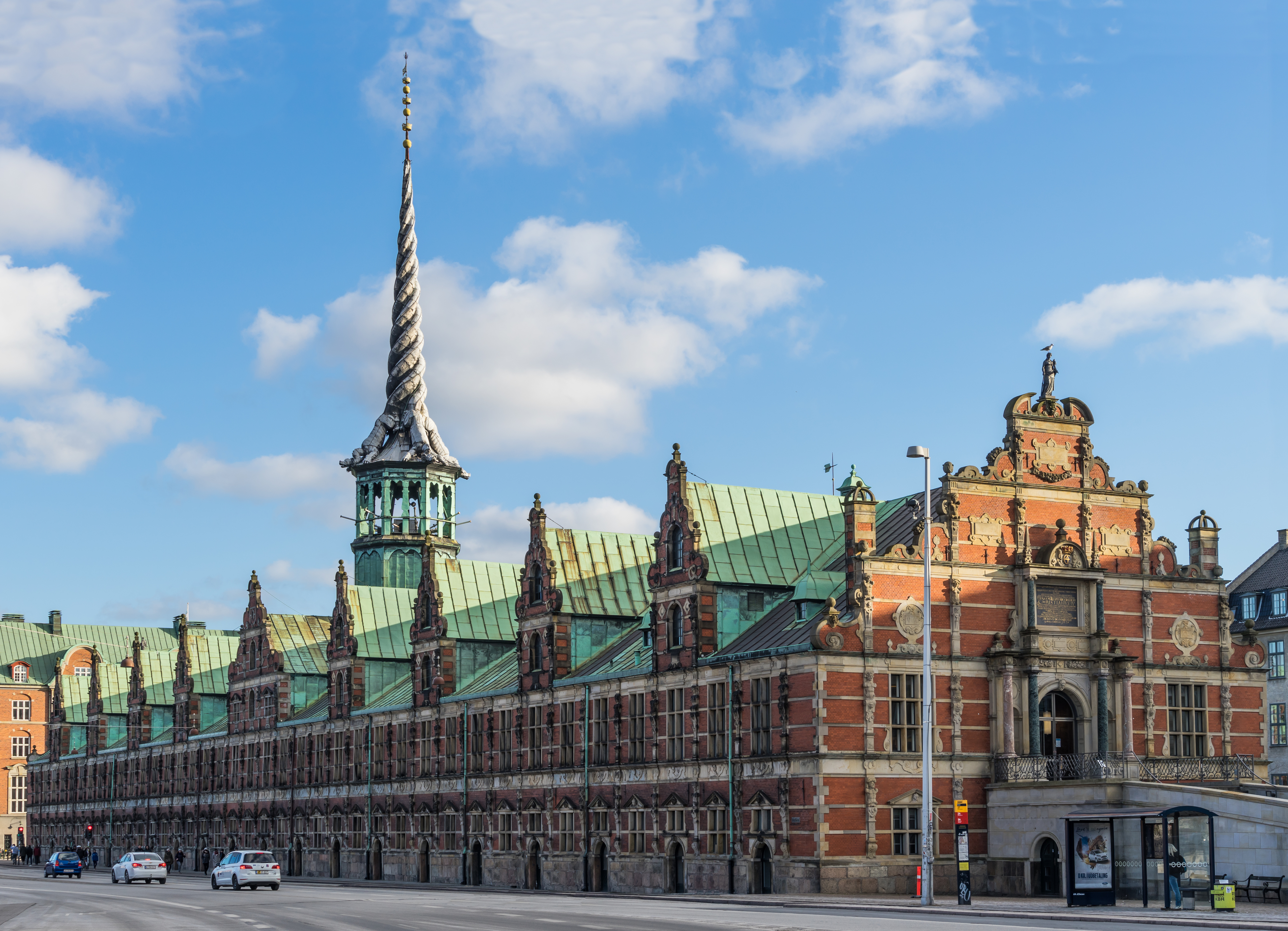
The former Stock-Exchange, Copenhagen, Denmark — CC0
Travel to Copenhagen
Getting There and Getting Around
Copenhagen is served by Kastrup Airport, about 8 kilometres south of the centre, on the island of Amager, and the metro and the trains join it to the city in about 15 minutes. Inside the city, the bicycle is the finest way to travel, and visitors can hire bicycles all over town, riding on paths that are separated from the cars. The driverless metro runs around the clock, and the harbour buses carry passengers on the water from the south of the city to the north. The centre is compact, and most of the sights lie within walking distance of each other, so a visitor can see a great deal on foot.
The finest time to visit Copenhagen is from May to September, when the days are long, the weather is warm and the city lives outdoors. June brings days of 17 to 18 hours, and the cafes put their tables outside, while the people swim in the harbour and sunbathe at Amager Strandpark. Spring, from March to May, brings cherry blossom to the parks, above all at Bispebjerg Cemetery and Langelinie Park, and autumn brings colour to the trees and a quieter city. Winter is cold and dark early, but December brings the Christmas market in Tivoli Gardens, one of the finest in northern Europe.
A Three-Day First Visit
Three days is the right length for a first visit to Copenhagen, and the days should be planned around the harbour and the palaces. The first day belongs to the centre: the canal of Nyhavn, the pedestrian street of Strøget, the Round Tower, Rosenborg Castle and the district of Amalienborg, with its four palaces around an octagonal square. The second day should be given to the museums and the palaces: Christiansborg, the National Museum of Denmark, the Ny Carlsberg Glyptotek and Tivoli Gardens in the evening, when the lights come on.
The third day should be given to the quieter corners: Christianshavn with the Church of Our Saviour and the free town of Christiania, the district of Nørrebro with the Torvehallerne food halls, and the beach at Amager Strandpark. With another day, the train across the Øresund Bridge to Malmö in Sweden takes only about 35 minutes.
The food of Copenhagen is the centre of the New Nordic cooking, and the restaurant Noma has been named the best in the world more than once. The traditional dish to try is smørrebrød, open sandwiches of dark rye bread with herring, smoked salmon, meat or egg, and the Danish pastry called wienerbrød, with cream and cinnamon, is the classic breakfast. The food halls of Torvehallerne, near Nørreport Station, hold stalls of Danish food in a modern market, and the old meatpacking district of Kødbyen in Vesterbro is now a centre of restaurants and nightlife. The hot dog stands of the city are the street food that everyone eats, and the harbour restaurants serve fish from the Øresund and the Baltic.
Practical Notes for Visitors
The Danish krone is the currency, and cards are accepted almost everywhere, so visitors rarely need cash. English is spoken by nearly everyone, and a greeting in Danish is appreciated, though the language is hard to pronounce. The Copenhagen Card gives unlimited travel on public transport and entry to many sights, but visitors should check the list of sights and the current price on the official site before buying.
The bicycle is the way to see the city, and riders should follow the cycle traffic rules and signal before turning, because the cycle lanes are busy and fast. The harbour is clean enough to swim in, and the pools at Islands Brygge are free, but the water is cold outside the summer months.
Copenhagen is a city that asks its visitors to slow down and to live outdoors, to ride a bicycle, to eat in a market hall and to sit beside the harbour in the long evening light. The city is small enough to walk, flat enough to cycle and safe enough to explore at any hour, and its pleasures are simple ones: a coloured house, a canal, a pastry and a view across the water to Sweden.
Notable Places in Copenhagen
The canal of Nyhavn is the first place in Copenhagen, dug in the seventeenth century and lined with coloured houses, restaurants and wooden boats, where Hans Christian Andersen once lived. The Little Mermaid is the second place, the small bronze statue raised in 1913 on the shore at Langelinie, after the fairy tale of Andersen, and the most photographed symbol of Denmark. Tivoli Gardens is the third place, the amusement park opened in 1843, one of the oldest in the world, with its rides, its flower gardens and its concerts, and said to have inspired Disneyland.
Beyond the centre, Rosenborg Castle, built in the early seventeenth century, holds the crown jewels of Denmark and the royal collections, in the gardens of Kongens Have. Amalienborg Palace, the home of the Danish royal family, holds four palaces around an octagonal square, with a daily changing of the guard, and it has stood on the Tentative List of UNESCO since 1993. Christiansborg Castle, on the island of Slotsholmen, holds the parliament, the prime minister’s office and the supreme court, on the site where the fortress of Absalon once stood. The pedestrian street of Strøget, the Round Tower built in 1642 with its spiral ramp to the viewing platform, the Church of Our Saviour with its spiral tower in Christianshavn, the free town of Christiania founded in 1971, the National Museum of Denmark and the Ny Carlsberg Glyptotek complete the visit to the capital.
Frequently Asked Questions
Where is Copenhagen, and how many people live there?
Copenhagen lies on the eastern coast of Zealand, on the Øresund strait facing Sweden. About 667,099 people live in the city as of January 2025, with about 1.4 million in the metropolitan area, and the city covers 90.9 square kilometres, at an average height of only about 14 metres above the sea.
Does Copenhagen have a UNESCO World Heritage site?
No, the city of Copenhagen itself holds no World Heritage property. Denmark counts 13 properties on the list, but all of them lie elsewhere, among them Roskilde Cathedral from 1995, Kronborg Castle from 2000 and the Viking-Age ring fortresses from 2023. The Amalienborg district has stood on the Tentative List since 1993, without a formal nomination so far.
Where is the Little Mermaid, and what makes it special?
The Little Mermaid stands on the shore at Langelinie, near the harbour of Copenhagen, and it was raised in 1913. The bronze statue, made by the sculptor Edvard Eriksen after the fairy tale of Hans Christian Andersen, is one of the most photographed symbols of Denmark, small in size and great in fame.
When is the best season to visit Copenhagen?
May to September is the finest time, with long days, warm weather and the city living outdoors, and June brings days of 17 to 18 hours. Spring brings cherry blossom, autumn is quieter, and December brings the Christmas market in Tivoli Gardens, one of the finest in northern Europe.
Should visitors hire a bicycle in Copenhagen?
Yes, the bicycle is the best way to see Copenhagen, with more than 350 kilometres of cycle paths separated from the cars. Bicycles can be hired all over the city, and most of the sights lie within an easy ride, though riders should follow the cycle rules and signal before turning.
Can Sweden be reached in a day from Copenhagen?
Yes, the train across the Øresund Bridge to Malmö in Sweden takes only about 35 minutes from the central station of Copenhagen. Malmö is the third city of Sweden, with an old town and a castle, and travellers should carry a passport or identity document for the crossing.
Verified
The population of about 667,099 in January 2025, the area of 90.9 square kilometres, the metropolitan population of about 1.4 million, the average elevation of about 14 metres, the airport 8 kilometres south of the centre, the more than 350 kilometres of cycle paths, the founding year of 1167, the capital confirmed in 1445, Tivoli Gardens opened in 1843, the Little Mermaid raised in 1913, Christiania founded in 1971, the Øresund Bridge opened in 2000, the metro opened in 2002 and the Cityringen opened in 2019 were taken from the figures carried in the Vietnamese article for Copenhagen and checked against its listed sources.
The Øresund Bridge at 7,845 metres, the Finger Plan of 1947, the loss of Schleswig and Holstein in 1864, the Carlsberg brewery founded in 1847 and the painters of the Danish Golden Age were checked against the history of Copenhagen.
The absence of a World Heritage property inside Copenhagen, the 13 properties of Denmark on the World Heritage List, 8 cultural and 5 natural, and the Amalienborg district on the Tentative List since 1993 were verified live on whc.unesco.org on 22 November 2026. The Wikidata entry Q1748 for Copenhagen, at 55.6761° N, 12.5689° E, with instance-of values including city and capital, was verified through the Wikidata API on 22 November 2026. Verified 22 November 2026.
Sources
- Copenhagen, population about 667,099 (January 2025), area 90.9 square kilometres, metropolitan area about 1.4 million, founded 1167 — https://en.wikipedia.org/wiki/Copenhagen
- Copenhagen Municipality, elevation about 14 metres, more than 350 kilometres of cycle paths — https://en.wikipedia.org/wiki/Copenhagen_Municipality
- Denmark, 13 properties on the World Heritage List, Amalienborg on the Tentative List since 1993 — https://whc.unesco.org/en/statesparties/dk
- History of Copenhagen (Absalon 1167, capital 1445, fires 1728 and 1795, bombardment 1807, Tivoli 1843, Christiania 1971, Øresund Bridge 2000) — https://en.wikipedia.org/wiki/History_of_Copenhagen
- Øresund Bridge, 7,845 metres, Pepparholm, Drogden Tunnel; Finger Plan 1947; Schleswig-Holstein 1864; Carlsberg founded 1847 — https://en.wikipedia.org/wiki/Øresund_Bridge
- Tivoli Gardens, opened 1843 — https://www.tivoli.dk/en/
- Wikidata Q1748 (Copenhagen, coordinates 55.6761/12.5689) — verified through the Wikidata API, 22 November 2026.
Unverified
- Ticket prices and opening hours for Tivoli Gardens, Rosenborg Castle, Christiansborg, the National Museum and the Ny Carlsberg Glyptotek change with the season, and this article gives none of them, so readers should check the official site of each place before visiting.
- The price of the Copenhagen Card and the list of sights it covers change from year to year, and this article gives no figures for it.
- The exact dates of the Christmas market in Tivoli Gardens change each year, and this article gives no dates for it.
- The number of bicycles in Copenhagen and the share of residents who cycle to work are often quoted in the press, and this article gives no figure for either, because no official source was checked.
Illustrations
- Hero: Copenhagen. Free image: https://upload.wikimedia.org/wikipedia/commons/1/19/Cityscape_and_skyline_by_the_Copenhagen_Lakes%2C_Denmark_-_%2836018109956%29.jpg — CC BY 2.0.
- In body, Copenhagen: The former Stock-Exchange, Copenhagen, Denmark. Free image: https://upload.wikimedia.org/wikipedia/commons/3/32/B%C3%B8rsen_Copenhagen_Denmark.jpg — CC0.
- In body, Copenhagen: Roof, Attics and “Dragon Spire” of the Old Stock Exchange of Copenhagen, Denmark. Free image: https://upload.wikimedia.org/wikipedia/commons/5/5f/B%C3%B8rsen_dragon_spire_roofs_Copenhagen_Denmark.jpg — CC0.