
Norway Getaways: Fjords, Northern Lights and Viking History
Norway getaways begin with fjords and northern lights. This guide covers the land, the Viking past and the eight UNESCO sites.
Norway getaways take travellers from the green fjords of the west to the Arctic islands of the far north, and the country packs that range into a long narrow strip of mountains, coast and forest. The kingdom holds about 5.6 million people on a mainland of steep valleys and deep inlets, and its story runs from Viking ships through four centuries of Danish rule to the oil wealth of the modern age. This article covers the geography that makes Norway unlike its neighbours, the history that shaped it, its eight World Heritage sites, and the practical facts for planning a first trip.
Quick Facts About Norway Getaways
| Item | Detail |
|---|---|
| Name | Norway, the Kingdom of Norway, Kongeriket Norge in Norwegian |
| Location | Western Scandinavia, in northern Europe |
| Coordinates | 59.93° N, 10.68° E, from Wikidata |
| Wikidata | Q20, verified through the Wikidata API on 22 November 2026 |
| Type | Sovereign state, a kingdom |
| Capital | Oslo, also the largest city |
| Area | 385,207 square kilometres, including Svalbard and Jan Mayen; mainland 323,802 square kilometres |
| Population | 5,601,049 people, an estimate for 2025 |
| Official languages | Norwegian, in the two written forms Bokmål and Nynorsk; Sámi in the north |
| Currency | Norwegian krone, NOK |
| Time zone | UTC+1 in winter, UTC+2 in summer |
| Highest point | Galdhøpiggen, 2,469 metres |
| Monarch | Harald V, king since 1991 |
| UNESCO | Eight World Heritage sites, seven cultural and one natural |
Geography of Norway Getaways
Norway getaways start with the coast, and no other country in Europe has a shoreline so long and so broken. The mainland coast runs about 2,650 kilometres from the south to the North Cape, yet the fjords cut so deeply inland that the country feels far longer than the map suggests. Sognefjord reaches 205 kilometres into the mountains, the longest fjord in Norway and the second longest in the world, and its branches hold villages that can only be reached by boat or by a single winding road. Glaciers carved these valleys during the ice ages, and the sea filled them when the ice melted, leaving cliffs that rise straight from the water.
Mountains cover most of Norway getaways country, and the Scandinavian range runs along the border with Sweden from south to north. Galdhøpiggen, at 2,469 metres in the Jotunheimen range, is the highest peak in the country and the highest in northern Europe outside the Alps. The Jotunheimen holds the densest cluster of high peaks in the north, and its glaciers, lakes and valleys draw hikers in summer and skiers in winter. Low land is scarce, and the largest flat areas lie around the Oslofjord in the south-east and the Jæren plain in the south-west, where most of the farming happens.
The climate of Norway getaways surprises first-time visitors, because the Gulf Stream carries warm Atlantic water far to the north. Bergen, the second city, is famous for its rain, with wet days in every season, while Oslo in the south-east has warm summers and cold snowy winters. The coast stays ice-free far above the Arctic Circle, and ports in the north operate through the winter. Inland valleys are colder and drier than the coast, and the mountains make their own weather, so a sunny morning in a fjord village can turn to rain on the pass above it.
Almost a third of Norway lies north of the Arctic Circle, and the light there follows a rhythm unknown in the south. From late May to late July the sun never sets in the far north, and the midnight sun turns night into a long golden evening. From September to March the nights return, and the northern lights appear most often between November and February, when the dark is longest. Tromsø, the largest city north of the circle, is called the gateway to the Arctic, and its position under the auroral oval makes it one of the best places on earth to watch the lights.
The islands of Norway getaways are as much a part of the country as the mainland, and each group has its own character. The Lofoten archipelago rises north of the Arctic Circle with fishing villages such as Reine and Henningsvær, sharp peaks that drop into the sea, and white sand beaches that look tropical until the cold water reminds swimmers where they are. Senja, the second largest island, mixes mountains, beaches and fishing hamlets along a single coastal road. Svalbard, far to the north between mainland Norway and the North Pole, holds more polar bears than people, and its town of Longyearbyen is the base for glacier expeditions.
Forests cover about a third of the mainland of Norway getaways country, mostly coniferous forest in the east and the south. The great valleys of the east, such as Gudbrandsdalen and Østerdalen, hold farms, rivers and pine woods between long ridges, while the west is steeper and wetter, with waterfalls falling from the cliffs into the fjords. The Hardangervidda, a high plateau in the south, stretches between fjord and valley as a treeless land of lakes and reindeer herds. Rivers run short and fast from the mountains to the sea, and their water powers the hydroelectric plants that light the country.
The fjords themselves deserve a closer look, because they are the heart of Norway getaways travel. Geirangerfjord, with its sheer walls and the Seven Sisters waterfall, is the most visited fjord in the country, and the viewpoints at Dalsnibba and Flydalsjuvet look down on farms clinging to ledges above the water. Nærøyfjord, the narrowest fjord in Norway at only 250 metres across at its tightest point, is reached by boat from Flåm, where the Flåm railway climbs from the fjord to the mountain plateau. The Lysefjord in the south holds the Preikestolen cliff, a flat rock 604 metres above the water, and the Kjerag boulder wedged between two cliffs.
Norway borders Sweden to the east, Finland and Russia to the north-east, and faces the North Sea to the south, the Norwegian Sea to the west and the Barents Sea to the north. The border with Sweden runs for more than 1,600 kilometres through forest and mountain, and the far north-east touches Russia near Kirkenes. The country is long and narrow, about 1,750 kilometres from the southern tip at Lindesnes to the North Cape, yet rarely more than a few hundred kilometres wide. That shape explains why travel inside Norway takes longer than the map suggests, and why the coastal ships and the railways matter so much.
The southern coast of Norway getaways country faces the Skagerrak, the strait between Norway, Denmark and Sweden, and its smooth rocks, white wooden towns and small islands feel gentler than the fjord country. Kristiansand, the largest town of the south, is the summer resort of the region, and the archipelago outside it fills with sailing boats in July. The Oslofjord runs north from the Skagerrak to the capital, and its shores hold summer houses, beaches and the old towns of Tønsberg and Fredrikstad. The south is where most Norwegians spend their summer holidays, and its light and its warmth surprise visitors who expect only cold and snow.
Lakes and waterfalls fill the gaps between the mountains of Norway getaways country, and the water is everywhere in the landscape. Lake Mjøsa, the largest lake in the country, stretches between the farming districts of Hedmark and Oppland, and its shores hold the town of Hamar and the ruins of a medieval cathedral. Hornindalsvatnet, in the west, is the deepest lake in Europe at 514 metres, and its clear water lies between steep mountains that rise straight from the shore. Waterfalls drop from the high plateaus into the fjords, and Vøringsfossen, near the Hardangervidda, is one of the best known, with a fall of 182 metres into a narrow gorge.
The far north of Norway getaways country holds a different landscape again, with the Finnmark plateau, the rock carvings of Alta and the long dark winters of the Barents coast. The Sámi people herd reindeer across this land, and their language and culture are protected in the northern counties. The Varanger peninsula in the far east feels like the end of Europe, with bird cliffs, fishing villages and tundra that meets the sea. The north rewards travellers who accept long distances and changeable weather, and its light, whether midnight sun or northern lights, is unlike anything further south.
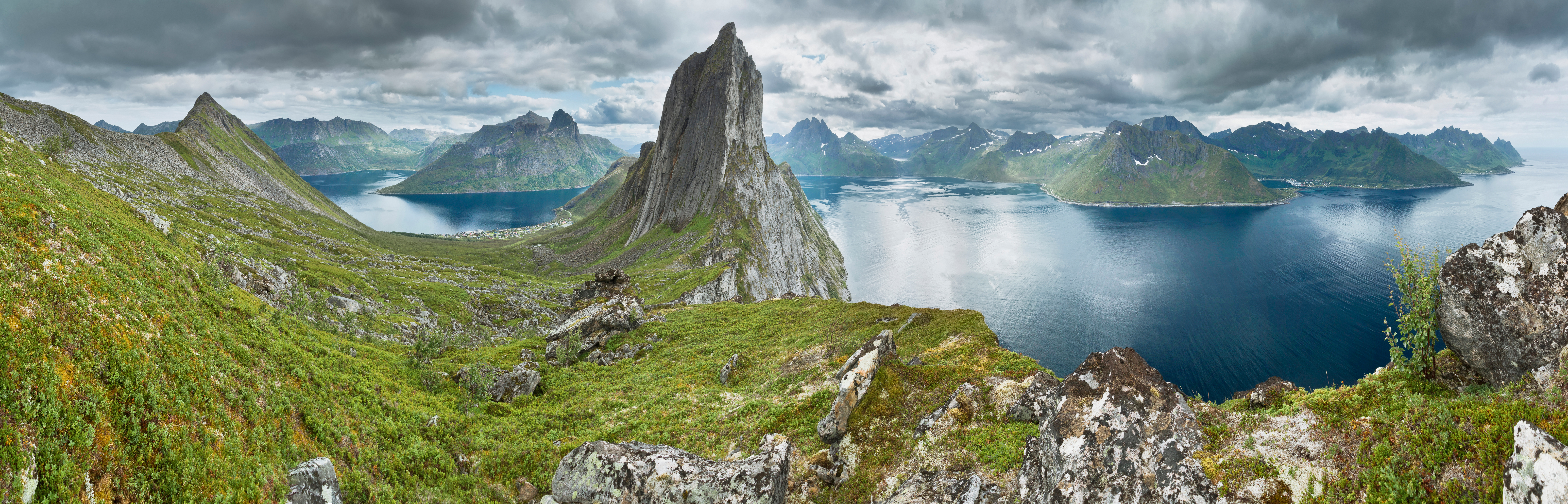
View from a ridge between Segla and Hesten, Senja, Norway, 2014 August — CC BY-SA 4

Sognefjord at dusk 01 — CC BY-SA 4

Sakrisøy village and mountains Lofoten Norway — CC BY-SA 4

A view towards Geirangerfjord from Dalsnibba, Møre og Romsdal, Norway, 2013 June — CC BY-SA 3
History Behind Norway Getaways
The story of Norway getaways begins with the Vikings, the seafaring Scandinavians who sailed across Europe from the eighth to the eleventh centuries. Around 872, according to tradition, King Harald Fairhair united the small kingdoms of Norway into one realm after the battle of Hafrsfjord, and the date is still taken as the start of Norway as a single kingdom. Norwegian Vikings sailed west to Iceland, Greenland and North America, and south to England, Ireland and France, trading, raiding and settling wherever their ships could reach. Their ships, their sagas and their art still shape how the world pictures Norway.
In the eleventh century King Olaf the Second, later Saint Olaf, brought Christianity to Norway, and after he fell at Stiklestad in 1030 the new faith became the religion of the land. Nidaros Cathedral in Trondheim, built over the grave of Saint Olaf, became the most important pilgrimage centre in medieval northern Europe, and kings were crowned there for centuries. Bergen grew into a great trading port in the same period, and from the fourteenth century the merchants of the Hanseatic League controlled the trade in dried cod from its wooden wharf. The stockfish of the Lofoten islands fed much of Europe, and the trade made Bergen rich.
In 1397 Norway joined the Kalmar Union with Denmark and Sweden, and from that point it slowly lost its independence, becoming a province of Denmark for more than four centuries. Norwegians call this period the 400-year night, when Danish became the language of government and Copenhagen held the power. The people kept their own language, folk tales, music and the wooden stave churches that are unique to Norway, and the rural culture survived even as the towns spoke Danish. The union with Denmark ended in 1814, after the Napoleonic Wars, when Denmark gave Norway to Sweden.
The Norwegians moved quickly in 1814, and on 17 May of that year they adopted a constitution at Eidsvoll, a date still celebrated as Constitution Day. Norway lived in union with Sweden until 1905, when its parliament declared independence and invited Prince Carl of Denmark to take the throne as Haakon the Seventh. Independence opened a new age of hydroelectric industry, shipping and fishing, and the young state built schools, railways and a merchant fleet that sailed the world. The constitution of 1814, one of the oldest still in force, remains the foundation of Norwegian democracy.
The Second World War was the greatest trial of modern Norway, and German forces occupied the country from April 1940 to May 1945. The resistance fought back with sabotage, and the attacks on the heavy water plant at Rjukan became legendary, since the plant produced material that could have served a German atomic programme. After the war Norway helped found NATO in 1949 and built a welfare state with free health care, free education and wide social security. The country that emerged from the war was poorer than its neighbours, yet it had a strong sense of shared purpose and a habit of planning for the long term.
In 1969 oil was found at the Ekofisk field in the North Sea, and Norway became one of the largest oil and gas exporters in the world. Unlike many resource-rich states, Norway put the income into the Government Pension Fund Global, often called the Oil Fund, to invest the earnings for future generations. The fund grew into one of the largest sovereign wealth funds on earth, and it pays for pensions and public services today. In 1994 Norwegians voted against joining the European Union, and the country stayed in the European Economic Area instead, keeping its own currency and its fisheries policy.
The stave churches are the most original buildings of medieval Norway, and only 28 of them still stand from the 1,000 to 2,000 that once filled the country. Built of upright wooden posts, or staves, they mix Christian plans with carved animal ornament from the Viking age, and their dark timber and shingled roofs look like ships turned upside down. Borgund, the best preserved of them, still stands in its valley in the west with its runic inscriptions on the walls, and Urnes, the oldest, carries carvings from an even earlier church on the same site. The churches show a Norway that built in wood because stone was scarce and forests were everywhere, and they remain the country’s greatest contribution to the architecture of Europe.
The nineteenth century was the age of national awakening in Norway, and writers, painters and musicians gave the young nation a culture of its own. Henrik Ibsen wrote plays that travelled the world, Edvard Grieg set the mountains and fjords to music, and Edvard Munch painted the anxiety and light of the northern soul. The language itself became a battleground, and the two written forms of Norwegian, Bokmål and Nynorsk, both won official status, a compromise that still shapes schools and newspapers. Painters of the national romantic school filled their canvases with fjords, waterfalls and summer farms, and their images still define how Norwegians see their own land.
The polar explorers carried the Norwegian name to the ends of the earth, and their ships and sledges became national symbols. Fridtjof Nansen drifted across the Arctic Ocean in the Fram from 1893 to 1896 and walked further north than any person before him, and Roald Amundsen reached the South Pole in December 1911, weeks ahead of the British expedition of Robert Falcon Scott. The Fram itself, built to survive the pressure of the ice, is now a museum in Oslo, and the stories of the expeditions are taught to every Norwegian schoolchild. Exploration gave the small new state a pride that matched its neighbours, and the flag planted at the pole became a founding image of independent Norway.
The Sámi people, who have herded reindeer across the far north for centuries, won recognition late in the story of Norway getaways country. Their language was suppressed in schools for much of the twentieth century, and the building of a hydroelectric dam on the Alta river in the 1970s brought their cause to national attention. The Sámi Parliament opened in Karasjok in 1989, and 6 February, the anniversary of the first Sámi meeting in 1917, is now the National Day of the Sámi people. Reindeer herding, the joik song and the gákti dress remain living parts of northern culture, and the parliament gives the Sámi a voice in the decisions that touch their land.
Modern Norway getaways country is one of the richest and safest in the world, and its towns mix wooden houses, modern architecture and a deep habit of outdoor life. The attacks in Oslo and on the island of Utøya in 2011 shocked the nation, and the response stressed openness and democracy rather than fear. The royal family remains popular, and King Harald the Fifth has reigned since 1991. Norwegians spend their weekends in the mountains and on the sea, and the custom of friluftsliv, or open-air life, is a part of the national character that visitors meet on every trail and every beach.

A Late evening view to Austnesfjorden at Sildpollnes Church, Austvågøya, Lofoten, Norway, 2015 April — CC BY-SA 4
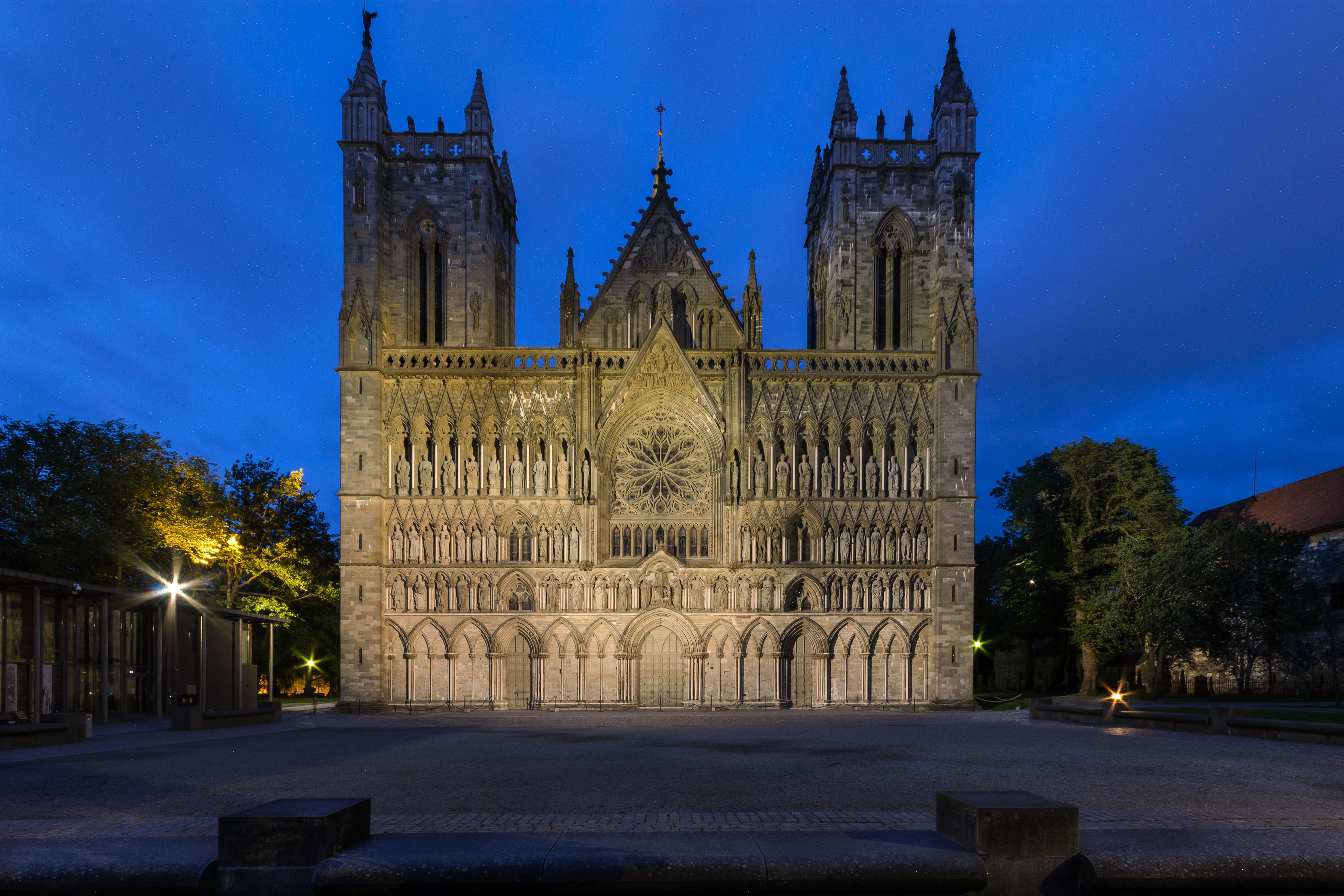
Nidaros cathedral front — CC BY-SA 3
UNESCO World Heritage Sites in Norway Getaways
Norway holds eight World Heritage sites, seven cultural and one natural, and the country ratified the World Heritage Convention on 12 May 1977. The first two sites were listed together in 1979: Urnes Stave Church under reference 58, the oldest and most famous stave church in the country, built in the twelfth and thirteenth centuries with carvings that blend Viking, Celtic and Romanesque art; and Bryggen in Bergen, the Hanseatic wharf under reference 59, where colourful wooden warehouses line the harbour. Røros Mining Town followed in 1980 under reference 55, a copper mining town from the seventeenth century, extended in 2010 to cover the surrounding mining landscape.
The Rock Art of Alta was listed in 1985 under reference 352, with more than 6,000 prehistoric carvings made between about 4200 and 500 before Christ in the far north of Finnmark. Vegaøyan, the Vega Archipelago, joined the list in 2004 under reference 1143, honouring the islanders who farmed eider ducks for their down in a sustainable life on the sea.
The Struve Geodetic Arc, listed in 2005 under reference 1187, is shared with nine other countries and marks a nineteenth-century survey of the shape of the earth, with four measurement points in Norway. The West Norwegian Fjords, Geirangerfjord and Nærøyfjord, were listed the same year under reference 1195 as the only natural site in the country. The newest site, the Rjukan-Notodden Industrial Heritage Site, was listed in 2015 under reference 1486, preserving the hydroelectric plants, railways and workers’ towns of the early fertiliser industry.

Bergen Bryggen 2986 — CC BY-SA 3

Roros02 — Public domain
Travel Planning for Norway Getaways
May to September is the best season for fjord travel in Norway getaways, with long days, the warmest weather and open mountain roads. June and July bring the midnight sun in the north, while September adds autumn colours to the valleys and fewer crowds on the trails. The northern lights season runs from September to March, with Tromsø and the Lofoten islands as the best bases, and the darkest months from November to February give the longest nights for watching the sky. Winter also brings skiing at Lillehammer and Geilo, while the fjords stay green and quiet under snow.
Oslo Gardermoen Airport is the main gateway for Norway getaways, with direct flights from many European cities and connections from Asia. From Oslo, trains run to Bergen, Trondheim and Stavanger, and the Oslo to Bergen line is counted among the most beautiful rail journeys in the world. The coastal ship Hurtigruten sails from Bergen to Kirkenes and calls at 34 ports, and it is the best way to see the fjords and the coast without driving. The Flåm railway climbs from the fjord to the mountain plateau in a single steep hour, and local ferries link the villages along the fjords.
A hire car gives the most freedom for exploring the Lofoten islands, the Geirangerfjord and the rural valleys, where buses are few and the distances are long. Drivers should expect tunnels, ferries and mountain passes, and some passes close in winter, so the route needs checking before the trip. Norway is one of the most expensive countries in Europe, and food, hotels and transport cost far more than in most of Europe. Cards are accepted almost everywhere, even in small cafés and on buses, and many places no longer take cash at all.
The food of Norway getaways belongs to the sea and the cold climate, with fish, lamb, potatoes and berries at its centre. Salmon is the best known dish, farmed in the fjords and eaten smoked, grilled or cured as gravlaks, while stockfish, dried cod from Lofoten, has been exported for centuries. Lutefisk, cod soaked in lye and then cooked, is the most debated Christmas dish in the country, and brunost, a sweet brown cheese made from goat and cow milk, is eaten with crispbread.
Fårikål, lamb stewed with cabbage and pepper, is regarded as the national dish and is eaten in autumn, and cloudberries from the northern marshes make jam and desserts. Aquavit, a spirit flavoured with caraway and dill, is the drink of festive meals.
Visitors from Vietnam need a Schengen visa before travelling to Norway, and the visa covers travel across the whole Schengen Area. The passport must stay valid for at least three months after the planned date of leaving the area, and the application goes through the Norwegian embassy or the visa centre before the trip. English is spoken widely, especially in the cities and in tourism, and Norwegians are known for punctuality, respect for private space and a love of nature. The Constitution Day parade on 17 May is the largest festival in the country, with children in national dress marching past the Royal Palace in Oslo.
Notable Places in Norway Getaways
- Oslo — the capital, with the iceberg-shaped Opera House, Vigeland Park with 212 sculptures, and the Munch Museum
- Bergen and Bryggen — the second city, with the UNESCO-listed Hanseatic wharf, the Fløibanen funicular and the fish market
- Geirangerfjord — the most famous fjord, with steep cliffs, the Seven Sisters waterfall and the viewpoints at Dalsnibba and Flydalsjuvet
- Nærøyfjord and Flåm — the narrowest fjord, reached by boat from Flåm and its mountain railway
- Lofoten — the Arctic archipelago of fishing villages, sharp peaks and white beaches
- Tromsø — the largest city north of the Arctic Circle, the gateway to the Arctic, with the Arctic Cathedral and the Fjellheisen cable car
- Trondheim and Nidaros Cathedral — the old capital, with the medieval pilgrimage cathedral and the wooden Bakklandet quarter
- Stavanger and Preikestolen — the oil city with the old town of Gamle Stavanger, and the Pulpit Rock 604 metres above the Lysefjord
- Røros — the seventeenth-century copper mining town, a UNESCO site with wooden houses and snowy winter streets
- Svalbard — the Arctic archipelago between mainland Norway and the North Pole, with more polar bears than people
- Sognefjord — the longest fjord in Norway at 205 kilometres, with villages such as Balestrand and Undredal on its shores

00 0345 Norway – Preikestolen — CC BY-SA 4

Oslo Opera House (Den Norske Opera & Ballett), Norway — CC BY-SA 4

NOR-2016-Tromsø-Arctic Cathedral (Ishavskatedralen) 01 front — CC BY-SA 4
Frequently Asked Questions About Norway Getaways
How many UNESCO World Heritage sites do Norway getaways include?
The country holds eight sites, seven cultural and one natural, which is the West Norwegian Fjords entry covering Geirangerfjord and Nærøyfjord. Urnes Stave Church and Bryggen in Bergen were the first two, listed in 1979, and the Rjukan-Notodden Industrial Heritage Site was the newest, listed in 2015.
What is the best month for Norway getaways?
May to September suits fjords, hiking and the cities, with the longest days and the warmest weather. September to March is the season for the northern lights in the north, with the darkest skies from November to February, and the midnight sun shines from late May to late July above the Arctic Circle.
Where is the best place to see the northern lights in Norway getaways?
Tromsø and the Lofoten islands are the best bases, thanks to their position north of the Arctic Circle and their low light pollution. The lights appear most often from September to March, and a clear sky away from town lights gives the best view, so check the forecast and avoid the full moon.
Are Norway getaways expensive?
Yes, Norway is one of the most expensive countries in Europe, and meals, hotels and transport cost far more than in most of the continent. Booking trains, ferries and hotels early, cooking some meals and using city tourist cards all help to keep the cost down.
Do Vietnamese citizens need a visa for Norway getaways?
Yes. Norway has belonged to the Schengen Area since 2001, although it is not a member of the European Union, so Vietnamese travellers need a Schengen visa for a visit. That visa covers stays of up to 90 days in any 180-day period across all the Schengen states, and the passport must remain valid for at least three months after the planned departure from the area.
What is the best way to travel between the fjords in Norway getaways?
The Hurtigruten coastal ship from Bergen to Kirkenes is the best way to see the fjords and the coast, calling at 34 ports along the way. The Oslo to Bergen train and the Flåm railway are the most scenic rail lines, local ferries link fjord villages, and a hire car gives the most freedom in Lofoten and around Geirangerfjord.
Verified
The population estimate of 5,601,049 people for 2025, the area of 385,207 square kilometres including Svalbard and Jan Mayen, the mainland area of 323,802 square kilometres, the capital Oslo, the highest peak Galdhøpiggen at 2,469 metres, the eight World Heritage sites with their years and reference numbers, the ratification of the World Heritage Convention on 12 May 1977, and the historical dates from the Viking age to the oil discovery at Ekofisk in 1969 were checked against the sources below. The coordinates 59.93° N, 10.68° E and the Wikidata identifier Q20 were verified through the Wikidata API. Verified 22 November 2026.
Sources
- Wikipedia, “Norway” — https://en.wikipedia.org/wiki/Norway
- Wikipedia, “History of Norway” — https://en.wikipedia.org/wiki/History_of_Norway
- UNESCO World Heritage Centre, Norway — https://whc.unesco.org/en/statesparties/no
- Visit Norway, Norway’s UNESCO sites — https://www.visitnorway.com/places-to-go/unesco-world-heritage-sites/
- Wikipedia, “List of World Heritage Sites in Norway” — https://en.wikipedia.org/wiki/List_of_World_Heritage_Sites_in_Norway
- Wikidata, Q20 Norway, verified through the Wikidata API on 22 November 2026
- TheTerraAtlas keyword file batch-eu4-en-keywords.json, entry TA-L2-norway, focus keyword “norway getaways”
Unverified
- The coastline figure of more than 100,000 kilometres when every fjord, strait and island is counted — travel sources give different numbers depending on how the coast is measured, so the article gives no single figure.
- Ticket prices for the Hurtigruten coastal ship, the Oslo to Bergen train, the Flåm railway and the cable cars in Bergen and Tromsø — check the official price lists before travelling.
- The exact size of the Government Pension Fund Global in November 2026 — the figure moves with the markets, so check the latest numbers from Norges Bank Investment Management.
- Exact dates of seasonal festivals such as the Bergen International Festival, the Tromsø Northern Lights Festival and the St Olav Festival — dates change each year, so check the official calendars before going.
- Current Schengen visa rules for Vietnamese citizens — check the Norwegian embassy or the visa centre for the rules in force, since visa policy can change.
Illustrations
- Hero: 2016-11-13 01 Kjeungskjær Lighthouse, Sør-Trøndelag, Norway. Free image: https://upload.wikimedia.org/wikipedia/commons/9/92/2016-11-13_01_Kjeungskj%C3%A6r_Lighthouse%2C_S%C3%B8r-Tr%C3%B8ndelag%2C_Norway.jpg — CC BY-SA 4.
- In body, panorama: A Late evening view to Austnesfjorden at Sildpollnes Church, Austvågøya, Lofoten, Norway, 2015 April. Free image: https://upload.wikimedia.org/wikipedia/commons/8/8c/A_Late_evening_view_to_Austnesfjorden_at_Sildpollnes_Church%2C_Austv%C3%A5g%C3%B8ya%2C_Lofoten%2C_Norway%2C_2015_April.jpg — CC BY-SA 4.
- In body, view: View from a ridge between Segla and Hesten, Senja, Norway, 2014 August. Free image: https://upload.wikimedia.org/wikipedia/commons/c/c2/View_from_a_ridge_between_Segla_and_Hesten%2C_Senja%2C_Norway%2C_2014_August.jpg — CC BY-SA 4.
- In body, Geography of Norway Getaways: Sognefjord at dusk 01. Free image: https://upload.wikimedia.org/wikipedia/commons/0/04/Sognefjord_at_dusk_01.jpg — CC BY-SA 4.
- In body, UNESCO World Heritage Sites in Norway Getaways: Bergen Bryggen 2986. Free image: https://upload.wikimedia.org/wikipedia/commons/a/af/Bergen_Bryggen_2986.jpg — CC BY-SA 3.
- In body, UNESCO World Heritage Sites in Norway Getaways: Roros02. Free image: https://upload.wikimedia.org/wikipedia/commons/2/23/Roros02.jpg — Public domain.
- In body, Notable Places in Norway Getaways: 00 0345 Norway – Preikestolen. Free image: https://upload.wikimedia.org/wikipedia/commons/f/f0/00_0345_Norway_-_Preikestolen.jpg — CC BY-SA 4.
- In body, Notable Places in Norway Getaways: Oslo Opera House (Den Norske Opera & Ballett), Norway. Free image: https://upload.wikimedia.org/wikipedia/commons/5/5a/Oslo_Opera_House_%28Den_Norske_Opera_%26_Ballett%29%2C_Norway.jpg — CC BY-SA 4.
- In body, Notable Places in Norway Getaways: NOR-2016-Tromsø-Arctic Cathedral (Ishavskatedralen) 01 front. Free image: https://upload.wikimedia.org/wikipedia/commons/9/94/NOR-2016-Troms%C3%B8-Arctic_Cathedral_%28Ishavskatedralen%29_01_front.jpg — CC BY-SA 4.
- In body, Geography of Norway Getaways: Sakrisøy village and mountains Lofoten Norway. Free image: https://upload.wikimedia.org/wikipedia/commons/d/d0/Sakris%C3%B8y_village_and_mountains_Lofoten_Norway.jpg — CC BY-SA 4.
- In body, History Behind Norway Getaways: Nidaros cathedral front. Free image: https://upload.wikimedia.org/wikipedia/commons/c/cd/Nidaros_cathedral_front.jpg — CC BY-SA 3.
- In body, Geography of Norway Getaways: A view towards Geirangerfjord from Dalsnibba, Møre og Romsdal, Norway, 2013 June. Free image: https://upload.wikimedia.org/wikipedia/commons/d/da/A_view_towards_Geirangerfjord_from_Dalsnibba%2C_M%C3%B8re_og_Romsdal%2C_Norway%2C_2013_June.jpg — CC BY-SA 3.