
Blue Mosque Shah Alam: The Sultan Salahuddin Abdul Aziz Mosque
Blue Mosque Shah Alam is the largest mosque in Malaysia. Its blue and silver dome rises over a lake in the city of Shah Alam.
Blue Mosque Shah Alam, in Malay Masjid Sultan Salahuddin Abdul Aziz Shah, is the state mosque of Selangor, Malaysia, and the largest mosque in the country. Although visitors often search for it as the Blue Mosque of Kuala Lumpur, Blue Mosque Shah Alam does not stand in Kuala Lumpur at all: it stands in Shah Alam, the capital of Selangor, about 25 kilometres south-west of Kuala Lumpur. The name Blue Mosque, in Malay Masjid Biru, comes from its great dome, clad in blue and silver.
Blue Mosque Shah Alam holds up to 24,000 people, and its main dome, 51.2 metres across and 106.7 metres high, was once ranked among the largest religious domes in the world. Its four minarets, each 142.3 metres high, were the tallest in the world when the mosque opened in 1988, and they remain the tallest set of four minarets in the world. This article gives the geography, the history and the practical visit of Blue Mosque Shah Alam for a first-time traveller, and it sets out plainly where the mosque stands, so that no visitor goes to the wrong city.
Quick Facts About Blue Mosque Shah Alam
| Fact | Detail |
|---|---|
| Name | Blue Mosque Shah Alam — Sultan Salahuddin Abdul Aziz Shah Mosque (Masjid Sultan Salahuddin Abdul Aziz Shah) |
| Place | Persiaran Masjid, Seksyen 14, 40000 Shah Alam, Selangor, Malaysia — about 25 km south-west of Kuala Lumpur |
| Type | State mosque of Selangor; largest mosque in Malaysia |
| Opened | 11 March 1988 (construction began 1982) |
| Architect | Dato Baharuddin Abu Kassim |
| Capacity | 24,000 people (main prayer hall 12,600 people) |
| Dome | 51.2 m in diameter, 106.7 m high — aluminium, clad in blue and silver enamelled steel plates |
| Minarets | 4 minarets, each 142.3 m high — tallest in the world at the opening in 1988, still the tallest set of four |
| Entry | Free; free guided tours, with robes and headscarves lent free at the mosque |
| UNESCO | Not a World Heritage property |
| Wikidata | Q308510 |
| Coordinates | 3.0786° N, 101.5206° E |
Geography of Blue Mosque Shah Alam
Shah Alam, Not Kuala Lumpur
Blue Mosque Shah Alam stands in Shah Alam, the capital of the state of Selangor, at 3.0786° north and 101.5206° east. Shah Alam lies in the west of the Malay Peninsula, about 25 kilometres south-west of Kuala Lumpur, and the mosque stands in the centre of the city, on Persiaran Masjid in Seksyen 14, beside Taman Tasik Shah Alam, the lake of Shah Alam. The mosque is the landmark of Shah Alam, and its dome can be seen from across the city, and on a clear day from high points in Kuala Lumpur.
One point must be remembered clearly: although the common search name is Blue Mosque Kuala Lumpur, Blue Mosque Shah Alam is not inside the city of Kuala Lumpur. Kuala Lumpur is a federal territory of its own, while Shah Alam belongs to the state of Selangor, and the two are separate places with a half-hour drive between them. Visitors who book a car should enter Shah Alam, Selangor, not Kuala Lumpur, or they may be taken to the National Mosque in Kuala Lumpur instead. The mosque is also not the Federal Territory Mosque, which stands in Kuala Lumpur on Jalan Duta; it is the state mosque of Selangor, in Shah Alam, and the distinction is the first fact of any visit.
Shah Alam itself is a planned city, made the capital of Selangor in 1978, when the capital moved from Klang. The city was laid out with wide roads, lakes and gardens, and the mosque was built as its centre, on the highest ground of the central district. Blue Mosque Shah Alam therefore stands at the heart of a planned capital, and its dome is the centre of the plan, visible from the roads, the lake and the gardens of the city.
The Lake and the Islamic Arts Garden
The setting of Blue Mosque Shah Alam is part of the visit, because the mosque stands beside the lake of Taman Tasik Shah Alam, and the Islamic Arts Garden of 14 hectares lies next to it. The lake reflects the blue dome, and the garden holds paths, water and plants in the Islamic tradition, so that the mosque, the lake and the garden form a single composition. The garden is a quiet place, and it is the place to walk before or after the mosque, when the dome is reflected in the water.
The lake of Shah Alam is the largest lake of the city, and its shore is a park, with paths, benches and trees. The mosque stands on the northern shore of the lake, and the view across the water, with the dome rising above the trees, is the photograph of Blue Mosque Shah Alam. The Islamic Arts Garden, beside the mosque, holds calligraphy, geometric patterns and planting in the Islamic style, and it is the garden that explains the art of the mosque in the open air.
The water and the garden also cool the mosque, because the lake breeze tempers the tropical heat, and the shade of the garden offers relief from the midday sun. The mosque was designed with its setting in mind, and the dome, the lake and the garden were planned together. A visitor who sees only the mosque, without the lake and the garden, has seen only part of Blue Mosque Shah Alam.
The Dome and the Minarets in the Skyline
The dome of Blue Mosque Shah Alam is the largest single feature of the building, 51.2 metres in diameter and 106.7 metres high, made of aluminium and clad in blue and silver enamelled steel plates. The dome was once ranked among the largest religious domes in the world, and its blue and silver surface catches the light of the tropical sky, turning from silver in the morning to deep blue in the afternoon. The dome is the reason for the name Blue Mosque, and it is the landmark by which the mosque is known across Malaysia.
The four minarets of Blue Mosque Shah Alam, each 142.3 metres high, stand at the four corners of the mosque, and they were the tallest minarets in the world when the mosque opened in 1988. They remain the tallest set of four minarets in the world, and they are the second thing a visitor sees, after the dome. The minarets are slender, white and blue, and they frame the dome from every direction, so that the mosque is recognised by its five verticals: one dome and four towers.
The skyline of Shah Alam is the skyline of Blue Mosque Shah Alam, because no other building of the city rises as high as the minarets. The mosque can be seen from the highways around Shah Alam, and its dome and towers are the sign that the traveller has reached the capital of Selangor. The mosque is not only a place of prayer; it is the symbol of the state, and its silhouette is the symbol that Selangor uses for itself.
Climate and the Best Hours
Malaysia lies near the equator, with a tropical climate, hot and humid all year, and temperatures usually between 25 and 33 degrees Celsius. The morning is usually more pleasant than the midday, and the rainy season, from about October to March on the west coast of the peninsula, can bring sudden showers in the afternoon. Blue Mosque Shah Alam is best visited in the morning, when the light is soft, the air is cooler, and the mosque is quiet between prayers.
The mosque is busiest at the Friday midday prayers, when the main hall fills and the grounds are crowded, and visitors should avoid that time. The mosque is open to visitors outside prayer times, and the guided tours run in the morning and the afternoon, so a visitor should plan around the prayer schedule. The lake and the garden are pleasant at any hour, yet the mosque itself is best seen in the morning, when the dome is lit by the sun and the tours are running.
Rain in Shah Alam falls in short, heavy showers, and a shower can pass in half an hour, leaving the air fresh and the dome shining. The mosque has covered areas, and the visitor can wait out a shower in the garden or in the hall. The climate of Blue Mosque Shah Alam is the climate of the equator, and the visit should be planned for the morning, with an umbrella in the bag and time to spare.

Sultan Salahuddin Abdul Aziz Shah mosque night view — CC BY 2
History of Blue Mosque Shah Alam
A State Mosque for Selangor
Blue Mosque Shah Alam was built as the state mosque of Selangor, and its history begins with the making of Shah Alam as the capital of the state. When the capital moved from Klang to Shah Alam in 1978, the new city needed a mosque worthy of a capital, and the state commissioned a mosque that would be the largest in Malaysia. The mosque was named for Sultan Salahuddin Abdul Aziz Shah, the Sultan of Selangor, and it was built to be the symbol of the state and of its ruler.
Construction of Blue Mosque Shah Alam began in 1982, and the mosque was inaugurated on 11 March 1988. The building took six years, and it was the largest building project of Selangor in its time, employing the craftsmen, the engineers and the artists of Malaysia. The mosque opened as the largest mosque in the country, and it has held that rank ever since, with a capacity of 24,000 people, of whom 12,600 can pray in the main hall.
The mosque was built at a time when Malaysia was building its modern identity, and Blue Mosque Shah Alam is a monument of that moment. The country was growing fast, the cities were rising, and the mosque was meant to show that a modern Malaysia could build in its own style, joining the Malay tradition with modern engineering. The mosque is therefore a historical document as well as a place of prayer, and its dome and minarets are the record of the Malaysia of 1988.
Dato Baharuddin Abu Kassim and the Design
The architect of Blue Mosque Shah Alam was Dato Baharuddin Abu Kassim, a Malaysian architect who designed the mosque in a style that joins Malay tradition with modernism. The Malay tradition is seen in the roof forms, the wood carving and the use of local motifs, while the modernism is seen in the structure: the great dome of aluminium, the steel plates, and the concrete frame that carries the weight. The mosque is a modern building in a Malay idiom, and its design was new in Malaysia when it was built.
The dome of Blue Mosque Shah Alam was the boldest part of the design. A dome 51.2 metres across and 106.7 metres high, made of aluminium and clad in blue and silver enamelled steel, was an engineering feat, and it was one of the largest religious domes in the world when it was built. The blue of the dome was chosen to mark the mosque, and the silver was chosen to catch the light, so that the dome changes colour with the sky. The dome is the signature of the architect, and it is the part of the mosque that every visitor remembers.
The four minarets of Blue Mosque Shah Alam were also a feat of engineering, each 142.3 metres high, and they were the tallest minarets in the world when the mosque opened. The minarets were built of concrete, clad in white and blue, and they were designed to be seen from far away, as the towers of the capital. The architect gave the mosque four minarets rather than one, because the state mosque of Selangor deserved the full number, and the four towers have become the emblem of the mosque. The design of Blue Mosque Shah Alam is the design of a state mosque, and it was built to be seen.
The Opening of 1988 and After
Blue Mosque Shah Alam opened on 11 March 1988, and its opening was a state occasion, attended by the Sultan, the government and the people of Selangor. The mosque filled with worshippers, and the city of Shah Alam gained its centre, and the dome and the minarets became the symbol of the state. The opening was the end of six years of building, and it was the beginning of the mosque as a living place of prayer.
Since 1988, Blue Mosque Shah Alam has served as the mosque of the state, hosting the Friday prayers, the festivals of the Islamic calendar, and the ceremonies of Selangor. The mosque has also become a place for visitors, and its free guided tours, its robes and its headscarves have made it one of the most visited mosques in Malaysia by non-Muslims. The mosque has kept its role as a place of prayer while opening its doors to the world, and that balance is part of its history.
The mosque has been maintained and renewed since its opening, and its dome, its minarets and its halls have been cared for by the state. The Islamic Arts Garden beside it has grown, and the lake has been kept as the setting of the mosque. Blue Mosque Shah Alam is now more than three decades old, and it is still the largest mosque in Malaysia, still the landmark of Shah Alam, and still the mosque that visitors mean when they search for the Blue Mosque of Kuala Lumpur, even though it stands in another city.
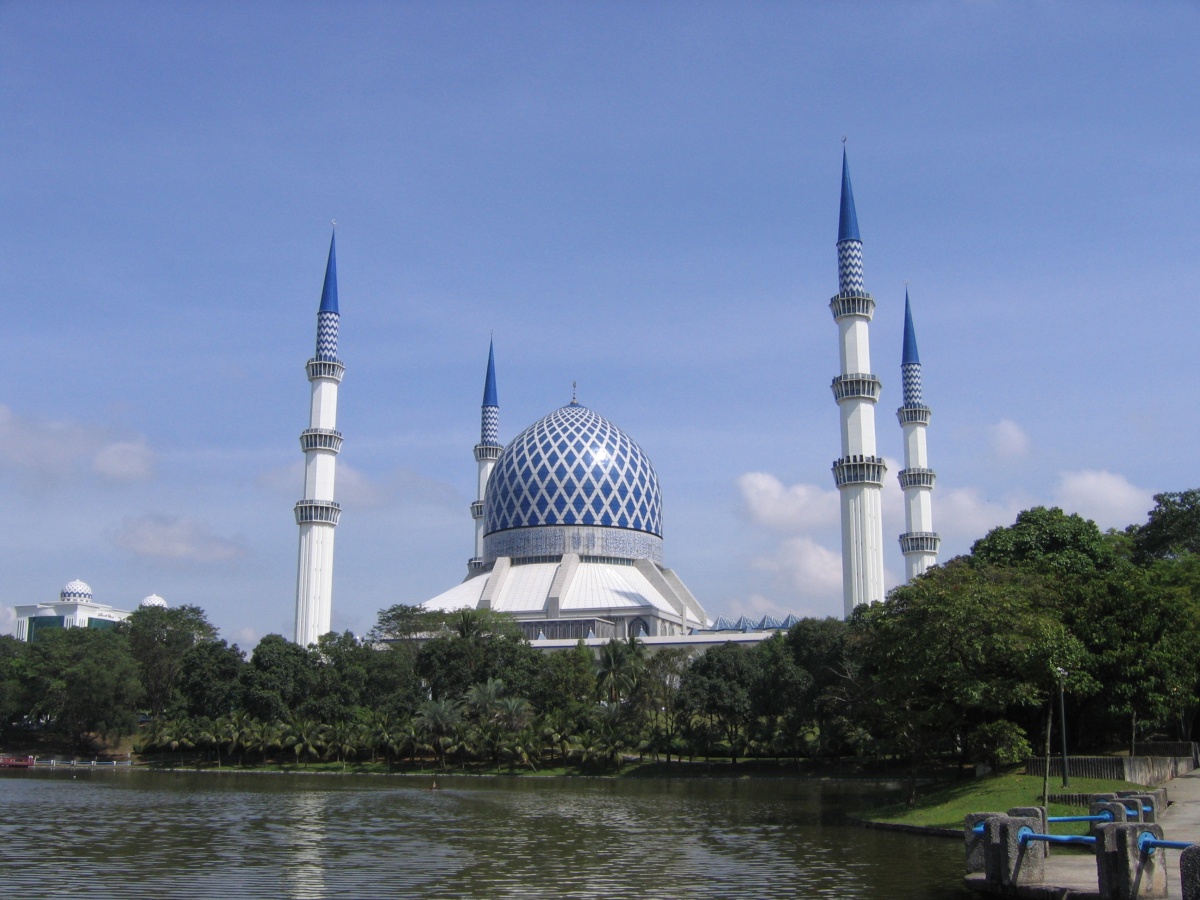
Sultan Salahuddin Mosque or Blue Mosque in Shah Alam, Selangor, Malaysia — CC BY-SA 3
Travel to Blue Mosque Shah Alam
Getting There from Kuala Lumpur
Blue Mosque Shah Alam is about 25 kilometres south-west of Kuala Lumpur, and the drive takes about thirty minutes by car or taxi. Visitors should enter Shah Alam, Selangor, as the destination, not Kuala Lumpur, or they may be taken to the National Mosque in Kuala Lumpur instead. The mosque stands on Persiaran Masjid in Seksyen 14, in the centre of Shah Alam, beside the lake, and it is easy to find once the driver knows the city.
Public transport to Shah Alam is possible by train and by bus from Kuala Lumpur, yet a taxi or a hired car is more reliable, because the mosque is in the centre of a planned city with wide roads and few pedestrians. Visitors who travel by train should take the KTM Komuter to Shah Alam station and then a taxi to the mosque. The mosque has parking, and visitors who drive can park near the mosque, although the car park fills at Friday prayers.
Blue Mosque Shah Alam fits into a day trip from Kuala Lumpur, combined with the other sights of the capital or with Putrajaya, the administrative capital to the south. A morning at the mosque, with a guided tour, pairs with an afternoon in Kuala Lumpur, at the Menara Kuala Lumpur tower or in Chinatown, and the two together give a day of the modern Malaysia. The mosque is a half-day visit, and it should be planned as the morning of a longer day.
Visiting as a Non-Muslim
Non-Muslim visitors are welcome at Blue Mosque Shah Alam outside prayer times, and the mosque offers free guided tours in English. Robes and headscarves are lent free at the mosque, and visitors should wear them, covering shoulders, arms and legs, and women should cover their hair. Shoes are removed at the entrance, and visitors should leave them in the racks provided.
The guided tour of Blue Mosque Shah Alam explains the architecture, the dome, the minarets and the practice of Islam, and it is the best way to see the mosque, because the guides know the building and its history. The tour takes about an hour, and it covers the main hall, the courtyard and the garden, and it ends with time for questions. Visitors should speak quietly in the prayer hall, should not walk in front of people at prayer, and should not take photographs during prayer. The mosque is a place of worship first, and a sight second, and the visitor should behave as a guest.
The mosque is closed to visitors during prayer times, and the Friday midday prayers close it for longer, so visitors should check the prayer schedule before going. The mosque publishes its visiting hours, and the tours run between prayers, so a visitor who arrives in the morning will find the mosque open and the guides ready. The visit is free, and the robes are free, and the only price is respect.
When to Go
The best time to visit Blue Mosque Shah Alam is the morning, when the light is soft, the air is cooler, and the mosque is quiet between prayers. The guided tours run in the morning and the afternoon, and the morning tour is the calmest, with fewer visitors and a clearer view of the dome. The mosque is open all year, and Malaysia has no winter, so the season matters less than the hour, and the morning is the hour to choose.
Visitors should avoid the Friday midday prayers, when the mosque fills and the grounds are crowded, and they should avoid the festivals of the Islamic calendar, when the mosque is full of worshippers. The months of the rainy season, from about October to March, can bring afternoon showers, so the morning is again the best time. The mosque is at its most beautiful in the morning, when the sun rises over the lake and the blue dome shines, and the garden is quiet.
The visit to Blue Mosque Shah Alam takes about one to two hours, including the guided tour and the walk in the garden. The mosque should not be hurried, because its scale needs time to be felt, and the garden and the lake need time to be walked. A morning at the mosque, followed by lunch in Shah Alam and an afternoon in Kuala Lumpur, is the best use of the day, and it is the day that most visitors choose.
Notable Places in Blue Mosque Shah Alam
The Main Dome
The main dome of Blue Mosque Shah Alam is 51.2 metres in diameter and 106.7 metres high, made of aluminium and clad in blue and silver enamelled steel plates. The dome was once ranked among the largest religious domes in the world, and its blue and silver surface changes colour with the sky. The dome is the reason for the name Blue Mosque, and it is the landmark of Shah Alam, visible from across the city and from the highways around it.
The Four Minarets
The four minarets of Blue Mosque Shah Alam stand at the four corners of the mosque, each 142.3 metres high, and they were the tallest minarets in the world when the mosque opened in 1988. They remain the tallest set of four minarets in the world, and they frame the dome from every direction. The minarets are slender, white and blue, and they are the towers by which the mosque is recognised from far away.
The Main Prayer Hall
The main prayer hall of Blue Mosque Shah Alam holds 12,600 people, and it is the heart of the mosque. The hall is a great open space under the dome, with carpets, calligraphy and light from the high windows, and it is the place where the Friday prayers fill the mosque. The hall is the most solemn part of Blue Mosque Shah Alam, and visitors see it on the guided tour, walking quietly through the space where the worshippers pray.
The Islamic Arts Garden and the Lake
The Islamic Arts Garden of Blue Mosque Shah Alam covers 14 hectares beside the mosque, with paths, water and planting in the Islamic tradition, and the lake of Taman Tasik Shah Alam lies beside it. The garden and the lake reflect the dome, and they are the setting of the mosque, planned together with it. The garden is the quiet place of Blue Mosque Shah Alam, and it is the place to walk after the tour, when the dome is reflected in the water.
Frequently Asked Questions
Is the Blue Mosque in Kuala Lumpur or Shah Alam?
Blue Mosque Shah Alam stands in Shah Alam, the capital of Selangor, about 25 kilometres south-west of Kuala Lumpur. It is not in Kuala Lumpur, and it is not the National Mosque or the Federal Territory Mosque, which stand in Kuala Lumpur.
What is the full name of Blue Mosque Shah Alam?
Its full name is the Sultan Salahuddin Abdul Aziz Shah Mosque, in Malay Masjid Sultan Salahuddin Abdul Aziz Shah. It is the state mosque of Selangor and the largest mosque in Malaysia.
How big is Blue Mosque Shah Alam?
The mosque holds up to 24,000 people, with 12,600 in the main prayer hall. Its dome is 51.2 metres across and 106.7 metres high, and its four minarets are each 142.3 metres high.
Can non-Muslims visit Blue Mosque Shah Alam?
Yes. Non-Muslim visitors are welcome outside prayer times, with free guided tours in English, and robes and headscarves are lent free at the mosque. Shoes are removed at the entrance, and visitors should dress modestly and speak quietly.
How do I get to Blue Mosque Shah Alam from Kuala Lumpur?
Drive or take a taxi for about thirty minutes, entering Shah Alam, Selangor, as the destination. By train, take the KTM Komuter to Shah Alam station and then a taxi to the mosque on Persiaran Masjid in Seksyen 14.
When is the best time to visit Blue Mosque Shah Alam?
The morning is best, when the light is soft and the mosque is quiet between prayers. Avoid the Friday midday prayers, when the mosque fills, and check the prayer schedule before going.
Verified
The facts in this article were checked against the Tourism Malaysia information, the Selangor tourism information, and the Vietnamese article for this entity, on 22 November 2026. The location in Shah Alam, Selangor, the opening date of 11 March 1988, the architect Dato Baharuddin Abu Kassim, the capacity of 24,000 people, the dome of 51.2 by 106.7 metres, and the four minarets of 142.3 metres are taken from those sources. The Wikidata entry of Blue Mosque Shah Alam is Q308510 at 3.0786° N, 101.5206° E, and that entry names the Sultan Salahuddin Abdul Aziz Shah Mosque. Points where the sources disagree are listed under Unverified, with the disagreement stated rather than hidden.
Sources
- Tourism Malaysia — https://www.malaysia.travel/
- Tourism Selangor — https://www.selangor.travel/
- Sultan Salahuddin Abdul Aziz Mosque, Wikipedia — https://en.wikipedia.org/wiki/Sultan_Salahuddin_Abdul_Aziz_Mosque
- Wikidata, Sultan Salahuddin Abdul Aziz Mosque Q308510 — https://www.wikidata.org/wiki/Q308510
Unverified
The claim that Blue Mosque Shah Alam is the second largest mosque in Southeast Asia by capacity is reported by some sources and is not asserted here, because the ranking depends on how capacity is counted. The exact visiting hours and the exact schedule of the guided tours change with the prayer times, so travellers should check them at the mosque before going. The parent of this registry entity is recorded as Kuala Lumpur, yet the mosque stands in Shah Alam, Selangor, and that mismatch is recorded in the fix queue rather than corrected in this article. The precise current capacity of the main prayer hall is given as 12,600 by the sources consulted, and it may change with the arrangement of the hall.
Illustrations
- Hero: View of Blue Mosque Shah Alam. Free image: https://upload.wikimedia.org/wikipedia/commons/4/48/The_Blue_Mosque_-Shah_Alam-_panoramio.jpg — CC BY-SA 3.0.
- In body, Blue Mosque Shah Alam: Sultan Salahuddin Mosque or Blue Mosque in Shah Alam, Selangor, Malaysia. Free image: https://upload.wikimedia.org/wikipedia/commons/4/4b/SA_Blue_Mosque.jpg — CC BY-SA 3.
- In body, Blue Mosque Shah Alam: Sultan Salahuddin Abdul Aziz Shah mosque night view. Free image: https://upload.wikimedia.org/wikipedia/commons/b/bf/Shah_Alam_Blue_mosque_at_night.jpg — CC BY 2.