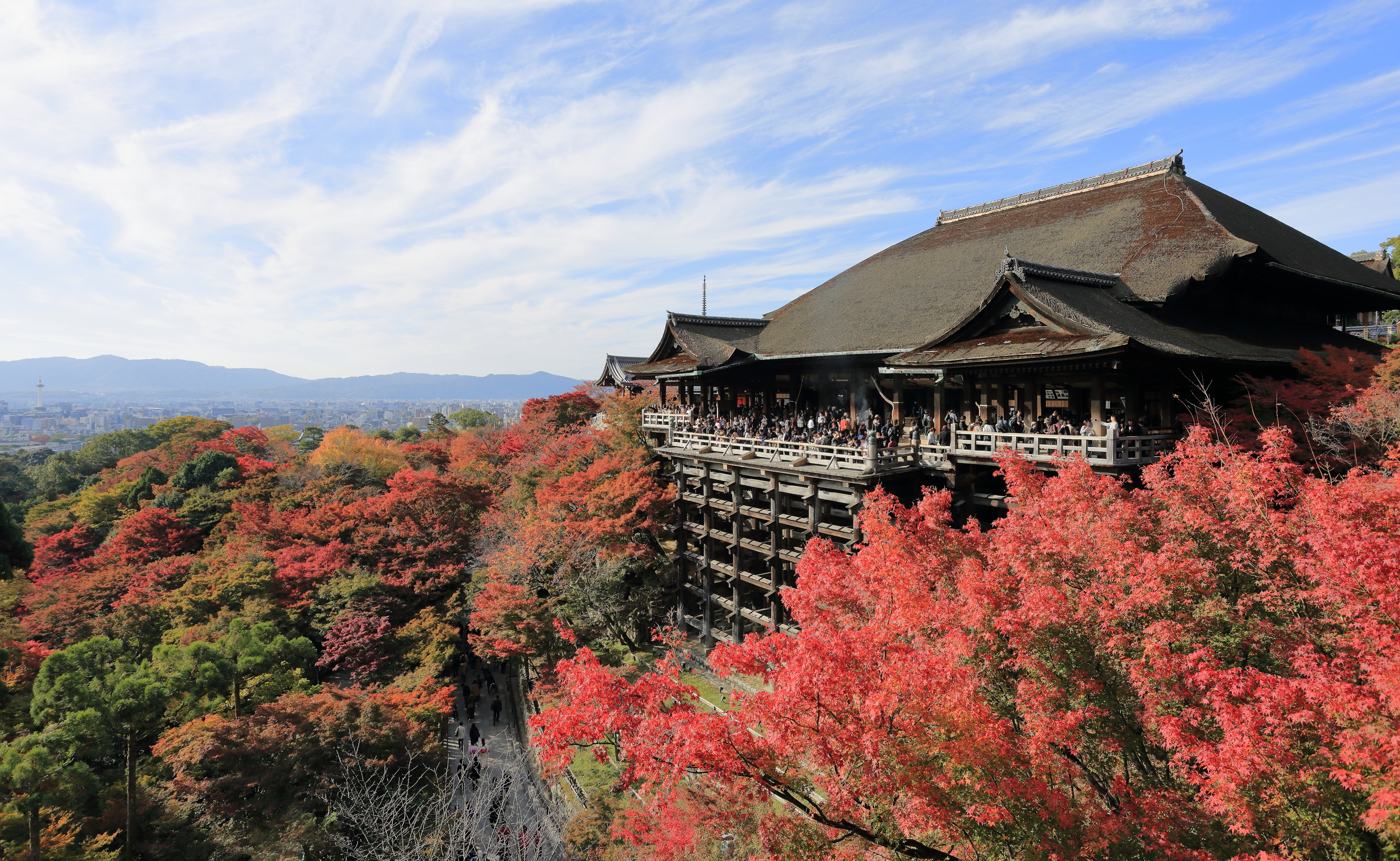
Kiyomizu-dera: The Wooden Stage Above Kyoto
Kiyomizu-dera is the temple of eastern Kyoto, a wooden stage above the city and a spring below. Founded in 778, it is one of the oldest temples in Japan.
Kiyomizu-dera, the full name of which is Otowasan Kiyomizu-dera, stands on Mount Otowa, in the Higashiyama district of Kyoto, and it is one of the most visited temples in Japan. The temple is famous for its wooden stage, which juts out from the main hall, thirteen metres above the hillside, held up by eighteen great pillars of zelkova wood, joined without a single nail, and the view from the stage, over the city of Kyoto, is one of the great views of Japan.
The temple was founded in 778, around the Otowa spring, the pure water that gives the temple its name, and the present main hall was rebuilt in 1633, under the shogun Tokugawa Iemitsu, and it is a National Treasure of Japan. The grounds cover about 130,000 square metres, with more than thirty halls and pagodas, and the temple is one of the seventeen components of the World Heritage site of the Historic Monuments of Ancient Kyoto, listed by UNESCO in 1994.
Quick Facts About Kiyomizu-dera
| Item | Detail |
|---|---|
| Name | Kiyomizu-dera, in Japanese Kiyomizu-dera, full name Otowasan Kiyomizu-dera |
| Location | 1-294 Kiyomizu, Higashiyama Ward, Kyoto, Japan |
| Coordinates | 34.9948° N, 135.7850° E |
| Wikidata | Q221716, verified through the Wikidata API on 21 November 2026 |
| Founded | 778, around the Otowa spring on Mount Otowa |
| Present main hall | Rebuilt 1633, under Tokugawa Iemitsu, a National Treasure |
| Wooden stage | About 13 metres high, kake-zukuri style, 18 main pillars of zelkova wood, no nails |
| Grounds | About 130,000 square metres, more than 30 halls and pagodas |
| Three-storey pagoda | About 31 metres high, one of the largest three-storey pagodas in Japan |
| UNESCO | Historic Monuments of Ancient Kyoto, listed 1994, reference 688, criteria ii and iv, one of 17 components |
| Opening | From 6:00 in the morning, all year |
| Access | Bus from Kyoto Station to Kiyomizu-michi, then walk up the slope through Ninenzaka |
Geography of Kiyomizu-dera
Kiyomizu-dera stands on Mount Otowa, in the Higashiyama district, in the east of Kyoto, and the temple looks west over the whole city, with the pagodas, the roofs and the mountains in a single view. The temple is reached by bus from Kyoto Station to Kiyomizu-michi, and then on foot up the slope, through the streets of Ninenzaka and Sannenzaka, the old lanes of Higashiyama, with their shops, their tea houses and their pottery, and the walk up the slope is the introduction to the temple, with the city falling away behind and the temple rising in front.
The wooden stage is the centre of the temple, and it juts out from the main hall, thirteen metres above the hillside, held up by eighteen great pillars of zelkova wood, joined without a single nail, in the kake-zukuri style of building on a slope. The stage is the place to stand and to look over Kyoto, and the view from it, with the city below and the mountains around, is the great view of the temple, and the reason the stage is the most photographed place in Kyoto.
The grounds of the temple cover about 130,000 square metres, with more than thirty halls and pagodas, and the grounds are a mountain in themselves, with paths, with steps, with trees and with water. The three-storey pagoda stands about thirty-one metres high, and it is one of the largest three-storey pagodas in Japan, with its red lacquer and its roofs, and it is the second landmark of the temple, after the stage, and the place to photograph from below.
The Otowa spring is the origin of the temple, and it is the pure water that gives Kiyomizu-dera its name, which means the temple of pure water. The spring falls in three streams, and visitors drink from them, with long-handled cups, and each stream is said to give a different blessing, for long life, for success in study and for a good love, and the spring is the reason the temple was founded here, in 778, by the monk Enchin, who found the water on the mountain.
The temple opens at six in the morning, all year, and the early morning is the best time to visit, when the gates have just opened and the crowds have not yet come, and the light is on the stage and the city. The temple is busy through the day, with visitors from across Japan and the world, and the crowds are greatest in spring, when the cherry blossom fills the grounds, and in autumn, when the maple leaves turn red, and the temple is at its finest in those two seasons, with the stage, the pagoda and the trees in a single view.
The streets of Ninenzaka and Sannenzaka, below the temple, are the old lanes of Higashiyama, with their stone paving, their wooden houses, their shops and their tea houses, and they are the way to the temple, and the way back, with the pottery shops, the sweet shops and the views down the slope to the city. The lanes are protected as a historic district, and they are the reason the approach to Kiyomizu-dera is as much a part of the visit as the temple itself, with the old Kyoto of the lanes and the temple of the mountain together.
The climate of Kyoto is mild, with hot summers and cold winters, and the temple is at its best in spring and autumn, when the blossom and the leaves are at their finest, and the air is mild. Summer is hot and humid, but the temple is on the mountain, with the trees and the shade, so the visit is good in summer too, and winter is cold, with the snow on the stage and the pagoda, and the temple is quiet then, with the crowds gone and the mountain to itself. Rain suits the temple as well, with the wet stone of the lanes, the dark wood of the halls and the mist hanging over the city below, so a grey day in Higashiyama can be as fine as a clear one.
The temple is one of the seventeen components of the World Heritage site of the Historic Monuments of Ancient Kyoto, listed by UNESCO in 1994, with the reference number 688 and the criteria ii and iv, and the listing covers the temples, the shrines and the castle of the old capital, with Kiyomizu-dera as one of the greatest of them. The temple is therefore not only a place of worship, but also a monument of the world, and its protection is the protection of the history of Kyoto itself.
The geography of Kiyomizu-dera is the geography of a temple on a mountain, with the stage above the city, the spring below the hall and the pagoda on the slope, and the lanes of Higashiyama leading up to it. The temple is the eastern landmark of Kyoto, and the view from its stage, over the city and the mountains, is the view that every visitor to Kyoto remembers. The other great sights of the city are close by: Gion, with its old streets, Fushimi Inari, with its thousand vermilion gates, and Arashiyama, with its bamboo grove, and the four together make the classic first days in Kyoto.

Kiyomizu Temple in Kyoto — CC BY 2
History of Kiyomizu-dera
The history of Kiyomizu-dera begins in 778, when the monk Enchin, also known as Kenshin, found the Otowa spring on Mount Otowa, and founded a temple around the pure water. The spring was the reason for the temple, and the name of the temple, Kiyomizu-dera, means the temple of pure water, so the water and the temple have been one since the beginning, and the spring still flows, with its three streams, under the main hall.
The temple grew through the centuries, and it became one of the great temples of Kyoto, with its halls, its pagodas and its stage, and the main hall of the temple, the hall that stands today, was rebuilt in 1633, under the shogun Tokugawa Iemitsu, and it is a National Treasure of Japan. The rebuilding of 1633 is the temple that the visitor sees today, with its stage, its pillars and its roofs, and the hall has stood for nearly four hundred years, through the wars, the fires and the changes of the city.
The wooden stage is the most famous part of the temple, and it was built in the kake-zukuri style, with eighteen great pillars of zelkova wood, joined without a single nail, holding up a stage thirteen metres above the hillside. The stage was built to be a place for dance and for prayer, and it became a place for a darker tradition: between 1694 and 1864, two hundred and thirty-four people jumped from the stage, believing that if they survived the fall, their wish would come true, and the jump became a saying in Japanese, to take the plunge from the stage of Kiyomizu.
The temple was a place of pilgrimage for centuries, and the people of Kyoto came here to pray, to drink from the spring and to look from the stage, and the temple was one of the great sights of the old capital, with its pagoda, its halls and its grounds. The temple was rebuilt, repaired and extended through the centuries, and each generation added its own halls, so the grounds of today, with more than thirty halls and pagodas, are the sum of twelve centuries of building.
The three-storey pagoda, about thirty-one metres high, is one of the largest three-storey pagodas in Japan, and it stands on the slope below the main hall, with its red lacquer and its roofs, and it is the second landmark of the temple. The pagoda was rebuilt through the centuries, as the temple was, and it is the sign of the temple from the city below, with its red tower rising above the trees of the mountain.
In 1994, UNESCO listed the Historic Monuments of Ancient Kyoto as a World Heritage site, with seventeen components, and Kiyomizu-dera was one of them, with the reference number 688 and the criteria ii and iv. The listing made the temple known to the world, and it made the temple one of the most visited places in Japan, with visitors from every country coming to see the stage, the spring and the pagoda, and to walk the lanes of Higashiyama.
The Jishu Shrine, the shrine of love that stands beside the temple, is part of the history of the place, and it has been closed for restoration, so the visitor should check whether it has reopened. The shrine is the shrine of the god of love, and it is the place where visitors pray for a good marriage, and its stones, the love stones, are the test of love, with the visitor walking from one stone to the other with closed eyes.
Today Kiyomizu-dera is one of the most visited temples in Japan, and it is the temple that every visitor to Kyoto sees, with its stage, its spring and its pagoda, and its lanes. The temple has stood for twelve centuries, and it has been rebuilt, repaired and listed, and it is still a place of worship, with the monks, the prayers and the water, as it was in 778, when the monk Enchin found the spring on the mountain.
The history of Kiyomizu-dera is the history of Kyoto itself, with the temple founded in the eighth century, rebuilt in the seventeenth and listed in the twentieth, and the city growing around it, with the lanes, the shops and the people. The temple that was founded around a spring is still a temple around a spring, and the water that gave it its name still flows, under the stage and through the mountain.

Kiyomizu-dera temple in Kyoto — CC BY-SA 4
Travel to Kiyomizu-dera
The way to Kiyomizu-dera is by bus from Kyoto Station to Kiyomizu-michi, and then on foot up the slope, through the lanes of Ninenzaka and Sannenzaka, with their shops and tea houses. The walk up the slope takes about ten minutes, and it is the introduction to the temple, with the city falling away behind and the temple rising in front, so the visitor should take the walk slowly, and stop at the shops and the views on the way.
The temple opens at six in the morning, all year, and the early morning is the best time to visit, when the gates have just opened and the crowds have not yet come. The stage, the pagoda and the spring are all quiet in the morning, and the light is on the city below, so the first hour of the day is the best hour in the temple, and the visitor who comes early will have the stage almost to themselves.
Spring and autumn are the great seasons for Kiyomizu-dera, when the cherry blossom fills the grounds in spring and the maple leaves turn red in autumn, and the temple is at its finest then, with the stage, the pagoda and the trees in a single view. The temple is busy in those seasons, and the crowds are greatest in the afternoon, so the morning, with the blossom and the light, is the time to choose.
Check the entry rules for Japan for your nationality before you plan your visit.
The spring is the quiet heart of the temple, and the visitor should drink from the three streams, with the long-handled cups, and each stream is said to give a different blessing, for long life, for success in study and for a good love. From the stage, the city lies below and the mountains ring it, a panorama that draws every camera in the temple, and the reason the stage is the most photographed place in Kyoto.
The lanes below the temple, Ninenzaka and Sannenzaka, are the way back, with their pottery shops, their sweet shops and their tea houses, and the visitor should allow time for the lanes, as well as for the temple, because the old Kyoto of the lanes is as much a part of the visit as the temple of the mountain. The day that joins the lanes and the temple, with the morning in the temple and the afternoon in the lanes, is the classic day in Higashiyama. In spring and in autumn, the temple opens at night for special illuminations, when the stage, the pagoda and the maple trees are lit, and the night visit, with the city below in lights, is the most memorable way to end the day.
Notable Places at Kiyomizu-dera
The Wooden Stage
The wooden stage of Kiyomizu-dera juts out from the main hall, thirteen metres above the hillside, held up by eighteen great pillars of zelkova wood, joined without a single nail. The stage is the best-known spot in the temple, and from it the whole of Kyoto spreads below, a view counted among the finest in Japan.

the wooden stage of Kiyomizu-dera in Kyoto — CC BY-SA 4
The Main Hall
The main hall of Kiyomizu-dera was rebuilt in 1633, under the shogun Tokugawa Iemitsu, and it is a National Treasure of Japan. The hall stands at the top of the stage, with its roofs and its pillars, and it is the heart of the temple, where the prayers are said and the offerings are made.

the main hall and wooden stage of Kiyomizu-dera in autumn — CC BY-SA 4
The Otowa Spring
The Otowa spring is the origin of Kiyomizu-dera, and it falls in three streams under the main hall, with long-handled cups for the visitors to drink from. Each stream is said to give a different blessing, for long life, for success in study and for a good love, and the spring is the reason the temple was founded here in 778.

the Otowa spring at Kiyomizu-dera — CC BY-SA 4
The Three-Storey Pagoda
The three-storey pagoda of Kiyomizu-dera stands about thirty-one metres high, and it is one of the largest three-storey pagodas in Japan. The pagoda stands on the slope below the main hall, with its red lacquer and its roofs, and it is the second landmark of the temple, after the stage.

the three-storey pagoda of Kiyomizu-dera in autumn — CC BY-SA 4
Ninenzaka and Sannenzaka
Ninenzaka and Sannenzaka are the old lanes of Higashiyama, below the temple, with stone paving, wooden houses, shops and tea houses. The lanes are the way to the temple, and the way back, and they are protected as a historic district, so the old Kyoto of the lanes is as much a part of the visit as the temple of the mountain.

Ninenzaka in Kyoto — CC BY-SA 2
The Jishu Shrine
The Jishu Shrine stands beside Kiyomizu-dera, and it is the shrine of love, where visitors pray for a good marriage. The shrine has been closed for restoration, so the visitor should check whether it has reopened, and its love stones, walked between with closed eyes, are the test of love in the temple.

the Jishu Shrine at Kiyomizu-dera — CC BY-SA 4
Frequently Asked Questions About Kiyomizu-dera
When was Kiyomizu-dera founded?
Kiyomizu-dera was founded in 778, around the Otowa spring on Mount Otowa, by the monk Enchin, and the present main hall was rebuilt in 1633, under the shogun Tokugawa Iemitsu.
How high is the wooden stage at Kiyomizu-dera?
The wooden stage is about 13 metres high, held up by 18 main pillars of zelkova wood, joined without a single nail, in the kake-zukuri style of building on a slope.
What is the Otowa spring?
The Otowa spring is the pure water that gives Kiyomizu-dera its name, and it falls in three streams, each said to give a different blessing, for long life, for success in study and for a good love.
Is Kiyomizu-dera a World Heritage site?
Yes. Kiyomizu-dera is one of the 17 parts of the Historic Monuments of Ancient Kyoto, listed in 1994, reference 688, criteria ii and iv.
What time does Kiyomizu-dera open?
Kiyomizu-dera opens at 6:00 in the morning, all year, and the early morning, when the gates have just opened, is the best time to visit.
How do I get to Kiyomizu-dera?
Take the bus from Kyoto Station to Kiyomizu-michi, and walk up the slope through the lanes of Ninenzaka and Sannenzaka to the temple.
Verified
- Kiyomizu-dera was founded in 778, around the Otowa spring on Mount Otowa. Checked 21 November 2026.
- The present main hall was rebuilt in 1633, under Tokugawa Iemitsu, and it is a National Treasure. Checked 21 November 2026.
- The wooden stage is about 13 metres high, with 18 main pillars of zelkova wood, joined without a single nail, in the kake-zukuri style. Checked 21 November 2026.
- The grounds cover about 130,000 square metres, with more than 30 halls and pagodas. Checked 21 November 2026.
- The three-storey pagoda is about 31 metres high, one of the largest three-storey pagodas in Japan. Checked 21 November 2026.
- Kiyomizu-dera is one of the 17 components of the Historic Monuments of Ancient Kyoto, listed by UNESCO in 1994, reference 688, criteria ii and iv. Checked 21 November 2026.
- Between 1694 and 1864, 234 people jumped from the stage of Kiyomizu-dera. Checked 21 November 2026.
- The temple opens at 6:00 in the morning, all year. Checked 21 November 2026.
- Coordinates 34.9948/135.7850 and Wikidata Q221716 for Kiyomizu-dera were verified through the Wikidata API on 21 November 2026. Checked 21 November 2026.
Sources
- Layers of Japan, Kiyomizu-dera — https://layersofjapan.com/2026/11/12/kiyomizudera-kyoto-wooden-stage-guide/ — for the founding of 778, the rebuilding of 1633, the stage of 13 metres and the 18 pillars.
- UNESCO, Historic Monuments of Ancient Kyoto — https://whc.unesco.org/en/list/688/ — for the listing of 1994, the 17 components and the criteria ii and iv, checked on the UNESCO site.
- Wikidata, Kiyomizu-dera Q221716 — https://www.wikidata.org/wiki/Q221716 — for the identity, the type and the coordinates, verified through the Wikidata API on 21 November 2026.
Unverified
- The story that 234 people jumped from the stage between 1694 and 1864 is given by the guides of the temple, and the exact count has not been checked against a primary record for this article.
- The blessings of the three streams of the Otowa spring are a tradition of the temple, not a dated historical record, so this article presents them as a tradition.
- The Jishu Shrine has been closed for restoration, and its reopening date is not stated in this article, since the sources give different dates.
Illustrations
- Hero: Kiyomizu-dera temple in autumn. Free image: https://upload.wikimedia.org/wikipedia/commons/8/83/Kiyomizu-dera%2C_Kyoto%2C_November_2016_-01.jpg — CC BY-SA 4.
- In body, the temple: Kiyomizu-dera temple in Kyoto. Free image: https://upload.wikimedia.org/wikipedia/commons/1/10/Kiyomizu-dera%2C_Kyoto%2C_November_2016_-06.jpg — CC BY-SA 4.
- In body, the temple: Kiyomizu Temple in Kyoto. Free image: https://upload.wikimedia.org/wikipedia/commons/6/61/Flickr_-yeowatzup–Kiyomizu_Temple%2C_Kyoto%2C_Japan%281%29.jpg — CC BY 2.
- In body, the Wooden Stage: the wooden stage of Kiyomizu-dera in Kyoto. Free image: https://upload.wikimedia.org/wikipedia/commons/3/3b/Path_below_the_Kiyomizu-dera_stage_in_summer_green%2C_Kyoto%2C_August_2019.jpg — CC BY-SA 4.
- In body, the Main Hall: the main hall and wooden stage of Kiyomizu-dera in autumn. Free image: https://upload.wikimedia.org/wikipedia/commons/a/ae/Kiyomizu-dera%2C_Kyoto%2C_November_2016_-02.jpg — CC BY-SA 4.
- In body, the Otowa Spring: the Otowa spring at Kiyomizu-dera. Free image: https://upload.wikimedia.org/wikipedia/commons/b/bb/Otowa-no-taki%2C_june_2019.jpg — CC BY-SA 4.
- In body, the Three-Storey Pagoda: the three-storey pagoda of Kiyomizu-dera in autumn. Free image: https://upload.wikimedia.org/wikipedia/commons/1/15/Kiyomizu-dera%2C_Kyoto%2C_November_2016_-04.jpg — CC BY-SA 4.
- In body, Ninenzaka and Sannenzaka: Ninenzaka in Kyoto. Free image: https://upload.wikimedia.org/wikipedia/commons/6/65/Gion_-Nineizaka%28Ninenzaka%29%2C_Kyoto%2C_Japan_%2848923269328%29.jpg — CC BY-SA 2.
- In body, the Jishu Shrine: the Jishu Shrine at Kiyomizu-dera. Free image: https://upload.wikimedia.org/wikipedia/commons/a/aa/Kyoto_Kiyumizu-dera_Jishu-jinja_3.jpg — CC BY-SA 4.