
Chion-in Kyoto: The Head Temple of Pure Land Buddhism and Its Great Sanmon Gate
Chion-in is the head temple of Pure Land Buddhism in Kyoto, Japan. Its great Sanmon gate is the largest temple gate in Japan.
Chion-in, in full Kachozan Chion-kyo-in Otani-dera, stands at 400 Rinka-cho in Higashiyama, Kyoto, on the lower slopes of the eastern hills. The temple is the head temple of the Jodo-shu school, the Pure Land school founded by Honen, and it was built in 1234 by Honen’s disciple Genchi to honour his teacher.
The Sanmon gate, built in 1619, is the largest temple gate in Japan and a National Treasure, and the great bell of the temple, cast in 1633, weighs 74 tons and is the largest temple bell in the country. Chion-in is one of the largest temples in Kyoto, and it is a working monastery as well as a place to visit. This guide sets out the geography of the temple, its history from Honen to the Tokugawa rebuilding, and the practical visit.
Quick Facts About Chion-in
| Fact | Detail |
|---|---|
| Name | Chion-in (Japanese: 知恩院; full name Kachozan Chion-kyo-in Otani-dera) |
| Location | 400 Rinka-cho, Higashiyama Ward, Kyoto, Japan |
| Type | Buddhist temple — Jodo-shu (Pure Land school), head temple of the school |
| Founded | Original temple built in 1234 by Genchi, disciple of Honen, in memory of Honen |
| Highlights | Sanmon gate (1619, National Treasure); Mieido main hall (National Treasure); great bell of 74 tons; the Seven Wonders of the temple |
| Entry | Entry to the grounds is free; some areas inside the temple charge a fee — check the current prices before going |
| UNESCO | Not a component of the Historic Monuments of Ancient Kyoto, listed in 1994, ref. 688 — Chion-in is not among the 17 listed components |
| Coordinates | 35.005208° N, 135.783403° E |
| Wikidata | Q873645 |
Geography of Chion-in
Chion-in stands in Higashiyama Ward, in the eastern part of Kyoto, at the foot of the hills that run along the east of the city. The temple grounds climb the lower slopes of those hills, so the Sanmon gate stands at the foot of the slope, the main hall stands higher up, and the bell tower and the upper halls stand higher still. The climb through the grounds is part of the visit, and the view back across the city opens as the visitor rises. The hills of Higashiyama are the setting for many of Kyoto’s great temples, and Chion-in is one of the largest of them.
The temple lies close to the centre of Higashiyama, and its neighbours are among the most visited places in Kyoto. The Yasaka Shrine stands a short walk to the south, the lanes of Gion lie to the west, and the Kiyomizu-dera temple stands further south along the hills. The position of Chion-in, between the city and the hills, is the position of a temple that serves both the people of Kyoto and the monks who live on the slope. The grounds are large enough to feel apart from the streets, yet the Sanmon gate opens directly onto the road, and the city is never far away.
The grounds of Chion-in are divided by the slope into a lower and an upper part. The lower grounds hold the Sanmon gate, the long approach, and the Mieido main hall, and they are the part of the temple that most visitors see. The upper grounds hold the bell tower, the Seishi-do hall and the mausoleum of Honen, and they are reached by stone steps that climb through the trees. The division is old, and it reflects the growth of the temple over the centuries, as new halls were built higher up the slope when the lower grounds were full.
The climate of Kyoto shapes the visit to Chion-in. The city has hot and humid summers, cold winters, and the sharpest seasons of any of Japan’s great cities.
The cherry blossom of spring and the maple leaves of autumn are the two great seasons, and the grounds of Chion-in are at their best in both. The summer is hot on the climb to the upper grounds, and the winter is cold on the exposed terrace, so the spring and the autumn give the most comfortable visit. The temple is open through the year, and the winter light on the Sanmon gate is as fine as the spring blossom.
The water of the temple is a small stream that runs through the grounds, and it is part of the Seven Wonders of Chion-in, the group of curious features that the temple is known for. The stream, the bell, the gate and the other wonders are scattered through the grounds, and finding them is a reason to walk the whole temple rather than only the main hall. The hills above the temple hold the springs that feed the stream, and the water runs down through the grounds towards the city.
The approach to Chion-in begins at the Sanmon gate, where the road from the city meets the temple, and the long stone-paved walk climbs gently from the gate towards the Mieido. The walk is lined with stone lanterns and with the pine trees that shade the lower grounds, and the sound of the city fades as the visitor climbs. The steps that lead to the upper grounds are steeper, cut into the slope and worn smooth by centuries of feet, and they pass the small shrines and the stone markers that line the way. The climb is the pilgrimage in miniature, and the visitor who takes it slowly will notice how the temple unfolds: first the gate, then the hall, then the bell tower above, each revealed in turn as the ground rises.
The terrace of the Mieido gives the finest view in the temple, looking west across the rooftops of Kyoto towards the mountains beyond the city. The view is best in the late afternoon, when the sun falls behind the western hills and the light turns gold on the tiles of the hall. The city below is a sea of dark roofs and grey walls, with the Yasaka pagoda rising to the south and the hills of Arashiyama far to the west. The terrace is the place to stand and look, and it is the reason the main hall was built where it stands, high on the slope above the city it serves.
The grounds of Chion-in are planted with pine and maple, and the trees are the second landscape of the temple, after the buildings. The maples turn red in November, and the pines stay green through the winter, so the grounds change colour with the seasons. The stream that runs through the grounds is the water of the temple, feeding the ponds and the gardens, and its sound follows the visitor along the paths. The trees and the water make the temple a garden as well as a monastery, and the walk through them is the quietest part of the visit.
The wider setting of Chion-in is the city of Kyoto, which was the capital of Japan from 794 to 1868, and which keeps more than a thousand temples and shrines. The eastern hills, where Chion-in stands, are the most temple-rich part of the city, and the Higashiyama district is the heart of the old capital. Chion-in is a temple of the medieval period, built after the capital had already stood for four centuries, and it belongs to the age when the great schools of Japanese Buddhism were founded and their head temples were built. The temple is a part of that history, and its size shows the power of the Pure Land school in medieval Kyoto.

Chion-in ‘s main hall “Mieido”, front view behind an incense altar, Higashiyama Ward , Kyoto , Japan — CC BY-SA 4

The lanes of Gion, Kyoto — Basile Morin, CC BY-SA 4
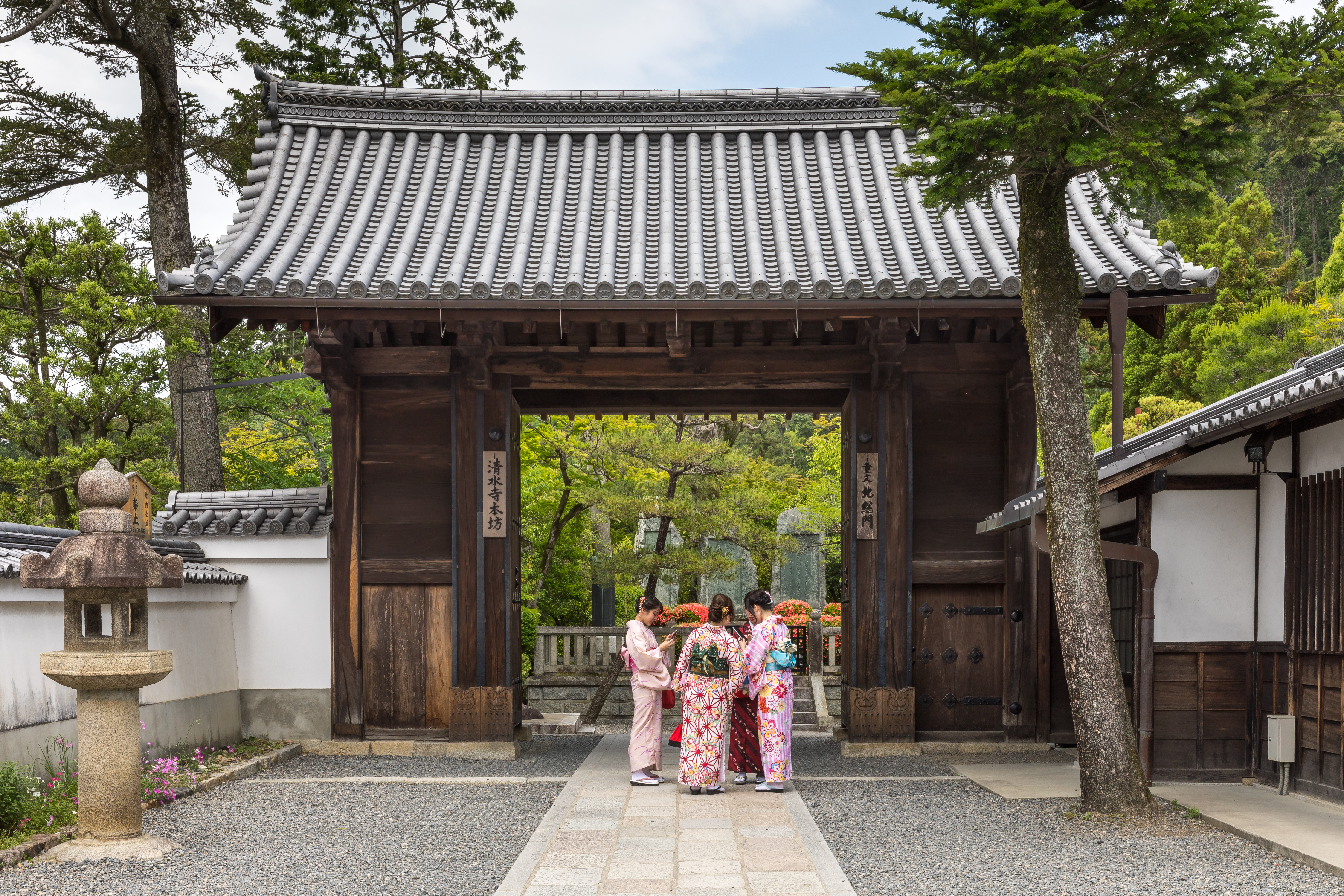
Kiyomizu-dera temple, Kyoto — Basile Morin, CC BY-SA 4

Yasaka Shrine, Kyoto — Jakub Hałun, CC BY 4
History of Chion-in
Honen and the Pure Land School
The history of Chion-in begins with Honen, who was born in 1133 and who founded the Jodo-shu school, the Pure Land school of Japanese Buddhism. Honen taught that the recitation of the name of Amida Buddha, the nembutsu, was enough for rebirth in the Pure Land, and that the teaching was open to all people, not only to monks and scholars. The teaching spread quickly in the troubled years of the late twelfth century, when war and famine made the promise of salvation simple and direct. Honen lived at Yoshimizu, on the slopes of Higashiyama, and he died there in 1212.
After Honen’s death, his disciple Genchi built Chion-in in 1234, on the site where Honen had lived, to honour his teacher. The temple was first a memorial to Honen, and it grew into the centre of the school. The early buildings were modest, and the temple grew slowly in its first two centuries, as the Pure Land school spread through Japan. The site at Yoshimizu was already a holy place, because Honen had lived and died there, and the temple kept that memory at its heart.
The Pure Land school that Honen founded was one of the great schools of Japanese Buddhism, alongside the Zen schools and the Nichiren school that were founded in the same period. The teaching of the nembutsu was simple, and it drew followers from every class of society, from the court to the common people. The head temple of the school needed to be large, and Chion-in grew to match the size of its following. The temple became the centre of the Chinzei branch of the school in 1450, and from that time it was the acknowledged head of the Pure Land school in Japan.
Growth Under the Muromachi Period and the Fire
The temple grew in the Muromachi period, in the fifteenth and sixteenth centuries, as the Pure Land school spread and the temple received the support of the powerful. The Seishi-do hall, built in 1530, is the oldest surviving building of the temple, and it stands on the upper grounds as a reminder of the temple before the great rebuilding of the seventeenth century. The hall is dedicated to Seishi, the bodhisattva who stands beside Amida Buddha, and it is a quiet building, far from the crowds of the lower grounds.
The history of Chion-in was broken by fire in 1633, when many of the buildings were burned. The fire was a turning point, because it led to the rebuilding of the temple on a grander scale, with the support of Tokugawa Iemitsu, the third Tokugawa shogun.
The shogun ordered the temple to be rebuilt, and the new buildings were larger and finer than the old ones. The great bell, weighing 74 tons, was cast in the same year, 1633, and it is the largest temple bell in Japan. The bell is rung on New Year’s Eve, and its deep sound carries across Kyoto.
The Sanmon gate was built in 1619, before the fire, and it survived to become the symbol of the temple. The gate is the largest temple gate in Japan, and it was made a National Treasure of Japan. The gate stands at the foot of the slope, and its great roof rises above the road, so that it can be seen from a long way off. The Sanmon is the entrance to the temple in the full sense: the visitor passes through it on the way to the main hall, and the passage is the passage from the city into the sacred grounds.
The Sanmon Gate and the Great Bell
The Mieido, the main hall of Chion-in, is the other National Treasure of the temple, and it stands on the terrace above the Sanmon gate. The hall is dedicated to Honen, and it holds his image, so the hall is the memorial heart of the temple. The Mieido is one of the largest wooden halls in Japan, and its scale matches the size of the school that it serves. The hall was rebuilt in the seventeenth century, after the fire, and it has been repaired and restored since, most recently in a long restoration that closed the hall for years.
The great bell of Chion-in is the largest temple bell in Japan, and it is the most famous single object of the temple after the Sanmon gate. The bell weighs 74 tons, and it is so large that it is rung by a team of monks, pulling the beam together. The bell is rung 108 times on New Year’s Eve, in the ceremony of Joya no Kane, and the sound marks the passing of the old year. The bell tower stands on the upper grounds, and the bell can be seen from the terrace below.
The Seven Wonders of Chion-in are the group of curious features that the temple is known for, and they are scattered through the grounds. The wonders include the white fox that is said to guard the temple, the umbrella that never rots, the stream that never runs dry, and the great bell that is said to be too large for its tower. The wonders are legends, not facts, yet they are part of the history of the temple, because they show how the people of Kyoto have thought about Chion-in over the centuries. The visitor who looks for the wonders will walk the whole temple, and that is the point of them.
Timeline of Chion-in
| Year | Event |
|---|---|
| 1133 | Honen, founder of the Pure Land school, is born |
| 1212 | Honen dies at Yoshimizu, Higashiyama |
| 1234 | The disciple Genchi builds Chion-in in memory of Honen |
| 1450 | Chion-in becomes the centre of the Chinzei branch of the Pure Land school |
| 1530 | The Seishi-do hall is built — the oldest surviving building of the temple |
| 1619 | The Sanmon gate is built — the largest temple gate in Japan |
| 1633 | Many buildings burn; the 74-ton bell is cast; Tokugawa Iemitsu orders the rebuilding of the temple |
| 1994 | UNESCO lists the Historic Monuments of Ancient Kyoto, ref. 688 — Chion-in is not among the 17 components |
| Today | Chion-in is the head temple of the Pure Land school, one of the largest temples in Kyoto |

Chioningu cemetery near Isshin-in Buddhist temple , within the vast compounds of Chion-in , Higashiyama Ward , Kyoto , Japan — CC BY-SA 4

The great bell of Chion-in, Kyoto — MShades from Chion-in, Kyoto, CC BY 2

The Sanmon gate of Chion-in, Kyoto — ttshr1970, CC BY 3

The Seishi-do hall of Chion-in, Kyoto — Wikimedia Commons contributor, CC BY-SA 3
Travel to Chion-in
When to Go and How to Get There
The best seasons for Chion-in are the spring and the autumn, when the cherry blossom and the maple leaves are at their best, and the air is cool for the climb to the upper grounds. The spring blossom comes in late March and early April, and the autumn leaves come in November, and both seasons draw crowds to Higashiyama. The early morning is the best time of day, before the crowds arrive, when the Sanmon gate stands quiet and the light falls across the terrace. The summer is hot and humid on the climb, and the winter is cold on the exposed terrace, so the visitor should dress for the season.
Chion-in is reached from Kyoto Station by city bus, and the ride takes about twenty minutes to the Higashiyama area. The nearest bus stop is a short walk from the Sanmon gate, and the temple is also a short walk from the Yasaka Shrine and from the lanes of Gion. The visitor who is walking through Higashiyama can reach Chion-in on foot from Kiyomizu-dera in about twenty minutes, along the lanes of the eastern hills. The temple is not served by a railway station of its own, so the bus and the walk are the ways to arrive.
Entry to the grounds of Chion-in is free, and the visitor can walk through the Sanmon gate and up to the Mieido without paying. Some areas inside the temple charge a fee, and the visitor should check the current prices before going, because the fees and the opening times of the inner areas change. The visitor should dress modestly, keep quiet in the halls, and remove shoes where the signs ask for it. Photography is allowed in the grounds, but it is restricted inside the halls, and the visitor should follow the signs.
The Sanmon Gate, the Mieido and the Bell
The visit begins at the Sanmon gate, and the gate is worth a long look before the visitor passes through it. The gate is the largest temple gate in Japan, and its two storeys rise above the road with a great tiled roof. The visitor can climb to the upper storey of the gate on some days, and the view from the top looks across the city to the west. The passage through the gate is the entrance to the temple, and the long approach beyond it leads up to the Mieido.
The Mieido stands on the terrace above the approach, and it is the main hall of the temple. The hall is dedicated to Honen, and it holds his image, so it is the memorial heart of Chion-in. The hall is one of the largest wooden halls in Japan, and its interior is dark and quiet, with the image of Honen at the far end. The visitor should enter the hall quietly, and should spend time inside, because the hall is the place where the history of the temple is most present.
The great bell stands on the upper grounds, and the climb to the bell tower is the steepest part of the visit. The bell weighs 74 tons, and it is the largest temple bell in Japan, and the tower that holds it is built to match. The bell is rung on New Year’s Eve, 108 times, and the sound carries across Kyoto. The visitor who climbs to the bell tower will also find the Seishi-do hall nearby, the oldest surviving building of the temple, built in 1530.
The Seven Wonders and the Upper Grounds
The Seven Wonders of Chion-in are scattered through the grounds, and looking for them is a reason to walk the whole temple. The wonders include the white fox, the umbrella, the stream and the bell, and each of them has a legend attached to it. The visitor should ask at the temple for the list of the wonders, because the legends are told differently by different guides, and the fun of the wonders is in the looking. The upper grounds, with the bell tower and the Seishi-do hall, are quieter than the lower grounds, and they give the best view back across the city.
Combining the Visit
Chion-in fits into a day in Higashiyama, together with the Yasaka Shrine, the lanes of Gion and the Kiyomizu-dera temple. The Kyoto guide sets out the city, and the visitor can walk from Chion-in to the Yasaka Shrine in a few minutes, and to Kiyomizu-dera in about twenty minutes. The temple is also a good place to begin the day, before the crowds arrive, because the Sanmon gate is at its best in the early morning light. The visitor should allow at least two hours for Chion-in, and longer if the upper grounds are included.

The grounds of Chion-in, Kyoto, in winter — 663highland, CC BY-SA 4

The Mieido main hall of Chion-in, Kyoto — Lombroso, Public domain
Notable Places in Chion-in
The Sanmon Gate
The Sanmon gate, built in 1619, is the largest temple gate in Japan, and it is a National Treasure. The gate rises at the foot of the slope, its great roof visible from far down the road. The upper storey of the gate holds images of the Buddha and his disciples, and the view from the top looks across Kyoto to the west. The Sanmon is the symbol of Chion-in, and the passage through it is the entrance to the temple.
The Mieido
The Mieido is the main hall of Chion-in, dedicated to Honen, and it is a National Treasure. The hall stands on the terrace above the Sanmon gate, and it is one of the largest wooden halls in Japan. Inside, the hall holds the image of Honen, and the dark interior is the quiet heart of the temple. The Mieido was rebuilt after the fire of 1633, and it has been restored since, most recently in a long restoration that closed the hall for years.
The Great Bell
The great bell of Chion-in, cast in 1633, weighs 74 tons and is the largest temple bell in Japan. The bell stands in its tower on the upper grounds, and it is rung 108 times on New Year’s Eve, in the ceremony of Joya no Kane. The bell is so large that it is rung by a team of monks, pulling the beam together, and its deep sound carries across the city. The bell tower is the highest point of the visit, and the view from the terrace below is the best in the temple.
The Seishi-do Hall
The Seishi-do hall, built in 1530, is the oldest surviving building of Chion-in, and it stands on the upper grounds. Seishi-do honours Seishi, the bodhisattva beside Amida Buddha, and the hall keeps a stillness far from the crowds below. The hall is the reminder of the temple before the fire of 1633, and it is worth the climb for that reason alone.
The Seven Wonders
The wonders are the temple’s store of curious legends, scattered across the grounds for the visitor to find. The wonders include the white fox, the umbrella that never rots, the stream that never runs dry, and the great bell that is said to be too large for its tower. The wonders are legends, and they are part of the history of the temple, because they show how the people of Kyoto have thought about Chion-in. Looking for the wonders is the best way to walk the whole temple.

The grounds of Chion-in, Kyoto — Michael Coghlan from Adelaide, Australia, CC BY-SA 2
Frequently Asked Questions
What is Chion-in?
Chion-in is the head temple of the Jodo-shu school, the Pure Land school of Japanese Buddhism, in Higashiyama, Kyoto. The temple was built in 1234 by Genchi, the disciple of Honen, the founder of the school, and it is one of the largest temples in Kyoto.
Where is Chion-in in Kyoto?
Chion-in stands at 400 Rinka-cho in Higashiyama Ward, Kyoto, on the lower slopes of the eastern hills. The temple is a short walk from the Yasaka Shrine and from the lanes of Gion, and it is reached from Kyoto Station by city bus in about twenty minutes.
What is the Sanmon gate of Chion-in?
The Sanmon, raised in 1619, is Japan’s largest temple gate and holds National Treasure status. The gate stands at the foot of the slope, and its upper storey holds images of the Buddha and his disciples, with a view across Kyoto to the west.
How heavy is the great bell of Chion-in?
The great bell of Chion-in weighs 74 tons, and it is the largest temple bell in Japan. The bell was cast in 1633, after the fire that burned many of the buildings, and it is rung 108 times on New Year’s Eve.
Is Chion-in a UNESCO World Heritage site?
No, Chion-in is not a component of the Historic Monuments of Ancient Kyoto, which UNESCO listed in 1994 under reference 688. The listing covers 17 components, and Chion-in is not among them, though it stands in the same Higashiyama district as several listed temples.
How long should I spend at Chion-in?
At least two hours is needed for the Sanmon gate, the Mieido and the bell tower, and longer if the upper grounds and the Seven Wonders are included. The temple fits into a day in Higashiyama, together with the Yasaka Shrine and the Kyoto guide’s other temples.
Verified
- Chion-in is the head temple of the Jodo-shu school, the Pure Land school, at 400 Rinka-cho in Higashiyama, Kyoto, and it was built in 1234 by Genchi, the disciple of Honen. Checked 21 November 2026.
- Honen, the founder of the Pure Land school, was born in 1133 and died in 1212 at Yoshimizu, Higashiyama. Checked 21 November 2026.
- The Sanmon gate was built in 1619, is the largest temple gate in Japan, and is a National Treasure; the Mieido is also a National Treasure. Checked 21 November 2026.
- The great bell was cast in 1633, weighs 74 tons, and is the largest temple bell in Japan; Tokugawa Iemitsu ordered the rebuilding of the temple after the fire of 1633. Checked 21 November 2026.
- The Seishi-do hall, built in 1530, is the oldest surviving building of the temple. Checked 21 November 2026.
- Chion-in is not a component of the Historic Monuments of Ancient Kyoto, listed by UNESCO in 1994, ref. 688, which covers 17 components. Checked 21 November 2026.
- The coordinates of Chion-in are 35.005208° N, 135.783403° E, and the Wikidata item is Q873645, a Buddhist temple in Kyoto Prefecture. Checked 21 November 2026.
Sources
- The Vietnamese article on Chion-in — for the temple, its history, the Sanmon gate and the visit, checked on 21 November 2026.
- Chion-in — https://en.wikipedia.org/wiki/Chion-in — for the temple, the Sanmon gate and the great bell, checked on 21 November 2026.
- Japan travel information — https://www.japan.travel/en/ — for Kyoto and Higashiyama, checked on 21 November 2026.
- The Kyoto guide and the Japan guide — for the city and the country, checked on 21 November 2026.
- The Fukuoka guide — for the other great city of the west, checked on 21 November 2026.
Unverified
- The exact opening times of the inner areas of Chion-in change, and the visitor should check the current times before going.
- The exact fees for the inner areas of Chion-in change, and the visitor should check the current prices before going.
- The legends of the Seven Wonders of Chion-in are traditional stories, and they are not verified historical facts.
- The exact number of monks resident at Chion-in has not been verified, and no figure is given in this guide.
Illustrations
- Hero: Chion-in Kyoto. Free image: https://upload.wikimedia.org/wikipedia/commons/b/bc/Interior_view_of_the_Buddhist_temple_Hounen_Jonin_Gobyo_with_red_wooden_chest_and_round_straw_carpets_Chion-in_Kyoto_Japan.jpg — CC BY-SA 4.0.
- In body, Chion-in Kyoto: Chion-in ‘s main hall “Mieido”, front view behind an incense altar, Higashiyama Ward , Kyoto , Japan. Free image: https://upload.wikimedia.org/wikipedia/commons/9/9a/Chion-in%27s_main_hall_Mieido_front_view_behind_an_incense_altar_in_Kyoto_Japan.jpg — CC BY-SA 4.
- In body, Chion-in Kyoto: Chioningu cemetery near Isshin-in Buddhist temple , within the vast compounds of Chion-in , Higashiyama Ward , Kyoto , Japan. Free image: https://upload.wikimedia.org/wikipedia/commons/3/39/Chioningu_cemetery_near_Isshin-in_Buddhist_temple_in_Chion-in_Kyoto_Japan.jpg — CC BY-SA 4.
- In body, Gion lanes: The lanes of Gion, Kyoto. Free image: https://upload.wikimedia.org/wikipedia/commons/3/38/Facade_of_a_dwelling_with_sudare%2C_wooden_balustrades_and_yellow_lamp%2C_Shinbashi-dori%2C_Gion%2C_Kyoto%2C_Japan.jpg — CC BY-SA 4.
- In body, Kiyomizu-dera: Kiyomizu-dera temple, Kyoto. Free image: https://upload.wikimedia.org/wikipedia/commons/d/d8/Four_ladies_wearing_a_yukata_in_front_of_the_North_Gate_of_Kiyomizu-dera_temple_Kyoto_Japan.jpg — CC BY-SA 4.
- In body, Yasaka Shrine: Yasaka Shrine, Kyoto. Free image: https://upload.wikimedia.org/wikipedia/commons/8/86/Honden%2C_Yasaka-jinja%2C_Kyoto%2C_20240820_1700_5154.jpg — CC BY 4.
- In body, Great bell of Chion-in: The great bell of Chion-in, Kyoto. Free image: https://upload.wikimedia.org/wikipedia/commons/7/7f/Chion-in_bell_1_by_MShades_in_Kyoto.jpg — CC BY 2.
- In body, Sanmon gate: The Sanmon gate of Chion-in, Kyoto. Free image: https://upload.wikimedia.org/wikipedia/commons/4/4a/Chion-in%2C_Sanmon_%28Main_Gate%29_-1_%28March_2016%29_-_panoramio.jpg — CC BY 3.
- In body, Seishi-do hall: The Seishi-do hall of Chion-in, Kyoto. Free image: https://upload.wikimedia.org/wikipedia/commons/1/11/Chio-in_seishidou.jpg — CC BY-SA 3.
- In body, Chion-in temple grounds: The grounds of Chion-in, Kyoto. Free image: https://upload.wikimedia.org/wikipedia/commons/7/73/Chion-in_Temple_Grounds_%2853416356062%29.jpg — CC BY-SA 2.
- In body, Chion-in grounds in winter: The grounds of Chion-in, Kyoto, in winter. Free image: https://upload.wikimedia.org/wikipedia/commons/e/e7/170225_Chionin_Kyoto_Japan05s3.jpg — CC BY-SA 4.
- In body, Mieido main hall: The Mieido main hall of Chion-in, Kyoto. Free image: https://upload.wikimedia.org/wikipedia/commons/1/15/Chion-in_%28Mieido%29.jpg — Public domain.