
Jinja — City at the Source of the Nile in Uganda
Jinja stands on the north shore of Lake Victoria, where the White Nile begins. The city is the adventure capital of Uganda.
Jinja is a city in eastern Uganda, on the north shore of Lake Victoria, at the exact place where the White Nile leaves the lake and starts its long journey to the Mediterranean. The city lies about 81 km east of the capital Kampala on the Kampala–Jinja highway, at an elevation of 1,204 m, almost on the equator. Jinja has about 279,184 people in the 2024 figures of the Uganda Bureau of Statistics, and it is the second largest economy of Uganda after Kampala.
The name Jinja comes from the word ejjinja in Luganda and Lusoga, meaning rocks, after the flat rocks that once marked the outlet of the lake. The city was founded in 1901 as a British administrative centre, planned again in 1948 by the German architect Ernst May, and given city status in July 2020. Today Jinja is best known for white-water rafting on the Nile, for its bungee jump and for the park at the source of the river, and the city has kept a slower and more human pace than the capital.
Quick Facts
- City: Jinja, in Jinja District, Busoga region, eastern Uganda.
- Position: North shore of Lake Victoria, at the source of the White Nile.
- People: About 279,184 in the 2024 figures of the Uganda Bureau of Statistics.
- Height: 1,204 m above sea level, almost on the equator.
- Distance from Kampala: About 81 km east by the Kampala–Jinja highway.
- Fame: White-water rafting on grade 4 and grade 5 rapids, bungee jumping, the Source of the Nile Park.
- Languages: Lusoga is the main local language, and English is widely used in tourism and administration.
- Best months: The dry seasons, June to September and December to February.
- Nearest World Heritage: The Tombs of Buganda Kings at Kasubi, ref 1022, about 74 km away in a straight line.
- World Heritage status: Jinja is not a World Heritage property and lies in no World Heritage area.
Geography of Jinja
Jinja lies in Jinja District, in the Busoga region of eastern Uganda, on the north shore of Lake Victoria. Lake Victoria is the largest lake of Africa and the second largest freshwater lake in the world, and the White Nile starts its flow from the lake at Jinja, through the rocky rapids that gave the city its name. The city stands just north of the equator, and its height of more than 1,200 m keeps the climate milder than the low lands near the equator.
The climate of Jinja is tropical, with two rainy seasons and two dry seasons. The main rains fall from March to May, and the shorter rains fall in October and November. Daytime temperatures usually run from 26 to 30 degrees Celsius, and nights fall to about 17 to 19 degrees. Rain reaches about 1,200 to 1,500 mm a year. The dry season from June to September is the best time for white-water rafting, because the river level is steady and the rain is light, though visitors in the rains can still join the activities, with the river higher and stronger.
The Nile runs north from Jinja through Uganda, South Sudan, Sudan and Egypt, before it reaches the Mediterranean, and the stretch from Jinja to Lake Kyoga holds many rapids, forming the famous rafting ground. The Owen Falls Dam, built from 1951 to 1954, drowned the Ripon Falls, where John Hanning Speke once stood to look at the source of the Nile. The Nalubaale hydroelectric plant at the dam supplies power to much of Uganda, and the Kiira plant, completed in 2003, added 200 MW of capacity. The Source of the Nile Bridge, opened on 17 October 2018, spans the river and joins Jinja with the town of Njeru on the far bank, and the bridge is 525 m long.
Lake Victoria shapes the daily life of the city. Fishers put out from dawn to catch tilapia and Nile perch, the two most important fish of the lake, and the fish market by the lake is busiest in the morning, when the boats come in and traders arrive to buy fresh fish. Grilled tilapia with matooke bananas is the dish visitors should try, and the lake also supplies drinking water and transport for many lakeside communities. The lake shore around Jinja holds small bays and inlets, where kingfishers, cormorants and other water birds can be seen from a boat.
The land around Jinja is green and rolling, with the Mabira Forest about 30 km to the west, between Kampala and Jinja. Mabira covers about 306 square km and holds more than 300 bird species and many monkeys, and it is a good stop for travellers on the road from the capital. The Ssezibwa Falls lie on the same road, and the Itanda Falls lie about 27 km downstream from the city, where the river runs wild and few tourists go. The Bujagali hydroelectric plant stands about 8 km north of the centre, with a capacity of 250 MW, on the site of the Bujagali Falls, which were drowned when the plant was built.
Lake Victoria covers about 68,800 square km and is shared by Uganda, Kenya and Tanzania, and Jinja sits on its northern shore where the lake narrows into the river. The shore near the city holds small bays and landing sites, and the fishing villages along it live from the lake, with boats, nets and drying racks spread along the water. The lake keeps the air of Jinja humid and the nights cool, and the storms that build over the water in the afternoon are a familiar sight from the shore. The river below the city runs through a series of rapids on its way to Lake Kyoga, and the grade of the water is what made Jinja famous among rafters.
The town centre of Jinja still shows the plan drawn by Ernst May in 1948, with separate residential areas, wide streets and gardens, and the colonial buildings of the old town stand beside the shops of the Indian trading quarter. Indian traders, many of them Goan Catholics, moved into Jinja from about 1910, and their shops and houses gave the centre its trading character. The old colonial police station, the war cemetery and the buildings of the Madhvani family are among the landmarks of the old town, and the railway station area recalls the days when Jinja was a port for Lake Victoria ferries.
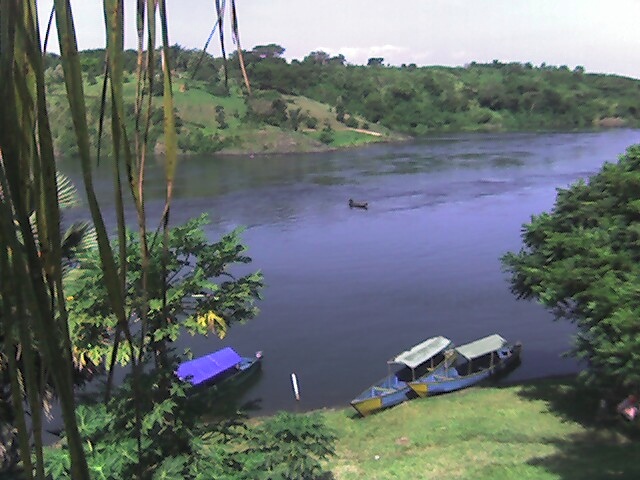
The source of the Nile launches sit on Lake Victoria at Jinja in Uganda — CC BY-SA 2
History of Jinja
In 1862 the British explorer John Hanning Speke became the first European to see the source of the Nile at Jinja. Speke described falls about 120 to 150 m wide, with water running over rocks and thousands of fish leaping, and his finding settled one of the great geographical mysteries of the 19th century, the origin of the Nile. The city of Jinja was founded in 1901 by the British and grew as the trading centre of the Busoga region, and in 1948 the architect Ernst May planned the town again, laying out separate residential areas in the same style as his plan for Kampala.
The Owen Falls Dam was the great turning point in the modern history of Jinja. The dam was built from 1951 to 1954 and drowned the Ripon Falls and the flat rocks that had given the city its name. The hydroelectric plant at the dam supplied power to Uganda and exported power to Kenya, and the cheap power drew factories to Jinja, among them the Kakira sugar factory, one of the largest sugar factories in East Africa. Jinja became the second industrial centre of Uganda after Kampala, and its economy kept growing from the early 2000s, with new factories and industrial areas.
The railway made Jinja before the dam did. The Uganda Railway from Mombasa reached Kisumu on the eastern shore of Lake Victoria in 1901, the same year Jinja was founded, and lake steamers linked Kisumu with Jinja across the water. The line ran through Nairobi, which grew from a rail depot into the capital of Kenya, and Jinja became a port for the ferries that crossed the lake. The railway and the steamers carried cotton, coffee and passengers, and the trade they brought is what turned a fishing village at the rocks into a town.
The industrial peak of Jinja came in the 1950s and 1960s, when the city produced textiles, sugar, beer and steel, and the factories drew workers from across Busoga and beyond. The Madhvani group built much of the industrial base, and the estates built for the ruling elite outside the centre led to slum clearance in the 1950s that displaced more than 1,000 residents. The boom left Jinja with wide streets, factory buildings and workers quarters that still shape the city, and the fall that followed left many of those buildings empty, a reminder of how fast an industrial town can rise and fade.
Jinja also saw the political upheavals of Uganda. In the Uganda–Tanzania War of 1978 to 1979, Jinja was the place President Idi Amin fled to after Kampala fell, and on 22 April 1979 the combined Tanzanian and Uganda National Liberation Army forces took Jinja after meeting little resistance. The city then became a hub for moving goods from Uganda to Mwanza in Tanzania, and the operation was followed by looting in the city. In 1987 the Holy Spirit Movement attacked the Magamaga barracks near Jinja but was driven back.
The expulsion of the Asian community in 1972 hit the economy of Jinja hard, and many industries closed, leaving the city quiet in a way Kampala never was. The Madhvani group, which owns the Kakira sugar factory, stayed on, and the factory still employs more than 7,500 workers and burns bagasse to generate 50 MW for its own needs and the national grid. From the 1990s Jinja slowly turned toward adventure tourism, with white-water rafting becoming the emblem of the city, and the Nyege Nyege festival, held in Jinja since 2015, has become the largest music and arts festival in East Africa, drawing thousands of visitors each year.
Travel to Jinja
White-water rafting on the Nile is the most famous activity in Jinja. The river here has grade 4 and grade 5 rapids, among the strongest in the world open to visitors, and rafting companies run half-day or full-day trips, with professional guides and full safety gear. Travellers with no experience can still join, because each raft has a guide steering it, and the dry season is the best time, because the water level is steady and easier to read. Many visitors call the rafting the most memorable adventure of their time in Africa.
Bungee jumping from the bridge over the Nile is the second great adventure of the city. The jump stands about 44 m above the water, near the source of the river, and jumpers can choose a water touch or a dry jump, depending on the river level that day. The jump draws many young travellers and ranks among the best known bungee jumps in Africa. Kayaking, horse riding along the river bank and mountain biking offer quieter ways to meet the Nile for visitors who do not want the big rapids.
The Source of the Nile Park is the most symbolic sight in Jinja. The park stands where the Nile leaves Lake Victoria, with the monument to John Hanning Speke and gardens looking over the lake, and visitors can take a boat to the marker on the water that is held to be the exact point where the river begins. Sunset in the park is one of the finest views in the city, and the park is the first stop of most tours to Jinja. A sunset boat trip on Lake Victoria is the most relaxing end to a day of adventure, with the boat leaving in the late afternoon and gliding past small bays, and the trip usually lasts two hours.
The Itanda Falls, about 27 km downstream from the centre, are the wildest falls left near Jinja, with large rocky rapids and many birds, and they suit travellers who like to explore away from the crowds. The Mabira Forest, about 30 km west, offers walks with a local guide, mountain biking and visits to nearby villages, and the Ssezibwa Falls on the road from Kampala make a good stop on the way in. The central market of Jinja is the best place to see the daily life of the Busoga people, with fresh produce, lake fish, kitenge cloth and crafts, and the morning is the liveliest time, when the fishers bring in the catch.
Jinja can be visited in a day from Kampala, because the city lies only about 81 km away, and a day tour usually covers the Source of the Nile Park, a half-day rafting trip and the central market. Leave Kampala early to avoid the morning traffic, and stay one or two nights to join more activities, above all if the Nyege Nyege festival is on, when lodging books up fast. The city has many places to stay for backpackers, from hostels to riverside lodges, and many of them run rafting trips on site.
Notable Places in Jinja
Source of the Nile Park
The Source of the Nile Park is the most important sight in Jinja, and it stands where the White Nile leaves Lake Victoria to begin its journey of more than 6,600 km to the Mediterranean. The monument to John Hanning Speke marks the place where the explorer stood to look at the source in 1862, and a boat can carry visitors to the marker on the water. Visit at sunset, when the light over the lake is at its best, and allow an hour for the gardens and the boat ride.
Itanda Falls and Bujagali
The Bujagali Falls were once among the best known rapids of the region, but they were drowned when the Bujagali hydroelectric plant was completed, and the plant now stands about 8 km north of the centre with a capacity of 250 MW. The Itanda Falls, further downstream, are now the wildest falls left near Jinja, with large rocky rapids and many birds. Itanda suits travellers who like to explore, and the falls are quieter than the busy rafting stretches, so bring a guide and allow half a day.
Source of the Nile Bridge
The Source of the Nile Bridge is a modern cable-stayed bridge over the Nile, joining Jinja with the town of Njeru. The bridge was started in 2013 and opened on 17 October 2018, and it is 525 m long, one of the finest bridges in Uganda. From the bridge, visitors see the whole sweep of the river and Lake Victoria, and the bridge has become a symbol of the city and a popular place for photographs. Cross on foot in the morning, when the light is clear and the traffic is light.
Mabira Forest
Mabira Forest is a tropical forest between Kampala and Jinja, about 30 km west of the city. The forest covers about 306 square km and holds more than 300 bird species and many monkeys, and visitors can walk in the forest, ride a mountain bike and visit the villages around it. The forest is an ideal stop for travellers on the road from Kampala to Jinja, and the community-run eco tours are the best way to see it. Allow half a day, and go in the morning, when the birds are most active.
Jinja Central Market
Jinja Central Market is the best place to see the daily life of the Busoga people, with vegetables, lake fish, cloth and crafts. The morning is the busiest time, when fishers bring fresh fish to sell, and visitors can buy kitenge cloth and souvenirs at better prices than in Kampala. The market is also the best place to try local food, such as grilled tilapia and matooke bananas, and the stalls near the fish section are the liveliest in the city.
Kakira Sugar Factory
The Kakira sugar factory is the largest factory of the city and one of the largest sugar factories in East Africa. The factory belongs to the Madhvani group and employs more than 7,500 workers, and it burns bagasse to generate power, supplying 50 MW for its own needs and the national grid. Visitors cannot freely enter the factory, but the wide cane fields on the road to Jinja can be seen from the highway, and the factory stands as a symbol of the industrial role of the city. Drive past in the late afternoon, when the cane fields catch the low sun.

The River Nile flows past Jinja in Uganda — CC BY 4
Frequently Asked Questions
Is one day in Jinja from Kampala enough?
One day in Jinja from Kampala is enough for the main sights, because the city lies only about 81 km away, and a day tour usually covers the Source of the Nile Park, a half-day rafting trip and the central market.
Which places should I visit in Jinja?
The places to visit first in Jinja are the Source of the Nile Park, the Source of the Nile Bridge and the Itanda Falls, and adventure travellers should try the rafting and the bungee jump.
Is white-water rafting in Jinja safe?
White-water rafting in Jinja is safe with a reputable company and a professional guide, and each raft carries life jackets, a guide and a safety boat, though children under 16 are usually not allowed on the high rapids.
Does Jinja have places to stay for backpackers?
Jinja has many places to stay for backpackers, from hostels to riverside lodges, and the camps and lodges near the source are the most popular choice, with restaurants, bars and rafting trips on site.
When is the best time to visit Jinja?
The dry seasons, June to September and December to February, are the best time to visit Jinja, when the rain is light, the river level is steady and the roads are dry.
Where can I go next from Jinja?
From Jinja, travellers can return to Kampala and fly from Entebbe to other national parks, or continue north to see the Murchison Falls, the most powerful falls on the Nile.
Verified
- Jinja is a city in the Eastern Region of Uganda, on the north shore of Lake Victoria, at the source of the White Nile; about 81 km east of Kampala, at an elevation of 1,204 m — Wikipedia, checked 23 November 2026.
- The population of Jinja is about 279,184 people in the 2024 figures of the Uganda Bureau of Statistics — Wikipedia, checked 23 November 2026.
- John Hanning Speke was the first European to see the source of the Nile at Jinja in 1862; the city was founded in 1901 by the British and planned again in 1948 by Ernst May — Britannica and Jinja City, checked 23 November 2026.
- The Owen Falls Dam was built from 1951 to 1954 and drowned the Ripon Falls; the Kiira plant was completed in 2003 with a capacity of 200 MW — Wikipedia, checked 23 November 2026.
- The Source of the Nile Bridge opened on 17 October 2018 and is 525 m long; the Bujagali hydroelectric plant has a capacity of 250 MW and stands about 8 km north of the centre — Wikipedia, checked 23 November 2026.
- The Uganda Railway reached Kisumu in 1901, the year Jinja was founded, and lake steamers linked Kisumu with Jinja across Lake Victoria — Wikipedia, checked 23 November 2026.
- Lake Victoria covers about 68,800 square km and is shared by Uganda, Kenya and Tanzania — Wikipedia, checked 23 November 2026.
- The Nyege Nyege festival has been held in Jinja since 2015 — Wikipedia, checked 23 November 2026.
- The nearest World Heritage property to Jinja is the Tombs of Buganda Kings at Kasubi, ref 1022, listed in 2001, about 73.5 km away in a straight line; the Rwenzori Mountains are about 362.0 km away and Bwindi Impenetrable Forest is about 421.6 km away — haversine from live coordinates, checked 23 November 2026.
- Jinja is not a World Heritage property and lies in no World Heritage area, so the registry value unesco:false is CORRECT — Wikipedia, checked 23 November 2026.
- The registry Q-ID Q501709 is Jinja, a city in Jinja District, Eastern Region, Uganda, at coordinates 0.4353 north and 33.2056 east — Wikidata API, checked 23 November 2026.
Sources
- Wikipedia, “Jinja, Uganda” (https://en.wikipedia.org/wiki/Jinja,_Uganda) — population, history, geography; checked 23 November 2026.
- Britannica, “Jinja” (https://www.britannica.com/place/Jinja-Uganda) — founded 1901, elevation; checked 23 November 2026.
- Jinja City, “History” (https://jinjacity.go.ug/page/history) — founded 1901, city status 2020; checked 23 November 2026.
- Uganda Tourism Board, Visit Uganda (https://www.visituganda.com/) — rafting, Source of the Nile; checked 23 November 2026.
- Tombs of Buganda Kings at Kasubi, UNESCO ref 1022 (https://whc.unesco.org/en/list/1022/) — listed 2001; checked 23 November 2026.
- Wikidata, Q501709 (https://www.wikidata.org/wiki/Q501709) — Jinja city, coordinates; checked 23 November 2026.
Unverified
- The exact length of the Source of the Nile Bridge is given as 525 m from popular sources, and this article uses that figure without a formal engineering source.
- The area of Mabira Forest is given as about 306 square km, though sources differ, so this article uses the common figure and does not settle a precise area.
- Opening hours and entrance fees for the Source of the Nile Park change by season, so this article gives no hours or fees and travellers should check on site before visiting.
- The claim that Jinja has the second largest economy in Uganda comes from Wikipedia and is a ranking rather than a measured figure, so this article states it as a reported ranking.
Illustrations
- Hero: Jinja stands on the north shore of Lake Victoria, where the White Nile begins. Free image: https://upload.wikimedia.org/wikipedia/commons/0/02/Jinja_PICT0177.JPG — CC BY-SA 3.0.
- In body, river: The source of the Nile launches sit on Lake Victoria at Jinja in Uganda Free image: https://upload.wikimedia.org/wikipedia/commons/6/62/Source_of_the_Nile%2C_Jinja.jpg — CC BY-SA 2.
- In body, river: The River Nile flows past Jinja in Uganda Free image: https://upload.wikimedia.org/wikipedia/commons/8/86/River_Nile%2C_Jinja%2C_Uganda_1.jpg — CC BY 4.