
Mombasa — Fort Jesus, the Old Town and the Beaches
Mombasa is the oldest port city on the Kenyan coast. Fort Jesus guards the old town, and the beaches north and south draw visitors from across the world. The city stands on an island and the mainland around it, and its harbour has worked for a thousand years, first for Arab and Persian dhows, then for Portuguese caravels, and now for container ships.
Mombasa is the second city of Kenya, and it feels entirely different from the capital inland. The air is humid, the streets of the old town are narrow and shaded, and the call to prayer mixes with the sound of the port and the surf. Visitors come for the fort, the old town and the beaches, and they find a city whose history is written in its walls, its mosques and its street names.
Mombasa is a city of layers, and its visitors peel them back one at a time, from the fort to the old town to the beaches. The port gives it noise and purpose, the old town gives it beauty, and the beaches give it rest, and the three together make a city that is unlike any other in Kenya.
Quick Facts
- Position: Island and mainland city on the Kenyan coast, about five hundred kilometres southeast of Nairobi
- Population: 1,208,333 in the 2019 census
- Harbour: Kilindini, the largest port in East Africa
- Old town: Fort Jesus and the Swahili old town on Mombasa Island
- Beaches: Nyali, Bamburi and Shanzu to the north, Diani to the south
- World Heritage in the city: Fort Jesus, ref 1295, inscribed in 2011
- Rail link: Standard gauge railway to Nairobi, opened in May 2017, about four hundred and seventy-two kilometres
- Best months: December to March and July to October, the drier seasons
- Sister city: Seattle, in the United States, since 1981
Geography of Mombasa
Mombasa is built on a coral island joined to the mainland by bridges and causeways, and the island itself is small enough to cross on foot in under an hour. The old town occupies the eastern side of the island, facing the sea, while the modern city spreads across the mainland to the west and north. Two creeks cut into the coast on either side of the island, Tudor Creek to the north and Kilindini Creek to the south, and the deep-water harbour sits in the southern creek, sheltered from the open ocean.
Kilindini Harbour is the largest port in East Africa, and its cranes and container stacks dominate the southern shore of the island. The harbour was inaugurated in 1896, and it has grown into the gateway for Kenya and for the landlocked countries beyond, including Uganda, Rwanda and South Sudan. The port gives Mombasa its working character, and the city has never been a resort alone, since the ships, the warehouses and the railway yards are part of the same landscape as the beaches.
The beaches run north and south from the island along a coast of white sand and coral reef. Nyali, Bamburi and Shanzu lie to the north, within easy reach of the city, and their reefs are protected by the Mombasa Marine National Park, established in 1986. To the south, across the Likoni ferry, lies Diani, a longer and quieter beach that many visitors prefer for swimming and for watching the sunset. The reef breaks the surf, so the water inside it is calm, and the sand is pale coral rather than the darker sand of the Atlantic coast.
The climate is tropical and humid, with two rainy seasons, the long rains from April to June and the short rains from October to December. Temperatures stay warm all year, and the humidity rarely drops far, which is why the old town was built with thick coral walls, carved wooden doors and shaded courtyards. The drier months, from December to March and again from July to October, bring the clearest skies and the calmest seas, and they are the best time to be on the water.
Mombasa sits at 4°03′S 39°40′E, just south of the equator, and its position has always been its fortune. The monsoon winds that carried dhows down the coast from Arabia and India also carried them back, and the city grew rich on the trade in ivory, spices, gold and enslaved people. That position still matters today, since the port, the airport and the railway all meet here, and the city remains the point where Kenya faces the sea.
The mainland districts of Mombasa spread west and north from the island, and they hold the city’s homes, markets and industries. Changamwe lies west of the island, Nyali spreads north across the bridge, and Likoni sits south across the ferry, with the road to the Tanzanian border running through it. The Likoni ferry carries vehicles and pedestrians across the harbour entrance all day, and its queues are part of the city’s daily life, since the bridge to the south has never been built.
The reef off the northern beaches holds coral, reef fish and turtles, and the marine park protects it from fishing and from the anchor damage that once scarred it. The old town of Mombasa shows a different kind of richness, with coral-stone houses, carved wooden doors and shaded balconies that overhang the narrow streets. The architecture is Swahili, with Arab, Persian and Indian touches, and it survives because the buildings were too solid to clear and too beautiful to lose.
South of Mombasa the coast runs to Wasini Island and the Kisite-Mpunguti Marine National Park, where the reef drops into deeper water and dolphins are often seen. The park protects coral gardens and the channels between the islands, and the dhows from Shimoni carry visitors out to snorkel over it. The southern coast is quieter than the northern beaches, and its villages live by fishing and by the boats that work the reef.

Beach view in Mombasa, Kenya – November, 2022 — CC BY-SA 4
History of Mombasa
Mombasa began as a Swahili trading town, and its early history is written in the accounts of travellers rather than in buildings. The Moroccan traveller Ibn Battuta visited in 1331 and described a prosperous port, and by the fifteenth century the town was ruled by its own sultan and traded with Arabia, Persia and India. The town was built of coral stone and lime, and its mosques and houses followed the Swahili pattern that still shapes the old town today.
The Portuguese arrived in 1498, when Vasco da Gama called at the port on his way to India, and they sacked the town in 1505. Fort Jesus was built between 1593 and 1596 to hold the coast for Portugal, and it became the most fought-over building on the East African coast. The fort changed hands nine times between the Portuguese and the Omanis, and the Omani siege of 1696 to 1698 lasted thirty-three months before the garrison fell. The fort still stands above the harbour, and its walls carry the marks of every army that held it.
Omani rule followed, and the town became part of the trading world of Zanzibar, whose sultan held the coast through the nineteenth century. The British episode of 1824, when a naval captain declared a protectorate at the request of the local Mazrui rulers, lasted only until 1826 and never made Mombasa part of British East Africa. That came later, when the town was leased to the British East Africa Company in 1887 and became the capital of the East Africa Protectorate in 1895, with Kilindini Harbour opening the following year.
The Uganda Railway reached the interior from Mombasa, and it began operating in 1901, linking the coast to Kisumu on Lake Victoria. The railway made Mombasa the port of East Africa, but it also made Nairobi, the railway town on the highlands, the new centre of power. The capital shifted from Mombasa to Nairobi in 1905, and the coast town settled into its role as the port and the holiday coast, while the politics moved inland. Kenya became independent on the twelfth of December 1963, with Jomo Kenyatta as its first leader.
The modern city grew around the port, and the old town survived because its coral buildings were too solid to clear and too beautiful to lose. The Moi Avenue tusks went up in 1952 for the visit of Princess Elizabeth, built of wood and canvas, and they were rebuilt in aluminium in 1956 for the visit of Princess Margaret, becoming the symbol of the city. The standard gauge railway to Nairobi opened in May 2017, and it cut the journey between the coast and the capital to a few hours, bringing the two cities closer than they had been since the railway age began.
Said bin Sultan of Muscat and Oman held the coast from 1837, and his successors ruled through Zanzibar, with Mombasa as their mainland port. A revolt against Zanzibar in 1875 was put down with British assistance, and the town’s Indian community grew through the same decades, founding the Hindu Union and the Lord Shiva Temple in 1885. The town by then was a mix of Swahili, Arab, Indian and European quarters, and the mix is still visible in its streets today.
After independence the city grew around the port, and the airport was expanded in 1979 while the New Nyali Bridge opened in 1980, joining the northern beaches to the island. Mombasa became a sister city of Seattle in 1981, and the tourist trade grew through the same years, with the northern beaches filling with hotels. The city has kept its working port beside its resorts, and the two sides of Mombasa still meet every morning at the Likoni ferry.
The city’s Swahili culture survives in its language, its food and its festivals, and the old town’s mosques still call the faithful to prayer five times a day. The blend of African, Arab and Indian life is what makes Mombasa distinct, and it is the reason visitors remember the city long after they leave.
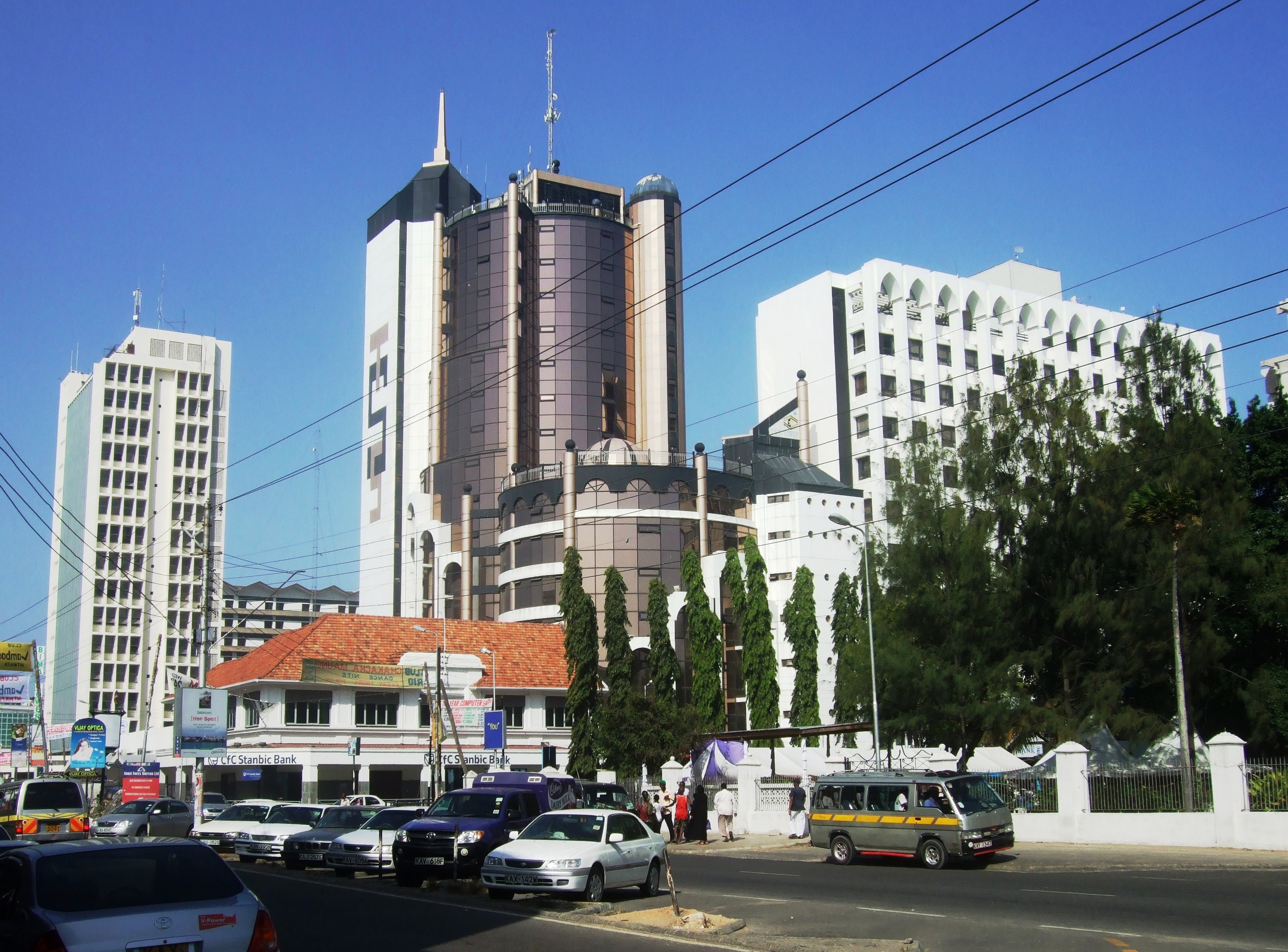
Downtown Mombasa — CC BY-SA 2
Travel to Mombasa
Mombasa is reached by air at Moi International Airport, by the standard gauge railway from Nairobi, or by road along the highway that runs southeast from the capital. The railway is the most comfortable choice, and the journey takes a few hours through the dry country of Tsavo, arriving at the terminus on the mainland west of the island. The road takes longer and runs through the same landscape, and the flight is the fastest option for travellers short on time.
The old town is best explored on foot, and its streets are too narrow for cars in places, which is part of their charm. Fort Jesus opens in the morning, and a visit takes a couple of hours, including the museum inside and the walk along the battlements above the harbour. The old town around it holds mosques, carved doors and small shops, and the best way to see it is to wander without a fixed route, stopping at the cafes and the spice stalls along the way.
The beaches north of the city are the easiest to reach, and Nyali and Bamburi both have hotels, restaurants and water sports, with the marine park protecting the reef offshore. Snorkelling and diving run from the beach resorts, and the reef holds coral, reef fish and turtles, with the clearest water in the dry months. Diani Beach to the south is quieter and longer, and it is reached by the Likoni ferry and a short drive, making it a good base for a longer stay.
Day trips from Mombasa run south to Diani and north toward Malindi, and the city also serves as the starting point for safaris into Tsavo, which lies inland on the road to Nairobi. Nairobi itself is a few hours away by rail, so a combined coast and capital trip is easy to arrange, and many travellers pair the beaches with a safari before flying home. Kenya tours that begin in Mombasa usually head inland first and finish on the coast, which is the most rewarding order.
Practical advice for Mombasa is straightforward, and it starts with the heat and the humidity. Light clothing, sunscreen and water cover the days, and the old town is best visited early, before the sun is high. The city is generally safe for visitors who use the same care as in any large port city, keeping valuables out of sight and using licensed taxis at night, and the beach resorts have their own security.
Food in Mombasa is Swahili, and it mixes the coast’s fish with the spices that once made the town rich. Biryani, pilau and grilled fish are served in the old town, and the Swahili coffee houses pour strong coffee with dates and halwa. The restaurants of the northern beaches serve the same food with a view of the sea, and the night markets near the harbour sell it more simply, with the smell of grilling fish in the air.
The Likoni ferry is the practical detail to plan around, since its queues can be long at rush hour and the crossing is the only way south by road. Licensed taxis are the easiest way to move around the city at night, and the old town is best visited early, before the heat builds and while the streets are still quiet. Mombasa rewards travellers who slow down, since its pleasures are in the wandering rather than in a list of sights.
Notable Places in Mombasa
Fort Jesus
Fort Jesus. The fort is the reason to come to Mombasa, and it is best visited in the morning, when the light is on the battlements and the harbour below is busy. The museum inside tells the story of the nine changes of hands, and the walk along the walls gives a view across the old harbour to the sea beyond.
The Old Town
The Old Town. The old town rewards a slow wander, with its narrow streets, carved wooden doors and coral-stone houses shaded by overhanging balconies. The mosques and the small shops sit side by side, and the spice stalls near the harbour sell the cloves, cardamom and cinnamon that once made the town rich.
Moi Avenue Tusks
Moi Avenue Tusks. The aluminium tusks arch over Moi Avenue, and they are the most photographed landmark in the city after the fort. They went up in aluminium in 1956, replacing the wood-and-canvas pair built for the visit of Princess Elizabeth four years earlier, and they mark the entrance to the old town.
Nyali and Bamburi Beaches
Nyali and Bamburi Beaches. The northern beaches are the easiest from the city, with white sand, calm water inside the reef and resorts along the shore. The marine park protects the reef offshore, and snorkelling trips run from the beach in the dry months, when the water is clearest.
Diani Beach
Diani Beach. The long beach south of the Likoni ferry is quieter than the northern beaches, and it suits a longer stay, with space to walk for miles at low tide. The palm trees, the white sand and the shallow reef make it the classic Kenyan beach, and the sunset over the water is the best in Mombasa.
Mombasa Marine National Park
Mombasa Marine National Park. The park protects the reef off Bamburi and Nyali, and it is the place to see coral, reef fish and turtles without leaving the city. Glass-bottomed boats and snorkelling trips run from the beach resorts, and the park is at its best in the dry months, from December to March.
The Likoni Ferry
The Likoni Ferry. The ferry crosses the harbour entrance south of the island, and it is the city’s busiest crossing, carrying vehicles and pedestrians all day. The ride costs pedestrians nothing, and it gives a view back across the harbour to Fort Jesus and the old town.
Haller Park
Haller Park. The park in Bamburi began as a limestone quarry, and it was rehabilitated into woodland and ponds that now hold giraffes, hippos and smaller animals. The park is a quiet half-day from the northern beaches, and its trails show how a scarred landscape can be brought back to life.
Frequently Asked Questions
How many days should I spend in Mombasa?
Three days covers the fort, the old town and the northern beaches, while five days adds Diani and a day trip inland.
Is Mombasa safe for visitors?
Yes, with the usual care of a large port city, including licensed taxis at night and valuables kept out of sight.
What is the best time to visit Mombasa?
December to March and July to October bring the driest weather, the calmest seas and the clearest water for snorkelling.
How do I get from Nairobi to Mombasa?
Take the standard gauge railway, which runs about four hundred and seventy-two kilometres, or fly into Moi International Airport.
Can I swim at Mombasa beaches?
Yes, the water inside the reef is calm, and the northern beaches and Diani are the best for swimming.
What is Fort Jesus?
A Portuguese fort built between 1593 and 1596, now a museum and a UNESCO World Heritage Site in the old town.
Verified
- Fort Jesus was inscribed in 2011 under criteria (ii) and (iv), on a core area of 2.36 hectares with a buffer of 31 hectares, and the Old Town acts as the buffer rather than a separate inscription — whc.unesco.org/en/list/1295/, checked 23 November 2026.
- The fort changed hands nine times between the Portuguese and the Omanis, and the Omani siege of 1696 to 1698 lasted thirty-three months.
- The tusks on Moi Avenue were first built of wood and canvas in 1952 for the visit of Princess Elizabeth, and the aluminium pair standing today was built in 1956 for the visit of Princess Margaret.
- Mombasa became the capital of the East Africa Protectorate in 1895, and the capital shifted to Nairobi in 1905.
- Kilindini Harbour was inaugurated in 1896, and it remains the largest port in East Africa.
- The standard gauge railway to Nairobi opened in May 2017 and runs 472 kilometres, and the 2019 census counted 1,208,333 people in Mombasa.
- The Mombasa Marine National Park was established in 1986, and Lamu Old Town, ref 1231, lies about 241 kilometres straight-line north of Mombasa.
- The Moroccan traveller Ibn Battuta visited Mombasa in 1331 and described a prosperous port.
- The New Nyali Bridge opened in 1980, and the Hindu Union and the Lord Shiva Temple were founded in 1885.
Sources
- UNESCO World Heritage List, Fort Jesus, Mombasa — https://whc.unesco.org/en/list/1295/
- Wikipedia, Mombasa — https://en.wikipedia.org/wiki/Mombasa
- Wikipedia, Fort Jesus — https://en.wikipedia.org/wiki/Fort_Jesus
- Wikipedia, Timeline of Mombasa — https://en.wikipedia.org/wiki/Timeline_of_Mombasa
Unverified
- Mombasa is widely called the oldest city in Kenya, but no founding date is documented, so the claim rests on tradition rather than on a recorded year.
- The exact position of the earliest Swahili settlement on the island is not established, and the old town visible today dates mainly from later centuries.
- Figures for the distance by road between Nairobi and Mombasa vary between sources, so the railway length is the firmer measure.
Illustrations
- Hero: Fort Jesus in Mombasa. Free image: https://upload.wikimedia.org/wikipedia/commons/c/cb/Fort_Jesus%2C_Mombasa1.jpg — CC BY-SA 4.
- In body, Mombasa: Beach view in Mombasa, Kenya – November, 2022. Free image: https://upload.wikimedia.org/wikipedia/commons/6/6a/Beach_view_in_Mombasa%2C_Kenya.jpg — CC BY-SA 4.
- In body, Mombasa: Downtown Mombasa. Free image: https://upload.wikimedia.org/wikipedia/commons/2/21/Downtown_Mombasa.jpg — CC BY-SA 2.