
The Giza Pyramids: A Necropolis on the Edge of Cairo
The Giza pyramids stand on a limestone plateau west of Cairo, three great tombs in a diagonal line. They are the last surviving wonder of the ancient world.
The Giza pyramids are not three monuments standing alone in the sand, and that is the mistake most first-time visitors make. They are the centre of a necropolis, a city of the dead that was planned as carefully as any living city, with mortuary temples, causeways, valley temples, queens’ pyramids and whole fields of mastaba tombs for the officials who served the kings. The plateau was built in about a century, under three kings of the Fourth Dynasty, and then it was used, robbed, worshipped, forgotten and dug up again over four and a half thousand years, until the newest chapter opened on 1 November 2025, when the Grand Egyptian Museum opened its doors about two kilometres from the plateau. This guide walks the plateau from the Great Pyramid of Khufu to the Sphinx, explains how the stones were cut, carried and set, and shows what the necropolis still keeps hidden beneath the sand.
Quick Facts
- Setting: a limestone plateau on the west bank of the Nile, about 15 km south-west of central Cairo
- The three pyramids: Khufu, 146.6 m when built; Khafre, 143.5 m when built; Menkaure, about 65 m when built
- Builders: Khufu, about 2589 to 2566 BC; Khafre, about 2558 to 2532 BC; Menkaure, about 2532 to 2503 BC
- Blocks in the Great Pyramid: about 2.3 million, averaging 2.5 tonnes each
- The Sphinx: 73 m long and 20 m high, carved from a ridge of rock south-east of the pyramid of Khafre
- The property: part of Memphis and its Necropolis, the Pyramid Fields from Giza to Dahshur, UNESCO ref 86, inscribed 1979
- Property area: 16,358.52 ha for the whole Memphis property
- The museum: the Grand Egyptian Museum, opened 1 November 2025, about 2 km from the plateau
- Wikidata: Q12508
Geography of the Giza pyramids
The Giza pyramids stand on the edge of the Western Desert, on a plateau of limestone that rises above the flood plain of the Nile. The plateau was chosen because the stone was there, and the builders cut the core of the pyramids from the rock under their own feet, so that the Great Pyramid is in part a hill of living rock dressed in stone. A branch of the Nile once flowed close to the foot of the plateau, much closer than the river runs today, and recent studies of the sediments have shown that the builders brought the heavy granite from Aswan by boat to a harbour at the edge of the necropolis, which explains how stones weighing tens of tonnes reached a building site in the desert. The plateau is high enough to be seen from Cairo, and the three pyramids stand in a diagonal line from north-east to south-west, with Khufu at the north-eastern end, Khafre in the middle and Menkaure at the south-western end, each one set back from the last so that all three can be seen from the valley below.
The Giza pyramids are the centre of a necropolis that spreads across the plateau in a planned pattern. Each pyramid has its own mortuary temple on its eastern face, a causeway running down to a valley temple near the old river bank, and a group of smaller pyramids for the queens, and around them lie the mastaba fields, the flat-topped tombs of the officials and the members of the royal family, laid out in streets like a town. The mastaba fields to the east of the Great Pyramid and to the west of the pyramid of Khafre hold hundreds of tombs, and the whole necropolis was a place of work as well as of burial, with bakeries, workshops and a town for the builders on the south-eastern edge of the plateau. The plan of the necropolis is so regular that the archaeologists who dug it could read the order of building from the streets, and the tombs grow smaller and simpler as the distance from the king’s pyramid grows, which shows how the court was arranged around the king even in death.
The Sphinx stands at the south-eastern corner of the Giza pyramids, at the end of the causeway of Khafre, and it is the most puzzling monument on the plateau. The lion body was cut from a ridge of rock that the quarrymen left standing, and the head was carved from the same rock, so that the statue is in part a natural feature and in part a work of art. The Sphinx is 73 m long and 20 m high, and it faces the rising sun, with the valley temple of Khafre beside it and the pyramid of Khafre behind it, so that the whole group forms a single composition.
The face of the Sphinx is often said to be the face of Khafre himself, and the likeness is plausible, though the statue has been damaged so often that the argument will never be settled by the stone alone. The Sphinx was buried in sand for most of its history, and it was dug out again and again, most famously by the prince who became Thutmose IV, who left a stone between its paws to record a dream in which the Sphinx promised him the throne.
The modern setting of the Giza pyramids is a shock to visitors who expect empty desert. The city of Cairo has grown to the foot of the plateau, and the suburbs of Giza reach the edge of the necropolis, so that the pyramids rise above a city of millions rather than above an empty waste. The plateau itself is fenced and ticketed, and the desert to the west is still empty, with the sand running to the horizon, but the view to the east is of apartment blocks and the traffic of the city.
The Grand Egyptian Museum, which opened on 1 November 2025, stands about two kilometres from the plateau on the road to Cairo, and it is the largest archaeological museum in the world devoted to a single civilisation, holding the treasures of Tutankhamun and the great statues of the Old Kingdom. The museum changes the visit to the Giza pyramids, because the objects that were found on the plateau can now be seen in one place, close to the place where they were made.
The climate of the Giza pyramids is the climate of the desert, with hot summers, mild winters and almost no rain. The temperature in summer can pass 35 degrees, and the sun on the plateau is fierce, with no shade except inside the tombs and the temples, so the best hours are the early morning and the late afternoon. The winter months, from October to April, bring cooler air and a softer light, and the pyramids look their best in the low sun of the morning, when the shadows are long and the stone is warm.
The wind blows from the north-west, and it carries sand across the plateau, which is why the monuments are constantly being cleaned, and why the limestone of the pyramids has been worn smooth on the windward side. The plateau is dry, and the only water is the Nile, which runs to the east, out of sight behind the city, though the ancient branch that served the builders is now buried under the fields and the suburbs.

The pyramids of Giza during an art exhibition — CC BY-SA 4
History of the Giza pyramids
The Giza pyramids begin with Khufu, the second king of the Fourth Dynasty, who ruled from about 2589 to 2566 BC. His pyramid, the Great Pyramid, was built from about 2580 to 2560 BC, and it is the largest pyramid ever built in Egypt, with a base of 230.3 m on each side and a height of 146.6 m when it was finished. The pyramid holds about 2.3 million blocks of limestone, each weighing about 2.5 tonnes on average, and it was the tallest building made by human hands in the world for nearly 3,800 years, until the spire of Lincoln Cathedral in England passed it in about 1311.
Inside the pyramid are three chambers, the King’s Chamber at the top with a sarcophagus of red granite, the Queen’s Chamber in the middle and an unfinished chamber cut into the rock below, and the Grand Gallery, a steep corridor 8.6 m high with a corbelled roof, is one of the most striking pieces of architecture in the ancient world. The pyramid was built by an organised workforce, not by slaves, and the diary of Merer, an inspector who carried limestone from the quarries at Tura to Giza, was found in 2013 at Wadi al-Jarf on the Red Sea coast, and it records the daily work of the crews, with their boats, their rations and their shifts.
The son of Khufu, Khafre, ruled from about 2558 to 2532 BC, and he built the second of the Giza pyramids, which is the only one of the three that still keeps part of its outer casing of white limestone from Tura at the top. The pyramid of Khafre was 143.5 m high when it was built, a little lower than the pyramid of his father, but it stands on higher ground, so that from a distance it looks the tallest of the three, and it still stands about 136.4 m high today, with a base of 215.5 m on each side. The causeway of Khafre runs for about 500 m from the mortuary temple to the valley temple beside the Sphinx, and the valley temple is one of the best preserved buildings on the plateau, with walls of granite and floors of alabaster.
The Sphinx is linked to Khafre by the valley temple, and most scholars hold that the face of the Sphinx is the face of Khafre, though the statue has no inscription to prove it. The pyramid of Khafre and the Sphinx together form the most complete royal complex on the plateau, and the white cap of the pyramid shows what all three pyramids once looked like, when they were covered in limestone that shone in the sun.
The grandson of Khufu, Menkaure, ruled from about 2532 to 2503 BC, and he built the third of the Giza pyramids, which is much smaller than the other two, with a height of about 65 m when it was built and a base of about 108 m on each side. The pyramid of Menkaure is faced in red granite at the bottom, a stone that had to be brought from Aswan, nearly 1,000 km to the south, and the granite shows that even the smallest of the Giza pyramids commanded resources from the whole length of the Nile. Menkaure built three small queens’ pyramids beside his own, and his mortuary temple was finished in mud brick rather than in stone, which suggests that the reign ended sooner than the king had planned. The pyramid of Menkaure was the last of the great pyramids of Giza, and the kings who followed built smaller pyramids at Abusir and at Saqqara, and the age of the giant pyramid ended with the Fourth Dynasty.
The Giza pyramids were already ancient when the Greeks came to Egypt, and the historian Herodotus visited the plateau in the fifth century BC and described the Great Pyramid in the second book of his Histories, and his account was read in Athens as well as in Alexandria. Egypt became a province of Rome in 30 BC, when the pyramids were already more than two thousand years old, and the Roman emperors who visited them left their names carved on the stones. Napoleon brought his scholars to Egypt in 1798, and the Description de l’Égypte, published in Paris, carried the first accurate drawings of the pyramids to Europe. The systematic digging of the plateau began in the nineteenth century, and Flinders Petrie, who taught in London, measured the Great Pyramid stone by stone and published his survey in 1883.
After the Fourth Dynasty the Giza pyramids stayed at the centre of Egyptian religion for centuries, with priests who kept the cults of Khufu, Khafre and Menkaure alive long after the kings were dead, but the capital moved away and the Old Kingdom fell, and the pyramids were left to the desert. The white limestone casing was stripped away over the centuries to build the mosques and the houses of Cairo, and the sand covered the temples and the causeways, until the Sphinx was buried to its neck and the valley temples were lost under the fields. The pyramids were never forgotten, and they were visited by travellers from the ancient world, but they were not dug in any systematic way until the nineteenth century, when Auguste Mariette and George Reisner began to excavate the plateau. Reisner dug the pyramid of Menkaure and the cemeteries around it, and in 1925 the tomb of Queen Hetepheres, the mother of Khufu, was found nearly intact beside the Great Pyramid, and in 1954 the solar boat of Khufu was found in a sealed pit beside the pyramid, a full-sized wooden ship buried for the king’s journey in the afterlife.
The twentieth and twenty-first centuries have added new chapters to the history of the Giza pyramids, and the most recent of them is still being written. The ScanPyramids project, which began in 2015, used muon scanning to look inside the Great Pyramid without touching a stone, and in 2017 it announced a great void above the Grand Gallery, and in 2023 it announced a hidden corridor behind the main entrance, both of them still unexplained. The Grand Egyptian Museum, which was planned for more than twenty years, was officially inaugurated on 1 November 2025 and opened fully to the public on 4 November 2025, and it holds the treasures of Tutankhamun, the colossus of Ramses II and the solar boat of Khufu, which was moved from the plateau to the museum. UNESCO inscribed the whole necropolis in 1979, as part of Memphis and its Necropolis, the Pyramid Fields from Giza to Dahshur, ref 86, and the property holds more than 38 pyramids and more than 9,000 rock-cut tombs, from Giza through Zawyet Elarian, Abu Ghurab, Abusir and Mit Rahina to Saqqara and Dahshur.
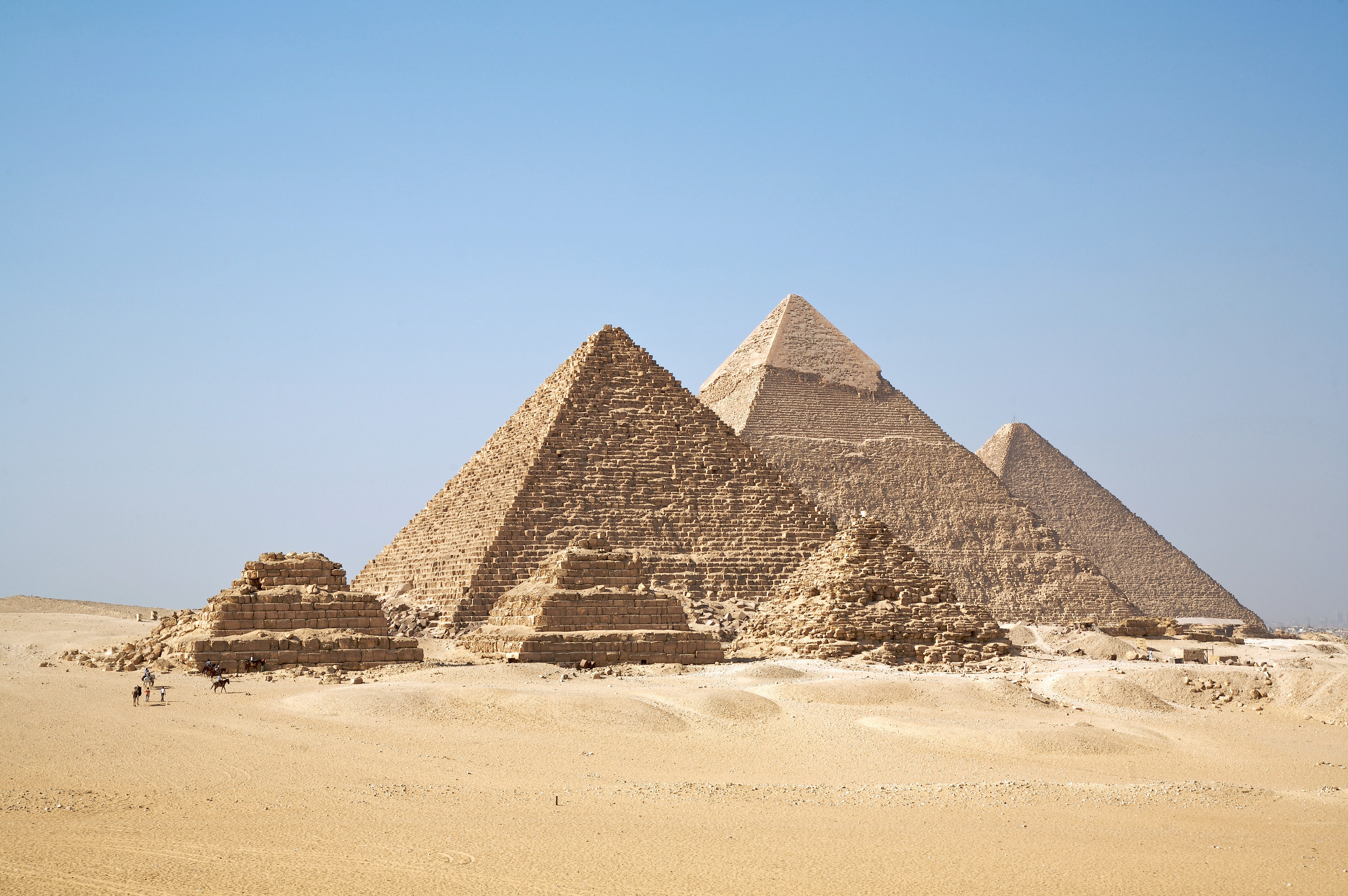
All the pyramids of Giza — CC BY-SA 2
Travel to the Giza pyramids
The Giza pyramids are reached from Cairo by metro, by taxi or by tour, and the journey from the centre of the city takes about an hour in traffic. The metro line to Giza station, followed by a short taxi ride, is the cheapest way to reach the plateau, and the taxis wait at the station for visitors, though the fare should be agreed before the ride begins. Most visitors come on a tour that includes a guide and a driver, and the guide is worth having, because the plateau is large and the monuments are spread out, and the history of the necropolis is hard to read from the stones alone. The entrance to the plateau is on the north-eastern side, near the Great Pyramid, and the ticket covers the plateau and the Sphinx, while the pyramid of Khufu requires a separate ticket, and the pyramids of Khafre and Menkaure open in rotation, so the visitor should ask at the gate which of the two smaller pyramids is open on the day.
The best time to visit the Giza pyramids is the winter, from October to April, when the air is cool and the light is soft, and the best hours are the first two hours after opening, before the coaches arrive and before the sun is high. The plateau has almost no shade, and the summer sun is fierce, so a visitor in the hot months should carry water, wear a hat and plan to be finished by midday. The camel and horse rides that are offered around the plateau are a part of the visit for many travellers, and the ride to the viewpoint at the south-western corner of the plateau gives the classic photograph of all three pyramids in a line, but the price should be agreed in advance and the ride should be kept short. The Sound and Light Show runs in the evening on the plateau, with the pyramids lit and the history told in several languages, and it is the only time the plateau is open after dark, which makes it the best way to see the Giza pyramids without the crowds of the day.
The Grand Egyptian Museum changes the plan of a visit to the Giza pyramids, and it should be given a full morning of its own. The museum stands about two kilometres from the plateau, and it holds the treasures of Tutankhamun in a single gallery for the first time, with more than five thousand objects from the tomb, and the great colossus of Ramses II stands in the entrance hall, where it greets every visitor. The museum also holds the solar boat of Khufu, which was moved from its pit beside the Great Pyramid, and the galleries of the Old Kingdom hold the statues and the reliefs that were found on the plateau. A visit to the museum before the plateau gives the visitor the objects, and a visit to the plateau after the museum gives the visitor the buildings, and the two together make the necropolis easier to understand than either one alone.
The inside of the Giza pyramids is open to visitors, with limits that the visitor should know before buying a ticket. The pyramid of Khufu is open with a separate ticket, and the climb inside leads down a narrow passage and then up the Grand Gallery to the King’s Chamber, where the granite sarcophagus stands empty, and the passage is low, steep and hot, so that visitors who fear closed spaces or who have trouble breathing should think twice before going in. The pyramids of Khafre and Menkaure are smaller inside, and they open in rotation for reasons of conservation, so the visitor should check at the gate which one is open on the day, and the interiors hold no decoration, because the pyramids of Giza were built as royal tombs and not as galleries of art, unlike the tombs of the Valley of the Kings. The valley temple of Khafre, beside the Sphinx, is open to visitors, and it is one of the best preserved buildings of the Old Kingdom, with granite walls that have stood for four and a half thousand years.
Notable Places in the Giza pyramids
- The Great Pyramid of Khufu. The largest of the Giza pyramids, and the only one of the three that is open to visitors with a separate ticket. The climb inside leads down a narrow passage and then up the Grand Gallery to the King’s Chamber, where the granite sarcophagus stands empty, and the passage is low, steep and hot, so visitors who fear closed spaces should think twice.
- The Pyramid of Khafre. The second of the Giza pyramids, which looks the tallest of the three from a distance, because it stands on higher ground than the Great Pyramid. The pyramid is linked to the Sphinx by its valley temple, and the face of the Sphinx is often said to be the face of Khafre himself, though the statue has no inscription to prove it.
- The Pyramid of Menkaure. The smallest of the three great pyramids of the Giza pyramids, about 65 m high when built and about 108 m on each side at the base. Its lower courses are faced in red granite brought from Aswan, nearly 1,000 km to the south, and three small queens’ pyramids stand beside it on the southern side.
- The Great Sphinx. The largest monolithic statue of the ancient world, 73 m long and 20 m high, carved from a ridge of rock south-east of the pyramid of Khafre. The lion body and the human head face the rising sun, and the valley temple of Khafre stands beside it, and the face is often said to be the face of Khafre himself.
- The Valley Temple of Khafre. The temple beside the Sphinx where the body of the king was received before it was carried up the causeway to the pyramid. The temple held statues of Khafre, including the great diorite statue that is now in the Egyptian Museum in Cairo, and its walls of granite have stood for four and a half thousand years.
- The Queens’ Pyramids. Three small pyramids beside the Great Pyramid and three beside the pyramid of Menkaure, built for the queens and the royal women of the Fourth Dynasty. The queens’ pyramids of Khufu are the best preserved, and one of them is thought to hold the burial of Queen Hetepheres, whose tomb was found nearly intact in 1925.
- The Mastaba Fields. The flat-topped tombs of the officials and the members of the royal family, laid out in streets to the east and to the west of the Giza pyramids. The fields hold hundreds of tombs, and the reliefs inside them show the daily life of the Old Kingdom, with farming, fishing, baking and the counting of cattle.
- The Solar Boats of Khufu. Two full-sized wooden ships buried in pits beside the Great Pyramid, found in 1954, and one of them is now displayed in the Grand Egyptian Museum. The boats were built for the king’s journey in the afterlife, and they are the oldest large wooden ships ever found.
- The Grand Egyptian Museum. The largest archaeological museum in the world devoted to a single civilisation, opened on 1 November 2025 about two kilometres from the Giza pyramids. The Grand Staircase holds sixty large statues, and the hanging obelisk of Ramses II stands in the entrance, with the solar boat of Khufu in its own hall.
Frequently Asked Questions
Can I go inside the Giza pyramids?
Yes, the pyramid of Khufu is open with a separate ticket, and the pyramids of Khafre and Menkaure open in rotation for conservation, so the visitor should ask at the gate which one is open on the day. The interiors are plain, because the pyramids were built as tombs and not as galleries of art, unlike the tombs of the Valley of the Kings.
Which of the Giza pyramids is the tallest?
The pyramid of Khufu is the tallest, at 146.6 m when it was finished, and it still stands about 138.8 m high today. The pyramid of Khafre looks the tallest from a distance, because it stands on higher ground, and the white cap that it still keeps at the top adds to the illusion.
How old are the Giza pyramids?
The Giza pyramids were built in the Fourth Dynasty, from about 2580 to 2503 BC, which makes them about four and a half thousand years old. The Great Pyramid was built first, from about 2580 to 2560 BC, and the pyramid of Menkaure was built last, from about 2532 to 2503 BC.
Who built the Giza pyramids?
The Giza pyramids were built by an organised workforce of Egyptian labourers, not by slaves, and the diary of Merer, an inspector found in 2013, records the crews who carried limestone from Tura to Giza by boat. The workforce lived in a town on the south-eastern edge of the plateau, with bakeries and workshops, and the building was a project of the state, with rations, shifts and records kept in writing.
How far are the Giza pyramids from Cairo?
The Giza pyramids stand about 15 km south-west of central Cairo, on a limestone plateau on the west bank of the Nile, and the journey from the centre of the city takes about an hour in traffic. The metro to Giza station, followed by a short taxi ride, is the cheapest way to reach the plateau, and most visitors come on a tour that includes a guide and a driver.
Is the Sphinx part of the Giza pyramids?
Yes, the Sphinx belongs to the complex of Khafre, and it stands at the end of the causeway of Khafre, beside the valley temple. The nose of the Sphinx was broken off in the fourteenth century, long before Napoleon came to Egypt, and the beard lies in the British Museum in London.
Verified
- The Giza pyramids are part of Memphis and its Necropolis, the Pyramid Fields from Giza to Dahshur, inscribed by UNESCO in 1979 as ref 86, under criteria (i), (iii) and (vi). The property runs from the Giza plateau through Zawyet Elarian, Abu Ghurab, Abusir and Mit Rahina to Saqqara and Dahshur, and it holds more than 38 pyramids and more than 9,000 rock-cut tombs, with the three pyramids of Giza as its most famous monuments.
- The Great Pyramid was known in ancient Egypt as Akhet Khufu, the Horizon of Khufu, and its base is level to within about two centimetres, a precision that Flinders Petrie measured stone by stone in his survey of 1883. The pyramid held the record for the tallest building made by human hands for nearly 3,800 years, until the spire of Lincoln Cathedral in England passed it in about 1311.
- The valley temple of Khafre, beside the Sphinx at the end of a causeway of about 500 m, is one of the best preserved buildings of the Old Kingdom, with walls of red granite and floors of alabaster. The causeway carried the body of the king from the valley temple to the mortuary temple, and the pyramid of Khafre is the only one of the three that still keeps part of its white limestone casing at the top.
- The pyramid of Menkaure was opened in 1837, and the basalt sarcophagus found in the burial chamber was lost at sea in 1838, when the ship carrying it to England sank off the coast of Spain. The wooden coffin found inside, with the name of Menkaure, is now in the British Museum, and the pyramid was the last of the great pyramids of Giza.
- The Wikidata record Q12508 describes the Giza pyramid complex as an ancient Egyptian necropolis, with coordinates 29.9761 degrees north and 31.1328 degrees east, and the live record returned by the Wikidata service matches those values. The Grand Egyptian Museum was officially inaugurated on 1 November 2025 and opened fully on 4 November 2025, about two kilometres from the plateau.
Sources
- UNESCO World Heritage Centre — Memphis and its Necropolis, the Pyramid Fields from Giza to Dahshur, inscribed 1979, ref 86: https://whc.unesco.org/en/list/86/
- UNESCO World Heritage Centre — Egypt, seven properties inscribed: https://whc.unesco.org/en/statesparties/eg
- Wikidata — Giza pyramid complex, Q12508: https://www.wikidata.org/wiki/Q12508
Unverified
- The reign dates of Khufu, Khafre and Menkaure follow the chronology in the Vietnamese corpus, and the exact years vary between Egyptologists, so they are given here as approximate dates.
- The distance of about 15 km from central Cairo to the plateau is a straight-line figure, and the journey time of about an hour follows the Vietnamese corpus and general traffic conditions, not a measured timetable.
- The opening arrangements for the pyramids of Khafre and Menkaure, which open in rotation, follow the Vietnamese corpus, and the visitor should check at the gate on the day, because the rotation can change.
- The claim that the Sphinx carries the face of Khafre is the majority view among scholars, not a fact proven by an inscription, and it is presented here as the common reading.
Illustrations
- Hero: The Giza Pyramids. Free image: https://upload.wikimedia.org/wikipedia/commons/c/c8/Sphinx_and_pyramids_of_Giza_panorama.jpg — CC BY-SA 3.0.
- In body, pyramid: All the pyramids of Giza. Free image: https://upload.wikimedia.org/wikipedia/commons/a/af/All_Gizah_Pyramids.jpg — CC BY-SA 2.
- In body, pyramid: The pyramids of Giza during an art exhibition. Free image: https://upload.wikimedia.org/wikipedia/commons/e/e7/Giza_Pyramids_during_%22Forever_is_Now%22_exhibition.jpg — CC BY-SA 4.