
Egypt Hotels
Egypt hotels follow the river and the sea. Cairo for the pyramids, Luxor for the temples, and the Red Sea for the long beach days.
No other country asks so much of its hotels. In Egypt the hotel is not just a bed, it is the base for a journey that runs the length of the Nile: the pyramids at Giza, the temples of Luxor, the tombs of the Valley of the Kings, the island of Philae at Aswan, and then the change of rhythm at the Red Sea, where the diving replaces the archaeology. The right hotel depends on which part of that journey you are on, and the wrong hotel is usually the one that tries to do all of it from a single address.
The pattern of Egypt hotels is simple once it is seen. Cairo holds the city hotels, the big Nile-side towers and the old palace hotels at the foot of the pyramids. Luxor and Aswan hold the smaller hotels and the cruise boats, because the Nile itself is the hotel for much of the journey south.
The Red Sea coast holds the resorts, Hurghada and Sharm el-Sheikh and Marsa Alam, where the all-inclusive model that Tunisia also uses takes a different shape, built around diving rather than beaches alone. The desert oases hold the lodges, Siwa and Bahariya and the White Desert camps, where the hotel is a mud-brick house and the sky is the attraction.
Quick Facts
- First night: Cairo, for Giza and the Egyptian Museum
- Pyramid base: Giza, at the foot of the plateau
- Temple base: Luxor, between Karnak and the Valley of the Kings
- Cruise base: Aswan, where the Nile cruises begin
- Beach base: Hurghada, Sharm el-Sheikh or Marsa Alam on the Red Sea
- Desert base: Siwa Oasis, at the edge of the Great Sand Sea
- Moving between bases: fly Cairo to Luxor in about an hour; the sleeper train runs overnight; the Red Sea is a one-hour flight from Cairo
- Best season: October to April for the Nile valley; the Red Sea is warm all year
Geography of Egypt Hotels
Egypt is a river with a country attached to it. The Nile runs about 1,600 kilometres through Egypt from the Sudanese border to the Mediterranean, and almost everything a visitor wants to see stands on its banks. Cairo sits where the river fans into the delta, Giza stands on the desert edge west of the city, and Luxor and Aswan lie upriver to the south, where the valley narrows between cliffs and the temples crowd the banks.
The Red Sea coast runs along the east, separated from the Nile by the Eastern Desert, and the Sinai peninsula lies across the Gulf of Suez. The Western Desert, the great sand sea that covers two-thirds of the country, holds the oases: Siwa near the Libyan border, Bahariya, Farafra, Dakhla and Kharga in a chain down the west.
The hotel map follows the river. Cairo’s hotels cluster in three places: the Nile-side towers of Zamalek, Garden City and the Corniche, where the big international hotels stand; the old palace hotels at Giza, above all the Mena House at the foot of the pyramids; and the airport hotels at Heliopolis, which serve the early flight south. Luxor’s hotels split between the East Bank, where the city and Karnak stand, and the West Bank, where the Valley of the Kings and the smaller guesthouses lie.
Aswan’s hotels sit on the river and on Elephantine Island, with the cruise boats moored along the Corniche. The Red Sea resorts spread along the coast: Hurghada’s hotels run north and south of the old town along the beach, Sharm el-Sheikh’s resorts line the bays of Naama Bay and Sharks Bay, and Marsa Alam’s resorts stretch along a quieter coast to the south, closer to the southern reefs and the dugong bays.
The climate is the reason the hotel calendar exists. The Nile valley is hot in summer, with daytime temperatures in Luxor and Aswan often above 40 degrees from June to September, and the sightseeing day is built around the early morning and the late afternoon. Winter is the high season: daytime temperatures between 22 and 28 degrees, cool nights, and clear light on the temples.
The Red Sea is different, because the water stays warm all year, between 21 degrees in February and 29 degrees in August, and the resorts fill in every season. The desert oases are the most extreme, with summer days above 45 degrees and winter nights that drop close to freezing, which is why the desert trips run from October to April. The coast at Alexandria, on the Mediterranean, is cooler and wetter than the rest of the country, and its hotels serve a different crowd, above all Egyptians escaping the summer heat of Cairo.
Distances in Egypt are long, and the hotel plan has to respect them. Cairo to Luxor is about 650 kilometres by road or rail, and most travellers fly the hour-long route or take the overnight sleeper train. Luxor to Aswan is about 200 kilometres along the river, and the cruise boats take three or four nights to cover it. Cairo to Hurghada is about 450 kilometres across the Eastern Desert, a five-hour drive or a one-hour flight.
Hurghada to Marsa Alam is about 280 kilometres down the coast. Cairo to Siwa is about 750 kilometres through the desert, an eight-hour drive, and most travellers go by bus or private car. The country is too big for a single base, and the classic trip uses three: Cairo, Luxor or Aswan, and the Red Sea.
Alexandria holds a different hotel geography again. The Mediterranean port, about 220 kilometres north-west of Cairo, has a cooler climate and a long Corniche lined with hotels that serve Egyptian families escaping the summer heat of the capital. The city’s hotels are smaller and older than the Red Sea resorts, and they sit beside the citadel, the catacombs and the new library rather than beside a beach.
The north coast, the strip of sand west of Alexandria toward Marsa Matruh, holds the summer villas and the newer resort hotels that fill in July and August and empty for the rest of the year. Alexandria is rarely the first stop on a foreign visitor’s trip, but it is the place where Egyptians themselves go on holiday, and its hotels show a side of the country that the Nile and the Red Sea do not.
History of Egypt Hotels
The hotel history of Egypt begins with the river. Thomas Cook ran the first organised Nile tours in 1869, the year the Suez Canal opened, and the steamers that carried British travellers up the river from Cairo to Aswan set the pattern for a century: the boat was the hotel, and the temples were the stops. The Mena House, built in 1869 as a hunting lodge for the Khedive Ismail and opened as a hotel in 1886, gave Cairo’s visitors a palace at the foot of the pyramids, and the Winter Palace in Luxor, opened in 1907, gave the winter visitors a palace on the Nile. The great hotels of the Belle Epoque, the Shepheard’s in Cairo, the Cataract in Aswan, the Winter Palace in Luxor, were built for the Europeans who came to Egypt for the winter, and their terraces and dining rooms were the social centres of the season.
The discovery of Tutankhamun’s tomb in November 1922 changed the scale of it. Howard Carter’s find made Luxor the most famous archaeological site in the world, and the hotels of the town filled with visitors who had read about the boy king in the newspapers. The interwar years were the golden age of the Nile hotel: Agatha Christie wrote Death on the Nile at the Cataract in Aswan, and the Winter Palace hosted the archaeologists, the writers and the wealthy winter residents who returned every year. The Second World War and the revolution of 1952 broke the pattern, and the nationalisation of the hotels in the 1960s put the grand hotels under state management.
The grand hotels of the interwar years set the tone for the century. Shepheard’s Hotel, opened in 1841, was the meeting place of Cairo’s British community until it burned in the Cairo Fire of January 1952. The Gezira Palace, built in 1869 for the celebrations around the opening of the Suez Canal, stands today as the Cairo Marriott on the island of Zamalek.
The Semiramis, opened in 1907 on the Corniche, gave the winter visitors the same luxury on the Nile. The hotels were more than places to sleep: their terraces and dining rooms were where the archaeologists, the writers and the diplomats of the season met, and the gossip of the terrace often reached the newspapers before the news from the digs.
The Aswan High Dam, completed in 1970, changed the geography of the river and the hotels with it. The dam created Lake Nasser, and the temples of Abu Simbel were cut apart and rebuilt on higher ground in a UNESCO rescue that ran from 1964 to 1968. The cruise boats that had sailed the river adapted to the new lake, and the hotels of Aswan rebuilt around the new waterfront.
The Red Sea came next: Hurghada grew from a fishing village into a resort town in the 1980s, Sharm el-Sheikh followed in the 1990s on the southern tip of Sinai, and Marsa Alam opened to tourism after its airport was built, with commercial flights from October 2001 and the official opening on 16 October 2003. The Red Sea resorts were built for a different traveller from the Nile’s, one who came for the diving and the sun rather than the temples, and the all-inclusive model that had grown up in Tunisia and Turkey was adopted wholesale.
The 2011 revolution and the years that followed cut visitor numbers sharply, and many hotels closed or cut their seasons. The recovery was slow, and it changed the hotel map again: the grand old hotels were restored, the boutique hotels appeared in Islamic Cairo and in Luxor’s West Bank, and the desert lodges of Siwa and the White Desert drew a new kind of traveller. The Grand Egyptian Museum, the great new museum on the Giza plateau, opened in 2025 and gave the pyramid hotels a new anchor. Egypt holds seven UNESCO World Heritage sites, and the hotels cluster near them: the pyramids of Giza are part of Memphis, ref 86, Ancient Thebes is ref 87, and the list runs through Historic Cairo, Abu Mena, the Monastery of Saint Catherine, the Nubian Monuments and the Whale Valley at Wadi Al-Hitan.
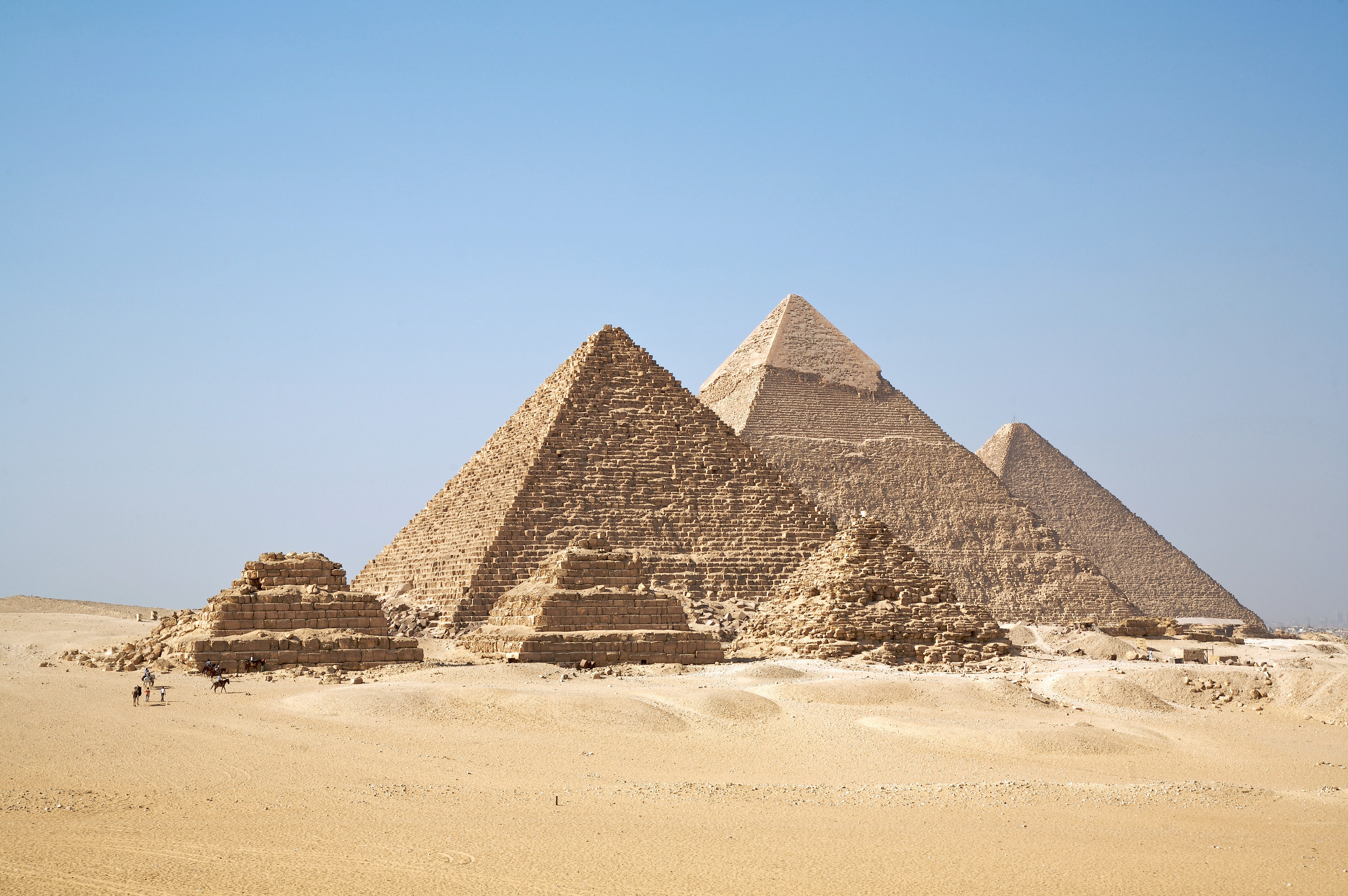
All Giza Pyramids in one shot — CC BY-SA 2
Travel to Egypt Hotels
Plan the trip in three parts, and the hotels choose themselves. Cairo first, for three nights: the pyramids and the Sphinx at Giza, the Egyptian Museum and the Grand Egyptian Museum, and the mosques and markets of Islamic Cairo. The Nile-side hotels suit a first stay, because the river is the city’s spine and the views run the length of it, and the Mena House suits travellers who want to wake up looking at the pyramids.
The airport hotels suit only the traveller with an early flight, because Heliopolis is far from the sights and the traffic in and out of Cairo is slow. The range of Egypt hotels in the capital runs from the big Nile-side towers to the old palace hotels at Giza.
Luxor and Aswan second, for four or five nights, and here the choice is between a hotel and a cruise. The cruise boats run from Luxor to Aswan in three or four nights, stopping at Edfu and Kom Ombo, and the boat is the hotel, the restaurant and the transport in one. The land hotels suit travellers who want more time in one place: Luxor’s East Bank hotels for Karnak and the Luxor temple, the West Bank guesthouses for the Valley of the Kings and the tombs, and Aswan’s river hotels for Philae and the Nubian villages. The sleeper train from Cairo to Luxor runs overnight and saves a hotel night, and the flight takes about an hour.
The Red Sea third, for three or four nights, and here the all-inclusive Egypt hotels are the natural choice. Hurghada suits families and first-time divers, with the largest choice of hotels and the easiest diving. Sharm el-Sheikh suits divers who want the reefs of Ras Mohammed and the nightlife of Naama Bay.
Marsa Alam suits the traveller who wants quieter water and the chance of dugongs and turtles, and its resorts are newer and more spread out along the coast. The Red Sea is warm all year, and the resorts are the place to end the trip, because the diving is best after the dust of the Nile valley. The desert is the fourth part for those with more time: Siwa Oasis, eight hours by road from Cairo, with mud-brick lodges and the oracle temple where Alexander the Great is said to have consulted the god Amun, and the White Desert, two nights from Bahariya, with camps among the chalk formations.
Book the Nile valley Egypt hotels for October to April, when the weather is kind and the crowds are largest, and book early for Christmas and Easter. The Red Sea resorts are cheaper in the summer, when the heat drives the Europeans away and the water is at its warmest. The cruise boats fill first, and the small guesthouses of the West Bank fill second, so the travellers who want those should book months ahead.
The big Cairo hotels rarely fill, and the Red Sea resorts almost always have rooms outside the European school holidays. For the same resort model on the other side of the Mediterranean, the Tunisia hotels guide covers the Sahel coast and the island of Djerba.

Boys playing street football in Egypt, one of the most popular games in Africa — CC BY-SA 4
Notable Places in Egypt Hotels
Giza and the pyramids. The plateau west of Cairo, part of the Memphis property, ref 86, inscribed in 1979. The Mena House, the most famous of the Egypt hotels at Giza, stands at the foot of the plateau, and the Giza complex holds the three pyramids, the Sphinx and the valley temples. The Grand Egyptian Museum stands two kilometres from the site.
Islamic Cairo. The old city, inscribed in 1979 as ref 89, holds the mosques, madrasas and markets of a thousand years, and the small boutique hotels that have opened in restored houses suit travellers who want to sleep inside the history. The citadel and the mosque of Ibn Tulun are the stops beyond the Khan el-Khalili market.
Luxor and Karnak. The temples of the East Bank, part of Ancient Thebes, ref 87, inscribed in 1979. The hotels of the East Bank serve Karnak and the Luxor temple, and the Winter Palace, opened in 1907, is the grand old hotel of the town.
Valley of the Kings. The tombs of the West Bank, part of Ancient Thebes, ref 87. The guesthouses of the West Bank suit travellers who want to walk to the tombs at dawn, and the Colossi of Memnon stand on the road between the river and the valley.
Aswan and Philae. The island temple of Isis, part of the Nubian Monuments, ref 88, inscribed in 1979. The hotels of Aswan sit on the river and on Elephantine Island, and the Cataract hotel, where Agatha Christie wrote Death on the Nile, stands above the first cataract.
Hurghada. The resort town on the Red Sea, about 450 kilometres south-east of Cairo. The hotels run north and south of the old town along the beach, and the diving boats leave from the marinas every morning for the reefs and the wrecks.
Marsa Alam. The quieter resort coast south of Hurghada, about 280 kilometres down the shore. The airport, officially opened on 16 October 2003, serves the resorts that stretch along the coast, and the southern reefs hold dugongs, turtles and dolphins.
Siwa Oasis. The oasis at the edge of the Great Sand Sea, about 750 kilometres west of Cairo near the Libyan border. The mud-brick lodges and the oracle temple of Amun are the reasons to make the long drive, and the salt lakes and the hot springs are the reward.
Frequently Asked Questions
Where should I stay on my first trip to Egypt?
Start in Cairo for the pyramids and the museums, then Luxor for the temples, then the Red Sea for the beach. The Egypt hotels in each base are built for that part of the trip. Three bases cover the country, and one base cannot.
Which Red Sea resort is best?
Hurghada suits families and first-time divers, Sharm el-Sheikh suits experienced divers and nightlife, and Marsa Alam suits quiet water and wildlife. The choice depends on the diving, not the hotel.
Should I take a Nile cruise or stay in hotels?
The cruise suits travellers who want the temples without packing, because the boat moves while you sleep. Land hotels suit travellers who want more time in Luxor or Aswan and a slower pace.
How many days do I need in Egypt?
Ten days cover Cairo, Luxor, Aswan and the Red Sea. A week covers Cairo and Luxor alone, and two weeks add the desert or Alexandria.
What is the nearest UNESCO site to Cairo?
Historic Cairo, ref 89, is in the city itself, around the mosques and markets of the old city. The pyramids of Giza, part of the Memphis property, ref 86, lie about 15 km south-west of the centre.
Is Egypt safe for tourists?
The tourist areas are calm, and the tourist police are visible at the main sites. The usual precautions apply: agree prices before any ride or tour, keep valuables out of sight in crowds, and book desert trips through a licensed operator.
Verified
- Egypt holds seven UNESCO World Heritage sites: Memphis 86, Ancient Thebes 87, the Nubian Monuments 88, Historic Cairo 89, Abu Mena 90, Saint Catherine Area 954 and Wadi Al-Hitan 1186. Checked 23 November 2026 on whc.unesco.org.
- The Mena House was built in 1869 as a hunting lodge for the Khedive Ismail and opened as a hotel in 1886. Checked 23 November 2026.
- The Winter Palace in Luxor opened in 1907. Checked 23 November 2026.
- The tomb of Tutankhamun was discovered in November 1922 by Howard Carter. Checked 23 November 2026.
- The Aswan High Dam was completed in 1970, and the temples of Abu Simbel were moved between 1964 and 1968. Checked 23 November 2026.
- Marsa Alam International Airport opened for commercial aviation in October 2001 and was officially opened on 16 October 2003. Checked 23 November 2026.
- The Nile runs about 6,650 kilometres from its farthest source to the Mediterranean, and about 1,600 kilometres of that lies within Egypt. Checked 23 November 2026.
Sources
- UNESCO World Heritage Centre, Egypt, whc.unesco.org/en/statesparties/eg, checked 23 November 2026
- UNESCO World Heritage Centre, Memphis and its Necropolis, whc.unesco.org/en/list/86/, checked 23 November 2026
- UNESCO World Heritage Centre, Ancient Thebes, whc.unesco.org/en/list/87/, checked 23 November 2026
- Wikipedia, Mena House, checked 23 November 2026
- Wikipedia, Winter Palace Hotel, checked 23 November 2026
Unverified
- Exact hotel counts for Cairo, Luxor and the Red Sea resorts are not published in a single source checked for this article.
- Whether Hurghada is the largest resort on the Egyptian Red Sea coast is not verified by a comparable count of rooms.
- The claim that the all-inclusive resort is the cheapest way to stay on the Red Sea depends on the season and the booking channel, and is not verified as a general rule.
Illustrations
- Hero: A beach in the north coast in Egypt. Free image: https://upload.wikimedia.org/wikipedia/commons/1/18/North_Coast%2C_Egypt.jpg — CC BY-SA 4.
- In body, egypt: All Giza Pyramids in one shot. Free image: https://upload.wikimedia.org/wikipedia/commons/a/af/All_Gizah_Pyramids.jpg — CC BY-SA 2.
- In body, egypt: Boys playing street football in Egypt, one of the most popular games in Africa. Free image: https://upload.wikimedia.org/wikipedia/commons/a/a8/Boys_playing_street_football_in_Egypt_-_edit1.jpg — CC BY-SA 4.