
Annaba — The Port City of Hippo Regius on the Algerian Coast
Annaba is a port city on the Mediterranean coast of north-eastern Algeria, near the border with Tunisia. Roman ruins and a basilica overlook its bay.
Annaba is a city where the layers of history lie close together, with the ruins of Hippo Regius at its southern edge, the basilica of Saint Augustine on its hill, and the white houses of the old French town running down to the port. The city was a Phoenician port, a Roman city, a bishopric of Saint Augustine, and a French colonial port called Bone, and each of those lives has left something to see. Today Annaba is the third city of Algeria, a port and an industrial centre, with a steel works at El Hadjar and with beaches that draw visitors in summer. This guide explains Annaba as a place to visit: its geography, its long history, and the ruins, the basilica, and the coast that repay a stay of two or three days.
Quick Facts
- Kind: A Mediterranean port city in north-eastern Algeria, and the capital of Annaba Province.
- Location: On the coast of the Mediterranean, near the border with Tunisia, about six hundred kilometres east of Algiers.
- Population: About four hundred and sixty-five thousand people in the city, with about a million in the wider metropolitan area.
- Name: From the Arabic for the place of the jujubes, and known as Bone under French rule from eighteen thirty-two.
- Landmark: The ruins of Hippo Regius, where Saint Augustine was bishop, and the Basilica of Saint Augustine on the hill.
- Industry: The steel complex at El Hadjar, one of the largest industrial sites in Algeria.
- Nearest World Heritage: Djemila, ref one nine one, inscribed nineteen eighty-two, about one hundred and ninety kilometres to the west in a straight line, with Timgad a little farther.
- Getting there: Rabah Bitat Airport, with flights from Algiers, and a railway and a road along the coast from the capital.
Geography of Annaba
Annaba stands on the Mediterranean coast of north-eastern Algeria, on a bay that opens to the north, with the city spread between the sea and the hills of the Edough massif to the south and west. The city lies about six hundred kilometres east of Algiers by road, and about two hundred kilometres west of Tunis, the capital of Tunisia, so that it is closer to the Tunisian border than to any other great Algerian city. The coast here is a curve of beaches and headlands, with the port at the centre and with the beaches of Chapuis, Ain Achir, and Seraidi stretching away to the east and west. The Seybouse River, which rises in the mountains of the interior, reaches the sea just east of the city, and its plain is one of the most fertile in Algeria, with farms, with orchards, and with the steel works of El Hadjar on its edge.
The Edough massif dominates the geography of Annaba, a chain of forested mountains that rises to one thousand and eight metres at its highest point and that runs from the coast inland to the south-west. The village of Seraidi stands in the massif at about eight hundred and fifty metres, in a setting of cork oak and pine, and it is the cool retreat of the city in summer, when the heat on the coast is at its worst. The massif is a protected area of forest, with cork oaks, with wild boar, and with birds, and its trails give walks with views across the bay and across the plain to the sea. The contrast between the massif and the coast is the geography of Annaba in miniature, with the mountain behind the city and the sea before it, and with the city itself squeezed between the two.
The climate of Annaba is Mediterranean, with hot dry summers and mild wet winters, and with more rain than the cities of the Algerian west, because the north-east catches the weather from the sea. Summer days are hot, with temperatures in the high twenties or low thirties in degrees Celsius, and the sea breeze keeps the coast cooler than the interior, while the nights stay warm through July and August. Winter brings rain, with the heaviest falls between November and February, and with mild days that rarely fall below ten degrees, so that the city is green in winter and dry in summer. The best months for a visit are April to June and September to October, when the air is mild, the sea is warm enough for swimming, and the hills are green, while the high summer months of July and August are the busiest, with visitors from across Algeria filling the beaches.
The city of Annaba is compact for its size, with a dense centre of tall buildings and narrow streets, and with a population density of about nine thousand five hundred people per square kilometre in the central districts. The old French town, with its arcades and its squares, lies around the port, and the newer districts spread south toward the ruins of Hippo Regius and west toward the hills, while the industrial zone of El Hadjar lies to the south, on the plain of the Seybouse. The port is the economic heart of the city, with ships carrying steel, phosphates, and farm produce, and with ferries and fishing boats working alongside the cargo ships. The beaches to the east and west of the port are the leisure heart of the city, with hotels, with restaurants, and with promenades where the people of Annaba walk in the evening.
The position of Annaba near Tunisia shapes its life, because the city has always looked east as well as west, toward the ports of the eastern Mediterranean and toward the trade of the region. The road east from Annaba runs to the Tunisian border in about two hours, and the city has long been a meeting point for Algerians and Tunisians, with family ties, with trade, and with a shared dialect across the border. The railway from Algiers runs along the coast to Annaba, and the airport, named for Rabah Bitat, links the city with the capital and with other Algerian cities, while the port links it with the sea. Annaba is a city of the edge, between Algeria and Tunisia, between the mountain and the sea, and between the ancient world of Hippo and the modern world of steel.
The plain of the Seybouse, east of the city, is the farmland of Annaba, with fields of wheat, with orchards of citrus, and with market gardens that supply the city, and it is one of the most productive plains in Algeria. The river itself, which rises in the mountains near Souk Ahras, runs for about two hundred and twenty-five kilometres before it reaches the sea, and its valley has been farmed since Roman times, when Hippo Regius drew its grain from the farms around it. The plain also holds the industrial town of El Hadjar, with the steel works, and with housing for the workers, so that the farmland and the factories stand side by side, and the city draws its food and its steel from the same plain. A drive east from Annaba, along the river and through the farms, shows the working side of the city, away from the ruins and the beaches, and it is the part of Annaba that most visitors miss.
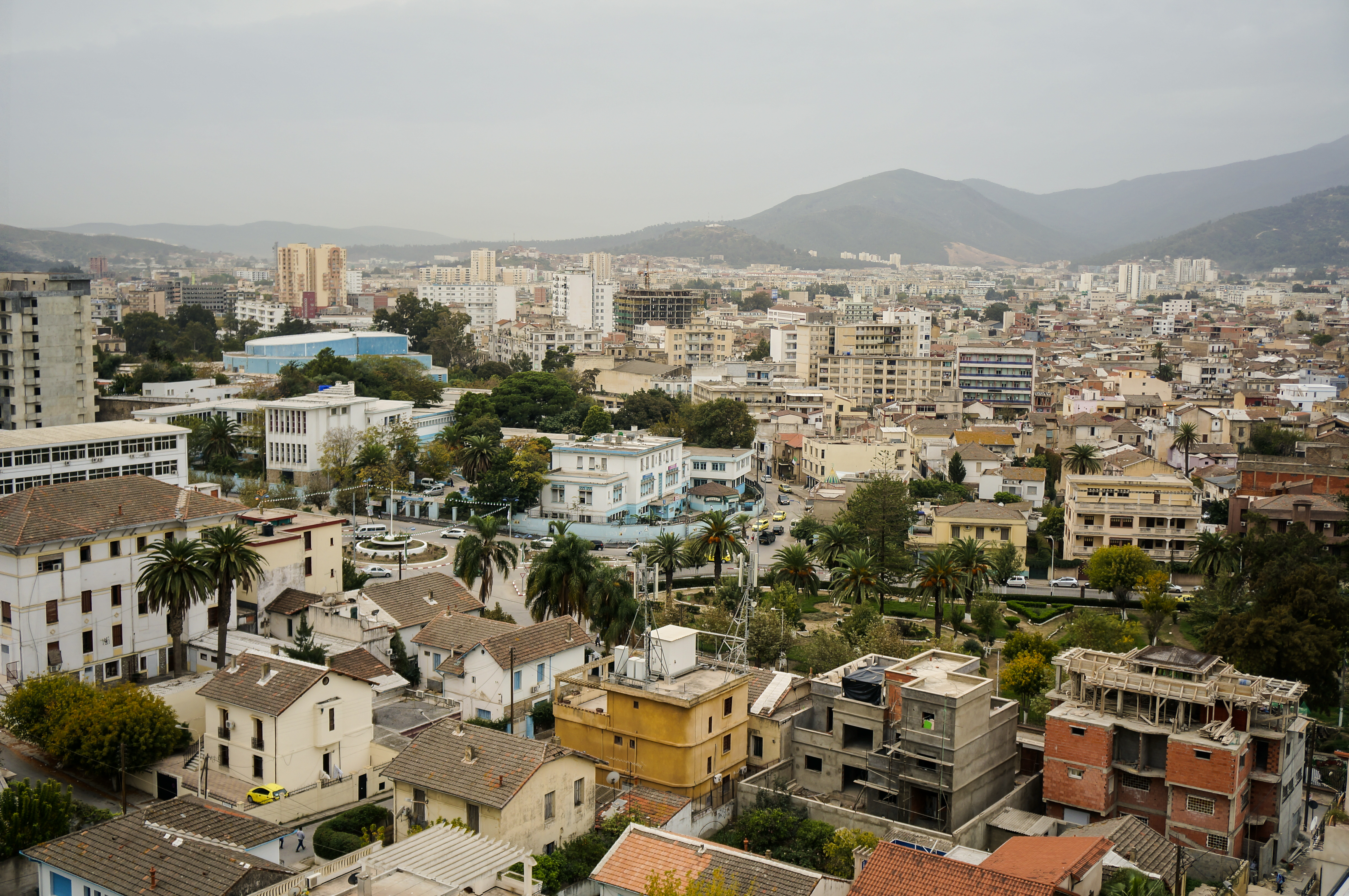
A view of Annaba — CC BY-SA 2

Annaba beach in Algeria — CC BY-SA 4

The Cap de Garde lighthouse at Annaba, Algeria — CC BY-SA 4
History of Annaba
The history of Annaba begins with the Phoenicians, who founded a trading post here, traditionally dated to the twelfth century before Christ, on a headland above the bay, where the ships from Tyre and from Carthage could shelter. The town grew as Hippo Regius, the royal Hippo, under the Numidian kings, and then under Rome, when it became one of the great ports of North Africa, with a forum, with baths, with a theatre, and with the villas of rich merchants. The ruins that survive today, at the southern edge of the modern city, show a Roman town of the first centuries after Christ, with mosaics, with columns, and with the remains of early Christian basilicas, and they are the oldest layer of Annaba that a visitor can walk through. The name of the city itself comes from the jujube trees that grew here, and the Arabic name Annaba means the place of the jujubes, a name that the city has kept through every change of ruler.
The most famous chapter in the history of Annaba is the life of Saint Augustine, who was bishop of Hippo from three hundred and ninety-five until his death in four hundred and thirty, during the siege of the city by the Vandals. Augustine was born in Thagaste, in the interior of Numidia, and he came to Hippo as a priest, and then as bishop, and he wrote here the works that shaped Western Christianity, including the Confessions and the City of God. The Council of Hippo, held in three hundred and ninety-three, fixed the canon of the Bible for the Western Church, and the city was a centre of learning and of debate, with Augustine arguing against the Donatists and against the Pelagians in the basilicas that stood where the ruins stand today. When the Vandals besieged Hippo in four hundred and thirty, Augustine died in the city, and the Vandals took it, and the Roman city never recovered its former greatness, although the bishopric survived under the Byzantines and under the Arabs.
The Arabs came to Annaba in the seventh century, and the city passed under the rule of the dynasties of North Africa, with the port trading in grain, in oil, and in goods from the interior, while the ruins of Hippo were left to the fields and to the stone robbers. The Ottomans held the coast from the sixteenth century, and the city was a small port, with a kasbah and with a harbour that served the corsairs and the traders of the Mediterranean. The French took the city in eighteen thirty-two, and they renamed it Bone, and they rebuilt it as a colonial port, with a new town of arcades and squares, with a railway, and with a harbour for the export of minerals and of farm produce. The French period left the city its layout, its boulevards, and its public buildings, and it also left the Basilica of Saint Augustine, built between eighteen eighty-one and nineteen hundred on the hill above the ruins, as a monument to the bishop who had made the city famous.
The modern history of Annaba is the history of industry, because the city became the steel capital of Algeria after independence in nineteen sixty-two. The steel complex at El Hadjar, south of the city, was built with Soviet help in the nineteen sixties and seventies, and it became one of the largest industrial sites in the country, with thousands of workers and with a town of its own around it. The city grew fast in those years, with new districts, with housing for the workers, and with a population that rose from a quarter of a million to nearly half a million, and the port grew with it, handling the steel, the phosphates, and the goods of the north-east. Annaba today is still an industrial city, but it is also a city that is rediscovering its history, with the ruins of Hippo Regius, with the basilica, and with the beaches drawing visitors who come for the past as much as for the sea.
The church of Saint Augustine has its own history after the saint, because the basilicas of Hippo were left to ruin, and the memory of Augustine was kept alive by the books that were carried to Europe, while the city itself forgot the bishop for centuries. The Vandals, the Byzantines, and the Arabs each ruled Hippo, and the churches fell, and the stones were taken for new buildings, so that by the time the French came in eighteen thirty-two, the ruins were fields and the basilica was a memory. The French built the new basilica on the hill, between eighteen eighty-one and nineteen hundred, as a monument to the saint, and they dug the ruins below, so that the city could see its own past again, and the basilica became the symbol of Annaba, with the saint looking out over the town that he had made famous.
The port of Annaba has its own story, because the city has always lived by the sea, with ships carrying grain to Rome, with corsairs in the Ottoman centuries, and with French steamers carrying minerals and wine to Marseille. The harbour was rebuilt by the French, with a breakwater and with quays, and it became one of the great ports of Algeria, with the steel of El Hadjar, the phosphates of the interior, and the farm produce of the Seybouse plain passing through it. The port is still the economic heart of the city, and the ferries and the fishing boats work alongside the cargo ships, so that the waterfront, with its noise and its smell of fish and of fuel, is the place where the city shows its working life, and where the history of Annaba as a port can still be seen.

Cap de garde Annaba — CC BY-SA 4

The ruins of Hippo Regius at Annaba, Algeria — CC BY-SA 2
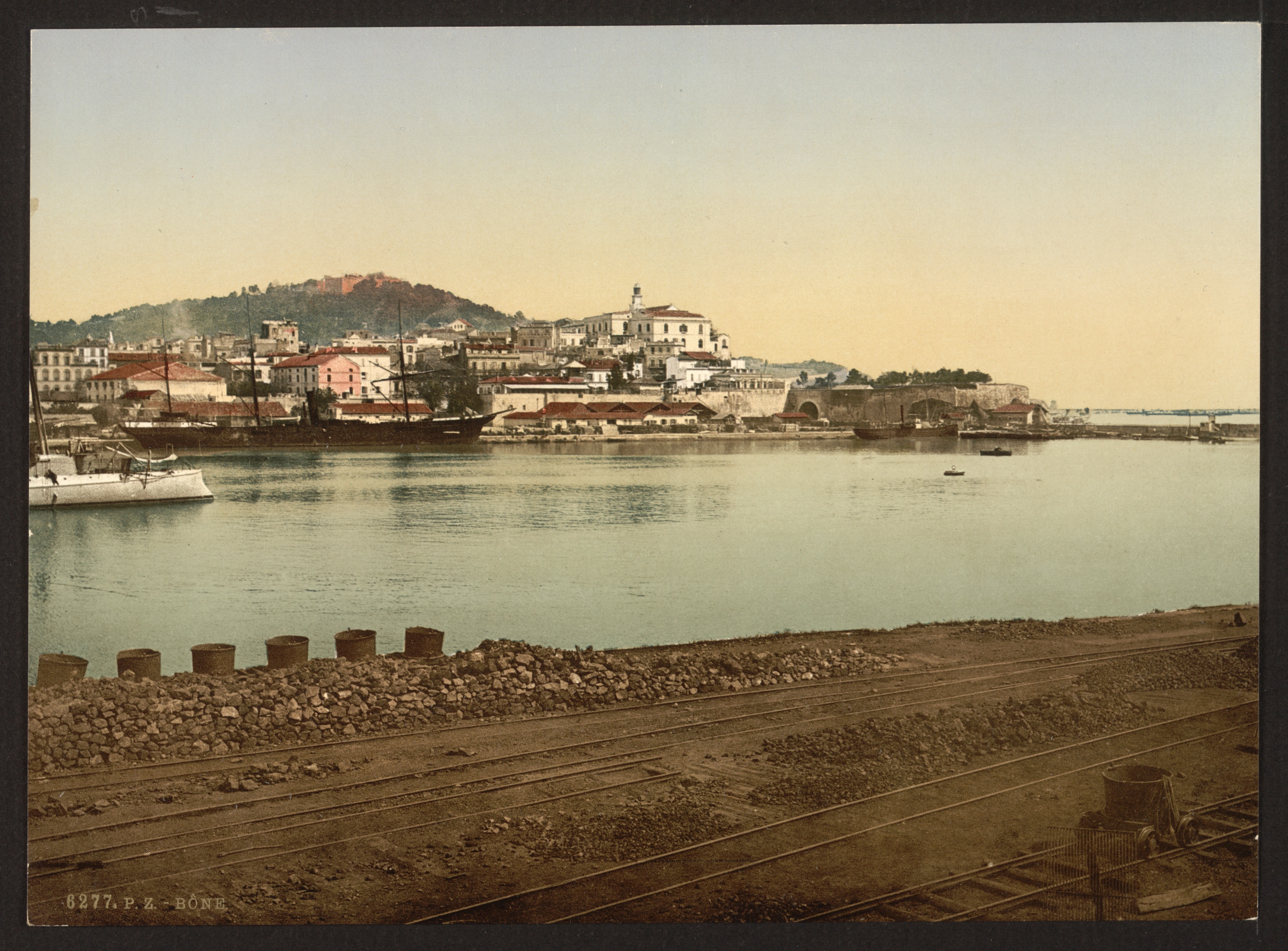
Bône, as Annaba was known under French rule — Public domain
Travel to Annaba
Most visitors reach Annaba by air, landing at Rabah Bitat Airport, which lies south of the city and is served by flights from Algiers and from other Algerian cities, with a taxi ride of about half an hour into the centre. The railway from Algiers runs along the coast to Annaba, with a journey of about six hours through the towns of the eastern coast, and the road from the capital takes about the same time, with a drive that follows the sea for much of the way. Visitors who come from Tunisia can cross the border by road, with the crossing about two hours east of the city, although the border formalities take time and the crossing should be planned for the morning. The city itself is compact, and the centre, the port, and the ruins can be covered on foot, with taxis for the basilica, for Seraidi, and for the beaches.
A visit to Annaba works best over two or three days, with the first day given to the ruins of Hippo Regius and to the Basilica of Saint Augustine, and the second day to the old town, the port, and the beaches. The ruins lie at the southern edge of the city, with a forum, with baths, with a theatre, and with the remains of early Christian basilicas, and they are best seen in the morning, when the light is low and the stones are cool. The basilica stands on the hill above the ruins, a neo-Byzantine church of white stone, built between eighteen eighty-one and nineteen hundred, with a statue of Saint Augustine looking out over the city and the sea, and with mosaics and marble inside that repay a visit. The two together, the ruins below and the basilica above, are the heart of any visit to Annaba, and they tell the story of the city from Rome to the present day.
The old town and the port give a different picture of Annaba, and they are worth a day of their own, with a walk through the arcades of the French town, with a visit to the market, and with a meal of fish on the waterfront. The market of Annaba is one of the liveliest in Algeria, with stalls selling vegetables, spices, and seafood, and with the catch of the day laid out on ice in the morning. The port, with its cargo ships and its fishing boats, is the working heart of the city, and the promenade along the bay is the place where the people of Annaba walk in the evening, with the sea on one side and the lights of the city on the other. The beaches of the city, with Chapuis and Ain Achir to the east and with Seraidi to the west, are the place for a swim and for a rest after the ruins, with cafes and with restaurants along the shore.
A day out of Annaba can add a great deal to a visit, and the most rewarding is the drive up to Seraidi, in the Edough massif, where the air is cool and the views stretch across the bay. The village stands at about eight hundred and fifty metres, in a setting of cork oak and pine, and it is the summer retreat of the city, with a small hotel and with walks in the forest that give views of the coast and of the plain. The road up to Seraidi climbs through the forest, with bends and with lookouts, and the village itself is quiet, with a church and with houses that belong to the families of Annaba who come here for the summer. Visitors who have more time can continue to the beaches east of the city, or to the Tunisian border, and travellers planning a wider circuit can follow Algeria tours, but Seraidi is the day trip that most visitors to Annaba remember, because it shows the mountain behind the city, and the sea before it, in a single view.
The best time to visit Annaba is spring or autumn, when the weather is mild and the city is at its most pleasant, with the hills green and the sea warm enough for swimming. Summer is the busiest season, with the beaches full and with the hotels of the city often booked, while winter brings rain and quiet streets, and the ruins and the basilica are at their most atmospheric in the low light. Visitors should bring sun protection for the beaches and for the ruins, because the sun is strong at midday, and should wear sturdy shoes for the ruins, where the ground is uneven and the stones are worn. Annaba is a safe city for travellers who use the usual care, and its people are welcoming, with a pride in their history that shows in the way they talk about Augustine, about Hippo, and about their city.

The landscape of Seraidi above Annaba, Algeria — CC BY-SA 4

Annaba beach before sunset — CC BY-SA 3
Notable Places in Annaba
The Ruins of Hippo Regius
The ruins of Hippo Regius lie at the southern edge of Annaba, on a low rise above the plain, where the Roman city stood with its forum, its baths, and its theatre. The site is one of the most important Roman sites in Algeria, and it shows a city that was rich, with mosaics in the villas, with columns in the forum, and with the remains of early Christian basilicas that stood where Saint Augustine preached. The forum, with its paving and its columns, is the heart of the site, and the baths, with their pools and their heating, show how the Romans lived, while the theatre, cut into the hillside, looks out over the plain toward the sea. A visit to the ruins takes about two hours, with a walk through the site and with a stop at the small museum, where the finds from the city are kept, including mosaics, statues, and inscriptions.
The ruins are at their best in the morning, when the light is low and the stones are cool, and when the site is quiet, before the heat of the day. The early Christian basilicas, with their apses and their baptisteries, are the most moving part of the site, because they are the churches where Augustine preached and where the Council of Hippo met, and because they stand as a reminder that Hippo was a centre of the Christian world, not just a port. Visitors should wear sturdy shoes, because the ground is uneven, and should bring water and sun protection, because there is little shade on the site. The ruins are the reason to come to Annaba, and they repay a slow visit, with time to sit among the stones and to imagine the city as it was.
The Basilica of Saint Augustine
The Basilica of Saint Augustine stands on the hill above the ruins of Hippo Regius, a church of white stone in the neo-Byzantine style, built between eighteen eighty-one and nineteen hundred, with a statue of the saint looking out over the city and the sea. The basilica was built by the French as a monument to Augustine, on the site where the bishop is thought to have preached, and its mosaics, its marble, and its stained glass make it one of the most beautiful churches in Algeria. The interior, with its nave and its apse, is cool and quiet, and the view from the terrace, across the city to the bay, is one of the finest in Annaba. The basilica is still a place of pilgrimage, with visitors from around the world coming to see the church of the saint, and with a small museum beside it that tells the story of Augustine and of Hippo.
A visit to the basilica should be combined with a visit to the ruins below, because the two together tell the story of the city, from the Roman town to the church that honours its bishop. The basilica is open to visitors, and the staff welcome travellers of all faiths, although visitors should dress modestly and should keep quiet inside the church. The best time to visit is in the late afternoon, when the sun falls on the white stone and when the view across the bay is at its clearest, with the sea turning gold and the city lights coming on below. The basilica is the landmark of Annaba, and it is the place where the history of the city is most alive, with the saint looking out over the town that he made famous.
Seraidi and the Edough Massif
Seraidi is a village in the Edough massif, at about eight hundred and fifty metres above the sea, in a setting of cork oak and pine, and it is the cool retreat of Annaba in summer. The village is small, with a church, with a hotel, and with houses that belong to the families of the city who come here for the summer, and it is reached by a road that climbs through the forest from Annaba, with bends and with lookouts over the bay. The air in Seraidi is cooler than the air on the coast, and the walks in the forest give views across the plain and across the sea, with birds and with wildflowers in spring. The village is at its best in the morning, when the mist clears from the forest and when the sun comes over the ridge, and it is a good place for a walk and for a meal before returning to the city.
The Edough massif, which rises to one thousand and eight metres at its highest point, is a protected area of forest, with cork oaks, with pines, and with trails that lead to viewpoints over the coast and over the interior. The forest is home to wild boar, to jackals, and to birds of prey, and it is one of the greenest places in north-eastern Algeria, with streams that run in winter and with shade in summer. A day in Seraidi and in the massif is a change from the city, with the mountain air and with the quiet of the forest, and it is the day trip that most visitors to Annaba should make, because it shows the other half of the geography of the city, the mountain behind the sea.
The Beaches of Annaba
The beaches of Annaba stretch along the coast to the east and west of the port, with sand, with cafes, and with a sea that is warm enough for swimming from late spring to early autumn. Chapuis, to the east of the city, is a long beach of fine sand, with hotels and with restaurants along its shore, and it is the busiest of the beaches in summer, with families from the city and with visitors from across Algeria. Ain Achir, farther east, is quieter, with a smaller beach and with a view across the bay to the headland, and it is a good place for a swim away from the crowds. The beaches to the west, toward Seraidi, are wilder, with cliffs and with coves, and they are the place for a walk and for a picnic, rather than for a day on the sand.
The beaches are the leisure heart of Annaba, and they are where the city relaxes, with the promenade along the bay filling in the evening, with families walking and with cafes serving mint tea and fish. The sea at Annaba is clean and warm in summer, and the beaches are safe for swimming, although visitors should watch for currents after storms and should swim where the lifeguards are. A day at the beach, after the ruins and the basilica, is the right way to end a visit to Annaba, with the sun setting over the bay and with the city lights coming on across the water. The beaches are not the reason to come to Annaba, but they are the reason to stay a day longer, and they give the city its summer life.

Another view of the ruins of Hippo Regius at Annaba, Algeria — CC BY-SA 2

The Basilica of Saint Augustine in Annaba, Algeria — CC BY-SA 3

Chapuis beach at Annaba, Algeria — CC BY-SA 4
Frequently Asked Questions
Where is Annaba?
Annaba is a port city in north-eastern Algeria, on the Mediterranean coast, about six hundred kilometres east of Algiers and near Tunisia.
What is Hippo Regius?
Hippo Regius is the Roman city at the edge of Annaba, where Saint Augustine was bishop from 395 to 430.
When was the Basilica of Saint Augustine built?
The basilica was built between eighteen eighty-one and nineteen hundred, on the hill above the ruins of Hippo Regius.
Is Annaba a World Heritage site?
No, the nearest inscribed sites are Djemila and Timgad, about one hundred and ninety kilometres to the west.
When is the best time to visit Annaba?
Spring and autumn are best, with mild weather and a warm sea, while summer is the busiest season on the beaches.
How do I get to Annaba from Algiers?
Fly to Rabah Bitat Airport, or take the train or the road along the coast, a journey of about six hours.
Verified
- Annaba is a port city in north-eastern Algeria, near the Tunisian border, at 36.9° N, 7.766667° E, Wikidata Q45942, checked 24/11/2026.
- The city had about 464,740 people in 2019, with about 1,000,000 in the wider metropolitan area, and is the third largest city in Algeria, checked 24/11/2026.
- Hippo Regius was a Phoenician foundation, a Numidian and then a Roman city, and Saint Augustine was bishop of Hippo from 395 until his death in 430, checked 24/11/2026.
- The Council of Hippo was held in 393, and the Basilica of Saint Augustine was built in 1881-1900, checked 24/11/2026.
- The French took Annaba in 1832 and renamed it Bone, and Algeria became independent in 1962, checked 24/11/2026.
- Seraidi stands at about 850 m in the Edough massif, whose highest point is 1,008 m, checked 24/11/2026.
- The steel complex at El Hadjar is one of the largest industrial sites in Algeria, checked 24/11/2026.
- The nearest World Heritage site is Djemila, ref 191, inscribed 1982, about 192 km straight-line to the west, with Timgad, ref 194, about 196 km away, checked 24/11/2026.
- Annaba lies about 600 km east of Algiers by road, checked 24/11/2026.
- This entity has registry volume_max 10 (FR), primary keyword “voyage organisé annaba tunisie”, and the focus of this article is the entity name Annaba, checked 24/11/2026.
Sources
- Annaba — Wikipedia (https://en.wikipedia.org/wiki/Annaba) — checked 24/11/2026.
- Hippo Regius — Wikipedia (https://en.wikipedia.org/wiki/Hippo_Regius) — checked 24/11/2026.
- Basilica of Saint Augustine — Wikipedia (https://en.wikipedia.org/wiki/Basilica_of_Saint_Augustine) — checked 24/11/2026.
- Djemila — UNESCO (https://whc.unesco.org/en/list/191/) — checked 24/11/2026.
- Timgad — UNESCO (https://whc.unesco.org/en/list/194/) — checked 24/11/2026.
- Wikidata — Annaba (Q45942) (https://www.wikidata.org/wiki/Q45942) — checked 24/11/2026.
Unverified
- The founding of Hippo Regius in the twelfth century before Christ is the traditional date, and this article records it as the traditional account, not as a dated fact.
- The population of about four hundred and sixty-four thousand seven hundred and forty in two thousand and nineteen comes from the Wikipedia lead, and the census figure for the city proper in two thousand and eight was two hundred and fifty-seven thousand three hundred and fifty-nine, so the two counts cover different areas.
- The claim that Annaba is the third largest city in Algeria is the standard ranking, and this article records it as the commonly cited order.
- The height of the Edough massif, one thousand and eight metres, is the commonly cited figure, and the exact summit height varies between sources.
Illustrations
- Hero: Annaba. Free image: https://upload.wikimedia.org/wikipedia/commons/c/ce/Annaba%2C_Algeria%2C_located_on_the_coast_of_the_Mediterranean_Sea_%28iss074e0491560%29.jpg — Public domain.
- In body, Annaba: Cap de garde Annaba. Free image: https://upload.wikimedia.org/wikipedia/commons/f/f8/Annaba%2C_Alg%C3%A9rie.jpg — CC BY-SA 4.
- In body, Annaba: A view of Annaba. Free image: https://upload.wikimedia.org/wikipedia/commons/4/45/Annaba%2C_algeria04.jpg — CC BY-SA 2.
- In body, Annaba beach: Annaba beach in Algeria. Free image: https://upload.wikimedia.org/wikipedia/commons/c/c9/Annaba_beach.jpg — CC BY-SA 4.
- In body, Cap de Garde: The Cap de Garde lighthouse at Annaba, Algeria. Free image: https://upload.wikimedia.org/wikipedia/commons/4/40/Le_phare_cap_de_garde_d%27Annaba.jpg — CC BY-SA 4.
- In body, Hippo Regius: The ruins of Hippo Regius at Annaba, Algeria. Free image: https://upload.wikimedia.org/wikipedia/commons/d/d6/Hippo_Regius_Algeria.jpg — CC BY-SA 2.
- In body, Bône: Bône, as Annaba was known under French rule. Free image: https://upload.wikimedia.org/wikipedia/commons/7/77/Bona%2C_Algeria-LCCN2001697857.jpg — Public domain.
- In body, Seraidi: The landscape of Seraidi above Annaba, Algeria. Free image: https://upload.wikimedia.org/wikipedia/commons/0/07/Paysage_%C3%A0_Sera%C3%AFdi.jpg — CC BY-SA 4.
- In body, Annaba beach at sunset: Annaba beach before sunset. Free image: https://upload.wikimedia.org/wikipedia/commons/9/96/Annaba_beach_before_sunset.jpg — CC BY-SA 3.
- In body, Hippo Regius: Another view of the ruins of Hippo Regius at Annaba, Algeria. Free image: https://upload.wikimedia.org/wikipedia/commons/4/46/Hippo_Regius_Algeria_2.jpg — CC BY-SA 2.
- In body, Basilica of Saint Augustine: The Basilica of Saint Augustine in Annaba, Algeria. Free image: https://upload.wikimedia.org/wikipedia/commons/1/17/Annaba_%2824%29.jpg — CC BY-SA 3.
- In body, Chapuis beach: Chapuis beach at Annaba, Algeria. Free image: https://upload.wikimedia.org/wikipedia/commons/9/98/Beautiful_chapi_beach_annaba_algeria.jpg — CC BY-SA 4.