
Tunisia: Carthage, the Sahara and the Mediterranean
Tunisia is the smallest country in North Africa, yet it holds ten World Heritage sites. Carthage, El Jem and Djerba sit a short drive apart.
Tunisia packs more history into a small space than almost any country in Africa. On a strip of land a third the size of France, Phoenician Carthage, Roman amphitheatres, the holy city of Kairouan, the island of Djerba and the dunes of the Sahara sit within a few hours of each other, and the sea is never far away. It is the only Arab country to move peacefully to democracy after the Arab Spring, and it is also one of the easiest countries in North Africa to travel in, with good roads, cheap trains and a coastline that runs from the beaches of Hammamet to the fishing ports of the south.
Quick Facts
- Where it is: North Africa, between Algeria to the west and Libya to the south-east, facing the Mediterranean
- Land area: 163,610 square km
- People: about 12.3 million, 2024 estimate
- Capital: Tunis, on the Gulf of Tunis
- Tongues: Arabic and French, with Berber spoken in the south
- Currency: Tunisian dinar
- Time: Central European Time, one hour ahead of Greenwich Mean Time
- Heritage count: 10 World Heritage properties, 9 cultural and 1 natural
Geography of Tunisia
Tunisia is the smallest country in North Africa, a wedge of land between Algeria and Libya, with the Mediterranean Sea along its northern and eastern shores. The country is about 163,610 square kilometres, roughly a third of the size of France, and it divides into three bands: the green Tell hills of the north, the dry steppe of the centre, and the Sahara in the south. The Tell is the wettest part of the country, with cork oak forests and wheat fields, and it holds most of the population. The centre is drier, with olive groves stretching for miles around Sfax, and the south is desert, with the great salt lake of Chott el Jerid, a white plain of salt that shimmers in the heat, and the oases of Tozeur and Nefta, where date palms grow in the shade of the dunes.
The Medjerda is the longest river in Tunisia, about 460 kilometres, flowing from Algeria through the north and into the Mediterranean near Tunis. It is the only river in the country that flows all year, and its valley is the most important farmland in Tunisia, growing wheat, olives and vegetables. The other rivers are seasonal, running only after rain and drying up in summer.
Lake Ichkeul, in the north, is a shallow lake that fills with fresh water in winter and turns brackish in summer, and it is one of the most important wetlands in the Mediterranean for migrating birds, which is why UNESCO listed it as a World Heritage property in 1980. The coast runs for about 1,300 kilometres, with long sandy beaches at Hammamet and Sousse, rocky coves near Tabarka, and the island of Djerba in the south-east, the largest island in the country at 514 square kilometres.
The climate of Tunisia changes fast from north to south. The north has a Mediterranean climate, with mild wet winters and hot dry summers, and the coast is comfortable for most of the year. The centre is hotter and drier, and the south is desert, with summer temperatures in Tozeur often above 45 degrees, and winter nights that can turn cold.
The best months to travel are April and May and September and October, when the days are warm, the sea is still swimmable and the desert is walkable. July and August are the months for the beach, when the coast is at its busiest, and January is the month for the desert festivals, when the days are clear and the nights are cold enough for a blanket. Rain falls mostly in winter, and the south can go for months without a drop.
The Sahel, the coastal strip between Sousse and Sfax, is the olive heart of Tunisia. The groves run for miles inland, with trees planted in rows across the dry hills, and the oil pressed here is among the finest in the Mediterranean, with a green colour and a peppery taste. The Sahel towns of Sousse, Monastir and Mahdia were once the ports of the olive trade, and their ribats, the fortified monasteries built in the 8th and 9th centuries to guard the coast against attack from the sea, still stand on the shore. Monastir holds the mausoleum of Bourguiba, a marble building with a golden dome, and Mahdia was once the capital of the Fatimids, before they moved to Cairo, and its old harbour still shelters fishing boats.
Tunisia lives from its land and its sea. Olives are the main crop, and the country is one of the largest olive oil producers in the world, with groves that cover the centre and the Sahel coast. Dates from the oases of Tozeur are exported around the world, and the fishing ports of Sfax, Mahdia and Zarzis supply the markets with sardines, octopus and shrimp.
Phosphate is mined in the south, and tourism is one of the largest employers, with beach resorts at Hammamet, Sousse and Djerba, and cultural tourism at Carthage, El Jem and Kairouan. The country is also known for its jasmine, which grows around Sousse and is picked at dawn in summer, and for its ceramics, carpets and mosaics, which carry on crafts that are two thousand years old.

pottery at Guellala, the pottery village of Djerba — CC BY-SA 3
History of Tunisia
The history of Tunisia begins with the Phoenicians, traders from the Levant, in what is now Lebanon, who founded Carthage in 814 BC, according to tradition by Queen Dido. Carthage grew into a trading empire that controlled much of the western Mediterranean, with a strong navy and colonies in Sicily, Sardinia and Spain, and its rivalry with Rome led to the Punic Wars, which lasted more than a century. The wars ended in 146 BC, when Rome destroyed Carthage and rebuilt the city as a Roman colony, and Tunisia became the breadbasket of the Roman Empire, growing wheat for Rome and building the amphitheatre at El Jem, the baths at Dougga and the towns that still stand as ruins today. The Roman period left the deepest mark on the country, and its ruins are among the best preserved in North Africa.
Tunisia became part of the Islamic world in 647, when Arab armies conquered the land, and Kairouan was founded in 670, becoming one of the first Islamic cities in North Africa and the fourth holiest city of Islam. The Great Mosque of Kairouan, built in 670 and rebuilt in the 9th century, is one of the oldest mosques in the Islamic world, and under the Aghlabid, Fatimid and Hafsid dynasties, Tunisia became a centre of culture and trade, with Tunis as the capital from the 13th century. The island of Djerba kept its own character through all of this, with Jewish, Muslim and Christian communities living side by side, and its settlement pattern of scattered farmsteads and small towns, which UNESCO recognised in 2023, grew out of a thousand years of living with little water and much insecurity.
From 1705, Tunisia was ruled by the Husainid Beys, a dynasty that kept the country semi-independent under the Ottomans, with its own army, its own taxes and its own trade with Europe. The Beys built palaces and mosques in Tunis, and they made the Bardo Palace, outside the medina, the seat of government, but they also borrowed heavily from European banks, and by the 1860s the country was deep in debt. France used the debt as a reason to intervene, and in 1881, under the Treaty of Bardo, Tunisia became a French protectorate, with a French resident-general running the country while the Bey stayed as a figurehead.
Under French rule, the country was modernised with railways, ports and plantations, but it also suffered injustice, and the independence movement led by Habib Bourguiba won independence on 20 March 1956. Bourguiba became the first president of Tunisia, and he ruled until 1987, when Zine El Abidine Ben Ali replaced him.
In 2011, Tunisia was where the Arab Spring began, when the street vendor Mohamed Bouazizi set himself on fire in Sidi Bouzid, starting a revolution that overthrew Ben Ali. Tunisia was the only country of the Arab Spring to move peacefully to democracy, with a constitution in 2014 and the Nobel Peace Prize in 2015 awarded to the National Dialogue Quartet. Tourism, an important part of the economy, fell after the attacks of 2015, and it has been recovering since.
In July 2022, President Kais Saied, elected in 2019, put a new constitution to a referendum, and it was approved, giving the president more power and changing the system built in 2014. Saied had dismissed the parliament in July 2021, and the referendum was the next step in his remaking of the state. The referendum passed with more than 90 per cent of the vote, but the turnout was low, at about 30 per cent, and the opposition called the vote illegitimate. Saied’s supporters said the new system would end the deadlock of the old parliament, while his critics said it returned power to one man.

the ruins of the Antonine Baths at Carthage — CC BY-SA 4
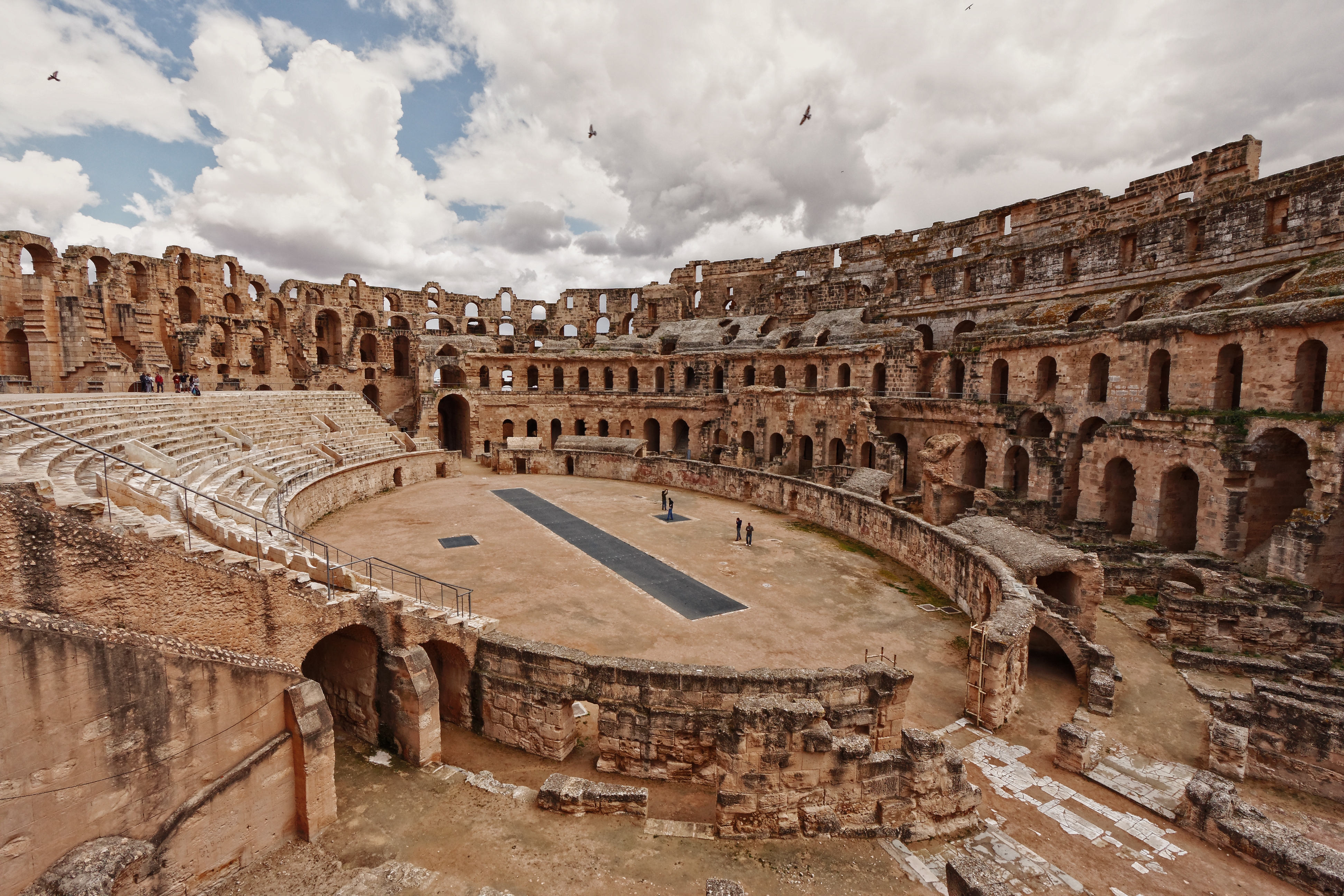
the amphitheatre of El Jem — CC BY-SA 3

the minaret of the Great Mosque of Kairouan — CC BY-SA 4
Travel to Tunisia
Tunis, the capital, is the natural start of every journey. The Medina of Tunis, inscribed by UNESCO in 1979 as ref 36, is one of the largest and best preserved medinas in North Africa, with more than 700 monuments, including the Zitouna Mosque, built in the 8th century. The Bardo Museum, in an old palace outside Tunis, holds one of the largest collections of Roman mosaics in the world, with pieces from Carthage, Dougga and El Jem, and a visitor should allow at least a day for the medina and the museum together.
Carthage, about 15 kilometres north-east of Tunis, is a scatter of sites rather than a single ruin, with the Punic harbour, the Roman theatre, the old quarter and the Carthage Museum, and the whole area was inscribed by UNESCO in 1979 as ref 37. From Carthage, a visitor can walk to Sidi Bou Saïd, a hill village of white houses and blue doors, famous for its cafe above the Bay of Tunis, and inscribed by UNESCO as a World Heritage property in 2026 as ref 1769.
El Jem is a small town in the middle of the olive country, and its amphitheatre rises over the houses like a mountain. The building, from the 3rd century, held about 35,000 people, and it was used for gladiator fights and wild animal hunts, much like the Colosseum in Rome, but it is better preserved, because it was less damaged. The museum in the town holds the mosaics found in the Roman villas nearby, with scenes of hunting, fishing and daily life, and the town is a good stop on the road from Tunis to Sousse.
From El Jem, a traveller can continue to Sousse, a seaside city with a medina inscribed by UNESCO in 1988, and to Kairouan, the holy city, with its Great Mosque built in 670. Dougga, about 100 kilometres south-west of Tunis, is one of the best preserved Roman towns in North Africa, inscribed by UNESCO in 1997 as ref 794, with a Roman theatre, temples, baths and old houses, and a view across the Medjerda valley. Djerba, in the south-east, is the largest island in the country, with beaches, the pottery village of Guellala, the El Ghriba synagogue of the oldest Jewish community in North Africa, and villages of traditional architecture, and it was inscribed by UNESCO in 2023 as ref 1640.
Safety is the question most travellers ask before coming to Tunisia, because the country suffered attacks in 2015. Since then, security in the main tourist areas such as Tunis, Hammamet, Sousse, Djerba and Tozeur has been strengthened, and millions of visitors come to Tunisia each year without incident. Travellers should read the latest travel advice from their own foreign ministry before the trip, because advice changes over time, and they should avoid the border areas with Libya and Algeria, where the risk is higher.
The country is easy to travel in, with trains from Tunis to Sousse and Sfax, shared taxis between towns, and car hire for the desert, and the food is one of the pleasures of the trip, with couscous, brik, harissa and fresh fish on every menu. Many travellers pair Tunisia with a week in Morocco or a Nile cruise in Egypt, and flights from Tunis connect to both.

a souq in the Medina of Tunis — CC BY-SA 4

the minaret of the Zitouna Mosque in the Medina of Tunis — CC BY-SA 4

the blue doors and white houses of Sidi Bou Said — CC BY-SA 2.5
Notable Places in Tunisia
- Medina of Tunis. The old city of the capital, inscribed by UNESCO in 1979 as ref 36, with more than 700 monuments, including the Zitouna Mosque from the 8th century, and lanes of souks selling perfume, leather, carpets and brass, much like the souks of Marrakech. It is one of the largest and best preserved medinas in North Africa, and a full day is the minimum to walk it.
- Carthage. The archaeological area about 15 kilometres north-east of Tunis, inscribed by UNESCO in 1979 as ref 37, with the Punic harbour, the Roman theatre, the old quarter and the Carthage Museum. The city was founded in 814 BC and destroyed by Rome in 146 BC, and its ruins tell the whole story of the Punic Wars.
- Amphitheatre of El Jem. The Roman amphitheatre built in the 3rd century, the third largest in the world, with room for about 35,000 people, and better preserved than the Colosseum in Rome. It stands in a small town 200 kilometres south of Tunis, and it is the most impressive Roman monument in North Africa.
- Kairouan. The holy city founded in 670, with the Great Mosque built in 670 and rebuilt in the 9th century, and a medina of white houses and narrow lanes. It is the fourth holiest city of Islam, and it was inscribed by UNESCO in 1988 as ref 499.
- Dougga. The Roman town about 100 kilometres south-west of Tunis, inscribed by UNESCO in 1997 as ref 794, with a theatre, temples, baths and old houses on a hill above the Medjerda valley. It is one of the best preserved Roman towns in North Africa, and it draws fewer visitors than El Jem or Carthage.
- Djerba. The island in the south-east, the largest in the country at 514 square kilometres, inscribed by UNESCO in 2023 as ref 1640 for its settlement pattern of scattered farmsteads and small towns. It is known for its beaches, the pottery village of Guellala and the El Ghriba synagogue, and it is reached by ferry from Zarzis or by plane to Djerba-Zarzis Airport.

the theatre of Dougga — CC BY-SA 4
Frequently Asked Questions
How many days should I spend in Tunisia?
A week covers the highlights, with two days in Tunis and Carthage, a day at El Jem and Sousse, a day at Kairouan and Dougga, and two days on Djerba. Travellers with more time can add the desert, with a night in a troglodyte house in Matmata and a camel ride at Douz.
Is Tunisia safe to visit?
Yes, in the main tourist areas, and millions of visitors come each year. The resorts of Hammamet and Sousse, the medina of Tunis and the island of Djerba are calm, and the police are visible in the tourist quarters. Avoid the border areas with Libya and Algeria, and read the latest advice from your own foreign ministry before the trip.
What is the best time to visit Tunisia?
April, May, September and October are the kindest months, when the Sahara is walkable by day and the sea is warm enough to swim. July and August bring desert heat above 45 degrees in Tozeur, while the coast stays bearable, and January is the month for the desert festivals, when the nights are cold and the days are clear.
What is Sidi Bou Saïd?
Sidi Bou Saïd is a hill village above the Bay of Tunis, with white houses and blue doors, and it was inscribed by UNESCO in 2026 as ref 1769, under criterion (iii), as a village that grew around the mausoleum of a saint. It is the tenth World Heritage property in Tunisia, and one of the most beautiful places in the country.
Can I visit the Sahara from Tunisia?
Yes, the desert is a day’s drive from Tunis, and the usual route runs through Tozeur to Douz, where camel rides and overnight camps in the dunes are offered. The troglodyte houses of Matmata, where families live underground to escape the heat, are on the way.
What should I eat in Tunisia?
Couscous with lamb or fish, brik with egg and tuna, harissa with bread, and fresh grilled fish on the coast are the dishes to try first. The food is spicier than in Morocco, and mint tea is served after meals, often with pine nuts floating in the glass.
Verified
- Tunisia holds 10 World Heritage properties, 9 cultural and 1 natural, as listed on the UNESCO Tunisia country page and checked 23/11/2026: Medina of Tunis 36 (1979), Carthage 37 (1979), El Jem 38 (1979), Ichkeul 8 (1980), Kerkuane 332 (1985), Kairouan 499 (1988), Medina of Sousse 498 (1988), Dougga 794 (1997), Djerba 1640 (2023), Village of Sidi Bou Saïd 1769 (2026).
- The Village of Sidi Bou Saïd was inscribed in 2026 at the 48th session in Busan, under criterion (iii) only, with an area of 77 hectares, and it is the tenth property in Tunisia.
- Djerba was inscribed in 2023 as ref 1640, under criterion (v) only, as a serial property of seven component sites showing a dispersed settlement pattern that grew between the 9th and 18th centuries.
- Carthage was founded in 814 BC, according to tradition by Queen Dido, and destroyed by Rome in 146 BC after the Punic Wars.
- Kairouan was founded in 670, and its Great Mosque was built in 670 and rebuilt in the 9th century.
- Tunisia became independent from France on 20 March 1956, and the National Dialogue Quartet won the Nobel Peace Prize in 2015.
- Checked 23/11/2026.
Sources
- Tunisia, UNESCO World Heritage Convention country page — whc.unesco.org/en/statesparties/tn, checked 23/11/2026
- Djerba, UNESCO ref 1640 — whc.unesco.org/en/list/1640/, checked 23/11/2026
- Village of Sidi Bou Saïd, UNESCO ref 1769 — whc.unesco.org/en/list/1769/, checked 23/11/2026
- Tunisia, Q948 (country) — Wikidata API, checked 23/11/2026
- Tunisia population about 12.3 million, 2024 estimate — National Institute of Statistics Tunisia
Unverified
- The claim that the Bardo Museum holds the largest collection of Roman mosaics in the world is widely repeated, but no official ranking was found, so the article says one of the largest.
- The claim that Kairouan is the fourth holiest city of Islam is a traditional ranking, not an official one.
- The claim that the El Ghriba synagogue holds one of the oldest Torah scrolls in the world could not be confirmed on an official source.
Illustrations
- Hero: the view over the Medina of Tunis. Free image: https://upload.wikimedia.org/wikipedia/commons/2/2b/View_over_the_Medina_of_Tunis_01.jpg — CC BY-SA 4.
- In body, Carthage: the ruins of the Antonine Baths at Carthage. Free image: https://upload.wikimedia.org/wikipedia/commons/a/a0/01996_01434_Ruins_of_Antonine_Baths_at_Carthage.jpg — CC BY-SA 4.
- In body, the Medina of Tunis: a souq in the Medina of Tunis. Free image: https://upload.wikimedia.org/wikipedia/commons/2/26/Souq_in_the_Medina_of_Tunis_01.jpg — CC BY-SA 4.
- In body, Djerba: pottery at Guellala, the pottery village of Djerba. Free image: https://upload.wikimedia.org/wikipedia/commons/a/a7/Guellala-55-olaria.jpg — CC BY-SA 3.
- In body, the amphitheatre of El Jem: the amphitheatre of El Jem. Free image: https://upload.wikimedia.org/wikipedia/commons/e/ee/Amphitheater_at_El_Djem.jpg — CC BY-SA 3.
- In body, Kairouan: the minaret of the Great Mosque of Kairouan. Free image: https://upload.wikimedia.org/wikipedia/commons/c/c5/Great_Mosque_of_Kairouan_minaret_view_01.jpg — CC BY-SA 4.
- In body, Dougga: the theatre of Dougga. Free image: https://upload.wikimedia.org/wikipedia/commons/f/ff/The_Theatre_of_Dougga%2C_Tunisia_2.jpg — CC BY-SA 4.
- In body, the Zitouna Mosque: the minaret of the Zitouna Mosque in the Medina of Tunis. Free image: https://upload.wikimedia.org/wikipedia/commons/9/92/Minaret_of_Mosque_Zitouna.jpg — CC BY-SA 4.
- In body, Sidi Bou Said: the blue doors and white houses of Sidi Bou Said. Free image: https://upload.wikimedia.org/wikipedia/commons/2/2c/Tunisie_Sidi_Bou_Said_10.jpg — CC BY-SA 2.5.