Cuba — The Long Island of Nine Heritages
Cuba is the largest island in the Caribbean, a long green island of old cities, tobacco valleys and classic cars. It is the island that time kept.
The island runs east to west for more than a thousand kilometres, and cuba travel follows that length, from the tobacco fields of Viñales in the west to the mountains and the second city of Santiago in the east, with Havana in between. This guide follows the island from west to east, through its nine World Heritage sites, its history and its rules, because Cuba is the Caribbean island where the rules matter as much as the roads.
Quick Facts
- Name: Cuba, officially the Republic of Cuba, an island country in the Caribbean.
- Position: At the meeting of the Caribbean Sea, the Gulf of Mexico and the Atlantic Ocean, east of the Yucatán Peninsula and south of Florida and the Bahamas.
- Coordinates: Twenty-two degrees north and seventy-nine degrees thirty minutes west, by the country Wikidata item Q241.
- Capital: Havana, the largest city in the country, with about two million one hundred and thirty-one thousand people.
- Area: One hundred and ten thousand eight hundred and sixty square kilometres, the largest country in the Caribbean by area.
- Population: Eleven million eighty-nine thousand five hundred and eleven people, by the census of two thousand and twenty-two.
- Shape: The main island stretches one thousand two hundred and fifty kilometres from Cabo de San Antonio in the west to Punta Maisí in the east, and never exceeds one hundred and ninety-one kilometres in width.
- Islands: The country comprises the main island, the Isla de la Juventud, and four thousand one hundred and ninety-five islands, islets and cays.
- Language: Spanish is the official language, with the Cuban Spanish of the island spoken everywhere.
- Highest point: Pico Turquino, at one thousand nine hundred and seventy-four metres, in the Sierra Maestra of the southeast.
- Nearest World Heritage: Old Havana and its Fortification System, ref 204, inscribed in nineteen eighty-two, stands in the capital itself.
- Neighbours: Cuba lies one hundred and forty-five kilometres south of Key West, Florida, and about two hundred and ten kilometres west of Haiti across the Windward Passage.
Geography of Cuba
Cuba is a long island, and its geography is the geography of length, with the country stretching one thousand two hundred and fifty kilometres from west to east and never more than one hundred and ninety-one kilometres wide, so that the sea is never far away and the island is never far from a coast. The north coast faces the Atlantic and the Straits of Florida, with the beaches of Varadero on the Hicacos Peninsula, the keys of the north coast and the port of Havana, and the south coast faces the Caribbean Sea, with the bays of Santiago de Cuba, the beaches of the south and the Zapata Peninsula, the great swamp of the south-central coast. The island is the largest in the Caribbean, and the third most populous, after Haiti and the Dominican Republic, and it is the country that anchors the western Caribbean, with Jamaica to its south and the Bahamas to its north. The cuba travel that follows the island from end to end is a journey through three Cubas, the west, the centre and the east, each with its own land, its own cities and its own character.
The west of Cuba is the country of tobacco and limestone, with the Viñales Valley in Pinar del Río, where the mogotes, the great limestone outcrops, rise out of the red tobacco fields, and where the farmers keep the traditional ways of growing the leaf that makes the Cuban cigar. The valley is a living cultural landscape, inscribed on the World Heritage List in nineteen ninety-nine, and it is the most photographed place in Cuba, with the mogotes, the royal palms and the tobacco drying barns as its emblem. West of the valley lies the Guanahacabibes Peninsula, a wild coast of forest and beach, and the capital of the west is Pinar del Río, a quiet city of tobacco warehouses and colonial streets. The west is the greenest part of the island, with the Cordillera de Guaniguanico as its mountain range, and with the caves and the rivers of the limestone country as its hidden places.
The centre of Cuba is the country of sugar and colonial cities, with the flat plains of the interior holding the sugar cane that once made the island rich, and with the cities of Trinidad, Cienfuegos, Santa Clara and Camagüey as its jewels. Trinidad, founded in fifteen fourteen, is a museum city of the eighteenth and nineteenth centuries, with its pastel houses, its cobbled streets and its plaza, and with the Valley of the Sugar Mills beside it, where more than seventy former sugar mills stand in the valley that fed the city. Cienfuegos, the French-founded port on the south coast, is a city of wide streets and French neoclassical buildings, and Camagüey, in the centre of the island, is a city of irregular streets and plazas, laid out like a maze rather than a grid. The centre is the heart of the island, and the traveller who crosses it sees the Cuba of the sugar boom, of the mills and the mansions, and of the cities that the sugar built.
The east of Cuba is the country of mountains and of the revolution, with the Sierra Maestra rising abruptly from the Caribbean coast in the southeast, and with Pico Turquino, at one thousand nine hundred and seventy-four metres, as the highest point in the country. The range runs westward across the south of the old Oriente Province, and it holds the Turquino National Park, the forests of the east and the history of the revolution, which was fought in these mountains. Santiago de Cuba, the second city of the country, stands on a bay in the southeast, with its fortress of San Pedro de la Roca above the water, and with the Afro-Caribbean culture of the east, shaped by Haitian immigration after the revolution of seventeen ninety-one and by the nearness of Jamaica, two hundred and ten kilometres to the south. The east is the wildest part of Cuba, with the Alejandro de Humboldt National Park in the northeast, one of the most biodiverse places in the Caribbean, and with the far east of Baracoa, the first Spanish settlement, on the Atlantic coast.
Cuba lies squarely on the Atlantic hurricane track, and the storms that cross it have shaped the island more than any other weather: the hurricanes of two thousand and eight tore through the west and flattened the tobacco fields of Viñales, stripping the barns and the leaf that makes the Cuban cigar. The northeast trade winds strike the Atlantic-facing north coast, bringing the heavier rain, while the south coast sits in the lee of the mountains and stays drier and warmer. Rain falls mainly from May to October, with a dry season from November to April, and the wet months bring the afternoon showers that keep the island green. Pack layers for the cool nights of the Sierra Maestra and rain gear for the wet season, and expect a shower on any afternoon between May and October.
The sea around Cuba is as important as the land, and the island is ringed by coral reefs, keys and shallow banks, with the Jardines de la Reina off the south coast as the finest diving in the country, and with the north coast keys as the beach country of the island. The reefs hold the fish, the turtles and the sharks of the Caribbean, and the diving is best in the dry season, when the water is clearest. The island has no great rivers, and its water comes from the rain and from the underground rivers of the limestone country, so the green of the island depends on the rain that falls through the year. The cuba travel that follows the coast, from Varadero in the north to Santiago in the south, is a journey through the beaches, the bays and the reefs that make the island a place of the sea as much as of the land.

Shows the valley with its limestone mogotes, royal palms and red tobacco soil — Charles J. Sharp, CC BY-SA 4

Varadero beach, Cuba — Hana Gaon, CC BY-SA 4

The Sierra Maestra near Marea del Portillo — Óðinn, CC BY-SA 2
History of Cuba
Cuba was inhabited as early as the fourth millennium BC, with the Guanahatabey and the Taíno peoples present at the time of Spanish colonisation in the fifteenth century. The Taíno, who arrived from South America about seventeen hundred years ago, farmed the island, made pottery and smoked tobacco, a practice they introduced to Europe and that spread around the world.
The first Spanish settlement was founded in fifteen eleven by Diego Velázquez de Cuéllar at Baracoa, on the far eastern coast, and other settlements followed, including San Cristóbal de la Habana, founded in fifteen fourteen on the southern coast and then in fifteen nineteen on its present site, which later became the capital in sixteen hundred and seven. Trinidad was founded in fifteen fourteen, and Santiago de Cuba in fifteen fifteen, and Santiago served as the colonial capital until fifteen fifty-six, when Havana took its place. The island stayed part of the Spanish Empire for nearly four centuries, and the population descends from the Taíno, from the Spanish settlers and from the Africans brought through the transatlantic slave trade.
Havana became the most defended port in the Americas, with its ring of fortifications, La Cabaña, El Morro and the Castillo de la Real Fuerza, guarding the harbour where the treasure fleets gathered before sailing to Spain. The city was the administrative and commercial hub of the Spanish Caribbean for more than three centuries, and its squares, churches and palaces tell the story of five centuries of history, from the founding in fifteen nineteen to the present day. The sugar boom of the nineteenth century made the island rich, with the mills of the Valle de los Ingenios feeding the city of Trinidad, and with the coffee plantations of the southeast, founded by French settlers fleeing the revolution in Haiti, as the second wealth of the island. The island was the richest colony of Spain, and its wealth was built on the labour of enslaved Africans, whose music, religion and food are the heart of Cuban culture today.
The struggle for independence began in the nineteenth century, with the poet and organiser José Martí as its voice, and with the wars of independence that ended in the Spanish-American War of eighteen ninety-eight. The island was occupied by the United States after the war, and gained independence in nineteen hundred and two, though the United States kept a base at Guantánamo Bay, which Cuba has regarded as illegal since nineteen fifty-nine. The republic was unstable, and in nineteen fifty-two Fulgencio Batista seized power in a coup, ruling as a dictator with the support of the United States. The revolution that overthrew him began in the Sierra Maestra, and in January nineteen fifty-nine the Twenty-sixth of July Movement, led by Fidel Castro, took power in Havana, and the revolution established a government that remains to this day.
José Martí, the poet and organiser of the independence movement, was killed in eighteen ninety-five fighting for Cuban independence, and a bronze bust of him stands on the summit of Pico Turquino, placed there in nineteen fifty-three. His name is honoured across the island, and the movement that took power in nineteen fifty-nine carried his ideas into the revolution that followed.
The revolution made Cuba a point of contention between the Soviet Union and the United States during the Cold War, and the Missile Crisis of nineteen sixty-two is widely considered to be the closest the world has come to a nuclear war. The United States imposed an embargo on the island in nineteen sixty, and the embargo stands as one of the longest-running trade measures in bilateral relations in history. Cuba received billions in Soviet aid, and after the dissolution of the Soviet Union the island faced a severe economic downturn in the nineteen nineties, known as the Special Period, when food, fuel and power were scarce. The island survived the Special Period, and it kept its health care and its education, with a literacy and a life expectancy that outperformed most of Latin America, though the economy stayed a command economy, dominated by tourism and by the exports of sugar, tobacco and coffee.
The United States ban on travel to Cuba from nineteen sixty-three boosted the resorts of the Bahamas, and Nassau grew as the beach destination of the Caribbean. Unlike Dominica, a single mountainous island of the Lesser Antilles, Cuba is a long archipelago country of many islands, and its scale is the reason its history holds so many cities, so many sites and so many stories.
Today Cuba is a socialist state, and its government is the only communist government outside Asia, with the role of the Communist Party enshrined in the Constitution. Fidel Castro retired in two thousand and eight after forty-nine years, and Raúl Castro succeeded him, retiring as president in two thousand and eighteen, when Miguel Díaz-Canel was elected president, and as First Secretary of the Party in two thousand and twenty-one, when Díaz-Canel succeeded him too. The island faces hardship, with the rationed food meeting only a fraction of daily needs for many Cubans, and with the embargo still in place, yet the old cities, the music and the welcome of the people are still there. The cuba travel of today is a journey through a country that has kept its past, with the classic cars on the streets of Havana, the colonial cities of the centre and the mountains of the east, and with a people who have lived through the revolution and the embargo and who still dance in the plazas.

El Morro fortress, Havana — FDBK, CC BY-SA 3

Baracoa, Cuba — madras91, CC BY 2
Travel to Cuba
Travellers come to Cuba for the old cities and the music, and cuba travel begins in Havana, where the old town, the Malecón and the classic cars are the first sight of the island. Old Havana is the historic centre of the capital, a World Heritage site of squares, churches, palaces and fortifications, with the Plaza de la Catedral, the Plaza Vieja and the Plaza de San Francisco as its heart, and with the fortifications of La Cabaña and El Morro across the harbour. The Malecón, the long sea wall of the city, is the place where the people of Havana walk in the evening, and the classic cars, the American automobiles of the nineteen fifties kept running by necessity and by ingenuity, are the transport of the city. Walk the old town slowly, because the city rewards the walker.
The rules of cuba travel are the first thing the traveller should learn, because Cuba is the only country in the world where the United States restricts the travel of its own citizens by law. Travel to Cuba for tourist activities remains prohibited for Americans by statute, though the Treasury’s Office of Foreign Assets Control has issued general licences for twelve categories of travel, including family visits, journalistic activity, educational activities, religious activities, humanitarian projects and support for the Cuban people.
The traveller from the United States should check the current rules before booking, because the rules change with the government, and should keep records of the trip. The traveller from other countries faces no such rules, and can visit Cuba as a tourist, though every visitor needs a visa, which for most travellers is a tourist card bought before the flight. The United States credit and debit cards cannot be used in Cuba, and the traveller should bring cash, because the card machines are few and the ATMs are unreliable.
Beyond Havana, the cuba travel of the island runs west to Viñales and east to Trinidad and Santiago, and the traveller should allow a week for the three. Viñales is the tobacco valley of the west, a World Heritage site of mogotes and red tobacco fields, reached by road from Havana in a few hours, and best seen on foot or on horseback, with a guide, and with a visit to a tobacco farm. Trinidad is the museum city of the centre, founded in fifteen fourteen, with its pastel houses, its cobbled streets and its plaza, and with the Valley of the Sugar Mills beside it, where the Manaca Iznaga Tower stands over the valley of the mills. Santiago de Cuba, the second city, is the Afro-Caribbean capital of the island, and it is reached by road or by air from Havana, a journey of about eight hundred and seventy kilometres.
The beaches of Cuba are the third part of the island, and Varadero, on the Hicacos Peninsula north of Havana, is the most famous of them, with white sand and turquoise water along a long peninsula of resorts. The diving is best off the south coast, in the Jardines de la Reina, where the reefs are protected and the sharks are many.
Getting to Cuba is straightforward for most travellers, because José Martí International Airport in Havana takes flights from Europe, Canada, Latin America and the Caribbean. Inside the country, the traveller moves by the Víazul buses between the cities, by domestic flight to Santiago and to the east, and by hired car or by taxi for the valleys and the beaches. Do not drive at night, because the roads are unlit and the animals wander, and allow more time than the distance suggests for every journey, because the island is long and the buses are slow.
Staying in Cuba means choosing between the hotels and the casas particulares, the private guesthouses that are the best way to see the island, with the family at the door and the home cooking on the table. Havana holds the hotels of the old town and the Vedado, and the casas of the old town, and it is the base for the capital, with the Malecón and the forts at the door. Viñales holds the casas of the valley, with the mogotes at the door, and Trinidad holds the casas of the old town, with the plaza at the door. Book ahead in the dry season, when the island fills up, and check the price of the casa before booking, because the rates change with the season.
The practical advice for Cuba is the advice of an island under embargo: bring cash in euros or in Canadian dollars, because the United States cards do not work and the ATMs are unreliable. The power cuts are common, and the traveller should carry a torch and a charged phone. The cuba travel of today is a journey through a country that is beautiful and hard, and the traveller who comes with patience, with cash and with time will find an island that rewards all three, with the old cities, the music and the welcome of the people.

The Malecón, Havana — Ezarate, CC BY-SA 4

Classic cars in Havana — Laslovarga, CC BY-SA 4
Notable Places in Cuba
Old Havana and its Fortifications — The Heart of the Capital
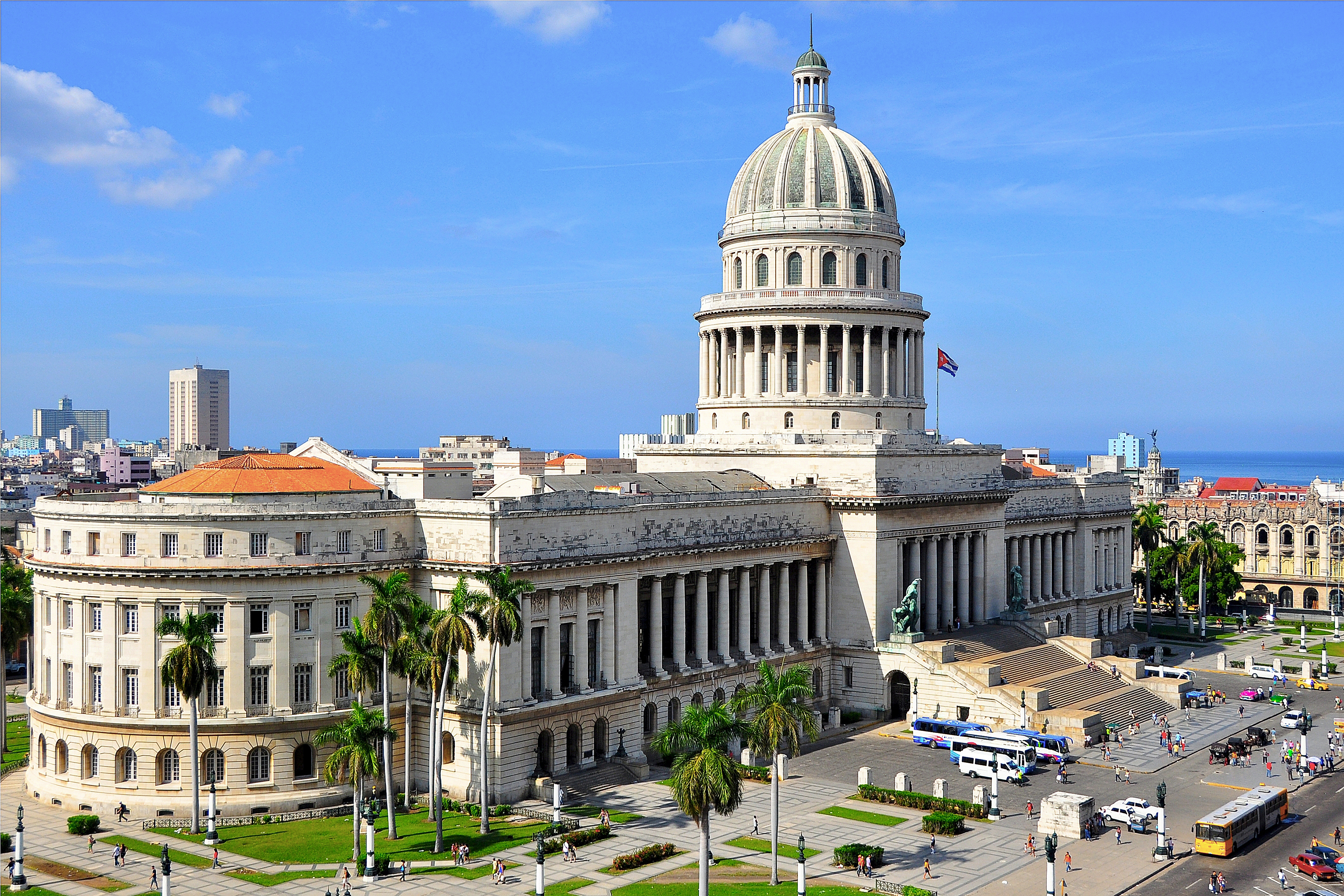
Old Havana is the historic centre of the capital, a World Heritage site inscribed in nineteen eighty-two, with its squares, churches, palaces and fortifications, and it is the best-preserved collection of colonial architecture in the Americas. The Plaza de la Catedral, the Plaza Vieja and the Plaza de San Francisco are the heart of the old town, with the cathedral, the palaces and the cafés around them, and the fortifications of La Cabaña, El Morro and the Castillo de la Real Fuerza guard the harbour where the treasure fleets gathered. The Capitolio, built from nineteen twenty-six to nineteen twenty-nine, stands at the edge of the old town, a replica of the United States Capitol, and the old town is best walked, with a morning in the plazas and an afternoon on the Malecón. Come early, when the streets are quiet and the light is soft on the pastel walls, and allow a full day, because the old town is large and the museums are many.

Plaza de la Catedral, Old Havana — Wolfgang Sauber, CC BY-SA 4
Trinidad and the Valley de los Ingenios — The Museum City
Trinidad is a museum city of the eighteenth and nineteenth centuries, founded in fifteen fourteen and inscribed on the World Heritage List in nineteen eighty-eight, with its pastel houses, its cobbled streets and its plaza, and with the Valley of the Sugar Mills beside it. The valley holds the remains of more than seventy former sugar mills, and the Manaca Iznaga Tower stands over it, a tower built by the sugar barons to watch their mills and their fields. The city is best walked, with a morning in the plaza and the churches, an afternoon in the valley, and an evening in the music of the town, with the Casa de la Música as the heart of the night. Come in the dry season, when the streets are dry and the valley is green, and stay in a casa in the old town, where the family will tell the story of the city.

View from the Manaca Iznaga Tower over the Valley de los Ingenios — Adam Jones, CC BY-SA 3
Viñales Valley — The Tobacco Valley
Viñales Valley is a living cultural landscape in the west of Cuba, inscribed in nineteen ninety-nine, where the mogotes, the great limestone outcrops, rise out of the red tobacco fields, and where the farmers keep the traditional ways of growing the leaf. The valley is the most photographed place in Cuba, with the mogotes, the royal palms and the tobacco drying barns as its emblem, and it is best seen on foot or on horseback, with a guide, and with a visit to a tobacco farm. The traveller should come in the dry season, when the fields are green and the barns are full, and should allow a day for the valley, with a morning in the fields and an afternoon in the town of Viñales, where the casas and the restaurants are the base for the valley.
Santiago de Cuba and San Pedro de la Roca — The Second City
Santiago de Cuba is the second city of Cuba, founded in fifteen fifteen and the colonial capital until fifteen fifty-six, and it is the Afro-Caribbean capital of the island, with its music, its Carnival and its fortress. San Pedro de la Roca Castle, inscribed in nineteen ninety-seven, stands above the bay of Santiago, and it is the best-preserved example of Spanish military architecture in the Americas, with its bastions, its dungeons and its views across the water. The city is best seen in the morning, with the fortress and the bay, and in the evening, with the music of the town, and the traveller should allow two days, because the city is large and the history is deep. Come for the fortress and stay for the music, which is the soul of the city.

San Pedro de la Roca Castle, Santiago de Cuba — Ron Van Oers, CC BY-SA 3
Cienfuegos and Camagüey — The French Port and the Maze City
Cienfuegos is a port on the south coast of Cuba, founded by settlers from France and inscribed in two thousand and five, with its wide streets, its French neoclassical buildings and its bay. The city is the only one in Cuba founded by the French, and its Parque José Martí, its cathedral and its Government Palace are the heart of it, with the Palacio de Valle on the point as its finest building. Camagüey, inscribed in two thousand and eight, is a city of irregular streets, plazas and churches, laid out like a maze rather than a grid, and it is the most distinctive city in Cuba, with its tinajones, the great clay jars that stand in the courtyards. Come to Cienfuegos for the bay and to Camagüey for the streets, and allow a day for each, because both cities reward the walker.
The Sierra Maestra and Pico Turquino — The Mountains of the East
The Sierra Maestra is the mountain range of the southeast, rising abruptly from the Caribbean coast, and it holds Pico Turquino, at one thousand nine hundred and seventy-four metres, the highest point in Cuba. The range is the home of the Turquino National Park, of the forests of the east and of the history of the revolution, which was fought in these mountains, and the climb to the summit takes two or three days from the campsite at La Mula, with a guide, because the trail is steep and the weather changes fast. The summit holds a bronze bust of José Martí, placed there in nineteen fifty-three, and the view from the top is over the mountains and the sea. Come in the dry season, when the trail is firm, and take a guide, because the mountain is remote and the trail is long.

Shows the colourful colonial houses and a classic car on a cobbled street — Adam Jones, CC BY-SA 3
Verified
- Cuba is Wikidata item Q241, an island country in the Caribbean, at twenty-two degrees north and seventy-nine degrees thirty minutes west, checked 26/11/2026.
- Cuba covers one hundred and ten thousand eight hundred and sixty square kilometres, and had eleven million eighty-nine thousand five hundred and eleven people at the census of two thousand and twenty-two, checked 26/11/2026.
- Cuba comprises the main island, the Isla de la Juventud, and four thousand one hundred and ninety-five islands, islets and cays, checked 26/11/2026.
- The main island stretches one thousand two hundred and fifty kilometres from Cabo de San Antonio to Punta Maisí, and never exceeds one hundred and ninety-one kilometres in width, checked 26/11/2026.
- Havana was founded in fifteen fourteen on the southern coast and then in fifteen nineteen on its present site, and became the capital in sixteen hundred and seven, checked 26/11/2026.
- The first Spanish settlement was founded in fifteen eleven by Diego Velázquez de Cuéllar at Baracoa, and Trinidad was founded in fifteen fourteen and Santiago de Cuba in fifteen fifteen, checked 26/11/2026.
- Cuba remained part of the Spanish Empire until the Spanish-American War of eighteen ninety-eight, and gained independence in nineteen hundred and two, checked 26/11/2026.
- The revolution established a government under Fidel Castro in January nineteen fifty-nine, and the Missile Crisis of nineteen sixty-two is widely considered the closest the world has come to nuclear war, checked 26/11/2026.
- The United States embargo against Cuba has been in place since nineteen sixty, checked 26/11/2026.
- José Martí was killed in eighteen ninety-five fighting for Cuban independence, and a bronze bust of him stands on the summit of Pico Turquino, placed there in nineteen fifty-three, checked 26/11/2026.
- Travel to Cuba for tourist activities remains prohibited for Americans by statute, and the Treasury’s Office of Foreign Assets Control has issued general licences for twelve categories of travel, checked 26/11/2026.
- Pico Turquino, at one thousand nine hundred and seventy-four metres, is the highest point in Cuba, in the Sierra Maestra, checked 26/11/2026.
- Old Havana and its Fortification System, ref 204, was inscribed in nineteen eighty-two, and Trinidad and the Valley de los Ingenios, ref 460, in nineteen eighty-eight, checked 26/11/2026.
- San Pedro de la Roca Castle, ref 841, was inscribed in nineteen ninety-seven, and Viñales Valley, ref 840, and Desembarco del Granma National Park, ref 889, in nineteen ninety-nine, checked 26/11/2026.
- The Archaeological Landscape of the First Coffee Plantations, ref 1008, was inscribed in two thousand, and Alejandro de Humboldt National Park, ref 839, in two thousand and one, checked 26/11/2026.
- The Urban Historic Centre of Cienfuegos, ref 1202, was inscribed in two thousand and five, and the Historic Centre of Camagüey, ref 1270, in two thousand and eight, checked 26/11/2026.
- Cuba has nine sites on the World Heritage List, seven cultural and two natural, checked 26/11/2026.
Sources
- Cuba — Wikipedia (https://en.wikipedia.org/wiki/Cuba) — position, area, population, history, embargo, revolution; checked 26/11/2026.
- Wikidata API — Q241 (https://www.wikidata.org/wiki/Q241) — country, capital, coordinates, area; checked 26/11/2026.
- List of World Heritage Sites in Cuba — Wikipedia (https://en.wikipedia.org/wiki/List_of_World_Heritage_Sites_in_Cuba) — nine sites, years, refs, criteria; checked 26/11/2026.
- Cuba — UNESCO World Heritage Convention (https://whc.unesco.org/en/statesparties/cu/) — nine properties, seven cultural, two natural; checked 26/11/2026.
- Traveling to Cuba — United States Embassy in Cuba (https://cu.usembassy.gov/services/traveling-to-cuba/) — twelve categories, tourist travel prohibited, cards unusable; checked 26/11/2026.
- Pico Turquino — Wikipedia (https://en.wikipedia.org/wiki/Pico_Turquino) — highest point in Cuba, one thousand nine hundred and seventy-four metres, Sierra Maestra; checked 26/11/2026.
- Pico Turquino: The Martí Bust On Top Of Cuba’s Highest Mountain (https://marysoltravel.com/pico-turquino-cuba-highest-mountain/) — José Martí killed in eighteen ninety-five, bronze bust placed on the summit in nineteen fifty-three; checked 26/11/2026.
Unverified
- The prices of the casas particulares, the hotels and the all-inclusive resorts change with the season, and no current price from an official source was checked, so the article gives no prices.
- The timetables of the Víazul buses and of the domestic flights to Santiago change with the season, and no current timetable was checked, so the traveller should confirm times before booking.
- The currency rules of Cuba change, and no current currency guidance from an official source was checked, so the traveller should check the current rules before bringing cash.
- The state of the internet and the power supply in Cuba changes, and no current report was checked, so the traveller should ask locally before relying on either.
- The number of American visitors to Cuba in recent years was not checked against a current source, so the article gives no figure for it.
Illustrations
- Hero — The Capitolio in Havana. Placement: top of the article, beside the opening. Shows the Capitol building in Havana, built from nineteen twenty-six to nineteen twenty-nine. Free image: https://upload.wikimedia.org/wikipedia/commons/1/1d/El_Capitolio_Havana_Cuba.jpg — Nigel Pacquette, CC BY-SA 3.
- In-body — Viñales Valley with mogotes. Placement: Geography section, beside the passage on the west of Cuba. Shows the valley with its limestone mogotes, royal palms and red tobacco soil. Free image: https://upload.wikimedia.org/wikipedia/commons/f/fc/Mogotes%2C_Vi%C3%B1ales_Valley%2C_Cuba.jpg — Charles J. Sharp, CC BY-SA 4.
- In-body — A cobbled street in Trinidad. Placement: Notable Places, beside the Trinidad entry. Shows the colourful colonial houses and a classic car on a cobbled street. Free image: https://upload.wikimedia.org/wikipedia/commons/8/86/Buick_Eight_on_Street_in_Trinidad_-_Cuba.jpg — Adam Jones, CC BY-SA 3.
- In-body — Old Havana. Placement: Travel section, beside the passage on Havana. Shows the old town of Havana with its colonial buildings. Free image: Wikimedia Commons, Jialiang Gao, Creative Commons Attribution, version two point five
- In-body — Varadero beach, Cuba. Placement: Geography section, beside the passage on Varadero beach. Free image: https://upload.wikimedia.org/wikipedia/commons/1/13/Varadero_beach%2C_Cuba%2C_2025.jpeg — Hana Gaon, CC BY-SA 4.
- In-body — The Sierra Maestra near Marea del Portillo. Placement: Geography section, beside the passage on Sierra Maestra. Free image: https://upload.wikimedia.org/wikipedia/commons/8/8e/Sierra_Maestra_near_Marea_del_Portillo.jpg — Óðinn, CC BY-SA 2.
- In-body — El Morro fortress, Havana. Placement: History section, beside the passage on El Morro fortress. Free image: https://upload.wikimedia.org/wikipedia/commons/8/8b/El_Morro_Havana_fortress.jpg — FDBK, CC BY-SA 3.
- In-body — Baracoa, Cuba. Placement: History section, beside the passage on Baracoa. Free image: https://upload.wikimedia.org/wikipedia/commons/7/7c/Baracoa%2C_Cuba_%2840624329642%29.jpg — madras91, CC BY 2.
- In-body — The Malecón, Havana. Placement: Travel section, beside the passage on the Malecón. Free image: https://upload.wikimedia.org/wikipedia/commons/7/74/AvMalecon-LaHabanaCuba-04735.jpg — Ezarate, CC BY-SA 4.
- In-body — Classic cars in Havana. Placement: Travel section, beside the passage on classic cars. Free image: https://upload.wikimedia.org/wikipedia/commons/e/e4/Classic_cars_in_Cuba%2C_Havana_-_Laslovarga002.JPG — Laslovarga, CC BY-SA 4.
- In-body — Plaza de la Catedral, Old Havana. Placement: Notable Places section, beside the passage on Plaza de la Catedral. Free image: https://upload.wikimedia.org/wikipedia/commons/9/9a/Havanna_-_Plaza_de_la_Catedral_1.jpg — Wolfgang Sauber, CC BY-SA 4.
- In-body — View from the Manaca Iznaga Tower over the Valley de los Ingenios. Placement: Notable Places section, beside the passage on Manaca Iznaga Tower. Free image: https://upload.wikimedia.org/wikipedia/commons/8/81/View_from_the_Torre_Manaca_Iznaga_-Near_Trinidad-_Cuba_02.jpg — Adam Jones, CC BY-SA 3.
- In-body — San Pedro de la Roca Castle, Santiago de Cuba. Placement: Notable Places section, beside the passage on San Pedro de la Roca Castle. Free image: https://upload.wikimedia.org/wikipedia/commons/5/57/San_Pedro_de_la_Roca_Castle%2C_Santiago_de_Cuba-112456.jpg — Ron Van Oers, CC BY-SA 3.