
Caye Caulker — A Slow Island Inside the Belize Barrier Reef
Caye Caulker is a small sandy island off the coast of Belize, where there are no cars. Its motto is Go Slow, and the island means it.
The island is about eight kilometres long, and it sits about one mile inside the Belize Barrier Reef, about twenty miles northeast of Belize City. The village is a place of sandy streets, wooden houses, docks and boats, and the reef is the reason to come, with the snorkelling, the diving and the sailing trips that leave from the piers every morning. A caye caulker vacation is a slow holiday, with mornings on the reef, afternoons at the Split and evenings on the docks, and the island is the opposite of a resort, with no cars, no high buildings and no hurry. This guide follows the island and the reef, and it explains where the caye stands, how it grew from a fishing village into a travellers island, and how a visitor reaches it and spends the days.
Quick Facts
- Name: Caye Caulker, a small island off the coast of Belize, in the Caribbean Sea, known for its slow pace and its reef.
- Position: About one mile inside the Belize Barrier Reef, about twenty miles northeast of Belize City, off the coast of Belize.
- Coordinates: Seventeen degrees forty-four minutes north and eighty-eight degrees one minute west, by the island Wikidata item Q1051967.
- Size: About eight kilometres long, with a village on the southern half and a quieter northern half across the Split.
- Population: About two thousand people, living mostly in the village on the southern half of the island.
- Motto: Go Slow, the motto of the island, painted on the signs and lived on the streets.
- Reef: The Belize Barrier Reef lies about one mile offshore, and the Caye Caulker Marine Reserve protects the waters close to the island.
- World Heritage: The island itself is NOT a World Heritage Site, but it sits inside the lagoon of the Belize Barrier Reef Reserve System, ref 764, inscribed in nineteen ninety-six.
- The Split: The channel between the north and south halves of the island, said to have been cut by Hurricane Hattie in nineteen sixty-one.
- Getting there: By water taxi from Belize City in about forty-five minutes, or by small plane from Belize City in about ten minutes.
- Getting around: On foot, by bicycle and by golf cart taxi, with a small ferry across the Split.
- Best time: The dry season runs from November to April, with calmer seas and clearer water, while the wet season brings rain and greener light.
Geography of Caye Caulker
Caye Caulker is a coral island, and its geography is the geography of sand, mangrove and reef. The island is about eight kilometres long and narrow, with the village on the southern half and the northern half quieter, with a beach club, a few hotels and the Caye Caulker Forest Reserve, a mangrove reserve protected since nineteen ninety-eight. The island has only three main streets, all sandy, with Front Street along the east coast, Back Street along the west coast and Middle Street between them, and almost everything a visitor needs lies along Front Street and the west coast.
The island has no proper beaches, in the sense of long stretches of sand, but the docks, the piers and the Split are the places to swim, with the water clear and shallow. The caye caulker vacation that works best is a holiday of docks and boats, not of beach clubs, and the island rewards the visitor who walks, swims from the piers and watches the sunset from the Split.
The Split is the channel that divides the island, and it is the centre of the social life of Caye Caulker. The channel is said to have been cut by Hurricane Hattie in nineteen sixty-one, which split the island in two, and the Lazy Lizard bar stands on the point, with the main swimming spot of the island below it. A small ferry crosses the Split on demand until late in the evening, and the crossing takes under two minutes, while the north side is quieter, with the beach club, the hotels and the forest reserve.
The Split is the place to swim in the day and to watch the sunset in the evening, with the water deep enough to swim and the bar as the meeting place. The caye caulker vacation that misses the Split misses the island, because the channel is the place where the village gathers.
The reef is the other geography of Caye Caulker, and it lies about one mile offshore to the east. The Belize Barrier Reef is the largest barrier reef in the northern hemisphere, and the reef runs north past Cozumel in Mexico, and the part off Caye Caulker is a lagoon of shallow water, coral gardens and sand channels, with the reef crest further out. The Caye Caulker Marine Reserve protects the waters close to the island, with a reef channel, a coral garden and the island’s own Shark Ray Alley, where nurse sharks and southern stingrays gather over the sand.
The Hol Chan Marine Reserve lies further north, off Ambergris Caye, with a cut in the reef where the fish gather, and the full-day trips from Caye Caulker cross to Hol Chan and back. The Great Blue Hole, the famous dive site, lies further out at Lighthouse Reef, and the small-plane flights from the island show its full circle in about an hour. The island sits inside the lagoon of the Belize Barrier Reef Reserve System, the World Heritage property of ref 764, and the reef is the reason the island exists as a place to visit.
The climate of Caye Caulker is tropical, with warm days and sea breezes for most of the year, and a temperature usually below thirty degrees in Celsius in the winter months. The dry season runs from November to April, with calmer seas, clearer water and the best snorkelling, while the wet season runs from May to October, with rain, wind and rougher seas. The hurricane season runs from June to November, and the island, low and sandy, is exposed to the storms, with Hurricane Hattie in nineteen sixty-one as the great storm of its history.
The best time for a caye caulker vacation is the dry season, when the water is clear and the boats run on time, and the wet season is the time for fewer visitors and lower demand. The traveller should check the weather before the boat trips, because the wind decides whether the reef trips run.
The lagoon between the island and the reef is the nursery of the reef, and its ecology is the reason the snorkelling is so rich. The seagrass beds of the lagoon hold the conch, the lobster and the young fish, and the mangroves of the north hold the birds, the crabs and the fish that grow into the reef. The manatees of Belize, the slow sea cows of the Caribbean, feed in the lagoon and the rivers of the mainland, and the turtles of the reef feed on the seagrass.
The lagoon is shallow and clear, with the sand white and the water turquoise, and the light in the lagoon is the light of the island, with the sun on the sand and the reef in the distance. The traveller who snorkels the lagoon sees the nursery, and the traveller who crosses to the reef sees the adult reef, and the two together are the whole system.
The island is part of Belize, and its position in the country shapes the travel. Belize City lies about twenty miles southwest of the island, and the water taxis run from the city to the island and on to San Pedro on Ambergris Caye, while the small planes fly from Belize City Municipal Airport to the airstrip on the island. The mainland of Belize holds the Maya ruins of Altun Ha and Caracol, the caves and the rainforest, and the day trips from the island to the mainland are long days, with an early boat and a late return.
The nearest World Heritage property is the Belize Barrier Reef Reserve System itself, ref 764, and the island sits inside its lagoon, about fifty-four kilometres from the centre of the reef system in a straight line, though the reef itself begins about one mile offshore. The island is therefore not a World Heritage Site, but a gateway to one, and the distinction matters, because the reef, not the island, is the protected property.

In-body, Geography — The shore of Caye Caulker, with the sandy streets and the docks of the village. Free image, Wikimedia Commons, File Caye Caulker, Belize – Shore, CC BY-SA 2, direct file URL
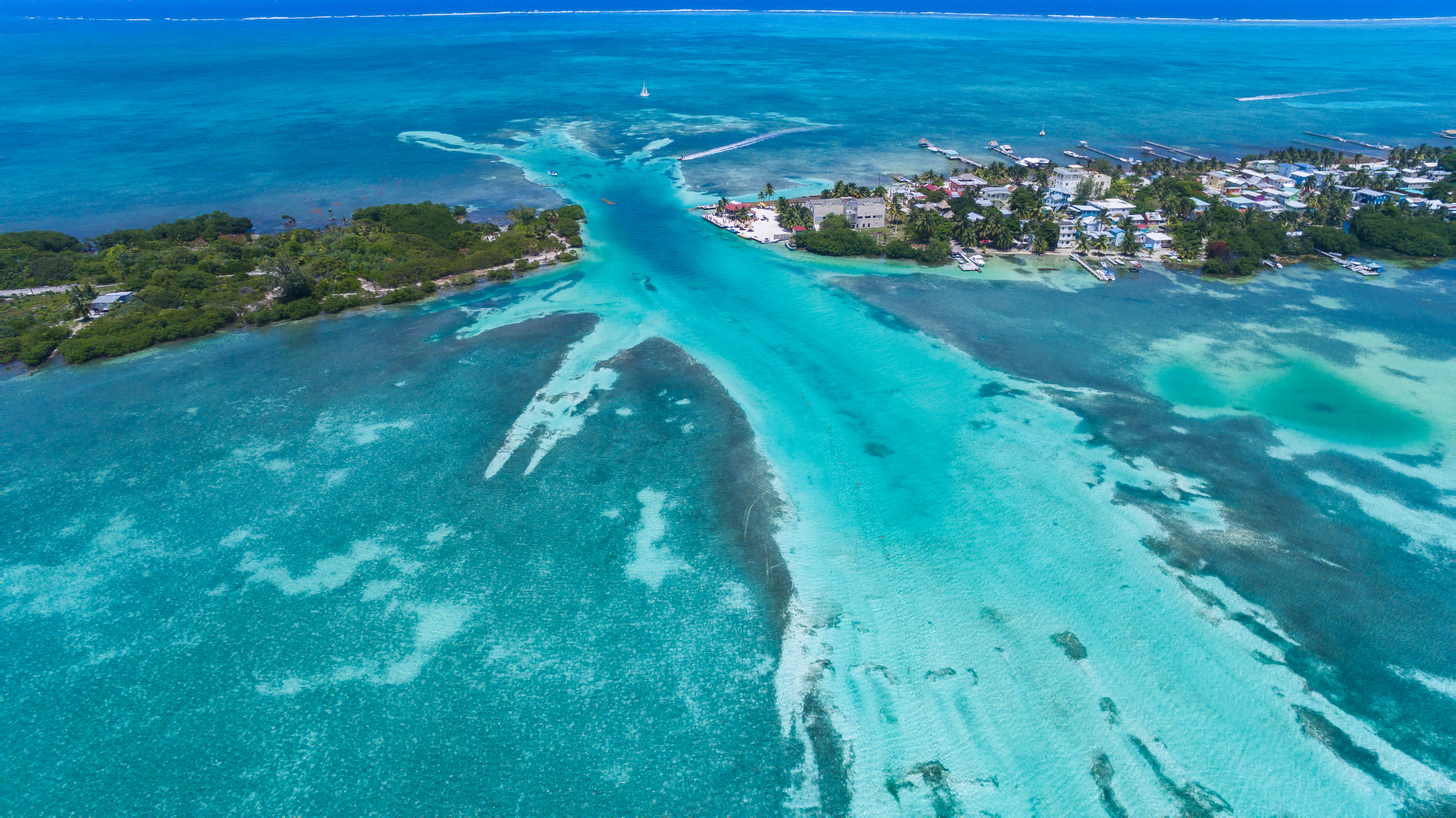
In-body, Geography — Caye Caulker from the air, with the village on the southern half of the island. Free image, Wikimedia Commons, File Caye Caulker Belize aerial (20688990128).jpg, CC BY 2, direct file URL

In-body, Geography — The Belize Barrier Reef, the largest barrier reef in the northern hemisphere. Free image, Wikimedia Commons, File Belize Barrier Reef – 55444838217.jpg, CC BY 4, direct file URL
History of Caye Caulker
Caye Caulker was a fishing village before it was a travellers island, and the history of the island is the history of the sea. The island was settled by fishermen, with the Mestizo, Garifuna and Creole families of Belize, and the village lived from the lobster, the conch and the fish of the reef. The name of the island is said to come from the caye, the low sandy island, and the caulker, the shipwright who sealed the boats, and the boats of the island were built and repaired on the shore.
The island was quiet, with no cars, no paved roads and few visitors, and the fishermen worked the reef in the morning and mended their nets in the afternoon. The Split, the channel that divides the island, is said to have been cut by Hurricane Hattie in nineteen sixty-one, and the storm is the great event of the island’s history, reshaping the land in a night.
The travellers came to Caye Caulker in the nineteen seventies and eighties, when the backpackers found the island on the way to the reef. The island was cheap, with hostels, guesthouses and small restaurants, and the reef was close, with the snorkelling and the diving a short boat ride away. The hostels, the dive shops and the tour operators grew along Front Street, and the island became known as the budget alternative to Ambergris Caye, with a slower pace and a smaller scale.
The motto Go Slow became the motto of the island, painted on the signs and on the walls, and the island kept its character, with no cars, no high buildings and no large resorts. The travellers who came for a night stayed for a week, and the island became a place to slow down, with the mornings on the reef and the evenings on the docks.
The protection of the reef came as the island grew, and the marine reserves are the recent history of Caye Caulker. The Hol Chan Marine Reserve, off Ambergris Caye, was established in nineteen eighty-seven, and it became the model for the protection of the reef, with the park fees, the guides and the rules for the boats. The Caye Caulker Marine Reserve followed, protecting the waters close to the island, with the reef channel, the coral garden and the Shark Ray Alley, and the Caye Caulker Forest Reserve, on the northern half of the island, was protected in nineteen ninety-eight, with the mangroves as its heart.
The Belize Barrier Reef Reserve System was inscribed on the World Heritage List in nineteen ninety-six, as a serial property of seven protected areas, and the island sits inside the lagoon of that system. The protection is the reason the reef is still alive, and the tours of the island work within it, with the guides, the fees and the rules.
The island is part of Belize, and the history of Belize is the history of the island. Belize was British Honduras, a British colony built on logwood and mahogany, and it became independent in nineteen eighty-one, with Belmopan as its capital and Belize City as its port. The reef was the wealth of the coast, with the lobster, the conch and the fish, and the fishermen of Caye Caulker worked the lagoon in the morning and sold their catch in the city. The protection of the reef came late, with the reserves of the nineteen eighties and the World Heritage inscription of nineteen ninety-six, and the island grew as the reef was protected.
The lobster is the economy of the island, and the lobster season is the calendar of the village. The season runs from the summer to the winter, with the fishermen diving for lobster and conch, and the restaurants of Front Street serving the catch in the evening. The lobster festival of the island, in the summer, is the great party of the village, with the grills, the music and the boats.
The tourism of the island grew beside the fishing, with the dive shops, the hostels and the tour operators, and the fishermen became the guides, the boatmen and the captains. The caye caulker vacation of today is a holiday of the reef and the lobster, and the island keeps both, with the fishing in the morning and the snorkelling in the afternoon.
The modern history of Caye Caulker is a history of a small island that has kept its pace while the world around it has grown. The water taxis, the small planes and the dive shops have made the island easier to reach, and the hostels, the guesthouses and the restaurants have grown along Front Street, yet the island still has no cars, and the village is still walkable end to end. The island has faced the storms, with Hurricane Hattie in nineteen sixty-one and the hurricanes since, and the village has rebuilt each time, with the docks, the piers and the bars as the first things to return. The caye caulker vacation of today is the same as the holiday of the nineteen eighties, with the reef in the morning, the Split in the afternoon and the sunset on the docks, and the island is proud of that sameness.

In-body, History — A cyclist on the sandy streets of Caye Caulker, where there are no cars. Free image, Wikimedia Commons, File Caye Caulker, Belize – Cyclist.jpg, CC BY-SA 2, direct file URL

In-body, History — The flag of Belize at Caye Caulker. Free image, Wikimedia Commons, File Caye Caulker, Belize – Flag.jpg, CC BY-SA 2, direct file URL
Travel to Caye Caulker
The way most visitors reach Caye Caulker is by water taxi from Belize City, and the crossing is the start of the holiday. Two water taxi companies run between Belize City and Caye Caulker, with boats roughly every hour from the early morning to the evening, and the crossing takes about forty-five minutes to an hour. The boats leave from the piers in Belize City, and the traveller should allow time to reach the pier from the airport, because the airport lies outside the city.
The boats continue on to San Pedro on Ambergris Caye, and the traveller who goes to Caye Caulker should check the boat times, because the last boat leaves in the late afternoon. The small planes are the faster way, with flights from Belize City Municipal Airport to the airstrip on the island in about ten minutes, and the flights are the way to arrive when the sea is rough.
The island is walked, cycled and crossed by golf cart, and the traveller should not expect cars. The village is walkable end to end in about twenty minutes, and the three sandy streets hold almost everything, with the dive shops, the tour operators, the restaurants and the guesthouses along Front Street. The bicycles are the fastest way to cover the island, and the golf cart taxis wait at the piers and charge a small fare in the village, with a higher fare to the airstrip or the south end.
The small ferry crosses the Split on demand until late in the evening, and the crossing takes under two minutes, while the north side is reached by the ferry and then by foot or by bicycle. The traveller should bring light shoes for the sand, and should expect to walk everywhere, because the island is small and the walking is the point.
The reef trips are the heart of the travel, and the traveller should choose by the day and the sea. The half-day trips visit three or four stops in the Caye Caulker Marine Reserve, close to the island, with a reef channel, the island’s own Shark Ray Alley and a shallow coral garden. The full-day trips cross to Hol Chan Marine Reserve, off Ambergris Caye, with the cut in the reef, the Shark Ray Alley, a wreck and lunch on the boat, and the trips take about six hours.
The diving trips go to the Great Blue Hole at Lighthouse Reef, with the dive to the stalactites and two reef dives, and the small-plane flights show the hole from the air in about an hour. The sailing trips run from the island, with the snorkel and sunset trips, and the day trips to the mainland run to the Altun Ha Maya ruins and the cave tubing, and the longer tours run to Tikal in Guatemala, with an early boat and a long day. The traveller should book the reef trips a day ahead, because the boats fill, and should check the wind, because the rough days cancel the trips.
The places to sleep on Caye Caulker are the hostels, the guesthouses and the small hotels of the village, and the traveller should choose by the street. The hostels lie along Front Street, with the dorms and the private rooms, and the guesthouses lie on the side streets, with the rooms and the gardens. The small hotels lie along the east coast, with the docks and the sea views, and the north side holds the beach club and the few hotels across the Split.
The island has no large resorts, and the rooms are few, so the traveller should book ahead in the dry season. The restaurants of the island are the seafood restaurants of Front Street, with the lobster, the conch and the fish of the reef, and the bars of the Split are the places for the sunset. The caye caulker vacation that stays in the village, eats on Front Street and swims at the Split is the holiday the island offers.
The practical side of the travel is the money, the water and the sun. The currency is the Belize dollar, and the hotels, the dive shops and the restaurants take cards, while the small shops and the taxis take cash. The water of the island is safe in the hotels and the restaurants, and the traveller should drink water and use sun protection, because the sun on the reef is strong and the reflection from the water burns quickly.
The traveller should bring a mask, a snorkel and a rash guard, or rent them from the dive shops, and should bring a light jacket for the boat trips, because the wind on the water is cool. The island is safe to walk at night, and the village is small, yet the traveller should keep to the main streets after dark, as in any small town.

In-body, Notable Places — Lizards on the beach at Caye Caulker, with the wildlife of the island in the sun. Free image, Wikimedia Commons, File Caye Caulker, Belize – Lizards on the Beach, CC BY-SA 2, direct file URL

In-body, Travel — The Caye Caulker water taxi dock, where the boats from Belize City arrive. Free image, Wikimedia Commons, File Caye Caulker water taxi dock Nov 2019.png, CC BY-SA 4, direct file URL

In-body, Travel — A nurse shark at Hol Chan Marine Reserve, on the full-day reef trip from Caye Caulker. Free image, Wikimedia Commons, File Nurse Shark at Hol Chan.jpg, CC BY-SA 4, direct file URL

In-body, Travel — A southern stingray at Shark Ray Alley, where nurse sharks and stingrays gather over the sand. Free image, Wikimedia Commons, File Southern Stingray (Dasyatis americana) (36644323776).jpg, CC BY-SA 2, direct file URL
Notable Places in Caye Caulker
The Split — The Channel and the Swimming Spot of the Island
The Split is the channel between the north and south halves of Caye Caulker, and it is the main swimming spot of the island. The channel is said to have been cut by Hurricane Hattie in nineteen sixty-one, and the Lazy Lizard bar stands on the point, with the swimming area below it and the sunset view to the west. The water at the Split is deep enough to swim, and the docks and the ladders give access to the water, while the bar is the meeting place of the island in the afternoon and the evening.
The small ferry crosses the Split to the north side, and the beach club, the hotels and the forest reserve lie across the water. The Split is the place to be at sunset, when the sky turns over the lagoon and the village gathers on the point.
The Caye Caulker Marine Reserve — The Reef Close to the Island
The Caye Caulker Marine Reserve protects the waters close to the island, and the half-day trips visit its stops. The reserve holds a reef channel, a shallow coral garden and the island’s own Shark Ray Alley, where nurse sharks and southern stingrays gather over the sand and come to the boats. The coral gardens hold the fish, the rays and the turtles of the lagoon, and the guides of the island know the stops and the animals.
The reserve is the snorkelling of the island, with the trips leaving from the piers in the morning and returning in the afternoon, and the park fee is usually included in the trip. The reserve is the reason the half-day trips work, because the reef is close, the water is shallow and the animals are easy to see.
Hol Chan Marine Reserve and Shark Ray Alley — The Full-Day Reef
Hol Chan Marine Reserve lies off Ambergris Caye, to the north of Caye Caulker, and the full-day trips cross to it. The reserve protects a cut in the barrier reef, where the fish gather in the current, and the trips visit the cut, the Shark Ray Alley, a wreck and the coral gardens, with lunch on the boat. The Shark Ray Alley of Hol Chan is the official site, with nurse sharks and southern stingrays gathering over the sand, and it is different from the island’s own Shark Ray Alley in the Caye Caulker reserve.
The trips take about six hours, and the boats leave in the morning and return in the afternoon, with the guides, the gear and the park fee included. The full-day trip is the best snorkelling of the island, and the traveller who takes it sees the reef at its best.
The North Island and the Forest Reserve — The Quiet Half of the Caye
The north half of Caye Caulker lies across the Split, and it is the quiet half of the island. The small ferry crosses on demand, and the sandy track runs north to Bliss Beach, the closest thing the island has to a proper beach, with the sand and the shallow water. The Caye Caulker Forest Reserve protects the mangroves of the north, since nineteen ninety-eight, and the trails through the mangroves are the place to see the birds and the crabs of the island.
The north side holds a beach club, a few hotels and the quiet of the island, with no shops and no bars beyond the club, and the traveller who crosses the Split finds the island as it was before the village grew. The north is the place for a slow afternoon, with the beach, the mangroves and the sunset.

In-body, Notable Places — A green sea turtle at Hol Chan Marine Reserve, the full-day reef trip from Caye Caulker. Free image, Wikimedia Commons, File GreenSeaTurtle-HolChanMarineReserve-Belize.JPG, CC BY-SA 3, direct file URL

In-body, Notable Places — A brown pelican on Caye Caulker, with the wildlife of the island in the sun. Free image, Wikimedia Commons, File Pelecanus occidentalis Caye Caulker 03.JPG, CC BY-SA 4, direct file URL
Verified
- Caye Caulker is Wikidata item Q1051967, an island in Belize, at seventeen degrees forty-four minutes north and eighty-eight degrees one minute west, checked 26/11/2026.
- The island is about eight kilometres long, with a population of about two thousand people, and it lies about one mile inside the Belize Barrier Reef, checked 26/11/2026.
- The Belize Barrier Reef Reserve System, ref 764, was inscribed in nineteen ninety-six under criteria vii, ix and x, as a serial property of seven protected areas covering ninety-six thousand three hundred hectares, checked 26/11/2026.
- Caye Caulker itself is NOT a World Heritage Site, and it sits inside the lagoon of the Belize Barrier Reef Reserve System, checked 26/11/2026.
- The Split is said to have been cut by Hurricane Hattie in nineteen sixty-one, and the Caye Caulker Forest Reserve has been protected since nineteen ninety-eight, checked 26/11/2026.
- The water taxi from Belize City to Caye Caulker takes about forty-five minutes, and the flight from Belize City takes about ten minutes, checked 26/11/2026.
- Hol Chan Marine Reserve lies off Ambergris Caye, and the full-day trips from Caye Caulker visit Hol Chan and Shark Ray Alley, checked 26/11/2026.
- The Belize Barrier Reef is the largest barrier reef in the northern hemisphere, and the reef system is the second largest reef system in the world, checked 26/11/2026.
- The island has no cars, and the village is walkable end to end, with three sandy main streets, checked 26/11/2026.
- The reef lies about one mile offshore from Caye Caulker, and the island lies about twenty miles northeast of Belize City, checked 26/11/2026.
Sources
- Belize Barrier Reef Reserve System — UNESCO (https://whc.unesco.org/en/list/764/) — ref 764, inscribed 1996, criteria vii, ix and x, 96,300 ha; checked 26/11/2026.
- Caye Caulker — Wikivoyage (https://en.wikivoyage.org/wiki/Caye_Caulker) — island length, population, Split, ferries, streets; checked 26/11/2026.
- Caye Caulker things to do — Caye Caulker HQ (https://cayecaulkerhq.com/things-to-do/) — Hol Chan, Shark Ray Alley, Split, Forest Reserve 1998; checked 26/11/2026.
- Wikidata API — Q1051967 (https://www.wikidata.org/wiki/Q1051967) — Caye Caulker, island, coordinates; checked 26/11/2026.
- Belize Barrier Reef — Wikipedia (https://en.wikipedia.org/wiki/Belize_Barrier_Reef) — reef length, second largest reef system, ref 764; checked 26/11/2026.
Unverified
- The claim that Hurricane Hattie cut the Split in nineteen sixty-one is widely repeated but the article could not check it against a primary source, so it is given as a local account.
- The exact population of Caye Caulker varies between sources, from about one thousand three hundred to about two thousand seven hundred, so the article gives only a rounded figure.
- The ferry times and the flight times between Belize City and Caye Caulker change with the season, and the article gives no fixed timetable.
- The state of the reef and the fish at the Shark Ray Alley sites changes with the season and with the number of boats, and the traveller should check with a dive shop before going.
Illustrations
- Hero — The Split on Caye Caulker, the channel between the north and south halves, with the swimming spot and the bar. Free image, Wikimedia Commons, File Caye Caulker, Belize – The Split, CC BY-SA 2, direct file URL https://upload.wikimedia.org/wikipedia/commons/3/3f/Caye_Caulker%2C_Belize_-_The_Split.jpg
- In-body, Geography — The shore of Caye Caulker, with the sandy streets and the docks of the village. Free image, Wikimedia Commons, File Caye Caulker, Belize – Shore, CC BY-SA 2, direct file URL https://upload.wikimedia.org/wikipedia/commons/2/20/Caye_Caulker%2C_Belize_-_Shore.jpg
- In-body, Notable Places — Lizards on the beach at Caye Caulker, with the wildlife of the island in the sun. Free image, Wikimedia Commons, File Caye Caulker, Belize – Lizards on the Beach, CC BY-SA 2, direct file URL https://upload.wikimedia.org/wikipedia/commons/0/05/Caye_Caulker%2C_Belize_-_Lizards_on_the_Beach.jpg
- In-body, Geography — Caye Caulker from the air, with the village on the southern half of the island. Free image, Wikimedia Commons, File Caye Caulker Belize aerial (20688990128).jpg, CC BY 2, direct file URL https://upload.wikimedia.org/wikipedia/commons/a/a8/Caye_Caulker_Belize_aerial_%2820688990128%29.jpg
- In-body, Geography — The Belize Barrier Reef, the largest barrier reef in the northern hemisphere. Free image, Wikimedia Commons, File Belize Barrier Reef – 55444838217.jpg, CC BY 4, direct file URL https://upload.wikimedia.org/wikipedia/commons/e/ef/Belize_Barrier_Reef_-_55444838217.jpg
- In-body, History — A cyclist on the sandy streets of Caye Caulker, where there are no cars. Free image, Wikimedia Commons, File Caye Caulker, Belize – Cyclist.jpg, CC BY-SA 2, direct file URL https://upload.wikimedia.org/wikipedia/commons/f/f6/Caye_Caulker%2C_Belize_-_Cyclist.jpg
- In-body, History — The flag of Belize at Caye Caulker. Free image, Wikimedia Commons, File Caye Caulker, Belize – Flag.jpg, CC BY-SA 2, direct file URL https://upload.wikimedia.org/wikipedia/commons/5/5e/Caye_Caulker%2C_Belize_-_Flag.jpg
- In-body, Travel — The Caye Caulker water taxi dock, where the boats from Belize City arrive. Free image, Wikimedia Commons, File Caye Caulker water taxi dock Nov 2019.png, CC BY-SA 4, direct file URL https://upload.wikimedia.org/wikipedia/commons/f/fc/Caye_Caulker_water_taxi_dock_Nov_2019.png
- In-body, Travel — A nurse shark at Hol Chan Marine Reserve, on the full-day reef trip from Caye Caulker. Free image, Wikimedia Commons, File Nurse Shark at Hol Chan.jpg, CC BY-SA 4, direct file URL https://upload.wikimedia.org/wikipedia/commons/2/20/Nurse_Shark_at_Hol_Chan.jpg
- In-body, Travel — A southern stingray at Shark Ray Alley, where nurse sharks and stingrays gather over the sand. Free image, Wikimedia Commons, File Southern Stingray (Dasyatis americana) (36644323776).jpg, CC BY-SA 2, direct file URL https://upload.wikimedia.org/wikipedia/commons/7/72/Southern_Stingray_%28Dasyatis_americana%29_%2836644323776%29.jpg
- In-body, Notable Places — A green sea turtle at Hol Chan Marine Reserve, the full-day reef trip from Caye Caulker. Free image, Wikimedia Commons, File GreenSeaTurtle-HolChanMarineReserve-Belize.JPG, CC BY-SA 3, direct file URL https://upload.wikimedia.org/wikipedia/commons/a/a2/GreenSeaTurtle-HolChanMarineReserve-Belize.JPG
- In-body, Notable Places — A brown pelican on Caye Caulker, with the wildlife of the island in the sun. Free image, Wikimedia Commons, File Pelecanus occidentalis Caye Caulker 03.JPG, CC BY-SA 4, direct file URL https://upload.wikimedia.org/wikipedia/commons/3/39/Pelecanus_occidentalis_Caye_Caulker_03.JPG