
Oxford: The City of Dreaming Spires
Oxford is a university city on the Thames, ninety kilometres northwest of London. Its colleges have taught students since 1096.
The spires of Oxford rise over the rooftops in a skyline that Matthew Arnold called the city of dreaming spires, and the phrase has stuck for a century and a half. The colleges hold the centre of the city, and their quadrangles, chapels and libraries run from the castle to the river in a maze of stone lanes. The Thames, called the Isis as it runs through Oxford, meets the Cherwell at the southern edge of the city, and the meadows along both rivers give the city its green setting.
Quick Facts
- Rivers: the Thames, called the Isis in Oxford, and the Cherwell, meeting south of the centre
- People: about 162,100 in the 2021 census, with about 25,000 university students
- University teaching since: 1096, the oldest university in the English-speaking world
- Colleges and halls: 39 colleges and 5 permanent private halls, 44 institutions in all
- Oldest museum: the Ashmolean, opened 1683, the oldest public museum in Britain
- Nearest World Heritage property: Blenheim Palace, about 12 km straight-line to the north-west
- Trains: about one hour to London Marylebone or Paddington
- Known as: the City of Dreaming Spires, after Matthew Arnold’s phrase
Geography of Oxford
Oxford stands on a gravel terrace between the Thames and the Cherwell, where the two rivers meet at the southern edge of the city. The centre lies at about 60 to 70 metres above sea level, and the land rises gently to the north toward the suburbs of Summertown and to the east toward Headington Hill. The rivers run through water meadows that flood in winter, and Port Meadow, a common of about 300 acres beside the Thames, has been grazed by cattle since the Domesday Book and is one of the oldest pieces of common land in England.
The Thames, called the Isis through Oxford, gives the city its western edge. The river runs south past the castle and the meadows, and the boats of the university rowing clubs use the reach from Folly Bridge to Iffley Lock. The Cherwell, the smaller river, runs through the university parks and past the college gardens, and the punts on the Cherwell are the quieter cousin of the punts on the Cam. The two rivers meet at the southern edge of the city, and the meadows below the meeting point run to the villages of the Thames valley.
Oxford lies about 90 km north-west of London, about 40 km south-east of the Cotswold town of Burford, and about 100 km south-east of Birmingham. The city sits at the edge of the Cotswolds, and the limestone hills rise to the west and the north. The Chiltern Hills run to the south-east, and the Thames valley opens to the south toward Reading and the London basin. The university dominates the centre, and the car factory at Cowley, on the eastern edge of the city, is the largest industrial site in Oxford.
The climate is mild and damp, with warm summers and cool winters. Oxford receives about 660 mm of rain a year, and July averages about 17 degrees Celsius. The rivers bring mist to the meadows on autumn mornings, and the city is at its most beautiful in the early morning, when the spires stand out of the mist. Snow falls most winters but rarely lies for long, and the flat valley gives the city long, low winter light.
Oxford is a walking city, and the centre is small enough to cross in twenty minutes. The High Street and the Broad hold the colleges, and the houses spread north to Summertown and south to the station. The railway station stands about 1 km west of the centre, and the bus station is on Gloucester Green. Bicycles outnumber cars on the college lanes, and the central streets are closed to most traffic.
The meadows and woods around the city give it a green edge. Wytham Woods, about 5 km west of the centre, is one of the most studied woodlands in the world, and the university has owned it since 1943. Shotover Hill, to the east, holds heathland and woodland with views back to the spires, and the Thames Path runs south from the city through the villages of the valley. The city has kept its meadows, and the green belt around Oxford is one of the oldest in England.
The Oxford Canal runs into the city from the north, a narrow waterway opened in 1790 to carry coal from the Midlands to the Thames. The canal ends at the station, and the narrowboats moored along its banks are a reminder of the city’s industrial past. The canal towpath runs north to the villages of the Cherwell valley, and the walk from the city to the village of Thrupp is a quiet afternoon out.
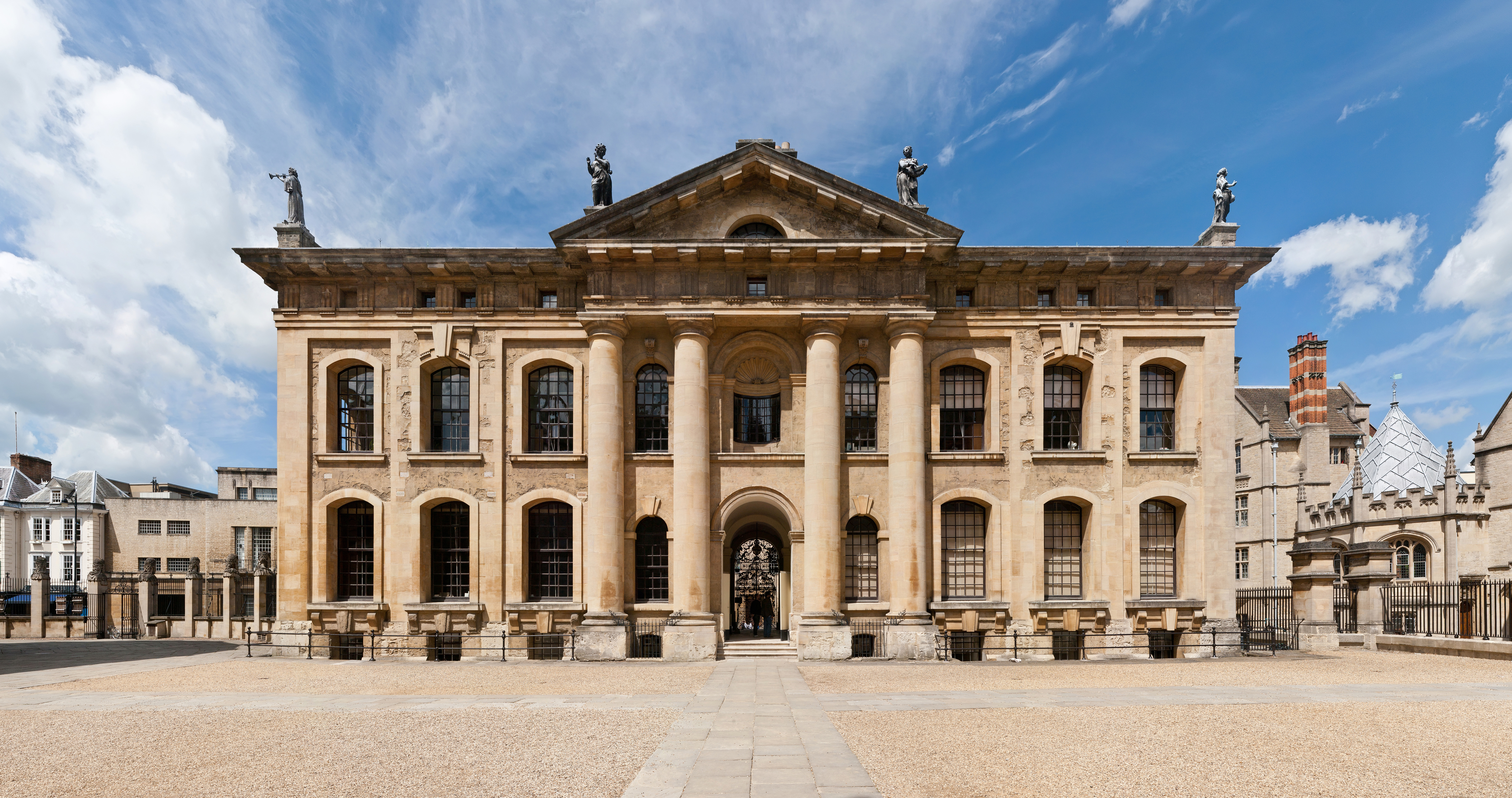
A perspective corrected view of the South face of the Clarendon Building in Oxford, England — CC BY-SA 3
History of Oxford
Oxford began as a Saxon ford over the Thames, and the name means the ford of the oxen. The town was founded in the tenth century, and the Normans built a castle on the western edge of the town in 1071, two years after they had taken the town. The castle mound still stands, and the tower of Saint George’s Chapel is the oldest building in the city. The town grew around the market place, and the streets of the old town still follow the Saxon plan.
Teaching began in Oxford in 1096, and the university grew from the masters who taught in the town’s churches and halls. The first colleges were founded in the thirteenth century: University College in 1249, Balliol in 1263 and Merton in 1264, and the colleges owned the land and the buildings that still shape the centre of the city. The scholars of Oxford left for Cambridge in 1209 after a dispute with the townspeople, and the two universities have been rivals ever since.
Town and gown quarrelled through the centuries. The riot of Saint Scholastica’s Day in 1355, the worst of the town-gown clashes, left about 63 scholars and 30 townsmen dead, and the town paid a penance to the university for nearly five centuries afterwards. The colleges built their walls high, and the town and the university kept their separate jurisdictions. The university’s chancellor held his own court, and the town’s mayor held his, and the two sides settled into a wary partnership.
The Reformation brought the Oxford Martyrs. Hugh Latimer, Nicholas Ridley and Thomas Cranmer were tried in Oxford and burned in 1555 and 1556, on the site now marked by the Martyrs’ Memorial on Saint Giles. The university survived the Reformation, and the colleges rebuilt in the seventeenth century. The Bodleian Library opened in 1602, and the Sheldonian Theatre, designed by Christopher Wren and built 1664 to 1669, became the ceremonial heart of the university.
The Civil War made Oxford the capital of the king. Charles I held his court in the city from 1642 to 1646, and the colleges housed the king’s soldiers and the parliament’s prisoners. The city was besieged twice, and the king fled in 1646.
The Restoration brought the Royal Society’s early meetings to Oxford, and the Ashmolean Museum, opened in 1683, was the first public museum in Britain. The university’s scientists, from Robert Boyle to Edmond Halley, made Oxford the centre of the new philosophy.
The nineteenth century brought the railway in 1844, and the city expanded north to Summertown and east to Cowley. The Oxford Movement of the 1830s, led by John Henry Newman, changed the Church of England, and the university’s colleges rebuilt in the Gothic Revival style. William Morris, later Lord Nuffield, founded the Morris Motor Company at Cowley in 1912, and the car factory became the largest employer in the city. Women were admitted to degrees in 1920, and the university’s colleges opened to women through the twentieth century.
The Cowley factory changed the east of the city. The plant grew from a small workshop into a factory of thousands of workers, and the housing estates of Cowley and Blackbird Leys filled with the families of the car workers. The Mini, designed by Alec Issigonis and built at Cowley from 1959, became the most famous car in Britain, and the factory still builds Minis today under the ownership of BMW. The university and the factory are the two poles of the city, and the town keeps both.
The twentieth century made Oxford a centre of science and of literature. The university’s laboratories produced the work of Dorothy Hodgkin, who won the Nobel Prize in 1964 for her work on the structure of insulin, and of the penicillin team at the Dunn School. The city is the home of Alice in Wonderland, written by Charles Dodgson, a mathematics tutor at Christ Church, and of the detective novels of Colin Dexter, whose Inspector Morse walks the streets of the city. The university now holds 39 colleges and 5 permanent private halls, and its students come from around the world.

Looking east in the interior of the Divinity School in the Bodleian Library, Oxford, Oxfordshire, England — CC BY-SA 3
Travel to Oxford
The Oxford Tube coach runs from London Victoria to Gloucester Green in about one hour and forty minutes, and trains from Marylebone and Paddington take about an hour. The station stands about 1 km west of the centre, with buses to the High Street and the colleges. Drivers use the A40 from London or the A34 from the south, and park-and-ride sites ring the city. Heathrow is about an hour away by coach, and Birmingham about an hour and a half.
The best way to see the colleges is on foot, starting at the High Street and walking west to Carfax, the crossroads at the centre of the city. The Radcliffe Camera stands in the square behind the University Church of Saint Mary the Virgin, and the Bodleian Library and the Sheldonian Theatre are beside it. The Ashmolean Museum stands on Beaumont Street, and the Botanic Garden, founded in 1621, lies on the High Street beside Magdalen Bridge. Punting on the Cherwell is the classic Oxford experience, and punts can be hired at Magdalen Bridge.
Oxford’s eight-week terms set the rhythm of the city, and the streets fill when the students arrive in October and January. Graduation in the Sheldonian Theatre brings families to the High Street in the summer, and the colleges close some chapels to visitors during examinations. Winter is the quietest season, with frost on the meadows and short days. Plan one day for the colleges and the museums, and a second for the river and the Botanic Garden.
Day trips from Oxford suit Blenheim Palace, about 12 km to the north-west, and Bath, about one hour and a half by train, with its Roman baths and Georgian crescents. The Cotswold villages of Burford, Bibury and Bourton-on-the-Water are an hour by car, and the Thames valley towns of Henley and Windsor are a day trip to the south. Most visitors give Oxford two days, one for the colleges and one for the river and the museums.
Eating in Oxford means the cafes and restaurants of the High Street and the Covered Market, with the market holding food stalls since the eighteenth century. The pubs of the city, from the Eagle and Child on Saint Giles, where the Inklings met, to the Turf Tavern down a narrow lane, serve the students and the visitors alike. The restaurants of Jericho and the Cowley Road hold the city’s international food, and the tea rooms of the colleges are a quiet stop on a walk through the town.
Staying in Oxford means the hotels of the High Street and the guesthouses of Jericho and Summertown. The city fills at graduation and at the start of term, so visitors should book ahead for May, June and September. The colleges let rooms to visitors in the vacations, and a night in a college is the closest a visitor comes to living in the university.
Notable Places in Oxford
- Christ Church. The largest college in Oxford, founded by Cardinal Wolsey in 1525 and refounded by Henry VIII in 1546, with the cathedral of Oxford as its chapel. The Great Hall inspired the hall of Hogwarts in the Harry Potter films, and the college’s meadow runs down to the Thames. Charles Dodgson, who wrote Alice in Wonderland as Lewis Carroll, was a tutor here.
- The Bodleian Library. The university’s main library, opened in 1602, holding more than 13 million printed items. The Divinity School, built in the fifteenth century, is the oldest teaching room in the university, and the Radcliffe Camera, built 1737 to 1749, is the most photographed building in the city.
- The Ashmolean Museum. The university’s museum of art and archaeology, opened in 1683 as the first public museum in Britain. The museum holds Egyptian mummies, Greek vases and the Alfred Jewel, and the building on Beaumont Street was rebuilt in 2009. Entry is free.
- Magdalen College. The college founded in 1458, with a tower that rises over the High Street and a deer park beside the Cherwell. The choir sings from the top of the tower on May Morning, and the college’s cloisters and gardens are among the most beautiful in Oxford.
- The Sheldonian Theatre. The ceremonial hall of the university, designed by Christopher Wren and built 1664 to 1669, where degrees are conferred. The theatre’s ceiling is painted with the figures of Truth and the Arts, and the view from the cupola runs over the rooftops of the city.
- The Radcliffe Camera. The circular library built 1737 to 1749, the centrepiece of Radcliffe Square and the most photographed building in Oxford. The camera holds the reading rooms of the Bodleian Library, and the square around it is the heart of the university.
- Oxford Botanic Garden. The oldest botanic garden in Britain, founded in 1621, holding more than 5,000 plant species on the High Street beside the Cherwell. The garden’s glasshouses hold tropical plants, and the walled garden is a quiet place in the centre of the city.
- The University Church of Saint Mary the Virgin. The university church on the High Street, with a tower that gives the best view over the spires of the city. The church was the centre of the university in the Middle Ages, and the trials of the Oxford Martyrs were held here.
- Merton College. The college founded in 1264, the oldest college in Oxford by its statutes, with a chapel built in the thirteenth century and a library that is the oldest continuously working library in the world. The college’s Mob Quad, built in the fourteenth century, is the oldest quadrangle in the university.
- The Covered Market. A market hall on the High Street, opened in 1774, holding butchers, bakers, florists and cafes under one roof. The market is the shopping heart of the old town, and its stalls have traded on the same site for two and a half centuries.
Frequently Asked Questions
How do I visit the colleges in Oxford?
Christ Church and the other colleges post their opening hours on the university website, and the hours change in examination term. The Bodleian Library and the Ashmolean Museum run guided tours, and the Botanic Garden opens daily. Buy tickets for Christ Church at the gate.
Is punting on the Cherwell worth doing?
Yes. The punts leave from Magdalen Bridge and pass the college gardens and the Botanic Garden, and the Cherwell is quieter than the Cam. Hire a chauffeur for the commentary, or take a pole yourself and learn the hard way.
How long should I spend in Oxford?
Give Oxford two days: the first for the High Street, the Radcliffe Camera and the Bodleian Library, the second for the Ashmolean Museum, the Botanic Garden and a punt on the Cherwell. A third day suits Blenheim Palace or the Cotswold villages, and the colleges are best seen in the morning before the crowds.
Can I visit the Bodleian Library?
The Divinity School and the Radcliffe Camera are open to visitors on guided tours, and the exhibition galleries are free. The reading rooms are for readers with a library card, and the tours run through the year. Book ahead in the summer, when the tours fill.
What is the best time to visit Oxford?
May brings the summer balls and the May Morning singing from Magdalen Tower, and June is the punting season on the Cherwell. September is quieter, with warm days and the colleges back in session. Winter brings frost on the meadows and the shortest days of the year.
How do I get from Oxford to London?
The Chiltern line from London Marylebone reaches Oxford in about an hour, with trains every half hour. The Oxford Tube runs day and night from Gloucester Green to central London. The Airline coach links the city with Heathrow and Gatwick, and five Park and Ride sites ring the city for drivers.
Verified
- University teaching since 1096 — standard university history, checked 23/11/2026.
- 39 colleges and 5 permanent private halls, 44 institutions in all — Conference of Colleges, Oxford University, checked 23/11/2026.
- Ashmolean Museum opened 1683, oldest public museum in Britain — museum records, checked 23/11/2026.
- Bodleian Library opened 1602; Sheldonian Theatre built 1664 to 1669 — university records, checked 23/11/2026.
- Blenheim Palace about 12 km straight-line north-west of Oxford — haversine from registry coordinates, checked 23/11/2026.
- Oxford population 162,100 in the 2021 census — census figure, checked 23/11/2026.
Sources
- https://www.ox.ac.uk/
- https://www.visitoxford.org/
- https://www.bodleian.ox.ac.uk/
- https://www.ashmolean.org/
- https://whc.unesco.org/en/list/425/
Unverified
- The exact current number of university students, about 25,000 — an approximate figure combining undergraduates and postgraduates.
- The number of printed items in the Bodleian Library, more than 13 million — an approximate figure from the library.
- The claim that the Botanic Garden is the oldest in Britain — the garden was founded in 1621 and is described as the oldest, but the ranking depends on the definition.
Illustrations
- Hero: Oxford. Free image: https://upload.wikimedia.org/wikipedia/commons/f/fd/Oxford_University_Museum_of_Natural_History%2C_Oxford%2C_UK_-_Diliff.jpg — CC BY-SA 3.
- In body, Oxford: A perspective corrected view of the South face of the Clarendon Building in Oxford, England. Free image: https://upload.wikimedia.org/wikipedia/commons/a/ad/Clarendon_Building%2C_Oxford%2C_England_-_May_2010.jpg — CC BY-SA 3.
- In body, Oxford: Looking east in the interior of the Divinity School in the Bodleian Library, Oxford, Oxfordshire, England. Free image: https://upload.wikimedia.org/wikipedia/commons/f/fb/Divinity_School_Interior_2%2C_Bodleian_Library%2C_Oxford%2C_UK_-_Diliff.jpg — CC BY-SA 3.