
National Gallery — London’s Free Home of Western European Painting
The National Gallery holds about 2,300 paintings in the heart of London. Its rooms cover seven centuries of Western European art.
The National Gallery stands on the north side of Trafalgar Square, and it is one of the most visited art museums in the world. Admission to the permanent collection is free, a principle the museum has kept since it opened in 1824. Visitors can walk from a thirteenth-century altarpiece to a Van Gogh sunflower in a single morning, and the collection stays small enough that its greatest pictures can all be seen in one visit.
This article is about the National Gallery in London, at Trafalgar Square. Other cities have museums with the same name, but this one holds the national collection of Western European painting for the United Kingdom, and it was founded in 1824 with 38 pictures bought from a private collector.
Quick Facts
| Fact | Detail |
|---|---|
| Name | National Gallery, London |
| Location | North side of Trafalgar Square, City of Westminster, London |
| Coordinates | 51.5089° N, 0.1283° W |
| Founded | 1824; opened 10 May 1824 |
| Collection | About 2,300 paintings, from the thirteenth century to the early twentieth century |
| Admission | Free for the permanent collection; some special exhibitions charge |
| Main entrance | Sainsbury Wing, facing Trafalgar Square |
| UNESCO | The gallery itself is not a World Heritage property |
| Nearest stations | Charing Cross and Leicester Square, about five minutes on foot |
| Wikidata | Q180788, art museum |
Geography of the National Gallery
Trafalgar Square and the North Side
Trafalgar Square lies in the City of Westminster, the administrative and tourist centre of London. The square was laid out in the early nineteenth century to celebrate the victory of Admiral Nelson at the Battle of Trafalgar in 1805, and Nelson’s Column at its centre rises about 52 metres. The National Gallery fills the whole north side of the square, with a long facade and a broad flight of steps leading up to the main entrance. From the steps, visitors look straight across the square to Nelson’s Column and south down Whitehall toward Parliament.
The gallery sits at the meeting point of several of London’s busiest walking routes. South of the square runs Whitehall, the road to Parliament Square, where the Palace of Westminster and Westminster Abbey stand. East of the square lies Covent Garden, with its shops and theatres, while westward the Mall leads to Buckingham Palace. This position makes the National Gallery a natural stop in almost any walk through central London, and many visitors combine it with the river, the parks and the historic streets around it.
Public transport reaches the gallery easily. The nearest Underground stations are Charing Cross and Leicester Square, both about five minutes away on foot. Charing Cross is also a national rail station, with trains to south-east England. Buses cross Trafalgar Square all day, and the square itself is closed to most traffic, so the approach on foot is calm and open.
The Building and Its Wings
The main building, designed by William Wilkins, dates from 1838, when the gallery moved to Trafalgar Square from its first home in Pall Mall. Wilkins gave the facade a long, low classical front with a dome and a portico, and later architects added rooms behind it as the collection grew. The result is a building that looks modest from the square but holds more than sixty rooms inside, arranged roughly in chronological order.
The Sainsbury Wing, opened in 1991, stands at the western end of the facade and serves as the main entrance today. Architects Robert Venturi and Denise Scott Brown designed it in a postmodern classical style, with smaller rooms and softer light than the main building. The wing holds the earliest paintings in the collection, from the thirteenth to the fifteenth centuries, and its layout leads visitors naturally into the main galleries.
Inside, the rooms follow the history of European painting. Early Renaissance rooms give way to Italian, Dutch, Spanish and French galleries, and the route ends with British painting and the Impressionists. The sequence lets a visitor follow seven centuries of change in one continuous walk, from gold-ground altarpieces to the broken colour of late nineteenth-century France.
The Neighbourhood Around the Gallery
The streets around Trafalgar Square hold some of the densest sightseeing in London. Within a ten-minute walk stand the Royal Opera House in Covent Garden, the theatres of the Strand, the shops of Regent Street and the gardens of St James’s Park. The Thames lies a short walk to the south, with the London Eye on the opposite bank and the South Bank walkway running east toward the Tate Modern and the Globe.
The National Gallery’s position also shapes its light. The tall windows of the main galleries face north across the square, and the even light suits the old paintings. The Sainsbury Wing uses smaller windows and lower ceilings, which suit the small early Renaissance panels. Visitors who arrive in the morning find the square quiet, while the afternoon brings crowds, street performers and the pigeons that have long been part of the square’s character.
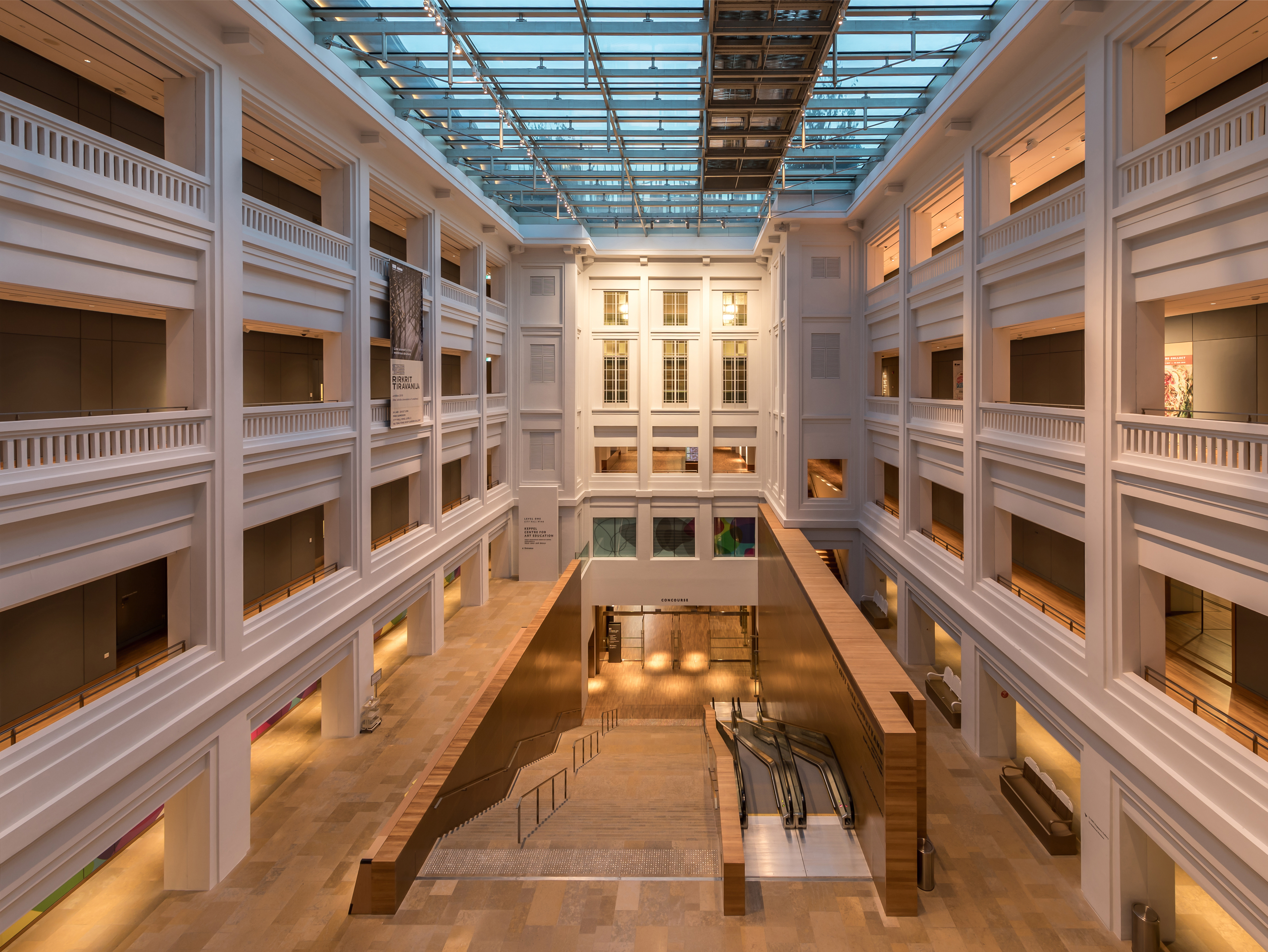
Interior of the National Gallery of Singapore with the airy corridors on 4 levels, the staircases and escalators, in the evening — CC BY-SA 4
History of the National Gallery
A Modest Beginning in Pall Mall
The National Gallery began with a purchase. In 1824 the British government bought 38 paintings from John Julius Angerstein, a merchant and art patron, and opened the museum in his house at 100 Pall Mall on 10 May 1824. The start was modest compared with the royal collections of continental Europe, which had grown over centuries in palaces, and the new gallery owned no building of its own and no tradition of state collecting.
Fourteen years later, in 1838, the gallery moved to its new building at Trafalgar Square, designed by William Wilkins. The move placed the museum at the centre of London, and from that point the collection grew steadily through purchases and gifts. The government bought with a clear aim: to acquire important works of European painting rather than to accumulate pictures by number. In 1842 the gallery bought the Arnolfini Portrait by Jan van Eyck, and works by Turner, Constable and other masters followed through the century.
Growth Through the Nineteenth Century
The nineteenth century turned the small collection into a national institution. Directors and trustees bought across the whole range of European schools, from Italian Renaissance altarpieces to Dutch landscapes and Spanish portraits. The gallery acquired paintings by Raphael, Titian and Caravaggio, and it built one of the strongest groups of British landscape painting anywhere, centred on Turner and Constable.
The collection grew by gift as well as by purchase. Collectors left pictures to the nation, and the gallery accepted bequests that filled gaps in its holdings. By the end of the century the museum held the core of the collection visitors see today, and its reputation rested on quality rather than size. The principle of free admission, kept from the beginning, made the pictures available to everyone, and the gallery became a place where Londoners and visitors met the history of European art without paying.
War, Evacuation and Renewal
The twentieth century brought the greatest test in the gallery’s history. During the Second World War the paintings were evacuated from London to protect them from bombing, and the building was hit several times but survived. After the war the gallery resumed buying, and among its later acquisitions was the Sunflowers by Van Gogh, which became one of the most famous pictures in the world.
The Sainsbury Wing opened in 1991, extending the gallery for the first time in more than a century and giving the early Renaissance pictures a home of their own. The wing changed the way visitors enter the museum, and its smaller rooms suit the intimate scale of fifteenth-century painting. In 2024 the National Gallery marked its two-hundredth anniversary with exhibitions and programmes, and two centuries after opening with 38 pictures it holds one of the most important collections of Western European painting in the world.
Timeline
| Year | Event |
|---|---|
| 1824 | Government buys the Angerstein collection of 38 paintings; gallery opens at 100 Pall Mall on 10 May |
| 1838 | Gallery moves to the Wilkins building at Trafalgar Square |
| 1842 | Arnolfini Portrait by Jan van Eyck acquired |
| 1991 | Sainsbury Wing opens |
| 2024 | Bicentenary of the gallery |
Travel to the National Gallery
How Long to Spend and What to See First
Two to three hours suits a first visit. In that time a visitor can see about 30 to 40 of the most important pictures and pass through all the main galleries. Those who love painting and want to read the labels in detail should allow half a day. The gallery provides seats in many rooms, and visitors may sit and look at a favourite picture for a quarter of an hour without disturbance.
The most effective route follows time. Start in the Sainsbury Wing with the early Renaissance, then move through the Italian, Dutch, Spanish and French rooms, and finish with the British and Impressionist galleries. The route shows the development of European painting across seven centuries, from thirteenth-century religious panels to nineteenth-century landscapes and portraits. A free audio guide covers more than 50 of the best-loved pictures, and the gallery runs short daily talks about a single work, usually lasting about ten minutes and needing no booking.
Admission, Exhibitions and Practical Notes
Admission to the permanent collection is free, as confirmed on the gallery’s official website. Visitors may book a free ticket in advance for faster entry, or simply arrive and join the queue. Some special exhibitions charge, and a ticket for one of those also covers the permanent collection. The main entrance today is the Sainsbury Wing, facing Trafalgar Square.
Personal, non-commercial photography is allowed in most galleries, unless a sign at a particular exhibition forbids it. Visitors may sketch in the gallery, with some materials permitted under the rules. Large bags and wheeled luggage may not be taken into the galleries, and the gallery runs a paid cloakroom service. Some rooms may close temporarily for refurbishment, and some pictures may move from their usual places, so anyone travelling to see one particular picture should check its location on the gallery website before the trip.
Eating and Combining the Visit
Lunch in the gallery restaurant, looking out over Trafalgar Square, makes a pleasant break after two hours among the pictures. After leaving the gallery, visitors can walk down Whitehall to the Palace of Westminster, with Big Ben, and Westminster Abbey in about fifteen minutes. The abbey and palace, with St Margaret’s Church, form a World Heritage property inscribed in 1987, reference 426, and combining the National Gallery with Westminster in one day is a common plan. The Tower of London stands about 3.6 km east along the river, an easy walk or a short bus ride from the gallery.
In the afternoon, visitors can cross Westminster Bridge to the south bank of the Thames, where the London Eye and the South Bank stand, or walk east to Covent Garden, about ten minutes away. The gallery’s central position means that a morning among the pictures can join easily with an afternoon in the parks, the theatres or the riverside walks of central London.

Blue hour photo of the National Gallery of Australia at dusk, Canberra ACT — CC BY-SA 4
Notable Places in the National Gallery
The Sainsbury Wing and Early Renaissance Painting
The Sainsbury Wing holds the earliest pictures in the collection, from the thirteenth to the fifteenth centuries. Its smaller rooms and softer light suit panels that were made for chapels and private devotion, and the pictures hang at eye level. The best-known work here is the Arnolfini Portrait by Jan van Eyck, painted in 1434, which shows a wealthy couple in their parlour, with a convex mirror behind them reflecting two figures entering the room. The picture is among the most studied in the history of painting, and it stands as a symbol of northern Renaissance art.
Leonardo da Vinci and Italian Renaissance Painting
The National Gallery holds one of the most important groups of Leonardo da Vinci paintings outside Italy. The best-known is the Virgin of the Rocks, the London version, painted around 1491 to 1508, which shows the Virgin with the Christ Child, Saint John and an angel in a dark rocky grotto, using Leonardo’s characteristic play of light and shadow. The gallery also holds the Burlington House Cartoon, one of the rare large drawings by Leonardo to survive.
The Italian rooms hold many other masterpieces, among them the Ansidei Madonna by Raphael, Bacchus and Ariadne by Titian and the Supper at Emmaus by Caravaggio. Each picture marks an important stage of Italian painting: Raphael for the High Renaissance, Titian for Venetian colour, Caravaggio for the Baroque, with its strong light and fierce emotion.
Turner, Constable and British Painting
The British rooms hold the two greatest landscape painters of England: Joseph Mallord William Turner and John Constable. Turner’s best-known work here is The Fighting Temeraire, painted in 1839, which shows an old warship towed to the breaker’s yard under a sunset. Many people in Britain regard it as the nation’s favourite picture, and it stands as a symbol of the change from the age of sail to the age of steam.
Constable’s best-known work is The Hay Wain, painted in 1821, which shows a peaceful rural scene on the River Stour. The British rooms also hold works by Gainsborough, Reynolds and Hogarth, showing the development of British painting from aristocratic portraiture to landscape and scenes of everyday life.
Van Gogh, Monet and the Impressionists
The nineteenth-century rooms draw the largest crowds in the gallery, largely because of the Sunflowers by Vincent van Gogh, painted in 1888. This is one of five versions of the Sunflowers that Van Gogh painted, and it ranks among the most famous pictures in the world. Visitors who want a quiet moment with it should come early in the morning or late in the afternoon.
The same rooms hold works by Claude Monet, Edgar Degas, Pierre-Auguste Renoir and Paul Cézanne. Paintings by Seurat, among them Bathers at Asnières, show the step from Impressionism to Neo-Impressionism, with its technique of painting in dots of colour.
The Ambassadors, the Rokeby Venus and Other Pictures to Seek
Beyond the rooms arranged by school, the gallery holds single pictures that visitors should not miss. The Ambassadors by Hans Holbein, painted in 1533, is famous for the distorted skull at the foot of the picture, which only becomes clear when viewed from a sharp angle. The picture is one of the most mysterious in the gallery, full of symbols of sixteenth-century politics, religion and science.
The Rokeby Venus by Velázquez shows the goddess Venus lying with her back turned, looking into a mirror held by Cupid, and it ranks among the most famous female nudes in Western painting. The gallery also holds the Lady Standing at a Virginal by Vermeer and the Self-Portrait at the Age of 34 by Rembrandt. Each of these pictures rewards a few minutes of close looking, with the label read and the details studied.
Frequently Asked Questions
Does the National Gallery in London charge for admission?
No, admission to the permanent collection is free. This is confirmed on the gallery’s official website. Some special exhibitions charge, and a ticket for one of those also covers the permanent collection, while visitors may book a free ticket in advance for faster entry or simply arrive and join the queue.
How long should a visit to the National Gallery take?
Two to three hours suits a first visit. In that time a visitor can see about 30 to 40 of the most important pictures and pass through all the main galleries. Those who love painting and want to read the labels in detail should allow half a day, and the gallery provides seats in many rooms for resting.
Which is the most famous painting in the National Gallery?
No single picture can claim the title, because the gallery holds so many masterpieces. The Sunflowers by Van Gogh draws the most visitors, while the Arnolfini Portrait by Van Eyck is the most studied. With only one hour, a visitor should seek those two pictures together with the Virgin of the Rocks by Leonardo.
Is the National Gallery a UNESCO World Heritage property?
No, the gallery itself is not a World Heritage property. It stands very near the Westminster World Heritage property, which covers the Palace of Westminster, Westminster Abbey and St Margaret’s Church, inscribed in 1987 with reference 426. The United Kingdom holds 35 World Heritage properties, and a morning at the gallery pairs well with an afternoon at Westminster.
May visitors take photographs inside the National Gallery?
Yes, the gallery allows personal, non-commercial photography in most rooms, unless a sign at a particular exhibition forbids it. Visitors may also sketch in the gallery, with some materials permitted under the rules. Large bags and wheeled luggage may not be taken into the galleries, and a paid cloakroom service is available.
What is the easiest way to reach the National Gallery?
The Underground is the easiest way: Charing Cross and Leicester Square stations both stand about five minutes away on foot. Charing Cross is also a national rail station, with trains to south-east England. Buses cross Trafalgar Square all day, and walking from anywhere in central London is easy, since the gallery stands among many other sights.
Verified
The facts in this article were checked against official sources on 23 November 2026. The National Gallery in London is an art museum at Trafalgar Square, Wikidata Q180788, type art museum, coordinates 51.5089° N, 0.1283° W. The gallery was founded in 1824 and opened on 10 May 1824 with 38 paintings bought from John Julius Angerstein. Admission to the permanent collection is free, and some special exhibitions charge, according to the gallery’s official website.
The Palace of Westminster, Westminster Abbey and St Margaret’s Church form a World Heritage property inscribed in 1987, reference 426, criteria (i), (ii) and (iv), verified live on the UNESCO website. The Tower of London is a World Heritage property inscribed in 1988, reference 488, criteria (ii) and (iv), also verified live. The United Kingdom holds 35 World Heritage properties. Distances were computed from coordinates as straight lines: Westminster Abbey stands about 1.05 km from the gallery, and the Tower of London about 3.63 km.
Sources
- nationalgallery.org.uk — Plan your visit: “The National Gallery is free to visit. There is a charge for some exhibitions”, checked 23 November 2026.
- whc.unesco.org/en/list/426/ — Palace of Westminster and Westminster Abbey including Saint Margaret’s Church, reference 426, 1987, criteria (i), (ii) and (iv), checked 23 November 2026.
- whc.unesco.org/en/list/488/ — Tower of London, reference 488, 1988, criteria (ii) and (iv), checked 23 November 2026.
- whc.unesco.org — list of World Heritage properties in the United Kingdom, 35 properties, checked 23 November 2026.
- Wikidata — National Gallery Q180788, art museum, London, United Kingdom, checked 23 November 2026.
Unverified
- Opening hours by day of the week and Friday late opening should be checked on the gallery’s official website before a visit, because hours may change with the seasons and the exhibition programme.
- The exact number of pictures on display at any one time, since some works may be on loan or in conservation.
- The reopening date of the Sainsbury Wing after refurbishment and the opening date of the new research centre should be checked on the gallery’s official website.
- The schedule of short daily talks and family activities may change with the gallery’s programme.
- Cloakroom charges and the ticket price of each special exhibition should be checked on the gallery’s official website before a visit.
Illustrations
- Hero: Replica of Dance of Death fresco. Free image: https://upload.wikimedia.org/wikipedia/commons/8/84/Dance_of_Death_%28replica_of_15th_century_fresco%3B_National_Gallery_of_Slovenia%29.jpg — Public domain.
- In body, National Gallery: Interior of the National Gallery of Singapore with the airy corridors on 4 levels, the staircases and escalators, in the evening. Free image: https://upload.wikimedia.org/wikipedia/commons/b/b3/Interior_of_the_National_Gallery_Singapore.jpg — CC BY-SA 4.
- In body, National Gallery: Blue hour photo of the National Gallery of Australia at dusk, Canberra ACT. Free image: https://upload.wikimedia.org/wikipedia/commons/f/f3/National_Gallery_at_dusk%2C_Canberra_ACT.jpg — CC BY-SA 4.