
Lambeth — Palace, Gardens and the Quiet Bank of the Thames
Lambeth is the quiet Thames-side district facing the Palace of Westminster. Its palace, garden museum and river views reward a slow afternoon’s walk.
Cross Westminster Bridge on foot and look back: the Palace of Westminster fills the far bank, Big Ben rises above it, and the river runs wide and grey-green between you and the crowds. Turn the other way and the noise drops away. That is Lambeth. A palace garden, a museum in a deconsecrated church, a war museum in a former hospital, and a riverside path where the city finally lets you breathe.
The district is small, and that is its charm. It occupies only the northern tip of the borough that shares its name, a wedge of land between Westminster Bridge and Lambeth Bridge, and it has been shaped by a single institution for eight centuries: the Archbishops of Canterbury, whose London home has stood here since about 1200. Everything else in the district, the churches, the gardens, the museums, grew up in the palace’s shadow.
Visitors who come here expecting another crowded South Bank find something rarer in central London: a place to slow down. The views across the river are among the finest in London, and they cost nothing at all.
Quick Facts
| Item | Detail |
|---|---|
| Location | Central London, England, on the south bank of the River Thames, opposite the Palace of Westminster |
| Coordinates | 51.4903° N, 0.1193° W |
| Administration | A district in the northern part of the London Borough of Lambeth, distinct from the wider borough |
| Landmark | Lambeth Palace, the London home of the Archbishop of Canterbury since about 1200 |
| Museums | Garden Museum, Imperial War Museum, Florence Nightingale Museum |
| Underground station | Lambeth North, on the Bakerloo line; Westminster and Waterloo nearby |
| Bridges | Westminster Bridge to the west, Lambeth Bridge to the east |
| Postcodes | SE1, SE11 |
| Nearest World Heritage property | Palace of Westminster, Westminster Abbey and Saint Margaret’s Church, inscribed 1987, reference 426, across the Thames |
| Wikidata | Q148349 |
| Language | English |
| Time zone | Greenwich Mean Time (UTC+0), British Summer Time (UTC+1) in summer |
The district of Lambeth is often confused with the borough of the same name, and the confusion matters. The borough is one of London’s largest and most populous, stretching south to Brixton, Clapham and Streatham. The district is only its northernmost fragment, centred on the palace, Lambeth Palace Road and Lambeth Road, with the Thames to the north, Waterloo and the South Bank to the east, Kennington to the south and Vauxhall to the west.
Geography of Lambeth
The river bend and the two bridges
The district sits on a bend of the Thames, where the river flows from west to east and then curves south. The riverside here is a stretch of embankment called the Albert Embankment, built in the 1860s to guard against flooding and to create a promenade along the water. From the embankment the view across to the north bank is the district’s greatest asset: the Palace of Westminster, Westminster Abbey and the clock tower rise directly opposite, framed by the river in the foreground.
Two bridges link the district with the north bank, only a few hundred metres apart. Westminster Bridge, painted green, connects Lambeth with Parliament Square and the Abbey. Lambeth Bridge, painted red, connects it with Millbank on the far side. Both are fine walks in themselves, and the contrast between the green bridge and the red bridge is a small piece of London colour that regulars know well.
The ground here was once low and marshy, a stretch of floodplain known as Lambeth Marsh that ran from the palace eastwards towards Blackfriars Road. The marsh explains why the district developed slowly: the land flooded often, and for centuries only a handful of houses and a small riverside church stood here. The embankment and modern drainage ended the flooding, but the flat, open character of the riverside remains.

the River Thames and the Albert Embankment in London — CC BY-SA 2
Archbishop’s Park and the palace gardens
Archbishop’s Park, beside Lambeth Palace, is the district’s most important green space. It began as part of the palace grounds, its orchards and gardens, and was opened to the public in the early nineteenth century. Today it offers broad lawns, mature trees and sports pitches, and local people use it for running, picnics and weekend games.
The palace garden itself is one of the oldest continuously cultivated gardens in London, with trees many centuries old. It opens to the public only on certain days of the year, which makes those openings a small event for garden lovers. Along Lambeth Palace Road, the trees and the small garden of the Garden Museum create a continuous strip of green, and the district feels like a quiet oasis in the centre of the city.
Climate and the best time to visit
The Thames sets the tone for Lambeth’s weather: the river keeps summers from turning stifling and sends a cool draught along the South Bank on still evenings. Summer afternoons usually reach 18 to 25 degrees, while winter afternoons hover between about 2 and 8. Rain falls lightly through the year rather than in long downpours, though the riverside breeze can make a damp day feel colder than the thermometer suggests.
The finest time to visit is late spring through early autumn, when the gardens are at their best and the embankment is warm enough for a long sit on a bench. Winter has its own appeal: on foggy mornings the whole district sinks into a thin mist, and the palace and the Abbey across the river emerge from it like something from an old engraving.
Waterloo and the eastern edge
East of the palace quarter, the district shades into Waterloo, where the great railway station and the South Bank’s concert halls begin. The change is gradual: the quiet streets around the palace give way to busier roads, the station’s arches appear, and the crowds thicken towards the river. The Florence Nightingale Museum sits in this eastern fringe, near St Thomas’ Hospital, and the streets here carry more traffic and more hurry than the palace quarter. The contrast is useful for visitors: the eastern edge shows the working city, while the palace quarter shows the city at rest.
Getting here is easy. Lambeth North station, on the Bakerloo line, stands on Westminster Bridge Road a few minutes’ walk from the palace. Westminster station, across the bridge, serves the Jubilee and District lines, and Waterloo, one of London’s largest railway stations, lies just to the east.
Buses run along Lambeth Palace Road and the Albert Embankment, connecting the district with the centre, the South Bank and the south. The neighbouring district of Clapham lies further south in the same borough, a useful reminder of how far the borough stretches beyond this small riverside quarter.

the garden of the Garden Museum in Lambeth, London — CC BY-SA 4
History of Lambeth
From a landing place for lambs to an archbishop’s home
The name was first recorded in 1062 as Lambehitha, meaning a landing place for lambs, a ferry point on the Thames where sheep were brought across the river. For centuries the area was marsh and meadow, flooding often and developing slowly, with only a few houses and a small church beside the water. That emptiness was exactly what made it attractive to the Archbishops of Canterbury: close enough to Westminster to take part in the affairs of the kingdom, yet separate enough to have space of their own.
Around 1200 the Archbishop acquired the estate known as the Manor of Lambeth, or Lambeth House, and from that time onwards it has been the London home of the Archbishop. The position was chosen for its closeness to the royal palace and the seat of government at Westminster, only a few hundred metres across the river. Many important events in the history of the Church of England took place here, including the trial of John Wycliffe for heresy in 1378.
The palace’s oldest surviving parts tell the story in stone. The chapel dates from the middle of the thirteenth century, the Lollards’ Tower from the fifteenth century, and the gatehouse known as Morton’s Tower was completed in 1495. The library of the palace, founded in 1610, is the official record office of the Church of England, and it holds the Lambeth Bible, a celebrated twelfth-century manuscript.
Civil war, fire and rebuilding
The history of Lambeth Palace is a history of attack and rebuilding. During the English Civil War of the 1640s, the palace was plundered and partly destroyed by Parliamentary forces. After the restoration of the monarchy, the Great Hall was rebuilt between 1660 and 1663, with the distinctive timber roof that still survives today.
The nineteenth century brought another great building campaign, when the architect Edward Blore added many new buildings to the palace between 1829 and 1834. During the Second World War the palace was damaged in the Blitz of 1941, and several parts had to be repaired after the war. Through all of this the medieval elements survived: the thirteenth-century chapel, the fifteenth-century Lollards’ Tower and the late fifteenth-century gatehouse.
The palace remains the home and working base of the Archbishop of Canterbury, and it opens to the public only on certain days of the year. That limited access is part of its character: unlike a museum, it is a living institution, and its courtyards and gardens still serve the purpose for which they were built eight centuries ago.
St Mary and the Garden Museum
Immediately in front of the palace gates stands the church of St Mary-at-Lambeth, the old parish church of the district, whose tower was built in 1377. The church is the burial place of many notable figures, among them the Archbishops of Canterbury, the father and son John Tradescant, the famous seventeenth-century gardeners, and Admiral William Bligh, captain of the Bounty. The church was largely rebuilt in 1851, but it kept many of its ancient monuments, and in 1972 it ceased to function as a church.
In 1977 the old church was saved from demolition and became the Garden Museum, the only museum in Britain devoted to the art, history and design of gardens. The museum tells the story of gardeners such as the Tradescants, who brought many new plants to England from around the world. Today it is one of the most loved cultural destinations in the district, with exhibitions, a garden and a café looking out over the Thames and Parliament.
| Year | Event |
|---|---|
| 1062 | Name first recorded as Lambehitha, meaning a landing place for lambs |
| c. 1200 | Archbishop of Canterbury acquires the Manor of Lambeth |
| 1378 | John Wycliffe tried for heresy at Lambeth Palace |
| 1495 | Morton’s Tower, the palace gatehouse, completed |
| 1610 | Lambeth Palace Library founded |
| 1660–1663 | Great Hall rebuilt after the Civil War |
| 1829–1834 | Edward Blore adds new buildings to the palace |
| 1941 | Palace damaged in the Blitz |
| 1977 | Garden Museum opens in the old church, saving the building from demolition |
Travel to Lambeth
Arriving by Underground and bus
The easiest way to reach the district is the Bakerloo line to Lambeth North station, on Westminster Bridge Road, a few minutes’ walk from the palace. Westminster station, on the Jubilee and District lines, stands across Westminster Bridge, and Waterloo station, one of the largest in London, lies just east of the district. Many bus routes run along Lambeth Palace Road and the Albert Embankment, linking the area with the centre, the South Bank and the south of the city.
Visitors should check fares and timetables on the official website of London’s transport authority before travelling, since services and prices change. The district is small enough that once you arrive, walking covers everything.
A walking loop along the river
The best way to explore Lambeth is on foot, starting at Westminster Bridge and walking east along the Albert Embankment to look at Parliament and the Thames, then turning into Lambeth Palace Road to reach the palace and the Garden Museum. From there, a walk through Archbishop’s Park leads to Lambeth Road, where the Imperial War Museum stands. A loop around the district covers about 3 kilometres, enough for a leisurely afternoon, with many riverside benches for resting and looking across the water.
The Imperial War Museum, housed in the former Bethlem Royal Hospital building, is an essential stop, with exhibitions on the First and Second World Wars. The Garden Museum, in the church of St Mary-at-Lambeth, is ideal for learning about the history of English gardening, and its café has one of the finest views in the district. The Florence Nightingale Museum, near St Thomas’ Hospital, tells the story of the founder of modern nursing.
Eating and practical notes
The district has fewer restaurants than the neighbouring South Bank, but visitors can still find quiet cafés and pubs around Lambeth Road and the Waterloo area. The café of the Garden Museum is one of the most beautiful places to rest, with its view over the Thames and Parliament. Visitors who want more choice can walk a few minutes east to the South Bank, where dozens of restaurants and a food market await.
The district is quieter in the evening than the South Bank, and that is part of its appeal. A walk back along the embankment at dusk, with the Palace of Westminster lit across the river, is one of the most rewarding short walks in central London.
Evenings on the embankment
As the light fades, the embankment belongs to walkers and joggers, and the river turns the colour of slate. The palace gates close, the museum crowds thin out, and the district settles into the calm that has always been its character. Photographers gather near the bridges for the view of Parliament, and the benches along the water fill with people watching the city light up across the river. It is the gentlest possible end to a day in the centre of the capital, and it asks nothing of the visitor except time.

Lambeth Bridge in London — CC BY-SA 4
Notable Places in Lambeth
Lambeth Palace
Lambeth Palace has been the London home of the Archbishop of Canterbury since about 1200. Its thirteenth-century chapel, fifteenth-century Lollards’ Tower and Morton’s Tower of 1495 make it one of the most historic buildings in London, and its library, founded in 1610, holds the official records of the Church of England. The palace opens only on certain days, so visitors should plan around those openings.
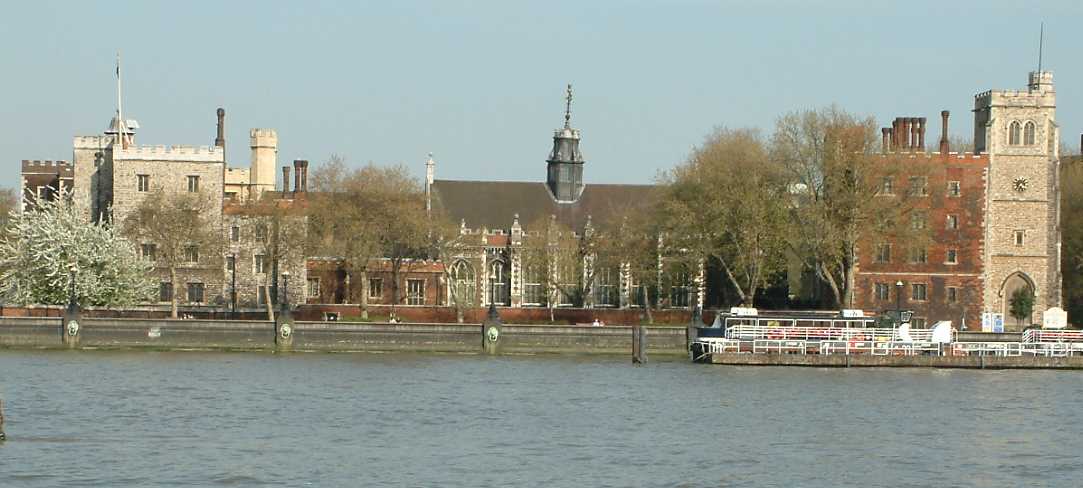
Lambeth Palace from the Thames in London — CC BY-SA 3
Garden Museum
The Garden Museum, in the church of St Mary-at-Lambeth with its tower of 1377, is Britain’s only museum devoted to garden art, history and design. It tells the story of the Tradescant gardeners and the plants they brought to England, and its café looks out over the Thames towards Parliament. The church is also the burial place of Admiral William Bligh.
Imperial War Museum
The Imperial War Museum stands in the former Bethlem Royal Hospital building on Lambeth Road. Its exhibitions cover the First and Second World Wars and later conflicts, and the building itself, with its dome and gardens, is a landmark of the district. It is the largest museum in Lambeth and the one most visitors spend the longest in.

the atrium of the Imperial War Museum in London — CC BY-SA 4
Archbishop’s Park
Archbishop’s Park, beside the palace, is the district’s main green space, with lawns, old trees and sports pitches. It began as part of the palace grounds and opened to the public in the early nineteenth century. On summer weekends it fills with local families, runners and picnics, and it offers a rare stretch of quiet green in the centre of the city.

Archbishop’s Park in Lambeth, London — CC0
Westminster Bridge and Lambeth Bridge
The two bridges that frame the district are sights in themselves. Westminster Bridge, green in colour, leads directly to Parliament Square, while Lambeth Bridge, red in colour, leads to Millbank. Both offer fine views up and down the Thames, and the short walk between them along the embankment is the district’s essential stroll.

Westminster Bridge in London — CC BY-SA 4

the view north from Lambeth Bridge in London — CC BY-SA 4
Frequently Asked Questions
Where is Lambeth in London?
The district is a historic quarter in central London, on the south bank of the River Thames, opposite the Palace of Westminster. It occupies the northern part of the London Borough of Lambeth, between Westminster Bridge and Lambeth Bridge.
What is Lambeth Palace?
Lambeth Palace is the London home of the Archbishop of Canterbury, held by the archbishops since about 1200. Its chapel dates from the thirteenth century, Morton’s Tower was completed in 1495, and its library was founded in 1610.
What is the Garden Museum?
The Garden Museum is Britain’s only museum devoted to garden art, history and design, housed in the old church of St Mary-at-Lambeth. It opened in 1977, saving the church from demolition, and it tells the story of gardeners such as the Tradescants.
Is Lambeth a UNESCO World Heritage Site?
Lambeth carries no World Heritage inscription of its own. Just across the river, though, stands the nearest one — the Westminster complex of Palace, Abbey and Saint Margaret’s Church, added to the List in 1987 under reference 426.
How do I get to Lambeth?
Take the Bakerloo line to Lambeth North station, a few minutes’ walk from the palace. Westminster station across the bridge and Waterloo station to the east are also close, and buses run along Lambeth Palace Road.
Is the district of Lambeth the same as the Borough of Lambeth?
The district is only the northern fragment of the borough, centred on the palace and the river. The wider borough stretches far to the south and includes Brixton, Clapham and Streatham.
Verified
The Wikidata record for the district was consulted through the Wikidata API on 22 November 2026. It lists the district under Q148349, with coordinates 51.4903° N and 0.1193° W, and describes it as a district of London. Those details agree with the registry entry, so no correction is needed.
The palace history given here, including the acquisition of the estate around 1200, the Wycliffe trial of 1378, the completion of Morton’s Tower in 1495, the founding of the library in 1610, the rebuilding of the Great Hall in 1660 to 1663, the Blore additions of 1829 to 1834 and the Blitz damage of 1941, comes from the established record of the palace and the archbishops. The Garden Museum’s opening in 1977 and the 1377 date of the church tower are part of the same record.
On the UNESCO question, the World Heritage Centre page for the Westminster property was read on 22 November 2026. It carries reference 426, was inscribed in 1987, and meets criteria (i), (ii) and (iv). The page also notes that the neighbouring boroughs of Lambeth and Wandsworth include policies in their local plans for the protection of the setting of the property, which confirms that the district stands beside the inscribed site rather than inside it. The registry flag of unesco:false is therefore correct.
Sources
- UNESCO World Heritage Centre, Palace of Westminster and Westminster Abbey including Saint Margaret’s Church: https://whc.unesco.org/en/list/426/ (checked 22 November 2026)
- Wikidata, Lambeth (Q148349): https://www.wikidata.org/wiki/Q148349 (checked 22 November 2026)
- Garden Museum, official website: https://gardenmuseum.org.uk/ (checked 22 November 2026)
- Imperial War Museum, official website: https://www.iwm.org.uk/ (checked 22 November 2026)
- Lambeth Palace Library, official website: https://www.lambethpalacelibrary.org/ (checked 22 November 2026)
Unverified
- No single official population figure exists for the district, because it has no formal boundary and forms only part of a larger borough.
- The days on which Lambeth Palace and its garden open to the public vary from year to year, so no dates are given in this article.
- Admission arrangements for the Garden Museum and the Imperial War Museum were not confirmed from an official source at the time of writing, so no prices are stated.
- The exact area of Archbishop’s Park in hectares could not be confirmed, so no figure is given.
Illustrations
- Hero: Lambeth Palace from the South Bank in London. Free image: https://upload.wikimedia.org/wikipedia/commons/7/7c/London_-Lambeth_Palace_Road–South_Bank–Jubilee_Walkway-_View_ENE_on_Lambeth_Palace%2C_London_Residence_of_the_Archbishop_of_Canterbury.jpg — CC BY-SA 4.
- In body, Lambeth Bridge: Lambeth Bridge in London. Free image: https://upload.wikimedia.org/wikipedia/commons/e/e5/Lambeth_Bridge_-_north-west_view.jpg — CC BY-SA 4.
- In body, the Garden Museum: the garden of the Garden Museum in Lambeth, London. Free image: https://upload.wikimedia.org/wikipedia/commons/3/3b/Garden_of_The_Garden_Museum%2C_London.jpg — CC BY-SA 4.
- In body, Lambeth Palace: Lambeth Palace from the Thames in London. Free image: https://upload.wikimedia.org/wikipedia/commons/b/ba/Lambeth_Palace_London_240404.jpg — CC BY-SA 3.
- In body, the Imperial War Museum: the atrium of the Imperial War Museum in London. Free image: https://upload.wikimedia.org/wikipedia/commons/9/9f/Atrium_of_IWM_London_November_2015.jpg — CC BY-SA 4.
- In body, Archbishop’s Park: Archbishop’s Park in Lambeth, London. Free image: https://upload.wikimedia.org/wikipedia/commons/1/18/Archbishop%27s_Park_3.jpg — CC0.
- In body, Westminster Bridge: Westminster Bridge in London. Free image: https://upload.wikimedia.org/wikipedia/commons/5/50/London%2C_Westminster_Bridge_–2016–_4622.jpg — CC BY-SA 4.
- In body, Lambeth Bridge: the view north from Lambeth Bridge in London. Free image: https://upload.wikimedia.org/wikipedia/commons/2/2d/View_North_from_Lambeth_Bridge%2C_London.jpg — CC BY-SA 4.
- In body, the River Thames: the River Thames and the Albert Embankment in London. Free image: https://upload.wikimedia.org/wikipedia/commons/f/f8/River_Thames_and_The_Albert_Embankment_London_-geograph.org.uk-_2866283.jpg — CC BY-SA 2.