
Elephant and Castle: The Great Crossroads of South London
Elephant and Castle stands at a great crossroads in south London. Its strange name has puzzled visitors for more than four centuries.
Elephant and Castle is the most oddly named place in London, a busy junction in Southwark where five roads meet and where the city has rebuilt itself again and again. The old shopping centre of the 1960s is gone, the concrete estates are gone, and a new town centre is rising on the same ground, yet the name survives, carried by the station, the streets and the people who call the place The Elephant. This guide covers the geography of the junction, the history of the inn that gave the place its name, the great rebuilding of the present day, and the practical facts for a visit to Elephant and Castle.
Quick Facts About Elephant and Castle
| Fact | Detail |
|---|---|
| Name | Elephant and Castle, known locally as The Elephant |
| Location | London Borough of Southwark, south London, England |
| Coordinates | 51.495° N, 0.101° W |
| Distance from the centre | About 2 kilometres south of central London |
| Neighbouring districts | Walworth, Newington and Kennington |
| Earliest record of the name | 21 March 1765, in the records of the Walworth manor |
| Origin of the name | A coaching inn and staging post at the junction |
| Old shopping centre | Opened March 1965, first covered shopping centre in Europe, closed 24 September 2020 |
| Demolition | Began January 2021 |
| Regeneration | Masterplan worth about 4 billion pounds, approved 2004 |
| Station | Elephant and Castle, Northern and Bakerloo lines, plus National Rail |
| Landmarks | Strata SE1, the Faraday Memorial, the Metropolitan Tabernacle |
| UNESCO | Not a World Heritage Site |
| Wikidata | Q2716414 |
Geography of Elephant and Castle
The Great Junction
Elephant and Castle is one of the busiest junctions in London, where Newington Causeway, New Kent Road, Walworth Road, London Road and Saint George’s Road meet. For decades the junction was a great traffic roundabout, with cars, buses and crowds of pedestrians circling a concrete island, and the roar of traffic was the sound of the place. In recent years the roundabout has been replaced by a signalled junction, with wider pavements and new public space, and the change has given the district a different face. The junction remains the heart of Elephant and Castle, and every part of the district is measured from it.
Around the junction stand tall buildings, shops, restaurants and homes, forming a busy urban centre for south London. The district is the gateway into central London from the south, and buses run through it in every direction, while the Underground station links it to the West End, the City and north London. Visitors to Elephant and Castle feel the pace of the city at once, since the streets are crowded from morning to night and the shops serve a population drawn from many countries. The district is urban, dense and loud, and it makes no pretence of being a village.
The ground here is flat, low-lying land south of the Thames, and the streets run straight from the junction towards the river, the parks and the suburbs. The Thames lies to the north, and the walk from Elephant and Castle to the South Bank takes about twenty minutes, passing the Imperial War Museum on Lambeth Road. To the east lies Burgess Park, one of the largest parks in south London, and to the west lies Kennington Park and the Oval cricket ground. Elephant and Castle sits at the centre of this web of streets and parks, and its position is the reason it has always been a meeting place.
Walworth, Newington and Kennington
Elephant and Castle stands where three historic districts meet, Walworth, Newington and Kennington, and the name is often used for the whole area around the station. Walworth to the south-east is an old residential district, with Walworth Road as its main shopping street and many independent shops. Newington to the north is tied to religion and science, since it was the birthplace of the scientist Michael Faraday, and Kennington to the west holds Kennington Park and the cricket ground of the Oval. Each of the three districts has its own character, and Elephant and Castle is the place where they join.
The mix of districts gives Elephant and Castle its diversity, since the streets around the junction hold homes, shops and places of worship from many communities. The Latin American community has lived here since the 1980s, and its restaurants, shops and markets give the district a flavour that few parts of London share. Students, workers, families and newcomers all use the same junction, the same station and the same shops, and the crowds at Elephant and Castle show the whole of London in one place. The district is a crossroads of people as much as of roads.
The streets around the junction are lined with a mix of old and new, since the rebuilding has put glass towers beside Victorian terraces and concrete blocks. The new buildings rise high, and the tallest of them can be seen from across south London, while the older streets keep the scale of the nineteenth century. The contrast is the look of Elephant and Castle today, a district that is changing fast yet keeps its old bones. Walking the side streets away from the junction shows a quieter London of terraced houses, small shops and corner pubs.
Getting Around the District
Elephant and Castle station is one of the busiest stations in south London, serving the Northern and Bakerloo lines of the Underground. The Northern line links the district to the City, King’s Cross and the north, while the Bakerloo line runs to the West End and the north-west, so the station is a quick route into the centre. The National Rail station of the same name serves Southeastern and Thameslink trains, linking Elephant and Castle to south London and Kent. Many bus routes pass through the junction, carrying passengers to central London, Brixton, Clapham and Greenwich.
The district is compact, and most of its sights lie within a short walk of the station. The new town centre, Elephant Park, the Faraday Memorial and the Metropolitan Tabernacle all stand near the junction, and the Imperial War Museum is about fifteen minutes away on foot. Burgess Park lies a few minutes to the east, and the walk north to the Thames passes the museum and the streets of Lambeth. Elephant and Castle rewards walking, since the changes in the district are best seen street by street, and the new public spaces are made for pedestrians.

Elephant and Castle stands where three historic districts meet, Walworth, Newington and Kennington, and the name is often used for the whole area around the station — CC BY-SA 2

The remodelled Elephant and Castle junction, where five roads meet. — CC BY-SA 2, by Robin Stott
History of Elephant and Castle
The Inn and the Name
The name Elephant and Castle comes from a coaching inn and staging post that stood at the junction, where travellers stopped on the road from London to Kent and the south coast. The earliest record of the name appears in the books of the Walworth manor on 21 March 1765, when the manor court met at Elephant and Castle in Newington. The inn was rebuilt in 1816 and again in 1898, and it became a familiar landmark of south London, until the name of the inn became the name of the whole district around it. The inn is gone, yet the name remains, and it is still the strangest name in the capital.
Many stories try to explain the name, and the most popular claims that it is a corruption of Infanta de Castilla, a reference to Eleanor of Castile, wife of King Edward the First. The local historian Stephen Humphrey rejected that story in his book Elephant and Castle, a History, published in 2013, finding no evidence to support it. A stronger theory holds that the name comes from the arms of the Cutlers’ Company, the medieval guild of knife makers, which showed an elephant carrying a castle on its back, with the ivory of the tusks standing for knife handles of ivory. The elephant and castle of the guild is still the emblem of the district, and a pink elephant once stood on the front of the old shopping centre.
William Shakespeare knew the inn, and he mentioned the Elephant in Twelfth Night, written in 1601, which shows that the name was already familiar to Londoners in the age of Elizabeth the First. The mention in the play is the earliest sign of the name in literature, and it places the inn at the heart of the London of Shakespeare’s day. The inn stood on a road that carried travellers, goods and news, and its sign of the elephant and the castle was a landmark for all who passed. Four centuries later the sign is still the sign of the district, and the elephant still stands for Elephant and Castle.
War and the Shopping Centre
In the Second World War, Elephant and Castle was heavily bombed, with many houses and shops destroyed, and the damage cleared the way for a full rebuilding in the 1960s. The Elephant and Castle shopping centre opened in March 1965, the first covered shopping centre in Europe, with 120 shops on three floors and a two-level underground car park. The centre had a pink frontage, and a pink elephant carrying a castle stood on its face, so the emblem of the district became the emblem of the building. For half a century the shopping centre was the symbol of Elephant and Castle, loved by some and disliked by others, yet known to all of London.
The 1960s rebuilding also brought concrete towers, a great traffic roundabout and the Heygate Estate, a housing estate of about 1,200 homes. The decade shaped the look of Elephant and Castle for the next fifty years, with buildings of raw concrete that drew praise and blame in equal measure. The shopping centre, the estate and the roundabout made the district a place of concrete and traffic, and the old streets of Newington and Walworth were swept away. The community that lived there was diverse and strong, yet the buildings themselves were often criticised, and by the end of the century the district was ready for change.
The shopping centre aged, and the estate aged with it, while the land at the junction grew more valuable with every year. The council of Southwark approved a masterplan for the district in 2004, with the aim of restoring Elephant and Castle as a great urban centre of south London, as it had been before the Second World War. The Heygate Estate was demolished, and Elephant Park rose in its place, with new homes, a park and public space. The plan was worth about 4 billion pounds, one of the largest regeneration schemes in London, and it set the district on a new course.
The New Town Centre
The old shopping centre closed on 24 September 2020, after the first closing date of 30 July 2020 had been delayed by the pandemic, and demolition began in January 2021. On the site of the old centre a new town centre called The Elephant is being built, with shops, restaurants, a cinema and public space, and a new home for the London College of Communication. The new buildings are taller, lighter and more open than the concrete of the 1960s, and the streets around them are made for walking. The district is changing day by day, and visitors see cranes, hoardings and new towers wherever they look.
The Latin American community of Elephant and Castle has been part of the rebuilding, since its shops, restaurants and cultural spaces are being kept in the new town centre. The community has lived in the district since the 1980s, and its food, music and markets are a valued part of the place. Elephant Park, beside the new town centre, is a modern park with lawns, trees, a playground and space for outdoor events, and it gives the district the green heart it lacked in the age of concrete. The park is where local people meet, picnic and celebrate, and it is the soft edge of the new Elephant and Castle.
The rebuilding is not finished, and the district will keep changing for years, yet the shape of the new Elephant and Castle is already clear. The junction has new public space, the park has new lawns, the towers have new homes, and the college brings young life to the streets. The name has survived every change, from the coaching inn to the shopping centre to the new town centre, and the elephant still stands for the district. Elephant and Castle is a place that reinvents itself, and the present rebuilding is only the latest chapter in a long story.
The People and the Landmarks
The Faraday Memorial stands at the junction, a stainless steel box built in 1961 to honour Michael Faraday, the scientist born in Newington. Faraday discovered the laws of electricity and magnetism, and his work shaped the modern world, so the memorial is a fitting landmark for the district of his birth. The memorial is plain, grey and geometric, and it has divided opinion since it was built, yet it is one of the most recognisable sights at the junction. The box stands between the roads, and it marks the place where the scientist was born.
Strata SE1 is the tower that defines the skyline of Elephant and Castle, a residential building of 148 metres completed in 2010, with three wind turbines on its crown. The turbines were meant to supply part of the power of the building, and the tower was among the tallest in south London when it opened. The Metropolitan Tabernacle on Elephant Road is one of the largest Baptist churches in London, tied to the preacher Charles Spurgeon, and the present church was rebuilt after a fire in 1898. The church still serves its congregation, and its quiet interior stands in contrast to the noise of the junction outside.
The Imperial War Museum on Lambeth Road, a short walk from Elephant and Castle, is one of the great museums of London, with exhibitions on the First World War, the Second World War and later conflicts. The museum stands in the old Bethlem Hospital, with great naval guns before its doors, and it draws visitors from across the world. Burgess Park to the east is one of the largest parks in south London, with a lake, sports grounds and open grass, and it gives the district a place to breathe. Elephant and Castle is a district of landmarks, and each of them tells a part of its story.

Elephant and Castle is one of the busiest junctions in London, where Newington Causeway, New Kent Road, Walworth Road, London Road and Saint George’s Road meet — CC BY-SA 2

The entrance to the old Elephant and Castle shopping centre car park. — CC BY-SA 2, by Robin Stott

The Faraday Memorial at the junction, honouring Michael Faraday. — CC BY-SA 2, by Nigel Cox
Travel to Elephant and Castle
Arriving and Exploring
The best way to reach Elephant and Castle is by Underground to Elephant and Castle station, on the Northern and Bakerloo lines, or by National Rail to the station of the same name. The station stands at the junction, and the new town centre, Elephant Park and the Faraday Memorial are all a few minutes away on foot. Buses from central London, Brixton and Clapham also stop at the junction, so the district is easy to reach from any part of the city. The streets around the station are busy, and the pavements are wide, so the first sight of Elephant and Castle is the crowd and the tower of Strata SE1.
A visit to Elephant and Castle suits half a day, with the morning at the new town centre and Elephant Park, and the afternoon on foot to the Imperial War Museum and Burgess Park. The district is still a building site in places, so some streets may be fenced or changed, and visitors should check the transport news before travelling. The evenings bring the restaurants and bars around the station to life, and the Latin American restaurants are a draw for dinner. Comfortable shoes help, since the pavements are being rebuilt and the ground is uneven in places.
The Metropolitan Tabernacle welcomes visitors who care for religious history, and the church tells the story of Spurgeon and the Baptist life of nineteenth-century south London. The Faraday Memorial is a short stop, yet it rewards a look, since the plain steel box is one of the most argued-over monuments in the city. The Imperial War Museum needs half a day of its own, with its galleries, films and memorial spaces, and it is free to enter. A walk north from Elephant and Castle to the Thames passes the museum and the streets of Lambeth, and it shows the district in its wider setting.
Food, Parks and Practical Advice
The Latin American food of Elephant and Castle is one of the best reasons to visit, with restaurants and cafes serving dishes from Colombia, Ecuador and other countries of the region. The shops around the junction sell food, music and goods from Latin America, and the markets give the district a colour that is rare in London. Visitors should try a lunch in one of the small restaurants near the station, where the food is generous and the prices are fair. The new town centre will add more restaurants, yet the small places of the old district are the ones to seek out.
Elephant Park is the green heart of the new district, with lawns, trees and a playground, and it is a good place to rest between sights. Burgess Park to the east is larger and wilder, with a lake and sports grounds, and it suits a longer walk or a picnic. The best seasons for Elephant and Castle are spring and summer, when the parks are green and the outdoor events are lively, while autumn is quieter and the light is softer. Winter can be grey, yet the restaurants and the museum make a visit worthwhile in any season.
Visitors should allow time for the building works, since the district is changing and the routes may shift with the progress of construction. The station is busy at peak hours, so an early visit gives quieter streets and shorter queues. Elephant and Castle is not a district of pretty streets, and its pleasures are the energy of the junction, the food, the parks and the museums nearby. Those who come with open eyes find a London that is alive and changing, and the elephant is still at the centre of it.

Elephant and Castle station is one of the busiest stations in south London, serving the Northern and Bakerloo lines of the Underground — CC BY-SA 3

The lake in Burgess Park, a few minutes east of Elephant and Castle. — CC BY 4, by acediscovery
Notable Places in Elephant and Castle
- The Elephant and Castle Junction — The great junction of south London, where five roads meet, now a signalled crossing with new public space and wide pavements.
- The Elephant Town Centre — The new town centre rising on the site of the old shopping centre, with shops, restaurants, a cinema and a new home for the London College of Communication.
- Elephant Park — A modern park beside the new town centre, with lawns, trees, a playground and space for outdoor events.
- The Faraday Memorial — A stainless steel box built in 1961 to honour Michael Faraday, the scientist born in Newington, standing at the junction.
- Strata SE1 — A residential tower of 148 metres, completed in 2010, with three wind turbines on its crown, once among the tallest buildings in south London.
- The Metropolitan Tabernacle — A great Baptist church on Elephant Road, tied to the preacher Charles Spurgeon, rebuilt after a fire in 1898.
- The Imperial War Museum — On Lambeth Road, about fifteen minutes on foot, with exhibitions on the two world wars and later conflicts.
- Burgess Park — One of the largest parks in south London, a few minutes east, with a lake, sports grounds and open grass.

Strata SE1, the residential tower with wind turbines on its crown. — CC BY-SA 3, by Cmglee

The Metropolitan Tabernacle on Elephant Road. — CC BY-SA 2, by Bill Boaden

The entrance to the Imperial War Museum on Lambeth Road. — CC BY-SA 2, by Robin Sones
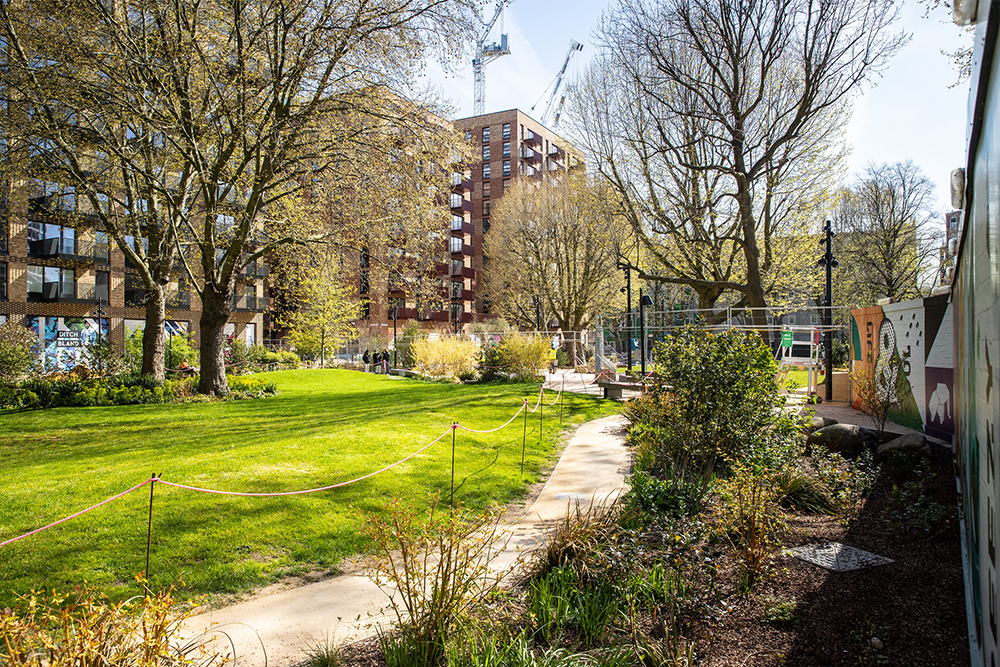
Elephant Park beside the new town centre. — CC BY-SA 4, by Zefrog
Frequently Asked Questions About Elephant and Castle
Where is Elephant and Castle?
Elephant and Castle lies in south London, in the Borough of Southwark, about 2 kilometres south of the centre, between Walworth, Newington and Kennington. Elephant and Castle station serves the Northern and Bakerloo lines and National Rail, and the district is a great junction where five roads meet.
Why is it called Elephant and Castle?
The name comes from a coaching inn and staging post at the junction, first recorded on 21 March 1765. The popular story that the name is a corruption of Infanta de Castilla was rejected by the historian Stephen Humphrey in 2013, and the stronger theory traces the name to the elephant and castle in the arms of the Cutlers’ Company.
What happened to the old Elephant and Castle shopping centre?
The Elephant and Castle shopping centre opened in March 1965 as the first covered shopping centre in Europe, with 120 shops and a pink frontage. It closed on 24 September 2020, demolition began in January 2021, and a new town centre called The Elephant is being built on the site.
What is there to see at Elephant and Castle?
Visitors can see the new town centre, Elephant Park, the Faraday Memorial, Strata SE1 and the Metropolitan Tabernacle. The Imperial War Museum and Burgess Park lie a short walk away, and the Latin American restaurants around the junction are a draw of their own.
Is Elephant and Castle a UNESCO World Heritage Site?
No. Elephant and Castle holds no World Heritage status, and Southwark has no inscribed property. The nearest inscribed sites stand across the river at Westminster and the Tower of London, with Maritime Greenwich further east.
How much time should I spend at Elephant and Castle?
Half a day suits Elephant and Castle, with the morning at the new town centre and Elephant Park, and the afternoon on foot to the Imperial War Museum and Burgess Park. Visitors who want to try the Latin American food should allow extra time for lunch or dinner near the station.
Verified
The earliest record of the name on 21 March 1765, the rebuilding of the inn in 1816 and 1898, the mention of the Elephant in Twelfth Night in 1601, the rejection of the Infanta de Castilla story by Stephen Humphrey in his book of 2013, the bombing of the district in the Second World War, the opening of the shopping centre in March 1965 as the first covered shopping centre in Europe, the 120 shops and the pink frontage, the approval of the masterplan in 2004, the demolition of the Heygate Estate of about 1,200 homes, the closing of the shopping centre on 24 September 2020 and the start of demolition in January 2021, the building of the Faraday Memorial in 1961, the height of Strata SE1 at 148 metres and its completion in 2010, the rebuilding of the Metropolitan Tabernacle after the fire of 1898, the Latin American community living in the district since the 1980s and the regeneration scheme worth about 4 billion pounds were checked against the sources below. The absence of Elephant and Castle from the World Heritage List, the inscription of the Palace of Westminster in 1987 and the Tower of London in 1988, the inscription of Maritime Greenwich in 1997 and the total of 35 World Heritage properties in the United Kingdom were verified on the UNESCO website on 22 November 2026. The Wikidata record Q2716414, which describes an area in South London, was checked through the Wikidata API on 22 November 2026. Verified 22 November 2026.
Sources
- Wikipedia, “Elephant and Castle” (https://en.wikipedia.org/wiki/Elephant_and_Castle)
- Imperial War Museum, official website (https://www.iwm.org.uk/)
- UNESCO World Heritage Centre, United Kingdom of Great Britain and Northern Ireland (https://whc.unesco.org/en/statesparties/gb)
- Wikidata, Q2716414 Elephant and Castle (https://www.wikidata.org/wiki/Q2716414), verified through the Wikidata API on 22 November 2026
- TheTerraAtlas keyword file batch-eu13-en-keywords.json, entry TA-L4-elephant-and-castle, focus keyword “elephant and castle”
Unverified
- Current progress on the new Elephant town centre — the centre is under construction, and its opening date and list of shops change with the building programme, so check the official announcements of the developer before travelling.
- Current ticket prices and opening hours of the Imperial War Museum — the museum has free entry to its main galleries and charges for some special exhibitions, so check the official website before travelling.
- The exact number of homes and the exact area of Elephant Park — the regeneration scheme is large and its figures change with each phase, so check the official sources of the developer and the council of Southwark before publication as exact figures.
- The exact area of Burgess Park — the park is one of the largest in south London, yet its precise area has not been verified on an official source.
- The direct link between the Cutlers’ Company arms and the name of the inn — the theory is widely told, yet historians still debate the direct link between the guild emblem and the name of the coaching inn.
Illustrations
- Hero: The Great Crossroads of South London. Free image: https://upload.wikimedia.org/wikipedia/commons/1/11/Elephant_%26_Castle%2C_London%2C_England.jpg — CC BY 2.
- In body, The Great Junction: Elephant and Castle is one of the busiest junctions in London, where Newington Causeway, New Kent Road, Walworth Road, London Road and Saint George’s Road meet. Free image: https://upload.wikimedia.org/wikipedia/commons/d/d2/Elephant_%5E_Castle_market%2C_8-30_on_a_Wednesday_evening_-geograph.org.uk-_3587457.jpg — CC BY-SA 2.
- In body, Walworth, Newington and Kennington: Elephant and Castle stands where three historic districts meet, Walworth, Newington and Kennington, and the name is often used for the whole area around the station. Free image: https://upload.wikimedia.org/wikipedia/commons/0/0e/Parade_of_shops%2C_south_end_of_Walworth_Road%2C_Walworth%2C_south_London_-geograph.org.uk-_5883575.jpg — CC BY-SA 2.
- In body, Getting Around the District: Elephant and Castle station is one of the busiest stations in south London, serving the Northern and Bakerloo lines of the Underground. Free image: https://upload.wikimedia.org/wikipedia/commons/3/31/Elephant_%26_Castle_stn_Northern_northbound_look_south.JPG — CC BY-SA 3.
- In body, The Great Junction: The remodelled Elephant and Castle junction, where five roads meet. Free image: https://upload.wikimedia.org/wikipedia/commons/0/0f/Cyclist_negotiating_the_remodelled_Elephant_and_Castle_junction%2C_south_London_-geograph.org.uk-_5608304.jpg — CC BY-SA 2, by Robin Stott.
- In body, War and the Shopping Centre: The entrance to the old Elephant and Castle shopping centre car park. Free image: https://upload.wikimedia.org/wikipedia/commons/0/0e/Entrance_to_Elephant_%5E_Castle_shopping_centre_car_park_from_Elephant_Road_-geograph.org.uk-_4338554.jpg — CC BY-SA 2, by Robin Stott.
- In body, The People and the Landmarks: The Faraday Memorial at the junction, honouring Michael Faraday. Free image: https://upload.wikimedia.org/wikipedia/commons/2/23/Elephant_%5E_Castle%2C_Michael_Faraday_Memorial_-geograph.org.uk-_6140292.jpg — CC BY-SA 2, by Nigel Cox.
- In body, Strata SE1: Strata SE1, the residential tower with wind turbines on its crown. Free image: https://upload.wikimedia.org/wikipedia/commons/a/ac/Cmglee_Strata_SE1_exterior.jpg — CC BY-SA 3, by Cmglee.
- In body, The Metropolitan Tabernacle: The Metropolitan Tabernacle on Elephant Road. Free image: https://upload.wikimedia.org/wikipedia/commons/3/35/The_Metropolitan_Tabernacle_at_Elephant_and_Castle_-geograph.org.uk-_2560775.jpg — CC BY-SA 2, by Bill Boaden.
- In body, The Imperial War Museum: The entrance to the Imperial War Museum on Lambeth Road. Free image: https://upload.wikimedia.org/wikipedia/commons/e/ed/Entrance_to_Imperial_War_Museum%2C_Lambeth_Road_SE1_-geograph.org.uk-_2558679.jpg — CC BY-SA 2, by Robin Sones.
- In body, Burgess Park: The lake in Burgess Park, a few minutes east of Elephant and Castle. Free image: https://upload.wikimedia.org/wikipedia/commons/7/76/Burgess_Park_Lake.jpg — CC BY 4, by acediscovery.
- In body, Elephant Park: Elephant Park beside the new town centre. Free image: https://upload.wikimedia.org/wikipedia/commons/7/7d/ElephantPark2.jpg — CC BY-SA 4, by Zefrog.