
Crystal Palace London: The Hilltop District That Lost Its Glass Palace
Crystal Palace London rises on Sydenham Hill in south London. Its park holds the famous dinosaurs and wide views over the city.
Crystal Palace London takes its name from a building that no longer stands, a vast hall of iron and glass that once crowned the hill and drew crowds from across the world. The palace burned down in 1936, yet the district kept its name, its park, its dinosaurs and its view, and today it is one of the most distinctive corners of south London. The hilltop gives Crystal Palace London a village feeling that is rare in the capital, with independent shops, quiet streets and a park that still follows the terraces of the lost palace. This guide covers the geography of the hill, the history of the glass palace, the park and its dinosaurs, and the practical facts for a visit to Crystal Palace London.
Quick Facts About Crystal Palace London
| Fact | Detail |
|---|---|
| Name | Crystal Palace, a residential district in south London |
| Location | Sydenham Hill, south London, England |
| Coordinates | 51.4203° N, 0.0705° W |
| Boroughs | Bromley, Croydon, Lambeth, Lewisham and Southwark |
| Height of the hill | About 112 metres above sea level |
| Named after | The Crystal Palace exhibition building, on the hill from 1854 to 1936 |
| The glass palace | Built for the Great Exhibition of 1851, rebuilt at Sydenham and opened in June 1854 |
| The fire | Night of 30 November 1936, the palace burned down completely |
| Park | Crystal Palace Park, about 80 hectares, Grade II* registered historic park |
| Dinosaurs | Models by Benjamin Waterhouse Hawkins, unveiled in 1854, Grade I listed |
| Transmitter | Crystal Palace transmitting station, built in 1956, about 219 metres tall |
| Nearest station | Crystal Palace, with trains to London Bridge and Victoria |
| UNESCO | Not a World Heritage Site |
| Wikidata | Q122909 |
Geography of Crystal Palace London
Sydenham Hill and the View
Crystal Palace London stands on Sydenham Hill, one of the highest points in south London, at about 112 metres above sea level. The hill rises above the streets of Upper Norwood and Sydenham, and its height is the reason the glass palace was rebuilt here, since a building of iron and glass could be seen from miles away across the city. From the top of the hill the view reaches across central London, taking in the towers of the City, Canary Wharf and The Shard, and east towards Greenwich and the Thames, and on a clear day the skyline stands sharp against the sky. The hill gives Crystal Palace London its character, a place above the city that still belongs to it.
The district spreads across five London boroughs, Bromley, Croydon, Lambeth, Lewisham and Southwark, with the park and the Triangle at its centre. The boundaries mean little to a visitor, since the streets run together around the hill, yet they explain why the district has always felt like a place apart, governed by no single town hall. The houses climb the slopes in terraces of brick and stucco, and the streets curve with the hill rather than following a grid, so walking here feels more like walking through a village than through a suburb. Crystal Palace London is a hilltop district first, and a suburb second.
The ground of Sydenham Hill is London clay capped with gravel, and the slopes fall away steeply to the north, east and south. The park occupies the crest and the western slopes, where the palace once stood, and the gardens and lakes lie below the terraces on the lower ground. The trees of the park are old and tall, with oaks and sweet chestnuts that shade the paths, and the wooded slopes give the district a green edge that the streets of central London lack. The hill, the trees and the open sky make Crystal Palace London feel higher and quieter than its distance from the centre would suggest.
Crystal Palace Park
Crystal Palace Park is the heart of the district, a Victorian park of about 80 hectares laid out on the grounds of the lost palace. The park holds lawns, lakes, woodland and the great Italian terraces where the palace once stood, with stone sphinxes guarding the steps that once led visitors up to the glass hall. The terraces are the most direct survival of the palace, broad flights of stone that now lead nowhere, and walking them gives a sense of the scale of the building that stood above. The park is registered Grade II* as a historic park, a recognition of its landscape and its history.
The lakes at the bottom of the park are the home of the dinosaurs, the models that have stood among the trees since 1854. The water is shallow and still, and the models rise from islands and banks among the reeds, so a walk around the lakes feels like a walk through a prehistoric landscape. The park also holds the National Sports Centre, with its athletics stadium, and the Crystal Palace Bowl, a natural amphitheatre where open-air concerts are held in summer. The park is free and open through the year, and it serves the district as a garden, a playground and a sports ground.
The park changes with the seasons, and each season gives it a different character. Spring brings blossom to the trees around the lakes, summer fills the lawns with picnics and the Bowl with music, autumn turns the woodland gold, and winter strips the trees and opens the long view from the terraces. The dinosaurs look different in every season, and the park rewards a slow walk rather than a hurried visit. Crystal Palace London is best understood on foot in its park, where the history of the place is written into the ground.

Crystal Palace dinosaurs across the lake.jpg — CC BY-SA 4

Lower Lake, Crystal Palace Park – geograph.org.uk – 3853072.jpg — CC BY-SA 2
The Triangle and the Streets
The Triangle is the commercial centre of Crystal Palace London, a small triangle of streets formed by Westow Street, Westow Hill and Church Road. The three streets hold cafes, restaurants, independent shops and bars, and the Triangle has the feeling of a village high street, with family-run businesses and a weekend market. Artists and makers have settled here, and the shopfronts show crafts, books, second-hand goods and food from many countries. The Triangle is where the district eats, drinks and meets, and an afternoon spent there shows the living side of Crystal Palace London.
The streets around the Triangle climb and fall with the hill, and the houses are a mix of Victorian villas, Edwardian terraces and later blocks. Church Road leads up to the church and the top of the hill, Westow Hill runs down towards the park, and the side streets are quiet and leafy. The district has no grand shopping street and no chain-dominated high street, and that is part of its appeal, since the Triangle keeps the scale of a neighbourhood. Visitors who come for the park often stay for the Triangle, and the two together make a full day.
Transport shapes the district, and the railway has served Crystal Palace London since the palace itself. Crystal Palace station opened in 1854 to bring visitors to the glass hall, and today its trains reach London Bridge and Victoria in about half an hour. Buses link the hill to Brixton, Croydon and central London, and the walk from the station to the park takes only a few minutes. The district sits on the edge of the city, yet the railway keeps it close, and the journey from the centre is part of the pleasure, since the train climbs to the hilltop.

Sydenham Hill Woods Tunnel on the Long Defunct Crystal Palace and South London Junction Railway — CC BY 2
History of Crystal Palace London
The Great Exhibition and Joseph Paxton
The story of Crystal Palace London begins with the Great Exhibition of 1851, the first great international exhibition, held in Hyde Park in London. The building for the exhibition was designed by Joseph Paxton, a gardener and greenhouse designer who had built great glasshouses at Chatsworth, and his design was a vast hall of iron and glass that could be raised in months. The satirical magazine Punch gave the building its name, Crystal Palace, and the name stuck, since the hall glittered like crystal in the sun. The exhibition showed more than 100,000 exhibits from around the world, from industrial machines to crafts and art, and more than six million people came to see it.
The exhibition was a triumph, and when it closed the question was what to do with the great glass hall. The building was taken down, moved to Sydenham Hill and rebuilt on a larger scale, with new wings, gardens and fountains, and it opened in June 1854 as a permanent place of exhibition, entertainment and education. The move gave the hill its name, and the district that grew around the palace took the name too, so the place and the building became one. The railway station opened in the same year to carry visitors to the new palace, and the hill became a destination for all of London.
At Sydenham the palace was more than an exhibition hall, since its grounds held gardens, fountains, courts of art and the first dinosaur models in the world. The courts showed plaster copies of great works of art from many ages, and the gardens were laid out with terraces, statues and water in the Italian style. The palace became a place where Londoners came to learn, to walk and to be amazed, and for fifty years it was one of the most famous sights in Britain. Crystal Palace London was born as a place of wonder, and the wonder has never quite left the hill.
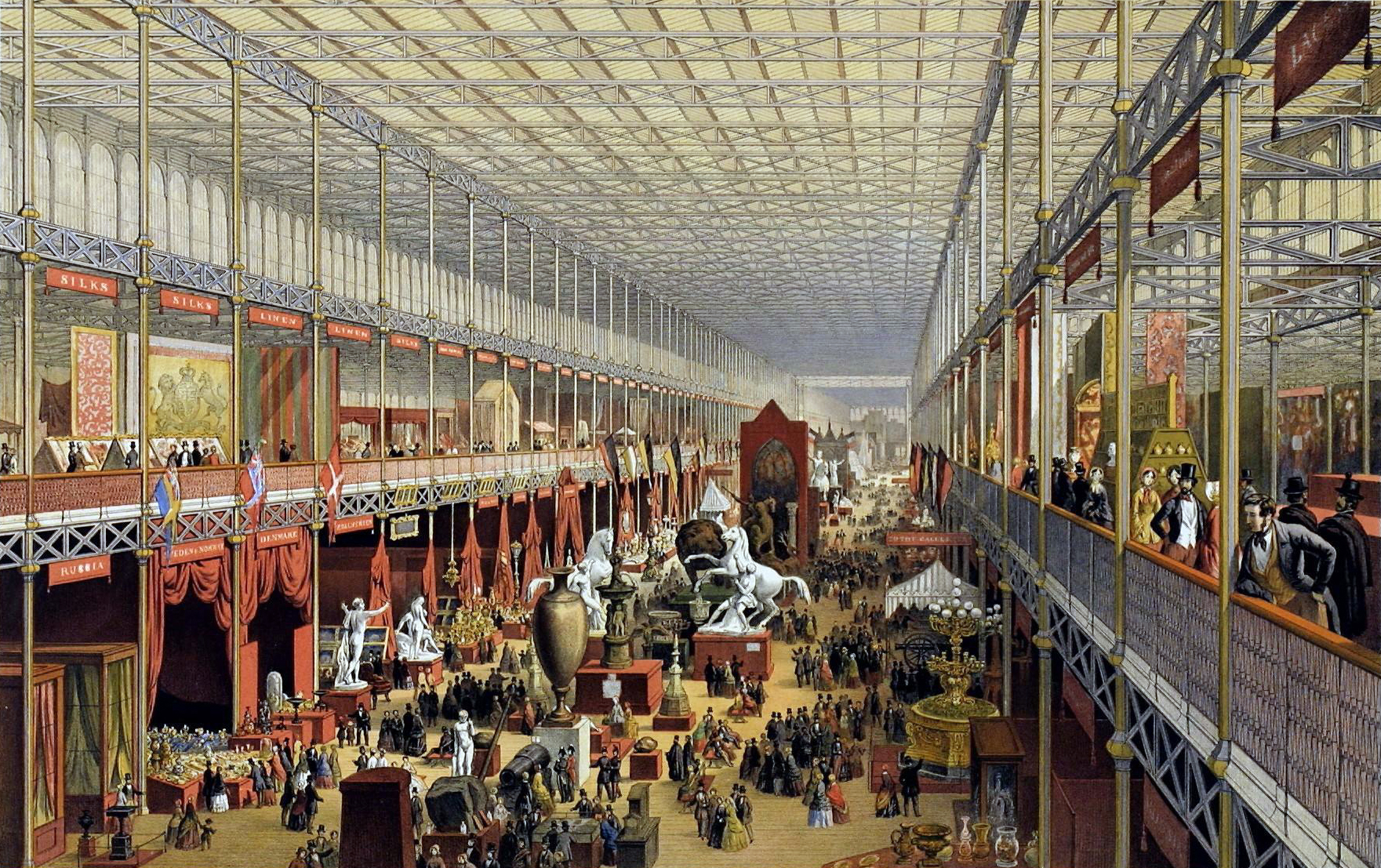
Crystal Palace – interior.jpg — Public domain
The Dinosaurs of 1854
The dinosaurs of Crystal Palace London were unveiled in 1854, in the same year the palace opened at Sydenham, and they were the first dinosaur models ever made. The sculptor Benjamin Waterhouse Hawkins built them under the guidance of the scientist Richard Owen, who had coined the word dinosaur only twelve years earlier, and the models were based on the fossils known at the time. The Iguanodon stood upright on its hind legs, with a horn on its nose, and the Megalosaurus crouched beside the lakes, and the shapes differ from what science knows today, since the science of dinosaurs was still young. The models are Grade I listed, a recognition of their place in the history of science.
The models were a sensation, and the story of the dinner inside the Iguanodon has become part of their legend. On New Year’s Eve in 1853, Hawkins hosted a dinner for 21 guests inside the unfinished model, with the scientists and artists of the day eating by candlelight within the great beast. The dinner showed the excitement of Victorian London for the new science, and the models still carry that excitement, since they were built when no one had ever seen a dinosaur and every fossil was a mystery. Children love the dinosaurs today, and the models remain one of the most visited corners of Crystal Palace London.
The dinosaurs stand around the lakes of the park, among the trees and the reeds, and the walk to find them is part of the pleasure. The Iguanodon, the Megalosaurus, the marine reptiles and the other prehistoric animals are scattered through the lower park, and each model has its own place among the water and the woodland. The models have been restored in recent years, and their colours and details are closer now to the bright paintwork of 1854. The dinosaurs are the oldest surviving part of the palace grounds, and they outlived the palace itself by nearly a century.
Fire, War and Decline
The palace at Sydenham suffered its first fire in 1866, when the north wing burned, and the building was repaired and carried on, with new areas added and the exhibitions continuing. In the First World War the palace was used as a naval depot under the name HMS Victory VI, and the grounds became workshops and stores for the war effort. The palace survived the war, yet its fortunes faded, since the great exhibitions belonged to a different age and the building was costly to keep. The park remained, and the dinosaurs remained, yet the palace itself grew quieter with the years.
On the night of 30 November 1936, a fire broke out beneath the floor near the centre of the palace, and the flames spread swiftly through the iron and glass hall. Dozens of fire engines and hundreds of firefighters came to the hill, yet they could not save the building, and the glow of the fire could be seen from counties around London. Within a few hours the palace was gone, leaving only the stone terraces, the two water towers and the dinosaurs in the park, and the cause of the fire has never been firmly established. The loss was felt across the country, and the hilltop has stood without its palace ever since.
The two great water towers of the palace, designed by Isambard Kingdom Brunel, were demolished in the Second World War, since it was feared that they would help German bombers find London. The site of the palace became Crystal Palace Park, and the National Sports Centre opened on the grounds in 1964, with an athletics stadium that still serves the district. The terraces, the sphinxes and the dinosaurs are what remain of the age of the palace, and the district keeps the name as a reminder of the building that made it famous. Crystal Palace London is a place that remembers its lost palace in its streets, its park and its name.
The District After the Palace
After the fire, Crystal Palace London grew into a residential district, with the park at its centre and the Triangle as its high street. The football club Crystal Palace FC was founded at the palace in 1905, and the stadium in the park hosted the FA Cup final from 1895 to 1914, so sport has deep roots on the hill. The National Sports Centre brought athletes to the district, and the Bowl brought music, so the park kept its role as a place of public life. The district changed slowly, and its Victorian streets survived, since the hill was never rebuilt as a modern centre.
In recent decades the Triangle has grown as a centre for independent shops, cafes and artists, and the district has become known as a creative corner of south London. The Crystal Palace Museum, run by local volunteers in the park, tells the story of the glass hall from 1851 to the fire of 1936, with models, photographs and maps. The museum is small, yet it holds the memory of the palace, and visitors who go there first see the park with different eyes. Crystal Palace London has kept its village character, and the hilltop remains a place apart from the rush of the city below.
The transmitter on the hill is part of the modern story, since the Crystal Palace transmitting station was built in 1956 on the site of the old aquarium in the park. The mast rises about 219 metres, and it carries television and radio across London, so the hill that once held a palace of glass now holds a tower of steel. The mast can be seen from many parts of the city, and it has become the landmark of south London, a slender tower above the trees. The palace is gone, yet the hill still sends its signal across London.

Car Park, National Sports Centre, Crystal Palace – geograph.org.uk – 1929013 — CC BY-SA 2

Crystal Palace Transmitter – geograph.org.uk – 1935649.jpg — CC BY-SA 2
Travel to Crystal Palace London
Getting There and Around
The easiest way to reach Crystal Palace London is by train to Crystal Palace station, with services to London Bridge and Victoria taking about half an hour. The station stands a short walk from the park and the Triangle, and the walk climbs gently to the hilltop, so comfortable shoes help. Buses link the hill to Dulwich, Brixton, Croydon and central London, and the bus stops around the Triangle put visitors close to the shops and cafes. The district is small, and once there most visitors explore on foot, since the park, the Triangle and the station all lie within a short walk of each other.
The park is free and open through the year, and the dinosaurs, the terraces and the lakes can be visited without a ticket. The Crystal Palace Museum is run by volunteers, so check its opening times before travelling, since the hours change with the season and the rota of volunteers. The Triangle is best explored slowly, with time for coffee, lunch and browsing, and the weekend market adds life to the streets. A visit to Crystal Palace London suits a half day, with the morning in the park and the afternoon in the Triangle.
Spring and summer are the best seasons for Crystal Palace London, when the park is green, the lakes are bright and the Bowl holds open-air concerts. Autumn brings colour to the woodland and quieter paths, and winter can be cold and damp, yet the Triangle with its warm cafes remains inviting. The dinosaurs look their best in low sunlight, and the view from the terraces is clearest after rain, when the air is washed and the skyline stands sharp. Whatever the season, the hilltop rewards those who climb it.

Crystal Palace railway station, Greater London – geograph.org.uk – 3761097.jpg — CC BY-SA 2
What to See First
Start a visit to Crystal Palace London at the terraces, where the palace once stood, and look down over the park to understand the scale of the lost building. The stone sphinxes guard the steps, and the broad terraces lead down to the lawns and the lakes, so the walk from the top to the water follows the path that Victorian visitors took. From the terraces, walk down to the lakes and find the dinosaurs among the trees, starting with the Iguanodon and the Megalosaurus. The walk is gentle, and the lakeside paths are flat, so the park suits visitors of all ages.
After the park, walk to the Triangle for lunch or coffee, and browse the independent shops along Westow Street, Westow Hill and Church Road. The Crystal Palace Museum sits in the park, and a short visit there before the walk helps to make sense of the terraces, the sphinxes and the dinosaurs. The transmitting station can be seen from the park and the Triangle, and it is best photographed in the evening, when it is lit. A half day gives time for the park, the museum and the Triangle, and a full day allows a slower walk through the streets of the hill.
Visitors should remember that the Triangle is a living neighbourhood, and the park is used daily by the people who live on the hill. The dinosaurs are the most popular sight, and they draw families at weekends, so an early visit gives quieter paths and better photographs. The park has open lawns for picnics, and the Triangle has food for every taste, so a visit can be as simple as a walk and a lunch. Crystal Palace London is a place to wander rather than to rush, and its pleasures are the view, the park and the streets.

Carberry Road off Westow Street, Crystal Palace ‘triangle’, south London – geograph.org.uk – 6376870 — CC BY-SA 2

Crystal Palace terraces – geograph.org.uk – 2474990.jpg — CC BY-SA 2

Sphinx, Crystal Palace Park – geograph.org.uk – 4332703.jpg — CC BY-SA 2
Notable Places in Crystal Palace London
- Crystal Palace Park — A Victorian park of about 80 hectares on the grounds of the lost palace, Grade II* registered, with lakes, woodland and the great Italian terraces.
- The Crystal Palace Dinosaurs — The first dinosaur models in the world, made by Benjamin Waterhouse Hawkins in 1854, Grade I listed, standing around the lakes of the park.
- The Italian Terraces and Sphinxes — The stone terraces and sphinx statues that survive from the glass palace, leading down from the crest of the hill to the lakes.
- The Crystal Palace Transmitting Station — The television mast built in 1956, about 219 metres tall, a landmark of south London visible from many parts of the city.
- The Crystal Palace Museum — A small museum in the park, run by local volunteers, telling the story of the glass palace from 1851 to the fire of 1936.
- The National Sports Centre — The sports centre opened in 1964, with an athletics stadium on the grounds of the old palace.
- The Crystal Palace Bowl — A natural amphitheatre in the park, used for open-air concerts and festivals in summer.
- The Triangle — The commercial heart of the district, where Westow Street, Westow Hill and Church Road meet, with cafes, restaurants and independent shops.

Crystal Palace Museum – geograph.org.uk – 4356680.jpg — Stephen Craven, CC BY-SA 2
Frequently Asked Questions About Crystal Palace London
Where is Crystal Palace London?
Crystal Palace London is a residential district in south London, on Sydenham Hill, spread across the boroughs of Bromley, Croydon, Lambeth, Lewisham and Southwark. Crystal Palace station has trains to London Bridge and Victoria, and the centre of the district is the Triangle, where Westow Street, Westow Hill and Church Road meet.
Does the Crystal Palace building still exist?
No, the glass palace burned down on the night of 30 November 1936 and was never rebuilt. Visitors to Crystal Palace London can still see what remains of the palace in Crystal Palace Park, including the stone terraces, the sphinx statues and the dinosaur models from 1854.
What is special about the dinosaurs in Crystal Palace London?
The dinosaurs in Crystal Palace Park were the first dinosaur models in the world, made by Benjamin Waterhouse Hawkins under the guidance of Richard Owen and unveiled in 1854. They are Grade I listed, and their shapes differ from modern knowledge, since they were built when the science of dinosaurs was still very young.
How tall is the Crystal Palace transmitting station?
The Crystal Palace transmitting station was built in 1956, and its mast rises about 219 metres, making it one of the tallest structures in London. The mast can be seen from many parts of the city, yet visitors cannot climb it.
Is Crystal Palace London a UNESCO World Heritage Site?
No, Crystal Palace London is not a UNESCO World Heritage Site, and no part of the district holds that status. The park is registered Grade II* and the dinosaur models are Grade I listed, which are national protections rather than World Heritage inscription.
How much time should I spend in Crystal Palace London?
Half a day to a full day suits Crystal Palace London, with the morning in the park among the dinosaurs and the terraces, and the afternoon in the Triangle. Visitors who love history should stop at the Crystal Palace Museum before walking through the park.
Verified
The building of the glass palace for the Great Exhibition of 1851, the design by Joseph Paxton, the naming by Punch, the move to Sydenham Hill and the opening in June 1854, the unveiling of the Hawkins dinosaur models in 1854, the dinner for 21 guests inside the unfinished Iguanodon on New Year’s Eve in 1853, the partial fire of 1866, the use of the palace as a naval depot in the First World War, the fire on the night of 30 November 1936, the demolition of the Brunel water towers in the Second World War, the opening of the National Sports Centre in 1964, the FA Cup finals at the palace ground from 1895 to 1914, the founding of Crystal Palace FC in 1905, the building of the transmitting station in 1956 and its height of about 219 metres, the hill height of about 112 metres, the park area of about 80 hectares and its Grade II* registration, the Grade I listing of the dinosaurs, the opening of Crystal Palace station in 1854 and the five boroughs of the district were checked against the sources below. The absence of Crystal Palace London from the World Heritage List and the total of 35 World Heritage properties in the United Kingdom were verified on the UNESCO website on 22 November 2026. The coordinates and the Wikidata identifier Q122909, with the type of a residential area in London, were verified through the Wikidata API on 22 November 2026. Verified 22 November 2026.
Sources
- Wikipedia, “Crystal Palace” (https://en.wikipedia.org/wiki/Crystal_Palace)
- Historic England, “Palace in Flames and London’s Gateway to the North” (https://historicengland.org.uk/campaigns/100-places/loss-destruction/palace-in-flames-and-londons-gateway-to-north/)
- UNESCO World Heritage Centre, United Kingdom of Great Britain and Northern Ireland (https://whc.unesco.org/en/statesparties/gb)
- Wikidata, Q122909 Crystal Palace (https://www.wikidata.org/wiki/Q122909), verified through the Wikidata API on 22 November 2026
- TheTerraAtlas keyword file batch-eu13-en-keywords.json, entry TA-L4-crystal-palace, focus keyword “crystal palace london”
Unverified
- Current opening hours of the Crystal Palace Museum — the museum is run by local volunteers, and its hours change with the season and the volunteer rota, so check before travelling.
- The exact area of Crystal Palace Park — the figure of about 80 hectares in this article is a commonly cited estimate, and the precise boundary should be checked with the park authority before publication as an exact figure.
- The exact number of dinosaur and prehistoric animal models in the park — the park holds many models, yet a count by species has not been verified on an official source.
- The exact height of the transmitting station — the figure of about 219 metres in this article is a commonly cited estimate, and the precise height should be checked with the operator before publication as an exact figure.
- Current concert dates at the Crystal Palace Bowl — open-air concerts follow a seasonal programme, so check the official listings before planning a visit.
Illustrations
- Hero: Crystal Palace General view from Water Temple. Free image: https://upload.wikimedia.org/wikipedia/commons/d/d8/Crystal_Palace_General_view_from_Water_Temple.jpg — Public domain.
- In body, Sydenham Hill and the View: Sydenham Hill Woods Tunnel on the Long Defunct Crystal Palace and South London Junction Railway. Free image: https://upload.wikimedia.org/wikipedia/commons/6/67/Sydenham_Hill_Woods_Tunnel_on_the_Long_Defunct_Crystal_Palace_and_South_London_Junction_Railway.jpg — CC BY 2.
- In body, Crystal Palace Park: Car Park, National Sports Centre, Crystal Palace – geograph.org.uk – 1929013. Free image: https://upload.wikimedia.org/wikipedia/commons/5/50/Car_Park%2C_National_Sports_Centre%2C_Crystal_Palace_-geograph.org.uk-_1929013.jpg — CC BY-SA 2.
-
In body, The Triangle and the Streets: Carberry Road off Westow Street, Crystal Palace ‘triangle’, south London – geograph.org.uk – 6376870. Free image: https://upload.wikimedia.org/wikipedia/commons/e/ed/Carberry_Road_off_Westow_Street%2C_Crystal_Palace_%E2%80%98triangle%E2%80%99%2C_south_London_-geograph.org.uk-_6376870.jpg — CC BY-SA 2.
-
In body, The Crystal Palace Dinosaurs: Crystal Palace dinosaurs across the lake.jpg. Free image: https://upload.wikimedia.org/wikipedia/commons/6/66/Crystal_Palace_dinosaurs_across_the_lake.jpg — CC BY-SA 4.
- In body, The Lower Lake: Lower Lake, Crystal Palace Park – geograph.org.uk – 3853072.jpg. Free image: https://upload.wikimedia.org/wikipedia/commons/8/89/Lower_Lake%2C_Crystal_Palace_Park_-geograph.org.uk-_3853072.jpg — CC BY-SA 2.
- In body, The Great Exhibition: Crystal Palace – interior.jpg. Free image: https://upload.wikimedia.org/wikipedia/commons/d/d9/Crystal_Palace_-_interior.jpg — Public domain.
- In body, The Crystal Palace Transmitting Station: Crystal Palace Transmitter – geograph.org.uk – 1935649.jpg. Free image: https://upload.wikimedia.org/wikipedia/commons/a/a8/Crystal_Palace_Transmitter_-geograph.org.uk-_1935649.jpg — CC BY-SA 2.
- In body, Crystal Palace Station: Crystal Palace railway station, Greater London – geograph.org.uk – 3761097.jpg. Free image: https://upload.wikimedia.org/wikipedia/commons/9/9e/Crystal_Palace_railway_station%2C_Greater_London_-geograph.org.uk-_3761097.jpg — CC BY-SA 2.
- In body, The Italian Terraces: Crystal Palace terraces – geograph.org.uk – 2474990.jpg. Free image: https://upload.wikimedia.org/wikipedia/commons/7/79/Crystal_Palace_terraces_-geograph.org.uk-_2474990.jpg — CC BY-SA 2.
- In body, The Sphinxes: Sphinx, Crystal Palace Park – geograph.org.uk – 4332703.jpg. Free image: https://upload.wikimedia.org/wikipedia/commons/a/a8/Sphinx%2C_Crystal_Palace_Park_-geograph.org.uk-_4332703.jpg — CC BY-SA 2.
- In body, The Crystal Palace Museum: Crystal Palace Museum – geograph.org.uk – 4356680.jpg. Free image: https://upload.wikimedia.org/wikipedia/commons/5/53/Crystal_Palace_Museum_-geograph.org.uk-_4356680.jpg — Stephen Craven, CC BY-SA 2.