
Holyrood Palace Edinburgh: The Monarch’s Residence at the Foot of the Royal Mile
Holyrood Palace Edinburgh is the monarch’s official home in Scotland. It stands at the foot of the Royal Mile, below Arthur’s Seat.
Quick Facts about Holyrood Palace Edinburgh
- Location: Eastern end of the Royal Mile, Canongate, Edinburgh, Scotland, United Kingdom, opposite Edinburgh Castle at the western end
- Coordinates: 55.9527° N, 3.17229° W
- Wikidata: Q505950 (Holyrood Palace, instance of official residence and palace)
- What it is: A royal palace and the official residence of the monarch in Scotland
- Origins: Augustinian abbey founded by King David I in 1128; palace built 1501–1505, rebuilt 1671–1679
- Architect: Sir William Bruce, for the rebuilding under Charles II, in the classical style of Scotland
- Managed by: Royal Collection Trust, which runs public visits
- Famous residents: Mary, Queen of Scots, 1561–1567; Bonnie Prince Charlie held court there in 1745
- UNESCO: Part of the Old and New Towns of Edinburgh, inscribed in 1995 as reference 728, under criteria (ii) and (iv)
- Visit: Open to the public except when the monarch is in residence during Holyrood Week; check the official Royal Collection Trust site for dates and tickets before visiting
Geography of Holyrood Palace Edinburgh
The eastern end of the Royal Mile
Holyrood Palace Edinburgh stands at the eastern end of the Royal Mile, the main street of the Old Town, which runs from Edinburgh Castle on its volcanic rock in the west down to the palace in the east. The position was chosen with purpose: the palace sits below Arthur’s Seat, beside the broad green space of Holyrood Park, and at the eastern gateway of the city, where royal processions and foreign embassies entered Edinburgh. The street between the castle and the palace is about 1.6 kilometres long, and it falls gently downhill from west to east, so a walk from the castle to Holyrood Palace Edinburgh is a walk through the whole history of the Old Town in a single straight line.
The Old Town grew along a high ridge, and its form reflects the burgage plots of the Canongate, founded as an abbatial burgh dependent on the Abbey of Holyrood. Narrow lanes and closes run off the spine of the High Street, and the tall tenement buildings that line them were among the tallest houses of their age. UNESCO describes the Old Town as a medieval fishbone pattern of closes, wynds and courts, and Holyrood Palace Edinburgh anchors its eastern end. The contrast with the New Town to the north, planned between 1767 and 1890 in neat classical terraces, is the reason the whole area was inscribed as a World Heritage property: two entirely different ideas of a city, joined across a valley.
The palace forecourt opens onto the Canongate, and across the road stands the modern Scottish Parliament building, a deliberate contrast between 17th-century classical architecture and 21st-century design. The juxtaposition surprises first-time visitors, because the two buildings could hardly look more different, yet they share the same small patch of ground at the foot of the Royal Mile. That meeting of old and new is characteristic of Edinburgh: the city layers its centuries on top of one another rather than clearing them away.
Gardens, park and the mountain behind
The grounds of Holyrood Palace Edinburgh include formal gardens of about four hectares, with lawns, flower beds and old trees enclosed by walls. The gardens host the royal garden parties of Holyrood Week, when the monarch welcomes thousands of guests from across Scotland. To the north of the palace stand the ruins of Holyrood Abbey, with high stone walls and Gothic windows that give the whole site a romantic and sombre air. The abbey roof collapsed in 1768, and the building has stood as a roofless ruin ever since, which only adds to its atmosphere.
Behind the palace rises Holyrood Park, a royal park of about 260 hectares, dominated by Arthur’s Seat, a hill of 251 metres that is the highest point in Edinburgh and its most popular climb. The park is a wild, open landscape of crags, lochs and grassland, and it begins almost at the palace gates, so a visitor can step from a royal residence into open hill country in a few minutes. The contrast is one of the great pleasures of Holyrood Palace Edinburgh: a palace, an abbey ruin, a formal garden and a mountain, all within a short walk of one another.
Edinburgh has a mild oceanic climate, with cool summers and cold but not severe winters, and rain falls in every month of the year. Average temperatures are around 15 degrees Celsius in July and 4 degrees in January, and the best months to visit are May to September, when the gardens are in flower and the palace is open daily. In winter the palace usually closes on Tuesdays and Wednesdays outside the summer season, so visitors should check the calendar before travelling. The light in Edinburgh is famously changeable, and a sunny morning can turn to rain by afternoon, which is why the city’s weather is a constant topic of conversation among its residents.
The Canongate and the city around the palace
The Canongate, the quarter around Holyrood Palace Edinburgh, was once a separate burgh with its own Tolbooth and its own character, and it still feels distinct from the High Street above it. Its buildings include merchants’ houses from the 16th and 17th centuries, the Canongate Kirk, and the Tolbooth that once served as the burgh’s court and prison. Walking the Canongate gives a sense of the Edinburgh that existed before the New Town was built: narrow, tall, stone-built and crowded, with the palace at its lower end as the reason the quarter existed at all.
Public transport serves the palace well. Buses stop on the Canongate close by, and the nearest tram stop is in the Waverley area, a walk of about fifteen minutes uphill.
Most visitors arrive on foot, walking down the Royal Mile from the castle, which is the best way to understand the geography of the Old Town. The walk is downhill all the way, and it passes St Giles’ Cathedral, the museum quarter and dozens of closes that invite detours. By the time the palace comes into view at the bottom of the hill, the visitor has already seen the city that the palace was built to rule.
Views, weather and the skyline
The skyline of Edinburgh is one of the reasons the city was inscribed by UNESCO, and Holyrood Palace Edinburgh sits at the heart of the most famous view in the city. From Calton Hill, the castle and the palace frame the Old Town ridge, and from Arthur’s Seat the whole city spreads out below, with the palace and the Parliament building at the foot of the hill. The City of Edinburgh Council protects these views with a skyline policy, which controls tall buildings that might harm the silhouette of the city. The policy means that the outline of the castle rock, the palace and Arthur’s Seat has stayed recognisable for generations, and it is one of the reasons the city photographs so well.
Edinburgh’s weather shapes every visit to Holyrood Palace Edinburgh, because the city sits on a windy coast and its light changes by the hour. A clear morning can give way to driving rain, and then to sunshine again before lunch, which is why local people dress in layers and carry a waterproof jacket in every season. The palace gardens look their best in late spring, when the flower beds are in full colour, and the abbey ruins look their most dramatic under a grey sky, when the stone turns dark and the Gothic windows stand out against the clouds. Visitors who accept the weather rather than fighting it will enjoy the palace far more than those who wait for a perfect day.

The Palace of Holyroodhouse seen from Salisbury Crags shows its roofs above Holyrood Park in Edinburgh — CC BY-SA 3
History of Holyrood Palace Edinburgh
The abbey of David I and the holy rood
Holyrood Abbey was founded in 1128 by King David I of Scotland as an Augustinian monastery, and the name Holyrood means holy cross, from the old English word rood for a cross. Legend says that David was hunting in the forest when a stag attacked him, and as he prayed, a cross appeared between the stag’s antlers and the animal stopped. In thanks, David founded the abbey on that very spot and gave it the name Holyrood. Whether or not the story is true, it explains the name, and the cross became the emblem of the place for the eight centuries that followed.
The abbey grew into one of the most important religious houses in Scotland, and the Canongate grew up around it as a burgh dependent on the abbey’s protection. Kings of Scotland were buried in the abbey church, including James II in 1460, and Charles I was crowned King of Scotland there in 1633. The abbey’s position at the foot of the Royal Mile made it the natural place for a royal residence, because the king could stay beside the church and at the edge of the city at the same time. The palace that grew beside the abbey inherited both its name and its prestige.
Mary, Queen of Scots, and the murder of Rizzio
The palace of Holyrood Palace Edinburgh as it began took shape under James IV, who built a new palace beside the abbey in 1501–1505, and under James V, who added a tower in 1528–1532. That tower, at the north-west corner of the palace, became the home of Mary, Queen of Scots, when she returned to Scotland from France in 1561 after the death of her first husband, Francis II of France. Mary lived at Holyrood Palace Edinburgh for six troubled years, from 1561 to 1567, and her rooms on the second floor of the tower survive today, with her bedchamber, her audience chamber and her small oratory.
On the night of 9 March 1566, a group of Scottish nobles, with the complicity of Mary’s husband Lord Darnley, burst into her private supper room and murdered David Rizzio, her Italian secretary, before her eyes. The murder is one of the most famous crimes in Scottish history, and guides still point out a stain on the wooden floor said to be Rizzio’s blood, although historians regard that detail as legend rather than fact. The killing broke the trust between Mary and Darnley beyond repair, and within a year Darnley himself was murdered, Mary married the Earl of Bothwell, who was suspected of the murder, and she was overthrown and forced to flee to England.
Mary was held prisoner in England for nineteen years before her execution in 1587, and her story has made Holyrood Palace Edinburgh one of the most visited places in Scotland. Her rooms are the emotional centre of any visit, because they are small, plain and personal in a building otherwise full of ceremony. Standing in her bedchamber, a visitor can imagine the young queen who returned from France at eighteen, ruled a divided kingdom for six years, and lost everything in a series of betrayals that began in the room next door.
Rebuilding under Charles II
After Mary’s fall, Holyrood Palace Edinburgh was neglected, and it suffered badly during the civil wars and the Commonwealth. In 1650, Oliver Cromwell’s army occupied Edinburgh and quartered soldiers in the palace, and a fire damaged much of the building. When the monarchy was restored, Charles II ordered the palace to be rebuilt almost entirely in 1671–1679, to the design of the architect Sir William Bruce, who is regarded as the father of classical architecture in Scotland.
The new palace was built as a quadrangle, with a courtyard, four towers at the corners and a classical Baroque facade. Its largest room, the Great Gallery, is 45 metres long and is hung with 89 portraits of Scottish kings painted by Jacob de Wet, and it was used for royal ceremonies and balls. The rebuilding under Charles II is one of the most important buildings of 17th-century Scotland, and most of what visitors see today dates from that campaign. The palace that Bruce built was a statement: the monarchy had returned, and it intended to be seen in a residence worthy of a European court.
Bonnie Prince Charlie and the road to the present
In 1745, during the last Jacobite rising, Bonnie Prince Charlie, who claimed the thrones of Scotland and England, took Edinburgh and held court at Holyrood Palace Edinburgh for five weeks. He held balls and receptions in the Great Gallery, and Jacobite supporters came to swear loyalty to him. After the defeat at Culloden in 1746, Charles fled, and the palace was neglected again for decades, used only occasionally by members of the royal family.
In 1822, George IV visited Scotland, the first visit by a British monarch to Scotland in almost two centuries, and stayed at Holyrood Palace Edinburgh in a ceremony organised with great care by the writer Walter Scott. The visit revived interest in Scottish culture, with kilts, tartan and Highland traditions celebrated as never before, and the palace once more became the centre of royal life in Scotland. Queen Victoria and Prince Albert visited often in the 19th century, and Victoria had many rooms in the palace redecorated.
Today, Holyrood Palace Edinburgh is the monarch’s official residence in Scotland, and the monarch stays there each year during Holyrood Week, in late June and early July, for a week of ceremonies, investitures and garden parties. The King’s Gallery, opened in 2002 for the Golden Jubilee of Queen Elizabeth II, shows exhibitions from the Royal Collection. The palace is managed by the Royal Collection Trust, and it is open to the public for most of the year, except when the monarch is in residence or when a royal event closes it.
Timeline
- 1128: King David I founds Holyrood Abbey for Augustinian canons
- 1460: King James II is buried in Holyrood Abbey
- 1501–1505: King James IV builds a new palace beside the abbey
- 1528–1532: King James V adds the north-west tower, later Mary’s home
- 1561: Mary, Queen of Scots, returns from France and lives at Holyrood Palace Edinburgh
- 9 March 1566: David Rizzio is murdered in Mary’s rooms
- 1567: Lord Darnley is murdered; Mary is overthrown and flees to England
- 1633: Charles I is crowned King of Scotland in Holyrood Abbey
- 1650: Cromwell’s army occupies the palace and a fire damages it
- 1671–1679: Charles II rebuilds the palace to the design of Sir William Bruce
- 1745: Bonnie Prince Charlie holds court at Holyrood Palace Edinburgh for five weeks
- 1768: The roof of Holyrood Abbey collapses, and the abbey becomes a ruin
- 1822: George IV visits Scotland and stays at Holyrood Palace Edinburgh
- 2002: The King’s Gallery opens for the Golden Jubilee of Queen Elizabeth II
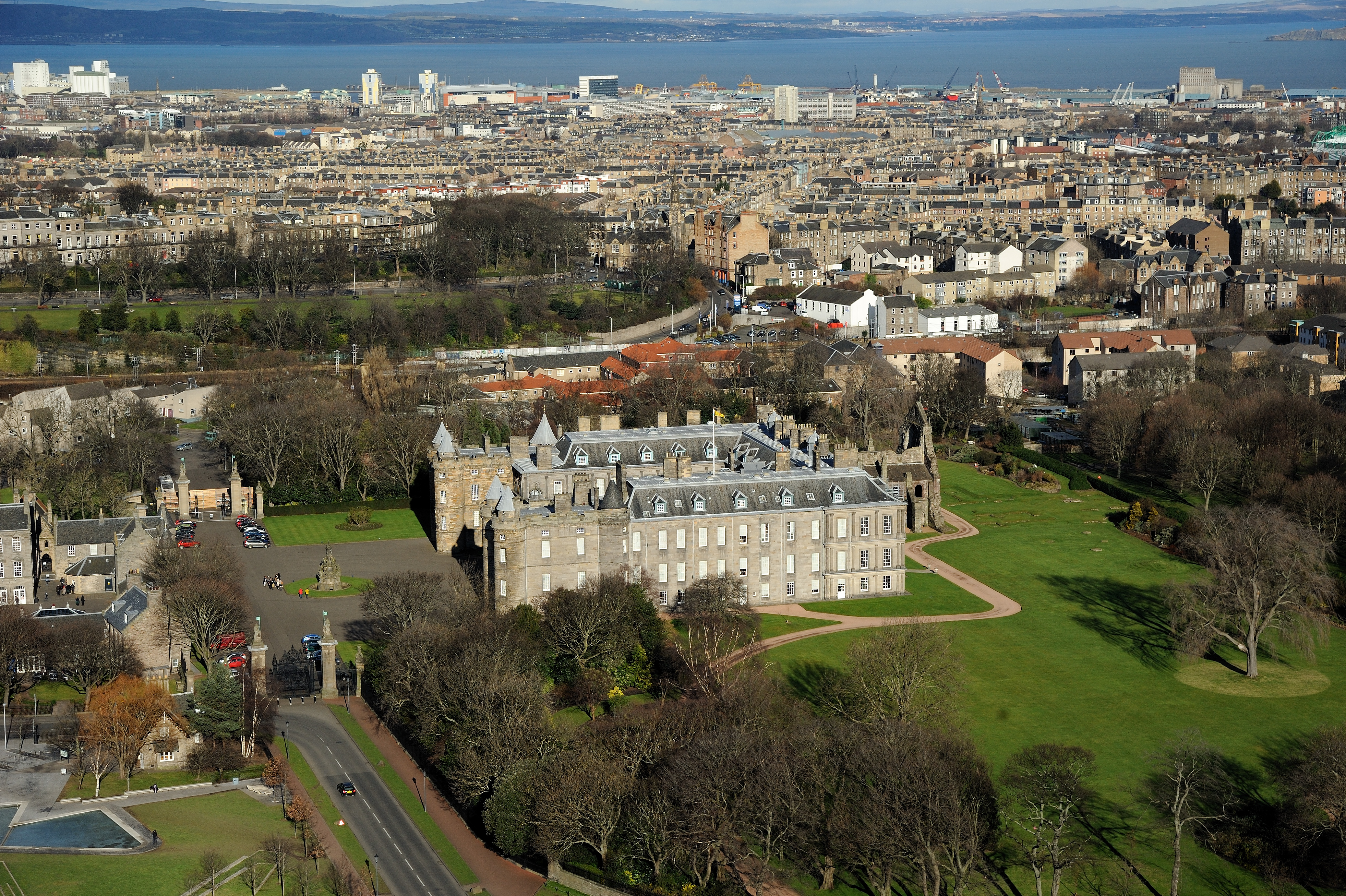
The Palace of Holyroodhouse and Holyrood Abbey stand below the Salisbury Crags in Edinburgh — CC BY 3
Travel to Holyrood Palace Edinburgh
When to go
The best months to visit Holyrood Palace Edinburgh are May to September, when the palace is open daily, the gardens are in flower and the Edinburgh weather is at its kindest. Summer is also the season of the Edinburgh Festival in August, when the city is at its liveliest and also at its busiest, and accommodation is hardest to find. May, June and September are the most balanced months: sunny days, less rain, the sights not yet crowded, and the city easier to enjoy. In winter, the palace usually closes on Tuesdays and Wednesdays outside the summer season, so check the calendar on the official site of the Royal Collection Trust before travelling.
How long to allow
Holyrood Palace Edinburgh needs about two to three hours for a full visit, covering the State Apartments, Mary’s rooms, the abbey ruins and the gardens. Morning is a good time to arrive, and booking tickets in advance secures a timed entry slot. A free multimedia guide is included with admission, and it tells the stories of the palace and of the people who lived there, which makes the visit far richer than a silent walk through the rooms. The palace is the ideal end of a day walking down the Royal Mile, from Edinburgh Castle in the morning to Holyrood Palace Edinburgh in the afternoon, and it can be combined with a climb of Arthur’s Seat behind the palace.
Getting there and eating nearby
The palace stands at the eastern end of the Royal Mile, about 1.6 kilometres on foot from Edinburgh Castle, a gentle downhill walk through the Old Town. Walking is the best way to arrive, because the route passes St Giles’ Cathedral, the museums and the closes of the Old Town.
Public buses stop on the Canongate close to the palace, and the nearest tram stop is in the Waverley area. The Canongate and the Royal Mile hold many cafes, pubs and restaurants, from quick soup and sandwiches to full Scottish meals, and the streets around the palace are a good place for lunch after the visit. Look for Scottish dishes such as haggis, Cullen skink and cranachan, and for the small cafes in the closes that serve coffee and cakes away from the main crowds.
Notable Places in Holyrood Palace Edinburgh
- The State Apartments — Splendid rooms used for royal ceremonies, with furniture, paintings and tapestries from the Royal Collection.
- Mary’s bedchamber — The bedchamber on the second floor of the James V tower, where Mary, Queen of Scots, lived from 1561 to 1567, with her oratory and the supper room where Rizzio was murdered.
- The Great Gallery — The largest room in the palace, 45 metres long, hung with 89 portraits of Scottish kings by Jacob de Wet, where Bonnie Prince Charlie held balls in 1745.
- The Throne Room — The room used for official ceremonies during Holyrood Week, with the thrones and royal emblems.
- The ruins of Holyrood Abbey — The remains of the Augustinian abbey founded in 1128, with high stone walls and Gothic windows, where many Scottish kings were buried.
- The King’s Gallery — An art gallery of the Royal Collection, opened in 2002, with exhibitions that change through the year.
- The palace gardens — Formal gardens of about four hectares, where the royal garden parties of Holyrood Week are held.
- Holyrood Park and Arthur’s Seat — A royal park of about 260 hectares behind the palace, with Arthur’s Seat at 251 metres, the most popular hill walk in Edinburgh.
- The Scottish Parliament building — A modern building standing directly opposite the palace, a striking contrast between 17th-century and 21st-century architecture.
- Canongate Kirk — The parish church of the Canongate, where many figures of Scottish history are buried, standing on the Royal Mile near the palace.
Frequently Asked Questions about Holyrood Palace Edinburgh
Where is Holyrood Palace Edinburgh and what is it?
Holyrood Palace Edinburgh stands at the eastern end of the Royal Mile, in the Canongate quarter of Edinburgh, opposite Edinburgh Castle at the western end. It is the official residence of the monarch in Scotland, and it began as an Augustinian abbey founded in 1128 before becoming a royal palace in the 16th century. The palace lies inside the Old and New Towns of Edinburgh, inscribed by UNESCO in 1995 as reference 728.
What connects Mary, Queen of Scots, with Holyrood Palace Edinburgh?
Mary lived at Holyrood Palace Edinburgh from 1561 to 1567, after returning to Scotland from France, and her rooms on the second floor of the James V tower are preserved today. On the night of 9 March 1566, her secretary David Rizzio was murdered in her supper room, one of the most famous crimes in Scottish history. Her husband Lord Darnley was murdered in 1567, and Mary was overthrown and fled to England.
Is Holyrood Palace Edinburgh open to the public?
The palace is open to the public and is managed by the Royal Collection Trust, except when the monarch is in residence during Holyrood Week, usually in late June and early July, or when a royal event closes it. Outside the summer season, it usually closes on Tuesdays and Wednesdays, and the hours are shorter in winter. Check the calendar on the official site of the Royal Collection Trust before visiting, and book tickets in advance.
How much time should I allow for Holyrood Palace Edinburgh?
Allow about two to three hours for a full visit, including the State Apartments, Mary’s rooms, the abbey ruins and the gardens. Holyrood Palace Edinburgh is the ideal end of a day walking down the Royal Mile, from Edinburgh Castle in the morning to the palace in the afternoon. A climb of Arthur’s Seat behind the palace can be added for visitors with more time and energy.
Do I need a visa to visit Holyrood Palace Edinburgh?
The United Kingdom is not part of the Schengen Area, so the rules for Scotland are separate from those for France, Italy or Spain. Citizens of the European Union and many other countries enter the United Kingdom without a visa for short visits, but a passport is required even for European Union citizens. Some nationalities need an Electronic Travel Authorisation or a visa, so check the current rules on the official United Kingdom government site before travelling.
Is Holyrood Palace Edinburgh itself a UNESCO World Heritage site?
Holyrood Palace Edinburgh is not a separate World Heritage site, but it stands inside the Old and New Towns of Edinburgh, inscribed by UNESCO in 1995 as reference 728, under criteria (ii) and (iv). UNESCO notes the contrast between the medieval Old Town, with Holyrood Palace Edinburgh at its eastern end, and the planned Georgian New Town, which together form an urban landscape without equal in Europe. The United Kingdom has 35 World Heritage sites in total.
Verified
Holyrood Palace Edinburgh stands at the eastern end of the Royal Mile in the Canongate quarter of Edinburgh, and the abbey was founded by King David I in 1128. James IV built a new palace beside the abbey in 1501–1505, and James V added the north-west tower in 1528–1532. Mary, Queen of Scots, lived at Holyrood Palace Edinburgh from 1561 to 1567, and David Rizzio was murdered in her rooms on 9 March 1566.
Charles II rebuilt the palace in 1671–1679 to the design of Sir William Bruce, and Bonnie Prince Charlie held court there for five weeks in 1745. The roof of Holyrood Abbey collapsed in 1768, George IV visited Scotland and stayed at the palace in 1822, and the King’s Gallery opened in 2002. The Old and New Towns of Edinburgh were inscribed by UNESCO in 1995 as reference 728, under criteria (ii) and (iv).
Wikidata Q505950 is labelled Holyrood Palace, with instance of official residence and palace, and coordinates 55.9527° N, 3.17229° W, matching the registry. The Royal Mile between the castle and the palace is about 1.6 kilometres long, and the New Town was built between 1767 and 1890. Verified 22 November 2026.
Sources
- UNESCO, Old and New Towns of Edinburgh, reference 728, criteria (ii) and (iv): https://whc.unesco.org/en/list/728/
- Royal Collection Trust, Palace of Holyroodhouse, official site: https://www.rct.uk/visit/palace-of-holyroodhouse
- Wikidata, Q505950 Holyrood Palace, instance of and coordinates, checked 22 November 2026: https://www.wikidata.org/wiki/Q505950
- TheTerraAtlas registry, entity TA-L4-holyrood-palace, coordinates and UNESCO status
- TheTerraAtlas Vietnamese article holyrood-palace.vi.md, facts and sources checked 18 November 2026
Unverified
- Ticket prices for Holyrood Palace Edinburgh, reported as 22 pounds when booked in advance and 26 pounds on the day in 2026, which were not checked directly on the Royal Collection Trust site and must be confirmed there before publication.
- Seasonal opening hours for the palace, reported as 9:30 to 18:00 in summer and 9:30 to 16:30 in winter, which must be checked on the official site before visiting.
- The area of the palace gardens (about four hectares), the area of Holyrood Park (about 260 hectares) and the height of Arthur’s Seat (251 metres), which are reference figures from travel sources and need confirmation from an official source.
- The length of the Great Gallery (45 metres) and the number of portraits of Scottish kings (89), which are reference figures from travel sources and need confirmation from the Royal Collection Trust.
- The stain on the floor said to be the blood of David Rizzio, which is a legend told to visitors and is not supported by historical evidence.
Illustrations
- Hero: Holyrood Palace Edinburgh. Free image: https://upload.wikimedia.org/wikipedia/commons/e/ed/Edinburgh_Holyrood_Palace-20110904-RM-130303.jpg — CC BY-SA 4.0.
- In body, palace: The Palace of Holyroodhouse and Holyrood Abbey stand below the Salisbury Crags in Edinburgh Free image: https://upload.wikimedia.org/wikipedia/commons/d/d3/Holyrood_Palace_and_Abbey.jpg — CC BY 3.
- In body, park: The Palace of Holyroodhouse seen from Salisbury Crags shows its roofs above Holyrood Park in Edinburgh Free image: https://upload.wikimedia.org/wikipedia/commons/e/e2/Edinburgh_Palace_of_Holyroodhouse_from_Salisbury_Crags_20211019.jpg — CC BY-SA 3.