
Glacier Express
The Glacier Express crosses Switzerland in eight slow hours, from Zermatt to St Moritz. Its panoramic windows frame 291 kilometres of Alps and high passes.
Quick Facts
| Item | Detail |
|---|---|
| Name | Glacier Express |
| Route | Zermatt to St Moritz, through Andermatt and Chur |
| Country | Switzerland |
| Coordinates | 46.595 degrees north, 9.76 degrees east |
| Length | 291 kilometres |
| Journey time | About 8 hours |
| First run | 25 June 1930 |
| Tunnels | 91 |
| Bridges and viaducts | 291 |
| Highest point | Oberalp Pass, 2,033 metres |
| Lowest point | Chur, 585 metres |
| Track gauge | 1,000 millimetres, narrow gauge |
| Operators | Matterhorn Gotthard Bahn and Rhaetian Railway |
| UNESCO | Albula and Bernina lines, 2008, reference 1276; the train itself is not listed |
| Wikidata | Q661561 |
The Glacier Express is often called the slowest express train in the world, and the name is a point of pride rather than a complaint. The train averages about 36 kilometres per hour because the route climbs two high passes, threads 91 tunnels and crosses 291 bridges and viaducts between the Valais and the Engadin. Every seat faces a panoramic window that runs up into the roof, so the mountains, glaciers and villages pass like a slow film. The journey needs no commentary to hold attention, although the train provides one in several languages.
The service links two of the most famous mountain resorts in Switzerland, the car-free village of Zermatt below the Matterhorn and the grand resort of St Moritz on the Engadin plateau. A branch at Filisur also serves Davos, the third resort on the network, and the full route passes through three cantons and three language regions. The Glacier Express runs every day of the year except for an autumn maintenance break, and every traveller must reserve a seat in advance. The train is a journey in itself rather than a way of getting somewhere quickly, and that distinction shapes everything about it.
Geography of Glacier Express
Three cantons and two watersheds
The Glacier Express begins in Zermatt, a car-free resort in the canton of Valais at the foot of the Matterhorn, and ends in St Moritz, a grand resort in the canton of Graubünden. Between them the line crosses the canton of Uri, so the eight-hour journey passes through three cantons and three language regions. German is spoken in Valais and Uri, while Romansh joins German in Graubünden, and the change shows in station names, menus and village architecture along the way.
The land itself is a summary of the Swiss Alps. From Zermatt the line follows the deep, narrow valley of the Rhone river to Brig, then climbs over the Furka Pass and the Oberalp Pass, both above 2,000 metres, before dropping into the Rhine valley at Chur. From Chur the train climbs again onto the Engadin plateau at about 1,800 metres for the final run to St Moritz, and the whole route reads like a cross-section of the mountain range.
The highest point of the journey is the Oberalp Pass at 2,033 metres, where a short tunnel passes under the summit and marks the watershed between the Rhine and the Rhone. The lowest point is Chur at 585 metres, the oldest city in Switzerland, where the train stops to change locomotives. Between those two extremes the line crosses from one great European river system to another and back again, which is part of why the scenery changes so completely in a single day.
The Rhine Gorge and the Engadin
West of Chur the line runs through the Rhine Gorge, known as the Ruinaulta, a deep canyon between Ilanz and Reichenau that is often called the Grand Canyon of Switzerland. White limestone cliffs rise above the young Rhine, and the train crosses the river several times on steel bridges before the valley opens out at Chur. The gorge is one of the wildest stretches of the whole route, and the panoramic windows matter most here, because the cliffs close in on both sides of the track.
East of Chur the character changes again. The Albula line climbs out of the Rhine valley through the Landwasser Viaduct and a series of spiral tunnels, then crosses the Albula Pass region toward the Engadin. The Engadin is a high valley at about 1,800 metres, with Romansh villages, pine forest and lakes, and the light there has a clarity that painters and photographers have chased for more than a century. St Moritz sits at the eastern end of the plateau, where the lakes freeze in winter and the resort season never quite ends.
Seasons along the line
The Glacier Express runs all year, and each season gives the same route a different face. Summer brings green meadows, wildflowers and glaciers glittering in the sun, while autumn turns the forests gold and red and thins the crowds. Winter covers everything in snow, and the panoramic windows let travellers watch the snow country pass without feeling the cold. Spring melts the snow into full waterfalls, and the rivers run high and fast beside the track.
June to September is the high season, with warm weather, long days and the fullest trains, so seats sell out early and reservations matter most. October brings autumn colour and fewer travellers, and December to March brings snow and the Christmas atmosphere of the mountain resorts. Travellers should check the timetable on the official Glacier Express website before booking, because the train does not run during an autumn maintenance break, when the line is serviced and local trains cover the route instead. The wider Swiss network connects at Chur and Brig, with onward trains to Lucerne and Interlaken, so the journey fits easily into a longer rail holiday.

the Oberalp Pass on the Glacier Express route — CC BY-SA 4

Zermatt below the Matterhorn — CC BY-SA 3
History of Glacier Express
An idea from 1930
The Glacier Express was born from a simple idea, to join the two most famous high mountain resorts in Switzerland, Zermatt and St Moritz, with a single tourist train. Before 1930 the journey needed several changes of train across different railway lines, and no unified service existed. On 25 June 1930 the first Glacier Express left Zermatt with three first and second class coaches, and it took about 11 hours to reach St Moritz, far slower than today, because the locomotives and the track were still primitive.
In its early decades the train served mainly wealthy travellers from Britain, America and continental Europe, who came to Switzerland for the mountain resorts. The service ran seasonally, mostly in summer, and stopped at many small stations so that passengers could step off and look around. After the Second World War the Glacier Express became a symbol of Swiss tourism, and passenger numbers grew quickly, especially from the 1960s, when international travel expanded.
The Albula line and World Heritage
The most celebrated stretch of the Glacier Express runs on the Albula line from Chur to St Moritz, built between 1898 and 1904 to connect the Graubünden capital with the resort. The 67 kilometre line has 42 tunnels and 144 viaducts and bridges, and it was a feat of early twentieth century engineering, because the builders had to lay track across sheer rock faces and deep valleys, with steep gradients and tight curves. The best known structure is the Landwasser Viaduct, 65 metres high and 136 metres long, built in 1901 and 1902 with six stone arches, and the train crosses it and dives straight into a tunnel through the cliff, one of the most photographed moments in Swiss rail travel.
In 2008 UNESCO inscribed the Rhaetian Railway in the Albula and Bernina Landscapes as a World Heritage property, reference 1276, under criteria (ii) and (iv), recognising the Albula and Bernina lines as outstanding examples of early twentieth century mountain railways, where engineering, architecture and landscape blend together. The Bernina line, 61 kilometres long and opened in 1910, links St Moritz with Tirano in Italy, and it shares the listing, although it is not part of the Glacier Express route. Only the Chur to St Moritz section of the Glacier Express runs on inscribed track, and the rest of the journey, beautiful as it is, lies outside the World Heritage property.
The distinction matters to travellers who come for the listing. The Albula section delivers the viaducts, spiral tunnels and stone architecture that UNESCO recognised, while the western half of the route delivers the high passes, the Rhine Gorge and the Matterhorn country. Both halves are worth the eight hours, and the train treats them as one continuous landscape rather than two separate attractions.
Modernisation and Excellence Class
Through the twentieth century and into the twenty-first, the Glacier Express was modernised again and again. Panoramic coaches with large windows arrived in the 1990s, replacing the older coaches with small windows, and the reservation system, catering and multilingual commentary all improved. The train now takes about eight hours from Zermatt to St Moritz, faster than the original eleven, thanks to modern locomotives and upgraded track, while the average speed stays low, at about 36 kilometres per hour.
In 2019 the Glacier Express launched Excellence Class, a premium class with only 20 seats per departure, wide leather seats, a private table, a five course menu, a bar and a dedicated concierge on board. Excellence Class is the most expensive way to ride the train, and seats sell out early in high season, because only 20 are available on each departure. First and second class coaches also have panoramic windows, so passengers in every class see the same landscape, and the difference lies in space, service and food rather than in the view.
Timeline
| Year | Event |
|---|---|
| 1898–1904 | Albula line built from Chur to St Moritz |
| 1901–1902 | Landwasser Viaduct built, 65 metres high, 136 metres long |
| 1910 | Bernina line opens, linking St Moritz with Tirano in Italy |
| 1930 | First Glacier Express departs Zermatt on 25 June |
| 1990s | Panoramic coaches with large windows enter service |
| 2008 | UNESCO inscribes the Rhaetian Railway in the Albula and Bernina Landscapes, reference 1276 |
| 2019 | Excellence Class launches with 20 seats per departure |

the Glacier Express in Switzerland — CC BY-SA 4

the Grand Canyon of Switzerland — CC BY-SA 4

the oldest city in Switzerland — CC BY-SA 4
Travel to Glacier Express
Booking and seats
The Glacier Express requires a seat reservation in addition to an ordinary train ticket, and seats sell out early in the high season from June to September and in the winter months from December to February. Travellers can book through the official Glacier Express website, and the earlier the booking, the better the choice of seats, especially for Excellence Class, which has only 20 seats per departure. Ordinary tickets can be single tickets, a Swiss Travel Pass or a Eurail pass, but every passenger must pay the reservation fee on top, and the fee is not refunded if the trip is cancelled.
Travellers should check fares and reservation fees on the official website before booking, because prices change with the season and the class of travel, and low season promotions sometimes appear. The train runs every day of the year except for an autumn maintenance break, when the track is serviced and the Glacier Express does not operate. During the break, local trains still connect Zermatt and St Moritz, but the journey needs several changes and has no panoramic coaches.
Eating on board and stopping along the way
The Glacier Express serves meals at the seat, with a seasonal menu of Swiss dishes such as soup, salad, beef, fish and pastries, along with local wine and beer. Passengers can order food in advance or on board, depending on the class of travel and availability, and the meal arrives at the seat with a folding table and a tablecloth. Excellence Class has its own five course menu with a bar and a dedicated concierge, while first and second class offer a simpler menu that is still full and well cooked.
The train stops at many stations along the route, and the longest stops are at Andermatt and Chur, where passengers can step off, walk around, take photographs and shop. Andermatt is a mountain village at 1,444 metres with the traditional architecture of the canton of Uri, and Chur is the oldest city in Switzerland, with an old town and many restaurants, where the train stops for about half an hour to change locomotives. Passengers can also step off at smaller stations such as Disentis, with its Benedictine abbey, or Filisur, from where a footpath leads to a viewpoint over the Landwasser Viaduct.

the village in the Ursern Valley — CC BY-SA 4
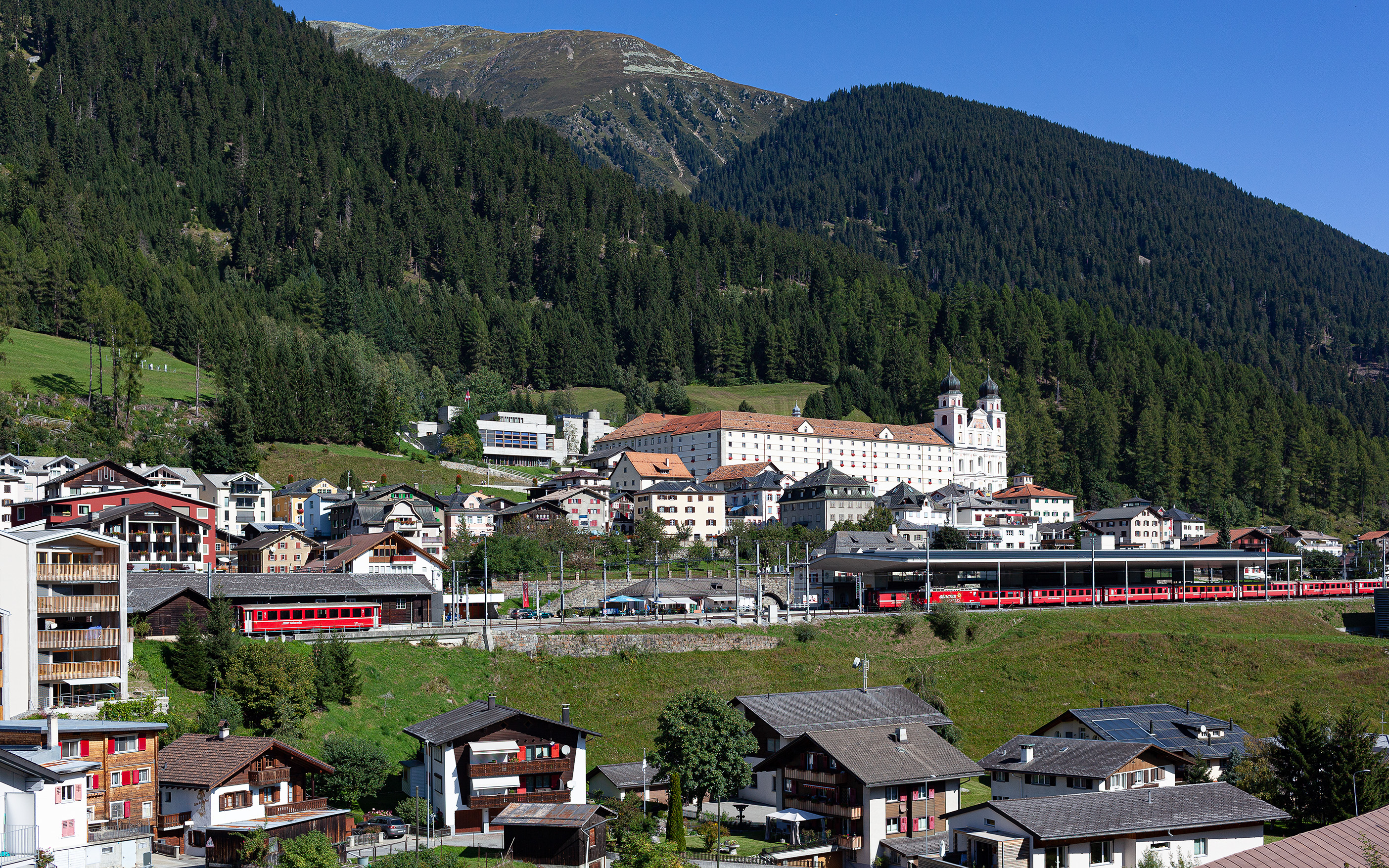
the abbey on the climb to the Oberalp Pass — CC BY-SA 4
Notable Places in Glacier Express
- Landwasser Viaduct — The stone viaduct on the Albula line is 65 metres high and 136 metres long, built in 1901 and 1902 with six arches, and the train crosses it before diving into a tunnel through the cliff face. The viewpoint on the footpath from Filisur is the best place to photograph the train on the viaduct, and the walk takes about 45 minutes from the station.
- Oberalp Pass — The highest point of the journey at 2,033 metres, where the train passes under the summit through a short tunnel and crosses the watershed between the Rhine and the Rhone. The pass is also the border between the cantons of Uri and Graubünden, and the small lake at the summit freezes hard in winter.
- Zermatt and the Matterhorn — The starting point of the Glacier Express is a car-free resort below the Matterhorn, the most famous mountain in the Alps, and the village itself is worth a day before boarding. Only trains, small electric vehicles and walking move people through the streets, and the air stays clean and quiet in a way few famous resorts can match.
- St Moritz — The destination of the Glacier Express is a grand resort on the Engadin plateau, famous for its lakes and winter sports, and the train arrives after the long climb from Chur. The resort hosted the Winter Olympics in 1928 and 1948, and its frozen lake carries horse races and polo in winter.
- Andermatt — A mountain village at 1,444 metres and a long stop on the journey, with the traditional architecture of the canton of Uri and a growing reputation as a year-round resort. The village sits at the junction of the Furka and Oberalp routes, and the train pauses here long enough for a walk through the old streets.
- Chur — The oldest city in Switzerland, where the train stops for about half an hour to change locomotives, with an old town of painted houses, churches and restaurants. Chur is also the gateway to the Albula line, and the climb out of the city is the most dramatic engineering of the whole journey.
- Rhine Gorge — The canyon of the young Rhine between Ilanz and Reichenau, often called the Grand Canyon of Switzerland, where white limestone cliffs rise above the river and the train crosses the water several times. The gorge is one of the wildest stretches of the route, and the panoramic windows matter most here.
- Disentis Abbey — A Benedictine abbey at Disentis, one of the oldest monasteries in Switzerland, standing close to the railway line on the climb to the Oberalp Pass. The abbey has been a centre of Romansh culture for more than a thousand years, and its white walls are visible from the train.
- Engadin Valley — The high valley at about 1,800 metres on the final stretch to St Moritz, with Romansh villages, pine forest and lakes, and a light that painters and photographers have chased for more than a century. The valley floor is wide and open after the narrow gorges of the west, and the change of scale is one of the pleasures of the last hour.

St Moritz on its lake — CC BY-SA 4
Frequently Asked Questions
Which route does the Glacier Express take, and how long does it last?
The Glacier Express runs between Zermatt and St Moritz, through Andermatt and Chur, over 291 kilometres in about eight hours. A branch from Filisur also serves Davos, and passengers can end the journey there instead of St Moritz. The route crosses 91 tunnels and 291 bridges, with the highest point at the Oberalp Pass, 2,033 metres, and the lowest at Chur, 585 metres.
Is the Glacier Express a UNESCO World Heritage site?
No, the train itself is not a World Heritage property. The Chur to St Moritz section, however, runs on the Albula line, which UNESCO inscribed in 2008 as part of the Rhaetian Railway in the Albula and Bernina Landscapes, reference 1276. The Bernina line shares the same listing, although it is not part of the Glacier Express route.
Do I need to reserve a seat before travelling on the Glacier Express?
Yes, the Glacier Express requires a seat reservation in addition to an ordinary ticket, and seats sell out early in the high season. Travellers can book on the official Glacier Express website, and early booking matters most for Excellence Class, which has only 20 seats per departure. The reservation fee applies whether the ticket is a single ticket, a Swiss Travel Pass or a Eurail pass.
Which season is best for the Glacier Express?
Every season has its own beauty, and the choice depends on what the traveller wants to see. Summer from June to September has warm weather, long days and green landscapes, but the trains are fullest. October has autumn colour and fewer travellers, while winter from December to March covers everything in snow.
Where is the Landwasser Viaduct on the Glacier Express route?
The Landwasser Viaduct stands on the Albula line between Filisur and Tiefencastel, on the Chur to St Moritz section of the journey. The viaduct is 65 metres high and 136 metres long, built in 1901 and 1902 with six stone arches, and the train crosses it before entering a tunnel through the cliff. A footpath from Filisur leads to a viewpoint where travellers can photograph the train on the viaduct.
What makes Excellence Class special on the Glacier Express?
Excellence Class, launched in 2019, is the premium class on the Glacier Express, with only 20 seats per departure, wide leather seats, a private table, a five course menu and a bar, plus a dedicated concierge on board. It is the most expensive way to ride the train, and seats sell out early in high season. Every class has panoramic windows, so passengers in every class see the same landscape.
Verified
The figures in this article were checked on 23 November 2026 against the sources listed below, starting with the UNESCO listing itself. Wikidata records the Glacier Express as item Q661561, a named passenger train service in Switzerland, at 46.595 degrees north and 9.76 degrees east, which matches the registry record. UNESCO inscribed the Rhaetian Railway in the Albula and Bernina Landscapes as a World Heritage property in 2008, under reference 1276 and criteria (ii) and (iv), covering the Albula line, 67 kilometres long and opened in 1904 with 42 tunnels and 144 viaducts and bridges, and the Bernina line, 61 kilometres long with 13 tunnels and 52 viaducts and bridges.
The Glacier Express itself is not inscribed, and only the Chur to St Moritz section of its route runs on inscribed track. Switzerland has 13 World Heritage properties, nine cultural and four natural. The first Glacier Express ran on 25 June 1930, the route is 291 kilometres long, the journey takes about eight hours, and the train crosses 91 tunnels and 291 bridges, with the highest point at the Oberalp Pass, 2,033 metres, and the lowest at Chur, 585 metres.
Sources
- Rhaetian Railway in the Albula and Bernina Landscapes, UNESCO World Heritage Centre — https://whc.unesco.org/en/list/1276/
- Glacier Express, Wikipedia — https://en.wikipedia.org/wiki/Glacier_Express
- Glacier Express official website — https://www.glacierexpress.ch/
- Switzerland, UNESCO World Heritage Centre — https://whc.unesco.org/en/statesparties/ch
Unverified
- Ticket prices and seat reservation fees by season and class — check the official Glacier Express website before travelling, because prices change with the season and low season promotions appear.
- The exact dates of the annual autumn maintenance break, usually from mid-October to mid-December — check the official timetable before travelling, because the dates change from year to year.
- The exact number of passengers carried each year — no official source was available at the time of writing, and the figure is not stated in this article.
- The seasonal menus served on board — check the official website before travelling, because the menu changes with the season.
- Exact departure times by day — check the official website or the Swiss railways application before travelling.
Illustrations
- Hero: the Glacier Express crossing the Landwasser Viaduct. Free image: https://upload.wikimedia.org/wikipedia/commons/a/a2/RhB_Ge_4-4_II_614_Glacier_Express_on_Landwasser_Viaduct.jpg — CC BY-SA 4.
- In body, the train: the Glacier Express in Switzerland. Free image: https://upload.wikimedia.org/wikipedia/commons/5/5e/Glacier_Express%2C_Switzerland_%28Ank_Kumar%2C_Infosys%29_04.jpg — CC BY-SA 4.
- In body, Oberalp Pass: the Oberalp Pass on the Glacier Express route. Free image: https://upload.wikimedia.org/wikipedia/commons/f/f9/00_0318_Oberalppass_-Ski-Arena_Alpsu%28Schweiz%29.jpg — CC BY-SA 4.
- In body, the Matterhorn: Zermatt below the Matterhorn. Free image: https://upload.wikimedia.org/wikipedia/commons/1/17/Zermatt_and_Matterhorn.jpg — CC BY-SA 3.
- In body, St Moritz: St Moritz on its lake. Free image: https://upload.wikimedia.org/wikipedia/commons/a/aa/Blick_%C3%BCber_den_Sankt_Moritzersee_auf_Sankt_Moritz.jpg — CC BY-SA 4.
- In body, Chur: the oldest city in Switzerland. Free image: https://upload.wikimedia.org/wikipedia/commons/d/d5/Chur_in_Graub%C3%BCnden_%28Zwitserland%29_054.jpg — CC BY-SA 4.
- In body, the Rhine Gorge: the Grand Canyon of Switzerland. Free image: https://upload.wikimedia.org/wikipedia/commons/c/cb/Ruinaulta_Rhine_Gorge.jpg — CC BY-SA 4.
- In body, Disentis Abbey: the abbey on the climb to the Oberalp Pass. Free image: https://upload.wikimedia.org/wikipedia/commons/a/ac/Benediktinerabtei_Disentis_September_2019.jpg — CC BY-SA 4.
- In body, Andermatt: the village in the Ursern Valley. Free image: https://upload.wikimedia.org/wikipedia/commons/0/0e/00_0372_Andermatt_im_Urserental_-_Schweiz.jpg — CC BY-SA 4.