
Camp Nou: FC Barcelona’s Home and Europe’s Largest Football Stadium
Camp Nou has been the home of FC Barcelona since 1957. The rebuilt arena will hold about 105,000 fans beneath a new roof.
Few football grounds carry the weight that this one does, because the stadium grew into something larger than a venue for matches. It became the place where Catalonia gathered when public life in Catalan was squeezed, where a club motto about being more than a club stopped sounding like a slogan, and where European finals turned into nights that supporters still describe play by play decades later. Today the ground is changing again, more deeply than at any point in its life, as the Espai Barça project rebuilds it stand by stand while matches return in stages.
A first visit needs a small adjustment of expectations. The old Camp Nou that held 99,354 people before the rebuild no longer exists in that form, and the finished version will not be a simple restoration of it. What stands in Les Corts now is a stadium mid-transformation: familiar in outline, new in structure, with a roof covering every seat for the first time and a museum that has moved to a temporary home nearby. The facts below describe the ground as it was built, as it played its great nights, and as it is becoming.
Quick Facts About Camp Nou
| Fact | Detail |
|---|---|
| Official name | Spotify Camp Nou (sponsored name since 2022) |
| Location | Les Corts district, Barcelona, Catalonia, Spain |
| Coordinates | 41.3808° N, 2.1228° E |
| Opened | 24 September 1957 |
| Home club | FC Barcelona (since 1957) |
| Capacity before rebuilding | 99,354 seats, the largest football stadium in Europe |
| Planned capacity after rebuilding | About 105,000 seats, all under cover |
| Pitch size | 105 m by 68 m |
| Height | 48 m |
| Site area | 55,000 square metres |
| Architects | Francesc Mitjans Miró, Josep Soteras Mauri and Lorenzo García-Barbón |
| Original construction cost | 288 million pesetas |
| Current status | Rebuilding under the Espai Barça project; reopening in stages from November 2025 |
| Wikidata | Q159848 |
Geography of Camp Nou
A Stadium Inside a Neighbourhood
Camp Nou sits in Les Corts, a quiet residential district west of central Barcelona, rather than on a motorway edge or an out-of-town retail park. Houses, schools, small shops and the club’s other sports buildings press close around the ground, so on a match day the whole quarter changes colour and rhythm. Tens of thousands of supporters in blue and red pour through streets that on ordinary days belong to local life, and the roar from inside the bowl carries across rooftops for blocks around. That closeness is unusual for a stadium of this size, and it shapes the experience of getting there as much as the match itself.
The ground occupies a plot of 55,000 square metres, about 250 metres long and 220 metres wide, rising to a height of 48 metres. When the site was chosen in the 1950s, Les Corts still felt like the western fringe of a growing city, and the stadium was a bet on where Barcelona would expand. The city grew around it instead of past it, and the ground is now woven into the district rather than standing apart from it. The Palau Blaugrana indoor arena stands immediately beside the stadium, and the club’s training and administrative buildings fill the blocks around it.
Getting to Camp Nou is straightforward by public transport, and the metro is the sensible choice on match days because the streets around the ground close to traffic and fill with pedestrians. The walk from the nearest metro stops passes through ordinary residential streets, which gives first-time visitors an honest sense of the place before they reach the turnstiles. Drivers should expect heavy congestion and long delays around the ground before and after matches, and the club advises supporters to arrive early. The stadium lies a short metro ride from the Gothic Quarter and La Rambla, so a match fits easily into a wider day in the city.
The Bowl, the Roof and the Pitch
The playing surface at Camp Nou measures 105 metres by 68 metres, the standard size for top-level European football, and the bowl was designed so that the great majority of seats sit close to the action despite the enormous capacity. Before the rebuild, the stands rose in three steep tiers, and the upper ring felt high enough that the pitch looked like a green table far below. The new design keeps that vertical drama while adding the one element the old ground never had: a roof that covers every seat. Barcelona’s summer sun and autumn rain used to fall directly on most of the crowd, and the covered bowl changes the comfort of a night match without changing the scale of the place.
The concrete and steel structure of the original stadium, designed by Francesc Mitjans Miró, Josep Soteras Mauri and Lorenzo García-Barbón, was a statement of post-war ambition, built at a cost of 288 million pesetas that left the club in debt for years. Its plain concrete exterior never tried to compete with the modernist facades of the city centre, and supporters loved it precisely for that bluntness. The Espai Barça rebuild keeps the location and the scale while remaking the interior, the facades and the surrounding public space, so the ground that returns is recognisably the same address with a different body.
The steepness of the stands is what visitors remember most after the scale itself, because the tiers rise so sharply that even a seat near the back feels close to the pitch, and the noise of the crowd folds down onto the grass instead of drifting away. That geometry is why the bowl has always sounded louder than its size suggests, and why the rebuild preserves the steep profile while improving sightlines, legroom and access for supporters with reduced mobility.
The Setting Across the Seasons
Barcelona’s Mediterranean climate makes Camp Nou a year-round destination, but the character of a visit shifts with the season. Summer evenings are warm and dry, and the bowl holds the heat of the day long after sunset, while winter nights bring cooler air and occasional rain that the new roof now keeps off the seats. The football season runs from August to May, so the busiest months for the stadium are autumn and spring, when the light is softer and the city is less crowded than in high summer. A spring visit pairs well with the rest of Barcelona, since the walk from the stadium to the city centre passes through neighbourhoods that most tourists never see.
The ground also sits within easy reach of the Collserola hills to the north-west, and on a clear day the upper tiers look out across the city towards the sea. That view reminds visitors that Camp Nou belongs to a coastal city rather than an inland arena town, and the sea air reaches the stadium on a breeze from the east. The setting is urban and ordinary at street level and unexpectedly panoramic from the top of the bowl, which is part of why supporters arrive early and stay late on the concourses.
Camp Nou and the Rest of Barcelona
The stadium anchors the western half of the city in a way that no other single building in Barcelona does, and its pull reaches far beyond the Les Corts district. Supporters arriving for a night match pass through neighbourhoods that most guidebooks skip, and the walk itself becomes part of the ritual: bars fill hours before kick-off, scarves appear in windows, and the streets narrow towards the floodlights. The ground’s presence has shaped the district’s economy for decades, with hotels, restaurants and sports shops clustering along the avenues that lead to the turnstiles, and the Espai Barça rebuild is designed to open that economy further with new public squares and a museum that draws visitors on days without matches.
For travellers planning a wider trip, Camp Nou pairs naturally with the rest of Spain as well as with the city around it. The high-speed rail network links Barcelona with Madrid in under three hours, so the two great poles of Spanish football sit within a single day’s travel of each other, and many visitors build a trip around both stadiums. Within Barcelona itself, the contrast between the stadium and the old town is the point: the Gothic Quarter preserves the medieval city, the Eixample shows the nineteenth-century grid, and Camp Nou shows the twentieth-century city at its most communal. Each of those layers rewards a different kind of attention, and the stadium rewards the visitor who treats it as a neighbourhood institution rather than a monument.

2009-04-18 Camp Nou stadium, Barcalona, Spain (1) — CC BY-SA 4

The playing surface at Camp Nou measures 105 metres by 68 metres, the standard size for top-level European football, and the bowl was designed so that the great majority of seats sit close to the action despite the enormous capacity — CC BY-SA 3

Barcelona’s Mediterranean climate makes Camp Nou a year-round destination, but the character of a visit shifts with the season — CC BY-SA 3
History of Camp Nou
Why Barcelona Needed a New Ground
By the early 1950s, FC Barcelona had outgrown Les Corts, the compact stadium where the team had played for decades. The arrival of the Hungarian star Ladislao Kubala had filled the old ground week after week, and the club’s leadership understood that the team needed a home roughly three times larger. The idea took shape under president Agustí Montal Galobart, and his successor Francesc Miró-Sans drove the project through, buying land in Les Corts and commissioning a stadium that would hold more than 90,000 people. The ambition was enormous for a club that was not rich, and the cost of 288 million pesetas burdened the club’s finances for years afterwards.
Construction ran from 1954 to 1957, and the new ground opened on 24 September 1957, on the feast of La Mercè, Barcelona’s great annual festival, with a friendly match against the Warsaw select team. The first capacity was 93,053, and the name Camp Nou began as a practical nickname meaning the new ground, used to distinguish it from the old Les Corts. The nickname stuck so firmly that it became the official name, and generations of supporters have never called the stadium anything else. The sponsored name Spotify Camp Nou, adopted in 2022, sits alongside the old name in official use, but the crowd still says Camp Nou.
A Stadium That Became a Catalan Symbol
Camp Nou quickly grew beyond football, because the years after its opening coincided with the Franco dictatorship, when the Catalan language was restricted in public life. The stadium became one of the few places where tens of thousands of people could gather and express Catalan identity openly, singing and waving flags in a crowd too large to police in detail. The club motto Més que un club, meaning more than a club, grew out of exactly that role, and the stadium became the physical home of the idea. Visitors who know only the football often miss this layer, but it explains why the ground matters to people who never attend a match.
The stadium’s size kept growing with the club’s ambitions. For the 1982 World Cup in Spain, Camp Nou was expanded to hold about 120,000 people, the largest crowd it ever held, with standing areas that later safety rules would remove. By the end of the 1990s the ground had become all-seater, and capacity settled at 99,354, which kept it the largest football stadium in Europe. UEFA awarded the ground its five-star rating in the 1998-1999 season, the highest rank of that era, and from 2010 the stadium held the equivalent top rank under the new system, Category 4.
The Great Nights
Camp Nou has hosted some of the most famous nights in European football, and the list reads like a short history of the modern game. The ground staged matches at the 1982 World Cup, then the first European Cup final held there in 1989, and the men’s football tournament at the Barcelona Olympics in 1992, where Spain won gold on home soil. Each of those occasions filled the bowl to its limits and fixed the stadium’s reputation as a stage for finals rather than ordinary league fixtures.
The most retold night of all came on 26 May 1999, when Manchester United met Bayern Munich in the Champions League final. Bayern led 1-0 for almost the entire match, and the trophy seemed decided, until United scored twice in injury time to win 2-1 and complete a historic treble. Supporters who were there still talk about the disbelief in the stands as the second goal went in, and the match has become the standard against which later finals are measured. Thirty years later, UEFA chose the rebuilt ground to host the Champions League final of 2029, a deliberate echo of that night.
Beyond finals, the fixture that defines the ground for most supporters is the Clásico against Real Madrid, the rivalry that divides Spain along sporting, cultural and political lines. A Clásico at Camp Nou fills the bowl hours before kick-off and carries an edge that ordinary league matches never reach, because the two clubs have embodied different ideas of Spanish identity for generations. The great players of each era have been judged by what they did on this pitch against Madrid, from Kubala in the 1950s to the modern stars who inherited the fixture. Even supporters who attend only once tend to remember the noise of a Clásico night above any other sound the stadium makes.
Espai Barça and the Rebuild
In January 2014, the club’s board decided against building a new stadium elsewhere and chose instead to rebuild Camp Nou completely within the Espai Barça project, a plan that members approved in a referendum in April 2014. The project reaches beyond the stadium itself, remaking the whole sporting complex in Les Corts with a new museum, new public spaces and new facilities around the ground. After the 2022-2023 season the stadium closed, the team moved temporarily to the Olympic Stadium on Montjuïc hill, and demolition and reconstruction began in earnest.
The rebuilt ground is planned to hold about 105,000 people, with a roof covering every seat for the first time, and the club returned to Camp Nou in November 2025 with reduced capacity while work continued in stages. Capacities, entrances and open areas change as each phase is licensed, so the numbers in this article describe the finished design rather than the ground on any single match day during the transition. The museum that stood inside the stadium closed on 28 May 2023, and its collection moved to a temporary home described below, returning to the new stadium only when construction allows.
Timeline
| Year | Event |
|---|---|
| 1954-1957 | Construction of the new stadium in Les Corts |
| 24 September 1957 | Camp Nou opens with a friendly against the Warsaw select team; first capacity 93,053 |
| 1982 | Expanded for the World Cup to about 120,000 places |
| 1984 | The club museum opens inside the stadium |
| 1989 | First European Cup final held at Camp Nou |
| 1992 | Olympic men’s football at Camp Nou; Spain wins gold |
| 1998-1999 | All-seater conversion complete at 99,354; UEFA five-star rating |
| 26 May 1999 | Champions League final: Manchester United 2-1 Bayern Munich |
| 2010 | Stadium holds UEFA’s top Category 4 rank |
| 2014 | Espai Barça project approved by members |
| 2022 | Stadium takes the sponsored name Spotify Camp Nou |
| 2023 | Stadium closes for rebuilding; team moves to Montjuïc; museum moves to a temporary site |
| November 2025 | FC Barcelona returns to Camp Nou with staged reopening |
| 2029 | Champions League final scheduled at the rebuilt ground |
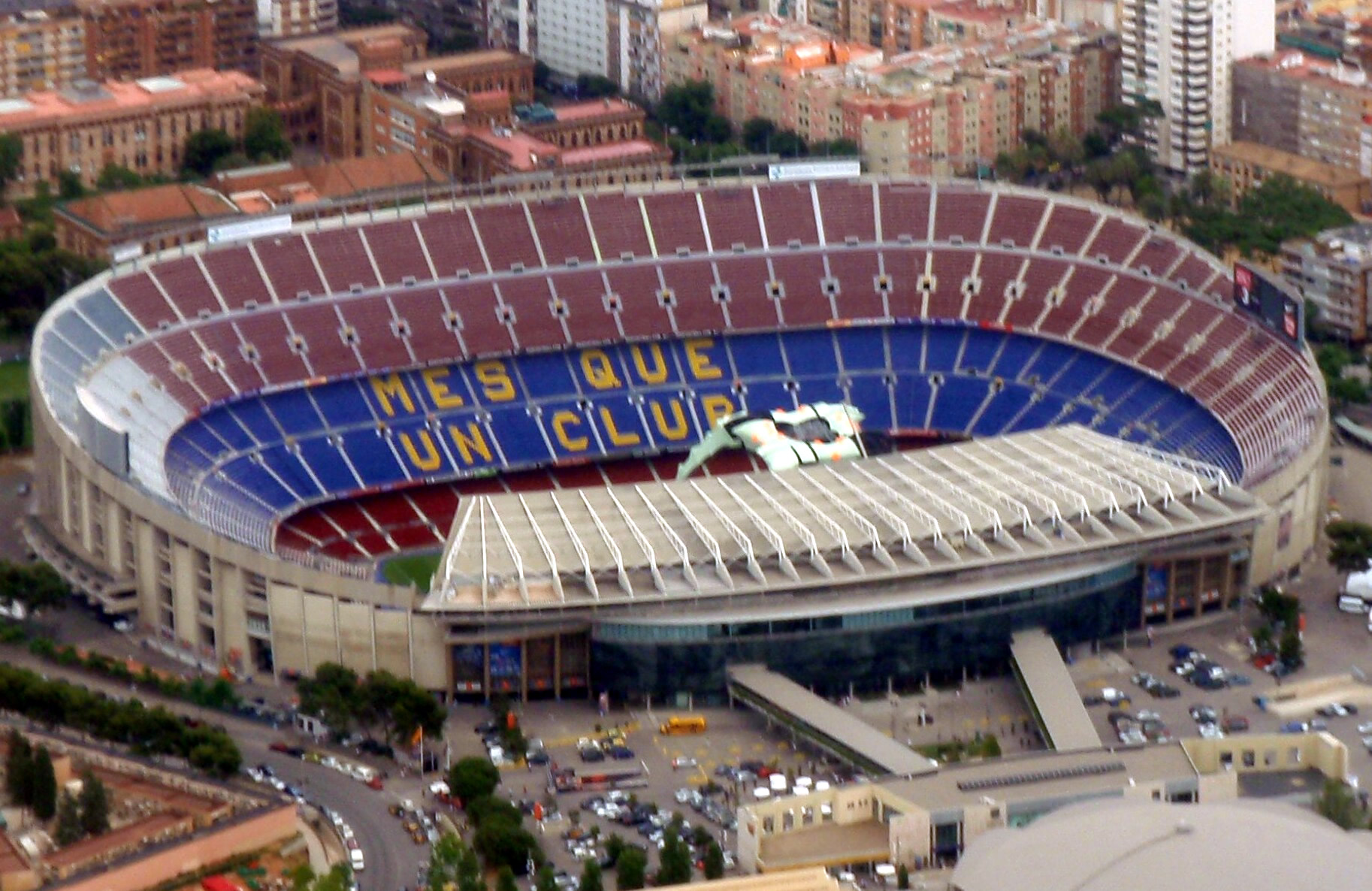
Camp Nou aerial (cropped) — CC BY 2

By the early 1950s, FC Barcelona had outgrown Les Corts, the compact stadium where the team had played for decades — Public Domain

Camp Nou quickly grew beyond football, because the years after its opening coincided with the Franco dictatorship, when the Catalan language was restricted in public life — CC BY-SA 3

Camp Nou has hosted some of the most famous nights in European football, and the list reads like a short history of the modern game — CC BY-SA 3

In January 2014, the club’s board decided against building a new stadium elsewhere and chose instead to rebuild Camp Nou completely within the Espai Barça project, a plan that members approved in a referendum in April 2014 — CC BY-SA 4
Travel to Camp Nou
Match Days and the Museum
The surest way to feel what Camp Nou means is to attend a match, because no tour reproduces the sound of the bowl when the teams walk out. La Liga fixtures are published by season, and tickets for the biggest games sell quickly, so supporters should buy only through the club’s official channels and check the official site for what is open during the rebuild. Arrive at least one to two hours early on a match day, since security checks at the gates take time and the streets around the ground fill with crowds.
For visitors who cannot attend a match, the club museum is the main alternative, and it currently sits in a temporary home rather than inside the stadium. The original museum closed on 28 May 2023, and on 7 June 2023 the Barça Immersive Tour opened in the old ice rink beside the Palau Blaugrana, on 2,400 square metres, with trophies, shirts, photographs and an immersive room that the club presents as the largest of its kind in a European sports museum. The collection will move back into the new stadium when construction is finished, and no firm date for that move has been announced. Plan about ninety minutes to two hours for the museum, and check the club’s official site before travelling, because opening arrangements change with the building work.
Planning Around the Building Work
During the Espai Barça works, Camp Nou is a working construction site as well as a stadium, and the classic stadium tour that once led visitors through the players’ tunnel, the dressing rooms and the technical areas has been suspended since the rebuild began. The current experience centres on the temporary museum and on viewpoints of the construction itself, which some visitors find fascinating and others find frustrating. Check the official FC Barcelona site close to the day of travel for the exact list of open areas, entrances and services, because these change from phase to phase.
The football season runs from August to May, and spring and autumn are the most comfortable months to combine a stadium visit with the rest of the city. Summer brings heat and the largest tourist crowds, while winter nights are cooler and quieter. A match day and a museum visit can be combined with the Sagrada Família, which lies across the city and is easy to reach by metro, and a full day in Barcelona can comfortably hold both. Staying in the Les Corts district itself puts visitors within walking distance of the ground, while staying in the old town means a short metro ride on match days.

The surest way to feel what Camp Nou means is to attend a match, because no tour reproduces the sound of the bowl when the teams walk out — CC BY-SA 4
Notable Places at Camp Nou
- The Camp Nou bowl — the stadium itself, the largest football ground in Europe before the rebuild at 99,354 seats, and planned to hold about 105,000 when the Espai Barça works finish, with a roof over every seat for the first time.
- Barça Immersive Tour, the temporary museum — the club’s museum in the old ice rink beside the Palau Blaugrana, open since 7 June 2023 on 2,400 square metres, holding trophies, shirts and photographs plus a large immersive room.
- Palau Blaugrana — the indoor arena immediately beside the stadium, home to the club’s basketball, handball and other indoor sports teams, and a landmark of the Les Corts sporting quarter.
- The Espai Barça complex — the whole Les Corts site being remade around the stadium, including the new museum, new public spaces and the rebuilt ground itself.

The indoor arena immediately beside the stadium, home to the club’s basketball, handball and other indoor sports teams, and a landmark of the Les Corts sporting quarter — CC BY 3

The whole Les Corts site being remade around the stadium, including the new museum, new public spaces and the rebuilt ground itself — CC BY-SA 4
Frequently Asked Questions About Camp Nou
When did Camp Nou open?
Camp Nou opened on 24 September 1957, during the La Mercè festival, with a friendly match against the Warsaw select team. The first capacity was 93,053 seats, and the name began as a nickname meaning the new ground.
How many people does Camp Nou hold?
Before the rebuild, Camp Nou held 99,354 seats and was the largest football stadium in Europe. The finished Espai Barça design is planned for about 105,000 seats. While the ground reopens in stages from November 2025, the usable capacity on any given match day is lower and changes as each phase is licensed.
Why did FC Barcelona leave Camp Nou for two seasons?
The stadium closed after the 2022-2023 season so that the Espai Barça project could rebuild it completely, the biggest reconstruction in the ground’s history. The team played temporarily at the Olympic Stadium on Montjuïc and returned to Camp Nou in November 2025.
Is the FC Barcelona museum still open?
Yes, but in a temporary home. The museum inside the stadium closed on 28 May 2023, and the Barça Immersive Tour opened on 7 June 2023 in the old ice rink beside the Palau Blaugrana. It will move back into the new stadium when construction is finished.
What happened in the 1999 Champions League final at Camp Nou?
On 26 May 1999, Bayern Munich led Manchester United 1-0 for almost the whole match, then United scored twice in injury time to win 2-1 and complete a historic treble. UEFA has chosen the rebuilt stadium to host the 2029 final, thirty years after that night.
Do visitors to Camp Nou need a visa for Spain?
Spain belongs to the Schengen Area, so travellers from outside the European Union should check whether their nationality needs a Schengen visa before booking. United States, Canadian, British and Australian passport holders can enter Spain without a visa for short stays, while many other nationalities must apply at a Spanish consulate in advance. The practical rule is to confirm the requirement for your own passport on the official Spanish government site, because visa lists change and airlines will check documents at departure.
Verified
Camp Nou opened on 24 September 1957 with a first capacity of 93,053, was expanded to about 120,000 for the 1982 World Cup, became all-seater at 99,354 by the end of the 1990s, and is being rebuilt under the Espai Barça project towards about 105,000 seats with a full roof, reopening in stages from November 2025, while the architects, the original cost of 288 million pesetas, the pitch size of 105 by 68 metres, the height of 48 metres, the site area of 55,000 square metres, the 1999 final result, the 2029 final award, and the museum move of 28 May and 7 June 2023 were all checked against the club’s official site, UEFA and the sources listed below. The Wikidata entry Q159848 for Camp Nou, at 41.3808° N, 2.1228° E, was verified through the Wikidata API on 22 November 2026. Verified 22 November 2026.
Sources
- FC Barcelona, official site: stadium history, 65 years of Camp Nou — https://www.fcbarcelona.com/en/club/news/2800729/spotify-camp-nou-is-65-years-old
- FC Barcelona, official site: stadium facts, architects, UEFA rating — https://www.fcbarcelona.com/en/card/644754/a-top-rated-stadium
- FC Barcelona, official site: temporary museum move — https://www.fcbarcelona.com/en/club/news/3447515/fc-barcelona-museum-temporary-change-of-location
- FC Barcelona, official site: Barça Immersive Tour opening — https://www.fcbarcelona.com/en/news/3530980/fc-barcelona-inaugurates-the-barca-immersive-tour-featuring-the-largest-immersive-room-in-a-sports-museum-in-europe/amp
- UEFA: United’s Camp Nou night of glory, 26 May 1999 — https://www.uefa.com/uefachampionsleague/news/01cc-0e6f4c50a748-7d12afcdc58c-1000–united-s-camp-nou-night-of-glory/
- Wikidata API, Q159848: instance of association football venue, coordinates 41.3808° N, 2.1228° E — checked 22 November 2026
- TheTerraAtlas registry (entities-p1.json): Camp Nou, parent Barcelona, Spain
Unverified
- Ticket prices for matches and for the Barça Immersive Tour, and exact opening hours — these change by fixture and by season and must be checked on fcbarcelona.com before travelling; this article gives no prices or hours.
- The usable capacity on any single match day during the staged reopening from November 2025 — the figure changes as phases are licensed.
- The final completion date of the whole Espai Barça project — the club has not announced one.
- The opening capacity is reported as 93,053 by the club’s stadium page, while other club pages and Wikipedia give different figures; this article follows the stadium page and records the disagreement here.
- The construction start is given as 1955-1957 by the club and 1954-1957 by Wikipedia; this article uses 1954-1957 and records the disagreement here.
Illustrations
- Hero: 2014. Camp Nou. Més que un club. Barcelona B40. Free image: https://upload.wikimedia.org/wikipedia/commons/a/a9/2014._Camp_Nou._M%C3%A9s_que_un_club._Barcelona_B40.jpg — CC BY-SA 3.
- In body, A Stadium Inside a Neighbourhood: 2009-04-18 Camp Nou stadium, Barcalona, Spain (1). Free image: https://upload.wikimedia.org/wikipedia/commons/a/ab/-2009-04-18_Camp_Nou_stadium%2C_Barcalona%2C_Spain_%281%29.JPG — CC BY-SA 4.
- In body, aerial view: Camp Nou aerial (cropped). Free image: https://upload.wikimedia.org/wikipedia/commons/f/fc/Camp_Nou_aerial_%28cropped%29.jpg — CC BY 2.
- In body, The Bowl, the Roof and the Pitch: The playing surface at Camp Nou measures 105 metres by 68 metres, the standard size for top-level European football, and the bowl was designed so that the great majority of seats sit close to the action despite the enormous capacity. Free image: https://upload.wikimedia.org/wikipedia/commons/2/26/Camp_Nou_estadi_5_estrelles.JPG — CC BY-SA 3.
- In body, The Setting Across the Seasons: Barcelona’s Mediterranean climate makes Camp Nou a year-round destination, but the character of a visit shifts with the season. Free image: https://upload.wikimedia.org/wikipedia/commons/3/3b/Stadion-fc-barcelona.JPG — CC BY-SA 3.
- In body, Why Barcelona Needed a New Ground: By the early 1950s, FC Barcelona had outgrown Les Corts, the compact stadium where the team had played for decades. Free image: https://upload.wikimedia.org/wikipedia/commons/e/ef/Camp_de_les_corts_1930.jpg — Public Domain.
- In body, A Stadium That Became a Catalan Symbol: Camp Nou quickly grew beyond football, because the years after its opening coincided with the Franco dictatorship, when the Catalan language was restricted in public life. Free image: https://upload.wikimedia.org/wikipedia/commons/f/f4/Mosaic_Catalonia_Freedom_2013.jpg — CC BY-SA 3.
- In body, The Great Nights: Camp Nou has hosted some of the most famous nights in European football, and the list reads like a short history of the modern game. Free image: https://upload.wikimedia.org/wikipedia/commons/8/81/Camp_Nou_during_El_Clasico_October_2012.jpg — CC BY-SA 3.
- In body, Match Days and the Museum: The surest way to feel what Camp Nou means is to attend a match, because no tour reproduces the sound of the bowl when the teams walk out. Free image: https://upload.wikimedia.org/wikipedia/commons/f/fd/Collections_of_the_Museum_of_FC_Barcelona.jpg — CC BY-SA 4.
- In body, Palau Blaugrana: The indoor arena immediately beside the stadium, home to the club’s basketball, handball and other indoor sports teams, and a landmark of the Les Corts sporting quarter. Free image: https://upload.wikimedia.org/wikipedia/commons/2/2b/Palau_Blaugrana_%28Barcelona%2C_ESP%29.jpg — CC BY 3.
- In body, The Espai Barça complex: The whole Les Corts site being remade around the stadium, including the new museum, new public spaces and the rebuilt ground itself. Free image: https://upload.wikimedia.org/wikipedia/commons/0/01/Camp_Nou_under_renovation_-_Sept._21%2C_2025.jpg — CC BY-SA 4.
- In body, Espai Barça and the Rebuild: In January 2014, the club’s board decided against building a new stadium elsewhere and chose instead to rebuild Camp Nou completely within the Espai Barça project, a plan that members approved in a referendum in April 2014. Free image: https://upload.wikimedia.org/wikipedia/commons/9/92/Obres_del_Camp_Nou_-_20240722_151956.jpg — CC BY-SA 4.