
Luxembourg
Luxembourg is a small Grand Duchy wedged between Belgium, France and Germany. Its fortified capital, castles and vineyards fit inside 2,586 square kilometres.
The Grand Duchy of Luxembourg is the only sovereign grand duchy left in the world, and it packs an unusual amount of history, wealth and green landscape into one of the smallest countries in Europe. Luxembourg City rises on a steep rock above two river valleys, and its old quarters and fortifications carry the UNESCO inscription that marks the country on the world map. Beyond the capital, the Mullerthal sandstone rocks, the wine villages of the Moselle and the castles of the Ardennes give the country a quieter, rural side that most visitors miss. Luxembourg also runs the first free public transport system in the world, so a traveller can cross the whole country by bus, tram and train without buying a ticket.
Quick Facts
| Item | Detail |
|---|---|
| Name | Luxembourg (Grand Duchy of Luxembourg) |
| Type | Country (L2), sovereign Grand Duchy |
| Location | Western Europe, between Belgium, France and Germany |
| Coordinates | 49.77° N, 6.13° E |
| Capital | Luxembourg City |
| Population | About 682,000 (1 January 2025, STATEC) |
| Area | 2,586 km² |
| Languages | Luxembourgish, French, German |
| Currency | Euro (EUR) |
| Head of state | Grand Duke Guillaume (since 3 October 2025) |
| Government | Constitutional monarchy, parliamentary democracy |
| International | Founding member of the European Union, NATO and Benelux |
| UNESCO | City of Luxembourg: its Old Quarters and Fortifications, inscribed 1994, reference 699 |
| Wikidata code | Q32 |
Luxembourg sits in Western Europe with Belgium to the west and north, France to the south and Germany to the east, and its capital stands in the south of the country on a high rock. The country is one of the smallest in Europe by area, yet it holds some of the busiest European institutions, including the Court of Justice of the European Union and the European Investment Bank. Luxembourg is also one of the richest countries in the world by income per person, with an economy built on finance, steel and services. Almost half of the people who live in Luxembourg were born in another country, which makes the Grand Duchy one of the most international places in Europe.
Geography of Luxembourg
The country covers 2,586 square kilometres, which makes it one of the smallest countries in Europe and smaller than many single regions of its neighbours. The country divides naturally into two landscapes that feel quite different from each other.
The north, called the Oesling, is part of the Ardennes plateau, with high ground, deep forests, steep valleys and small villages. The south, called the Gutland, is lower and gentler, with farmland, gardens, towns and the vineyards that line the Moselle river. The highest point of the country is the Kneiff, at 560 metres, in the northern Ardennes, while the lowest point is the Moselle river at Wasserbillig, at 130 metres.
Three rivers shape the geography of the country more than any other feature. The Moselle forms the eastern border with Germany for about 40 kilometres, and its sunny slopes carry the vineyards that produce the white wines of the region. The Sûre, known as the Sauer in German, flows through the north and east of the country and joins the Moselle at Wasserbillig. The Our forms the north-eastern border and winds through the Ardennes valleys around Vianden.
The capital itself stands where the Alzette and the Pétrusse meet, on a rock that rises steeply above both valleys, and that natural position explains why a fortress grew there in the first place.
The capital divides into quarters that sit on very different levels, and the contrast between them is one of the pleasures of visiting the city. The Upper Town holds the old quarters, the cathedral, the Grand Ducal Palace and the main squares, while the Grund and Pfaffenthal quarters lie far below in the valley, with old houses, churches and gardens along the Alzette. The Kirchberg plateau to the east holds the modern glass buildings of the European institutions, the Philharmonie concert hall and the Museum of Modern Art. Bridges and a glass lift connect the levels, and the views from the Corniche walkway, often called the most beautiful balcony in Europe, look across the valley to the fortifications and the green slopes beyond.
The Mullerthal region in the east of Luxembourg is known as the Little Switzerland of Luxembourg, and the name fits its sandstone rocks, narrow gorges, streams and forests. The Mullerthal Trail runs for about 112 kilometres in three loops through this landscape, past rock formations, caves, waterfalls and small villages. The Moselle region in the south-east has a different character again, with a mild climate, vineyard terraces, wine villages and castles along the river. The Ardennes in the north stays quiet and wooded, with hiking and cycling routes through valleys that feel far from the busy capital.
The walking season runs from late spring to early autumn, when the Mullerthal rocks are dry underfoot and the Moselle vineyards turn gold before the harvest. Summer days reach about 20 to 24 degrees Celsius, which suits the long trails and the vineyard walks, while winter brings cold air of about 0 to 5 degrees and occasional snow to the Ardennes. Rain falls through the year, and the green valleys of the country owe their colour to it. December suits a different kind of visit, with Christmas markets and winter concerts in the capital and the towns.
Getting around the country is unusually easy, because it made all public transport free for everyone in 2020, the first country in the world to do so. Buses, trams and trains run across the whole country without tickets, and a traveller can ride from Luxembourg City to the Ardennes or the Moselle without paying a fare. Luxembourg Airport stands about 6 kilometres east of the capital, with flights to many European cities, and trains connect the capital with Brussels, Paris and Frankfurt in a few hours. The old Roman city of Trier lies just across the German border, about 50 kilometres from the capital.
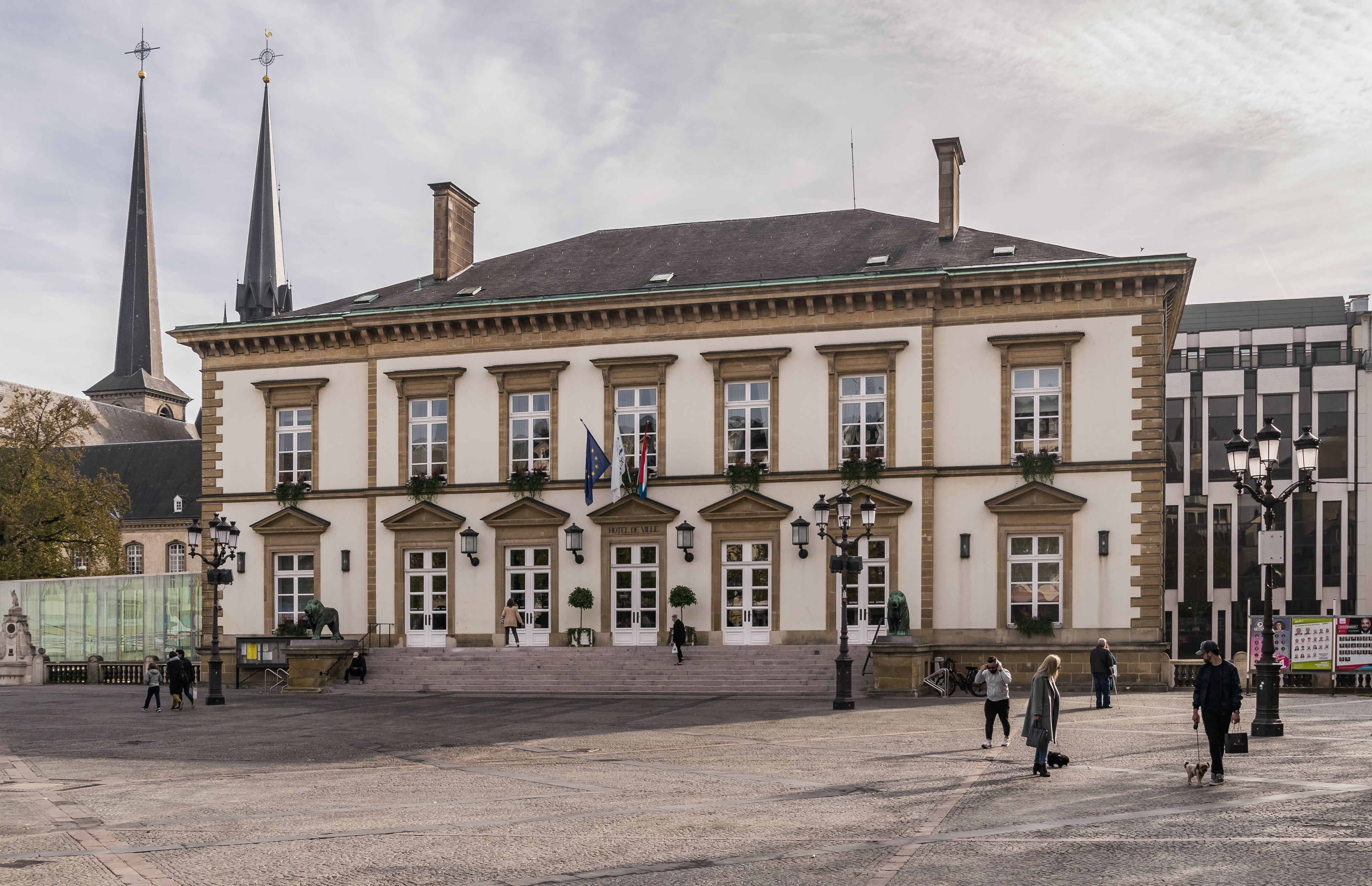
City Hall of Luxembourg City, Luxembourg — CC BY-SA 4
History of Luxembourg
The history of Luxembourg begins in the year 963, when Count Sigfried, a Frankish nobleman, built a small fort on the rock that is now Luxembourg City. The fort grew into a town, and the town grew into a county that played a larger role in European politics than its size suggested. In the 14th century the counts of Luxembourg became dukes, and the House of Luxembourg produced several Holy Roman Emperors, including Charles the Fourth, who built Prague Castle and founded the university in Prague. The fortress on the rock kept growing, and by the early modern period it was one of the strongest fortresses in Europe, known as the Gibraltar of the North.
The fortress passed from one great power to another over the centuries, and each owner strengthened it further. Burgundy took the city in 1443, and through inheritance it passed to the Habsburgs and then to Spain, which held it until 1684. The French king Louis the Fourteenth conquered the city and ordered Vauban, his great military engineer, to extend and reinforce the fortifications. The Austrians continued the work in the 18th century and created the fortress that earned the Gibraltar of the North name.
After the Congress of Vienna, the Prussians built new military structures and held the fortress until the middle of the 19th century.
The 19th century turned Luxembourg from a fortress town into an independent country. In 1839 the territory was partitioned, with the western part going to Belgium and the rest becoming an independent Grand Duchy under the Dutch king as Grand Duke. The Treaty of London in 1867 recognised the neutrality of Luxembourg and ordered the fortress to be dismantled, and most of the walls and bastions were pulled down, although the casemates and some gates survived. The dismantling opened the city to growth, and the old quarters kept their street plan while new districts spread beyond the former walls.
The 20th century brought occupation and then a new role at the heart of Europe. Germany occupied Luxembourg in both world wars, in 1914 and again from 1940 to 1944, and the country suffered heavily, especially in the Ardennes during the Battle of the Bulge in the winter of 1944. After the Second World War, Luxembourg became a founding member of NATO in 1949, of the European Coal and Steel Community in 1951 and of the European Economic Community in 1957. The steel industry that had built the economy declined, and finance took its place, with banks and European institutions bringing wealth and an international population to the capital.
The 21st century has kept Luxembourg at the centre of European politics and finance, with the Court of Justice of the European Union, the European Investment Bank and the European Court of Auditors all based in the Kirchberg district. The country has also become a popular destination for travellers who want a small, calm and green corner of Europe, with castles, valleys, forests and historic towns. On 3 October 2025 Grand Duke Henri abdicated after 25 years on the throne, and his eldest son Guillaume became Grand Duke, the first change of monarch in a quarter of a century.
Timeline
| Year | Event |
|---|---|
| 963 | Count Sigfried builds a fort on the rock of Luxembourg |
| 14th century | Luxembourg becomes a duchy; the House of Luxembourg produces Holy Roman Emperors |
| 1443 | Burgundy takes the city; it passes to the Habsburgs and then to Spain |
| 1684 | France conquers the city; Vauban extends the fortifications |
| 1839 | Partition: the western part goes to Belgium; the rest becomes an independent Grand Duchy |
| 1867 | Treaty of London recognises Luxembourg neutrality; the fortress is dismantled |
| 1914 | Germany occupies Luxembourg in the First World War |
| 1940–1944 | Germany occupies Luxembourg in the Second World War |
| 1949 | Luxembourg becomes a founding member of NATO |
| 1957 | Luxembourg becomes a founding member of the European Economic Community |
| 1994 | Luxembourg City is inscribed by UNESCO, reference 699 |
| 2020 | Luxembourg makes all public transport free for everyone |
| 3 October 2025 | Grand Duke Henri abdicates; Guillaume becomes Grand Duke |

Luxembourg City: Entrance of the so-called Schéieschlach as seen from the defensive wall – above boulevard Thorn – of the ancient fortress — CC BY-SA 4
Travel to Luxembourg
Most travellers start in Luxembourg City, and the old quarters are the best place to begin. The Bock casemates, the underground passages and galleries of the old fortress, run for many kilometres under the rock and give the clearest sense of why the city was called the Gibraltar of the North. The Corniche walkway, the cathedral, the Grand Ducal Palace and the squares of the Upper Town sit within a short walk of each other, and the Grund and Pfaffenthal quarters below the rock offer quiet streets, gardens and restaurants along the Alzette. The city also holds several museums, including the National Museum of History and Art and the City History Museum.
Vianden Castle in the north of the country is one of the finest castles in Europe, with Romanesque and Gothic architecture and a view across the valley of the Our river. The castle was built between the 11th and 14th centuries as the home of the counts of Vianden, and its rooms, towers and gardens are open to visitors. The town of Vianden below the castle has stone streets, shops and restaurants, and a chairlift runs up to a viewpoint above the valley. The Ardennes around Vianden offer hiking and cycling through forests and valleys, with castles and small villages along the way.
The Mullerthal region in the east suits walkers, with the 112-kilometre trail split into three loops that can each be walked in two or three days. The routes pass sandstone rocks, narrow gorges, streams, waterfalls and villages, and the village of Berdorf sits in the middle of the rock formations. The Moselle region in the south-east suits wine lovers, with vineyard walks, wine cellars, river cruises and villages such as Remich and Grevenmacher. Echternach, the oldest town in Luxembourg, holds an abbey founded in the 7th century and the dancing procession, a UNESCO intangible heritage tradition held every year at Whitsun since 2010.
The best time to visit Luxembourg is from May to September, when the weather is warm and the walking and cycling routes are at their best. December brings Christmas markets to the capital and the towns, with lights, food stalls and concerts. A stay of three or four days suits the country well, with one day in the capital, one day in Vianden and the Ardennes, one day in the Mullerthal and the Moselle, and one day for the smaller towns. Many travellers combine the Grand Duchy with Brussels, Paris or Frankfurt, since all three lie within a few hours by train.
Notable Places in Luxembourg
Luxembourg City
Luxembourg City, the capital, is the heart of the country and its only UNESCO property. The old quarters and fortifications were inscribed in 1994 with reference 699, and the property covers the old town on the rock, the Bock casemates, the gates and bastions, and the quarters of Grund and Pfaffenthal below. Visitors can walk the Corniche, tour the casemates, visit the cathedral and the Grand Ducal Palace, and look across the valley from the viewpoints above the Alzette. The Kirchberg plateau adds a modern contrast, with the Philharmonie, the Museum of Modern Art and the glass buildings of the European institutions.
Vianden Castle
Vianden Castle stands above the town of Vianden in the north of the country, with a view across the valley of the Our river. The castle was built between the 11th and 14th centuries and restored in the 20th century, and its rooms, towers and gardens show how the counts of Vianden lived. The town below has stone streets, a chairlift to a viewpoint and restaurants along the river, and the Ardennes valleys around it offer hiking and cycling routes.
The Mullerthal Region
The Mullerthal region in the east is the best walking country in Luxembourg, with sandstone rocks, narrow gorges, streams and forests. The Mullerthal Trail runs for about 112 kilometres in three loops, and each loop can be walked in two or three days from a base in Echternach or Berdorf. The region is known as the Little Switzerland of Luxembourg, and its rock formations, caves and waterfalls make it the most popular natural destination in the country.
The Moselle and Echternach
The Moselle region in the south-east follows the river along the German border, with vineyards, wine villages and castles on the slopes above the water. Visitors can walk the vineyard trails, visit wine cellars, take a river cruise and eat in the villages of Remich and Grevenmacher. Echternach, the oldest town in Luxembourg, holds a 7th-century abbey and the dancing procession, a UNESCO intangible heritage tradition in which dancers step through the streets of the town at Whitsun.
Beaufort Castle and the Ardennes
Beaufort Castle in the east of the country dates from the 11th century and stands above a valley of forests and streams, with rooms, towers and gardens to explore. The Ardennes in the north offer a quieter landscape of high ground, deep forests and steep valleys, with castles, villages and long hiking and cycling routes. The region also holds the battlefields of the winter of 1944, when the Ardennes saw some of the hardest fighting of the Second World War.
Frequently Asked Questions
Where is Luxembourg?
Luxembourg lies in Western Europe between Belgium to the west and north, France to the south and Germany to the east, with an area of 2,586 square kilometres. The capital is Luxembourg City, which stands in the south of the country on a high rock above the Alzette and Pétrusse valleys.
What makes Luxembourg special?
Luxembourg is the only sovereign grand duchy left in the world, and its capital fortress was known as the Gibraltar of the North. The country is also one of the richest in the world by income per person, a founding member of the European Union and NATO, and the first country to make all public transport free.
Who is the head of state of Luxembourg?
Grand Duke Guillaume has been head of state since 3 October 2025, when his father Grand Duke Henri abdicated after 25 years on the throne. Guillaume is the eldest son of Henri and Grand Duchess Maria Teresa, and his eldest son Charles is now the heir apparent.
Is public transport really free in Luxembourg?
Public transport has been free for everyone in Luxembourg since 2020, covering buses, trams and trains across the whole country. Travellers need no ticket at all, which makes it easy to reach the Ardennes, the Mullerthal and the Moselle from the capital by bus or train.
How many UNESCO sites does Luxembourg have?
Luxembourg has exactly one World Heritage property, the City of Luxembourg with its old quarters and fortifications, inscribed in 1994 with reference 699. The dancing procession of Echternach is also on the UNESCO intangible heritage list, inscribed in 2010, but it is not a World Heritage property.
How long should I stay in Luxembourg?
Three or four days suits Luxembourg well, with one day in the capital, one day in Vianden and the Ardennes, one day in the Mullerthal and the Moselle, and one day for the smaller towns. Many travellers combine Luxembourg with Brussels, Paris or Frankfurt, since all three lie within a few hours by train.
Verified
- Luxembourg is a sovereign Grand Duchy in Western Europe, between Belgium, France and Germany, with coordinates 49.77° N, 6.13° E and the Wikidata code Q32, a country with the instance-of values sovereign state and country.
- The population of Luxembourg was 681,973 on 1 January 2025 according to STATEC, the national statistics office, and the area of the country is 2,586 square kilometres.
- Count Sigfried built a fort on the rock of Luxembourg in the year 963, and the House of Luxembourg produced several Holy Roman Emperors in the 14th century, including Charles the Fourth.
- The Treaty of London in 1867 recognised the neutrality of Luxembourg and ordered the fortress to be dismantled, and the partition of 1839 gave the western part of the territory to Belgium.
- Grand Duke Henri abdicated on 3 October 2025 after 25 years on the throne, and his eldest son Guillaume became Grand Duke the same day, with the swearing-in at the Chamber of Deputies.
- The City of Luxembourg with its old quarters and fortifications was inscribed by UNESCO in 1994 with reference 699 under criterion (iv), and it is the only World Heritage property in Luxembourg, confirmed on the UNESCO states parties page for Luxembourg, which lists 1 property and 0 tentative sites.
- Luxembourg made all public transport free for everyone in 2020, the first country in the world to do so, covering buses, trams and trains.
- The Mullerthal Trail runs for about 112 kilometres in three loops of 36.7, 39.7 and 37.7 kilometres, confirmed on the Visit Luxembourg portal.
- The dancing procession of Echternach has been on the UNESCO intangible heritage list since 2010.
Sources
- Wikidata, item Q32 Luxembourg — country in Western Europe, coordinates 49.77° N, 6.13° E.
- UNESCO World Heritage Centre, https://whc.unesco.org/en/list/699/ — City of Luxembourg: its Old Quarters and Fortifications, reference 699, criterion (iv).
- UNESCO World Heritage Centre, https://whc.unesco.org/en/statesparties/lu — Luxembourg, 1 property inscribed, 0 tentative sites.
- STATEC, https://statistiques.public.lu/en/publications/series/en-chiffres/2025/demographie-lux-en-chiffres-2025.html — population 681,973 on 1 January 2025.
- Government of Luxembourg, https://gouvernement.lu/en/actualites/toutes_actualites/articles/2025/10-octobre/03-avenement-trone.html — abdication of Grand Duke Henri and accession of Grand Duke Guillaume, 3 October 2025.
- Visit Luxembourg, https://www.visitluxembourg.com/tour/stage-trail-mullerthal-trail-route-3 — Mullerthal Trail, about 112 km in three loops.
- The matching Vietnamese article luxembourg.vi.md — facts and sources, checked 19/11/2026.
Unverified
- The exact current population of Luxembourg City, which changes through the year and needs checking with the city or STATEC.
- The construction dates of Vianden Castle, given as the 11th to 14th centuries in encyclopaedic sources and not checked directly against the castle archive.
- Opening hours and ticket prices for the Bock casemates and Vianden Castle, which change by season and need checking on the official sites before a visit.
- Wine production figures for the Moselle region, which need checking with the Luxembourg wine board.
- Dates of the Christmas markets in Luxembourg City for the current year, which need checking with the city tourist office.
Illustrations
- Hero: View of Luxembourg. Free image: https://upload.wikimedia.org/wikipedia/commons/2/2e/Luxembourg_Pfaffenthal_Alzette_B%C3%A9inchen_01.jpg — CC BY-SA 3.
- In body, Luxembourg: City Hall of Luxembourg City, Luxembourg. Free image: https://upload.wikimedia.org/wikipedia/commons/a/ad/City_Hall_of_Luxembourg_City_01.jpg — CC BY-SA 4.
- In body, Luxembourg: Luxembourg City: Entrance of the so-called Schéieschlach as seen from the defensive wall – above boulevard Thorn – of the ancient fortress. Free image: https://upload.wikimedia.org/wikipedia/commons/a/a8/Luxembourg_City_-_Sch%C3%A9ieschlach_depuis_Rempart.jpg — CC BY-SA 4.