
Basilica of Santa Croce in Florence: Tombs, Frescoes and the Franciscan Heart of the City
The Basilica of Santa Croce in Florence holds the tombs of Michelangelo and Galileo. Its Franciscan church has watched over the city since 1294.
The Basilica of Santa Croce in Florence stands on the Piazza Santa Croce, east of the historic centre, and it is the largest Franciscan church in the world, a Gothic basilica of stone, timber and fresco that the Florentines call the Temple of Italian Glories. The church was begun in 1294, on the site of an earlier Franciscan church, and it was consecrated in 1442, yet its marble facade was not finished until 1863, so the building carries six centuries of Florentine history in a single view. Inside lie the tombs of Michelangelo, Galileo, Machiavelli and Rossini, the frescoes of Giotto, the Pazzi Chapel of Brunelleschi and the leather workshop that still works in the cloister, and the Basilica of Santa Croce in Florence is named by UNESCO among the monuments of the Historic Centre of Florence, inscribed in 1982.
Santa Croce Florence, the short name that most visitors search for, is a working church as well as a museum, and the friars of the Franciscan order still live beside it. The square outside hosts the calcio storico, the historic football of Florence, each June, and the streets around it hold the leather shops, the workshops and the restaurants of the Santa Croce quarter, one of the liveliest districts of the city, reached through the Florence guide. A visit here takes about two hours, and it pairs naturally with the Uffizi, the Bargello and the Duomo, all within a short walk through the historic centre.
Quick Facts About the Basilica of Santa Croce in Florence
| Item | Detail |
|---|---|
| Full name | Basilica di Santa Croce |
| Location | Piazza Santa Croce, Florence, Tuscany, Italy |
| Coordinates | 43.76845° N, 11.26274° E, from Wikidata |
| Wikidata | Q51177, verified through the Wikidata API on 22 November 2026 |
| Type | Franciscan basilica, church and museum |
| Begun | 1294, designed by Arnolfo di Cambio |
| Consecrated | 1442 |
| Facade | Completed 1853–1863, designed by Niccolò Matas |
| Tombs | Michelangelo, Galileo Galilei, Niccolò Machiavelli, Gioachino Rossini |
| Frescoes | Giotto, in the Bardi and Peruzzi Chapels |
| Chapel | Pazzi Chapel, by Filippo Brunelleschi, begun 1429 |
| UNESCO | Named in the Historic Centre of Florence, ref 174, inscribed 1982, criteria (i)(ii)(iii)(iv)(vi) |
Geography of the Basilica of Santa Croce in Florence
The Basilica of Santa Croce in Florence stands on the eastern edge of the historic centre, in the quarter of the same name, where the medieval city met the Arno and the road east toward Arezzo and Rome. The Piazza Santa Croce before the church is one of the largest squares in Florence, a broad rectangle of stone that the Franciscans used for preaching to crowds, and the square is bounded by palaces, by the church of Santa Croce itself and by the streets that run west toward the Duomo and south toward the river. The Arno flows about three hundred metres to the south, and the Ponte alle Grazie, the bridge nearest the church, links the quarter with the Oltrarno, the district across the river where the Pitti Palace and the artisan workshops stand.
The position of the Basilica of Santa Croce in Florence inside the city walls explains its scale, because the Franciscans, like the Dominicans at Santa Maria Novella, built outside the old Roman centre, on land where a great church and a great square could grow together. The historic centre that UNESCO inscribed in 1982 covers 505 hectares, bounded by the remains of the fourteenth-century walls, and the Basilica of Santa Croce in Florence stands inside that boundary, at the eastern end of the inscribed area, with the Duomo to the west, the Uffizi to the south-west and the Palazzo Vecchio between them. The UNESCO page for the property names the Church of Santa Croce among the monuments that give the centre its value, beside the Cathedral of Santa Maria del Fiore, the Baptistery, the Palazzo Vecchio and the Uffizi gallery.
The quarter around the Basilica of Santa Croce in Florence is a district of workshops and markets, and its streets keep the trades that have worked here for centuries. The leather school, the Scuola del Cuoio, works in the cloister of the church itself, where artisans cut, stitch and tool leather in a workshop founded after the Second World War to teach orphans a trade. The streets east of the square, toward the Sant’Ambrogio market, hold food stalls, bakeries and small restaurants, while the streets west toward the Duomo hold the leather shops and the souvenir stalls that serve the visitors of the centre. The quarter is flat and easy to walk, and the walk from the Duomo to Santa Croce takes about ten minutes through the streets of the old city.
The Arno has shaped the history of the Basilica of Santa Croce in Florence more than any other feature of the city, because the church stands low, near the river, and it has flooded whenever the Arno has risen. The great flood of 4 November 1966 covered the church in more than four metres of water and mud, damaging the frescoes, the Cimabue Crucifix and the archives, and the restoration that followed became a symbol of the international effort to save Florence. The flood marks are still visible on the walls of the cloister, and the Crucifix of Cimabue, painted about 1280, hangs in the refectory museum as a reminder of the damage, its paint partly washed away by the water. The church now keeps its most fragile works above the flood line, and the flood of 1966 is part of every guided visit.
The climate and the seasons of the Basilica of Santa Croce in Florence follow the Tuscan year, and the church is at its best in the soft light of spring and autumn, when the sun falls through the high windows onto the stone floor. Summer brings heat and crowds to the square, and the calcio storico fills the piazza with sand, stands and noise each June, while winter brings a quieter church, with fewer visitors and a colder stone interior. The church is cool even in summer, and the light changes through the day, so a morning visit gives the clearest view of the frescoes and the tombs, while the late afternoon gives the warmest light on the marble facade.

The Crucifix of Cimabue in the Basilica of Santa Croce, Florence — CC BY-SA 3

The Greater Cloister of the Basilica of Santa Croce, Florence — CC BY-SA 4

The Duomo of Florence seen from the Uffizi terrace — CC0

The courtyard of the Uffizi Gallery in Florence — CC BY-SA 4
History of the Basilica of Santa Croce in Florence
The history of the Basilica of Santa Croce in Florence begins with St Francis himself, who is said to have visited Florence in the early thirteenth century, and with the Franciscan friars who settled outside the city walls and built a small church on the site. The present church was begun in 1294, when the commune of Florence, at the height of its wealth, gave the Franciscans the land and the architect Arnolfo di Cambio, the same architect who designed the Duomo and the Palazzo Vecchio. Arnolfo planned a vast basilica in the Tuscan Gothic style, with a timber roof, a wide nave and chapels along the sides, and the work went on for more than a century, with the church consecrated in 1442, when the facade was still bare brick and the bell tower was still unfinished.
The fifteenth century made the Basilica of Santa Croce in Florence a centre of Florentine art, because the great families of the city bought chapels and commissioned frescoes from the best painters of the age. Giotto painted the Bardi Chapel and the Peruzzi Chapel about 1320, with scenes from the lives of St Francis and St John the Baptist that broke with the flat gold of the Byzantine style and gave the figures weight, space and feeling. The Pazzi family commissioned Brunelleschi to build the Pazzi Chapel in the cloister, begun in 1429, a small building of perfect proportion that became a model of Renaissance architecture, and Donatello carved the relief of the Annunciation for the Cavalcanti Chapel. The church became the burial place of the city’s great men, and the tombs that followed turned it into a pantheon of Italian culture.
The tombs are the reason most visitors come to the Basilica of Santa Croce in Florence, and they were built across three centuries, each in the style of its own age. Michelangelo, who died in Rome in 1564, was brought back to Florence in secret, because the Florentines feared the Romans would keep his body, and his tomb, designed by Vasari, stands in the south aisle with three figures for Painting, Sculpture and Architecture. Galileo, who died in 1642, was buried in a small room of the church because the Church had condemned his writings, and his monument was not raised until 1737, when his remains were moved to a tomb in the south aisle with a bust, a telescope and a globe. Machiavelli, who died in 1527, received his monument in 1787, and Rossini, who died in Paris in 1868, was buried here in 1887, while Dante, exiled from Florence and buried in Ravenna, has only a cenotaph, an empty monument raised in 1829 that marks an absence rather than a grave.
The nineteenth century gave the Basilica of Santa Croce in Florence its facade, and the story of the facade is a story of Jewish Florence as well as of Christian Florence. The facade was designed by Niccolò Matas, a Jewish architect from Ancona, and it was built between 1853 and 1863 with money left by the English banker Francis Sloane, in white, green and pink marble that matches the Duomo and the Baptistery. Matas placed a Star of David above the main door, a quiet signature that visitors still look for, and he died before the work was finished, so he was buried in the church he had designed, under the porch, the only non-Catholic buried in Santa Croce. The campanile, the bell tower, was rebuilt in the nineteenth century after lightning destroyed the old one, and the square was paved and opened to the city, so that the church and the piazza became a single civic space.
The twentieth century brought war and flood to the Basilica of Santa Croce in Florence, and both left marks that are still visible. The church survived the Second World War with less damage than the bridges and the Oltrarno, yet the flood of 1966, the worst in the history of the city, filled the nave with mud and water and damaged the frescoes, the tombs and the archives, and the restoration drew conservators from across the world. The leather school in the cloister was founded in 1950 to teach orphans of the war a trade, and it still works today, while the Opera di Santa Croce, the body that cares for the church, has restored the chapels, the frescoes and the cloisters one by one. The church remains a Franciscan house, and the friars still celebrate Mass in the basilica, so the building is a living church as well as a museum of Florentine art.

Tomb of Michelangelo by Vasari, Basilica of Santa Croce, Florence (1) — CC BY 2

The Cenotaph of Dante in the Basilica of Santa Croce, Florence — CC BY-SA 4

The Stigmatization of Saint Francis by Giotto in the Bardi Chapel — Public domain

The Pazzi Chapel in the Basilica of Santa Croce, Florence — CC BY-SA 4
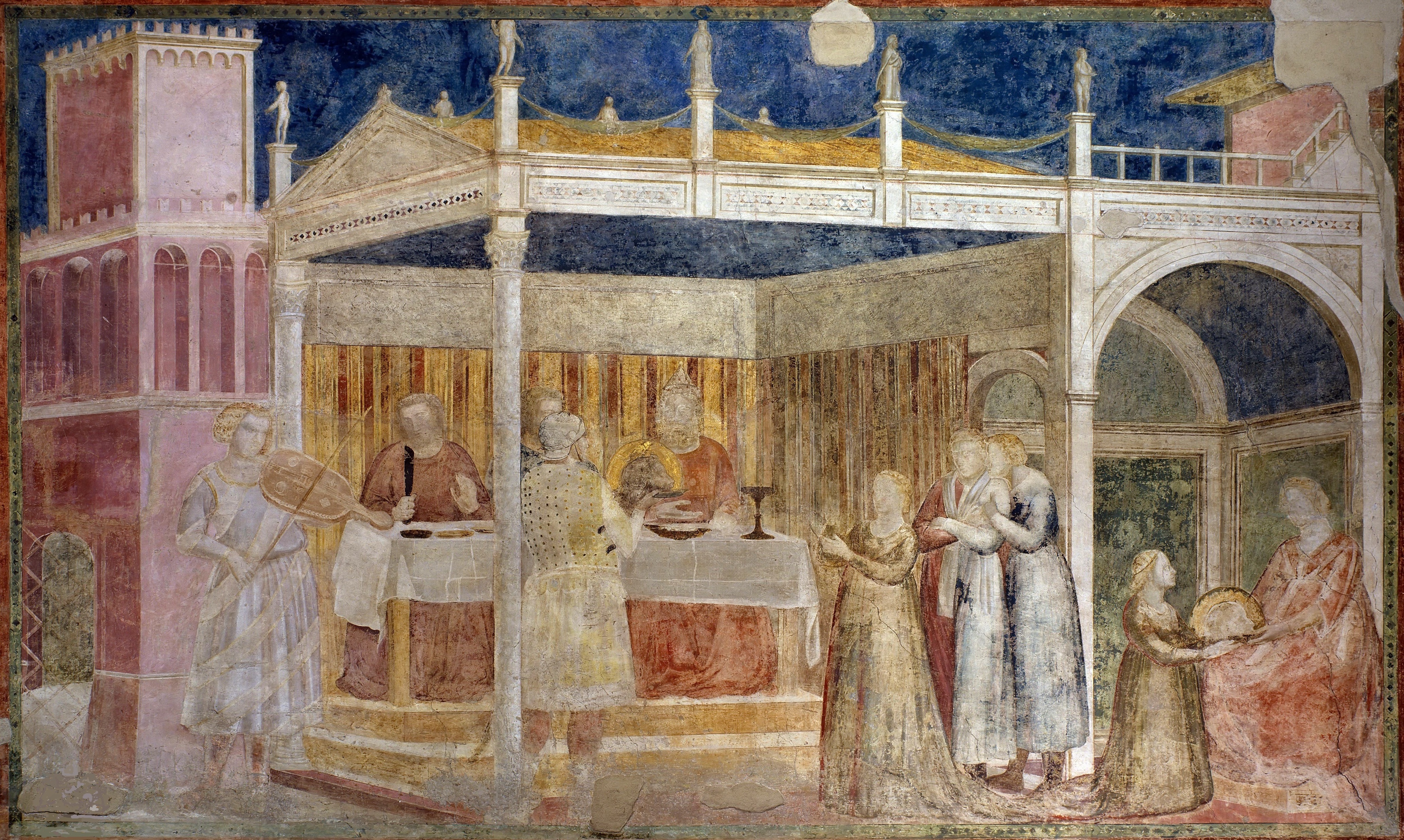
The Feast of Herod by Giotto in the Peruzzi Chapel of Santa Croce, Florence — Public domain
Travel to the Basilica of Santa Croce in Florence
The best months to visit the Basilica of Santa Croce in Florence are April to June and September to October, when the weather in Florence is mild and the light inside the church is at its clearest. July and August are the busiest months, with heat in the square and queues at the door, while the calcio storico fills the piazza with sand and stands each June, so the square is closed to normal use during the tournament. Winter is the quietest season, with fewer visitors and a colder interior, and the church is a good refuge on a rainy day, since the visit takes about two hours under cover.
Getting to the Basilica of Santa Croce in Florence is a short walk from anywhere in the historic centre, and the walk itself is part of the visit. The Duomo stands about ten minutes to the west, the Uffizi about eight minutes to the south-west and the Santa Maria Novella station about fifteen minutes to the west, and the streets between them are flat and pedestrian, with the exception of the buses that run along the river. The nearest bus stops are on the Lungarno, the embankment along the Arno, and the city buses from the station stop at the Piazza Santa Croce itself, while taxis can drop visitors at the edge of the square, which is closed to most traffic. Visitors who arrive by train should walk through the historic centre rather than take a bus, since the route passes the Duomo, the Baptistery and the Piazza della Signoria.
A visit to the Basilica of Santa Croce in Florence follows a natural route through the church, and the ticket covers the basilica, the chapels, the cloisters and the museum in the refectory. The nave holds the tombs of Michelangelo, Galileo, Machiavelli and Rossini, and the south aisle holds the monument to Dante, the cenotaph that marks his exile, while the chapels along the sides hold the frescoes of Giotto in the Bardi and Peruzzi Chapels and the works of Donatello, Taddeo Gaddi and Agnolo Gaddi. The Pazzi Chapel, in the first cloister, is the masterpiece of Brunelleschi, and the second cloister holds the leather school, where visitors can watch the artisans at work and buy bags, belts and jackets made on the premises. The museum in the refectory holds the Crucifix of Cimabue, damaged in the flood of 1966, and the Last Supper of Taddeo Gaddi, painted about 1330.
Practical details for the Basilica of Santa Croce in Florence are best checked on the official site before travelling, since opening hours and ticket prices change by season, and the church closes for Mass and for concerts. The church is a place of worship, so visitors should dress modestly, with shoulders and knees covered, and keep their voices low, while photography without flash is allowed in most of the church and the cloisters. Guided tours in English run daily in the high season, and the audio guide covers the tombs, the frescoes and the chapels in about an hour, while the bookshop near the exit sells guides, prints and the catalogues of the exhibitions that the Opera di Santa Croce mounts in the cloisters.

Tomb of Galileo; Basilica of Santa Croce, Florence — CC BY 2
Notable Places in the Basilica of Santa Croce in Florence
- The Tomb of Michelangelo — the monument by Vasari in the south aisle, with three figures for Painting, Sculpture and Architecture, raised after the body was brought back from Rome in 1564.
- The Tomb of Galileo — the monument of 1737 in the south aisle, with a bust, a telescope and a globe, raised almost a century after his death in 1642.
- The Cenotaph of Dante — the empty monument of 1829 in the north aisle, marking the poet who died in exile in Ravenna and never came home.
- The Bardi and Peruzzi Chapels — the frescoes of Giotto, painted about 1320, with scenes from the lives of St Francis and St John the Baptist.
- The Pazzi Chapel — the chapel of Brunelleschi, begun in 1429, in the first cloister, a model of Renaissance proportion with a dome of glazed terracotta.
- The Crucifix of Cimabue — the great painted cross of about 1280, damaged in the flood of 1966, now kept in the refectory museum of the Basilica of Santa Croce in Florence.
- The Leather School — the Scuola del Cuoio in the cloister, founded in 1950, where artisans cut and stitch leather in the open workshop.
- The Cloisters — the first cloister of Brunelleschi and the second cloister of the friars, with the tombs, the chapels and the garden of the convent.
- The Duomo — the Cathedral of Santa Maria del Fiore, a ten-minute walk west, with the dome of Brunelleschi, described in the Duomo Florence guide.
- The Uffizi Gallery — the museum on the Arno, eight minutes south-west, with the paintings of Botticelli, Leonardo and Michelangelo, described in the Uffizi Gallery guide.
Frequently Asked Questions About the Basilica of Santa Croce in Florence
Who is buried in the Basilica of Santa Croce in Florence?
Michelangelo, Galileo, Machiavelli and Rossini are buried in the Basilica of Santa Croce in Florence, and their tombs stand in the aisles of the church, each raised in the style of its own century. Dante is not buried here: he died in exile in Ravenna, and the monument in Santa Croce is a cenotaph, an empty tomb raised in 1829. The church is called the Temple of Italian Glories because so many of the great names of Italian culture lie here, and the tombs are the first stop on most visits.
Is the Basilica of Santa Croce in Florence a UNESCO site?
The Basilica of Santa Croce in Florence holds no inscription of its own, yet it stands inside the Historic Centre of Florence, ref 174, inscribed by UNESCO in 1982 under criteria (i)(ii)(iii)(iv)(vi). The UNESCO page for the property names the Church of Santa Croce among the monuments that give the centre its value, beside the Duomo, the Baptistery and the Uffizi. The registry flag for this entity reads unesco:false, and the article follows the UNESCO record, which places the church inside the inscribed property rather than listing it alone.
How long does a visit to Santa Croce Florence take?
A visit to Santa Croce Florence takes about two hours, covering the nave, the tombs, the Giotto chapels, the Pazzi Chapel, the cloisters and the refectory museum. Visitors who want to study the frescoes closely, or to watch the leather school at work, should allow half a day, and the church pairs well with the Bargello, which stands a few minutes away. The audio guide covers the main sights in about an hour, and guided tours in English run daily in the high season.
What is the Pazzi Chapel?
The Pazzi Chapel is the small chapel in the first cloister of the Basilica of Santa Croce in Florence, designed by Filippo Brunelleschi and begun in 1429 for the Pazzi family. It is a model of Renaissance architecture, with a dome of glazed terracotta, a portico of columns and a harmony of proportion that influenced church building across Italy. The chapel was still unfinished when Brunelleschi died in 1446, and it was completed by his followers, yet it remains one of the most admired buildings of the early Renaissance.
What happened to the Basilica of Santa Croce in Florence in the flood of 1966?
The flood of 4 November 1966 covered the Basilica of Santa Croce in Florence in more than four metres of water and mud, damaging the frescoes, the tombs and the archives of the church. The Crucifix of Cimabue, painted about 1280, lost much of its paint to the water, and it now hangs in the refectory museum as a reminder of the damage. The restoration that followed drew conservators from across the world, and the flood marks are still visible on the walls of the cloister.
Can I visit the leather school at Santa Croce Florence?
The leather school at Santa Croce Florence, the Scuola del Cuoio, works in the cloister of the church and welcomes visitors to watch the artisans cut, stitch and tool leather in the open workshop. The school was founded in 1950 to teach orphans of the war a trade, and it still trains craftsmen today, selling bags, belts and jackets made on the premises. A visit to the workshop is included in the ticket for the church, and the shop near the cloister sells the work of the school.
Verified
The Basilica of Santa Croce in Florence was begun in 1294 to the design of Arnolfo di Cambio, consecrated in 1442, and given its marble facade between 1853 and 1863 to the design of Niccolò Matas, and the church holds the tombs of Michelangelo, who died in 1564, and Galileo, whose monument was raised in 1737. The Historic Centre of Florence, ref 174, was inscribed by UNESCO in 1982 under criteria (i)(ii)(iii)(iv)(vi), and the UNESCO page for the property names the Church of Santa Croce among its monuments, so the church stands inside an inscribed property while holding no inscription of its own.
Wikidata Q51177 was checked through the Wikidata API on 22 November 2026 and returned the Basilica of Santa Croce as a minor basilica, a church building and a museum, at 43.76845° N, 11.26274° E, matching the registry entry exactly. The flood of 4 November 1966 covered the church in more than four metres of water, the Pazzi Chapel was begun in 1429 by Brunelleschi, and the registry flag unesco:false understates the position, since the UNESCO record places the church inside ref 174 and the article follows that record. Verified 22 November 2026.
Sources
- UNESCO, Historic Centre of Florence — https://whc.unesco.org/en/list/174/ — for the 1982 inscription, the criteria and the naming of the Church of Santa Croce, checked on 22 November 2026.
- Wikipedia, Basilica of Santa Croce, Florence — https://en.wikipedia.org/wiki/Basilica_of_Santa_Croce,_Florence — for the dates, the tombs, the frescoes and the flood of 1966, checked on 22 November 2026.
- Opera di Santa Croce, official site — https://www.santacroceopera.it/en/ — for the opening hours, the tickets and the leather school, checked on 22 November 2026.
- Wikidata, Basilica of Santa Croce Q51177 — https://www.wikidata.org/wiki/Q51177 — for the identity, the type and the coordinates, verified through the Wikidata API on 22 November 2026.
- The Vietnamese article santa-croce.vi.md in TheTerraAtlas, checked 18 November 2026 — for the verified facts and sources reused in this original English article.
Unverified
- Ticket prices and opening hours for the basilica, the chapels and the museum — prices and hours change by season, and the official Opera di Santa Croce site should be checked before visiting.
- The exact depth of the flood water inside the church in 1966 — the figure of more than four metres is the commonly given depth, and the Opera di Santa Croce should be checked for the official record.
- The schedule of concerts and Masses in the basilica — the programme changes through the year, and the official site should be checked before planning a visit.
- The dates of the calcio storico in the Piazza Santa Croce each year — the tournament is held in June, and the exact dates should be checked on the official city calendar.
Illustrations
- Hero: IT2 05 06 Basilica of Santa Croce Florence small. Free image: https://upload.wikimedia.org/wikipedia/commons/6/64/IT2_05_06_Basilica_of_Santa_Croce_Florence_small.jpg — CC BY-SA 4.
- In body, The Tomb of Michelangelo: Tomb of Michelangelo by Vasari, Basilica of Santa Croce, Florence (1). Free image: https://upload.wikimedia.org/wikipedia/commons/b/b5/Tomb_of_Michelangelo_by_Vasari%2C_Basilica_of_Santa_Croce%2C_Florence_%281%29.jpg — CC BY 2.
- In body, The Tomb of Galileo: Tomb of Galileo; Basilica of Santa Croce, Florence. Free image: https://upload.wikimedia.org/wikipedia/commons/2/27/Tomb_of_Galileo%3B_Basilica_of_Santa_Croce%2C_Florence.jpg — CC BY 2.
- In body, the Cenotaph of Dante: The Cenotaph of Dante in the Basilica of Santa Croce, Florence. Free image: https://upload.wikimedia.org/wikipedia/commons/5/5f/Cenotaph_for_Dante%2C_1829%2C_Santa_Croce%2C_Florence.jpg — CC BY-SA 4.
- In body, the Giotto frescoes: The Stigmatization of Saint Francis by Giotto in the Bardi Chapel. Free image: https://upload.wikimedia.org/wikipedia/commons/a/aa/Giotto._Stigmatization_of_Saint_Francis._Bardi_Chapel.jpg — Public domain.
- In body, the Pazzi Chapel: The Pazzi Chapel in the Basilica of Santa Croce, Florence. Free image: https://upload.wikimedia.org/wikipedia/commons/a/ac/Florence%2C_Santa_Croce%2C_Cappella_dei_Pazzi%2C_1440s-70s.jpg — CC BY-SA 4.
- In body, the Crucifix of Cimabue: The Crucifix of Cimabue in the Basilica of Santa Croce, Florence. Free image: https://upload.wikimedia.org/wikipedia/commons/0/00/Cimabue_Kruzifix_ca._1266_Santa_Croce_Florenz-1.jpg — CC BY-SA 3.
- In body, the cloisters: The Greater Cloister of the Basilica of Santa Croce, Florence. Free image: https://upload.wikimedia.org/wikipedia/commons/7/7f/Florence%2C_Santa_Croce%2C_Greater_Cloister.jpg — CC BY-SA 4.
- In body, the Duomo: The Duomo of Florence seen from the Uffizi terrace. Free image: https://upload.wikimedia.org/wikipedia/commons/f/ff/Duomo_Brunelleschi_Florence_terrace_Uffizi.jpg — CC0.
- In body, the Uffizi Gallery: The courtyard of the Uffizi Gallery in Florence. Free image: https://upload.wikimedia.org/wikipedia/commons/8/8b/Uffizi_courtyard%2C_Florence.jpg — CC BY-SA 4.
- In body, the Peruzzi Chapel frescoes: The Feast of Herod by Giotto in the Peruzzi Chapel of Santa Croce, Florence. Free image: https://upload.wikimedia.org/wikipedia/commons/5/53/Giotto%2C_Feast_of_Herod%2C_1315-25%2C_Capella_Peruzzi%2C_Santa_Croce%2C_Florence.jpg — Public domain.