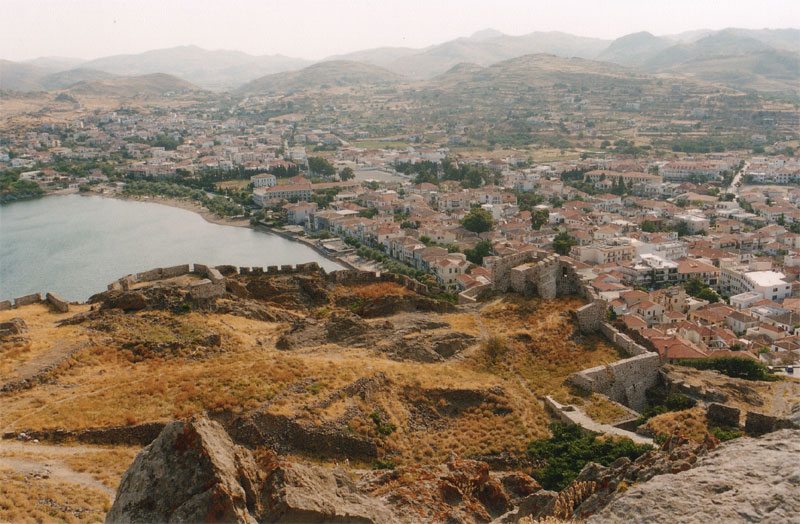
Lemnos — a quiet volcanic island in the northern Aegean
Lemnos is a quiet volcanic island in the northern Aegean. Its long sandy beaches, Bronze Age ruins and windy shores reward slow travel.
Quick Facts
| Item | Figure |
|---|---|
| Name | Lemnos (Greek: Λήμνος; German: Limnos) |
| Type | Island, Lemnos regional unit, North Aegean region |
| Location | Northern Aegean, between Mount Athos and the Dardanelles |
| Coordinates | 39.916667° N, 25.25° E |
| Country | Greece |
| Region | North Aegean |
| Capital | Myrina, on the west coast |
| Area | 477.6 km², the eighth largest island of Greece |
| Population | 16,411 (2021 census, whole island) |
| Highest point | Mount Vigla, 470 m |
| Coastline | More than 260 km, with more than 30 sandy beaches |
| Airport | Lemnos International Airport (LXS), near Myrina |
| UNESCO status | Lemnos has no World Heritage property and no site on the tentative list of Greece; Greece has 21 World Heritage properties |
| Wikidata code | Q192483 |
Lemnos, in Greek Λήμνος and in German usually written Limnos, is a Greek island in the northern Aegean, known for its long sandy beaches, its traditional stone villages and the Bronze Age settlement of Poliochni, one of the oldest towns in Europe. German visitors, the largest international group searching for the island, usually use the phrases “griechenland limnos” or “limnos griechenland”, together with “limnos urlaub” and “urlaub limnos”, when planning a holiday.
Lemnos is a destination for travellers who want a slow Greece: wild beaches, archaeological sites bound up with mythology, small fishing villages and local food with Kalathaki Limnou cheese and Muscat wine. The island’s capital is Myrina, a graceful port town beneath a Byzantine castle, and Moudros Bay was once an important naval base in the First World War.
Geography of Lemnos
A volcanic island between Athos and the Dardanelles
Lemnos lies in the northern Aegean, between the Athos peninsula to the west and the Dardanelles strait to the east, not far from the Turkish mainland. Its coordinates are 39.916667° N, 25.25° E, and the island belongs to the North Aegean region of Greece, together with Lesbos, Chios, Samos and Ikaria.
The terrain of Lemnos is mainly volcanic, with most of the island made up of plains and low hills, while the west and north-west are rougher and more mountainous, with the highest point, Mount Vigla, at 470 metres. The island has more than 30 sandy beaches, mostly on the south and east coasts, together with the Gomati sand dunes in the north, a rare stretch of sand in Greece, and two salt lakes, Alyki and Chortarolimni, where flamingos stop during migration.
Wind, beaches and the meltemi
The climate of Lemnos is Mediterranean, with hot and dry summers, mild winters and much wind, and the island is known as one of the windiest places in the Aegean. The summer wind, called the meltemi, blows strongly from the north, making Lemnos an ideal destination for kitesurfing and windsurfing, above all at Keros beach in the south-east.
The capital Myrina lies on the west coast, with the ferry port, the hospital, shops, restaurants and bars, and it is the administrative centre of the whole island. The second largest town is Moudros, on the eastern shore of the great bay in the middle of the island, a deep natural bay that was once an important naval base.
Salt lakes, dunes and protected nature
Around 34,000 hectares of Lemnos lie within the Natura 2000 nature conservation network, a share of the island that reflects how much of its landscape remains wild. The two salt lakes, Alyki and Chortarolimni, fill with water in winter and dry to salt flats in summer, and flamingos stop there during migration, together with herons and other wading birds. The Gomati dunes in the north, a rare stretch of sand in Greece, form a small desert of golden dunes beside a wild beach, and the low volcanic hills around them hold thyme, oregano and wildflowers that feed the island’s bees. The volcanic soil also shapes the island’s farming, with vineyards of Muscat grapes growing in the sandy earth and wheat fields spreading across the central plains.
Coasts, beaches and the wind
The coasts of the island change character from west to east. The west coast, around the capital, is rocky and steep, with the castle hill falling straight into the sea, while the north and east coasts hold long sandy beaches such as Gomati, Keros and Evgatis, where the sand runs for hundreds of metres and the water stays shallow far from the shore. The meltemi wind, which blows from the north in summer, makes the eastern beaches a favourite for windsurfers and kitesurfers, while the sheltered bays of the south, around Platy and Thanos, suit families and swimmers. In winter the same wind drives waves against the cliffs, and the island’s beaches empty except for walkers and fishermen.

Panorama of the Third Australian General Tent Hospital, Lemnos, 1915, by Albert William Savage, gelatin silver print, State Library of New South Wales, PXE 698 — Public domain
History of Lemnos
Myth: Hephaestus, the women of Lemnos and the Argonauts
In Greek mythology, Lemnos is the island bound up with Hephaestus, the god of smiths and fire, who fell onto the island after Zeus threw him from Mount Olympus in a fit of anger. The people of the island rescued and healed Hephaestus, and the island became a centre of his worship, with forges and temples dedicated to him.
Lemnos is also famous for the legend of the women of Lemnos, who killed all the men on the island after being betrayed by their husbands, and then welcomed the Argonauts led by Jason on their voyage to find the Golden Fleece. Queen Hypsipyle of Lemnos loved Jason and bore him two sons, and the story became one of the best-known legends of Greek mythology.
Poliochni and the Bronze Age
The settlement of Poliochni, on the eastern side of the island, is one of the most important archaeological sites of Lemnos and of the whole Aegean. Poliochni was founded around the fifth millennium BC and grew into an organised town with houses, streets, a drainage system and public areas, which makes it one of the oldest towns in Europe.
Near Poliochni lies the Kabeiria area, where the Kabeiroi gods were worshipped in a mystery cult, and the ancient city of Hephaestia, the largest city of the island in antiquity, on the northern shore of Pournias Bay. Ancient Myrina, on the site of the modern town of Myrina, was the second most important city of the island, with a busy harbour and public buildings.
From Athens to the Ottomans and modern Greece
In antiquity, Lemnos passed in turn under the control of the Persians, Athens, Macedonia and Rome, and the island was an important member of the Delian League led by Athens in the fifth century BC. Athens settled its own citizens on the island as cleruchs, farmer-soldiers who kept the land while remaining Athenian citizens, and Lemnos supplied Athens with grain and soldiers for generations. The island then fell to the Venetians, and the Ottoman Empire conquered it in 1479, ruling it for more than four centuries, until 1912.
The fortress that crowns the hill above the capital belongs to this long history of changing rulers. The castle was first built in the Byzantine period, then rebuilt by the Venetians and later by the Ottomans, and its walls still run along the ridge between the two bays of the town, with the remains of a mosque and a powder store inside. From the walls, the view takes in the whole of the capital, the ferry port below and the open sea to the west, and the climb to the castle at sunset is one of the best walks on the island. The castle also explains why the capital grew where it did, on the narrow neck of land between two sheltered bays, with the fortress guarding the entrance to both.
In 1912, during the First Balkan War, Lemnos was annexed to Greece, and Moudros Bay quickly became an important naval base. During the First World War, Moudros Bay was the main base of the Allies in the Gallipoli campaign of 1915, and the Armistice of Moudros, by which the Ottoman Empire surrendered to the Allies, was signed aboard HMS Agamemnon in Moudros Bay on 30 October 1918. The bay also served as the staging post for the Australian and New Zealand troops who landed at Gallipoli, and the Commonwealth war cemeteries at Portianou and Moudros still mark the island’s part in the campaign.
After the First World War, Lemnos went through the population exchange of 1923 between Greece and Turkey, when the Muslim community left the island and Greeks from Asia Minor came to settle. In 2011, the Kallikratis administrative reform merged the old municipalities of the island into a single municipality named Lemnos, with Myrina as its capital.
Timeline
| Year | Event |
|---|---|
| Around the 5th millennium BC | The settlement of Poliochni is founded, one of the oldest towns in Europe |
| 5th century BC | Lemnos is a member of the Delian League led by Athens |
| 13th century | Myrina Castle is built to protect the harbour in the Byzantine period |
| 1479 | The Ottoman Empire conquers Lemnos; the island stays under Ottoman rule for more than four centuries |
| 1912 | Lemnos is annexed to Greece in the First Balkan War |
| 1915 | Moudros Bay is the main Allied base in the Gallipoli campaign |
| 30 October 1918 | The Armistice of Moudros is signed aboard HMS Agamemnon; the Ottoman Empire surrenders |
| 2021 | The population of the whole island is 16,411 according to the census |

Archaeological Museum of Lemnos (former Turkish headquarters) — CC BY-SA 4
Travel to Lemnos
Starting from Myrina
Visitors to Lemnos usually start from Myrina, the capital, where the Byzantine castle stands on a hill above the harbour and the bay, together with the Archaeological Museum of Lemnos, which displays finds from Poliochni, Hephaestia, Kabeiria and ancient Myrina. The town of Myrina has two sandy beaches inside the town, Romeikos Gialos and Plati, and an old quarter with stone-paved lanes, cafes and seafood restaurants.
Getting to Lemnos is an important part of the plan, and German visitors often search with the phrases “flug nach limnos” for flights, “limnos anreise” for the journey in general and “limnos pauschalreise” for package holidays. Lemnos International Airport (LXS) lies about 18 km from Myrina, with flights from Athens and Thessaloniki, together with some seasonal international flights from Europe.
Getting around and eating well
Hiring a car is the best way to explore Lemnos, because the sights are scattered across the island and public buses run on a limited schedule, especially in the low season. From Myrina, visitors can drive to Poliochni and Kabeiria in the east in about 30 minutes, to Keros beach in the south-east for kitesurfing, and to the Gomati dunes in the north for a rare sandy landscape.
Lemnos is famous for Kalathaki Limnou, a white cheese protected by geographical indication, Muscat wine made from Alexandria grapes, thyme honey and the traditional flomaria pasta. Visitors should try fresh seafood at the coastal restaurants of Myrina and Moudros, together with local dishes such as roast lamb and seasonal vegetables.
The beaches of Lemnos are one of the main reasons visitors return, with more than 30 sandy beaches along the southern and eastern coasts. Plati and Thanos near Myrina suit families, with shallow water and coastal restaurants, while Evgatis and Agios Ioannis in the east are quieter and suit visitors who want to sunbathe in privacy. Visitors should bring swimwear, sunscreen and drinking water, because some wild beaches have no sunbed hire or food stalls.
Notable Places in Lemnos
The settlement of Poliochni. The most important archaeological site of Lemnos, a Bronze Age town founded around the fifth millennium BC, with houses, streets and a drainage system, regarded as one of the oldest towns in Europe.
Myrina Castle. A Byzantine castle built in the thirteenth century on a hill above Myrina harbour, with walls and towers surviving to this day.
The Archaeological Museum of Lemnos. A museum in Myrina displaying finds from Poliochni, Hephaestia, Kabeiria and ancient Myrina, including pottery, metalwork, statues and Bronze Age tools.
Keros beach. A long beach in the south-east of the island, famous as one of the best kitesurfing and windsurfing spots in Greece, thanks to the strong and steady meltemi wind in summer.
The Gomati dunes. A wide sandy area in the north of the island, one of the rare sandy landscapes in Greece, with long golden dunes and a wild beach beside them.
Moudros Bay. A large natural bay in the middle of the island, once an important naval base in the First World War and the place where the Armistice of Moudros was signed in 1918.
The Kabeiria area and Hephaestia. Two archaeological sites in the north of the island, with the sanctuary of the Kabeiroi gods and the ruins of Hephaestia, the largest city of Lemnos in antiquity.
The villages of Kontias and Plaka. Two traditional villages of Lemnos, with houses of volcanic stone, stone-paved lanes and local cafes.
Plati and Thanos beaches. Two long sandy beaches in the south of the island, near Myrina, with shallow and clear water, suited to families with children and to visitors who want a relaxing swim. Plati lies right beside the town of Myrina, while Thanos lies a few kilometres to the south, with coastal restaurants and a quieter atmosphere.
Frequently Asked Questions
Does Lemnos have any UNESCO World Heritage property?
No. Lemnos has no UNESCO World Heritage property, and no site on the island is on the tentative list of Greece, according to the Greece country page of UNESCO checked on 19/11/2026. The current tentative list of Greece holds 11 sites, and Poliochni is not among them, although the settlement is often described as one of the oldest towns in Europe.
How do visitors reach Lemnos?
Visitors can reach Lemnos by plane or by ferry, and German visitors often search with the phrases “flug nach limnos” for flights and “limnos anreise” for the journey in general. Lemnos International Airport (LXS) lies about 18 km from Myrina, with flights from Athens and Thessaloniki, together with some seasonal international flights from Europe.
When is the best time to visit Lemnos?
The best time to visit Lemnos is from May to October, when the weather is stable, the sea is warm and most tourist services are open. Summer, from June to September, is the high season with temperatures of 25 to 30 degrees Celsius and a strong meltemi wind, ideal for kitesurfing at Keros beach. Spring, from April to May, is also beautiful, with wildflowers across the island and pleasant temperatures, though the sea is still colder than in summer.
Is Lemnos suited to a family holiday?
Yes, Lemnos suits a family holiday very well, with long sandy beaches that are safe for children, peaceful towns and a slow pace of life. German visitors often search for package holidays with the phrase “limnos pauschalreise”, and the island has many holiday apartments and family guesthouses, above all in Myrina and around the southern beaches.
What is special about Poliochni?
Poliochni is a Bronze Age settlement founded around the fifth millennium BC, with houses, streets and a drainage system, regarded as one of the oldest towns in Europe. Poliochni is not on the tentative list of World Heritage properties of Greece, so visitors should not confuse its archaeological importance with UNESCO status.
What should visitors eat on Lemnos?
Lemnos is famous for Kalathaki Limnou, a white cheese protected by geographical indication, Muscat wine made from Alexandria grapes, thyme honey and the traditional flomaria pasta. Visitors should try fresh seafood at the coastal restaurants of Myrina and Moudros, together with local dishes such as roast lamb and seasonal vegetables.
Verified
The Wikidata record for Q192483 classifies Lemnos as an island in Greece, at 39.916667° N, 25.25° E, and the record is for the island itself, not for the town of Myrina. The island of Lemnos covers 477.6 square kilometres, making it the eighth largest island of Greece, with a population of 16,411 according to the 2021 census and Myrina as its capital.
The highest point of the island is Mount Vigla, at 470 metres, and around 34,000 hectares of the island lie within the Natura 2000 nature conservation network. Lemnos has no World Heritage property, and Greece has 21 World Heritage properties, 18 cultural and 3 mixed. The tentative list of Greece holds 11 sites, and Poliochni is not among them. The Armistice of Moudros was signed aboard HMS Agamemnon in Moudros Bay on 30 October 1918, by which the Ottoman Empire surrendered to the Allies.
The nearest World Heritage property to Lemnos is Mount Athos, reference 454, inscribed in 1988 under criteria (i)(ii)(iv)(v)(vi)(vii), covering 33,042 hectares with twenty monasteries. The nearest point of the Mount Athos property lies about 46 km west of Lemnos by straight line, while Delos, reference 530, lies about 280 km away, so Mount Athos, not Delos, is the nearest inscribed property.
Sources
- Wikidata, item Q192483 (Lemnos), checked 23/11/2026 — https://www.wikidata.org/wiki/Q192483
- UNESCO, Greece country page, checked 23/11/2026 — https://whc.unesco.org/en/statesparties/gr
- UNESCO, “Mount Athos”, reference 454, checked 23/11/2026 — https://whc.unesco.org/en/list/454/
- UNESCO, “Delos”, reference 530, checked 23/11/2026 — https://whc.unesco.org/en/list/530/
- Wikipedia, “Lemnos”, checked 23/11/2026 — https://en.wikipedia.org/wiki/Lemnos
Unverified
- Flight and ferry prices to Lemnos in the 2026 tourist season, because prices change with the booking time and the carrier, and only the carrier’s official information is exact.
- The detailed ferry timetable from Piraeus and Kavala to Lemnos in summer 2026, because ferry schedules change with the season.
- The current opening hours of the Archaeological Museum of Lemnos and the Poliochni site, because opening hours can change with the season.
- The exact absolute number of beaches on the island, because sources give different figures, from more than 30 beaches to higher numbers, depending on how they are counted.
- The exact absolute date of the Poliochni settlement, because sources give different points within the fifth millennium BC.
Illustrations
- Hero: View of Lemnos. Free image: https://upload.wikimedia.org/wikipedia/commons/6/6d/MirinaLimnosGreece.jpg — Public domain.
- In body, Lemnos: Archaeological Museum of Lemnos (former Turkish headquarters). Free image: https://upload.wikimedia.org/wikipedia/commons/9/9c/Archaeological_Museum_of_Lemnos_%28former_Turkish_headquarters%29_-_1.jpg — CC BY-SA 4.
- In body, Lemnos: Panorama of the Third Australian General Tent Hospital, Lemnos, 1915, by Albert William Savage, gelatin silver print, State Library of New South Wales, PXE 698. Free image: https://upload.wikimedia.org/wikipedia/commons/c/c9/Australian_tent_hospital_Lemnos_1915_SLNSW_FL1523749.jpg — Public domain.