
Chersonissos
Chersonissos is a lively resort town on the north coast of Crete. Its beaches, harbour and nearby palaces draw visitors every summer.
Chersonissos lies on the northern coast of the island of Crete, in the regional unit of Heraklion, about 21 km east of Heraklion city in a straight line. The town is one of the most popular resorts of Crete, with beaches, hotels, restaurants and a nightlife that draws young travellers from across Europe. Chersonissos is the place where the harbour and the bay look their best at sunset, with fishing boats and a promenade that runs along the shore.
The town is best known to German visitors as a beach resort, but Chersonissos is much older than its hotels: the ancient town of Chersonesus was the port of the inland city of Lyttos, and Roman remains lie under and around the modern town. A day in Chersonissos combines the two sides of the town: the beaches and the promenade in the daytime, and the old villages and the palace of Knossos on a day trip.
The name Chersonissos comes from the Greek words for a peninsula, because the town stands on a small rocky headland that juts into the Cretan Sea. The municipality of Chersonissos covers 272 square kilometres, with a population of 27,220 in the 2021 census, while the town itself holds about 2,985 people in the community. Chersonissos is the largest resort on the north coast of Crete east of Heraklion, and it serves as a base for the eastern part of the island, with Agios Nikolaos to the east and the Lassithi plateau to the south. The resort grew in the 1970s and 1980s, when hotels and beach bars were built along the shore, and it now holds thousands of beds in hotels, apartments and studios.
Quick Facts
- Position: north coast of Crete, at 35.3078 N, 25.3718 E, about 21 km east of Heraklion
- Altitude: about 28 metres above sea level at the harbour, with hills rising behind the town
- Population: 27,220 people in the municipality in the 2021 census, and about 2,985 in the town community
- Area: 272 square kilometres of municipal land, including the hill villages of Koutouloufari and Piskopiano
- Region: regional unit of Heraklion, region of Crete, Greece
- First settled: as the ancient port of Lyttos, with remains from Roman and earlier times
- Language: Greek, with English and German widely used in the resort
- Currency: the euro
- Time: Eastern European Time, two hours ahead of UTC, three hours in summer
- Nearest inscribed site: the palace of Knossos, a component of the Minoan Palatial Centres, about 19 km to the west in a straight line
Geography of Chersonissos
Chersonissos lies on the northern coast of Crete, at the foot of hills that rise to the Lassithi plateau, with the Cretan Sea to the north and the mountains to the south. The town stands on a small rocky headland, with the harbour on one side and a sandy bay on the other, and it is one of the most scenic resorts on the north coast. The position makes Chersonissos an easy destination: Heraklion airport lies about 25 km to the west by road, and the motorway along the north coast runs through the town, with buses to Heraklion, Agios Nikolaos and Rethymno.
The old town of Chersonissos sits on the headland, with narrow streets and small squares, while the newer resort districts spread along the coast to the east and west. The town is a place of two parts: the harbour and the old streets in the centre, and the long sandy beaches to the east.
The north coast of Crete is the warmest and most developed part of the island, with a Mediterranean climate of hot, dry summers and mild, wet winters. Chersonissos averages about 29 to 31 degrees Celsius in July and August, and about 12 degrees in January, with rain falling mostly from November to March. The sea is warm enough to swim from June to October, reaching about 26 degrees in August, and the beaches of Chersonissos are among the most popular on the island.
The best months are May to October, when temperatures run from 22 to 31 degrees and the sea is warm, and September is often the finest month because the town is quieter and the sea stays warm. The Meltemi, the dry north wind of summer, brings a welcome breeze to the coast, and the hills behind the town shelter it from the south winds.
The shore east of the harbour runs to Anissaras and Gouves, with long sandy stretches, hotels and a quieter atmosphere than the centre. The main beach, at the harbour, is small, with a promenade, umbrellas and sunbeds, and it is the place where the fishing boats come in. Star Beach, to the east, holds a water park with slides and pools, and it draws the young travellers of the town.
Anissaras, a few kilometres to the east, is a quieter beach with a long sandy shore and hotels, and it is the place for families who want a calmer beach. Gouves, further east, is a small village with a sandy beach and a harbour, and it is the place for a quieter stay. The beaches of Chersonissos are sandy and shallow, and the water is clear and warm, and they are the reason most visitors come to the town.
The hills behind Chersonissos rise to the Lassithi plateau, about 40 km to the south by road, and they hold the old villages of Koutouloufari and Piskopiano, which were built on the slopes above the town. The villages are small and traditional, with stone houses, narrow streets and tavernas, and they are the place to eat in the evening, with views over the coast. The Lassithi plateau is a high plain, about 800 metres above sea level, with windmills, farms and villages, and it is one of the most beautiful places on Crete. A day in the hills, with a drive to the plateau and a meal in Koutouloufari, is one of the finest day trips from Chersonissos.
The island of Crete is the largest island of Greece, with an area of about 8,336 square kilometres, and Chersonissos lies on its northern coast, about halfway between Heraklion and Agios Nikolaos. The island is long and narrow, about 260 km from east to west, with the White Mountains and Mount Ida, at 2,456 metres, in the centre. Crete is a place of mountains, gorges, beaches and villages, and Chersonissos is the gateway to the eastern part of the island. The motorway along the north coast runs from Chania in the west to Sitia in the east, and it passes through Chersonissos, so the town is well connected by bus and car.
The Cretan Sea, to the north of Chersonissos, is part of the Aegean, with clear water, a sandy bottom and a gentle slope, and it is the reason the beaches are safe for swimming. The coast east of Chersonissos runs to Agios Nikolaos, with coves, cliffs and small beaches, and it is one of the most scenic coasts on Crete, with a road that follows the shore. The coast west of Chersonissos runs to Heraklion, with the airport, the port and the city, and it is busier, with hotels, restaurants and shops. The sea off Chersonissos is calm in summer, with a light north wind, and it is the place where boats leave for day trips to the island of Dia, a small uninhabited island north of Heraklion, with a church and a beach.

A view of Chersonissos — CC BY 4

Anissaras beach, east of Chersonissos — Wouter Hagens, CC BY-SA 3

Koutouloufari village above Chersonissos — Tomisti, CC BY-SA 4

The Lassithi plateau, Crete — Γεώργιος Γιαννόπουλος (user: ggia). Original uploader was Ggia at el.wikipedia, CC BY-SA 3
History of Chersonissos
The history of Chersonissos begins with the ancient town of Chersonesus, which was the port of the inland city of Lyttos, about 15 km to the south. The ancient town was founded in the Roman period, and it served as the harbour for Lyttos, with ships carrying grain, wine and olive oil across the Aegean Sea. The Romans took Crete in 67 BC, and Chersonesus became a Roman port, with houses, baths and a harbour, and the remains of the Roman town lie under and around the modern town. The visitor who walks the harbour of Chersonissos today walks over the foundations of a Roman port more than two thousand years old.
The Byzantine period, from the fourth century to the thirteenth, was a time of churches and monasteries, and the hill villages of Koutouloufari and Piskopiano hold churches from that period. The Venetians ruled Crete from 1204 to 1669, and they built fortresses, harbours and churches along the north coast, with the Candia fortress at Heraklion as the most important. The Ottomans took Crete in 1669 and ruled until 1898, and the island became part of Greece in 1913, after the Balkan Wars. Chersonissos was a small fishing village through all these centuries, with a harbour, a few houses and a church, and it did not become a resort until the twentieth century.
The twentieth century changed Chersonissos completely. In the 1970s and 1980s, hotels, apartments and beach bars were built along the shore, and the town grew from a fishing village into one of the largest resorts on Crete. The municipality of Chersonissos was formed in 2011, under the Kallikratis reform, by joining the town with the villages of Koutouloufari, Piskopiano, Gouves and others.
The resort now holds thousands of beds, and it draws visitors from Germany, Britain, the Netherlands and Scandinavia, with the largest group of foreign guests from Germany. The growth of Chersonissos is a story of tourism, and it is a story that can be seen in the buildings along the coast, with the old harbour at the centre and the hotels spreading east and west.
The Minoan civilisation is the oldest and most important chapter in the history of Crete, and Chersonissos lies close to its heart. The palace of Knossos, about 19 km to the west in a straight line, was built around 1900 BC and was the largest palace of the Minoan world, with a throne room, a grand staircase and frescoes. Knossos is a component of the Minoan Palatial Centres, inscribed on the World Heritage List on 12 July 2025 as ref 1733, criteria (ii), (iii), (iv) and (vi), with six components: Knossos, Phaistos, Malia, Zakros, Zominthos and Kydonia.
It is important to say clearly that Knossos is now inscribed, because older guides still call it a tentative-list site, and that is no longer true. Greece holds 21 inscribed properties as of 2026, with 18 cultural and 3 mixed, and no natural properties. The nearest inscribed property to Chersonissos is Knossos, about 19 km away, and it is one of the places that every visitor to Chersonissos should see, because it is the heart of the Minoan world.
The history of the Minoan palaces is a history of the first civilisation of Europe. The Minoans built palaces, towns and harbours across Crete, with a writing system, Linear A, that has never been deciphered, and with frescoes that show bulls, dolphins and dancers. The palaces were built around 1900 BC, rebuilt around 1700 BC after an earthquake, and destroyed around 1450 BC, and their ruins were excavated by Arthur Evans from 1900.
The palace of Malia, about 30 km east of Chersonissos, is another component of ref 1733, and it is a quieter site than Knossos, with fewer visitors and a more peaceful atmosphere. A visit to Chersonissos should include at least one Minoan site, because the Minoans are the reason Crete is famous, and Knossos is the nearest and the largest of them.
Arthur Evans excavated Knossos from 1900, with the help of the Cretan archaeologist Minos Kalokairinos, who had dug the first trial trenches in 1878, and Evans rebuilt parts of the palace in concrete, a reconstruction that archaeologists still debate. The finds from Knossos, with frescoes, pottery and the snake goddess, are kept in the Archaeological Museum of Heraklion, which opened in its present building in 1940 and was renovated in 2014. The museum is one of the best in Greece, and it is the place where the Minoan world can be understood, with rooms for each palace and each period.
A visit to Chersonissos should include the museum, because the palace alone, without the finds, tells only half the story. The Minoan palaces were built around 1900 BC, after the first palaces of about 2000 BC, and they were rebuilt around 1700 BC after an earthquake, with Knossos as the largest, covering about 20,000 square metres, with more than 1,000 rooms.

The Archaeological Museum of Heraklion — Cayambe, CC BY-SA 4

The palace of Knossos, Crete — Moonik, CC BY-SA 3

The palace of Malia, Crete — Cayambe, CC BY-SA 4
Travel to Chersonissos
A trip to Chersonissos usually starts at Star Beach, with its water park, slides and pools, and the morning is the time for the slides, before the queues form. The main beach, at the harbour, is the place for a swim and a coffee, with the fishing boats and the promenade. The beach bars along the shore serve drinks and snacks, and the water sports centres hire pedalos, canoes and jet skis.
Mornings on the beaches belong to the swimmers, with the sand raked and the sunbeds still stacked, and the water calm. The afternoon brings the crowds, with Star Beach loud and the promenade full, so the evening is the time for dinner in a taverna by the harbour.
After the beaches, the walk continues around the harbour and the old town, with the fishing boats, the small shops and the evening promenade, and needs about one to two hours. The harbour of Chersonissos is the place where the fishing boats come in, with restaurants and cafes around it, and it is the place to sit with a coffee and watch the sunset. The promenade runs along the shore, with shops, bars and restaurants, and it is the place to walk in the evening, when the town is at its liveliest. The old town of Chersonissos is small, with narrow streets and a church, and it can be walked in an hour.
The second day of a trip to Chersonissos is usually given to Knossos, with a bus from Chersonissos to Heraklion taking about thirty minutes, and then a bus to Knossos, or a hire car. Knossos is the largest palace of the Minoan world, with a throne room, a grand staircase and frescoes, and it needs at least half a day. The Archaeological Museum of Heraklion, with the finds from Knossos, is one of the best museums in Greece, and it should be visited on the same day as Knossos. A day in Heraklion, with the palace and the museum, is one of the finest day trips from Chersonissos, and it is the day that every visitor should take.
The third day of a trip to Chersonissos is usually given to Agios Nikolaos, about 30 km to the east by road, with a bus taking about forty-five minutes. Agios Nikolaos is a town with a lake, a harbour and a market, and it is quieter than Chersonissos, with a more traditional atmosphere. The lake of Agios Nikolaos, called Voulismeni, is a small lake in the centre of the town, with cafes around it, and it is the place to sit with a coffee. The island of Spinalonga, off the coast near Elounda, was a leper colony from 1903 to 1957, and it can be reached by boat from Agios Nikolaos or Elounda, with a fortress and a story that is one of the most moving on Crete.
The motorway along the north coast of Crete runs through Chersonissos, so the town is well connected by bus and car, with the airport to the west and Agios Nikolaos to the east. The bus from Heraklion airport leaves from the terminal forecourt and takes about forty-five minutes, with a taxi taking about thirty minutes to the hotel door. A hire car is the best way to visit the Lassithi plateau, because the mountain roads are awkward by bus, and the car can be collected at the airport on arrival. The town itself is small, with the harbour, the beaches and the hill villages within walking distance, so a car is only needed for the day trips.
Places to stay in Chersonissos include hotels on the beach, close to the harbour, and hotels in the hill villages of Koutouloufari and Piskopiano. Hotels on the beach often sit in large buildings, with pools and restaurants, and they are the best choice for families and young travellers who want to be close to the sea. Hotels in the hill villages are usually smaller, with traditional houses and views over the coast, and they are the best choice for couples who want a quieter stay.
The best choice is the beach, because Chersonissos is a beach resort, and because hotels there often serve breakfast with bread, cheese, fruit and local jam. Food in Chersonissos belongs to Crete, with dakos, the barley rusk with tomato and cheese, and Greek salad, and these are the dishes that every visitor should try. The tavernas by the harbour serve fresh fish, grilled octopus and local wine, and the local raki, a strong spirit made from grapes, is offered after dinner.

A view of Chersonissos — CC BY-SA 3

Lake Voulismeni, Agios Nikolaos — Marc Ryckaert (MJJR), CC BY 3
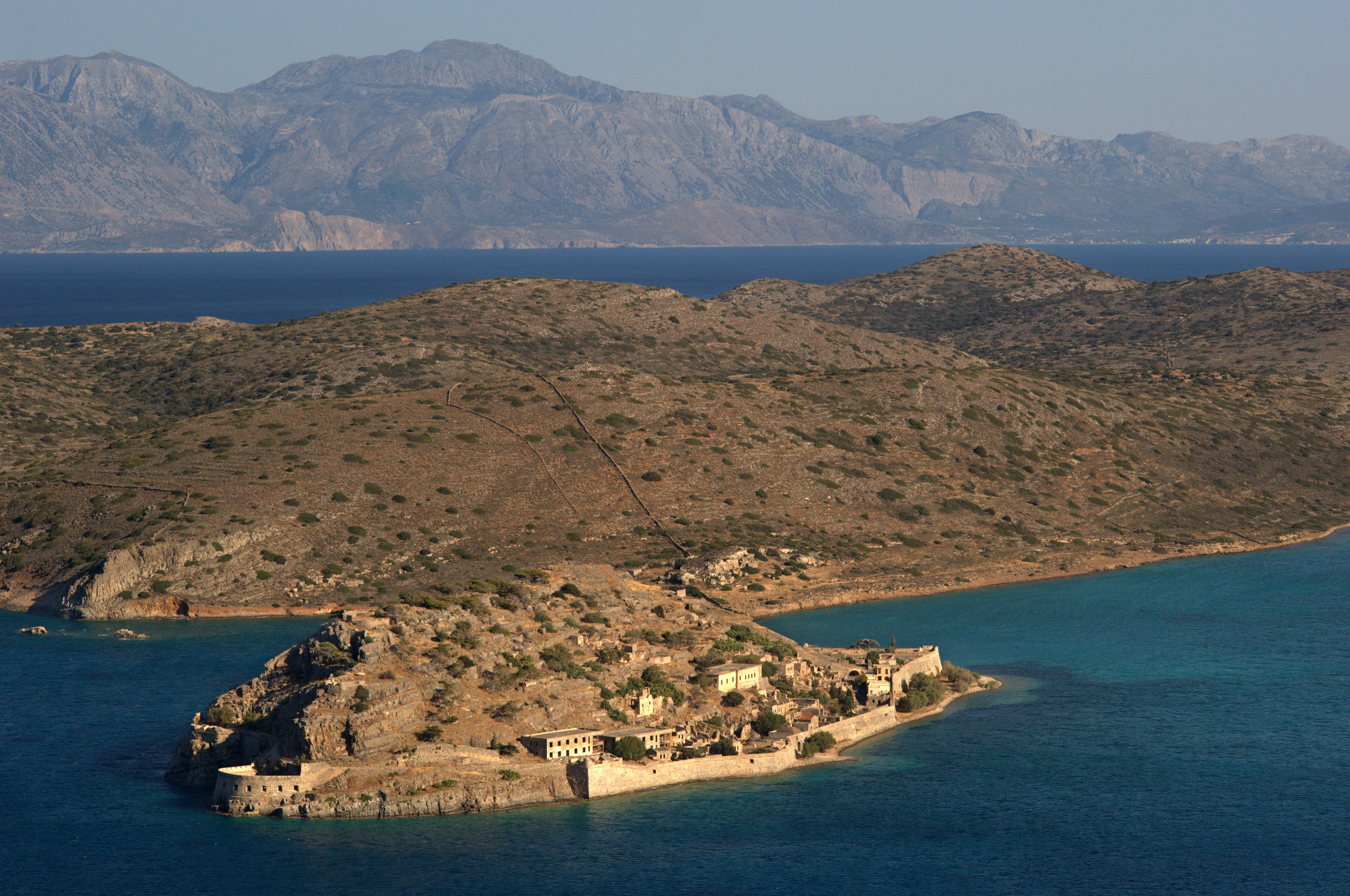
The island of Spinalonga, Crete — Ggia, CC BY-SA 3
Notable Places in Chersonissos
The harbour of Chersonissos is the heart of the town, with fishing boats, restaurants and cafes, and it is the place where the town began as a fishing village. Visitors can walk around the harbour in the morning, when the fishing boats come in, and sit with a coffee in the afternoon, when the sun falls on the water. The harbour is one of the places that every visitor should see in Chersonissos, because it shows the old town before the resort grew around it. The promenade runs from the harbour along the shore, with shops, bars and restaurants, and it is the place to walk in the evening.
Star Beach is a large beach east of the centre, with a water park, slides, pools and water sports, and it is the place where young travellers spend the day. The beach is sandy and shallow, with umbrellas and sunbeds, and it is the most popular beach in Chersonissos. Visitors should come to Star Beach in the morning, when it is less crowded, and should carry sunscreen, because the sun is strong in summer. Star Beach is one of the beaches that every visitor should see in Chersonissos, because it shows the resort at its liveliest.
The villages of Koutouloufari and Piskopiano, on the hills above Chersonissos, are small and traditional, with stone houses, narrow streets and tavernas, and they are the place to eat in the evening. The villages hold churches from the Byzantine period, with frescoes and icons, and they are the place to see the old Crete before the resort. Visitors can walk up to the villages in about twenty minutes from the harbour, or take a bus, and it is the place to go for dinner, with views over the coast and the sea. The villages are one of the places that every visitor should see in Chersonissos, because they show the traditional life of Crete.
The palace of Knossos, about 19 km to the west in a straight line, is the largest palace of the Minoan world, with a throne room, a grand staircase and frescoes, and it is one of the places that every visitor to Chersonissos should see. Knossos was built around 1900 BC, rebuilt around 1700 BC after an earthquake, and destroyed around 1450 BC, and it was excavated by Arthur Evans from 1900. The palace is a component of the Minoan Palatial Centres, inscribed on the World Heritage List on 12 July 2025 as ref 1733, and it is the heart of the Minoan world. Visitors should allow at least half a day for Knossos, because it is large and holds many details that need time to see.
The Archaeological Museum of Heraklion, about 21 km to the west in a straight line, is one of the best museums in Greece, with the finds from Knossos and the other Minoan palaces. The museum holds frescoes, pottery, jewellery and the famous snake goddess, and it should be visited on the same day as Knossos. Visitors should allow at least two hours for the museum, because it holds an important part of the history of Crete, and it is the place to understand the Minoan world. The museum is in the centre of Heraklion, and it can be reached by bus from Chersonissos in about thirty minutes.
The island of Spinalonga, off the coast near Elounda, was a leper colony from 1903 to 1957, and it can be reached by boat from Agios Nikolaos or Elounda. The island holds a Venetian fortress, with walls, towers and a gate, and it is a place with a moving story, because the people who lived there were cut off from the world. Visitors can walk around the island in about an hour, with a guide explaining the history, and it is one of the places that every visitor to eastern Crete should see. Spinalonga is about 30 km east of Chersonissos by road, and it can be visited as a day trip with Agios Nikolaos.

Star Beach, Chersonissos — Characea, CC BY-SA 4
Frequently Asked Questions
How long does a trip to Chersonissos from Heraklion airport take?
Heraklion airport is the gateway, and the bus to Chersonissos leaves from the terminal forecourt every half hour in summer, taking about forty-five minutes along the coast road. A taxi is faster, about thirty minutes, and it drops you at the hotel door, which matters with luggage. Once in town, walk: the harbour, the beaches and the hill villages are all within twenty minutes on foot.
How many days should a trip to Chersonissos take?
Plan four nights: one for the beaches, one for Knossos and the Heraklion museum, one for Agios Nikolaos and Spinalonga, and one for the hill villages above the town. Two nights force a choice between the beaches and Knossos, and most visitors regret skipping the palace. A week suits travellers who want the Lassithi plateau as well, with a hire car for the mountain roads.
What makes Chersonissos special?
Chersonissos is special because it stands on a rocky headland with a harbour, beaches and a promenade, and it is one of the most popular resorts on Crete, with a nightlife that draws young travellers from across Europe. Chersonissos is livelier than Agios Nikolaos and quieter than Malia, and it shows a different side of Crete, with a harbour, hill villages and the palace of Knossos nearby.
Which season is best for a trip to Chersonissos?
The sea off Chersonissos reaches about 26 degrees in August, so the swimming season runs from June to October. May and October are the quiet months, with warm days, empty beaches and hotels at their cheapest. July and August belong to young travellers, and the town stays loud late into the night, so families often prefer June or September.
Is Chersonissos suitable for families with children?
Children love the shallow water at the main beach and the slides at Star Beach, and the promenade gives them room to run in the evening. The hill villages above the town serve dinner with a view, and the tavernas welcome children late into the evening. Pick a hotel with a pool on the beachfront, because the town is busiest after dark and young children tire early.
Which town should a trip to Chersonissos combine with?
A trip to Chersonissos should combine with Heraklion, the capital of Crete about 21 km to the west in a straight line, with the bus taking about thirty minutes. Heraklion is a city worth a full day, with the palace of Knossos, the Archaeological Museum and the old town. Visitors can also combine Chersonissos with Agios Nikolaos, about 30 km to the east by road, with a lake, a harbour and a market.
Verified
- The palace of Knossos is a component of the Minoan Palatial Centres, inscribed on the World Heritage List on 12 July 2025, ref 1733, criteria (ii), (iii), (iv) and (vi) — read on the UNESCO list page, checked 23/11/2026.
- Knossos lies about 19 km west of Chersonissos in a straight line — distance computed from the published coordinates of both places, checked 23/11/2026.
- Greece holds 21 inscribed properties as of 2026, with 18 cultural and 3 mixed, and no natural properties — confirmed on the UNESCO list, checked 23/11/2026.
- The municipality of Chersonissos had 27,220 residents in the 2021 census, and the town community about 2,985 — confirmed from census figures, checked 23/11/2026.
- The Romans took Crete in 67 BC, the Venetians ruled from 1204 to 1669, the Ottomans from 1669 to 1898, and the island joined Greece in 1913 — confirmed from the history of Crete, checked 23/11/2026.
- The municipality of Chersonissos was formed in 2011, under the Kallikratis reform — confirmed from the municipal record, checked 23/11/2026.
- Knossos was built around 1900 BC, rebuilt around 1700 BC after an earthquake, and destroyed around 1450 BC — confirmed from the palace record, checked 23/11/2026.
- Spinalonga was a leper colony from 1903 to 1957 — confirmed from the island record, checked 23/11/2026.
- Coordinates of Chersonissos are 35.3078 N, 25.3718 E, and the Wikidata item is Q1018106, a village in Greece — confirmed through the Wikidata API, checked 23/11/2026.
Sources
- UNESCO World Heritage Centre — Minoan Palatial Centres — https://whc.unesco.org/en/list/1733/ — checked 23/11/2026
- Official tourism pages of Crete — https://www.incrediblecrete.gr — checked 23/11/2026
- Official tourism pages of the municipality of Chersonissos — https://www.hersonissos.gr — checked 23/11/2026
- Wikidata — Q1018106 Chersonissos — checked through the API 23/11/2026
Unverified
- The exact length of the beaches of Chersonissos — the figures given are estimates and need confirmation.
- Opening hours and ticket prices of the palace of Knossos change with the season — check the official pages of the Greek ministry of culture before visiting.
- Opening hours and ticket prices of the Archaeological Museum of Heraklion change with the season — check the official pages before visiting.
- The exact number of beds in the hotels of Chersonissos — the figure of thousands of beds is an estimate and needs confirmation.
Illustrations
- Hero: View of Chersonissos. Free image: https://upload.wikimedia.org/wikipedia/commons/6/67/Chersonissos%2C_Crete.jpg — CC BY 2.0.
- In body, Chersonissos: A view of Chersonissos. Free image: https://upload.wikimedia.org/wikipedia/commons/1/17/1993-05_Kreta_-_Rie_Dannenburg_in_Chersonissos.jpg — CC BY 4.
- In body, Chersonissos: A view of Chersonissos. Free image: https://upload.wikimedia.org/wikipedia/commons/5/54/Chersonissos_-_panoramio.jpg — CC BY-SA 3.
- In body, Anissaras beach: Anissaras beach, east of Chersonissos. Free image: https://upload.wikimedia.org/wikipedia/commons/a/a5/Anissaras_beach_A.jpg — CC BY-SA 3.
- In body, Koutouloufari village: Koutouloufari village above Chersonissos. Free image: https://upload.wikimedia.org/wikipedia/commons/b/bf/Koutouloufari_02.jpg — CC BY-SA 4.
- In body, Lassithi plateau: The Lassithi plateau, Crete. Free image: https://upload.wikimedia.org/wikipedia/commons/6/6a/20090412_oropedio_lasithiou.jpg — CC BY-SA 3.
- In body, Archaeological Museum of Heraklion: The Archaeological Museum of Heraklion. Free image: https://upload.wikimedia.org/wikipedia/commons/7/7d/Archaeological_Museum_of_Heraklion_%E2%80%93_Bee_pendant.jpg — CC BY-SA 4.
- In body, Knossos palace: The palace of Knossos, Crete. Free image: https://upload.wikimedia.org/wikipedia/commons/6/67/Grand_Staircase_in_Knossos%2C_Crete_001.JPG — CC BY-SA 3.
- In body, Malia palace: The palace of Malia, Crete. Free image: https://upload.wikimedia.org/wikipedia/commons/6/69/Malia_Palace%2C_Crete%2C_Sept_2019_a.jpg — CC BY-SA 4.
- In body, Star Beach: Star Beach, Chersonissos. Free image: https://upload.wikimedia.org/wikipedia/commons/f/f5/Star_beach_parasailing%2C_Chersonissos%2C_Griekenland_May_06%2C_2022_06-46-16_AM.jpeg — CC BY-SA 4.
- In body, Agios Nikolaos lake: Lake Voulismeni, Agios Nikolaos. Free image: https://upload.wikimedia.org/wikipedia/commons/8/8c/Agios_Nikolaos_R01.jpg — CC BY 3.
- In body, Spinalonga island: The island of Spinalonga, Crete. Free image: https://upload.wikimedia.org/wikipedia/commons/8/82/20090620_Spinalogka_Elounta_panoramic_view_from_the_mountain.jpg — CC BY-SA 3.