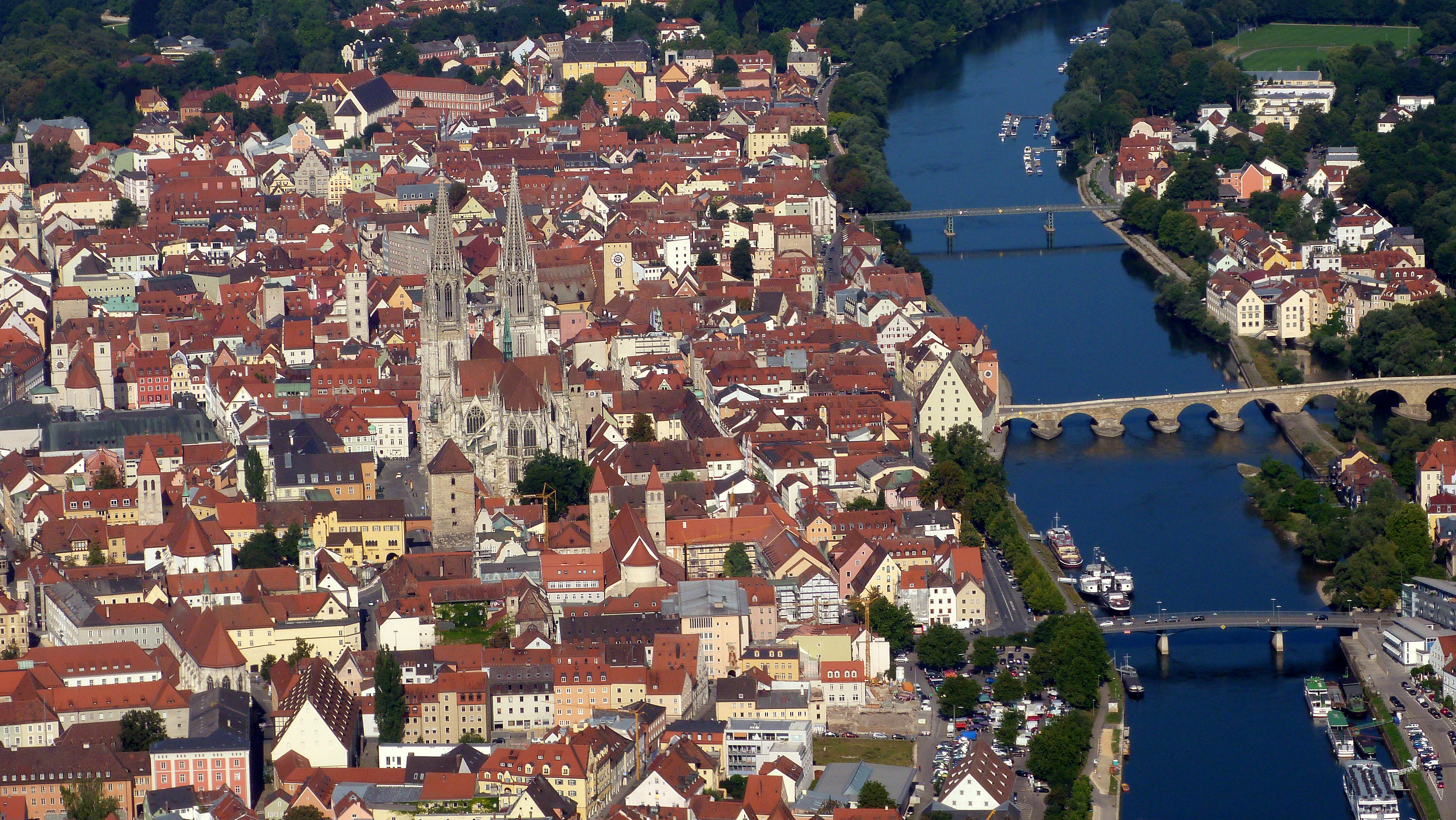
Regensburg: The Stone Bridge on the Danube
Regensburg is a city on the Danube in Bavaria. Its Stone Bridge and old town are the best-preserved medieval city in Germany.
The Romans built a camp here in AD 179, under the emperor Marcus Aurelius, and called it Castra Regina, the camp on the Regen. The medieval city that grew from the camp became one of the great trading cities of Europe, and its merchants sailed the Danube to Vienna and beyond, and its patrician houses, with their tall towers, still stand in the old town. The cathedral of Saint Peter, begun around 1275, is the finest Gothic church in Bavaria, and the Old Town Hall held the Perpetual Imperial Diet from 1663 to 1806, when the city was the seat of the Holy Roman Empire. Regensburg was inscribed on the UNESCO World Heritage List in 2006, and the old town survived the Second World War almost intact, so that the medieval city can still be walked as it was eight hundred years ago.
Quick Facts
| Item | Detail |
|---|---|
| River and state | Regensburg, on the Danube in Bavaria, Germany |
| Population | About 159,000 people in the city |
| Bridge | The Stone Bridge, built 1135 to 1146, the oldest stone bridge on the Danube |
| Inscribed | Old Town of Regensburg, ref 1155, inscribed 2006 |
| Roman camp | Castra Regina, founded AD 179 under Marcus Aurelius |
| University | Founded in 1962, with about 21,000 students |
| Nearest separate World Heritage property | Town of Bamberg, ref 624, about 130 km straight-line to the northwest |
Geography of Regensburg
Regensburg stands at the northernmost bend of the Danube, where the river turns south and the Regen joins it from the north, and the city is built on both banks of the Danube and on the islands between its arms. The old town sits on the southern bank, on a slight rise above the river, and the district of Stadtamhof lies on the northern bank, joined to the old town by the Stone Bridge. The Danube at Regensburg is wide and slow, and the river carries shipping between the Black Sea and the Rhine, with the Main-Danube Canal joining the river west of the city. The Regen, a smaller river from the Bavarian Forest, joins the Danube at the eastern edge of the old town, and its name gave the city its Roman name, Castra Regina.
The land around Regensburg is the plain of the Danube, with the Bavarian Forest rising to the northeast and the hills of the Franconian Jura to the northwest. The city stands at about 340 metres above sea level, and the countryside around it is farmland, with fields, hop gardens and the villages of the Upper Palatinate. The Walhalla, a great hall of German fame, stands on a hill above the Danube about ten kilometres east of the city, and its white columns are visible from the river for miles. The Danube valley east of Regensburg is a gorge of limestone cliffs and castles, and the river runs through it to Passau and to Austria.
The climate of Regensburg is continental, with warm summers and cold winters, and the city is one of the driest in Germany, with less rain than the towns of the Bavarian Forest. Summer temperatures reach the high twenties, and the river valley holds the heat, with warm evenings on the terraces of the old town. Winter brings frost and fog, and the Danube can freeze in a cold year, though the ice rarely holds. May to September is the best season for the old town and the river, when the beer gardens are open and the Danube cruises run, and December brings the Christmas markets to the squares of the old town.
The Danube at Regensburg splits around low islands, and the district of Stadtamhof stands on the northern bank, with the Stone Bridge joining it to the old town. The river promenade runs along the southern bank, and the boats that moor there carry passengers to Passau, to Vienna and to the gorge at Kelheim.
Regensburg is the capital of the Upper Palatinate, and it is the fourth largest city in Bavaria, after Munich, Nuremberg and Augsburg. The city is compact, and the old town fits inside the medieval walls, so that a visitor can walk from the cathedral to the Stone Bridge in ten minutes. The university, founded in 1962, lies south of the old town, and its students give the city a young and lively character. The Danube is the centre of the city, and the river promenade, the bridges and the islands are the places where the people of Regensburg walk, cycle and sit in the sun.
History of Regensburg
Regensburg began as a Roman camp, Castra Regina, founded in AD 179 under the emperor Marcus Aurelius, on the northern frontier of the empire. The camp was built of stone, with walls, gates and a headquarters, and the Porta Praetoria, the northern gate of the camp, still stands in the old town, one of the few Roman gates in Germany that survives to its full height. The camp guarded the Danube frontier, and the legion that was stationed there, the Third Italic Legion, held the border against the Germanic tribes for three centuries. The camp became a town, and the town survived the fall of the empire, with the bishops and the dukes of Bavaria making it their seat.
The medieval city grew from the Roman camp, and it became one of the great trading cities of Europe. The Stone Bridge, built between 1135 and 1146, was the first stone bridge across the Danube, and it opened the road from northern Europe to the south, and the merchants of Regensburg sailed the river to Vienna, to Hungary and to the Black Sea. The patrician families of the city built tall towers on their houses, as a sign of their wealth, and the old town still holds more than a dozen of these towers, the most in any German city. The cathedral of Saint Peter was begun around 1275, and it was built in the French Gothic style, with two great spires that were finished only in the nineteenth century.
The city became a Free Imperial City in 1245, and it held the Perpetual Imperial Diet from 1663 to 1806, when the envoys of the princes and cities of the Holy Roman Empire met in the Old Town Hall. The Diet made Regensburg the political centre of the empire, and the city hosted the diplomats of Europe for a century and a half. The Thirty Years’ War brought the Swedes to the city in 1633, and the Napoleonic wars brought the French in 1809, and the city lost its independence in 1810, when it became part of Bavaria. The nineteenth century brought the railway, and the city grew beyond its walls, with new districts and factories along the Danube.
The nineteenth century brought the railway to Regensburg, and the first trains reached the city in 1859, linking it to Nuremberg and to Munich, and the station was built south of the old town, outside the medieval walls. The city grew beyond its walls for the first time, with new districts of houses and factories along the Danube and the railway, and the population rose from about 20,000 in 1800 to more than 50,000 by 1900. The old town was left largely as it was, because the new growth went outside the walls, and that accident of growth is the reason the medieval city survives so complete today. The railway also brought the first tourists, who came to see the Stone Bridge and the cathedral, and the city began its long life as a place that visitors come to walk.
The twentieth century spared Regensburg. The old town survived the Second World War almost intact, because the city was not a major industrial target, and the medieval streets, the cathedral and the Stone Bridge were undamaged. The university was founded in 1962, and the city grew into a centre for the electronics and car industries, with factories on the edge of the town.
The old town was inscribed on the UNESCO World Heritage List in 2006, under criteria (ii), (iii) and (iv), for its medieval townscape and its role in the history of Europe. Regensburg today is a university city and a tourist city, and its old town is the best-preserved medieval city in Germany.
Travel to Regensburg
Regensburg is reached by train from Munich in about an hour and a half, and from Nuremberg in about an hour, with the railway station a short walk from the old town. The station sits south of the medieval walls, and the walk from the station to the cathedral takes ten minutes, through the streets of the old town. Trains run to Vienna, to Passau and to Prague, and the city is on the main line between Munich and the east.
The A3 motorway runs past the city, linking it to Nuremberg and to Passau, and the A93 runs north to the Bavarian Forest. The Danube cruises stop at Regensburg, and the river boats run from the city to Passau, to Vienna and to the gorge of the Danube.
The old town is best explored on foot, and the whole medieval city fits inside the walls, so that a visitor can walk from the cathedral to the Stone Bridge to the Old Town Hall in half an hour. The streets are narrow and cobbled, and the squares hold cafes, beer gardens and markets, and the river promenade runs along the Danube from the Stone Bridge to the east. Bicycles are the best way to see the river, and the Danube cycle path runs through the city, from the Black Forest to the Black Sea. The best time to visit Regensburg is May to September, when the beer gardens are open and the river is busy, and December, when the Christmas markets fill the squares.
The Danube cycle path runs through Regensburg, and it is one of the great cycle routes of Europe, running from the Black Forest to the Black Sea. The path through the city follows the river promenade, and the ride east to the gorge at Kelheim takes an afternoon, with the limestone cliffs and the monastery of Weltenburg on the way. Bicycles are hired in the old town, and the path is flat and paved, so it suits families as well as long-distance riders.
A single day covers the cathedral, the Stone Bridge, the Old Town Hall and the Porta Praetoria, and the old town rewards a slow walk, with its towers, its courtyards and its medieval houses. A second day allows a trip to the Walhalla, ten kilometres east, or a cruise on the Danube to the gorge at Kelheim, or a visit to the town of Passau, an hour east by train. The city is compact and walkable, and the old town is at its best in the evening, when the day visitors have gone and the squares belong to the people of the city.
Notable Places in Regensburg
The Stone Bridge. The Stone Bridge was built between 1135 and 1146, and it is the oldest stone bridge on the Danube, with sixteen arches spanning the river to Stadtamhof. The bridge was the model for the Charles Bridge in Prague, and it carried the road from northern Europe to the south for eight hundred years. The bridge is open to pedestrians and cyclists, and the view from it back to the old town, with the cathedral and the towers, is the classic image of Regensburg.
Regensburg Cathedral. The cathedral of Saint Peter was begun around 1275, and it is the finest Gothic church in Bavaria, with two great spires that were finished only in the nineteenth century. The interior holds the stained glass of the fourteenth century, the largest collection of medieval glass in Germany, and the silver high altar of the seventeenth century. The cathedral choir, the Domspatzen, is one of the oldest boys’ choirs in the world, and its concerts fill the cathedral on Sundays.
The Porta Praetoria. The Porta Praetoria is the northern gate of the Roman camp of Castra Regina, built in AD 179, and it still stands in the old town, one of the few Roman gates in Germany that survives to its full height. The gate is a massive stone arch, with the Roman wall running from it in both directions, and it marks the point where the Roman camp met the Danube. The gate is the oldest building in Regensburg, and it is the reason the city can claim a history of more than eighteen centuries.
The Old Town Hall. The Old Town Hall stands on the Rathausplatz, and it held the Perpetual Imperial Diet from 1663 to 1806, when the envoys of the Holy Roman Empire met in its great hall. The building dates from the thirteenth century, and its tower, its council chamber and its imperial hall are open to visitors, with the furniture and the portraits of the Diet still in place. The square outside the Town Hall is the centre of the old town, with cafes and the Christmas market in December.
The Walhalla. The Walhalla stands on a hill above the Danube about ten kilometres east of Regensburg, and it was built between 1830 and 1842 by King Ludwig I of Bavaria as a hall of fame for the great Germans. The hall is a Greek temple in white marble, and it holds the busts of more than a hundred Germans, from the ancient chieftain Arminius to the modern scientists and artists. The terrace of the Walhalla looks out over the Danube, and the view from it is one of the finest in Bavaria.
Stadtamhof. Stadtamhof lies on the northern bank of the Danube, joined to the old town by the Stone Bridge, and it is the oldest part of the city, with its own church, its own market and its own character. The district was once a separate town, and it was joined to Regensburg in 1924, and its streets hold the sausage kitchen, the old houses and the view back to the cathedral. The district is quieter than the old town, and it is the best place for a walk along the river.
The Sausage Kitchen. The Historic Sausage Kitchen stands beside the Stone Bridge in Stadtamhof, and it has served sausages since the twelfth century, when the builders of the bridge ate there. The kitchen is one of the oldest sausage kitchens in Germany, and its small sausages, served with sauerkraut and mustard, are the classic food of Regensburg. The kitchen is a small building with a terrace on the river, and it is busy at every hour of the day.
The Thurn und Taxis Palace. The palace of the princes of Thurn und Taxis stands in the old town, on the site of the monastery of Saint Emmeram, and it is one of the largest palaces in Germany, with more than five hundred rooms. The palace was the seat of the family that ran the postal service of the Holy Roman Empire, and its state rooms, its stables and its treasury are open to visitors. The palace is the grandest house in Regensburg, and its gardens and its cloister are the quietest places in the old town.
Frequently Asked Questions
How long do I need in Regensburg?
Plan two days. The first belongs to the old town: the cathedral, the Stone Bridge, the Porta Praetoria and the lanes between them. The second is for the river — a boat down the Danube, the Walhalla temple on its hill above Donaustauf, or the train to Passau at the meeting of the Danube, the Inn and the Ilz.
How do I get to Regensburg from Munich?
Trains from Munich take about an hour and a half, and the old town is a ten-minute walk from the station.
What is the Stone Bridge?
The oldest stone bridge on the Danube, built 1135 to 1146, joining the old town to Stadtamhof.
Is Regensburg a UNESCO World Heritage property?
Yes, ref 1155, inscribed in 2006 under criteria (ii), (iii) and (iv).
What is the Walhalla?
A Greek temple in white marble on a hill above the Danube, built by King Ludwig I as a hall of fame for great Germans.
What is the best time to visit Regensburg?
May to September is best, with warm weather and the beer gardens open. December brings the Christmas markets to the squares of the old town.
Verified
- The Stone Bridge was built between 1135 and 1146, and it is the oldest stone bridge on the Danube, with sixteen arches spanning the river to Stadtamhof.
- Castra Regina was founded in AD 179 under the emperor Marcus Aurelius, and the Porta Praetoria, the northern gate of the camp, still stands in the old town.
- The Old Town of Regensburg, ref 1155, was inscribed in 2006 under criteria (ii), (iii) and (iv), and the old town survived the Second World War almost intact.
- The cathedral of Saint Peter was begun around 1275, and its two spires were finished only in the nineteenth century.
- The Walhalla was built between 1830 and 1842 by King Ludwig I of Bavaria, and it stands on a hill above the Danube about 10 km east of Regensburg.
- The Old Town Hall held the Perpetual Imperial Diet from 1663 to 1806, when the envoys of the Holy Roman Empire met in the city.
Sources
- UNESCO World Heritage Centre, Old Town of Regensburg with Stadtamhof, whc.unesco.org/en/list/1155/
- City of Regensburg, history of the city and the Stone Bridge
- Bavarian State Office for Statistics, population data for Regensburg
- Thurn und Taxis Palace, history of the palace and the family
Unverified
- The claim that the Stone Bridge was the model for the Charles Bridge in Prague is the standard account, but the exact influence of one bridge on the other is a matter of architectural history rather than a documented fact.
- The Sausage Kitchen is said to have served sausages since the twelfth century, but the earliest documentary evidence for the kitchen dates from a later period.
Illustrations
- Hero: View of Regensburg. Free image: https://upload.wikimedia.org/wikipedia/commons/2/2f/Regensburger_Altstadt_von_oben_.jpg — CC BY-SA 4.