
Germany Switzerland Tours — Rhine Castles, Romantic Palaces and Alpine Lakes
Munich beer halls give way to Rhine castles and Swiss peaks. A Germany and Switzerland itinerary runs south from river to glacier.
The Rhine draws the first half of a Germany and Switzerland itinerary, and the Alps draw the second. The route follows the river past vineyards and castle ruins, crosses Bavaria to the fairy-tale palaces of King Ludwig the Second, then drops into Switzerland for the lakes of Lucerne and the high valleys of the Bernese Oberland. Two countries share one railway network and one mountain range, and the journey between them feels like a single story told in two accents.
This article takes the river as its thread and the mountains as its climax. It starts with the geography of the Rhine and the Alps, then the history of emperors, monks and romantic kings, then the travel itself, city by city and lake by lake. The notable places, the questions travellers ask, and the verified facts close the piece. A Germany and Switzerland itinerary suits travellers who love castles and trains in equal measure, because the route gives them both without a single long drive.
Quick Facts
- Name: Germany Switzerland Tours.
- Type: Two-country touring route across Germany and Switzerland.
- Thread of the route: The Rhine from Frankfurt to Lake Constance, then the Swiss lakes and the Bernese Oberland.
- Typical length: 9 to 13 days.
- Main stops: Frankfurt, Heidelberg, Stuttgart, Munich, Neuschwanstein, Lucerne, Interlaken, Bern, Zurich.
- River highlight: Upper Middle Rhine Valley, a UNESCO property of castles and vineyards.
- Mountain highlight: The Jungfraujoch station, 3454 m above sea level, reached by rack railway through the Eiger.
- UNESCO sites on the route: Upper Middle Rhine Valley 1066 in 2002, Maulbronn 546 in 1993, Speyer Cathedral 168 in 1981, Palaces of King Ludwig the Second 1726 in 2025, Bern 267 in 1983, Jungfrau-Aletsch 1037 in 2001, Lavaux 1243 in 2007.
- Best months: May to September, for Rhine cruises and open mountain railways.
- Transport: Train, river cruise and touring coach.
- Languages: German in Germany, and German, French, Italian and Romansh in Switzerland.
Geography of Germany Switzerland Tours
A Germany and Switzerland itinerary runs from the river plains of the German west to the high Alps of the Swiss centre, and the Rhine connects the two halves. The river rises in the Swiss Alps, flows north past Lake Constance, turns west through Basel and then north again through the gorge between Bingen and Koblenz, where castles stand on nearly every hill. The journey follows that water south to north in reverse, starting among the vineyards of the Rhine and ending among the glaciers that feed it.
The Upper Middle Rhine Valley forms the most beautiful stretch of the river, a 65 km gorge between Bingen and Koblenz where the Rhine cuts through the Rhenish Slate Mountains. About forty castles and fortresses stand on the hills above the water, and the steep slopes below them carry vineyards terraced for more than a thousand years. The Lorelei rock narrows the river to 130 m at its tightest point, and the valley towns of Bacharach, Oberwesel and Sankt Goar sit along the banks where the river bends. UNESCO listed the valley in 2002 under reference number 1066, and a river cruise through it is the slow heart of a Germany and Switzerland itinerary.
South of the Rhine gorge the land opens into the plains of the upper Rhine, where Heidelberg sits on the river Neckar and Speyer and Mannheim guard the flat country. The Black Forest rises to the east, a dark range of fir woods, waterfalls and clock-making villages, and the Danube begins its long journey eastward from its springs in the same hills. Stuttgart lies in a basin among vineyards to the southeast, and Munich sits further east on the gravel plain at the foot of the Bavarian Alps. The German stage of the journey therefore moves from river gorge to forest to plain, and the mountains grow closer with every day south.
Lake Constance marks the border between Germany and Switzerland, a wide lake where three countries meet and where the Rhine flows in from the Alps and out again toward Basel. The lake towns of Lindau, Friedrichshafen and Konstanz give the route its gentlest water, and the island of Mainau fills with flowers in summer. South of the lake the Swiss plateau begins, a rolling country of farms, small towns and lakes that runs from Basel to Zurich and Bern. A Germany and Switzerland itinerary crosses this plateau quickly, because the mountains beyond it pull every traveller onward.
The Bernese Oberland holds the high country of the route, with the lakes of Thun and Brienz at its foot and the three great peaks of Eiger, Mönch and Jungfrau above them. Interlaken sits between the two lakes, and the railways climb from there to Grindelwald, Lauterbrunnen and the Jungfraujoch, where the Aletsch Glacier spreads below the observatory. No other glacier in the Alps runs longer, and the UNESCO property of Jungfrau-Aletsch covers about 82,400 hectares of ice, rock and high valley. The route then turns west to Bern, the Swiss capital on its loop of the river Aare, and to the Lavaux terraces above Lake Geneva, where the vineyards run for about 30 km.
The climate of the route follows the same north to south pattern as the land, growing warmer in the plains and colder in the mountains. The Rhine valley enjoys mild summers with long evenings on the river, while the Black Forest stays cooler under its fir trees and the Bavarian plain brings warm days and sudden thunderstorms. The Swiss mountains stay cool even in August, and the Jungfraujoch holds snow all year, so a traveller packs a jacket beside the summer clothes.
Summer is therefore the kindest season for a Germany and Switzerland itinerary, since the boats run, the passes stay open and the evenings last long. Winter turns the Bavarian Alps and the Bernese Oberland into ski country, while the Rhine towns grow quiet and the Christmas markets fill the squares.
The rivers and lakes give the journey its shape, and the Rhine alone links every stage from the Alps to the sea. The Neckar joins the Rhine at Mannheim, the Main joins it at Mainz, and the Moselle joins it at Koblenz, each bringing the wine and the towns of its own valley. Lake Lucerne, Lake Thun, Lake Brienz and Lake Zurich add still water to the Swiss stage, and the Rhine Falls near Schaffhausen drop the river over a broad rock ledge on its way north. A Germany and Switzerland itinerary that follows the water never loses its way, and the railway runs beside the river for much of the German stage.
History of Germany Switzerland Tours
The history of a Germany and Switzerland itinerary begins on the Rhine frontier, where Rome drew the border of its empire along the river. Roman legions built forts at Mainz, Koblenz and Cologne, and the Rhine became a highway for wine, grain and soldiers between the Mediterranean and the north. The Limes, the fortified border east of the river, marked the edge of Roman power, and the towns it guarded grew into the cities the route visits today. Speyer Cathedral, founded in 1030 by the emperor Konrad the Second, still shows the scale of the empire that followed Rome, and its crypt holds the tombs of eight medieval emperors.
Monks and emperors shaped the middle Rhine in the centuries after Rome, and their buildings anchor the German stage of the journey. Maulbronn Monastery, founded in 1147, grew into the most complete medieval monastic complex north of the Alps, and its water system of reservoirs, canals and drains still works in the valley around it. UNESCO listed the monastery in 1993 under reference number 546, and its church carried the Gothic style from France across northern and central Europe. The bishops of Speyer, Worms and Mainz ruled the Rhine towns as princes, and their cathedrals, castles and toll stations taxed every boat that passed.
The Romantic movement remade the Rhine in the nineteenth century, and a Germany and Switzerland itinerary still follows the taste it created. Poets and painters came to the ruined castles of the gorge, Lord Byron praised the river in verse, and the Lorelei rock became a legend of a siren who lured sailors to their deaths. The ruined castles were rebuilt as romantic residences, the vineyards were replanted, and the first steamboats carried tourists past the same cliffs the poets had described. The Rhine became the most painted river in Europe, and the castles that had once guarded tolls became hotels and viewpoints.
King Ludwig the Second of Bavaria built the most famous palaces of the route, and his reign from 1864 to 1886 filled the Bavarian Alps with stage-set castles. Neuschwanstein, begun in 1869, rises on a rock above the valley near Füssen, and its white towers have become the image of Germany itself, though the king never finished it and lived there only briefly. Linderhof, Schachen and Herrenchiemsee complete the set, and UNESCO listed all four together in 2025 under reference number 1726, as the palaces of a king who built for art rather than for power. A Germany and Switzerland itinerary that stops at Neuschwanstein meets the romantic dream at its purest, and the crowds at its gates show how widely that dream still travels.
Switzerland built the mountain half of the journey in the same century, when British climbers and Thomas Cook parties discovered the Alps. The Jungfrau Railway, built between 1896 and 1912, climbed through tunnels inside the Eiger and the Mönch to the station at Jungfraujoch, and the Gornergrat Railway and the Pilatus Railway followed the same ambition. Bern, founded in 1191, kept its medieval arcades and its clock tower through all of it, and UNESCO listed its old town in 1983 under reference number 267. The Swiss stage of the route is therefore a nineteenth-century invention as much as the Rhine stage, and the two halves met when the Gotthard Tunnel opened in 1882 and joined the German railways with the Italian lakes.
The twentieth century made the journey a pleasure for the many, as coaches, motorways and rail passes brought a new generation to the Rhine and the Alps. The Gotthard road tunnel opened in 1980 and the Gotthard Base Tunnel followed in 2016, the longest railway tunnel in the world, carrying trains under the mountains in under an hour. The scenic trains kept their slower pace on purpose, because their value lies in the view rather than the speed, and the Rhine cruise boats still run the gorge at walking pace. Germany now counts 55 World Heritage properties and Switzerland counts 13, and a Germany and Switzerland itinerary touches seven of them, from the Rhine gorge to the Lavaux terraces.
Today the route runs on open borders and frequent trains, and the two countries share the Schengen area, so the border at Lake Constance is a line on the map rather than a stop. The castles of the Rhine, the palaces of Ludwig the Second and the glaciers of the Jungfrau now sit on a single ticket of railways and boats, and the journey that once took weeks by coach and steamer takes days by train. A Germany and Switzerland itinerary still ends where the mountains end, on the shores of Lake Geneva or Lake Zurich, and the traveller leaves with the Rhine behind and the Alps in memory.

The courtyard of Maulbronn Monastery in Germany — CC BY-SA 3
Travel to Germany Switzerland Tours
Frankfurt opens a Germany and Switzerland itinerary, and the city gives the route its airport, its railway hub and its first taste of the Rhine. The old town around the Römer square, the cathedral and the river promenade fill a day, and the morning train south follows the Rhine to the gorge. The cruise from Rüdesheim or Bingen to Koblenz takes about five hours, and the boat passes castles, vineyards and the Lorelei rock at a pace that lets the valley sink in. Stay a night in Bacharach or Sankt Goar, where the castle hotels sit above the river and the evenings belong to the wine taverns.
Heidelberg follows the gorge, and the ruined castle above the Neckar gives the finest view of the old town and the river below. The university city fills a day with its old bridge, its lanes and its castle gardens, and the walk up to the castle is the steepest of the German stage. Stuttgart and Maulbronn come next, and the monastery at Maulbronn rewards a morning among its cloisters, its church and its fishponds, while Stuttgart offers museums, parks and the vineyards that ring the city. A Germany and Switzerland itinerary that skips Maulbronn misses the quietest UNESCO site on the route, and the detour costs only a morning.
Munich fills two days, and the Marienplatz, the English Garden and the beer halls give the city its rhythm. The Residenz palace and the museums fill the mornings, and the Viktualienmarkt fills the lunchtimes with Bavarian food and beer. Munich is the liveliest overnight stop on a Germany and Switzerland itinerary, and its beer halls give the journey its loudest evening.
Neuschwanstein takes a full day from Munich, with the train to Füssen and the climb to the castle, and the view from the Marienbrücke bridge shows the white towers above the gorge. Book the castle entry early, since the timed tickets sell out on summer days, and go in the morning before the crowds gather.
Lake Constance follows Munich, and the lake towns give the route its gentlest day. Lindau sits on an island in the lake, Konstanz holds the old town where the council met in the fifteenth century, and the island of Mainau fills with flowers in summer. The railway then crosses into Switzerland, and Lucerne greets the traveller with its Chapel Bridge, its Lion Monument and its painted old town. A Germany and Switzerland itinerary changes character here, from the broad river plains of Germany to the steep lake country of Switzerland, and the change is visible from the train window.
Interlaken fills the mountain days, and the town between the lakes of Thun and Brienz makes the best base for the Jungfrau region. The rack railway to Jungfraujoch takes a full day, rising through the tunnel inside the Eiger to the observatory that looks across the Aletsch Glacier, and the villages of Grindelwald, Lauterbrunnen and Wengen fill the days around it. Bern follows, and the old town rewards a slow walk under its arcades, past the Zytglogge clock tower and the house where Einstein lived. The Lavaux terraces between Lausanne and Montreux close the Swiss stage, with vineyard paths above Lake Geneva and the castle of Chillon at the water edge.
Zurich closes the journey, and the largest city of Switzerland gives the route its farewell. The old town along the river Limmat, the lake promenade and the Bahnhofstrasse fill a day, and the museums and the cafes fill the evening. The Rhine Falls near Schaffhausen make a final detour, where the river drops over a broad rock ledge in a curtain of white water. A Germany and Switzerland itinerary that ends in Zurich ends within an hour of the airport, and the return flight leaves from a city that sums up the whole route, orderly, lakeside and close to the mountains.
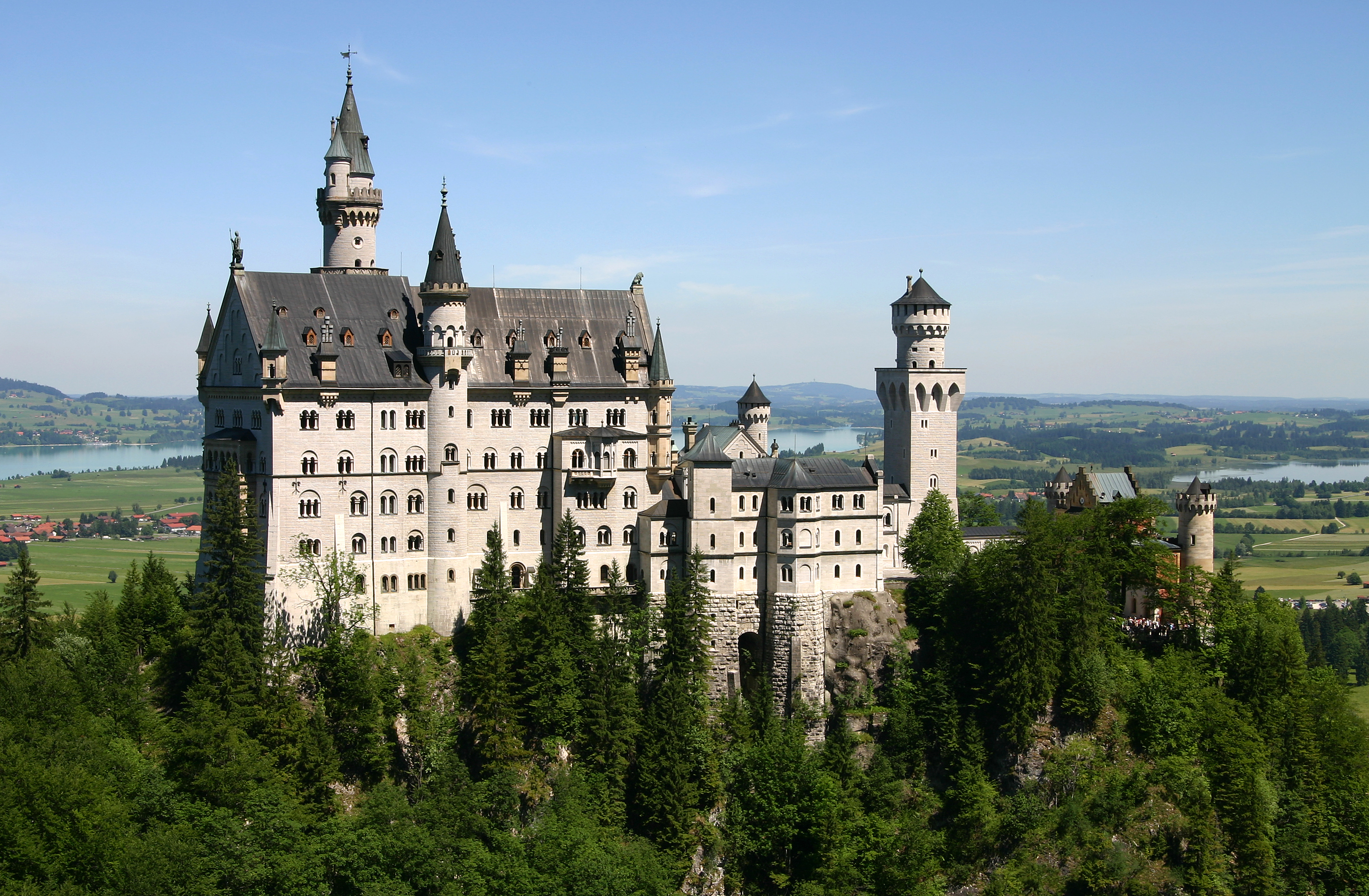
Neuschwanstein Castle in Bavaria — CC BY-SA 3
Notable Places in Germany Switzerland Tours
Speyer Cathedral
Speyer Cathedral, founded in 1030 by the emperor Konrad the Second, is the largest Romanesque church in the world, and UNESCO listed it in 1981 under reference number 168. The cathedral was rebuilt by Henry the Fourth as the first consistently vaulted church building in Europe, and its crypt, consecrated in 1041, holds the tombs of eight medieval emperors and kings. The four towers and two domes rise above the old town, and the cathedral square fills with markets and festivals through the year.
Maulbronn Monastery
Maulbronn Monastery, founded in 1147, is the most complete medieval monastic complex north of the Alps, and UNESCO listed it in 1993 under reference number 546. The Cistercian monks built a church, a cloister and a water system of reservoirs, canals and drains that still shapes the valley around the monastery. The church carried the Gothic style across northern and central Europe, and the monastery buildings show the order at work, from the kitchens to the dormitories and the wine cellars.
Neuschwanstein Castle
Neuschwanstein Castle, begun in 1869 by King Ludwig the Second, stands on a rock above the valley near Füssen, and its white towers have become the image of Germany around the world. The king built it as a private retreat inspired by opera and medieval legend, and he lived there only briefly before his death in 1886, leaving the castle unfinished. UNESCO listed it with the other palaces of Ludwig the Second in 2025 under reference number 1726, and the view from the Marienbrücke bridge remains the finest single sight on the route.
Rhine Falls
The Rhine Falls near Schaffhausen drop the river over a broad rock ledge in a curtain of white water, and the rock in the middle of the falls carries a small platform that boats reach in summer. The falls sit on the border between Germany and Switzerland, and the viewing terraces on both banks give the full force of the river at close range. A visit takes about two hours from Zurich, and the falls pair well with the old town of Schaffhausen and its fortress above the river.
Old Town of Bern
The Old Town of Bern, founded in 1191, keeps its medieval street plan, its long arcades and its clock tower, and UNESCO listed it in 1983 under reference number 267. The Zytglogge, the clock tower of the thirteenth century, still shows its moving figures on the hour, and the arcades shelter six kilometres of shops and cafes. The river Aare loops around the old town in a bend of green water, and the house where Einstein lived stands on Kramgasse among the fountains and the sandstone facades.
Frequently Asked Questions
How many days does a Germany and Switzerland itinerary need?
Nine days covers a Germany and Switzerland itinerary at a brisk pace, with two days on the Rhine, two in Munich, and three in the Swiss mountains. Thirteen days lets the journey breathe, adding a slow day on Lake Constance and a second day around Interlaken. Travellers who rush the mountain stage regret it most, since the Jungfrau region rewards a spare day for bad weather.
Is a Rhine cruise better than the train through the gorge?
The cruise shows the gorge the way the Romantics saw it, from the water, with the castles rising above the banks and the vineyards close at hand. The train runs along the same valley in about an hour, and it suits travellers who want the castles without the five hours on the boat. Take the cruise south to north in the morning, when the light falls on the castles, and save the train for the return.
Do I need a car for this route?
The trains and boats cover every stop on the classic route, and the railway stations sit in the town centres. A rental car earns its keep only in the Black Forest, where the villages, the waterfalls and the clock makers sit away from the railway lines. Pick the car up in Freiburg and return it in Konstanz, and let the train carry the rest of the journey.
Is Neuschwanstein worth the crowds?
Neuschwanstein repays the effort for travellers who love romantic castles, since no other palace in Europe matches its setting above the gorge. Go on the first tour of the morning, book the timed entry before leaving home, and walk to the Marienbrücke bridge for the view that the postcards copy. Travellers who dislike queues should visit Linderhof instead, where the gardens and the grotto draw far fewer visitors.
Which town makes the best base for the Jungfrau region?
Interlaken suits travellers who want trains, hotels and restaurants in one place, and it sits between two lakes with the mountain railways at its door. Grindelwald suits travellers who want to wake up under the Eiger, and Lauterbrunnen suits those who want waterfalls and quiet valleys. Stay in Interlaken for a first visit, and move up the valley only when the mountains, not the logistics, set the plan.
When do the Rhine cruises and the mountain railways run?
The Rhine cruise boats run from spring to autumn, with the full timetable from May to September and fewer sailings in the shoulder months. The mountain railways run all year, and the Jungfrau Railway climbs to the snow even in January. A Germany and Switzerland itinerary in May or September catches both the boats and the clear mountain air, while July and August bring the largest crowds to both.
Verified
- The Upper Middle Rhine Valley forms a UNESCO World Heritage property, reference number 1066, inscribed in 2002, covering a 65 km stretch of the Rhine between Bingen and Koblenz with about forty castles.
- Speyer Cathedral forms a UNESCO World Heritage property, reference number 168, inscribed in 1981, and it was founded in 1030 by the emperor Konrad the Second, with its crypt consecrated in 1041.
- Maulbronn Monastery forms a UNESCO World Heritage property, reference number 546, inscribed in 1993, and it was founded in 1147 as the most complete medieval monastic complex north of the Alps.
- The Palaces of King Ludwig the Second of Bavaria form a UNESCO World Heritage property, reference number 1726, inscribed in 2025, and Neuschwanstein among them was begun in 1869.
- The Old Town of Bern forms a UNESCO World Heritage property, reference number 267, inscribed in 1983, and the city was founded in 1191.
- Jungfrau-Aletsch, the high Alpine property of glaciers and peaks, joined the UNESCO list in 2001 under reference number 1037, and its land covers about 82,400 hectares.
- Above Lake Geneva, the Lavaux terraces carry vineyards for about 30 km, and UNESCO listed them in 2007 under reference number 1243.
- The rack railway to Jungfraujoch, completed in 1912 after sixteen years of building, ends at 3454 m above sea level, and the Gotthard Tunnel opened in 1882.
- Germany counts 55 World Heritage properties and Switzerland counts 13.
- No Wikidata item covers this combined route as one entity, since the journey links two countries and many separate stops, and the registry therefore leaves the identifier blank by design.
- I read the UNESCO pages and the other sources for this article on 22 November 2026, and every statement above rests on those readings.
Sources
- UNESCO — Upper Middle Rhine Valley, reference number 1066 (https://whc.unesco.org/en/list/1066/) — read on 22 November 2026.
- UNESCO — Speyer Cathedral, reference number 168 (https://whc.unesco.org/en/list/168/) — read on 22 November 2026.
- UNESCO — Maulbronn Monastery Complex, reference number 546 (https://whc.unesco.org/en/list/546/) — read on 22 November 2026.
- UNESCO — The Palaces of King Ludwig II of Bavaria, reference number 1726 (https://whc.unesco.org/en/list/1726/) — read on 22 November 2026.
- UNESCO — Old Town of Bern, reference number 267 (https://whc.unesco.org/en/list/267/) — read on 22 November 2026.
- UNESCO — Lavaux, Vineyard Terraces, reference number 1243 (https://whc.unesco.org/en/list/1243/) — read on 22 November 2026.
- Switzerland Tourism, the official tourism site of Switzerland (https://www.myswitzerland.com/en/) — read on 22 November 2026.
- Germany, the official tourism site of Germany (https://www.germany.travel/en/home.html) — read on 22 November 2026.
Unverified
- Timed-entry slots for Neuschwanstein were still open questions when this article was written, since availability changes daily and only the official booking site shows the current picture.
- Sailing dates for the Rhine cruise boats were not pinned down here, because the timetable shifts between the spring, summer and autumn seasons.
- Opening days for Maulbronn Monastery were left unchecked, since the monastery follows a seasonal calendar that the visitor site updates.
- Prices for the Swiss Travel Pass and for the Jungfrau Railway were not confirmed from an official seller, so they belong to the planning stage rather than to this article.
- Hotel availability in the Black Forest villages and around Lake Constance was not verified, because the small guesthouses there list rooms through many different channels.
Illustrations
- Hero: The Rhine Falls at Neuhausen in Switzerland. Free image: https://upload.wikimedia.org/wikipedia/commons/7/75/Neuhausen_Rhine_Falls_from_above_1.jpg — CC BY-SA 4.
- In body, castle: Neuschwanstein Castle in Bavaria. Free image: https://upload.wikimedia.org/wikipedia/commons/a/ae/Castle_Neuschwanstein.jpg — CC BY-SA 3.
- In body, monastery: The courtyard of Maulbronn Monastery in Germany. Free image: https://upload.wikimedia.org/wikipedia/commons/c/c7/Alpsee_-Pindarplatz–Hohenschwangau_Castle–Alpenrose-_Neuschwanstein_Castle_01.jpg — CC BY-SA 3.