
Eiffel Tower: The Iron Lady of Paris and 330 Metres of History
The Eiffel Tower has stood over Paris since 1889, an iron lattice tower. It is the most recognised monument in all of France.
The Eiffel Tower, in French the Tour Eiffel, stands on the Champ de Mars in the 7th arrondissement, on the left bank of the River Seine in Paris. It was built for the World’s Fair of 1889, the Exposition Universelle, as the entrance arch to the fair, and it was meant to stand for twenty years before being taken down. More than 135 years later, the Eiffel Tower is still there, and it is the tallest structure in Paris, the most visited paid monument in the world, and the image by which France is known everywhere.
For a visitor, the Eiffel Tower is two experiences at once. From the ground, it is a work of iron lace, a structure that seems light and almost transparent, although it weighs 10,100 tonnes, and the four great legs that rise from the Champ de Mars are the first thing that strikes a visitor who stands beneath them. From the top, it is a viewpoint, and the summit, at 276 m, gives a view across the whole of Paris, from the hills of Montmartre to the towers of La Défense, and the city that looks so large from the ground becomes a map below.
The tower is not a building in the ordinary sense, because it holds no offices and no flats. Inside the ironwork there are only three floors for visitors, two restaurants, a champagne bar at the summit and a small office that belonged to Gustave Eiffel himself, preserved at the top of the Eiffel Tower. The tower belongs to the City of Paris, and it is repainted regularly, and it is lit every evening, and it sparkles on the hour, and it has become as much a part of the life of Paris as the river it stands beside.
Quick Facts About the Eiffel Tower
| Fact | Detail |
|---|---|
| Name | Eiffel Tower (French Tour Eiffel, nicknamed la Dame de fer, the Iron Lady) |
| Location | Champ de Mars, 7th arrondissement, left bank of the Seine, Paris, France |
| Height | 330 m including the antenna (300 m of ironwork when completed in 1889) |
| Visitor floors | First floor at 57 m; second floor at 115 m; summit at 276 m |
| Stairs | 674 steps to the second floor; 1,710 steps from the ground to the summit |
| Construction began | January 1887 |
| Inaugurated | 31 March 1889 |
| Opened to the public | 15 May 1889 |
| Designers | Gustave Eiffel; engineers Maurice Koechlin and Émile Nouguier; architect Stephen Sauvestre |
| Material | 18,038 iron pieces, 2.5 million rivets; total weight 10,100 tonnes |
| Visitors | About 7 million a year (rounded figure) |
| UNESCO | Part of Paris, Banks of the Seine (1991, ref 600, criteria i, ii, iv) |
| Coordinates | 48.8583° N, 2.2945° E |
| Wikidata | Q243, tower |
Geography of the Eiffel Tower
The Tower on the Champ de Mars
The Eiffel Tower stands on the Champ de Mars, a long open park in the 7th arrondissement, on the left bank of the Seine. The Champ de Mars runs from the École Militaire, the military school at its southeastern end, to the river at its northwestern end, and the tower stands at the river end, with its four legs planted in the park. The site was chosen because it was open ground, close to the river and to the fairgrounds of the Exposition Universelle, and because the tower, as the entrance to the fair, needed to be seen from across the city.
The position of the Eiffel Tower on the river is part of its meaning. The Seine flows past the Champ de Mars, and the tower stands on the bank where the fairgrounds met the water, and the bridges beside it, the Pont d’Iéna and the Pont de Bir-Hakeim, join the left bank to the Trocadéro on the right bank, where the Palais de Chaillot stands. From the Trocadéro, across the river, the tower is seen in its full height, framed by the gardens and the fountains, and that view, from the Trocadéro, is the classic view of the Eiffel Tower, the one that appears on postcards and in films.
The tower dominates the skyline of Paris because the city is low. Paris has few tall buildings in its centre, and the height of the Eiffel Tower, 330 m including the antenna, makes it visible from almost everywhere in the city, from the hills of Montmartre to the parks of the south. The tower is the point by which Parisians find their bearings, and a visitor who is lost in the city can look up and find the tower, and know which way the river lies. The ironwork is open, so the tower does not block the sky, and from a distance it looks like a drawing in the air rather than a solid mass.
The Champ de Mars itself is a public park, and it is the foreground of the Eiffel Tower. The lawns are used for picnics, for games and for the crowds that gather to watch the tower light up in the evening, and the park is the place where the city meets the monument. The gardens are formal, with paths, trees and flowerbeds, and the park is at its busiest in summer, when the lawns fill with visitors and with Parisians, and the tower rises above them all, as it has since 1889.
The Ironwork and the Three Floors
The Eiffel Tower is a structure of iron, and its design is the reason it has lasted. The tower is made of 18,038 pieces of iron, held together by 2.5 million rivets, and the total weight is 10,100 tonnes. The iron is puddled iron, a form of wrought iron that is strong and flexible, and the pieces were made in the workshops of Gustave Eiffel and assembled on site, and the whole structure was put together in just over two years. The lattice design, with its four legs curving inwards and joining at the top, distributes the weight and resists the wind, and the tower sways only slightly in a storm, as it was designed to do.
The tower has three floors for visitors. The first floor, at 57 m, holds a glass floor, restaurants and exhibitions, and it is the place to look down through the ironwork to the ground below. The second floor, at 115 m, holds the restaurants and the best view of the city at a height that still shows the streets and the roofs in detail, and it is the floor that most visitors choose for a meal or a drink. The summit, at 276 m, is the highest point, and it holds a champagne bar and the small office of Gustave Eiffel, and the view from the summit is the view of the whole of Paris, with the river winding through it and the monuments spread below.
The stairs of the Eiffel Tower are part of the experience. There are 674 steps from the ground to the second floor, and 1,710 steps from the ground to the summit, although the stairs to the summit are not open to the public and the last part of the climb is by lift. The lifts of the tower were a marvel in 1889, and they remain the only way to the top, and the ride in the glass lift, climbing at an angle through the ironwork, is one of the most memorable parts of a visit to the Eiffel Tower.
The colour of the Eiffel Tower is part of its identity. The tower is painted in a bronze colour known as Eiffel Tower brown, and it is repainted regularly, every few years, by painters who work on ropes and platforms across the ironwork. The paint protects the iron from rust, and it is the reason the tower has survived more than a century of weather, and the colour, which changes slightly with the light, is the colour by which the tower is known.
The Tower in the Skyline of Paris
The Eiffel Tower is the centre of the skyline of Paris, and it is the landmark by which the city is known. The tower was the tallest structure in the world when it was completed in 1889, at 300 m, and it held that title until the Chrysler Building in New York passed it in 1930. The tower is still the tallest structure in Paris, and it is the first thing a visitor sees on arrival, from the plane or from the train, and the last thing on departure.
The city around the Eiffel Tower is the Paris of the great monuments. The Invalides, with its golden dome, stands to the east, and the École Militaire stands to the southeast, and the Trocadéro and the Palais de Chaillot stand across the river, and the Arc de Triomphe stands to the northwest, at the end of the avenue that runs from the tower. The tower joins them all, because it is the point from which the city is measured, and the view from the summit shows the plan of Paris, with its avenues radiating from the great squares.
At night, the Eiffel Tower changes the city. The tower is lit by floodlights, and it glows against the dark, and on the hour it sparkles with thousands of small lights, a display that lasts a few minutes and draws crowds to the Champ de Mars and the Trocadéro. The sparkling was added for the millennium, and it has stayed, and it is now as much a part of the tower as the ironwork. The tower is the centre of the night of Paris as well as its day, and the light is the reason the park fills in the evening.
The Eiffel Tower is also a working piece of the city, because its summit carries the antennas that broadcast radio and television to Paris. The antenna, which brings the height of the tower to 330 m, was added after the tower was built, and it is the reason the tower was kept after the twenty years of its first life, because the military and then the broadcasters found it useful. The tower that was meant to be temporary survived because it was useful, and it is now impossible to imagine Paris without it.
History of the Eiffel Tower
A Tower for the World’s Fair
The Eiffel Tower was built for the Exposition Universelle of 1889, the World’s Fair that marked the centenary of the French Revolution. The fair needed a monument, and the French government held a competition for a tower of iron, 300 m high, that would stand at the entrance to the fairgrounds on the Champ de Mars. More than a hundred designs were submitted, and the winner was the design of Gustave Eiffel, whose engineers, Maurice Koechlin and Émile Nouguier, had drawn the first sketch of a great iron pylon, and whose architect, Stephen Sauvestre, had given it the arches and the curves that made it beautiful.
Gustave Eiffel was the most famous engineer in France, and he had built bridges and railway stations across the world, including the iron framework of the Statue of Liberty in New York. The tower that bore his name was the largest iron structure ever attempted, and it was built in just over two years, from January 1887 to March 1889, by a team of about three hundred workers. The pieces were made in Eiffel’s workshops, and they were brought to the site and riveted together, and the work was done with a precision that surprised the engineers of the time, because the tower rose straight and true, and the four legs met at the top exactly as planned.
The tower was inaugurated on 31 March 1889, when Gustave Eiffel climbed to the top and raised the French flag, and it was opened to the public on 15 May 1889. The fair that followed was a triumph, and millions of visitors came to Paris to see the tower and to ride its lifts, and the tower became the image of the fair and of the new France. The tower was meant to stand for twenty years, and then to be taken down, yet it survived because it was useful, and because the people of Paris, who had at first disliked it, came to love it.
The tower was not loved at first. Artists and writers of Paris protested against it, and they called it a monstrosity, a factory chimney, a blot on the skyline, and they demanded that it be torn down. The protest, signed by some of the most famous names in French art, is now a curiosity, because the tower that was hated in 1889 is loved today, and the artists who signed the protest are remembered, if at all, for having been wrong about the Eiffel Tower.
From Temporary Arch to Permanent Symbol
The Eiffel Tower survived its first twenty years because the army found it useful for radio, and the tower became a station for wireless telegraphy, and its height made it the best place in Paris to send and receive signals. During the First World War, the tower’s radio station intercepted enemy messages, and it became a part of the defence of France, and the tower that had been built for a fair became a military asset. The concession for the tower was extended, and the tower stayed, and the city of Paris, which owns the Eiffel Tower, took it over and kept it.
In the decades that followed, the Eiffel Tower became the symbol of Paris and of France. It appeared on postcards, in films and in advertisements, and it became the place where visitors proposed marriage, where lovers met, and where the city celebrated its great moments. The tower was lit for the first time in 1925, with the name of Citroën in lights, and it was lit again for the great occasions of the century, and the lighting of the tower became a part of the life of the city.
The Second World War brought a darker chapter. When the Germans occupied Paris in 1940, the French cut the cables of the lifts, so that the occupiers would have to climb the stairs, and Hitler, who visited Paris in 1940, did not climb the tower. The tower survived the war, and it was lit again at the Liberation, and it became the symbol of the Paris that had endured. The story of the cut cables is told to every visitor, and it is part of the legend of the Eiffel Tower, even if the details are debated.
The tower has been repainted and repaired many times, and it has been changed in small ways, with new lifts, new lights and new floors, yet it is the same tower that was built in 1889. The first floor was rebuilt in recent years, with a glass floor that lets visitors look down to the ground, and the summit was restored, and the tower is maintained by a team that works on it every day. The Eiffel Tower is a monument that is also a machine, and it needs constant care, and the care is the reason it still stands.
The Tower in the Twentieth Century and Today
In the twentieth century, the Eiffel Tower became the most visited paid monument in the world, with about seven million visitors a year, and the queues at its feet became a part of the experience of Paris. The tower has been the scene of stunts, of protests, of weddings and of celebrations, and it has been climbed, jumped from and flown around, and it has survived them all. The tower is also a place of work, because the restaurants on its floors serve thousands of meals a day, and the lifts carry millions of people a year, and the tower is a small city in itself.
The tower’s place in the heritage of Paris was recognised in 1991, when the Banks of the Seine were inscribed by UNESCO as a World Heritage site, under reference 600, on criteria i, ii and iv. The listing covers the riverbanks from the Louvre to the Eiffel Tower, and the tower is named in the inscription as one of the masterpieces of the banks, and as a living testimony of the great universal exhibitions of the nineteenth and twentieth centuries. The Eiffel Tower is therefore not a World Heritage site on its own, but it is part of a World Heritage site, and the distinction matters, because the listing protects the whole river landscape of Paris, not only the tower.
Today, the Eiffel Tower is the heart of Paris, and it is the place where the city gathers for its great moments. The tower is lit in the colours of France for national days, and it sparkles on the hour every evening, and the crowds on the Champ de Mars and the Trocadéro watch it together. The tower has been the symbol of Paris for more than 135 years, and it shows no sign of losing its place, because it is not only a monument but a part of the life of the city, and the city would not be Paris without it.
Timeline
- January 1887 — Construction of the Eiffel Tower begins on the Champ de Mars.
- 31 March 1889 — Gustave Eiffel inaugurates the tower and raises the French flag at the summit.
- 15 May 1889 — The Eiffel Tower opens to the public for the Exposition Universelle.
- 1889 — The tower becomes the tallest structure in the world, at 300 m.
- 1909 — The tower’s concession is extended, because the army uses it for radio.
- 1925 — The tower is lit with the name of Citroën, the first great illumination.
- 1930 — The Chrysler Building in New York passes the tower as the tallest structure in the world.
- 1940–1944 — The tower stands through the German occupation of Paris; its lift cables are cut.
- 1991 — Paris, Banks of the Seine, including the Eiffel Tower, is inscribed by UNESCO (ref 600).
- 2000s — The first floor is rebuilt with a glass floor; the tower’s lighting is renewed.
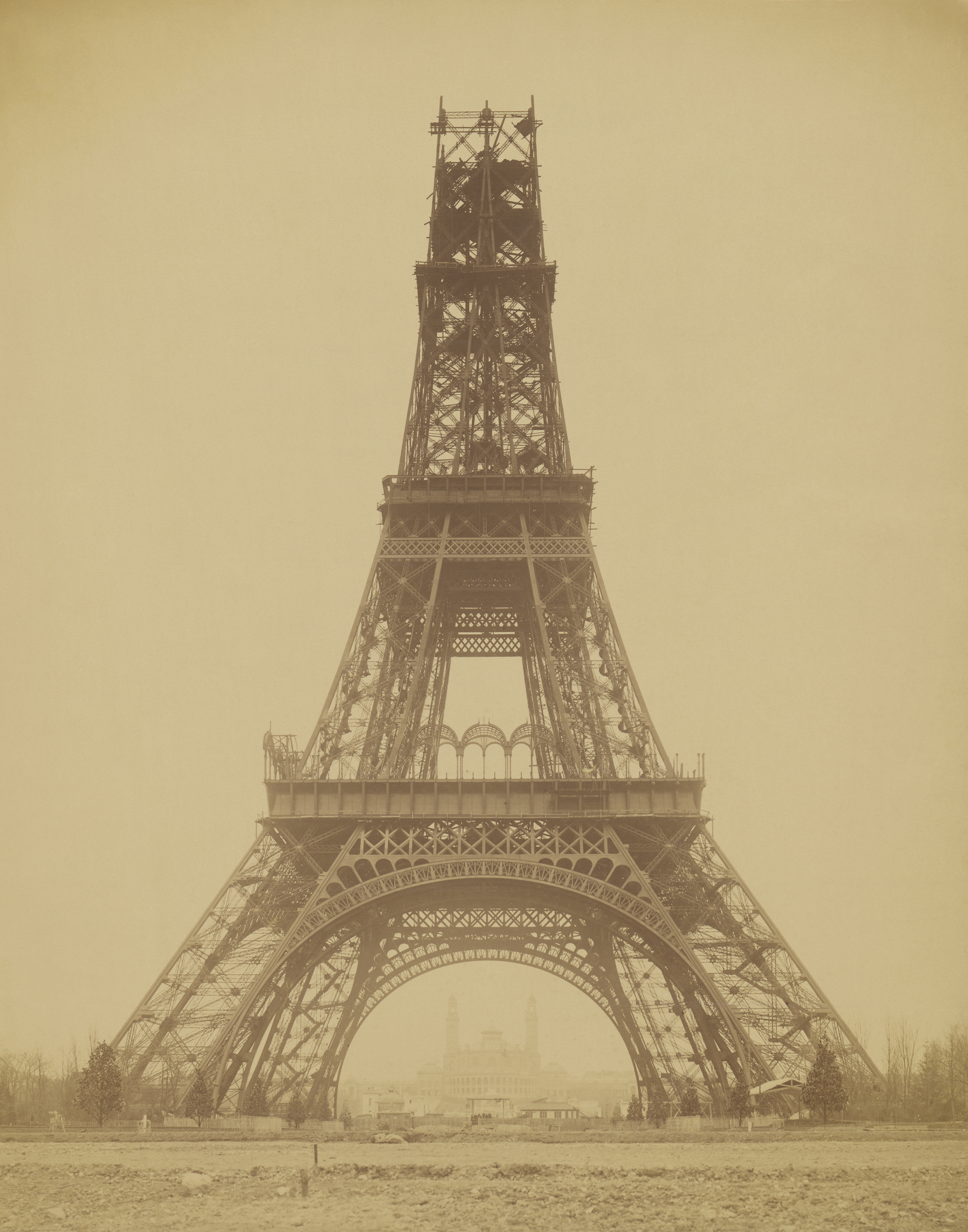
The Centennial Exposition of 1889 was organized by the French government to commemorate the French Revolution — Public domain
Travel to the Eiffel Tower
Getting There and How to Visit
The Eiffel Tower stands on the Champ de Mars, and it is easy to reach by metro, by bus and on foot. The nearest metro stations are Bir-Hakeim and Trocadéro, and the RER station Champ de Mars–Tour Eiffel serves the tower directly, and the walk from the Trocadéro across the Pont d’Iéna is the finest approach, because the tower grows as the visitor walks towards it. The buses that serve the Champ de Mars stop close to the tower, and the river boats that run along the Seine pass beneath it.
Tickets for the Eiffel Tower are sold on the official site, and the official site is the only place to buy the official tickets. Visitors should book in advance, especially in summer and on weekends, because the tower is busy and the tickets for the summit sell out.
The tickets are sold for a fixed time, and visitors should arrive early, because the security checks take time and the queues at the entrance are long. The official site lists the ticket types, for the stairs and for the lifts, and for the second floor and for the summit, and visitors should check the site before going, because the exact offer can change. Some Paris visitor passes include the Eiffel Tower, but the official site remains the place to check what any pass covers before buying it.
The visit to the Eiffel Tower takes a few hours, and it is best taken slowly. The climb by stairs to the second floor, 674 steps, is the way to see the ironwork up close, and the lift to the summit is the way to the highest view. The first floor, at 57 m, holds the glass floor and the exhibitions, and the second floor, at 115 m, holds the restaurants and the best view of the streets, and the summit, at 276 m, holds the champagne bar and the office of Gustave Eiffel. The tower is open every day, and the evening visit, when the city lights come on and the tower sparkles, is the most beautiful.
Visitors searching in French or Spanish will meet the names Tour Eiffel and Torre Eiffel for the same tower and the same tickets. The tower is known by its French name in France, and by its Spanish name in Spain and Latin America, and the tickets sold under those names are the same tickets, sold on the same official site. The drawings of the Eiffel Tower, made by artists who sit on the Champ de Mars and the Trocadéro, are sold in the streets around the tower, and they are the most common souvenir of Paris.
Activities Around the Tower
The Eiffel Tower is not only a visit but a place, and the activities around it fill a day. The Champ de Mars is a park for picnics and games, and the carousel near the Eiffel Tower, on the Champ de Mars, is the place where children ride while their parents watch the tower. The river boats that leave from the Port de la Bourdonnais, beside the tower, give a view of the city from the water, and the gardens of the Trocadéro, across the river, give the classic view of the tower framed by fountains.
Practical Notes
The best time to visit the Eiffel Tower is early in the morning or late in the evening, when the crowds are smaller and the light is at its best. The morning gives the clearest view from the summit, and the evening gives the lights of the city, and the sunset from the second floor is the most beautiful hour of the day. Summer is the busiest season, and the queues are longest, while winter is quieter, and the tower in the rain or the snow is a sight that few visitors see. For places to stay near the tower, the Paris hotels guide covers the districts around the Champ de Mars.
The Eiffel Tower is a tall and open structure, and the wind at the summit is strong, and the temperature is lower than on the ground, so visitors should bring a layer even in summer. The stairs are steep, and the lifts are crowded, and visitors with a fear of heights should stay on the first floor, where the glass floor is the only test. The tower is a safe place for visitors, yet the usual care applies in the crowds at its feet, where pickpockets work, and bags should be kept closed.

The Eiffel Tower at sunset — CC0
Notable Places in the Eiffel Tower
The summit is the first place, and it is the highest point of the Eiffel Tower, at 276 m. The summit holds the champagne bar and the small office of Gustave Eiffel, preserved as it was, with wax figures of Eiffel and his guests, and the view from the summit is the view of the whole of Paris. The summit is reached by lift from the second floor, and it is the place where the city becomes a map below.
The second floor is the second place, and it is the floor that most visitors love best. At 115 m, it holds the restaurants, including the Jules Verne, and the view from the second floor shows the streets and the roofs of Paris in detail, and it is the best place to see the city as a living place rather than as a map. The second floor is reached by the stairs, 674 steps from the ground, or by lift, and it is the floor where the ironwork is closest.
The first floor is the third place, and it is the floor that was rebuilt with a glass floor at 57 m. The glass floor lets visitors look straight down to the ground, through the ironwork, and the exhibitions on the first floor tell the story of the tower, from the competition of 1889 to the present day. The first floor is the place to understand the Eiffel Tower, because it shows how the tower was built and why it has lasted.
Beyond the three floors, the Eiffel Tower offers the places that complete the visit. The Champ de Mars, the park at the foot of the tower, is the place to see the tower from the ground, and the Trocadéro, across the river, is the place to see it framed by fountains. Paris is the city of the tower, and the Arc de Triomphe and the Petit Palais are the other great monuments of the same age, and they are the natural next step after the tower.
Frequently Asked Questions
How tall is the Eiffel Tower?
The Eiffel Tower is 330 m high including the antenna, and 300 m of ironwork when it was completed in 1889. The first floor is at 57 m, the second floor at 115 m, and the summit at 276 m.
When was the Eiffel Tower built?
Construction began in January 1887, and the tower was inaugurated on 31 March 1889 and opened to the public on 15 May 1889, for the Exposition Universelle of 1889. It was built as the entrance arch to the fair and was meant to stand for twenty years.
Who designed the Eiffel Tower?
The Eiffel Tower was designed by Gustave Eiffel, with the engineers Maurice Koechlin and Émile Nouguier, who drew the first sketch, and the architect Stephen Sauvestre, who gave the tower its arches and curves. The tower is named for Eiffel, whose company built it.
How do I get tickets for the Eiffel Tower?
Tickets for the Eiffel Tower are sold on the official site, and visitors should book in advance, because the tower is busy and the summit tickets sell out. The official site lists the ticket types for the stairs and the lifts, and for the second floor and the summit, and visitors should check the site before going.
Is the Eiffel Tower a UNESCO World Heritage site?
The Eiffel Tower is not a World Heritage site on its own, but it is part of Paris, Banks of the Seine, inscribed by UNESCO in 1991 under reference 600, on criteria i, ii and iv. The listing covers the riverbanks from the Louvre to the tower, and the tower is named in the inscription as one of the masterpieces of the banks.
Can I climb the Eiffel Tower on foot?
Yes, by the stairs to the second floor, 674 steps from the ground, which is the way to see the ironwork up close. The stairs to the summit, 1,710 steps in total, are not open to the public, and the last part of the climb to the summit is by lift.
Verified
This article’s facts were checked against the sources below and confirmed on 22 November 2026. The height of 330 m including the antenna and 300 m of ironwork in 1889, the floors at 57 m, 115 m and 276 m, the 674 steps to the second floor and 1,710 steps in total, the 18,038 iron pieces, 2.5 million rivets and 10,100 tonnes, the construction from January 1887, the inauguration on 31 March 1889, the opening to the public on 15 May 1889, the designers Gustave Eiffel, Maurice Koechlin, Émile Nouguier and Stephen Sauvestre, and the ownership by the City of Paris were checked against the sources below. The UNESCO inscription of Paris, Banks of the Seine in 1991, under reference 600, on criteria i, ii and iv, with the Eiffel Tower named among the masterpieces of the banks, was verified on the UNESCO site. The Wikidata entry Q243 for the Eiffel Tower, a tower at 48.858296° N, 2.294479° E, was verified through the Wikidata API on 22 November 2026.
Sources
- Eiffel Tower, height, history, construction, designers — https://en.wikipedia.org/wiki/Eiffel_Tower
- Eiffel Tower, inauguration 31 March 1889, opened 15 May 1889, 18,038 pieces, 2.5 million rivets — https://en.wikipedia.org/wiki/Eiffel_Tower
- Paris, Banks of the Seine, inscribed 1991, ref 600, criteria i, ii, iv, Eiffel Tower named — https://whc.unesco.org/en/list/600/
- Paris, Banks of the Seine, ICOMOS evaluation, Eiffel Tower as a masterpiece of the banks — http://whc.unesco.org/archive/advisory_body_evaluation/600.pdf
- Eiffel Tower, official site, tickets and visiting information — https://www.toureiffel.paris/en
- Wikidata Q243 (Eiffel Tower, P31 tower, coordinates 48.858296/2.294479) — verified through the Wikidata API, 22 November 2026.
Unverified
- The number of visitors, about 7 million a year, is a rounded figure and varies from year to year — this article presents it as approximate.
- The claim that the Eiffel Tower was the tallest structure in the world until 1930, when the Chrysler Building passed it, is widely accepted, but the exact wording varies between sources — this article uses the standard form.
- The story that the French cut the lift cables during the German occupation so the occupiers would have to climb is widely told, and the details are debated — this article presents it as told.
- The number of replicas of the Eiffel Tower around the world is not counted, and most are much smaller than the original — this article describes them in general terms.
- Ticket types and availability change, and the official site is the only source for current tickets — this article gives no prices and advises checking the official site.
Illustrations
- Hero: The Eiffel Tower has stood over Paris since 1889, an iron lattice tower. Free image: https://upload.wikimedia.org/wikipedia/commons/0/0e/Champ_de_Mars_from_the_Eiffel_Tower_-_July_2006_edit.jpg — CC BY 2.5.
- In body, skyline: The Eiffel Tower at sunset. Free image: https://upload.wikimedia.org/wikipedia/commons/9/90/Eiffel_Tower_sunset_skyline_%28Unsplash%29.jpg — CC0.
- In body, eiffel tower: The Centennial Exposition of 1889 was organized by the French government to commemorate the French Revolution. Free image: https://upload.wikimedia.org/wikipedia/commons/1/14/Louis-Emile_Durandelle%2C_The_Eiffel_Tower_-_State_of_the_Construction%2C_1888.jpg — Public domain.