
Nîmes — Day Trips from Nimes to Roman Arenas, the Pont du Gard and the Camargue
Nîmes is a southern French city where Roman stone still shapes daily life. Its arena, temple and tower have stood for two thousand years.
Nîmes lies in the south of France, in the region of Occitanie, between Montpellier and Avignon, and it holds the best-preserved Roman monuments in the country. The Arena still hosts concerts and festivals, the Maison Carrée still opens its doors to visitors, and the cafés around them serve lunch beneath the Tour Magne. The city was a Roman colony called Nemausus, and its stones carry the name of Augustus, the crocodile and the palm, and the word denim itself, which comes from the serge de Nîmes cloth woven here. Day trips from nimes start from this Roman centre and reach the Pont du Gard, the Camargue wetlands and the Mediterranean beaches in under an hour.
The city suits a base of two or three days, because the Roman monuments fill a full day and the surrounding country fills two more. Day trips from nimes run in every direction, north to the Pont du Gard and Uzès, east to Avignon and the Rhône, south to the Camargue and the sea, and west to Montpellier and the coast. The high-speed train reaches Paris in about three hours, and the two stations, Nîmes Centre in the middle of town and Nîmes Pont-du-Gard to the east, keep the city on the main line between Paris and the Mediterranean. The limestone of the Roman buildings turns pale gold at noon in summer, and the whole city glows in the heat.
Nîmes is also the first city of this batch with a World Heritage property of its own. The Maison Carrée, the Augustan temple in the city centre, entered the World Heritage List in September 2023 under reference 1569, and the Pont du Gard nearby has stood on the list since 1985 under reference 344. Day trips from nimes therefore move between two inscribed monuments in a single day, and the Roman history here is not a ruin behind a fence but a living part of the streets.
Quick Facts
| Item | Detail |
|---|---|
| Name | Nîmes (Nemausus in Roman times) |
| Location | Southern France, Occitanie, between Montpellier and Avignon |
| Coordinates | 43.8383333° N, 4.3597222° E |
| Type | Historic city (Wikidata: Q42807) |
| Population | About 150,000 people |
| Best known for | Arena, Maison Carrée, Tour Magne, Jardin de la Fontaine |
| History | Roman colony from about 28 BC |
| World Heritage | Maison Carrée, inscribed 2023, reference 1569; Pont du Gard nearby, 1985, reference 344 |
| Emblem | Crocodile chained to a palm tree, from ancient Roman coins |
| Word origin | Denim, from serge de Nîmes cloth |
| Transport | High-speed train from Paris in about 3 hours; Nîmes-Alès-Camargue airport |
Geography of Nîmes
The Coastal Plain and the Roman Hills
Nîmes stands on a coastal plain in the south of France, about 35 kilometres from the Mediterranean Sea to the south-east and about 50 kilometres north-east of Montpellier. Low hills ring the city, and the Mont Cavalier hill to the north carries the Tour Magne, which looks down over the whole town. The land around the city is the garrigue of southern France, with aromatic scrub, green oaks and vineyards running to the horizon, and the Rhône river flows about 30 kilometres to the east.
In Roman times the city stood on the Via Domitia, the first Roman road built in Gaul, linking Italy with Spain through the south of France, and that road made Nîmes a trading centre where goods from the Mediterranean moved inland. Day trips from nimes still follow the old Roman roads, and the motorway and the high-speed railway run close to the ancient route.
The climate is Mediterranean, with hot dry summers, mild winters and the Mistral wind blowing down from the Rhône valley. Temperatures often pass 35 degrees Celsius in July and August, and the city counts among the sunniest in France. Visitors in summer should carry water, a hat and sunscreen, above all when walking the open monuments such as the Arena and the Tour Magne.
The best months for day trips from nimes are spring and autumn, when the weather stays pleasant and the city is less crowded, while June brings the Feria de Nîmes, a great festival of parades, concerts and bullfighting that draws hundreds of thousands of visitors.
The Jardin de la Fontaine and the Sacred Spring
The Jardin de la Fontaine is the most important green space in the city, a public garden built in the eighteenth century around the sacred spring of Nemausus, where the Romans once worshipped the god of the water. The garden lies north of the centre, at the foot of Mont Cavalier, with shaded paths, ponds and Roman remains, including the Temple of Diana and the ruins of the Roman baths. In summer the garden is where the people of Nîmes picnic and escape the heat, and the water still runs through the old channels. Day trips from nimes often end here, with a slow walk under the trees after the heat of the Arena, and the garden shows how the Roman city grew around its water.
The Garrigue and the Camargue
Around Nîmes the land is garrigue, dry scrubland of thyme, rosemary and green oak, and the vineyards of the Costières de Nîmes stretch toward the sea. The Camargue lies about 40 kilometres to the south, a wetland of white horses, black bulls and flamingos, and a landscape entirely unlike the dry hills around the city. Day trips from nimes reach the Camargue in under an hour, and many visitors pair the Roman morning in the city with an afternoon among the marshes and the salt pans. The contrast between the stone city and the flat wetlands is one of the sharpest in southern France, and the two landscapes sit side by side within a short drive.
Getting to Nîmes
The city is easy to reach by high-speed train, with Nîmes Centre station in the middle of town and Nîmes Pont-du-Gard station to the east, and the journey from Paris takes about three hours. The airport of Nîmes-Alès-Camargue lies about 15 kilometres from the city, with flights to several European cities. From Nîmes the roads run in every direction, and day trips from nimes can reach the Pont du Gard, Avignon and Montpellier in under an hour by road or by rail. The city keeps its Roman grid in the centre, so the Arena, the Maison Carrée and the Jardin de la Fontaine all lie within a short walk of one another.

En gare de Nîmes, locomotive personnalisée avant la finale de la coupe de France (18 mai 1958) entre le Nîmes Olympique et le Stade de Reims disputée à Colombes — CC BY-SA 4
History of Nîmes
The Sacred Spring and the Roman Colony
The story of the city begins at a sacred spring, where the local Celts worshipped Nemausus, the god of the water. When the Romans conquered Gaul they built a city around that spring, and in about 28 BC the emperor Augustus made Nîmes a Roman colony, settling veterans of the legions that had fought in Egypt. Those veterans brought coins showing a crocodile chained to a palm tree, the emblem of the victory in Egypt, and the image remains the emblem of the city today. The colony grew quickly, and in the first century AD it became one of the most important cities of Gaul, with great public buildings raised in limestone from the nearby quarries.
The Arena was built in about 70 AD, with room for about 24,000 spectators, and the Maison Carrée was raised in the Augustan period and dedicated in 4–7 AD to Gaius and Lucius Caesar, the grandsons and adopted heirs of Augustus. The Tour Magne, a watchtower from the first century BC, stood on Mont Cavalier to guard the city, and the aqueduct from Uzès brought water to Nîmes, with the Pont du Gard as its most famous span. The forum of the Roman city lay where the Maison Carrée stands now, and the temple dominated the civic heart of Nemausus. Day trips from nimes still walk the Roman grid, and the stones underfoot in the old town follow the same lines the surveyors laid out two thousand years ago.
The Middle Ages and the Modern Era
After the fall of the Roman Empire, Nîmes passed through centuries of upheaval, with invasions by Visigoths, Franks and Saracens. The Arena became a fortress and a neighbourhood, with hundreds of people living inside its walls, and the Maison Carrée became a church, then a series of other buildings over the centuries. The Roman monuments were only restored and protected in the nineteenth century, when the French state recognised their value and began large programmes of repair. The Tour Magne took an unexpected role in the nineteenth century as an optical telegraph station, with signal arms on its summit passing messages across France by a common code, the fastest communication of its day before the electric telegraph.
Inside the Arena the medieval city built its own world, with houses and chapels pressed against the Roman stone, and hundreds of people lived within the walls. The Maison Carrée passed through its own changes, serving as a church and then as other buildings, before the nineteenth century cleared the later additions away and restored the temple to its Roman form. The clearing of the Arena houses in the same century returned the amphitheatre to a single open space, and the work of that period saved both monuments for the modern city.
In the nineteenth and twentieth centuries the city grew into an important textile centre, and the serge de Nîmes, a tough cotton cloth, gave the world the word denim, the fabric of jeans. The city also became known for its bullfighting festivals, a tradition from the nineteenth century that still fills the Arena each June for the Feria. In September 2023 the Maison Carrée entered the World Heritage List, the first inscription for the city itself, and the recognition brought new attention to the Roman centre. Day trips from nimes now carry visitors to a city whose Roman temple holds the same international status as the Pont du Gard nearby.
Nîmes Today
Today the city is a lively urban centre of about 150,000 people, the administrative capital of the Gard department and a major tourist destination of Occitanie. The city blends its Roman monuments with modern life, and the cafés, shops and markets sit beside the Arena and the temple. The Feria de Nîmes and the summer concerts in the Arena draw hundreds of thousands of visitors each year, and the city ranks among the most loved destinations of the region. Day trips from nimes show a place where the Roman past is not a museum piece but a stage for concerts, festivals and daily life, and the limestone still glows gold at noon in July.
Timeline
| Year | Event |
|---|---|
| About 28 BC | Augustus makes Nîmes a Roman colony, settling Egyptian campaign veterans |
| About 70 AD | Arena built, seating about 24,000 spectators |
| 4–7 AD | Maison Carrée dedicated to Gaius and Lucius Caesar |
| 1st century BC | Tour Magne built on Mont Cavalier |
| 5th–10th centuries | Arena becomes a fortress and neighbourhood; city passes through invasions |
| 19th century | Roman monuments restored; Tour Magne serves as optical telegraph station |
| 19th century | Serge de Nîmes cloth gives the world the word denim |
| 1985 | Pont du Gard enters the World Heritage List, reference 344 |
| 2023 | Maison Carrée enters the World Heritage List, reference 1569 |
Travel to Nîmes
The Best Day Trips
The best of the day trips from nimes runs to the Pont du Gard, the Roman aqueduct bridge inscribed in 1985, which stands about 25 kilometres north-east of the city. The bridge crosses the Gardon river in three tiers of arches and rises 49 metres, and visitors can walk across its top level, swim in the river below in summer and visit the museum of Roman water engineering beside it. A morning at the Pont du Gard pairs naturally with an afternoon in Uzès, a small ducal town with a medieval centre and a market square. Day trips from nimes to the bridge suit a first day in the region, since the site needs only half a day and the road back passes vineyards and stone villages.
A second direction runs south to the Camargue, about 40 kilometres away, where the wetlands hold white horses, black bulls and flamingos, and the salt pans stretch to the sea. The town of Aigues-Mortes, with its complete medieval walls, stands at the edge of the marshes, and the road onward reaches the beaches of the Mediterranean. Day trips from nimes to the Camargue give a landscape entirely unlike the Roman city, and the flat light of the marshes at sunset is one of the sights of the south. A third direction runs east to Avignon and the Rhône, with the papal palace and the bridge of Saint-Bénézet, and a fourth runs west to Montpellier and the coast.
When to Go
Spring and autumn give the most pleasant weather for Nîmes, with mild days and a less crowded city. Summer is hot and dry, with temperatures often above 35 degrees Celsius, and the stone monuments throw back the heat, so visitors should plan the Arena for the morning and the shaded garden for the afternoon. June brings the Feria, when the city fills with music, parades and bullfights, and hotel prices rise.
Winter is quiet, with mild days and golden light on the old streets, and the cafés stay warm and busy. Day trips from nimes run in every season, but the Pont du Gard and the Camargue are best from April to October, when the river is warm enough to swim and the marshes hold the most birds.
How Long to Stay
One day suits Nîmes itself, with the morning at the Arena and the Maison Carrée and the afternoon at the Tour Magne and the Jardin de la Fontaine. A second day goes to the Pont du Gard and Uzès, and a third to the Camargue and Aigues-Mortes. Day trips from nimes reward a base of two or three nights, since each direction deserves a full day, and the city itself repays a slow evening among the cafés around the Arena. Travellers with only half a day should walk the Arena and the Maison Carrée, since the two monuments stand minutes apart and together tell the Roman story.
Getting Around and Practical Notes
The city centre is compact, and the Arena, the Maison Carrée and the garden all lie within a short walk of one another. Nîmes Centre station stands in the middle of town, and buses run to the Pont du Gard, the Camargue and the neighbouring towns.
Admission to the Roman monuments carries a charge, and the hours change with the season and the event calendar, so travellers should check the current information on the official tourist office site before the trip. The old town costs nothing to walk, and the market streets reward a slow morning. Day trips from nimes are easy to arrange at the tourist office beside the Arena, where the staff sell combined tickets and hand out maps of the Roman sites.
Notable Places in Nîmes
The Arena
The Arena of Nîmes is the finest sight in the city, an oval 133 metres long, 101 metres wide and 21 metres high, with 34 rows of stone seats that once held about 24,000 spectators. The building survives better than the Colosseum in Rome, because it stayed in use without interruption for two thousand years, from a Roman arena to a medieval fortress and then to a concert and festival ground. Visitors can walk the tiers, look down into the arena floor and visit the displays on gladiators and Roman spectacles.
In summer the Arena hosts concerts with thousands of listeners, and the stone carries the sound across the whole building. Day trips from nimes should start here, since the Arena sets the scale for everything else in the city.
The Maison Carrée
The Maison Carrée is the second stop no visitor should miss, a temple of the Augustan period raised on a podium 2.85 metres high, measuring 26.42 metres by 13.54 metres, with six Corinthian columns under the pediment at each end. The temple is one of the best-preserved Roman temples in the world, and in September 2023 it entered the World Heritage List under reference 1569, on criterion (iv). Inside, a film tells the Roman history of Nîmes, and the square outside holds the Carré d’Art, the modern art gallery and library built by Norman Foster across from the temple. The temple inspired the Virginia State Capitol in the United States, designed by Thomas Jefferson, who had a model of it made while minister to France in 1785.
The Tour Magne and the Jardin de la Fontaine
Walking north from the centre brings visitors up Mont Cavalier to the Tour Magne, a Roman watchtower from the first century BC, the largest remaining tower of the ancient city wall. From its summit the view opens over the whole city, with the Arena, the Maison Carrée and the red roofs of Nîmes running out to the coastal plain. The Jardin de la Fontaine below holds the sacred spring of Nemausus, the Temple of Diana and the remains of the Roman baths, set among shaded paths and ponds from the eighteenth-century garden. An afternoon climbing the tower and walking the garden is one of the most memorable experiences of Nîmes, and the sunset from the summit turns the limestone gold.
The Pont du Gard
The Pont du Gard stands about 25 kilometres from Nîmes, a three-tier Roman aqueduct bridge across the Gardon river, built in the first century to carry water to the city and still the tallest surviving Roman aqueduct bridge in the world. The bridge rises 49 metres, and its three levels of arches carry the ancient water channel across the valley. Visitors can walk across the top level, swim in the Gardon in summer and learn about Roman engineering in the museum beside it. Day trips from nimes reach the bridge in half a day, and the site pairs well with the town of Uzès in the afternoon.
The Camargue and Aigues-Mortes
South of the city the Camargue opens out, a wetland of salt pans, marshes and rice fields, with white horses, black bulls and flamingos. The walled town of Aigues-Mortes stands at its edge, its towers and ramparts complete, and the road onward reaches the sea. The salt pans turn pink in summer, and the flamingos feed in the shallow water. Day trips from nimes to the Camargue show a landscape with nothing Roman in it, and the contrast with the stone city makes both places stronger.
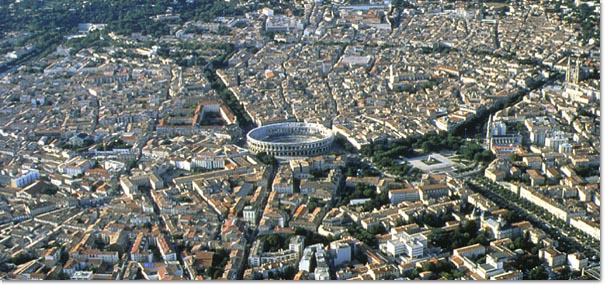
A view of Nîmes — CC BY-SA 3
Frequently Asked Questions
Where is Nîmes?
Nîmes stands in the south of France, in the region of Occitanie, between Montpellier and Avignon, about 35 kilometres from the Mediterranean Sea to the south-east. High-speed trains from Paris take about three hours, and the city is the administrative capital of the Gard department.
When was the Arena of Nîmes built?
The Arena of Nîmes was built in about 70 AD, with room for about 24,000 spectators across 34 rows of stone seats. The building survives better than the Colosseum in Rome, because it stayed in use without interruption, and it still hosts concerts and festivals today.
What is special about the Maison Carrée?
The Maison Carrée is an Augustan temple dedicated in 4–7 AD to Gaius and Lucius Caesar, and it ranks among the best-preserved Roman temples in the world. In September 2023 it entered the World Heritage List under reference 1569, and it inspired the Virginia State Capitol, designed by Thomas Jefferson.
Why is the emblem of Nîmes a crocodile chained to a palm tree?
The emblem comes from ancient Roman coins struck to mark the victory of Augustus in Egypt, showing a crocodile chained to a palm tree. Veterans of the Egyptian campaign settled in Nîmes as colonists and brought the emblem with them, and it remains the symbol of the city.
What does denim have to do with Nîmes?
The English word denim comes from serge de Nîmes, a tough cotton cloth woven in the city in the nineteenth century. The cloth later became the material for jeans, one of the most worn garments in the world, and the name still carries the city with it.
How long should I stay in Nîmes?
One day suits Nîmes itself, with the morning at the Arena and the Maison Carrée and the afternoon at the Tour Magne and the Jardin de la Fontaine. A second day goes to the Pont du Gard, and day trips from nimes reward a base of two or three nights in total.
Verified
- The Wikidata record for Nîmes, Q42807, gives the city as a commune and big city of France at 43.8383333° N, 4.3597222° E, and the registry coordinates match that record.
- Augustus made Nîmes a Roman colony in about 28 BC, settling veterans of the Egyptian campaign, and the crocodile chained to a palm tree comes from the coins of that victory.
- The Arena was built in about 70 AD, measures 133 metres by 101 metres and 21 metres high, holds 34 rows of seats and about 24,000 spectators.
- The Maison Carrée was dedicated in 4–7 AD to Gaius and Lucius Caesar, measures 26.42 metres by 13.54 metres on a podium 2.85 metres high, and stands 17.1 metres tall.
- The Maison Carrée of Nîmes entered the World Heritage List in September 2023 under reference 1569, on criterion (iv), which means the registry flag unesco:false for this city is wrong.
- The Pont du Gard entered the World Heritage List in 1985 under reference 344, on criteria (i), (iii) and (iv), and it rises 49 metres in three tiers.
- Arles entered the World Heritage List in 1981 under reference 164, on criteria (ii) and (iv).
- The word denim comes from serge de Nîmes cloth, and the Tour Magne served as an optical telegraph station in the nineteenth century.
- France holds 56 properties on the World Heritage List.
- Checked 23 November 2026.
Sources
- Wikipedia, Nîmes: https://en.wikipedia.org/wiki/N%C3%AEimes
- Wikipedia, Maison carrée: https://en.wikipedia.org/wiki/Maison_carr%C3%A9e
- Nîmes Tourisme, official site: https://www.nimes-tourisme.com/en
- UNESCO World Heritage Centre, The Maison Carrée of Nîmes: https://whc.unesco.org/en/list/1569/
- UNESCO World Heritage Centre, Pont du Gard (Roman Aqueduct): https://whc.unesco.org/en/list/344/
- Wikidata, Nîmes Q42807, checked through the public API on 23 November 2026
Unverified
- Nîmes is described by many sources as one of the sunniest cities in France, with more than 2,700 hours of sunshine a year, but the figure has not been checked against official weather data.
- The exact surviving height of the Tour Magne is given as about 32 metres by some sources, but it has not been checked against archaeological records.
- Admission fees for the Arena and the Maison Carrée change with the season, and the official tourist office site carries the current information.
Illustrations
- Hero: Nîmes. Free image: https://upload.wikimedia.org/wikipedia/commons/a/a5/N%C3%AEmes_Place_Abb%C3%A9_Pierre_from_the_west.jpg — CC BY-SA 4.
- In body, Nîmes: En gare de Nîmes, locomotive personnalisée avant la finale de la coupe de France (18 mai 1958) entre le Nîmes Olympique et le Stade de Reims disputée à Colombes. Free image: https://upload.wikimedia.org/wikipedia/commons/3/39/Locomotive_N%C3%AEmes_Olympique.jpg — CC BY-SA 4.
- In body, Nîmes: A view of Nîmes. Free image: https://upload.wikimedia.org/wikipedia/commons/8/83/N%C3%AEmes%2C_Centre_ville.jpg — CC BY-SA 3.