
Day Trips from Nice France
Day trips from Nice France fan out along the Riviera by coastal train. Nice is the base, and Monaco lies twenty minutes east.
Quick Facts
| Item | Detail |
|---|---|
| Product | Day trips from Nice France, one-day journeys from Nice along the French Riviera |
| Focus keyword | day trips from Nice France |
| Base city | Nice, Provence-Alpes-Côte d’Azur, south-east France |
| Coordinates of Nice | 43.7 N, 7.27 E |
| Countries visited | France, with Monaco on the eastern routes |
| Language | French, with English widely spoken in tourist areas |
| Currency | Euro, also used in Monaco |
| Transport | TER coastal train, regional bus, ferry, hire car, guided coach |
| Main destinations | Èze, Monaco, Cannes, Antibes, Menton, Saint-Paul-de-Vence, Grasse, Îles de Lérins, Saint-Tropez, Gorges du Verdon |
| UNESCO at the base | Nice, the Winter Resort Town of the Riviera, inscribed 2021, ref 1635 |
| Best months | April to June and September to October |
| Wikidata ID | None (L5 tour, no Q-ID by design) |
Geography of Day Trips from Nice France
Nice stands at 43.7 degrees north and 7.27 degrees east, on the Mediterranean coast of south-east France, between Cannes to the south-west and Menton to the north-east, close to the Italian border. The coastal railway runs from Marseille through Cannes, Antibes, Nice, Monaco and Menton to Ventimiglia in Italy, and it links nearly every destination in this guide. Nice-Ville is the main station of the city, about fifteen minutes on foot from the old town and the Promenade des Anglais. Day trips from Nice France work so well because the railway follows the shore, and the train window becomes a moving view of the sea.
Èze lies about 12 kilometres north-east of Nice, on a rocky peak 427 metres above the sea. The old village is a maze of narrow stone lanes, and the Jardin Exotique on the summit grows cacti and succulents above a view that reaches from Nice to Italy. The church of Notre-Dame de l’Assomption, with its yellow facade, was built in the eighteenth century on the site of an older church. Walkers can descend from Èze to Èze-sur-Mer station along the Nietzsche path, the trail the philosopher Friedrich Nietzsche walked while he lived in the village.
Monaco lies about 20 kilometres north-east of Nice, and it is the second smallest country in the world after the Vatican, with an area of about 2 square kilometres. The principality is built around the Rock of Monaco-Ville, the Monte Carlo quarter with its casino, the harbour of La Condamine and the reclaimed district of Fontvieille. Monaco uses the euro and has no border control with France, and the train from Nice reaches Monaco-Monte-Carlo station in about twenty minutes. Day trips from Nice France cross into a second country without any border formalities, which is part of the pleasure of the eastern route.
Cannes lies about 27 kilometres south-west of Nice, and Antibes lies between the two cities, about 13 kilometres from Nice. Cannes is famous for its film festival and for the seafront boulevard of La Croisette, while Antibes has an old town, the fortress of Fort Carré and the Picasso Museum in the Grimaldi castle. Menton lies about 30 kilometres north-east of Nice, near the Italian border, and it is famous for lemons, gardens and a colourful old town on the hillside. The three towns sit on the same coastal railway, so a traveller can visit two of them on day trips from Nice France without a car.
Inland from the coast, Saint-Paul-de-Vence lies about 20 kilometres north-west of Nice, a walled village on a hill that drew painters and writers in the twentieth century. Grasse lies about 30 kilometres north-west, in the hills, and it is known as the world capital of perfume. The Lérins Islands lie off Cannes, with Sainte-Marguerite and Saint-Honorat reached by ferry in fifteen to twenty minutes. The land behind Nice rises quickly into the Alps, and that meeting of sea, hill and mountain gives day trips from Nice France their range, from a hill village to a gorge in a single day.
Nice has a Mediterranean climate, with hot dry summers and mild winters, and the city is often credited with more than 300 days of sunshine a year. The city has about 350,000 people within its limits and about one million in the whole metropolitan area, and it is the capital of the Alpes-Maritimes department. Nice Côte d’Azur Airport is the main air gateway of the Riviera, and the tram or bus reaches the city centre in about twenty to thirty minutes. The best months for day trips from Nice France are April to October, when the weather is warm and the days are long.
The coastal railway
The TER railway of Provence-Alpes-Côte d’Azur is the backbone of day trips from Nice France, and it runs along the shore with frequent services. Most legs take between ten and forty minutes, so the train is faster than the coast road and far simpler than driving. Travellers should check the times on the official SNCF Connect site or at the station, because the frequency changes with the season and can fall on Sundays. The railway is also the cheapest way to move between the Riviera towns, and it leaves the traveller free to change plans in the middle of the day.
The regional bus numbered 100 runs along the coast from Nice to Monaco and Menton, and it is slower than the train but cheaper, with a sea view for the whole journey. Bus 112 climbs from Nice-Ville station to Èze village, for travellers who prefer not to walk up from the shore. Saint-Paul-de-Vence has no railway station, so it is reached by bus from Nice through Cagnes-sur-Mer in about an hour. The buses fill the gaps that the railway leaves, and together the two networks cover nearly every destination in this guide.
The hills and the islands
The hill villages are the quiet counterweight to the coastal cities on day trips from Nice France. Èze and Saint-Paul-de-Vence keep their medieval walls, their stone lanes and their views, and they reward slow walking rather than sightseeing at speed. Grasse sits higher in the hills, where the perfume workshops and the flower fields grew up together over centuries. The Lérins Islands offer the opposite direction, out to sea, where the monastery island of Saint-Honorat has been inhabited by monks since the fifth century.
Further afield, Saint-Tropez and the Gorges du Verdon test the limits of a day trip from Nice. Saint-Tropez lies about 90 kilometres away and has no railway station, so it needs a summer ferry or a bus through Saint-Raphaël, or a hire car. The Gorges du Verdon, a great limestone canyon inland, needs a hire car or a guided tour, because public transport into the gorge is limited. Both are possible in a day, but both need a full day and an early start, and they suit travellers who have already seen the nearer towns.
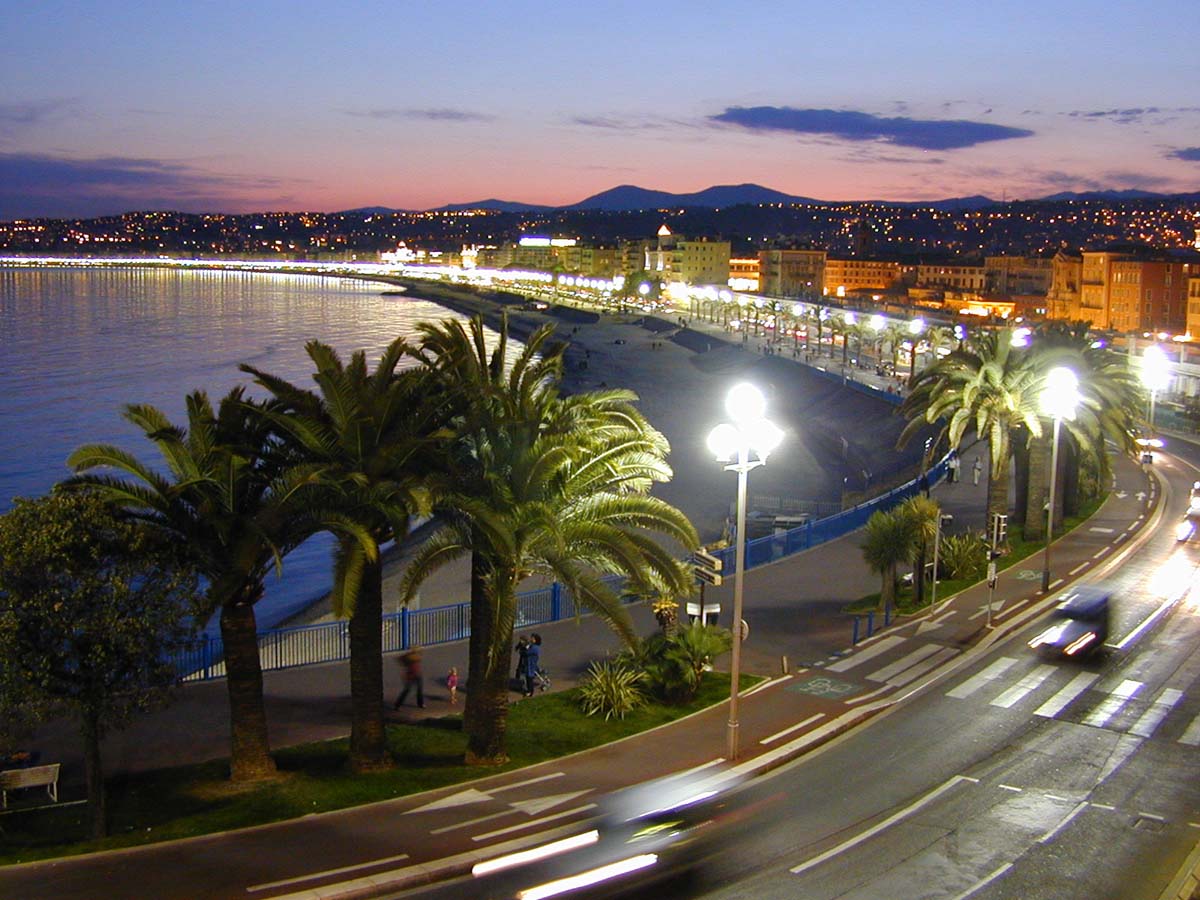
A view along the Quai des États-Unis and the Promenade des Anglais in Nice at night — CC BY-SA 3
History of Day Trips from Nice France
Nice began with the ancient Greeks, who founded the settlement of Nikaia in about the fourth century BC, and the city then passed to Rome and through centuries under the counts of Provence and the House of Savoy. Nice became part of France in 1860, after centuries as a Savoyard city on the edge of Italy. From the eighteenth century, English and European aristocrats came to Nice to escape the winter cold, and that winter resort laid the foundations of the reputation that UNESCO recognised in 2021. The property was inscribed as Nice, the Winter Resort Town of the Riviera, under reference 1635, and it records the city as an international winter resort rather than as a single monument.
Èze has a history that begins in prehistory and in Roman times, and it later became a medieval fortress village on its high rock. The village was destroyed in wars and rebuilt, keeping the shape of a stone stronghold with narrow lanes and old gates. The Jardin Exotique was laid out after the Second World War on the ruins of the castle, and it is now one of the finest viewpoints on the Riviera. Day trips from Nice France to Èze are therefore a visit to a village that has kept its defensive character, even as it became a place of gardens and views.
Monaco has a history that begins in 1297, when François Grimaldi seized the fortress on the Rock and founded the dynasty that still rules the principality today. The Monte Carlo casino opened in 1863 and turned Monaco into a destination for the wealthy of Europe, while the old town of Monaco-Ville kept the Prince’s Palace, the cathedral and its quiet streets. Monaco joined the United Nations in 1993 and uses the euro under an agreement with the European Union. The contrast between the palace quarter and the casino quarter is the heart of a day in Monaco, and both belong to the same small Rock.
Cannes began as a small fishing village and became a resort after the English lord Henry Brougham built a house there in 1834. The Cannes Film Festival was first held in 1946 and grew into one of the most important film festivals in the world. Antibes began as the Greek city of Antipolis, then became a Roman port and a French fortress, with Fort Carré rebuilt under Vauban in the seventeenth century. The Picasso Museum stands in the Grimaldi castle, where Picasso worked in 1946, and it shows the works he made in Antibes alongside works by other modern artists.
Menton has a history tied to the lemon, which has been grown there since the fifteenth century and became the symbol of the city, with a Lemon Festival held every February. Saint-Paul-de-Vence became a haunt of painters from the early twentieth century, and Marc Chagall lived in the village in his last years and is buried in its cemetery. Grasse has made perfume since the sixteenth century, when tanning and flower growing met, and the craft of perfume in Grasse was placed on the UNESCO Representative List of the Intangible Cultural Heritage of Humanity in 2018. The Lérins Islands have a monastic history from the fifth century, when Saint Honorat founded the abbey on Saint-Honorat, where monks still live and make wine today.
The winter resort
The winter resort story is what makes Nice different from the other Riviera towns, and it shapes day trips from Nice France in a quiet way. The grand hotels, the villas and the seafront promenade were built for visitors who stayed for months rather than days, and the city still carries that spacious scale. The inscription of 2021 recognised the resort town as a whole, with its hotels, its promenades and its gardens, rather than a single building. Travellers who start the day in Nice walk through that history before they even reach the station, and the day trips from Nice France that follow are the excursions those winter visitors invented.
The artists of the twentieth century added a second layer to the same coast, and day trips from Nice France follow their trail. Chagall is buried in Saint-Paul-de-Vence, Picasso worked in Antibes, and the perfume makers of Grasse supplied the world. The coast attracted painters because of its light, and it attracted writers and musicians for the same reason. That artistic past is still visible in the galleries, the museums and the village studios that line the routes from Nice.
Timeline
- Fourth century BC: Greek settlers found Nikaia, the origin of Nice.
- 1297: François Grimaldi seizes the Rock and founds the dynasty of Monaco.
- Fifteenth century: lemons are first grown at Menton and become the symbol of the city.
- Sixteenth century: Grasse begins its perfume craft, joining tanning and flower growing.
- 1834: Lord Henry Brougham builds a house at Cannes and starts its life as a resort.
- 1860: Nice becomes part of France after centuries under the House of Savoy.
- 1863: the Monte Carlo casino opens in Monaco.
- 1946: the Cannes Film Festival is first held, and Picasso works in Antibes.
- 1993: Monaco joins the United Nations.
- 2018: the perfume craft of Grasse is placed on the UNESCO intangible heritage list.
- 2021: Nice is inscribed on the World Heritage List, reference 1635.

A view of nice — CC0
Travel to Day Trips from Nice France
The easiest way to take day trips from Nice France is the TER train, which runs along the coast with frequent services. The line links Nice with Cannes, Antibes, Monaco, Menton and Ventimiglia in Italy, and most legs take between ten and forty minutes. Check the times on the official SNCF Connect site or at the station, because the frequency changes with the season and can fall on Sundays. The train is the best choice for the coastal towns, because it is fast, cheap and free of the traffic that clogs the coast road in summer.
Èze is reached from Nice by bus 112 from Nice-Ville station, or by train to Èze-sur-Mer and then on foot up the village along the Nietzsche path in about an hour. Monaco is reached by train from Nice to Monaco-Monte-Carlo station in about twenty minutes, or by bus 100 along the coast in about forty-five minutes, which is slower but cheaper and has a sea view. Cannes and Antibes are reached by TER train, in about twenty-five minutes to Cannes and ten to fifteen minutes to Antibes. Menton is reached by TER train in about thirty-five minutes, or by bus 100 along the coast.
Saint-Paul-de-Vence needs a bus from Nice through Cagnes-sur-Mer, because the village has no railway station, and the journey takes about an hour. Grasse is reached by train from Nice through Cannes in about one hour and fifteen minutes, or by bus. The Lérins Islands are reached by ferry from the port of Cannes, and travellers usually combine the ferry with the train from Nice to Cannes in the same day. Guided day trips from Nice France often combine Èze, Monaco and Menton in one day, or Cannes, Antibes and Saint-Paul-de-Vence in another, and those pairings follow the geography of the coast.
Saint-Tropez has no railway station, so travellers usually take a bus from Nice through Saint-Raphaël or a summer ferry from Nice and Cannes, or they hire a car. The Gorges du Verdon usually needs a hire car or a guided tour, because public transport to the gorge is limited. Both destinations need a whole day on day trips from Nice France, and they suit travellers who have already seen the nearer towns. The best time for day trips from Nice France is from April to October, when the weather is warm and the days are long, while July and August are the most crowded months, especially in Monaco, Cannes and on the beaches.
Comfortable walking shoes are essential, because many old villages such as Èze and Saint-Paul-de-Vence have steep stone streets and steps. Drinking water, sun cream and a hat are needed in summer, especially on the walking paths and in the gardens. In Monaco, travellers should remember that the Monte Carlo casino requires smart dress and identity papers, while the old town and the Japanese Garden are open freely. An early start is the simplest way to beat the crowds, and it leaves the afternoon free for a second town on the way back to Nice.
Notable Places in Day Trips from Nice France
- Èze — a medieval village on a rock 427 metres high, with the Jardin Exotique and the eighteenth-century church of Notre-Dame de l’Assomption.
- Monaco — the principality of the Grimaldi dynasty since 1297, with the Prince’s Palace, the Monte Carlo casino of 1863 and the harbour of La Condamine.
- Cannes — the festival city on La Croisette, with the Palais des Festivals, the old quarter of Le Suquet and the morning market of Forville.
- Antibes — the old town with the Provençal market, Port Vauban, Fort Carré and the Picasso Museum in the Grimaldi castle.
- Menton — the lemon city near the Italian border, with a colourful old town, the church of Saint-Michel-Archange and the garden of Serre de la Madone.
- Saint-Paul-de-Vence — a walled hill village of galleries and studios, where Marc Chagall lived and is buried.
- Grasse — the world capital of perfume, with historic perfume workshops and the International Perfume Museum.
- Îles de Lérins — the islands off Cannes, with the monastery of Saint-Honorat from the fifth century and Fort Royal on Sainte-Marguerite.
- Saint-Tropez — the resort town about 90 kilometres from Nice, reached by summer ferry or by road.
- Gorges du Verdon — the great limestone canyon inland, visited by hire car or guided tour.
Frequently Asked Questions
How long does it take to go from Nice to Monaco?
The TER train from Nice-Ville to Monaco-Monte-Carlo takes about twenty minutes, with many trains each day. Bus 100 along the coast takes longer, about forty-five minutes, but it is cheaper and has a sea view for the whole journey. Both services run to the same small principality, and the train is the better choice when time is short.
Which of the day trips from Nice France is the best?
Èze and Monaco usually rank first among day trips from Nice France, because they are near, easy to reach by train and bus, and they give two different experiences in the same day. Cannes and Antibes are the second best choice, while Menton and Saint-Paul-de-Vence suit travellers who like old villages and quieter places. The best choice depends on taste, because the coast offers cities, villages and islands within the same short radius.
Can Èze and Monaco be combined in one day?
Yes, many travellers combine Èze in the morning with Monaco in the afternoon, and day trips from Nice France often pair the two, because the two places lie on the same route north-east of Nice. Buses link Èze with Nice and Monaco, and the TER train links Monaco with Nice, so the pairing needs no hire car. The combination works best with an early start, which leaves time for the garden at Èze and the palace quarter in Monaco.
Is a day trip to Saint-Tropez from Nice feasible?
Yes, but it needs a whole day and the right transport, because Saint-Tropez lies about 90 kilometres from Nice and has no railway station. The summer ferry from Nice is the fastest and most beautiful choice for day trips from Nice France, while the bus through Saint-Raphaël takes much longer. Travellers who go by road should leave early and expect heavy traffic in July and August.
Do I need a guided tour, or can I travel on my own?
Most coastal destinations on day trips from Nice France are easy to visit on your own by TER train and bus, with low cost and full freedom over the timetable. A guided tour suits the Gorges du Verdon, Grasse and the hill villages better, because public transport there is limited and a car is needed. Guided tours also help travellers who want to see Èze, Monaco and Menton in a single day without planning the connections themselves.
What is the best season for day trips from Nice France?
April to June and September to October are the best months for day trips from Nice France, with warm weather, long days and fewer crowds than the high season of July and August. Winter is mild and quieter, but some ferries and seasonal tours may stop running. Spring brings the flowers of the Riviera, and autumn brings a softer light to the coast and the hill villages.
Verified
A Wikidata item does not exist for this journey product, and no Q-ID is assigned, because level-five tour pages are written without one by design. The UNESCO position for day trips from Nice France was read on the World Heritage Centre site on 22 November 2026: Nice, the Winter Resort Town of the Riviera, reference 1635, was inscribed in 2021 under criterion (ii), and France holds 56 properties, 47 cultural, 7 natural and 2 mixed. Monaco covers about 2 square kilometres and is the second smallest country in the world after the Vatican.
The Grimaldi dynasty dates from 1297, the Monte Carlo casino opened in 1863, and the Cannes Film Festival was first held in 1946. The perfume craft of Grasse was placed on the UNESCO Representative List of the Intangible Cultural Heritage of Humanity in 2018, and the monastery on Saint-Honorat was founded in the fifth century. Èze stands 427 metres above the sea, and the coordinates of Nice are 43.7 degrees north and 7.27 degrees east.
Sources
- UNESCO World Heritage Centre, Nice, the Winter Resort Town of the Riviera, ref 1635, 2021, criterion (ii): https://whc.unesco.org/en/list/1635/
- UNESCO World Heritage Centre, France, 56 properties inscribed: https://whc.unesco.org/en/statesparties/FR
- UNESCO, the craft of perfume in Grasse, Representative List of the Intangible Cultural Heritage of Humanity, 2018: https://ich.unesco.org/en/RL/the-skills-related-to-perfume-in-pays-de-grasse-the-cultivation-of-perfume-plants-the-knowledge-and-processing-of-natural-raw-materials-and-the-art-of-perfume-composition-01207
- SNCF Connect, official site for TER trains in Provence-Alpes-Côte d’Azur: https://www.sncf-connect.com/en-en
- Explore Nice Côte d’Azur, official tourism site: https://www.explorenicecotedazur.com/en/
All sources checked on 22 November 2026.
Unverified
- Train, bus and ferry fares for day trips from Nice France, which change by season and have not been checked directly on the official site of each operator; check the current fare before travelling.
- Opening hours and admission for the Monte Carlo casino, the Picasso Museum in Antibes and the perfume workshops in Grasse, which have not been checked directly on their official sites; check before going.
- The figure of more than 300 days of sunshine a year in Nice, which is often quoted in travel sources and has not been matched against official meteorological data.
- The population of the Nice metropolitan area at about one million people, which is a rounded figure from combined sources and has not been matched against the latest INSEE census.
- Summer ferry timetables from Nice to Saint-Tropez, which change from year to year and have not been checked for the current season.
Illustrations
- Hero: The village of Èze, a day trip from Nice, France. Free image: https://upload.wikimedia.org/wikipedia/commons/4/43/Eze_Village_-panoramio-_kajikawa.jpg — CC BY 3.
- In body, nice: A view along the Quai des États-Unis and the Promenade des Anglais in Nice at night. Free image: https://upload.wikimedia.org/wikipedia/commons/1/1b/Nice-night-view-with-blurred-cars_1200x900.jpg — CC BY-SA 3.
- In body, nice: A view of nice. Free image: https://upload.wikimedia.org/wikipedia/commons/8/8b/Nice_5.jpg — CC0.