
Albertina Vienna: The Graphic Collection in the Habsburg Palace
Albertina Vienna keeps the most famous hare in art behind palace walls. Durer drew it in 1502, and the museum guards it from light.
The museum is not a city, an island or a quarter, but one of the great graphic collections of the world, holding about one million prints and tens of thousands of drawings by masters from Durer, Raphael and Michelangelo to Picasso, Monet and Klimt. Albertina Vienna stands in the Palace of Archduke Albrecht on Albertinaplatz in the Innere Stadt, the historic centre of the Austrian capital, a few steps from the Vienna State Opera and the Hofburg Palace, and its name comes from its founder, Duke Albert of Saxe-Teschen, the son-in-law of Empress Maria Theresa, who began collecting drawings and prints in 1776.
What makes Albertina Vienna unlike other great museums is that it keeps works on paper, the most fragile works in art, which cannot hang in the light the way oil paintings can. The Young Hare of Durer appears only on special occasions, since light fades watercolour within weeks, and many travellers come to Vienna for the hare alone. This guide follows the collection from its founding through the Habsburg palace, the war and the rebuilding, and it explains how to visit the museum and its second house, the Albertina Modern.
Quick Facts About the Albertina
| Fact | Detail |
|---|---|
| Full name | The ALBERTINA Museum |
| Type | Art museum (Wikidata Q371908) |
| Address | Albertinaplatz 1, Innere Stadt, Vienna, Austria |
| Coordinates | 48.2047° N, 16.3683° E |
| Founded | 1776, by Duke Albert of Saxe-Teschen |
| Building | Palace of Archduke Albrecht (Palais Erzherzog Albrecht) |
| Collection | About 1 million prints and tens of thousands of drawings |
| Best known work | Young Hare by Albrecht Durer (1502) |
| Second house | Albertina Modern, Künstlerhaus, Karlsplatz, opened 2020 |
| UNESCO | Inside the Historic Centre of Vienna (2001, ref 1033, criteria ii, iv, vi) |
| Austria | 12 World Heritage properties |
| Nearest metro | Karlsplatz, about 5 minutes on foot |
Geography of the Albertina
The Palace on the Old Bastion
Albertina Vienna stands at the southern edge of the historic centre of Vienna, on a raised terrace that is the remains of the old city wall, and the position gives the museum its character. From the terrace a visitor looks over Albertinaplatz, the Vienna State Opera standing beside the museum, and further on the coloured tile roof of St Stephen’s Cathedral, while the main walking axis of central Vienna runs past the door, joining the Ringstrasse to the shopping street of Karntner Strasse. The palace is raised above the square on its bastion, so the museum looks down on the city it serves, and the titanium wing added in the rebuilding reaches over the square like a metal sail above the old palace walls.
The building began as a noble residence of the seventeenth century, which Duke Albert bought and enlarged into a palace and a home for his collection, and the rooms still show that double purpose, since the state apartments of the Habsburgs lead directly into the galleries. Albertina Vienna is therefore a palace that became a museum without ceasing to be a palace, and the visitor walks through the home of an archduke before reaching the drawings. The terrace, the wing and the square together make the museum one of the most photographed corners of Vienna, and the cafe beneath the wing looks over the square where the trams pass the Opera.
The raised ground matters for the visit, since the climb from the square to the terrace is short but steep, and the view from the top repays it at once. The Opera stands so close that its facade fills the view to one side, while the Ringstrasse opens to the other, and the museum sits exactly where the old wall once divided the city from its suburbs. A traveller who arrives at Albertina Vienna from Karlsplatz walks uphill through the Opera quarter, and the palace appears suddenly above the square, which is the finest approach the museum offers.
The Innere Stadt
The Innere Stadt, where Albertina Vienna stands, is the first district of Vienna, the historic centre ringed by the Ringstrasse boulevard, and it is the smallest district of the city yet the one that holds the most monuments. The Hofburg Palace, St Stephen’s Cathedral, the Vienna State Opera and dozens of museums, palaces and historic cafes all stand within its narrow streets, and the Albertina stands at the south-west corner of the district, beside the Opernring, where the old wall once ran. The district is small enough to walk in a morning, and the museum is the natural starting point for a walk through it, since it stands at the corner where the Ringstrasse meets the old town.
The streets around the museum hold the densest history in Vienna, with the Hofburg a short walk to the north, the cathedral a short walk to the east and the Opera at the door, so a traveller can join the three great sights of the centre in a single stroll. The Kunsthistorisches Museum stands on Maria-Theresien-Platz beside the Hofburg, holding the art collections of the Habsburgs, and the Belvedere Palace south-east of the centre holds the Klimt collection, so the museums of the old town form a single walk from the Albertina outward. The cafes of the Innere Stadt are the historic cafes of the empire, and the shops of Karntner Strasse run from the Opera to the cathedral in a straight line that passes the museum. Albertina Vienna belongs to this dense centre rather than to a museum quarter on the edge of town, and the visit to it is a visit to the heart of Vienna itself.
The Ringstrasse, the boulevard that rings the district on the line of the demolished walls, holds the parliament, the town hall, the university and the Burgtheater, and the walk along it from the Opera to the Hofburg is one of the great urban walks in Europe. The museum stands where that boulevard meets the old town, and the contrast between the wide Ringstrasse and the narrow streets of the Innere Stadt is the contrast that defines Vienna. A visitor who walks from Albertina Vienna to the Hofburg crosses from the palace of a collector to the palace of an empire in ten minutes.
Vienna on the Danube
Vienna lies in the east of Austria, on the Danube, near the borders with Slovakia, Hungary and the Czech Republic, and it is the largest city in Austria and its capital. The city grew from Celtic and Roman settlements into a medieval and Baroque city, and then into the capital of the Austro-Hungarian Empire, and its historic centre is one of the best preserved old towns in Europe. Albertina Vienna stands in the middle of that history, on the ground where the Roman settlement once stood and where the medieval walls once ran, so the museum is a small part of a very old city.
Summer in Vienna is warm and winter is cold, and the old town looks its best in the gentle light of spring and autumn, when the crowds thin. The Danube runs past the city to the north-east, the Vienna Woods rise to the west, and the old town lies on the flat ground between river and forest. The museum itself has no view of the river, yet the river explains the city, since Vienna grew where the Danube could be crossed and where the trade roads of central Europe met.
The historic centre became a World Heritage property in 2001, taking in the medieval core, the Baroque ensembles and the Ringstrasse buildings that show three great periods of European history. Albertina Vienna stands inside those boundaries, and the palace, the Opera and the cathedral around it all belong to the same inscribed landscape, so a visit to the museum is also a visit to a World Heritage property. The city holds a second inscribed property as well, the Palace and Gardens of Schonbrunn, which lies outside the centre and shows the summer face of the same empire.

The Albertina in Vienna — CC BY-SA 4

Albertinaplatz in Vienna — CC BY-SA 4
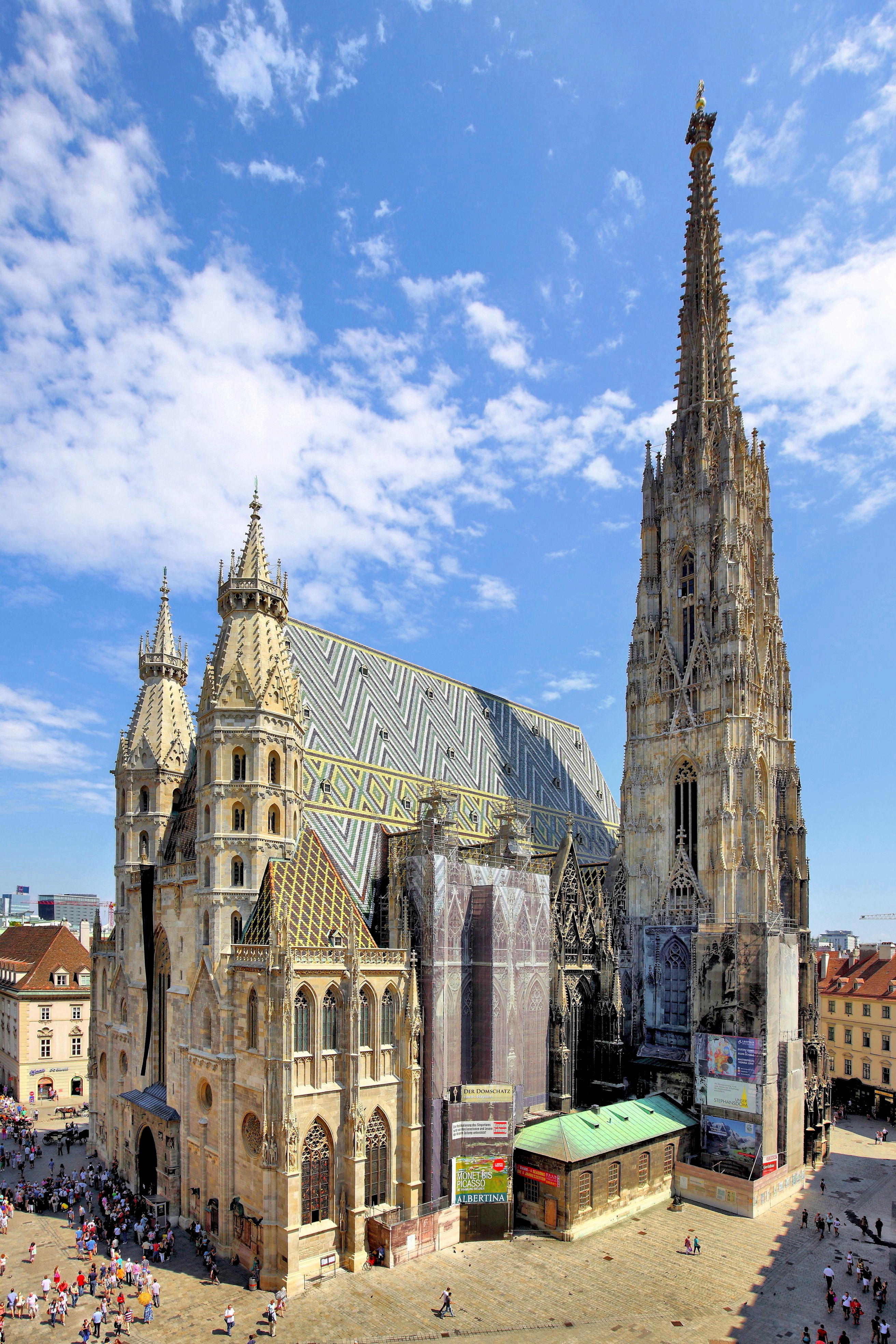
The Stephansdom in Vienna — CC BY-SA 4

The Hofburg Palace in Vienna — CC BY-SA 4
History of the Albertina
Duke Albert and the Collection of 1776
The collection of Albertina Vienna began in 1776, when Duke Albert of Saxe-Teschen, the son-in-law of Empress Maria Theresa and the husband of Archduchess Maria Christina, decided to collect drawings and prints in a systematic way. Albert did not collect by passing taste but by a clear plan, since he wanted to build a complete collection of the history of European graphic art, from the Renaissance to his own time, and he bought whole collections to do it, among them the collection of Count Giacomo Durazzo. By the end of his life his collection was already one of the most important graphic collections in Europe, and the plan he set in 1776 still shapes the museum today.
Albert was then the governor of the Austrian Netherlands, living in Brussels, and the collection was first housed there, far from the city where it now stands. After his death the collection was moved to Vienna, into the Palace of Archduke Albrecht that he had bought and enlarged, and the palace became the home of the drawings and prints as well as the home of the family. The palace itself was a noble residence from the seventeenth century, which Albert rebuilt as a place to live and a place to show the collection, so the museum grew out of a home rather than out of a public building.
The year 1776 is the founding date of Albertina Vienna, and it marks the moment when a private passion became a public trust. The duke collected the drawings of Raphael, Michelangelo and Durer beside the prints of Rembrandt, and he kept them in order, catalogued and studied, so that the collection was a history of art in itself rather than a hoard of beautiful sheets. A visitor who walks the galleries today walks through the plan of a man who believed that drawings show the mind of the artist more clearly than any finished painting.
From a Habsburg Palace to a National Museum
After the fall of the Habsburgs in 1918, the palace and the collection passed to the Republic of Austria, and the Albertina formally became a national museum. The palace had been the home of archdukes and archduchesses, among them Archduchess Maria Christina and her husband Duke Albert, and its state rooms kept the furniture, the chandeliers, the carpets and the wall paintings of the eighteenth and nineteenth centuries. Albertina Vienna therefore carries two histories at once, the history of the collection and the history of the palace that holds it, and the state rooms are the bridge between them.
During the Second World War the building was heavily damaged by bombing, and part of the collection had to be moved out of Vienna for safety, while the palace stood ruined in the centre of the city. The war left the museum with a damaged home and a scattered collection, and the rebuilding took decades, yet the drawings survived, and the collection returned to the palace as the city rebuilt itself around it.
The Albertina that visitors know today is the product of that return, a museum that survived the worst century in the history of Vienna and came back to its palace. The state rooms that visitors walk through first were the home of Archduchess Maria Christina, the favourite daughter of Maria Theresa, and her husband Duke Albert, and the rooms keep the furniture and the paintings of their household, so the palace still shows the domestic life of the family that founded the collection. Albertina Vienna is therefore a house museum as well as an art museum, and the rooms explain the collector before the galleries explain the collection.
From 1999 to 2003 the building was fully restored and enlarged, with a titanium canopy designed by the architect Hans Hollein, often called the flying roof, reaching over the square like a modern sail above the old palace. The director Klaus Albrecht Schroder, who led the museum from 1999, turned the Albertina from a specialist graphic collection into a large art museum open to the public, and he brought the Batliner Collection to the museum, one of the most important collections of modern art in Europe, with works by Monet, Picasso, Miro and Bacon. Albertina Vienna reopened in 2003 with a new face, and the museum has grown ever since.
In 2020 the museum opened a second house, the Albertina Modern, in the Kunstlerhaus building on Karlsplatz, devoted to modern and contemporary art, above all Austrian art from 1945 onward. The Kunstlerhaus was built in the nineteenth century as the home of the Vienna Artists’ Society, and its rebuilding as a museum gave the Albertina a second address ten minutes from the first. The two houses together show the whole span of the collection, from the drawings of Durer to the art of living Austrian artists, and the museum that began in 1776 now fills two buildings in the centre of Vienna.
Timeline
| Year | Event |
|---|---|
| 1776 | Duke Albert of Saxe-Teschen begins collecting drawings and prints |
| 1790s | The collection is moved to Vienna |
| 1919 | The palace and the collection pass to the Republic of Austria |
| 1945 | The building is heavily damaged in the Second World War |
| 1999–2003 | Full restoration and enlargement, titanium canopy by Hans Hollein |
| 2003 | The Albertina reopens with its new face |
| 2007 | The Batliner Collection comes to the Albertina |
| 2020 | Albertina Modern opens at the Kunstlerhaus, Karlsplatz |

The entrance of the Albertina Museum in Vienna — CC BY-SA 4

The Young Hare by Albrecht Durer, drawn in 1502 — Public domain

The Great Piece of Turf by Albrecht Durer, drawn in 1503 — Public domain
Travel to the Albertina
When to Go and How Long to Stay
Albertina Vienna is open through the year, and the finest time to visit is a weekday morning, when the visitors are few and the works on paper can be seen in quiet rooms. Weekends and public holidays are the busiest times, above all during special exhibitions on Durer, when the queues for tickets can grow long, and the galleries are at their most crowded in the middle of the day. The museum rewards travellers who come early, since the paper galleries are dim and the quiet helps the eye adjust to the small scale of the drawings.
Two to three hours are enough for a visit to the main house of Albertina Vienna: one hour for the state rooms and the permanent collection, one hour for the special exhibition, and more time for the terrace and the shop. Travellers who also wish to see the Albertina Modern at Karlsplatz should allow at least two more hours, since the second house is a full museum in its own right and the walk between the two takes about ten minutes. The two houses together fill a day, and the traveller who sees both has seen the whole span of the collection.
Getting There
Albertina Vienna stands in the centre of Vienna, so it is easy to reach by public transport from anywhere in the city. The nearest metro station is Karlsplatz, served by the U1, U2 and U4 lines and about five minutes on foot from the museum, and Stephansplatz, served by the U1 and U3 lines, is about ten minutes away on foot through Karntner Strasse. Tram lines 1, 2, D and 71 stop at the Opera beside the museum, and the walk from any of these stops to the palace terrace takes only a few minutes. From Vienna International Airport the City Airport Train or the suburban railway reaches Wien Mitte or Karlsplatz in about thirty to forty minutes in total.
The museum sits on the main walking axis of central Vienna, so many travellers arrive on foot from the Hofburg, the cathedral or the Opera, and the walk itself is part of the visit. The streets around Albertinaplatz are pedestrian in large part, and the square in front of the museum is a meeting place for the city, so the approach is easy and the palace appears suddenly above the square. A traveller who comes by metro should leave at Karlsplatz and walk toward the Opera, since the museum stands beside it and the signs are clear.
Tickets and Planning
Prices and hours at Albertina Vienna move with the season and with the exhibition, so travellers should read the official site before going, and the museum sells separate tickets for the main house, for the Albertina Modern and for a combined visit to both. Tickets bought online help travellers avoid the queues, above all at weekends and in the high season, when the lines at the museum can be long. The official site is the only source for current prices, and this guide states none, since a price printed here would be out of date before the traveller arrives.
Planning matters more for the Albertina than for most museums, because the works on paper cannot be shown all at once, and the display changes with each exhibition. The Young Hare is not always on view, and the traveller who comes for it alone should check the official site first, since the original appears only in special exhibitions and a high-quality facsimile or another work by Durer stands in its place at other times. Albertina Vienna rewards the traveller who checks before going, and the museum is at its best for those who arrive with a plan.
Notes for the Visit
Works on paper are very sensitive to light, so the galleries of Albertina Vienna are kept dim and the temperature is tightly controlled, and the small scale of the drawings asks for slow looking rather than a quick walk past. Flash photography is not allowed, and some special exhibitions forbid photography entirely, so travellers should ask at the door of each gallery. The Young Hare is the work most affected by light, since watercolour on paper fades within weeks of exposure, and the museum shows the original only in special exhibitions, displaying a facsimile or another Durer at other times.
The state rooms come first in the visit, before the galleries, and they show the palace as the Habsburgs lived in it, with furniture, chandeliers and wall paintings from the eighteenth and nineteenth centuries. The galleries that follow hold the drawings and prints, and the special exhibitions change through the year, so each visit to Albertina Vienna shows a different selection of works. The terrace and the cafe beneath the titanium wing make a natural rest at the end, with a view over the square and the Opera, and the shop holds the catalogues that explain the collection in full.

The Albertina Modern at the Kunstlerhaus on Karlsplatz — CC BY-SA 4

The Belvedere Palace in Vienna — CC BY-SA 4
Notable Places in the Albertina
The Young Hare of Durer
The Young Hare, drawn in 1502 by Albrecht Durer, is the best known work of Albertina Vienna and one of the most famous watercolours in the history of art. The drawing shows a hare curled in on itself, with every hair, every whisker and the reflection in its eye rendered so exactly that many first-time viewers take it for a photograph, and Durer drew it as a finished work, a study of nature with scientific precision that became an emblem of the German Renaissance. The original appears only in special exhibitions, since watercolour on paper is too sensitive to light for permanent display, and at other times the museum shows a facsimile or another work by Durer.
The Habsburg State Rooms
Before the galleries, visitors to Albertina Vienna walk through more than twenty state rooms of the Habsburg palace, restored to their original state with furniture, chandeliers, carpets and wall paintings from the eighteenth and nineteenth centuries. The rooms were once the home of members of the imperial family, among them Archduchess Maria Christina and her husband Duke Albert, and they form one of the best preserved classical interiors in Vienna. The ballroom, the reception rooms and the royal bedrooms give a sense of court life in the Habsburg Empire that no gallery can match.
The Batliner Collection
The Batliner Collection is one of the most important collections of modern art in Europe, lent to Albertina Vienna on a long term basis by Herbert and Rita Batliner from 2007. The collection holds works by Monet, Picasso, Miro, Bacon, Giacometti and Chagall, among many great names of twentieth century art, from Impressionism to Surrealism and contemporary art, and its highlight is the Water Lilies Pond of Monet, painted in 1917 to 1919, beside works by Picasso from many periods of his career.
The Great Piece of Turf and the Renaissance Masters
Beside the Young Hare, Albertina Vienna holds another work by Durer that is nearly as famous, the Great Piece of Turf, drawn in 1503, a study of a patch of wild grass with every blade and every wildflower drawn as exactly as a botanist would draw them. The two works are often named together as the twin emblems of Renaissance nature study, and the graphic collection holds drawings by Raphael, Michelangelo, Leonardo da Vinci and Rembrandt as well, many of them studies for famous frescoes and monuments. These works are shown in rotation, since paper cannot bear continuous light, so each visit to the museum shows a different selection.
Albertina Modern
Albertina Modern is the second house of the museum, in the Kunstlerhaus building on Karlsplatz, about ten minutes on foot from the main house, and it opened in 2020. The Kunstlerhaus was built in the nineteenth century as the home of the Vienna Artists’ Society, and its rebuilding as a museum gave the Albertina a house for modern and contemporary art, above all Austrian art from 1945 onward, with works by Arnulf Rainer, Maria Lassnig and Hermann Nitsch. The second house shows the art that the main house leaves aside, and the two together cover the whole history of the collection.
The Terrace and the Titanium Wing of Hans Hollein
The titanium canopy designed by the architect Hans Hollein in the rebuilding of 1999 to 2003 is one of the most debated details of Albertina Vienna, and also one of the most photographed. The canopy reaches over the square like a metal sail, sheltering the entrance to the museum and a terrace that looks over the Vienna State Opera, and the cafe and restaurant of the museum sit beneath it, with a view over the square. From the terrace a visitor can see the whole of Albertinaplatz, the Ringstrasse and the historic centre, and the wing is the modern signature of a museum that began in 1776.

The gardens of Schonbrunn Palace in Vienna — CC BY-SA 4

The Austrian Parliament on the Ringstrasse in Vienna — CC BY-SA 2
Frequently Asked Questions About the Albertina
What is the Albertina?
The Albertina is an art museum in Vienna, Austria, known for its graphic collection of drawings, prints and engravings, counted among the largest in the world. Albertina Vienna was founded in 1776 by Duke Albert of Saxe-Teschen, and it stands in the Palace of Archduke Albrecht on Albertinaplatz, with the Wikidata identifier Q371908 and the type of an art museum.
Where is Albertina Vienna?
Albertina Vienna stands at Albertinaplatz 1, in the Innere Stadt, the historic centre of Vienna, Austria, at 48.2047 degrees north and 16.3683 degrees east. The museum stands beside the Vienna State Opera and the Hofburg Palace, about five minutes on foot from Karlsplatz metro station, and the airport train reaches Karlsplatz in about thirty to forty minutes.
Can I see the Young Hare by Durer at Albertina Vienna?
The original Young Hare, drawn in 1502, appears only in special exhibitions, since watercolour on paper fades quickly in the light. At other times the museum shows a high-quality facsimile or another work by Durer, so travellers who come for the hare alone should check the official site before visiting.
Is Albertina Vienna a UNESCO World Heritage site?
Albertina Vienna holds no inscription of its own, yet the museum stands inside the Historic Centre of Vienna, listed by UNESCO in 2001 with reference 1033 and criteria ii, iv and vi. The property covers 371 hectares of the medieval core, the Baroque ensembles and the Ringstrasse, and the museum is one of the buildings inside it.
How long does a visit to Albertina Vienna take?
Two to three hours are enough for the main house, with one hour for the state rooms and the permanent collection, one hour for the special exhibition and more time for the terrace and the shop. Travellers who also wish to see the Albertina Modern at Karlsplatz should allow at least two more hours for the second house.
How is Albertina Modern different from the main Albertina?
Albertina Modern is the second house of the museum, in the Kunstlerhaus building on Karlsplatz, opened in 2020 and devoted to modern and contemporary art, above all Austrian art from 1945 onward. The main house of Albertina Vienna holds the historic graphic collection, from Durer, Raphael and Michelangelo to the Batliner Collection of twentieth century art.
Verified
The museum itself supplied the backbone of this guide: its own records give the founding year of 1776, the Palace of Archduke Albrecht and the scale of the collection, while Wikidata and UNESCO supplied the rest, all read on 22 November 2026. Wikidata lists the Albertina as Q371908, an art museum in Vienna, Austria, with coordinates of 48.2047 degrees north and 16.3683 degrees east, and its inception is recorded as 1776. The Young Hare was drawn by Albrecht Durer in 1502, the Great Piece of Turf in 1503, the palace and the collection passed to the Republic of Austria in 1919, the building was heavily damaged in 1945, the restoration ran from 1999 to 2003, the Batliner Collection arrived in 2007 and the Albertina Modern opened in 2020.
Albertina Vienna holds no UNESCO inscription of its own, and that position was checked against the UNESCO page for the Historic Centre of Vienna, listed in 2001 with reference 1033 and criteria ii, iv and vi, covering 371 hectares with a buffer zone of 462 hectares. Austria holds 12 World Heritage properties, and the historic centre property takes in the medieval core, the Baroque ensembles and the Ringstrasse buildings. This guide states no ticket price and no opening hour, since both belong on the official site of the museum.
Sources
- Wikidata, Albertina Q371908: art museum in Vienna, Austria, coordinates 48.2047° N, 16.3683° E, inception 1776, official site albertina.at — https://www.wikidata.org/wiki/Q371908
- UNESCO World Heritage Centre, Historic Centre of Vienna (2001, ref 1033, criteria ii, iv, vi, 371 ha) — https://whc.unesco.org/en/list/1033/
- UNESCO World Heritage Centre, World Heritage List for Austria: 12 properties — https://whc.unesco.org/en/list/?search_by_country=austria&order=year&mode=table
- The ALBERTINA Museum, official site — https://www.albertina.at/home
- TheTerraAtlas registry: Albertina, L4 under Vienna, canonical URL /en/europe/austria/vienna/albertina/
Unverified
- What tickets cost at the Albertina and the Albertina Modern, and whether visitors under 19 enter free — the museum revises its prices by season, so the official site should be read before visiting.
- When the original Young Hare by Durer will be on show — it appears only in special exhibitions, and the dates should be checked on the official site before going.
- How large the graphic collection is in exact numbers — the figures of about one million prints and tens of thousands of drawings come from general sources, and the totals differ slightly between them.
- Where the Historic Centre of Vienna stands on the List of World Heritage in Danger today — the position should be read on the UNESCO site before travelling.
- Which evenings the museum stays open late in the week — the hours move with the season and should be read on the official site before visiting.
Illustrations
- Hero: Albertina Vienna. Free image: https://upload.wikimedia.org/wikipedia/commons/e/e0/Albertina_-_Vienna%2C_March_2020.jpg — CC BY-SA 4.0.
- In body, entrance: The entrance of the Albertina Museum in Vienna. Free image: https://upload.wikimedia.org/wikipedia/commons/d/d7/Entrance_of_the_Albertina_Museum_Vienna.jpg — CC BY-SA 4.
- In body, albertina: The Albertina in Vienna. Free image: https://upload.wikimedia.org/wikipedia/commons/6/63/Albertina%2C_Vienna%2C_2006_%2801%29.jpg — CC BY-SA 4.
- In body, albertinaplatz: Albertinaplatz in Vienna. Free image: https://upload.wikimedia.org/wikipedia/commons/5/5f/Albertinaplatz_Vienna_19-20_IMG_2167.jpg — CC BY-SA 4.
- In body, stephansdom: The Stephansdom in Vienna. Free image: https://upload.wikimedia.org/wikipedia/commons/d/dd/Wien_-Stephansdom%281%29.JPG — CC BY-SA 4.
- In body, hofburg: The Hofburg Palace in Vienna. Free image: https://upload.wikimedia.org/wikipedia/commons/a/a9/Wien%2C_Hofburg_–2018–_3185.jpg — CC BY-SA 4.
- In body, young Hare: The Young Hare by Albrecht Durer, drawn in 1502. Free image: https://upload.wikimedia.org/wikipedia/commons/4/44/Albrecht_D%C3%BCrer_-Hare%2C_1502-_Google_Art_Project.jpg — Public domain.
- In body, great Piece of Turf: The Great Piece of Turf by Albrecht Durer, drawn in 1503. Free image: https://upload.wikimedia.org/wikipedia/commons/f/f6/Albrecht_D%C3%BCrer_-The_Large_Piece_of_Turf%2C_1503-_Google_Art_Project.jpg — Public domain.
- In body, albertina Modern: The Albertina Modern at the Kunstlerhaus on Karlsplatz. Free image: https://upload.wikimedia.org/wikipedia/commons/4/41/Wien_-Museum%E2%80%9EAlbertina_modern%E2%80%9C_bzw.K%C3%BCnstlerhaus%281%29.JPG — CC BY-SA 4.
- In body, belvedere: The Belvedere Palace in Vienna. Free image: https://upload.wikimedia.org/wikipedia/commons/3/31/Belvedere%2C_Vienna_September_2016.jpg — CC BY-SA 4.
- In body, schonbrunn Gardens: The gardens of Schonbrunn Palace in Vienna. Free image: https://upload.wikimedia.org/wikipedia/commons/9/9a/Gardens_of_Schoenbrunn_Palace_%281%29.jpg — CC BY-SA 4.
- In body, austrian Parliament: The Austrian Parliament on the Ringstrasse in Vienna. Free image: https://upload.wikimedia.org/wikipedia/commons/0/07/The_Austrian_Parliament%2C_Vienna_%288879624085%29.jpg — CC BY-SA 2.