Day Trips from Salzburg: Hallstatt, Lake Wolfgangsee and the Alps
Salzburg sits at the edge of the Alps, and its day trips reward an extra night. Lakes, ice caves, salt mines and one famous village lie within a few hours.
Salzburg itself earns a long stay, with its old town, its fortress and its music, yet the country around it holds the trips that travellers remember longest. The city stands near the German border on the Salzach river, under the Alps and beside the lake district of the Salzkammergut in Austria, so a morning train or bus can put a visitor on a lakeshore, inside an ice cave or on a mountain road by midday. This guide covers the best day trips from Salzburg with the transport, the timing and the main sights of each destination, and it states no ticket price and no tour price, since prices change with the season and the operator.
Quick Facts
| Item | Detail |
|---|---|
| Departure city | Salzburg, Austria |
| Location | Western Austria, on the Salzach river near the German border |
| Coordinates | 47.80 N, 13.04 E |
| Type | L5 tour guide, under Salzburg |
| Best known destination | Hallstatt, on Lake Hallstatt |
| Other highlights | Lake Wolfgangsee, Berchtesgaden, Werfen Ice Caves, Hallein Salt Mine |
| UNESCO records | Historic Centre of the City of Salzburg, 1996, ref 784; Hallstatt-Dachstein and Salzkammergut, 1997, ref 806 |
| Transport | Train, bus, guided tour, hired car |
| Time per trip | Half a day to a full day |
| Prices | No ticket or tour price is given in this guide |
| Wikidata | No Q-ID by design: this is an L5 tour guide, not a place entity |
How to Plan Day Trips from Salzburg
The first choice on any of the day trips from Salzburg is between a guided tour and an independent journey, and the answer depends on the destination. Hallstatt rewards a guided tour for travellers short on time, since the train route needs two changes and a ferry, while the coach drives straight through the lake district. Lake Wolfgangsee suits independent travel, since bus 150 runs from Salzburg to Saint Gilgen in about an hour and boats cross the lake to Saint Wolfgang and Strobl.
Werfen and Hallein suit the train, since both sit on the main line south from Salzburg, and Berchtesgaden suits the bus, since the route crosses into Bavaria in about an hour. Day trips from Salzburg work best with an early start, because the lakes and the village of Hallstatt grow crowded by late morning in summer.
The second choice is the season, and it changes the list more than most visitors expect. Summer, from June to September, opens every road, cave and mountain lift, and it gives the longest days for the longest trips. Winter brings snow to the mountains and Christmas markets to the towns, yet it closes the ice caves and the Eagles Nest, and some mountain roads shut until spring.
Spring and autumn give quieter lakes and lower crowds, though the weather can turn quickly in the mountains. Whatever the season, a warm layer belongs in every bag, since the temperature on a mountain or inside an ice cave sits far below the temperature in the city. The day trips from Salzburg in this guide note the seasonal limits of each destination, so a plan made in January looks different from a plan made in July.
Hallstatt: The Lakeside Village
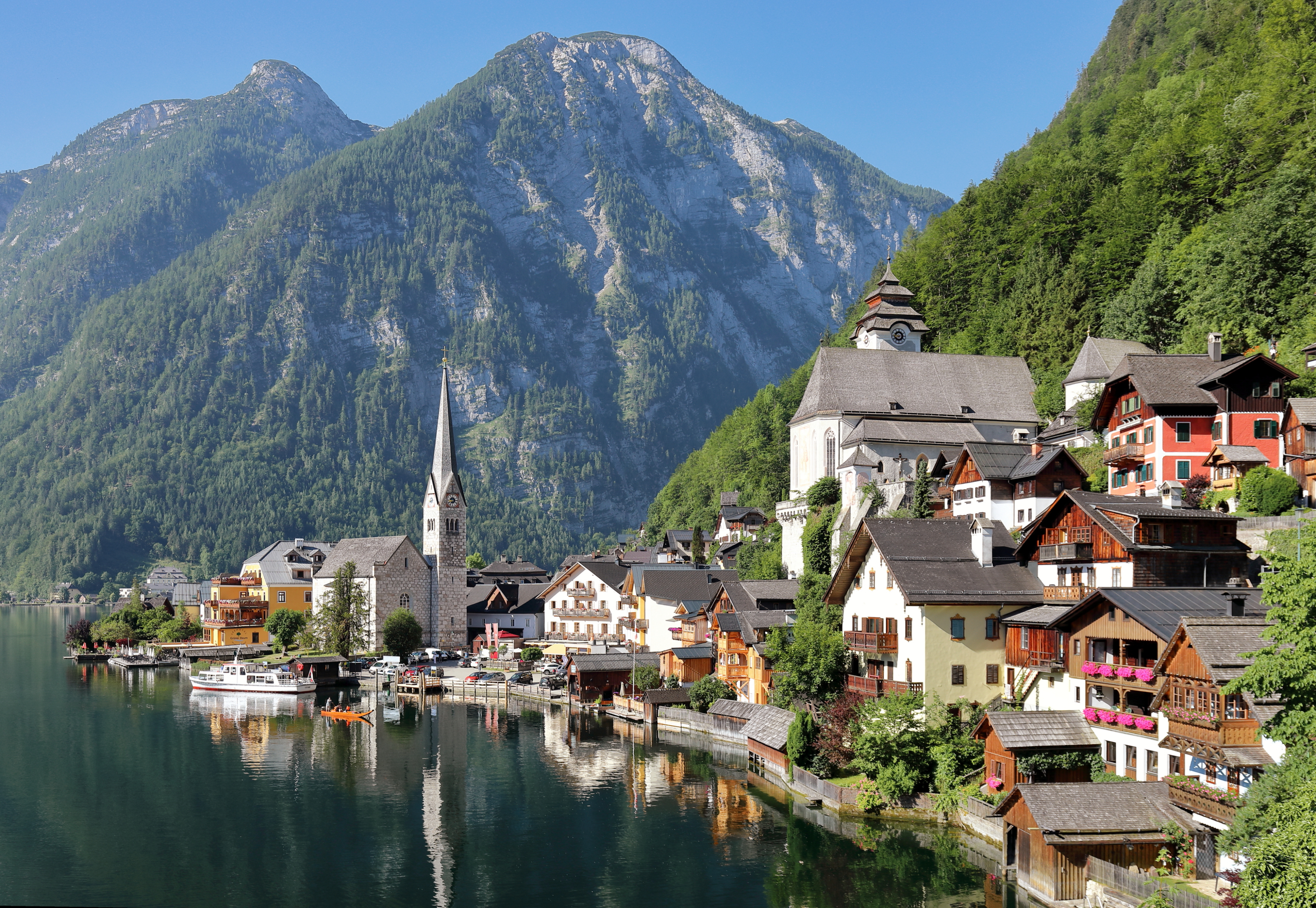
Hallstatt is the most famous of all the day trips from Salzburg, and it is also the most visited village in Austria. The village stands on the shore of Lake Hallstatt beneath the Dachstein mountain, with timber houses stacked on the steep slope, a small church and a cemetery above the water, and a lakeside path that fills with photographers from morning to evening. Salt made the village rich, and the mine above the town has worked for thousands of years, while the Iron Age culture named after Hallstatt was first recognised here in the nineteenth century. UNESCO inscribed the Hallstatt-Dachstein and Salzkammergut Cultural Landscape in 1997 under reference 806, with criteria (iii) and (iv), which covers the village, the lake and the mountain together.
A guided Hallstatt day tour from Salzburg usually leaves in the morning, crosses the Salzkammergut past lakes and mountains, and gives several hours in the village for walking, boating and the viewpoints. Independent travellers take the train from Salzburg to Attnang-Puchheim, change for the line to Hallstatt station, and cross the lake by ferry to the village, a journey of about two and a half hours each way.
A half-day tour suits visitors who want the village, the lake and the photographs, while a full day allows the salt mine and the Hallstatt Skywalk viewpoint above the village. The village is small, and the crowds gather fast in summer, so an early arrival changes the whole experience. Day trips from Salzburg that aim at Hallstatt should start as early as the transport allows, and they should end before the afternoon coaches arrive.
Lake Wolfgangsee and the Mozart Villages
Lake Wolfgangsee is the gentlest of the day trips from Salzburg, and it suits travellers who want water, villages and music rather than mountains. The lake lies in the Salzkammergut with clear water and wooded slopes, and three small towns stand on its shores: Saint Gilgen, Saint Wolfgang and Strobl. Saint Gilgen is the birthplace of the mother of Mozart, and the family spent summers around the lake, which ties the villages to the composer as closely as the city itself. Bus 150 runs from Salzburg to Saint Gilgen in about an hour, and boats cross the lake between the towns, so the trip can be shaped freely through the day.
Saint Wolfgang holds a pilgrimage church with the Pacher altar, a carved Gothic altarpiece that ranks among the finest in Austria, and the town keeps a quieter pace than Hallstatt. Mondsee, on the neighbouring lake of the same name, holds the church where the wedding scene of The Sound of Music was filmed, and it draws fans of the film from around the world. A day on the lake can combine a boat ride, a walk through Saint Gilgen, a visit to the church in Saint Wolfgang and a swim from a lakeside meadow in summer. The day trips from Salzburg to the Wolfgangsee suit families and slow travellers, since the lake rewards lingering rather than rushing, and the boats set the pace of the day.
Berchtesgaden, Lake Konigssee and the Eagles Nest
Berchtesgaden is a small town in Bavaria, Germany, about 30 kilometres south-west of Salzburg, and it anchors one of the most varied day trips from Salzburg. The town sits in a valley ringed by limestone mountains, and its main sights are the lake of Konigssee, the Eagles Nest on the Kehlstein mountain and the old salt mine beneath the town. Lake Konigssee is a long and narrow lake between steep rock walls, with the church of Saint Bartholomew standing on its western shore, and electric boats cross the water in silence past the echo wall where a trumpet call still answers from the cliffs. The lake feels wilder than the Wolfgangsee, and the mountains rise straight from the water without a village in between.
The Eagles Nest, known in German as the Kehlsteinhaus, stands at 1834 metres on the summit of the Kehlstein, and it was built in the late nineteen thirties as a mountain retreat. Today it serves as a restaurant with a panoramic view across the Alps, reached by a special bus from Berchtesgaden and then by a lift through the rock to the summit. The building opens only from mid-May to October, since the mountain road closes in winter, and visitors should check the opening dates before planning the trip.
A full day covers the boat on the Konigssee and the Eagles Nest together, while a shorter visit can take the lake alone. Day trips from Salzburg to Berchtesgaden cross an international border, so travellers should carry their passport or identity card even though the crossing is usually unstaffed.
Werfen Ice Caves and Hohenwerfen Fortress
The Werfen Ice Caves, known in German as the Eisriesenwelt, form the largest ice cave in the world, with more than 42 kilometres of explored passages inside the Tennengebirge mountain. The cave lies near the town of Werfen, about 40 kilometres south of Salzburg, and the train from Salzburg reaches Werfen in about 40 minutes. From the town, a bus and a cable car carry visitors toward the cave mouth, and a guided walk leads through halls of ice, frozen waterfalls and towering ice formations. The temperature inside stays below freezing even in summer, so a warm jacket is essential, and the cave opens only from May to October.
Hohenwerfen Fortress stands on a hill above the Salzach valley near the cave, and it was built in the eleventh century as a residence of the archbishops of Salzburg. The fortress is known for its falconry displays, where birds of prey fly over the valley, and for its wide view across the river and the Alps. A visit to the cave and the fortress fits comfortably into one of the day trips from Salzburg, since the two sites stand close together and share the same bus from Werfen. Travellers who arrive early can walk the cave in the morning and climb to the fortress in the afternoon, while late arrivals should choose one site and give it proper time.
Hallein Salt Mine and the Grossglockner Road
The Hallein Salt Mine, known as the Salzwelten Hallein, lies about 15 kilometres south of Salzburg, and it ranks among the oldest salt mines in the world. Salt has been worked in the Hallein area for more than 7000 years, and the mine tour takes visitors underground by small train and wooden slide to the chambers where the salt was cut. The tour explains how salt built the wealth of the archbishops of Salzburg, and how the white gold of the region shaped the city and its neighbours. A half day covers the mine comfortably, and the site suits families, since the slides and the train keep children engaged through the tour.
The Grossglockner High Alpine Road offers the grandest drive among the day trips from Salzburg, though it needs a full day and a hired car or a guided tour. The road runs 48 kilometres through the Hohe Tauern mountains, climbing past meadows, glaciers and viewpoints to the Kaiser-Franz-Josefs-Hohe, where the Grossglockner, the highest mountain in Austria, fills the horizon. The road opens only from May to October, since snow closes the passes in winter, and the drive itself is the attraction, with stopping points for walks and photographs along the way. Travellers who prefer trains can reach Zell am See and Kaprun instead, where the lake and the Kitzsteinhorn glacier give a full mountain day without a car.
Day Trips from Salzburg in Winter
Winter changes the day trips from Salzburg more than any other season, and it rewards travellers who plan around the snow rather than against it. Hallstatt in winter is quieter and whiter, with snow on the roofs and the lake, and the village feels closer to its old self when the summer crowds have gone. The ski areas around Salzburg, including Zell am See, Kaprun and Flachau, give full days on the slopes for every level, and the Kitzsteinhorn glacier near Kaprun allows skiing through much of the year. Christmas markets fill the towns of the Salzkammergut in December, and the lights on the lakesides make an evening trip worthwhile.
Some destinations close in winter, and the plan should respect those limits. The Werfen Ice Caves and the Eagles Nest shut from late autumn to spring, and the Grossglockner road closes under snow, so those trips belong to the summer months. The day trips from Salzburg in winter focus instead on Hallstatt, the Wolfgangsee, the ski areas and the Christmas markets, with timetables that flex with the weather. A winter traveller should check the opening dates of each site before setting out, and should carry warm clothing and good footwear, since the paths around the lakes can ice over.
Getting There: Trains, Buses and Guided Tours
Salzburg Hauptbahnhof, the main station of the city, anchors the rail journeys on the day trips from Salzburg, with trains to Vienna, Munich and Innsbruck and to the regional lines of the Salzkammergut. The train to Hallstatt runs through Attnang-Puchheim and needs a ferry at the end, while the train to Werfen runs direct in about 40 minutes, and the train to Hallein takes only a short ride south. Bus 150 serves the Wolfgangsee, and buses from the station square reach Berchtesgaden across the German border. The Austrian railway and bus timetables change with the season, so travellers should check the current times before the day of travel rather than trusting a printed guide.
Guided tours suit travellers who want a fixed plan and a driver who knows the roads, and they cover Hallstatt, Berchtesgaden and the Grossglockner road most often. A guided tour removes the changes of train and the ferry at Hallstatt, and it gives a commentary on the way, though it fixes the timetable and the stops.
Independent travel suits the Wolfgangsee, Werfen and Hallein, where the trains and buses are simple and the sights are close to the stations. Hired cars give the most freedom, especially for the Grossglockner road and for combining two lakes in one day, though some mountain roads open only in summer and parking in Hallstatt is limited. The best day trips from Salzburg are the ones that match the transport to the destination, rather than forcing one mode onto every trip.
Practical Planning
Start early, since the lakes and the village of Hallstatt fill by late morning in summer, and the first train or bus of the day buys the quietest hours. Pack a warm layer even in July, because the ice cave stays below freezing and the mountain viewpoints sit far above the city. Carry water and snacks, since the small villages have fewer shops than the city, and the mountain roads have long stretches without services.
Book guided tours in advance in summer, when the popular departures fill early, and check the opening dates of the Eagles Nest, the ice caves and the Grossglockner road before fixing the date. Day trips from Salzburg reward travellers who plan the transport first and the sights second, because a missed connection costs more time than a missed viewpoint.
Travellers who stay several days in Salzburg can group the trips by direction and save repeated journeys. Hallstatt and the Wolfgangsee share the Salzkammergut to the east, Berchtesgaden lies to the south-west across the German border, and Werfen and Hallein lie to the south along the Salzach valley. A plan that pairs Hallstatt with the Wolfgangsee on one day and Werfen with Hallein on another covers four destinations in two days without rushing. The day trips from Salzburg in this guide are written to be mixed and matched in that way, so a three-day stay can reach the lake, the village, the cave and the mountain without repeating a road.
Frequently Asked Questions
What is the best day trip from Salzburg?
Hallstatt is the best known day trip from Salzburg, with its lakeside village, its salt mine and its UNESCO-listed landscape. The Wolfgangsee suits travellers who want a gentler lake day, while Berchtesgaden suits those who want a lake and a mountain summit in one trip. Werfen suits visitors who want the ice caves and a fortress together.
How do I get from Salzburg to Hallstatt in one day?
Travellers can take the train from Salzburg to Attnang-Puchheim, change for the line to Hallstatt station, and cross the lake by ferry to the village, with about two and a half hours each way. A guided tour drives straight through the Salzkammergut and saves the changes, which suits travellers short on time. Day trips from Salzburg to Hallstatt should start early, since the village grows crowded by late morning.
Can I visit Hallstatt in half a day?
A half-day tour of Hallstatt suits travellers with little time, and it covers the village, the lake and the main viewpoints. The salt mine and the Skywalk need more time, so visitors who care about the mining history should give Hallstatt a full day. A half-day visit still counts among the most popular day trips from Salzburg for travellers with a tight schedule.
What changes about day trips from Salzburg in winter?
Winter brings snow to the mountains, ski areas and Christmas markets, and Hallstatt grows quieter under snow. The Werfen Ice Caves and the Eagles Nest close in winter, and the Grossglockner road shuts under snow, so winter trips focus on Hallstatt, the Wolfgangsee and the ski areas. Travellers should check opening dates before setting out, since winter hours change with the weather.
How much time do I need for Berchtesgaden and Lake Konigssee?
A full day suits Berchtesgaden and Lake Konigssee, with time for the boat on the lake, the church of Saint Bartholomew and the Eagles Nest when it is open. The journey from Salzburg takes about an hour by bus or car, so an early start leaves the whole day free. Visitors who want only the lake can manage in a shorter visit, but the summit deserves unhurried time.
Does this guide give ticket or tour prices?
This guide gives no ticket price and no tour price, since prices change with the season and the operator. Travellers should check the official price list of each attraction and each tour operator before the trip. The day trips from Salzburg in this guide are planned by time and transport, so the advice stays useful whatever the current price.
Verified
Every fact in this guide was confirmed from the sources below on 22 November 2026. The Historic Centre of the City of Salzburg was inscribed on the World Heritage List in 1996 under reference 784, with criteria (ii), (iv) and (vi), and the property covers 236 hectares on both banks of the Salzach.
The Hallstatt-Dachstein and Salzkammergut Cultural Landscape was inscribed in 1997 under reference 806, with criteria (iii) and (iv), and the property covers 28637 hectares across the provinces of Upper Austria, Styria and Salzburg. Mozart was born in Salzburg in 1756, and Saint Gilgen is the birthplace of his mother. The Werfen Ice Caves stretch for more than 42 kilometres and rank as the largest ice cave in the world, while the Eagles Nest stands at 1834 metres and opens from mid-May to October. Bus 150 links Salzburg with Saint Gilgen in about an hour, and the train from Salzburg to Werfen takes about 40 minutes.
The distances in this guide were checked against the sources below on 22 November 2026. Berchtesgaden lies about 30 kilometres south-west of Salzburg, Werfen lies about 40 kilometres to the south, Hallein lies about 15 kilometres to the south, and the Grossglockner High Alpine Road runs 48 kilometres through the Hohe Tauern. The train journey from Salzburg to Hallstatt takes about two and a half hours each way through Attnang-Puchheim, with a ferry across the lake at the end. No ticket price and no tour price appears in this guide, because none was verified on an official site for this guide.
Sources
- UNESCO World Heritage Centre, Historic Centre of the City of Salzburg, ref 784, inscribed 1996, criteria (ii), (iv) and (vi), 236 hectares, checked 22 November 2026, https://whc.unesco.org/en/list/784/
- UNESCO World Heritage Centre, Hallstatt-Dachstein and Salzkammergut Cultural Landscape, ref 806, inscribed 1997, criteria (iii) and (iv), 28637 hectares, checked 22 November 2026, https://whc.unesco.org/en/list/806/
- UNESCO World Heritage Centre, Decision 21 COM VIII.C, inscription of Hallstatt-Dachstein and Salzkammergut, criteria (iii) and (iv), checked 22 November 2026, https://whc.unesco.org/en/decisions/2863/
- Salzburg Info, official tourism site of the city of Salzburg: Mozart born 1756, old town and transport, checked 22 November 2026, https://www.salzburg.info/en
- Hallstatt-Dachstein and Salzkammergut, official World Heritage site: salt mining since the second millennium BCE, property area and core zone towns, checked 22 November 2026, https://www.welterbe-salzkammergut.at/en
- Eisriesenwelt Werfen, official site: largest ice cave in the world, more than 42 kilometres, open May to October, checked 22 November 2026, https://www.eisriesenwelt.at/en
- Wikidata, Salzburg: coordinates 47.80 N, 13.04 E, verified through the Wikidata API on 22 November 2026, https://www.wikidata.org/wiki/Q34713
Unverified
- Ticket prices and opening hours for the Hallstatt salt mine, the Skywalk, the Werfen Ice Caves, the Eagles Nest, the Hallein Salt Mine and the Konigssee boats, since none was checked on an official site for this guide and hours change with the season.
- The exact train and bus timetables from Salzburg to Hallstatt, Berchtesgaden and the Wolfgangsee on a given day, since times change with the season and should be checked on the official railway and bus timetables before travel.
- The year 1481 for the carving of the Pacher altar in Saint Wolfgang, which comes from Austrian travel sources and was not checked against an official church source for this guide.
- Tour prices for guided day trips from Salzburg, since prices vary by operator and season and this guide states no price.
- The exact length of the Grossglockner road in current use and the current opening dates of the Eagles Nest, since both change with road works and snow conditions and should be checked before travel.
Illustrations
- Hero: View of Day Trips from Salzburg. Free image: https://upload.wikimedia.org/wikipedia/commons/b/b0/Hallstatt_-Zentrum.JPG — CC BY-SA 4.