
Austria, Germany and Switzerland in Seven Days: An Alpine Loop by Rail
Seven days and three countries link Vienna with Lucerne by rail. This germany austria switzerland itinerary 7 days links palaces, lakes and passes. The route runs in a closed loop, starting on the Danube plain, crossing the lake country of the Salzkammergut, dipping into Bavaria for a castle on a cliff, and finishing among the lakes of central Switzerland. Trains carry the whole journey, so the traveller changes scenery without ever changing the rhythm of the trip.
A germany austria switzerland itinerary 7 days suits a first visit to Central Europe because the three countries share a language and a rail network yet feel different at every stop. Vienna brings imperial palaces and coffee houses, Munich brings beer gardens and a royal castle, and Lucerne brings wooden bridges and mountain lakes. The distances stay short, the trains run on time, and each day ends in a place worth a slow evening walk.
Quick Facts
| Item | Detail |
|---|---|
| Itinerary | Austria, Germany and Switzerland in seven days |
| Route | Vienna, Salzburg, Hallstatt, Munich, Neuschwanstein, Zurich, Lucerne, Rhine Falls |
| Duration | 7 days |
| Countries | Austria, Germany, Switzerland |
| Main transport | Trains between cities, local buses to Hallstatt and Neuschwanstein |
| Best season | May to October, when the mountain roads are open and the days are long |
| World Heritage sites on the route | Historic Centre of Vienna (2001), Historic Centre of Salzburg (1996), Hallstatt-Dachstein (1997), Palaces of King Ludwig II of Bavaria (2025), Old City of Berne (1983), Jungfrau-Aletsch (2001) |
| World Heritage totals | Austria 12, Germany 55, Switzerland 13 |
| Visa | One Schengen visa covers all three countries |
| Language | German in all three countries, English widely spoken at tourist sites |
| Currency | Euro in Austria and Germany, Swiss franc in Switzerland |
Geography of Austria Germany Switzerland Tours
A germany austria switzerland itinerary 7 days crosses three kinds of terrain in a single week, and the change from one to the next is the main pleasure of the route. Vienna stands on the Danube plain in eastern Austria, where the land is flat and the climate is mild and continental. From Vienna the ground rises westward into the hills and lakes of the Salzkammergut, then into the Bavarian Alps, and finally into the steep lake country of central Switzerland. Each day of the journey moves the traveller into a different landscape, yet the distances between stops stay short enough for unhurried mornings.
Vienna sits where the Danube bends around a rocky hill, and the river has shaped the city since its Roman beginnings. The old centre lies on the south bank, ringed by the broad boulevard of the Ringstrasse, while the Danube Island stretches for more than twenty kilometres along the river as a park and bathing shore.
Salzburg lies further west on the Salzach river, under the northern Alps, and only about 73 kilometres by road separate it from Hallstatt. Hallstatt itself clings to a narrow strip of land between the Hallstätter See and the Dachstein mountain, so narrow that the village railway station stands on the opposite shore of the lake. A germany austria switzerland itinerary 7 days uses this stretch as its turning point, because the scenery changes completely within a single short train ride.
From Salzburg the route drops onto the Bavarian plateau around Munich, a landscape of meadows, pine forest and small lakes. Munich stands on the Isar plain, about 145 kilometres west of Salzburg by road, and this is the flattest and easiest leg of the whole journey.
South of Munich the Bavarian Alps rise again, and Neuschwanstein stands on a rocky outcrop above the Hohenschwangau valley, looking down over the Alpsee lake. From Bavaria the route crosses the Allgäu and Lake Constance, where the borders of Germany, Austria and Switzerland meet, and then runs south to Zurich and Lucerne, where the lake lies tight between the Rigi and Pilatus mountains. The Swiss leg feels steeper and more enclosed than the Bavarian plain, which is why Swiss towns are smaller and hug the water.
Three rivers: Danube, Salzach and Rhine
Three rivers mark the three stages of a germany austria switzerland itinerary 7 days, and each one gives its stage a different character. The Danube flows through Vienna, carrying trade and silt for centuries, and its banks are where the people of the city walk, cycle and watch the sunset. The Salzach flows through Salzburg, dividing the old town from the new, and its grey-green water comes down from limestone mountains. The Rhine appears on the final leg, when the route reaches northern Switzerland to see the Rhine Falls near Schaffhausen, and the river then flows north through Germany as one of the great waterways of Europe.
The Rhine Falls are about 150 metres wide and 23 metres high, and they count as the largest waterfall in Europe by flow. Visitors can take a boat to the rock in the middle of the falls or stand on the viewing platform at Schloss Laufen castle for the full panorama. The falls sit at the end of the Swiss leg, so they work as a natural finale before the quieter scenes of Lucerne. A germany austria switzerland itinerary 7 days that ends at the falls and then returns to Lucerne gives the traveller noise and stillness on the same day, which is a good way to remember both.
Lakes of the Salzkammergut and central Switzerland
Lakes are the second thread that holds a germany austria switzerland itinerary 7 days together, and the route stops at three of the finest. The Hallstätter See wraps around Hallstatt with cold, deep water reflecting a steep mountain wall, and the village has only a narrow shore on which to build. Lake Zurich opens to the north of the city of the same name, with a broad surface that suits an afternoon walk along the promenade. Lake Lucerne lies between the Rigi and Pilatus mountains with dark blue water, and a boat trip across it shows the mountains from the water in a way no road can match.
The lakes matter because they show the differences between the three countries more clearly than any city can. The Salzkammergut lakes sit in limestone valleys carved by glaciers, with small villages and salt mines on their shores.
The Swiss lakes sit in steeper valleys, with towns pressed close to the water and mountains rising straight from the shore. The Bavarian lakes, smaller and gentler, sit on the plateau between the two, and the route passes them without stopping long. Travellers who take a boat on at least one of the three lakes will understand the geography of the whole loop better than any map can explain.
The Alps and the passes between three countries
The Alps form the backbone of a germany austria switzerland itinerary 7 days, but the route never climbs a high pass and never asks the traveller to hike. Instead it follows valleys and low crossings, from the Salzkammergut into Bavaria and then into Switzerland, with the mountains always in view and never in the way. From Munich the Bavarian Alps appear as limestone peaks above green valleys, and Neuschwanstein stands on a hill that shows the romantic side of the range, far from the harsh faces of the high passes.
From Bavaria into Switzerland the route crosses the Allgäu and the shore of Lake Constance, the third largest lake in Central Europe, where the southern shore belongs to Switzerland. Borders here are lines on a map, while language, architecture and food change gradually from one valley to the next. Around Lucerne the mountains close in, with Pilatus and Rigi visible in the same view, and the towns grow smaller and closer to the water. This is the steepest part of the loop, and it is also the part where the traveller should slow down, because the views reward a long stop more than a quick photograph.
Climate and the best months
The climate on a germany austria switzerland itinerary 7 days changes with height and latitude, but it stays mild from May to October. Vienna and Munich have warm summers with pleasant daytime temperatures, while the mountains around Hallstatt and Lucerne run a few degrees cooler in the evening. Summer showers can appear at any time in the Alps, so travellers should carry a rain jacket even on a sunny morning. May and September balance crowds and weather best, when the visitors have not yet arrived in force and the days are still long.
October brings yellow leaves to the Salzkammergut and the shores of Lake Lucerne, but the evenings turn cold and the light fades early. Winter is not the right season for this loop, because the days are short and some mountain roads close. December brings Christmas markets to Vienna, Salzburg and Munich, but the route needs adjusting for the cold and the early dark. For a first trip, late May or early September gives the best combination of open roads, long days and comfortable walking weather.

A view of austria germany switzerland — CC BY 3

Lake Constance at Lindau — CC BY 4

The Rhine Falls — CC BY-SA 4
History of Austria Germany Switzerland Tours
A germany austria switzerland itinerary 7 days passes through lands that once belonged to three different powers, yet share one German-speaking culture. Vienna was the capital of the Habsburgs for centuries, and the marks of that dynasty survive in the Schönbrunn and Hofburg palaces. Salzburg belonged to prince-archbishops who were both religious lords and builders of a baroque city. Munich was the capital of Bavaria under the Wittelsbach kings, who built the Residenz palace in the centre of the city and, in the end, the castle of Neuschwanstein.
Switzerland took a different road from its neighbours, because the mountain cantons joined into a confederation instead of living under one king. Zurich and Lucerne both belonged to that confederation from the Middle Ages, and their old towns still show the marks of guilds, town councils and Reformed churches. The difference gives the Swiss leg of the journey a different feeling from the two legs before it, even though the language stays German. A germany austria switzerland itinerary 7 days therefore tells three political stories in one week, and each stop shows its history in stone.
Vienna and the Habsburgs
Vienna became the centre of the Habsburg empire from the sixteenth century, and it kept that role until the empire fell in 1918. Schönbrunn palace, with its wide gardens and old greenhouse, was the summer home of the imperial family, while the Hofburg in the centre was the winter residence and the seat of government. The Historic Centre of Vienna was inscribed on the UNESCO World Heritage List in 2001 as reference 1033, under criteria (ii), (iv) and (vi), and the old town still shows buildings from the Baroque period to the nineteenth century.
Saint Stephen’s Cathedral, with its patterned tiled roof, marks the centre of the old town, and the Ringstrasse around it holds the great public buildings of the nineteenth century. Classical music also belongs to Vienna, where Mozart, Beethoven and Strauss lived and worked, and the city still fills its concert halls every evening. A germany austria switzerland itinerary 7 days gives Vienna a full first day, because the two palaces alone need many hours, and the old town rewards a slow walk after the museums close.
Salzburg is the birthplace of Mozart, born in 1756 in a house on Getreidegasse that is now a museum. The city was inscribed by UNESCO in 1996 as reference 784, and the Hohensalzburg fortress stands on a hill above the whole old town. The route stops in Salzburg not only for Mozart but because the city keeps the shape of an eighteenth-century prince-archbishop’s city almost intact. Its baroque churches, narrow lanes and river views make it the most complete small city on the loop.
Munich, Bavaria and King Ludwig II
Munich was founded in the twelfth century, but its present shape comes largely from the Wittelsbach kings. Marienplatz, with its new town hall in neo-Gothic style, is the centre of the city, and the Residenz palace nearby served as the home of the Bavarian kings for centuries. King Ludwig II ruled Bavaria from 1864 to 1886, and he spent much of the royal budget on building castles. Neuschwanstein is the most famous of them, begun in 1869 on a rock near the village of Hohenschwangau, and it was still unfinished when the king died.
On 12 July 2025 UNESCO inscribed the four Palaces of King Ludwig II of Bavaria, Neuschwanstein, Linderhof, Schachen and Herrenchiemsee, as a single World Heritage property, reference 1726 under criterion (iv), bringing the total for Germany to 55. Linderhof is the only one of the four that Ludwig lived to see finished, and it was also the palace where he spent the most time. Herrenchiemsee stands on an island in Lake Chiemsee, modelled on the palace of Versailles in France. A germany austria switzerland itinerary 7 days stops only at Neuschwanstein in seven days, because the other three palaces lie scattered and need more time, but travellers should know that all four belong to one UNESCO listing.
Switzerland and the federal road
Swiss history begins with the alliance of three forest cantons in the late thirteenth century, and Lucerne was one of the early members of that alliance. The Chapel Bridge in Lucerne was built in about 1333 as part of the city defences, and it remains the oldest surviving covered wooden bridge in Europe. The bridge gives the Swiss leg of the journey its quiet symbol, modest and durable beside the grand palaces of Vienna and Munich.
Zurich has a different history from Lucerne, because the city was a centre of trade and finance from the Middle Ages and also the starting point of the Swiss Reformation in the sixteenth century. Its old town lies on both banks of the Limmat river, with large churches and narrow stone lanes. The Old City of Berne, the capital of Switzerland, was inscribed by UNESCO in 1983 as reference 267, and it counts among the best preserved medieval old towns in Europe. A germany austria switzerland itinerary 7 days does not reach Berne in seven days, but travellers standing in Lucerne can already see the Bernese Alps in the distance, which is an invitation to a longer Swiss trip in the future.
The Jungfrau-Aletsch region, the high mountains between Berne and Valais, was inscribed by UNESCO as a natural World Heritage property in 2001 as reference 1037, with the Aletsch glacier, the longest and largest in the Alps. The route stays in the lower valleys, but the glacier country shapes the climate and the views of the whole Swiss leg. Swiss federal history explains why the towns look the way they do, with town halls and guild houses instead of royal palaces, and why the country feels different from its two neighbours even when the language is the same.

Schönbrunn Palace in Vienna — CC BY-SA 4

Hohensalzburg Fortress above Salzburg — CC BY 4

Marienplatz in Munich — CC BY 2
Travel to Austria Germany Switzerland Tours
A germany austria switzerland itinerary 7 days divides into seven clear days, one stage each, and the rhythm matters more than the number of sights. Day one belongs to Vienna, with Schönbrunn palace in the morning and the old town around Saint Stephen’s Cathedral in the afternoon. Day two takes the train from Vienna to Salzburg, about 300 kilometres, and the afternoon goes to the Hohensalzburg fortress and Getreidegasse. Day three is a day trip from Salzburg to Hallstatt, about 73 kilometres to the south-east, and travellers should leave early for a walk around the lake, the Skywalk viewpoint and the old salt mine on the mountain.
Day four leaves Salzburg for Munich, with Marienplatz and the Residenz palace, and an overnight stay in the city before the next day. Day five belongs entirely to Neuschwanstein, with a morning trip from Munich to Hohenschwangau village and an afternoon climb to the castle.
Day six runs from Bavaria to Zurich, past Lake Constance, with an afternoon walk through the old town on the Limmat river. Day seven runs from Zurich to Lucerne, to the Chapel Bridge and a boat on Lake Lucerne, before the journey ends. A germany austria switzerland itinerary 7 days that follows this order never backtracks, and each night’s stop is a new place.
Getting between the cities by train
Trains carry most of a germany austria switzerland itinerary 7 days, because the rail networks of Austria, Germany and Switzerland are dense and punctual. Long legs such as Vienna to Salzburg take about two and a half hours, while short legs such as Zurich to Lucerne take about one hour. Tickets for long legs should be booked ahead, while short legs can use flexible tickets bought on the day. Local buses connect the stations to Hallstatt and Neuschwanstein, so travellers do not need a hire car for this loop.
Border crossings need no checks, because all three countries belong to the Schengen area, and one Schengen visa covers the whole route. Travellers should still carry a passport or identity document, because police may check on trains. Luggage should stay light, because many mountain stations have no lifts and the old towns have stone streets. A small bag with wheels or a backpack works better than a large suitcase on this route.
Where to linger and where to move on
A germany austria switzerland itinerary 7 days works best when the traveller lingers in Vienna and Lucerne and moves faster through the middle. Vienna deserves a full day because the palaces and the old town cannot be rushed, and Lucerne deserves a slow final day because the lake and the bridge reward unhurried time. Hallstatt deserves an early start, because the village fills with day visitors by late morning, and Neuschwanstein deserves the afternoon light from the Marienbrücke bridge rather than a quick stop at the courtyard.
Zurich works as a short stop rather than a long stay on this loop, because the route gives it only an afternoon and an evening. Travellers who want more of Switzerland should add days at the end for Berne and the Jungfrau region, while travellers who want more of Germany should add a day in Munich for the English Garden and the Residenz. The seven-day shape is a minimum, not a limit, and the route grows naturally in either direction.

The Fraumünster and the Limmat in Zurich — CC BY-SA 4
Notable Places in Austria Germany Switzerland Tours
Hallstatt is the most memorable stop on a germany austria switzerland itinerary 7 days, even though the village has fewer than 900 residents. The village sits squeezed between lake and mountain, with wooden houses along the water and a salt mine on the mountain that has been worked for about 7,000 years. The Hallstatt-Dachstein cultural landscape was inscribed by UNESCO in 1997 as reference 806, and visitors have crowded the village ever since, so an early morning arrival is the best way to see it.
Neuschwanstein is the most famous stop on the route and also the busiest. The castle stands on a high rock above the valley and the Alpsee lake, and its image has become the symbol of Germany on postcards around the world. Travellers should climb to the Marienbrücke bridge for the full view of the castle, rather than standing only in the courtyard. The castle is one of four Ludwig palaces inscribed by UNESCO in 2025 as reference 1726, and it is the only one of the four that this seven-day route reaches.
The Rhine Falls near Schaffhausen are the largest natural stop on the Swiss leg, with water about 150 metres wide falling 23 metres. Visitors can take a boat close to the foot of the falls or stand on the platform at Schloss Laufen castle for the whole panorama. The falls are loud and busy, which makes the quiet of Lucerne afterwards feel even stronger.
Lucerne closes the journey with the Chapel Bridge and Lake Lucerne, two scenes far calmer than Neuschwanstein and the Rhine Falls. The bridge, built in about 1333, is the oldest surviving covered wooden bridge in Europe, and a boat on the lake shows the Rigi and Pilatus mountains from the water. A germany austria switzerland itinerary 7 days that ends here gives the traveller time to sit by the water and remember the week, which is the right ending for a loop that began in a palace city.

Zoomable full resolution image available at davidrumsey.com — Public domain

Hallstatt village on Lake Hallstatt — CC BY 4
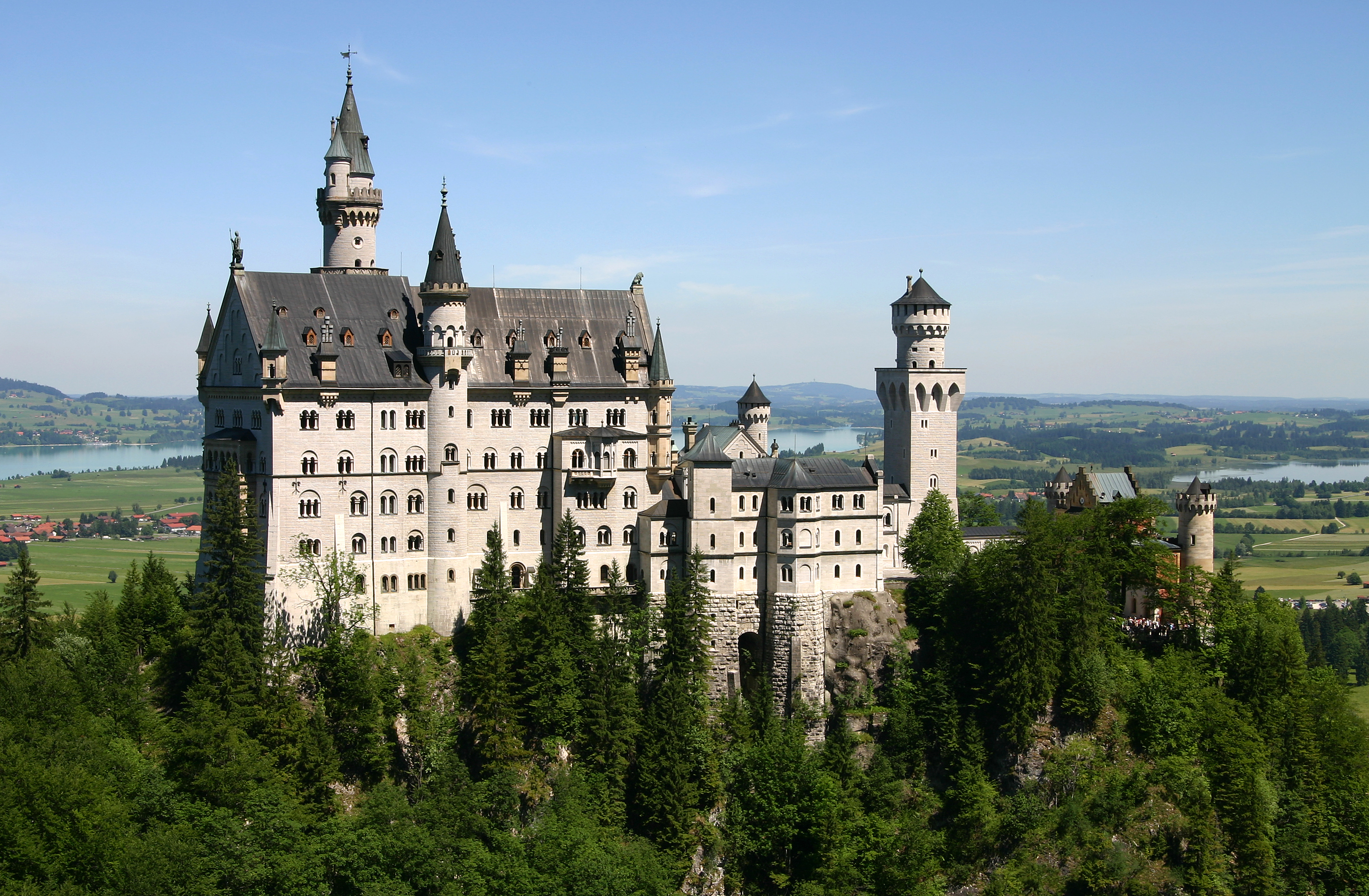
Neuschwanstein Castle in Bavaria — CC BY-SA 3

The Chapel Bridge in Lucerne — CC BY-SA 4
Frequently Asked Questions
How many days does a germany austria switzerland itinerary 7 days need?
A germany austria switzerland itinerary 7 days is the minimum that covers Vienna, Salzburg, Hallstatt, Munich, Neuschwanstein, Zurich and Lucerne without dropping a major stop. Five days can still work, but travellers must choose between Hallstatt and Neuschwanstein, or between Zurich and Lucerne. Nine to ten days is more comfortable, because it adds a rest day in Vienna and a day in the Jungfrau mountains.
When is the best season for a germany austria switzerland itinerary 7 days?
May to October is the best season for a germany austria switzerland itinerary 7 days, when the days are long and the mountain roads are open. June and September balance best, because the crowds have not peaked and the weather stays stable. December brings Christmas markets to Vienna, Salzburg and Munich, but the days are short and cold, so the route needs adjusting for winter.
What does the seven-day route of a germany austria switzerland itinerary 7 days include?
The seven-day route of a germany austria switzerland itinerary 7 days includes Vienna, Salzburg, Hallstatt, Munich, Neuschwanstein, Zurich and Lucerne, with the Rhine Falls as an added stop on the final leg. Each day stops in one city or one natural place, and trains carry the traveller between stops. Travellers can swap the order of the final leg, visiting Lucerne before Zurich, depending on train times and the flight home.
Does a germany austria switzerland itinerary 7 days need a Schengen visa?
A germany austria switzerland itinerary 7 days crosses three countries that all belong to the Schengen area, so travellers need only one Schengen visa for the whole journey. Switzerland is not in the European Union, but it is a Schengen member, so travel between the three countries has no regular border checks. Travellers should still carry a passport or identity document, because police may check on trains.
How do travellers move between cities on a germany austria switzerland itinerary 7 days?
Trains are the main transport on a germany austria switzerland itinerary 7 days, because the rail networks of Austria, Germany and Switzerland are dense and punctual. Long legs such as Vienna to Salzburg take about two and a half hours, while short legs such as Zurich to Lucerne take about one hour. Local buses link the stations to Hallstatt and Neuschwanstein, so travellers do not need a hire car for this route.
Is a germany austria switzerland itinerary 7 days good for a first trip to Europe?
A germany austria switzerland itinerary 7 days suits a first trip to Europe well, because all three countries are safe, the transport is easy, and German and English work at the tourist sites. The route mixes large cities and mountain scenery, so travellers see many sides of Central Europe in one trip. First-time visitors should allow extra time in Vienna and Lucerne, the two easiest cities to walk and navigate on the route.
Verified
The decision that anchors this guide is the UNESCO inscription of 12 July 2025, when the Palaces of King Ludwig II of Bavaria, Neuschwanstein, Linderhof, Schachen and Herrenchiemsee, were inscribed as a single World Heritage property, reference 1726 under criterion (iv), and the decision brought the German total to 55. The UNESCO listing records that Ludwig II reigned from 1864 to 1886, that Neuschwanstein was begun in 1869, and that the four palaces were built as private residences in the age of historicism. The other World Heritage figures in this guide were checked against the same UNESCO list: Vienna reference 1033 in 2001, Salzburg reference 784 in 1996, Hallstatt-Dachstein reference 806 in 1997, the Old City of Berne reference 267 in 1983, and Jungfrau-Aletsch reference 1037 in 2001. The national totals are Austria 12, Germany 55 and Switzerland 13.
The distances in this guide come from the road and rail figures used by the Austrian and Swiss tourist offices: Vienna to Salzburg about 300 kilometres by road, Salzburg to Hallstatt about 73 kilometres, and Munich about 145 kilometres west of Salzburg by road. The Rhine Falls measure about 150 metres wide and 23 metres high, and count as the largest waterfall in Europe by flow. The Chapel Bridge in Lucerne was built in about 1333 and remains the oldest surviving covered wooden bridge in Europe. Mozart was born in Salzburg in 1756, and the Hallstatt salt mine has been worked for about 7,000 years.
No part of this seven-day loop is itself inscribed, so the registry correctly marks the tour itself as not listed. In the registry the journey sits under Austria as an L5 entry, and like every L5 journey it carries no Wikidata identifier. Ticket prices and departure times are left out of the body on purpose: they shift with the season, and the railway sites carry the current figures.
Sources
- https://whc.unesco.org/en/list/1726/
- https://whc.unesco.org/en/list/1033/
- https://whc.unesco.org/en/list/784/
- https://whc.unesco.org/en/list/806/
- https://whc.unesco.org/en/list/267/
- https://whc.unesco.org/en/list/1037/
- https://en.wikipedia.org/wiki/Neuschwanstein_Castle
- https://en.wikipedia.org/wiki/Hallstatt
- https://en.wikipedia.org/wiki/Rhine_Falls
- https://en.wikipedia.org/wiki/Chapel_Bridge
All sources checked on 23 November 2026.
Unverified
- Exact road distances for the Munich to Zurich and Zurich to Lucerne legs were not matched against a single consistent source, so this guide gives no figures for those two legs.
- Train times between cities change with the timetable, so this guide gives only approximate journey times and asks travellers to check the official railway sites.
- Ticket prices for trains and for entry to Neuschwanstein change with the season and the booking date, so this guide gives no prices.
- Opening hours and visiting rules inside Neuschwanstein change with the season, so this guide gives no fixed hours.
- The exact number of residents in Hallstatt changes with the census year, so this guide says only that the village has fewer than 900 residents.
Illustrations
- Hero: View of Austria, Germany and Switzerland in Seven Days. Free image: https://upload.wikimedia.org/wikipedia/commons/4/43/K%C3%B6lner_Rosenmontagszug_2013_192.JPG — CC BY-SA 3.
- In body, austria germany switzerland: A view of austria germany switzerland. Free image: https://upload.wikimedia.org/wikipedia/commons/e/eb/%28Germany_-Switzerland_-Austria%29_Bodensee-_panoramio.jpg — CC BY 3.
- In body, austria germany switzerland: Zoomable full resolution image available at davidrumsey.com. Free image: https://upload.wikimedia.org/wikipedia/commons/f/f1/Germany%2C_Austria%2C_and_Switzerland._%28IA_dr_germany-austria-and-switzerland-0312064%29.jpg — Public domain.
- In body, austria germany switzerland: Schönbrunn Palace in Vienna. Free image: https://upload.wikimedia.org/wikipedia/commons/1/1b/Palacio_de_Sch%C3%B6nbrunn%2C_Viena%2C_Austria%2C_2020-02-02%2C_DD_10.jpg — CC BY-SA 4.
- In body, austria germany switzerland: Hohensalzburg Fortress above Salzburg. Free image: https://upload.wikimedia.org/wikipedia/commons/8/81/Festung_Hohensalzburg_seen_from_the_West%2C_Salzburg%2C_Austria%2C_20260430_1638_0140.jpg — CC BY 4.
- In body, austria germany switzerland: Hallstatt village on Lake Hallstatt. Free image: https://upload.wikimedia.org/wikipedia/commons/4/41/Hallstatt_village_and_mountain_reflections_on_Lake_Hallstatt%2C_Austria.jpg — CC BY 4.
- In body, austria germany switzerland: Marienplatz in Munich. Free image: https://upload.wikimedia.org/wikipedia/commons/1/14/Marienplatz_Munich_Germany_1960s.jpg — CC BY 2.
- In body, austria germany switzerland: Neuschwanstein Castle in Bavaria. Free image: https://upload.wikimedia.org/wikipedia/commons/a/ae/Castle_Neuschwanstein.jpg — CC BY-SA 3.
- In body, austria germany switzerland: Lake Constance at Lindau. Free image: https://upload.wikimedia.org/wikipedia/commons/7/72/20240929_Lake_Constance_Lindau_02.jpg — CC BY 4.
- In body, austria germany switzerland: The Fraumünster and the Limmat in Zurich. Free image: https://upload.wikimedia.org/wikipedia/commons/f/f2/Fraum%C3%BCnster_and_Limmat_in_Z%C3%BCrich_%282025-12-11%2C_DLTL4478%29.jpg — CC BY-SA 4.
- In body, austria germany switzerland: The Chapel Bridge in Lucerne. Free image: https://upload.wikimedia.org/wikipedia/commons/3/35/Kapellbr%C3%BCcke_%26_H%C3%A4user_am_Rathausquai_in_Luzern_%282013%29.jpg — CC BY-SA 4.
- In body, austria germany switzerland: The Rhine Falls. Free image: https://upload.wikimedia.org/wikipedia/commons/e/e7/Chutes_du_Rhin_-_Octobre_2021.jpg — CC BY-SA 4.