
Dubai
Dubai, the desert city that rose from a pearl-diving village, now stacks the tallest tower on earth above malls and beaches. The city rewards travellers who look twice, from the old creek and gold souks to the Palm, the desert at sunset and the skyline at dusk.
Dubai stands as one of the seven emirates of the United Arab Emirates, a federation founded on 2 December 1971, and the city ranks as the second largest emirate by area after Abu Dhabi. The city counted about 183,000 people in 1975, passed 4 million in 2025 and reached about 4.5 million by the end of that year, with about 92 percent of residents born outside the country. The city holds the Burj Khalifa at 828 metres, the tallest building in the world, and the tower stands at the centre of a city that builds at a scale few places attempt.
Dubai began as a fishing and pearl-diving village in the early eighteenth century, and by 1822 it had grown into a town of about 700 to 800 people. The city changed course in 1833, when about 800 members of the Al Bu Falasah branch of the Bani Yas tribe left Abu Dhabi under Maktoum bin Butti and settled here, founding the Al Maktoum dynasty that still rules the emirate. The city declared itself a free port in 1901, found oil in 1966 and used the income to build ports, an airport and free zones rather than living on oil alone.
Quick Facts
| Item | Detail |
|---|---|
| Location | Southeastern Arabian Peninsula, on the Persian Gulf coast |
| Coordinates | 25.2697° N, 55.3094° E |
| Wikidata | Q612 |
| Status | One of seven emirates of the United Arab Emirates; most populous city in the federation |
| Emirate area | 4,114 square kilometres |
| City area | About 1,500 square kilometres |
| Population | About 4.5 million by end of 2025; about 92 percent foreign-born |
| Ruler | Sheikh Mohammed bin Rashid Al Maktoum |
| Tallest building | Burj Khalifa, 828 metres, opened 4 January 2010 |
| Best months | November to March, daytime 24 to 30 degrees Celsius |
Geography of Dubai
A desert strip on the Gulf
The emirate occupies a coastal strip of desert about 60 kilometres long and 10 to 15 kilometres deep, pressed against the Persian Gulf. The city has no river, and the water that shaped the city is Dubai Creek, a saltwater inlet about 14 kilometres long that divides the city into Deira in the northeast and Bur the city in the southwest. The city grew first along that creek, where dhows unloaded goods from India, Persia and East Africa, and the old districts still keep the low coral-stone houses and wind towers of that trading town.
The city stretches westward from the creek toward long beaches along the Gulf, where the Palm Jumeirah reaches into the sea as a man-made palm. The city extends eastward and southward into the desert, where the red dunes of the Dubai Desert Conservation Reserve rise beyond the suburbs. The city therefore offers three landscapes in a single day, a creek, a beach and a desert, and visitors who plan a route across all three see the city whole.
The city endures a hot desert climate, with summers from June to September that often pass 40 degrees Celsius and can reach 45 degrees. The city turns gentle in winter, from November to March, when daytime temperatures sit between 24 and 30 degrees Celsius and evenings turn cool enough for outdoor dining. The city receives very little rain, with an average of only about 100 millimetres a year, although a single storm can flood streets, as the record rain of 16 April 2024 showed with about 250 millimetres in one day.
Districts that tell the story
The city divides into districts that each mark a different era, and walking them in order tells the history of the city. The city keeps its old town at Al Fahidi in Bur the city, where coral-stone houses and wind towers now hold museums, galleries and cafes. The city crosses the creek by abra, the wooden boat that costs 1 dirham, to reach Deira and its gold souk and spice souk, where hundreds of shops sell gold, saffron, cinnamon and frankincense.
The city built its modern centre at Downtown, around the Burj Khalifa, the Dubai Mall and the Dubai Fountain, and the district draws the largest crowds in the city. The city extends south along Sheikh Zayed Road to Dubai Marina and Jumeirah Beach Residence, where towers, a yacht harbour and a beach promenade make the liveliest evening walk in the city. The city keeps its newest district at Expo City, the site of Expo 2020, which ran in 2021 and 2022 and has become a new urban quarter.
The city connects those districts with a metro of two lines, the Red Line and the Green Line, which link the airport, Downtown, the Marina and the old town. The city taxis and app-based cars run everywhere at metered fares, and a tram serves the Marina and Jumeirah areas. Visitors who ride the metro from the airport reach the centre in minutes, since Dubai International Airport sits about 15 minutes by road from Downtown and ranks among the busiest airports in the world.
The emirate on the map
Dubai stands on the south-eastern coast of the Arabian Peninsula, on the Persian Gulf, at 25.2697° N, 55.3094° E. It is one of the seven emirates of the United Arab Emirates, a federation founded on 2 December 1971, and it ranks as the second largest emirate by area after Abu Dhabi. The emirate covers 4,114 square kilometres, while the city itself covers about 1,500 square kilometres.
The city counted about 183,000 people in 1975, passed 4 million in 2025 and reached about 4.5 million by the end of that year. About 92 percent of residents were born outside the country, and Dubai is the most populous city in the federation. That growth explains why the city keeps spreading from its old creek into the desert and along the coast.
A desert climate with one famous storm
The Gulf shapes the seasons here as much as the sun does, with warm, muggy air lingering along the coast even when the sky stays clear. From June to September the heat peaks, often climbing beyond 40 degrees Celsius and at times touching 45. Cooler air returns between November and March, when days stay between 24 and 30 degrees and terraces fill again after sunset, though December and January also bring the largest crowds and dearest rooms.
The city receives very little rain, with an average of only about 100 millimetres a year. A single storm can still flood streets, as the record rain of 16 April 2024 showed, with about 250 millimetres in one day. That storm is the sharpest reminder that a desert city can flood, and it stands in the record beside the long dry summers.

A photo of Dubai Skyline, United Arab Emirates — CC BY-SA 4
History of Dubai
From pearl village to free port
The city formed as a fishing and pearl-diving village in the early eighteenth century, and the first written mention of the place dates to 1095. The city counted about 700 to 800 people by 1822, when it had become a small trading town on the creek. The city changed hands in 1833, when the Al Bu Falasah settlers arrived from Abu Dhabi and founded the Al Maktoum dynasty, which has ruled the city ever since.
The city declared itself a free port in 1901, and merchants from across the Gulf and India moved their trade to the creek. The city dredged and widened the creek in 1961, so that larger ships could dock and the port could grow. The city found oil in 1966, although its reserves were far smaller than those of Abu Dhabi, and the rulers chose to spend the income on the port, the airport and trade rather than on oil alone.
The city opened Jebel Ali Port in 1979, and the port grew into the largest container port in the Middle East. The city built the Jebel Ali Free Zone beside it, which drew thousands of international companies to set up offices and warehouses. The city turned its airport into a global hub at the same time, and the city began to attract the airlines, hotels and conferences that made it a meeting point between Europe, Asia and Africa.
The federation and the global city
The city joined six other emirates to form the United Arab Emirates on 2 December 1971, and the federation gave the city a national framework for its ambitions. The city began its most dramatic transformation in the 1990s, when the rulers pushed trade, tourism and finance as the engines of growth. The city opened the Burj Al Arab in 1999, a sail-shaped hotel 321 metres tall on its own island, and the building became the symbol of luxury the city around the world.
The city began building the Palm Jumeirah in 2001, a palm-shaped archipelago that can be seen from space and now holds hotels, villas and beach clubs. The city opened the Dubai Mall in 2008, the largest shopping mall in the world by area, with more than 1,200 shops, an aquarium, an indoor ice rink and the Dubai Fountain outside. The city completed the Burj Khalifa on 4 January 2010 at 828 metres with 163 floors, and the tower has held the title of tallest building in the world ever since.
The city hosted Expo 2020, delayed to 2021 by the pandemic, as the first world exposition in the Middle East, and the event drew tens of millions of visits. The city turned the Expo site into Expo City, a new district of offices, homes and cultural venues. The city keeps building at the same pace, with the Museum of the Future, which opened in 2022, as the clearest sign of the direction, a torus-shaped building covered in Arabic calligraphy and devoted to technology and the future.
Timeline
| Year | Event |
|---|---|
| 1095 | Dubai first mentioned in written records |
| Early 18th century | Fishing and pearl-diving village forms |
| 1822 | Dubai a town of about 700 to 800 people |
| 1833 | Al Maktoum dynasty settles in Dubai |
| 1901 | Dubai declares itself a free port |
| 1961 | Dubai Creek dredged and widened |
| 1966 | Oil discovered in Dubai |
| 2 December 1971 | United Arab Emirates founded; Dubai one of seven emirates |
| 1979 | Jebel Ali Port opens |
| 1999 | Burj Al Arab opens |
| 2001 | Palm Jumeirah construction begins |
| 2008 | Dubai Mall opens |
| 4 January 2010 | Burj Khalifa opens, 828 metres |
| 2021–2022 | Expo 2020 held in Dubai |
| 2022 | Museum of the Future opens |
| 16 April 2024 | Record rain, about 250 millimetres in one day |
| 2025 | Population passes 4 million, then about 4.5 million by year end |
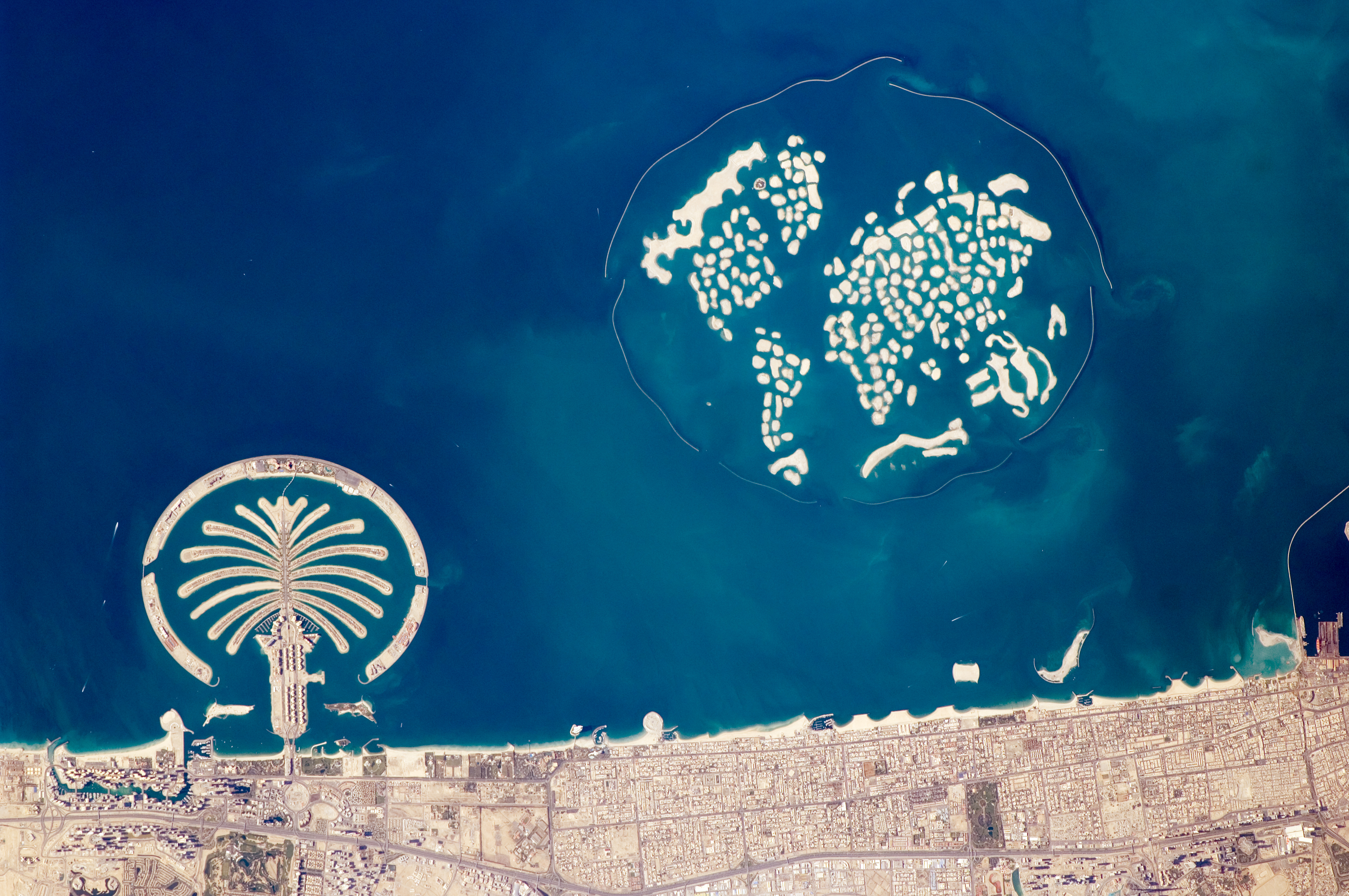
The municipality of Dubai is the largest city of the Persian Gulf emirate of the same name, and has built a global reputation for large-scale developments and architectural works — Public domain
Travel in Dubai
When to go and how long to stay
The city suits a stay of four to five days, because the city splits naturally into a day for each of its faces. The city gives one day to the old town, with Al Fahidi, the gold souk, the spice souk and an abra ride across the creek. The city gives a second day to Downtown, with the Burj Khalifa, the Dubai Mall and the Dubai Fountain, and a third day to the beaches and the Palm Jumeirah. The city reserves a fourth day for a desert safari, with camel rides, dune bashing, sunset over the red dunes and a Bedouin-style dinner under the stars, and a fifth day for museums and shopping.
Dubai shows its best weather from November to March, when daytime temperatures sit between 24 and 30 degrees Celsius and every outdoor activity works. The city peaks in December and January, when hotels cost the most and crowds grow thickest, so travellers who want the same weather with fewer people should choose November or March. The city in summer, from June to September, turns very hot, although hotels cost far less and the indoor attractions, malls, museums and indoor parks, run normally under strong air conditioning.
The city holds its biggest shopping event in January, the Dubai Shopping Festival, with deep discounts in the malls, fireworks and street performances across the city. The city during Ramadan turns quiet by day, when many restaurants close, and lively at night, when families gather for iftar, the meal that breaks the fast. Visitors who travel during Ramadan should respect the fast in public and plan meals around the evening hours.
Shopping, food and getting around
Dubai earns its reputation as a shopping city in its malls, and the English search for the city shows that more clearly than any other theme. The city holds the Dubai Mall as the largest mall in Dubai and the largest mall in the world by area, with more than 1,200 shops, and the Mall of the Emirates, Deira City Centre, Ibn Battuta Mall, Dubai Hills Mall, Dubai Festival City Mall, Dragon Mart and the Outlet Mall each serve a different corner of the city, so the best mall in Dubai depends on what a shopper wants. The city also keeps the gold souk in Deira, where hundreds of shops sell gold by weight, and the spice souk beside it, where saffron, cinnamon and frankincense fill the air.
Dubai feeds more than 200 nationalities, and its food spans cheap street stalls and restaurants run by world-famous chefs. Visitors should try shawarma, machboos rice with meat and spices, luqaimat sweet dumplings and Arabic coffee with dates, and the old town holds the best-value Arab and Indian restaurants in the city. The city serves alcohol only in licensed restaurants and bars inside hotels, and drinking in public remains forbidden, so visitors should plan evenings accordingly.
Dubai moves visitors on the metro, which runs clean, fast and cheap across two lines, and on taxis that use meters everywhere. The city keeps the abra ride across the creek at 1 dirham, one of the cheapest and most memorable experiences in the city, and the boats run from early morning until late at night. Visitors who want a day outside the city can drive to Abu Dhabi in about 90 minutes to see the Sheikh Zayed Grand Mosque, a journey that fits easily into a five-day stay.
Highlights of Dubai
- Burj Khalifa — the tallest building in the world at 828 metres with 163 floors, opened 4 January 2010, with the At The Top observation deck on floors 124 and 125.
- Dubai Mall — the largest shopping mall in the world by area, with more than 1,200 shops, the aquarium in Dubai, an indoor ice rink and the Dubai Fountain outside.
- Palm Jumeirah — the palm-shaped artificial archipelago begun in 2001, home to Atlantis and many beach resorts, with Dubai Palm Beach along its crescent and the best views from above.
- Dubai Fountain — the Dubai dancing fountain on Burj Lake beside the Dubai Mall, with evening shows set to music and light.
- Al Fahidi Historical Neighbourhood — the old town of coral-stone houses and wind towers, now a quiet quarter of museums, galleries and cafes.
- Gold Souk and Spice Souk — the markets of Deira, with hundreds of gold shops and stalls selling saffron, cinnamon and frankincense, reached by abra across the creek.
- Dubai Creek — the inlet that made the city, crossed by wooden abra boats for 1 dirham, the cheapest and most atmospheric ride in Dubai.
- Museum of the Future — the torus-shaped building covered in Arabic calligraphy, opened in 2022, with exhibitions on technology and the future.
- Dubai Desert Conservation Reserve — the red dunes east and south of the city, where safaris offer camel rides, sandboarding, sunset views and Bedouin-style dinners.
- Burj Al Arab — the sail-shaped hotel 321 metres tall on its own island, opened in 1999, with the public beach at Umm Suqeim nearby for a free view.
- Dubai Marina and JBR — the modern waterfront of towers, a yacht harbour and a beach promenade, the liveliest evening walk in Dubai.
Frequently Asked Questions
Is Dubai the capital of the United Arab Emirates?
Dubai is not the capital of the United Arab Emirates, because the capital is Abu Dhabi, the largest emirate by area. The city ranks as the second largest emirate by area and the most populous city in the federation. The city serves as the commercial and tourism centre of the country, while Abu Dhabi holds the federal government and the presidency.
How tall is the Burj Khalifa in Dubai?
Dubai holds the Burj Khalifa at 828 metres, with 163 floors, and the tower has been the tallest building in the world since it opened on 4 January 2010. Visitors reach the At The Top observation deck on floors 124 and 125 for a panorama of the city, the Gulf and the desert. The city also shows the tower from the Dubai Fountain and the Dubai Mall, where its full height reads best at dusk.
What is the best mall in Dubai?
Dubai offers the Dubai Mall as the largest mall in the world by area, with more than 1,200 shops, an aquarium and an indoor ice rink. The city also draws shoppers to the Mall of the Emirates, Deira City Centre, Ibn Battuta Mall, Dubai Hills Mall and Dubai Festival City Mall, each with a different mix of brands. Bargain hunters head to Dragon Mart for low prices and to the Outlet Mall for discounted brands, while the gold souk in Deira suits jewellery buyers.
What is the best time to visit Dubai?
Come between November and March for mild days in the mid-twenties to about 30 degrees. Shoulder months at either end of that window offer similar conditions with thinner crowds and lower prices.
How many days do you need in Dubai?
Dubai needs four to five days for a first visit, because the city divides into distinct days for the old town, Downtown, the beaches and the Palm, the desert safari and a spare day for museums and shopping. Visitors with only two days should focus on the old town and Downtown, which together carry the story of the city. The city rewards a longer stay with a day trip to Abu Dhabi, about 90 minutes away, to see the Sheikh Zayed Grand Mosque.
Is Dubai safe for tourists?
Dubai ranks among the safest large cities in the world for visitors, with low street crime and a strong police presence in tourist areas. Travellers should still take normal precautions, keep valuables secure in crowded malls and souks and check current travel advice from their own government before departure. The city asks visitors to respect local customs, including modest dress in the old town and mosques and no drinking in public.
Verified
Checked 20/11/2026. One of seven emirates of the United Arab Emirates, federation founded 2 December 1971; second largest emirate by area after Abu Dhabi; emirate area 4,114 square kilometres; population about 183,000 in 1975, passed 4 million in 2025, about 4.5 million by end of 2025, about 92 percent foreign-born; Al Bu Falasah settled 1833 under Maktoum bin Butti; free port 1901; creek dredged 1961; oil found 1966; Jebel Ali Port opened 1979; Burj Al Arab opened 1999, 321 metres; Palm Jumeirah construction began 2001; Dubai Mall opened 2008; Burj Khalifa opened 4 January 2010, 828 metres, 163 floors; Expo 2020 held 2021–2022; Museum of the Future opened 2022; record rain 16 April 2024, about 250 millimetres in one day; Dubai Creek about 14 kilometres long; abra fare 1 dirham; coordinates 25.2697° N, 55.3094° E; Wikidata Q612.
Sources
- Dubai: population, area, coordinates, founding, Al Bu Falasah settlement 1833, free port 1901, creek widening 1961, Burj Khalifa 2010 — Wikipedia, checked 20/11/2026 — en.wikipedia.org (https://en.wikipedia.org/wiki/the) city
- Dubai: population over 4 million in 2025, 4.58 million by end of 2025, emirate area 4,114 square kilometres, UAE founded 2 December 1971, Burj Khalifa 828 metres and 163 floors — the city statistics and travel guides, checked 20/11/2026 — dubaieverything.com (https://dubaieverything.com/15-facts-about-dubai/)
- Dubai Mall: largest mall in the world by area, opened 2008, more than 1,200 shops — Emaar and travel guides, checked 20/11/2026 — www.emaar.com (https://www.emaar.com/en/)
- Burj Khalifa: 828 metres, 163 floors, opened 4 January 2010 — Emaar, checked 20/11/2026 — www.burjkhalifa.ae (https://www.burjkhalifa.ae/en/)
Not Yet Verified
- Current ticket prices for the Burj Khalifa observation deck, the Museum of the Future and the Dubai Aquarium, which change by time and season; this article gives no prices and readers should check the official sites before a visit.
- The exact count of shops in the Dubai Mall and the exact area of the mall, since figures vary between sources; this article uses the figure of more than 1,200 shops.
- The claim that Jebel Ali Port is the largest container port in the Middle East, which is widely repeated but not re-checked against current port statistics for this article.
- The population figure of about 4.5 million by the end of 2025, which comes from Dubai statistics summaries and may be revised in later releases.
Illustrations
- Hero: Dubai. Free image: https://upload.wikimedia.org/wikipedia/commons/d/d3/The_well-lit_city_of_Dubai%2C_United_Arab_Emirates_%28iss072e447465%29.jpg — Public domain.
- In body, desert: A photo of Dubai Skyline, United Arab Emirates. Free image: https://upload.wikimedia.org/wikipedia/commons/1/10/Dubai_Skyline_2016.jpg — CC BY-SA 4.
- In body, desert: The municipality of Dubai is the largest city of the Persian Gulf emirate of the same name, and has built a global reputation for large-scale developments and architectural works. Free image: https://upload.wikimedia.org/wikipedia/commons/1/15/Artificial_Archipelagos%2C_Dubai%2C_United_Arab_Emirates_ISS022-E-024940_lrg.jpg — Public domain.