
Al Malqa: The Modern District of North Riyadh
Al Malqa is a modern district in the north of Riyadh. Wide streets, new villas and the Anas Ibn Malik food strip define it.
Al Malqa is the Riyadh that was built in the last two decades, and it looks it. The district sits in the north of the Saudi capital, below King Salman Road, in the area that property guides call the Golden Square, where the most sought-after neighbourhoods of northern Riyadh stand side by side. Its buildings are mostly less than ten years old, its streets are wide, and its compounds come with swimming pools, gyms and private security. Al Malqa is not a place of old palaces or mud-brick lanes; it is a place of contemporary Salmani architecture, smart apartments and restaurants that stay open late.
The district matters to visitors for practical reasons. Al Malqa lies close to the King Abdullah Financial District, known as KAFD, and to King Saud University and the King Faisal Specialist Hospital, so it is where many professionals live and where many business travellers stay. Anas Ibn Malik Road, the main axis of the district, is one of the liveliest eating streets in northern Riyadh, with hundreds of restaurants, cafes and shops along its length. This guide explains where Al Malqa sits, how it grew, and what a visitor can do there.
Quick Facts About Al Malqa
| Item | Detail |
|---|---|
| Name | Al Malqa, Arabic for the meeting place |
| Location | North Riyadh, below King Salman Road, Saudi Arabia |
| Character | High-end modern residential district in the Golden Square |
| Neighbours | Al Yasmin, Hittin and Al Narjis |
| Main street | Anas Ibn Malik Road, the commercial axis |
| Nearby | King Abdullah Financial District (KAFD), King Saud University, King Faisal Specialist Hospital |
| Metro | Blue Line runs along the King Fahd corridor; Red Line opened 15 December 2024 |
| Best time | November to March, the cooler months |
| Currency | Saudi riyal (SAR) |
| Language | Arabic; English is widely used in services and business |
| UNESCO | Not a World Heritage site; Saudi Arabia has 8 World Heritage sites |
Geography of Al Malqa
Al Malqa sits in the north of Riyadh, in the part of the city that grew fastest in the last twenty years. The district lies below King Salman Road, which marks its northern edge, and its southern boundary is Imam Saud bin Faisal Road, while King Fahd Road closes it on the east. Its neighbours are Al Yasmin, Hittin and Al Narjis, three districts of similar character, and together they form the Golden Square, the cluster of high-end neighbourhoods that property guides use as shorthand for northern Riyadh. The district is flat, like the rest of the city, and it stands on the Najd plateau, the high central plain of Arabia.
The ground of Al Malqa is desert plain, and the district was built on land that was open ground a generation ago. Riyadh sits about 600 metres above sea level on the Najd, and the city has no river and no hill of consequence, so its geography is the geography of roads, not of landforms. Al Malqa’s streets are wide and straight, laid out on a modern grid, and the district’s compounds sit behind walls with gardens that are watered, not natural. The contrast with the old centre of Riyadh, where the streets are narrow and the buildings are old, is the whole point of the district: Al Malqa is a planned place, and its plan is visible from the street.
Anas Ibn Malik Road runs through Al Malqa and is the district’s spine. The road carries hundreds of restaurants, cafes and shops, and it is the reason the district is known across the city as an eating destination. Al Malqa Mall stands inside the district, and Al Nakheel Mall is about five minutes away, while the King Abdullah Financial District is ten to fifteen minutes by car and the Digital City is five to eight minutes.
King Khalid International Airport is about eighteen minutes away, which makes Al Malqa one of the most convenient districts in the city for a business traveller. Riyadh Boulevard, the entertainment zone, is about twelve minutes away.
The climate is desert, and it shapes the life of the district more than any building does. Summers in Riyadh are extremely hot, with daytime temperatures that pass 45 degrees Celsius, and the streets of Al Malqa empty in the afternoon heat. Winters are mild and dry, with daytime temperatures of 20 to 28 degrees, and November to March is the season when the district is at its best.
The cafes of Anas Ibn Malik Road fill with outdoor tables in the cooler months, and the compounds open their gardens. Rain is rare and brief, and when it comes the wide streets drain quickly, but the city is not built for it.
The district’s position near KAFD is its economic geography. The King Abdullah Financial District is the new business heart of Riyadh, and Al Malqa is the residential district that serves it, housing the professionals who work in its towers. King Saud University lies nearby, and the King Faisal Specialist Hospital is close as well, so the district’s population mixes Saudi families with expatriate professionals.
International schools serve the foreign community, and the district’s services — hospitals, clinics, supermarkets and gyms — are built for that mix. The Dr Sulaiman Al Habib Hospital and the Al Malqa Medical Centre both stand in the area, and the district’s infrastructure is new, because the district itself is new.
The neighbours of the district share its character, and the four districts of the Golden Square read as one continuous landscape of new villas and compounds. Al Yasmin lies to one side, Hittin to another, and Al Narjis beyond them, and the roads between them are lined with the same mix of restaurants, schools and mosques. The King Fahd corridor binds them together, and the Blue Line of the metro now runs along it, so the whole cluster is better connected than any single district would be alone. A visitor who drives from one to the next will notice that the street names change while the architecture stays the same, and that sameness is the signature of a city built in a single generation.

The King Abdullah Financial District in Riyadh — CC BY-SA 4
History of Al Malqa
Al Malqa began as a simple residential area of traditional houses on the northern edge of Riyadh, before the city expanded northward. For most of its early life it was an outer suburb, a place of low houses and open ground, and few people outside the city would have known its name. The change came in the last two decades, when Riyadh grew fast and the demand for modern housing rose, and developers and investors turned their attention to the north. Al Malqa became the district where that growth landed, and its transformation from a simple suburb into a high-end neighbourhood happened in a single generation.
The northward expansion of Riyadh is the larger story behind Al Malqa. The city has grown outward in every direction, but the north has been the direction of the newest growth, because the land there was open and the roads were new. King Fahd Road, the great north-south axis of the city, carried the expansion, and the districts along it — Al Malqa, Al Yasmin, Hittin and Al Narjis — became the Golden Square, the name that property guides give to the most desirable part of the north. The growth was not accidental: the city’s plans pushed development north, and the market followed, building villas, smart apartments and gated compounds for families who wanted new homes with new infrastructure.
Vision 2030, the national plan announced in 2016, accelerated the change. The plan aims to diversify the Saudi economy away from oil, to build new industries and to open the country to visitors, and Riyadh is its centrepiece. The King Abdullah Financial District, the entertainment zones and the new metro are all part of that programme, and Al Malqa has grown with them. The district’s new buildings, its restaurants and its services are the domestic side of a national project, and the pace of construction in the north of the city is the most visible sign of Vision 2030 in daily life.
The architecture of Al Malqa reflects the modern Riyadh. Many of the villas and apartments use the contemporary Salmani style, a modern interpretation of the Najdi tradition, with clean lines, shaded courtyards and materials that suit the desert. Smart apartments with home automation sit beside luxury villas, and gated compounds offer swimming pools, gyms and private security.
The style is deliberate: it is modern without being placeless, and it marks Al Malqa as a district of the present, not a copy of the old centre. The buildings are mostly less than ten years old, and the district’s skyline is low, because the villas and compounds spread horizontally rather than rising vertically.
The Riyadh Metro is the newest chapter in the history of Al Malqa. The network has six lines and 85 stations, and it entered full operation in January 2025. The Blue Line runs north to south along the King Fahd corridor, with KAFD as an interchange, and the Red Line, Line 2, runs east to west along King Abdullah Road for 25.3 kilometres with 15 stations, from King Saud University to King Fahd Sports City.
The Red Line opened on 15 December 2024, and the Blue Line began carrying passengers at the start of the same month. The metro changed how the north of the city connects to the centre, and Al Malqa, which once depended on cars, now sits within reach of the whole network.
The community of the district is as new as its buildings. It is home to many expatriate professionals who work in the nearby business districts, and its population mixes Saudi families with people from across the world. International schools serve the foreign community, and the district’s restaurants and cafes cater to a clientele that expects English as well as Arabic. That mix is part of what makes the place feel different from the older districts: it is a district built for a city that is opening outward, and its streets carry the languages of that opening.
The metro has already begun to change daily life in the north of the city. Before the network opened, a resident of the northern districts needed a car for almost every journey, and the roads filled with traffic at the start and the end of the working day. The Blue Line and the Red Line now offer an alternative, and the interchange at KAFD connects the northern districts to the university, the sports city and the airport road. The change is recent, and its full effect will take years to show, but the stations are already busy, and the districts along the lines are the ones where the new Riyadh is most visible.
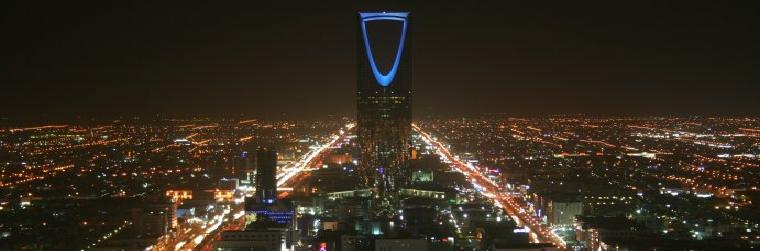
The skyline of Riyadh — CC BY-SA 3
Travel in Al Malqa
The best time to visit Al Malqa is November to March, when the daytime temperatures run from 20 to 28 degrees and the outdoor tables of Anas Ibn Malik Road are full. Summer is the season to avoid, because the heat passes 45 degrees and the streets empty in the afternoon. A visit to Al Malqa is best planned as an evening, when the restaurants and cafes are at their liveliest, and the district’s food is the main reason to come. The district is not a sightseeing destination in the usual sense; it is a place to eat, to shop and to see how the new Riyadh lives.
Anas Ibn Malik Road is where a visitor should start. The road runs through the district and carries hundreds of restaurants, cafes and shops, and a slow drive or walk along it shows the range of the district’s eating: Saudi restaurants, international chains, coffee shops and bakeries. Al Malqa Mall stands inside the district for everyday shopping, and Al Nakheel Mall, about five minutes away, is the larger option. The King Abdullah Financial District is ten to fifteen minutes by car, and the Digital City is five to eight minutes, so a visitor staying in Al Malqa can reach the business heart of the city quickly.
Getting around Al Malqa is easy by car and by metro. The Riyadh Metro’s Blue Line runs along the King Fahd corridor, and the Red Line runs east to west along King Abdullah Road, so the district connects to the university, the financial district and the sports city without a car. Taxis and ride-hailing apps work well, and the airport is about eighteen minutes away.
Walking is pleasant in the cooler months, but the district is spread out, and the distances between the malls and the restaurants are best covered by car. Visitors should confirm the current entry and visa rules for Saudi Arabia for their own nationality before they travel, since the rules have changed several times in recent years and the newest categories, including the tourist visa, apply differently by passport.
Notable Places in Al Malqa
Anas Ibn Malik Road
Anas Ibn Malik Road is the commercial spine of Al Malqa and the reason most visitors come to the district. The road carries hundreds of restaurants, cafes and shops, and it is one of the liveliest eating streets in northern Riyadh. An evening walk along it, from cafe to restaurant, is the best introduction to the district.
Al Malqa Mall
Al Malqa Mall stands inside the district and serves its everyday shopping, with supermarkets, shops and cafes under one roof. It is a neighbourhood mall rather than a destination, and it shows the district’s domestic side: families shopping, children playing, and the ordinary life of a new suburb.
King Abdullah Financial District
The King Abdullah Financial District, known as KAFD, lies ten to fifteen minutes from Al Malqa by car, and it is the business heart that the district serves. Its towers are the newest skyline in Riyadh, and the district’s metro interchange connects it to the rest of the city. A visitor to Al Malqa who wants to see the new Riyadh should look at KAFD.
Al Nakheel Mall
Al Nakheel Mall, about five minutes from Al Malqa, is the larger shopping option near the district. It holds international brands, a food court and a cinema, and it draws shoppers from across northern Riyadh. It is the mall to choose when Al Malqa Mall is not enough.
The Golden Square
The Golden Square is not a single place but the name for the cluster of high-end districts in northern Riyadh: Al Malqa, Al Yasmin, Hittin and Al Narjis. The name comes from property guides, and it marks the most sought-after part of the north. Driving through the four districts shows how the new Riyadh was built, one compound at a time.
Frequently Asked Questions About Al Malqa
Where is Al Malqa in Riyadh?
Al Malqa is in the north of Riyadh, below King Salman Road, in the Golden Square of high-end districts. Its neighbours are Al Yasmin, Hittin and Al Narjis, and its southern boundary is Imam Saud bin Faisal Road.
What is Al Malqa known for?
Al Malqa is known for its modern housing, its wide streets and its food. Anas Ibn Malik Road, the district’s main axis, carries hundreds of restaurants, cafes and shops, and the district is one of the liveliest eating areas in northern Riyadh.
How far is Al Malqa from the airport?
Al Malqa is about eighteen minutes from King Khalid International Airport by car. The King Abdullah Financial District is ten to fifteen minutes away, the Digital City is five to eight minutes, and Al Nakheel Mall is about five minutes. The historic town of Diriyah lies to the west of the city, and the Edge of the World is the desert escarpment that draws day trips from Riyadh.
Does the Riyadh Metro serve Al Malqa?
The Riyadh Metro serves the area around Al Malqa through the Blue Line along the King Fahd corridor and the Red Line along King Abdullah Road. The whole network, six lines and 85 stations, entered full operation in January 2025.
When is the best time to visit Al Malqa?
The best time to visit Al Malqa is November to March, when daytime temperatures run from 20 to 28 degrees. Summer is extremely hot, with temperatures passing 45 degrees, and the streets empty in the afternoon heat.
Is Al Malqa a UNESCO World Heritage site?
Al Malqa is not a UNESCO World Heritage site. Saudi Arabia has 8 World Heritage sites, the newest being the Cultural Landscape of Al-Faw, inscribed in 2024, and none of them is in the district of Al Malqa.
Verified
- Checked 20 November 2026: Al Malqa lies in the north of Riyadh, below King Salman Road, with Imam Saud bin Faisal Road to the south and King Fahd Road to the east.
- Checked 20 November 2026: Anas Ibn Malik Road is the commercial axis of the district, and KAFD is ten to fifteen minutes away by car.
- Checked 20 November 2026: Vision 2030 was announced in 2016, and the Riyadh Metro has six lines and 85 stations, entering full operation in January 2025.
- Checked 20 November 2026: the Red Line, 25.3 kilometres with 15 stations, opened on 15 December 2024, and the Blue Line began service at the start of December 2024.
- Checked 20 November 2026: Saudi Arabia has 8 World Heritage sites, the newest being Al-Faw, inscribed in 2024.
- Checked 20 November 2026: no Wikidata item exists for the Al Malqa district in Riyadh; searches in English and Arabic found only a village in Yemen and Malkata.
- Checked 20 November 2026: the focus keyword is “al malqa”, taken from the English keyword group measured in the United States market.
Sources
- Imtilak, Al Malqa district guide — https://www.imtilak.sa/en/articles/almalqa-district-riyadh — for the Golden Square, the boundaries, the neighbours and the nearby landmarks.
- Bayut, Al Malqa area guide — https://www.bayut.sa/blog/en/area-guides/al-malqa-riyadh/ — for Anas Ibn Malik Road, the malls, the hospital and the international schools.
- Executive Centre, Al Malqa area guide — https://executivecentre.sa/blog/al-malqa-riyadh-area-guide — for the district’s services and the expatriate community.
- Wikipedia, Line 2 of the Riyadh Metro — https://en.wikipedia.org/wiki/Line_2_(Riyadh_Metro) — for the Red Line length of 25.3 kilometres, its 15 stations and its opening on 15 December 2024.
- UNESCO, World Heritage list — https://whc.unesco.org/en/list/ — for the 8 Saudi sites and the Al-Faw inscription of 2024.
- TheTerraAtlas Vietnamese article on Al Malqa, checked 18 November 2026, for the district’s growth, the Salmani architecture and the metro dates.
- English keywords: file batch30-en-keywords.json, key “TA-L4-al-malqa” — “al malqa” 70, “malqa” 10, group total 80.
Unverified
- The estimated coordinates of about 24.8000/46.6123 for Al Malqa come from a postcode lookup, not from a boundary record, so they are not used in this article and were not added to the registry.
- The exact current driving times to KAFD and the airport vary with traffic and were not measured on the day; the figures given are the ranges from the area guides.
- No official count of the district’s population was found, so no population figure is given in this article.
Illustrations
- Hero: Al Malqa is a modern district in the north of Riyadh. Free image: https://upload.wikimedia.org/wikipedia/commons/0/0b/Malqa_1561501.jpg — CC BY-SA 4.0.
- In body, king Abdullah Financial District: The King Abdullah Financial District in Riyadh. Free image: https://upload.wikimedia.org/wikipedia/commons/8/86/King_Abdullah_Financial_District_%28KAFD%29%2C_Riyadh%2C_Saudi_Arabia%2C_2026.jpg — CC BY-SA 4.
- In body, skyline: The skyline of Riyadh. Free image: https://upload.wikimedia.org/wikipedia/commons/9/9b/Riyadh-Skyline.jpg — CC BY-SA 3.