
Fort Santiago Manila: The Stone Fortress of Intramuros
Fort Santiago Manila is a stone fortress from 1571 at the north-west corner of Intramuros. Its dungeons held Jose Rizal before his death.
Fort Santiago Manila stands at the north-western corner of Intramuros, the walled city of Manila, where the Pasig River meets Manila Bay. The fort was built in 1571 by Miguel Lopez de Legazpi, rebuilt in stone between 1589 and 1592, and its main gate rises 12 metres high. Its most famous prisoner was Jose Rizal, who spent 56 days in its cells from 3 November to 29 December 1896 before his execution.
This guide explains the geography of Fort Santiago Manila, its history from the settlement of Rajah Sulayman to the restoration after the Second World War, and how to visit it for the first time. Visitors who know Manila will find the city’s oldest stones, and those who know Intramuros will find the fort that guarded its corner.
Quick Facts About Fort Santiago Manila
| Fact | Detail |
|---|---|
| Name | Fort Santiago (Fort Santiago Manila) |
| Location | North-western corner of Intramuros, Manila, Philippines |
| Coordinates | 14.595° N, 120.9694° E |
| Built | 1571, by Miguel Lopez de Legazpi |
| Rebuilt in stone | 1589–1592 |
| Main gate | 12 m high |
| Famous prisoner | Jose Rizal, 3 November to 29 December 1896 (56 days) |
| Entry | 75 pesos, 50 pesos concession (Intramuros Administration) |
| Hours | Monday to Friday 08:00–22:00, Saturday and Sunday 06:00–22:00 |
| Status | National Cultural Treasure, 2014 |
| Neighbour | Baluarte de San Diego, oldest stone fort in Manila |
| Wikidata | Q478181 |
Fort Santiago Manila is a fortress that has been a citadel, a prison, a ruin and a museum, and each of those lives is written in its stones. Its walls are the oldest in the city, and its dungeons are the city’s darkest rooms. The fort’s ground is the ground where Manila began, and its river is the ground’s edge.
Geography of Fort Santiago Manila
The Corner of the Walled City
Fort Santiago Manila stands at the north-western corner of Intramuros, where the Pasig River flows into Manila Bay. The fort’s position is the position of a guard, because the corner commands both the river and the bay. The fort’s walls face the water on two sides, and their guns once covered the approaches to the city. The fort’s geography is the geography of a corner that was chosen for defence, and its stones are the corner’s walls.
The fort’s ground is the ground of the settlement of Rajah Sulayman, the ruler of Manila before the Spanish came. The settlement’s site is the fort’s foundation, and its river is the foundation’s edge. The fort’s geography is the geography of a place that was a city before it was a fort, and its stones are the city’s first walls. The fort’s ground is the ground of Manila’s beginning, and its river is the beginning’s water.
The fort’s walls are thick and low, and their shape follows the ground of the corner. The walls’ stones are the fort’s strength, and their bastions are the strength’s points. The walls’ geography is the geography of a fortress that was built to hold a corner, and their guns are the holding’s voice. The fort’s walls are the walls of the sixteenth century, and their stone is the century’s work.
The Pasig River runs past the fort’s northern wall, and its water is the fort’s moat. The river’s current is the fort’s defence, and its mouth is the defence’s gate. The river’s geography is the geography of a waterway that was a highway and a wall, and its water is the fort’s neighbour. The fort’s river is the river of Manila, and its mouth is the city’s door.
Manila Bay spreads west of the fort, and its sunsets are the fort’s evenings. The bay’s water is the fort’s horizon, and its ships are the horizon’s life. The bay’s geography is the geography of a harbour that the fort was built to guard, and its waves are the guarding’s sound. The fort’s bay is the bay of the city, and its sunsets are the city’s gold.
The Gate, the Plaza and the Dungeons
The main gate of Fort Santiago Manila rises 12 metres high, and its arch is the fort’s entrance. The gate’s height is the fort’s welcome, and its stone is the welcome’s weight. The gate’s geography is the geography of a door that was built to impress and to resist, and its arch is the door’s mouth.
The gate was reconstructed after the war, and its stones are the reconstruction’s proof. The gate’s arch is the fort’s face, and its height is the face’s measure.
The rear gate of the fort faces the river, and its arch is the fort’s second door. The gate’s position is the river’s entrance, and its stones are the entrance’s guard. The gate’s geography is the geography of a door that opened to the water, and its arch is the water’s mouth. The fort’s two gates are the fort’s two mouths, and their arches are the mouths’ stone.
The Plaza de Armas stands inside the fort, and its open ground is the fort’s parade. The plaza’s stones are the soldiers’ floor, and its silence is the floor’s memory. The plaza’s geography is the geography of a courtyard that held a garrison, and its ground is the garrison’s drill. The plaza’s openness is the fort’s heart, and its walls are the heart’s sides.
The dungeons of Fort Santiago Manila lie below the fort’s walls, and their darkness is the fort’s horror. The dungeons’ cells held the prisoners of the Spanish and, later, of the Japanese occupation, and their walls are the prisoners’ last sight. The dungeons’ geography is the geography of a place that was built to hide suffering, and their stones are the hiding’s proof. The dungeons’ darkness is the fort’s night, and their silence is the night’s voice.
The Rizal Shrine stands inside the fort, and its halls hold the memory of Jose Rizal’s last days. The shrine’s rooms are the prisoner’s cell, and their walls are the cell’s stones. The shrine’s geography is the geography of a museum that was once a prison, and its halls are the prison’s echo. The shrine’s silence is the prisoner’s prayer, and its bronze footprints are the prayer’s path.
Intramuros and the River
Intramuros surrounds Fort Santiago Manila, and its walls are the fort’s city. The walled city’s streets are the fort’s neighbourhood, and their stones are the neighbourhood’s age. The walled city’s geography is the geography of a city that was built inside walls, and its fort is the walls’ corner. The fort’s city is the city of the Spanish, and its churches are the city’s prayer.
The Baluarte de San Diego stands south of the fort, and it is the oldest stone fort in Manila, designed by Antonio Sedeno in 1586 and 1587. The baluarte’s stones are the city’s oldest defence, and its bastion is the defence’s point. The baluarte’s geography is the geography of a round tower that guarded the city’s southern wall, and its guns are the guarding’s voice. The baluarte’s status as a National Historical Landmark since 1951 and a National Cultural Treasure since 2014 is the tower’s honour.
The San Agustin Church stands in Intramuros, and it was built between 1587 and 1607 as the oldest stone church in the Philippines. The church’s stones are the city’s oldest prayer, and its walls are the prayer’s home. The church’s geography is the geography of a church that survived the wars, and its survival is the church’s miracle. The church is part of the Baroque Churches of the Philippines, listed by UNESCO in 1993 under reference 677.
The river walk of Fort Santiago Manila runs along the Pasig, and its path is the fort’s edge. The walk’s stones are the river’s bank, and its breeze is the bank’s cool. The walk’s geography is the geography of a path that follows the water, and its views are the path’s gift.
The walk’s gate, the Riverwalk gate, was temporarily closed by an official notice of 7 January 2026, and it is not clear whether it has reopened. The walk’s visit is the fort’s quiet hour, and its river is the hour’s water.
The fort’s neighbourhood is the old city, and its streets are the city’s oldest roads. The neighbourhood’s houses are the city’s heritage, and their balconies are the heritage’s shade. The neighbourhood’s geography is the geography of a city that was walled, and its fort is the wall’s corner. The fort’s neighbourhood is the neighbourhood of the Spanish city, and its stones are the city’s age.

The walled city of Intramuros in Manila — CC BY 4
History of Fort Santiago Manila
From Sulayman to Legazpi
The history of Fort Santiago Manila begins with Rajah Sulayman, the ruler of the settlement at the mouth of the Pasig River. The settlement’s site is the fort’s ground, and its people are the ground’s first inhabitants. The settlement’s history is the history of a trading town at a river’s mouth, and its river is the town’s highway. The fort’s ground is the ground of a city that was already a city, and its river is the city’s life.
Miguel Lopez de Legazpi arrived in 1571, and his men built the first fort on the settlement’s ground. The fort’s building is the city’s second birth, and its wood is the birth’s material. The fort’s history begins with a conquest, and its walls are the conquest’s mark. The city’s history turns on the fort’s building, and its stones are the turning’s proof.
The first fort was built of wood and earth, and its walls were the walls of a new town. The fort’s wood is the city’s first defence, and its earth is the defence’s mound. The fort’s history in its first years is the history of a wooden fort on a river’s mouth, and its palisades are the fort’s first face. The city’s fort was the fort of a conquest, and its wood is the conquest’s timber.
The fort’s name honoured Saint James, Santiago in Spanish, the patron of the Spanish soldiers. The name’s saint is the fort’s guardian, and its Spanish is the guardian’s tongue. The fort’s history is the history of a name that came from across the sea, and its stones are the name’s home. The fort’s name is the city’s name, and its saint is the city’s protector.
The fort’s ground was the ground of the settlement, and its rebuilding would erase the settlement’s traces. The ground’s change is the city’s loss, and its stones are the loss’s cover. The fort’s history is the history of a place that was built over, and its river is the building’s witness. The city’s beginning is the fort’s beginning, and its river is the beginning’s water.
The Stone Fort Through the Occupations
The fort was rebuilt in stone between 1589 and 1592, and its walls became the walls that stand today. The rebuilding’s years are the fort’s stone age, and its masons are the age’s hands. The rebuilding’s history is the history of a wooden fort that became a stone one, and its walls are the becoming’s proof. The fort’s stone is the stone of the sixteenth century, and its gates are the century’s arches.
The fort’s main gate rose 12 metres high, and its arch became the fort’s face. The gate’s height is the fort’s pride, and its stone is the pride’s weight. The gate’s history is the history of a door that was built to last, and its arch is the lasting’s proof. The fort’s gate is the gate of the city, and its stones are the city’s threshold.
The British occupied Manila from 1762 to 1764, and their soldiers held the fort. The occupation’s years are the fort’s first capture, and its guns are the capture’s prize. The fort’s history in the occupation is the history of a fortress that fell to an enemy, and its walls are the falling’s mark. The fort’s capture is the capture of a city, and its stones are the city’s shame.
The fort’s later centuries were the centuries of a prison, and its dungeons held the enemies of the Spanish crown. The dungeons’ cells are the fort’s darkness, and their prisoners are the darkness’s people. The fort’s history as a prison is the history of a fortress that became a jail, and its stones are the jail’s walls. The fort’s dungeons are the dungeons of the colony, and their silence is the colony’s fear.
The fort’s walls held through the nineteenth century, and their guns watched the river and the bay. The walls’ watch is the fort’s duty, and their stone is the duty’s weight. The fort’s history is the history of a fortress that guarded a city for three centuries, and its walls are the guarding’s proof. The fort’s stones are the stones of the Spanish city, and their age is the city’s age.
Rizal, War and Restoration
Jose Rizal was imprisoned in Fort Santiago Manila from 3 November to 29 December 1896, for 56 days before his execution. The prisoner’s days are the fort’s most famous chapter, and his cell is the chapter’s room. The prisoner’s history is the history of a writer who became a martyr, and his words are the martyrdom’s proof. The fort’s cell is the cell of the nation’s hero, and its stones are the hero’s last walls.
The Rizal Shrine now stands in the fort, and its halls hold the memory of those 56 days. The shrine’s rooms are the prisoner’s cell, and their exhibits are the cell’s story. The shrine’s history is the history of a prison that became a museum, and its halls are the becoming’s proof.
The shrine’s bronze footprints mark the prisoner’s last walk, and their metal is the walk’s trace. The fort’s shrine is the shrine of the hero, and its stones are the hero’s memory.
The Battle of Manila in 1945 destroyed much of Intramuros, and Fort Santiago Manila was left a ruin. The battle’s destruction is the fort’s wound, and its broken walls are the wound’s scars. The fort’s history in the war is the history of a fortress that was shattered, and its stones are the shattering’s pieces. The fort’s ruin is the ruin of a city, and its silence is the ruin’s voice.
The restoration of the fort began in 1951, and its walls were rebuilt stone by stone. The restoration’s start is the fort’s healing, and its masons are the healing’s hands. The restoration’s history is the history of a ruin that was made whole, and its stones are the wholeness’s proof. The fort’s walls are the walls of the restoration, and their stone is the restoration’s work.
Fort Santiago Manila was declared a National Cultural Treasure in 2014, and that honour is the fort’s official mark. The honour’s year is the fort’s distinction, and its status is the distinction’s protection. The fort’s history is the history of a fortress that became a treasure, and its stones are the treasure’s walls. The fort’s present is the present of a museum, and its visitors are the present’s people.
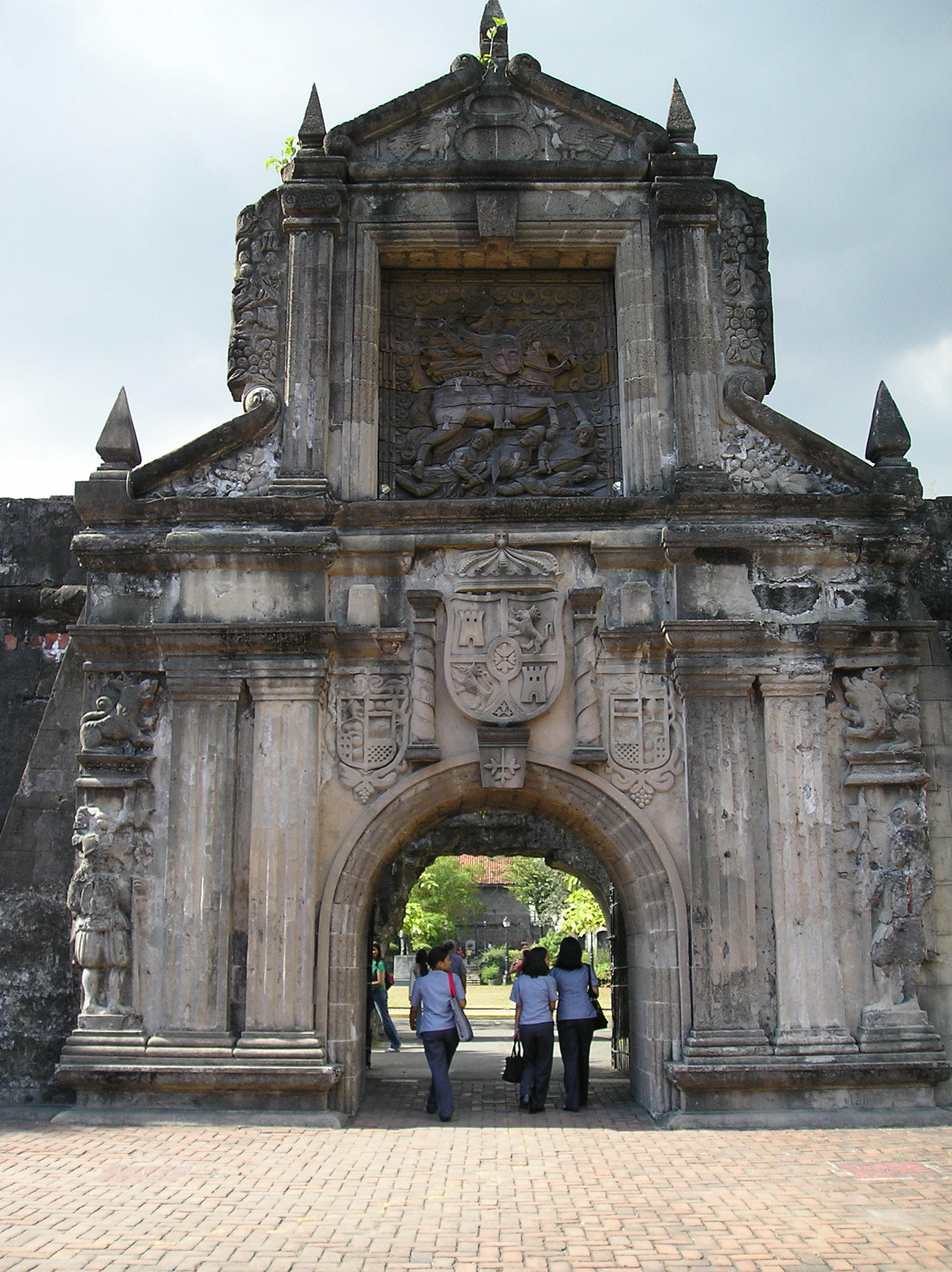
The gate of Fort Santiago in Manila — Public domain
Travel to Fort Santiago Manila
Hours, Tickets and the First Walk
Fort Santiago Manila is open from Monday to Friday from 08:00 to 22:00, with last entry at 20:00, and on Saturday and Sunday from 06:00 to 22:00, with last entry at 20:30. Those hours come from the Intramuros Administration, and they should be checked against the latest notice before going. The hours’ length is the visit’s frame, and their checking is the frame’s care. The fort’s day is a long one, and its evenings are the day’s gold.
The entry price is 75 pesos for a regular visitor and 50 pesos for a concession, according to the Intramuros Administration. The price’s pesos are the visit’s cost, and their smallness is the cost’s welcome. The fort’s ticket is the ticket of a national treasure, and its price is the treasure’s door. The visitor should confirm the price at the gate, because the prices of the Philippines change with the years.
The first walk in Fort Santiago Manila should begin at the main gate, whose arch rises 12 metres high. The gate’s arch is the fort’s face, and its stones are the face’s weight. The gate’s visit is the visit’s threshold, and its height is the threshold’s measure. The visitor who passes the gate enters the fort’s history, and its plaza is the history’s floor.
The Plaza de Armas is the second stop, and its open ground is the fort’s parade. Its stones are the soldiers’ old drill floor, and their silence is the floor’s memory. The plaza’s visit is the visit’s heart, and its walls are the heart’s sides. The visitor who stands in the plaza stands where the garrison drilled, and its ground is the drilling’s echo.
The Rizal Shrine is the third stop, and its halls hold the memory of the hero’s 56 days. Its rooms keep the prisoner’s cell and the cell’s story. The shrine’s visit is the visit’s prayer, and its bronze footprints are the prayer’s path. The visitor who follows the footprints walks the hero’s last walk, and their metal is the walk’s trace.
The Dungeons, the Baluarte and the River
The dungeons of Fort Santiago Manila are the fort’s darkest rooms, and their cells held the prisoners of the Spanish and the Japanese. The dungeons’ darkness is the fort’s horror, and their walls are the horror’s stones. The dungeons’ visit is the visit’s silence, and their cells are the silence’s rooms. The visitor who enters the dungeons enters the fort’s night, and their stones are the night’s weight.
South of the fort stands the Baluarte de San Diego, the oldest stone fort in Manila, drawn by Antonio Sedeno in 1586 and 1587. Its round bastion guarded the southern wall, and its guns are the guarding’s voice. The baluarte keeps hours of 08:00 to 17:00, and it has been a National Historical Landmark since 1951 and a National Cultural Treasure since 2014.
The river path beside the Pasig is the fort’s edge, and its breeze is the bank’s cool. Its walk is the fort’s quiet hour, though the gate was shut by an official notice of 7 January 2026, so check before counting on the river path.
Casa Manila stands in Intramuros near the fort, and it is open from Tuesday to Sunday from 09:00 to 18:00. The house’s rooms are the colonial city’s furniture, and their wood is the furniture’s age. The house’s visit is the visit’s domestic hour, and its courtyard is the hour’s shade. The visitor who enters Casa Manila enters a merchant’s house, and its rooms are the house’s life.
When to Go and the Old City
December to May brings the clearest air to the fort, and the stones stay dry underfoot. June to November brings the afternoon rains, which make the old stones slippery. The air runs between 24 and 33 degrees, and the golden hour is dusk, when the sun sets over Manila Bay.
The fort’s mornings are quiet, and its evenings are golden, when the sun sets over Manila Bay. The mornings’ quiet is the visit’s gift, and their light is the gift’s gold. The fort’s evenings are the evenings of a fortress that faces the bay, and their sunsets are the evenings’ fire. The visitor who comes at dusk sees the fort’s walls in the bay’s light, and their stone is the light’s canvas.
The old city of Intramuros surrounds the fort, and its streets are the visit’s extension. The streets’ churches and houses are the city’s heritage, and their stones are the heritage’s age. The streets’ walk is the fort’s complement, and their walls are the complement’s frame. Visitors who pair the fort with the San Agustin Church see the fortress and the oldest stone church of the Philippines in one walk, and those who want the new Manila can continue to Bonifacio Global City.
The fort is a managed heritage site, with guards and lights on its grounds. Still, the ordinary caution of a big city applies here, with bags watched in crowds and ride-hailing cars used after dark. The stones are easy to enjoy, and the site repays an unhurried visit.
Notable Places in Fort Santiago Manila
The Main Gate. The main gate of Fort Santiago Manila, 12 metres high, rebuilt after the war. Its arch is the fort’s face, and its stones are the face’s weight.
The Plaza de Armas. The parade ground inside Fort Santiago Manila, where the garrison drilled. Its stones are the soldiers’ floor, and its silence is the floor’s memory.
The Rizal Shrine. The shrine inside Fort Santiago Manila that holds the memory of Jose Rizal’s 56 days in the fort’s cells. Its bronze footprints mark the hero’s last walk.
The Dungeons. The cells below the walls of Fort Santiago Manila, which held the prisoners of the Spanish and the Japanese occupations. Their darkness is the fort’s horror, and their stones are the horror’s proof.
The Baluarte de San Diego. The oldest stone fort in Manila, south of Fort Santiago Manila, designed by Antonio Sedeno in 1586 and 1587. Its bastion guarded the southern wall of Intramuros.
The Riverwalk. The path along the Pasig River at Fort Santiago Manila, whose gate was temporarily closed by an official notice of 7 January 2026. Its banks give the best view of the river’s mouth.
Frequently Asked Questions
What is Fort Santiago Manila?
Fort Santiago Manila is a stone fortress at the north-western corner of Intramuros, built in 1571 by Miguel Lopez de Legazpi and rebuilt in stone between 1589 and 1592. Its main gate rises 12 metres high, and its walls guard the mouth of the Pasig River.
When was Fort Santiago Manila built?
Fort Santiago Manila was built in 1571, and it was rebuilt in stone between 1589 and 1592. Its first form was wood and earth, and its stone walls are the walls that stand today.
Who was imprisoned in Fort Santiago Manila?
Rizal spent 56 days in the fort’s cells, from 3 November to 29 December 1896, before his execution. His cell is now the Rizal Shrine, and its bronze footprints mark his last walk from the fort.
What are the opening hours of Fort Santiago Manila?
Weekdays run 08:00 to 22:00 with last entry at 20:00, and weekends run 06:00 to 22:00 with last entry at 20:30. Those hours come from the Intramuros Administration, and they should be checked against the latest notice.
How much is the entry to Fort Santiago Manila?
The entry to Fort Santiago Manila is 75 pesos for a regular visitor and 50 pesos for a concession, according to the Intramuros Administration. Confirm the price at the gate, because Philippine prices change with the years.
What is the Baluarte de San Diego?
The Baluarte de San Diego is the oldest stone fort in Manila, south of Fort Santiago Manila, designed by Antonio Sedeno in 1586 and 1587. It was declared a National Historical Landmark in 1951 and a National Cultural Treasure in 2014, and it is open from 08:00 to 17:00.
Verified
The facts in this Fort Santiago Manila guide were drawn from the Vietnamese article for this entity and its cited sources, checked on 22 November 2026. The building of the fort in 1571 by Miguel Lopez de Legazpi, the rebuilding in stone between 1589 and 1592, the main gate of 12 metres, the British occupation of 1762 to 1764, the imprisonment of Jose Rizal from 3 November to 29 December 1896 for 56 days, the Battle of Manila in 1945, the restoration from 1951, the declaration as a National Cultural Treasure in 2014, the hours of Monday to Friday 08:00 to 22:00 and Saturday and Sunday 06:00 to 22:00, the entry of 75 pesos and 50 pesos concession, the Baluarte de San Diego designed by Antonio Sedeno in 1586 and 1587 and its status as a National Historical Landmark in 1951 and a National Cultural Treasure in 2014, the building of the San Agustin Church between 1587 and 1607, and the UNESCO listing of the Baroque Churches of the Philippines in 1993 under reference 677 are taken from those sources. Wikidata Q478181 is Fort Santiago (P31 Q1785071, P625 14.595/120.96944444444), verified by API on 22 November 2026.
Sources
- Wikipedia, Fort Santiago — https://en.wikipedia.org/wiki/Fort_Santiago
- Intramuros Administration, Hours — https://intramuros.gov.ph/hours/
- UNESCO, Baroque Churches of the Philippines — https://whc.unesco.org/en/list/677/
- Wikidata, Fort Santiago Q478181 — https://www.wikidata.org/wiki/Q478181
Unverified
- The current opening hours of the Rizal Museum inside Fort Santiago Manila are given as Tuesday to Sunday, 09:00 to 16:00, closed on Monday, in travel guides, but the Intramuros Administration does not list the museum’s hours separately.
- The Riverwalk gate of Fort Santiago Manila was temporarily closed by an official notice of 7 January 2026, and it is not clear whether it has reopened.
- The exact number of bodies found in the dungeons when American forces retook the fort in 1945 is unsettled: sources give hundreds, and one source gives about 600, with no agreed figure from an official source.
- The schedule of the free guided tours of the Intramuros Administration at Fort Santiago Manila should be checked directly before going.
Illustrations
- Hero: Fort Santiago Manila is a stone fortress from 1571 at the north-west corner of Intramuros. Free image: https://upload.wikimedia.org/wikipedia/commons/a/a1/Main_gate_of_Fort_Santiago%2C_Manila%2C_Philippines.jpg — CC BY-SA 4.0.
- In body, fort: The gate of Fort Santiago in Manila. Free image: https://upload.wikimedia.org/wikipedia/commons/7/77/Fort_Santiago_Gate.jpg — Public domain.
- In body, view: The walled city of Intramuros in Manila. Free image: https://upload.wikimedia.org/wikipedia/commons/3/39/Manila%2C_Fort_Santiago%2C_Walled_city_of_Intramuros%2C_Philippines.jpg — CC BY 4.