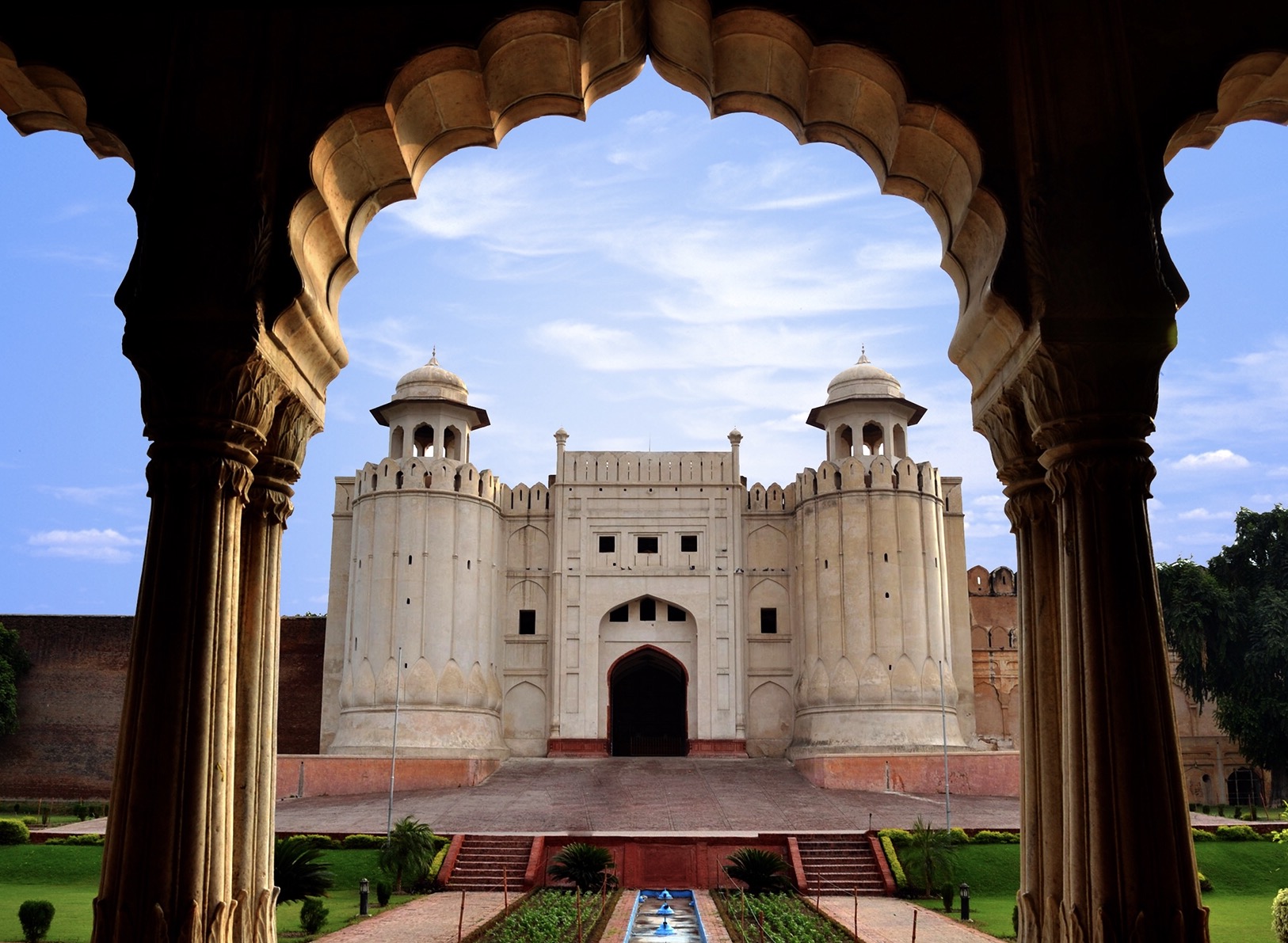
Lahore Fort
Lahore Fort is the great Mughal palace-fortress of Lahore, Pakistan. It guards the north-west corner of the walled old city.
The fort covers more than 20 ha, and it holds 21 surviving monuments from the Mughal centuries. It was rebuilt from 1566 onwards, and its walls, courts, mosques and palaces show the change from the red sandstone of Akbar to the white marble of Shah Jahan. The Lahore Fort stands beside the Badshahi Mosque, at the edge of the Walled City, and together with the Shalamar Gardens it was listed by UNESCO in 1981.
Quick Facts
| Item | Detail |
|---|---|
| Name | Lahore Fort, also called the Shahi Qila, the Royal Fort |
| Location | North-west corner of the Walled City, Lahore, Punjab, Pakistan |
| Type | Mughal palace-fortress, a royal citadel |
| Area | More than 20 ha, about 49 acres |
| Surviving monuments | 21 monuments inside the walls |
| Rebuilt from | 1566, under the Mughal emperors |
| Alamgiri Gate | Built in 1674, under Aurangzeb |
| Shish Mahal | Built 1631 to 1632, the Palace of Mirrors |
| Coordinates | 31.5903 N, 74.3097 E |
| Wikidata | Q613720, Lahore Fort, a fortress in Pakistan |
| UNESCO | Fort and Shalamar Gardens in Lahore, listed 1981, reference 171, criteria (i), (ii) and (iii) |
| Highlights | Alamgiri Gate, Shish Mahal, Naulakha Pavilion, Moti Masjid, the Picture Wall |
| Language | Urdu and Punjabi; English is common in the tourist areas |
| Currency | Pakistani rupee (PKR) |
| Time zone | UTC+5 |
The fort stands on raised ground at the north-west corner of the old city, where the Ravi River once ran close to the walls. The Lahore Fort was the seat of Mughal power in Lahore, and every emperor from Akbar to Aurangzeb added to it, so the fort is a record of the empire in stone, brick, marble and tile. The Lahore Fort is the largest monument of the old city, and its gate, its walls and its palaces are the first sight of Lahore for a visitor who comes from the Badshahi Mosque.
The Lahore Fort is not a ruin. It is a living monument, with a museum, gardens, a mosque and halls that are still used for ceremonies, and its courtyards are open to visitors who walk from the Alamgiri Gate to the Shish Mahal. The Lahore Fort was placed on the List of World Heritage in Danger in 2000, and it was taken off that list in June 2012, after the walls and the gardens had been repaired.
Geography
The fort stands on the high ground at the north-west corner of the old city, on the plain of the Punjab, in the north-east of Pakistan. The Ravi once flowed beside its walls, guarding the crossing, but the river has shifted west, leaving the fort a short way from the water. Around it lie the wheat, rice and sugar-cane fields of the Punjab, and Lahore is the market town for that farmland.
The fort covers more than 20 ha, about 49 acres, inside a wall of brick and stone that follows the edge of the old city. The fort is a walled town in itself, with courts, halls, mosques, gardens and barracks, and its 21 surviving monuments are spread across the ground from the Alamgiri Gate in the south to the northern wall. The Lahore Fort is entered from the south, through the Alamgiri Gate, and the great mosque, the Badshahi Mosque, stands beside the gate, outside the fort wall.
The Picture Wall of the Lahore Fort is the great decorated wall of the northern side, and it is the most famous wall of the fort. The wall was decorated under Jahangir, from 1624 to 1625, with glazed tiles, mosaics and frescoes, and it shows elephants, horses, soldiers, hunters and polo players in bright colours. The Picture Wall runs along the north and the north-west of the Lahore Fort, and it is the face the fort turns to the river and to the road that once came from the north.
Lahore has the weather of the Punjab plain: fierce heat in summer, a mild winter and monsoon rain between them, and the fort is an open place with little shade in its courts. From May to July the heat passes 40 degrees and the stone keeps it through the afternoon. July to September brings the monsoon, with rain and damp air, and the courts run with water. December to February is cool and clear, with fog at dawn, and it is the finest season to walk the fort, when the air is gentle and the marble feels cool underfoot.
The Shalamar Gardens lie about 7 km from the Lahore Fort, by road, and about 5 km to the north-east as the crow flies, outside the old city. The gardens were built from 1641 to 1642, under Shah Jahan, and they cover 16 ha, in three terraces, with fountains, pavilions and water channels. The Lahore Fort and the Shalamar Gardens were listed together by UNESCO in 1981, as one property, because they are the two great works of Mughal Lahore, the palace and the garden.
The ground of the Lahore Fort is raised above the old city, and its walls look over the rooftops of the Walled City to the east and over the open ground to the west. The Lahore Fort was built on the site of an older fort, and the ground has been built on for centuries, so the fort stands on layers of earlier walls and courts. The fort is the high point of the old city, and its gate, its minarets and its marble pavilions can be seen from far across Lahore.

Hazuri Bagh Pavillion and Lahore Fort in 1863 — Public domain
History
The Lahore Fort was rebuilt from 1566 onwards, under the Mughal emperor Akbar, and the fort that stands today is the Mughal fort. Akbar built in burnt brick and red sandstone, with Hindu motifs in the carving, and his work set the plan of the Lahore Fort, with its courts, its halls and its walls. The fort was the palace of the Mughal court when the emperor was in Lahore, and it was the centre of the government of the Punjab.
Under Jahangir, the son of Akbar, the fort gained its great northern court, finished from 1617 to 1618, and the decoration of the northern and the north-western walls, from 1624 to 1625. Jahangir loved Lahore, and he built in the fort and in the gardens outside the city, and his court made Lahore a city of palaces. The Picture Wall, with its glazed tiles and its scenes of hunting and war, is the work of Jahangir, and it is the most vivid wall of the Lahore Fort.
Under Shah Jahan, the Lahore Fort changed from red sandstone to white marble, and the fort gained its most famous rooms. The Shish Mahal, the Palace of Mirrors, was built from 1631 to 1632, with walls of small mirrors set in plaster, so that a single lamp fills the room with light. The Naulakha Pavilion, a small marble pavilion with a curved roof, was built in 1633, and the Moti Masjid, the Pearl Mosque, was built from 1630 to 1635, in white marble, for the private prayers of the court. Shah Jahan made the Lahore Fort a palace of marble and inlaid stone, and his work is the finest in the fort.
The Alamgiri Gate of the Lahore Fort was built in 1674, under Aurangzeb, and it is the great gate of the fort. The gate is a tall brick and stone structure, with two round towers, and it faces the Badshahi Mosque, which Aurangzeb built from 1671 to 1673. The gate was rebuilt in 1674, and it is the entrance every visitor uses today, and it is the symbol of the Lahore Fort.
After the Mughals, the Lahore Fort passed to the Sikhs, and Ranjit Singh held Lahore from the early 19th century until 1849. The Sikhs built in the fort and used its halls, and the fort remained the seat of power in Lahore. In 1849 the British took Lahore, and the fort became a military place, with barracks and stores, and its palaces were used as offices and quarters. The British period changed the use of the Lahore Fort, but the walls, the courts and the marble rooms survived.
The Lahore Fort was nominated for the World Heritage List in 1980, and it was listed in October 1981, at the session in Sydney, together with the Shalamar Gardens, as the Fort and Shalamar Gardens in Lahore, reference 171, criteria (i), (ii) and (iii). The listing recognised the Lahore Fort as an outstanding example of Mughal art of the 16th and 17th centuries. In 2000 the property was placed on the List of World Heritage in Danger, because the walls and the gardens were in poor repair, and in June 2012, at the 36th session in Saint Petersburg, UNESCO took the property off the Danger List, after the repairs had been made.
The fort is now a museum and a monument, and its halls hold the story of the Mughal court. The Shish Mahal is the most visited room of the Lahore Fort, and the Picture Wall is the most photographed wall, and the Alamgiri Gate is the most famous gate. The Lahore Fort is the great monument of Lahore, and it is the reason the old city is the cultural capital of Pakistan.
Timeline
- 1566 onwards: Akbar rebuilds the Lahore Fort in burnt brick and red sandstone.
- 1617 to 1618: Jahangir finishes the great northern court of the Lahore Fort.
- 1624 to 1625: the northern and north-western walls are decorated, the Picture Wall.
- 1630 to 1635: the Moti Masjid, the Pearl Mosque, is built in white marble.
- 1631 to 1632: the Shish Mahal, the Palace of Mirrors, is built under Shah Jahan.
- 1633: the Naulakha Pavilion is built, in white marble, with a curved roof.
- 1641 to 1642: the Shalamar Gardens are built, 16 ha, in three terraces.
- 1671 to 1673: the Badshahi Mosque is built beside the Lahore Fort, under Aurangzeb.
- 1674: the Alamgiri Gate of the Lahore Fort is built, under Aurangzeb.
- 1849: the British take Lahore, and the Lahore Fort becomes a military place.
- 1980: the Lahore Fort and the Shalamar Gardens are nominated for the World Heritage List.
- October 1981: UNESCO lists the Fort and Shalamar Gardens in Lahore, reference 171.
- 2000: the property is placed on the List of World Heritage in Danger.
- June 2012: UNESCO takes the property off the Danger List, at the 36th session in Saint Petersburg.

Beautiful view of Lahore fort main Gate — CC BY-SA 4
Travel
Winter, from December to February, is the season for the Lahore Fort, with cool, clear air and a soft morning fog. The summer is very hot, past 40 degrees, and the courts of the Lahore Fort hold the heat, so a morning visit is the wise choice. From July to September the monsoon soaks the fort, and the marble is slippery underfoot. The winter light is the best light for the Picture Wall and the Shish Mahal.
Enter the Lahore Fort through the Alamgiri Gate, and walk from the gate to the Shish Mahal, through the courts and the halls. The fort is a half day in itself, with its palaces, its mosque and its museum, and the Shish Mahal is the room to linger in, with its mirrors and its inlaid stone. The Picture Wall is best seen from the north, where the tiles and the frescoes run along the wall, and the Naulakha Pavilion is the small marble room to look for in the court.
The Lahore Fort is a place to walk slowly, and its courts are open, so bring water and a hat in the warm months. Dress modestly, and remove your shoes before entering the Moti Masjid, and ask before taking photographs of people. The fort is beside the Badshahi Mosque, and the two together are the great sight of the old city, and the Walled City lies to the east of the gate, with its lanes, its bazaars and its food.
Allow a half day for the Lahore Fort, and combine it with the Badshahi Mosque and the Walled City, which lie beside it. The Shalamar Gardens are about 7 km away, by road, and they are the other half of the UNESCO property, with three terraces of fountains and pavilions. The fort is crowded on weekends and on holidays, and a weekday morning is the quietest time to walk its courts.
Notable Places
The Alamgiri Gate is the great entrance of the Lahore Fort, built in 1674 under Aurangzeb, with two round towers of brick and stone. The gate faces the Badshahi Mosque, and it is the door through which every visitor enters the Lahore Fort, and it is the symbol of the fort on the postcards of Lahore. The gate was rebuilt in 1674, and it has stood since then as the front of the Lahore Fort.
The Shish Mahal is the Palace of Mirrors of the Lahore Fort, built from 1631 to 1632 under Shah Jahan, with walls of small mirrors set in plaster. A single lamp fills the room with light, and the mirrors catch the flame and throw it back across the walls. The Shish Mahal is the most famous room of the Lahore Fort, and it is the room that shows the craft of the Mughal court at its finest.
The Picture Wall runs along the north and the north-west of the Lahore Fort, and it was decorated under Jahangir, from 1624 to 1625, with glazed tiles, mosaics and frescoes. The wall shows elephants, horses, soldiers, hunters and polo players, in bright colours, and it is the most vivid wall of the Lahore Fort. The Picture Wall is the face the fort turns to the river, and it is the wall that tells the story of the Mughal court in pictures.
The Naulakha Pavilion is a small marble pavilion of the Lahore Fort, built in 1633, with a curved roof and inlaid stone. The pavilion stands in a court of the Lahore Fort, and it is the most delicate building in the fort, a room of white marble that shows the change from the red sandstone of Akbar to the marble of Shah Jahan. The Moti Masjid, the Pearl Mosque, stands nearby, built from 1630 to 1635, in white marble, for the private prayers of the court.
Lahore is the city that holds the Lahore Fort, and the Walled City lies to the east of the gate, with its lanes and bazaars. The Badshahi Mosque stands beside the Alamgiri Gate, and the Shalamar Gardens are the other half of the UNESCO property, about 7 km away. The Lahore Fort, the mosque, the old city and the gardens together are the heritage of Lahore.
Frequently Asked Questions
What is the Lahore Fort?
The Lahore Fort is the Mughal palace-fortress of Lahore, Pakistan, also called the Shahi Qila, the Royal Fort. The Lahore Fort covers more than 20 ha, holds 21 surviving monuments, and was rebuilt from 1566 onwards under the Mughal emperors, with the Alamgiri Gate of 1674 and the Shish Mahal of 1631 to 1632.
Is the Lahore Fort a UNESCO World Heritage site?
Yes, the Lahore Fort is a World Heritage site, listed together with the Shalamar Gardens in 1981, as the Fort and Shalamar Gardens in Lahore, reference 171, criteria (i), (ii) and (iii). The property was placed on the List of World Heritage in Danger in 2000 and taken off that list in June 2012.
What is the Shish Mahal in the Lahore Fort?
The Shish Mahal is the Palace of Mirrors of the Lahore Fort, built from 1631 to 1632 under Shah Jahan. Its walls are set with small mirrors in plaster, so a single lamp fills the room with light, and it is the most famous room in the fort.
What is the Picture Wall of the Lahore Fort?
The Picture Wall is the decorated northern wall of the Lahore Fort, finished under Jahangir from 1624 to 1625. It is covered with glazed tiles, mosaics and frescoes showing elephants, horses, soldiers, hunters and polo players, and it runs along the north and north-west sides of the fort.
When is the best time to visit the Lahore Fort?
Winter, from December to February, is the best time, with cool, clear air and a soft morning fog. Summer, from May to July, is very hot, past 40 degrees, and the monsoon, from July to September, brings rain and slippery marble, so a morning visit is wise in the warm months.
How far is the Shalamar Gardens from the Lahore Fort?
The Shalamar Gardens are about 7 km from the Lahore Fort by road, and about 5 km to the north-east as the crow flies. The gardens were built from 1641 to 1642 under Shah Jahan, cover 16 ha in three terraces, and are listed with the fort as one UNESCO property.
Verified
- Lahore Fort facts in this article were checked on 20 November 2026 against the verified Vietnamese article for the Lahore Fort and the sources it cites, including the official UNESCO list page for the Fort and Shalamar Gardens in Lahore, reference 171, at https://whc.unesco.org/en/list/171/.
- The Lahore Fort covers more than 20 ha, holds 21 surviving monuments, and was rebuilt from 1566 onwards, as recorded in the verified Vietnamese article for the Lahore Fort.
- The Shish Mahal was built from 1631 to 1632, the northern court was finished from 1617 to 1618, the northern walls were decorated from 1624 to 1625, and the Alamgiri Gate was built in 1674, as recorded in the verified Vietnamese article for the Lahore Fort.
- The Fort and Shalamar Gardens in Lahore were listed by UNESCO in 1981, reference 171, criteria (i), (ii) and (iii), placed on the Danger List in 2000, and taken off that list in June 2012 at the 36th session in Saint Petersburg, as recorded in the verified Vietnamese article for the Lahore Fort.
- The Wikidata record Q613720 gives Lahore Fort, with coordinates 31.590277777778 and 74.309722222222, matching the registry.
Sources
- UNESCO, Fort and Shalamar Gardens in Lahore, official list page: https://whc.unesco.org/en/list/171/
- UNESCO, decision to remove the property from the Danger List, 36th session, 2012: https://whc.unesco.org/en/decisions/4641/
- Wikipedia, Lahore Fort: https://en.wikipedia.org/wiki/Lahore_Fort
- TheTerraAtlas Vietnamese article for the Lahore Fort (lahore-fort.vi.md), facts verified in that article with sources and check dates.
Unverified
- The exact opening hours and entry fees for the Lahore Fort were not verified on the official site for this article, and they should be checked at the gate before a visit.
- The dates for the Naulakha Pavilion, 1633, and the Moti Masjid, 1630 to 1635, follow the standard guides cited in the Sources, and the Vietnamese article does not list them.
- The Shalamar Gardens lie about 7 km from the Lahore Fort by road and about 5 km as the crow flies; the two figures measure different routes, and the UNESCO page gives 7 km.
- The registry records the Lahore Fort with no UNESCO flag of its own, although the fort is a component of the listed Fort and Shalamar Gardens in Lahore, reference 171; whether the registry flag should be set is a question for the fix queue, and this article does not change the registry.
Illustrations
- Hero: View of Lahore Fort. Free image: https://upload.wikimedia.org/wikipedia/commons/4/4f/Lahore_Fort_view_from_Baradari.jpg — CC BY-SA 3.
- In body, Lahore Fort: Beautiful view of Lahore fort main Gate. Free image: https://upload.wikimedia.org/wikipedia/commons/3/34/Fort_of_Lahore.jpg — CC BY-SA 4.
- In body, Lahore Fort: Hazuri Bagh Pavillion and Lahore Fort in 1863. Free image: https://upload.wikimedia.org/wikipedia/commons/d/d2/Hazuri_Bagh_Pavillion_and_Lahore_Fort_in_1863.jpg — Public domain.