
Shwezigon Pagoda: The Golden Pagoda of Bagan, Myanmar
Shwezigon Pagoda is the golden pagoda of Bagan, in Myanmar. Its bell-shaped stupa has stood above the Irrawaddy plain since 1102.
Shwezigon Pagoda, in Burmese Shwezigon Paya, stands in the town of Nyaung-U, at the north-eastern gateway of the Bagan archaeological zone, in the Mandalay Region of central Myanmar. The pagoda was begun in 1059–1060, in the reign of King Anawrahta, and completed in 1102, in the reign of King Kyansittha, and it is the model on which the pagodas of Myanmar were built afterwards: a gilded bell-shaped stupa on five square terraces, with a solid sandstone core. The stupa is about 49 metres high, on a square base of about 49 metres, and it is covered in gold leaf, so that it shines across the plain of Bagan.
Shwezigon Pagoda is more than a monument. It is the place where Buddhism and the worship of the nats, the spirits of Myanmar, were joined together, when Anawrahta gave official recognition to 37 nats and set their statues on the terraces of the pagoda, facing the Buddha. The pagoda is a living place of worship, and its festival, at the end of the year in about October and November, brings thousands of monks to receive alms. The pagoda is part of the Bagan World Heritage site, listed by UNESCO in 2019, although it holds no listing of its own.
Quick Facts
| Item | Detail |
|---|---|
| Name | Shwezigon Pagoda; also Shwezigon Paya |
| Burmese name | ရွှေစည်းခုံဘုရား (Shwezigon Paya) |
| Type | Buddhist pagoda (L4) in the town of Nyaung-U, Bagan region, Myanmar |
| Position | Nyaung-U town, north-east of the Bagan archaeological zone, near the east bank of the Irrawaddy river |
| Coordinates | 21.1903° N, 94.8947° E |
| Begun | 1059–1060, in the reign of King Anawrahta; completed in 1102, in the reign of King Kyansittha |
| Height | About 49 m (160 feet), on a square base of about 49 m |
| Architecture | A gilded bell-shaped stupa on five square terraces, with a solid sandstone core |
| Religion | Theravada Buddhism, joined with the worship of the nats |
| UNESCO | Part of the Bagan World Heritage site, listed in 2019, ref 1588, criteria (iii)(iv)(vi); no listing of its own |
| Wikidata | Q2747222 (a Buddhist pagoda) |
| GeoNames | None |
Geography of Shwezigon Pagoda
Shwezigon Pagoda stands in the town of Nyaung-U, the north-eastern gateway of the Bagan archaeological zone, in the Mandalay Region of central Myanmar. The pagoda stands on high ground near the east bank of the Irrawaddy river, a few kilometres north-east of the Ananda Temple area in Old Bagan. From the terrace of Shwezigon Pagoda, visitors look out over the wide plain of Bagan, with thousands of stupas rising between the trees and the fields.
The region of Bagan is a dry plain in the dry zone of central Myanmar, with low rainfall and a long sunny season. More than 2,000 temples, stupas and monasteries from the 11th to the 13th centuries still stand on the plain, on a heritage area of about 5,005 hectares, and at the height of the kingdom, Bagan is thought to have held about 10,000 religious buildings. Shwezigon Pagoda is one of the oldest of them to keep its shape almost whole, and its gold leaf catches the sun from far away.
The climate of Bagan is the climate of the dry zone: the dry season from November to February is cool and pleasant, with daytime temperatures often below 30 degrees Celsius and cool mornings, while the hot season from March to May can pass 40 degrees, and the rainy season from June to October brings showers but a greener plain. Nyaung-U is the busiest town in the Bagan area, with a market, a bus station and guesthouses for visitors, and from the centre of the town, visitors reach Shwezigon Pagoda in a few minutes by electric bike or horse cart.
The plain of Bagan
The plain of Bagan is the heart of the old kingdom, and the temples stand in every direction from Shwezigon Pagoda. The Irrawaddy river runs along the west of the plain, and the town of Nyaung-U stands on its eastern bank, where the boats and the buses arrive. The land is flat and dry, with scrub and palm trees between the temples, and the dust of the plain turns gold in the late afternoon light. The pagoda stands on a rise, so that it is seen from across the plain, and the gold of its stupa is the landmark by which travellers find Nyaung-U.
The enclosing wall of Shwezigon Pagoda is about 750 feet on each side, with four gates, and the compound inside the wall is a place of shade and quiet, with trees, shrines and the small temples that have grown up around the great stupa. The wall marks the sacred ground, and the four gates face the four directions, so that the pagoda is entered from every side of the town.

Nyaung-U, Bagan, Pagan, Myanmar — CC BY 4
History of Shwezigon Pagoda
King Anawrahta, who reigned from 1044 to 1077, was the king who united the kingdoms of Myanmar and founded the kingdom of Pagan, and he was the first king to make Theravada Buddhism the state religion. Following the Burmese chronicles, Anawrahta began building Shwezigon Pagoda in 1059–1060, to hold precious relics, among them a replica of the tooth relic of the Buddha received from Sri Lanka, a forehead bone, a collarbone and a jade Buddha image said to come from China. The king had time to build only the terraces before he died in 1077, following legend killed by a wild buffalo.
Legend tells that Anawrahta placed the relics on the back of a white elephant and let it walk freely to find the place for the pagoda. The elephant stopped on a sandbank near the Irrawaddy river, and that was where the pagoda was built, which explains the name, the golden pagoda on the sandbank. The successor of Anawrahta, King Kyansittha, who reigned from 1084 to 1113, completed the work in 1102.
Following one source on Bagan, Kyansittha reduced the scale of the plan of Anawrahta, from a base 320 cubits wide to 300 cubits, and enclosed the half-built stupa in the new work. The sources do not agree fully on the exact year of completion, ranging from 1086 to 1102, but they agree that the bell shape of the stupa was fixed in the time of Kyansittha and has stayed the same to this day.
Buddhism and the worship of the nats
The most special point in the history of Shwezigon Pagoda is its role in joining Buddhism to the worship of the nats, the native spirits of Myanmar. Anawrahta once wanted to forbid the worship of the nats, but he did not succeed, so he gave official recognition to 37 nats and placed their statues on the terraces of the pagoda, in a position facing the Buddha. This is held to be the first official royal recognition of the worship of the nats, and to this day the followers of the nats come to the pagoda to pray beside the Buddhists.
The architecture of Shwezigon Pagoda became the model for the pagodas of Myanmar afterwards, with a bell-shaped stupa on a square base of many terraces, and a golden umbrella, the hti, set with jewels on top. Three of the five terraces are faced with about 550 glazed terracotta tiles, of 584 in the beginning, showing the stories of the former lives of the Buddha, the Jataka tales. Four standing bronze statues of the Buddha stand before the stairways, and the stairways climb the terraces to the stupa itself.
Later kings, earthquakes and the World Heritage listing
King Bayinnaung gilded the pagoda and gave a bronze bell on 23 May 1557, weighing 2,100 viss, or 3,423 kilograms, and 165 centimetres high. King Hsinbyushin set a new hti on the stupa in 1768. The earthquake of 8 July 1975, of magnitude 6.8, damaged the pagoda, and the regilding of 1983–1984 restored its gold. The earthquake of 28 March 2025, near Mandalay and Sagaing, was further from Bagan, and the pagoda stands far from the centre of that quake.
Bagan was listed as a World Heritage site in 2019, with the reference 1588 and the criteria (iii), (iv) and (vi), over an area of 5,005 hectares, and Shwezigon Pagoda is a part of that listing. The festival of Shwezigon Pagoda falls in the festival season at the end of the year, in about October and November by the Myanmar calendar, when alms are given to thousands of monks. Climbing the stupas is forbidden, and the pagoda is visited on foot, from the gates through the compound to the terraces.
Timeline
| Year | Event |
|---|---|
| 1044–1077 | King Anawrahta reigns; he unites Myanmar and makes Theravada Buddhism the state religion |
| 1059–1060 | Anawrahta begins building Shwezigon Pagoda to hold the relics |
| 1077 | Anawrahta dies, having built only the terraces |
| 1084–1113 | King Kyansittha reigns |
| 1102 | Kyansittha completes Shwezigon Pagoda |
| 23 May 1557 | King Bayinnaung gives a bronze bell of 2,100 viss |
| 1768 | King Hsinbyushin sets a new hti on the stupa |
| 8 July 1975 | An earthquake of magnitude 6.8 damages the pagoda |
| 1983–1984 | The pagoda is regilded |
| 2019 | Bagan is listed as a World Heritage site, ref 1588 |
| Today | Shwezigon Pagoda is the model pagoda of Myanmar and a living place of worship |
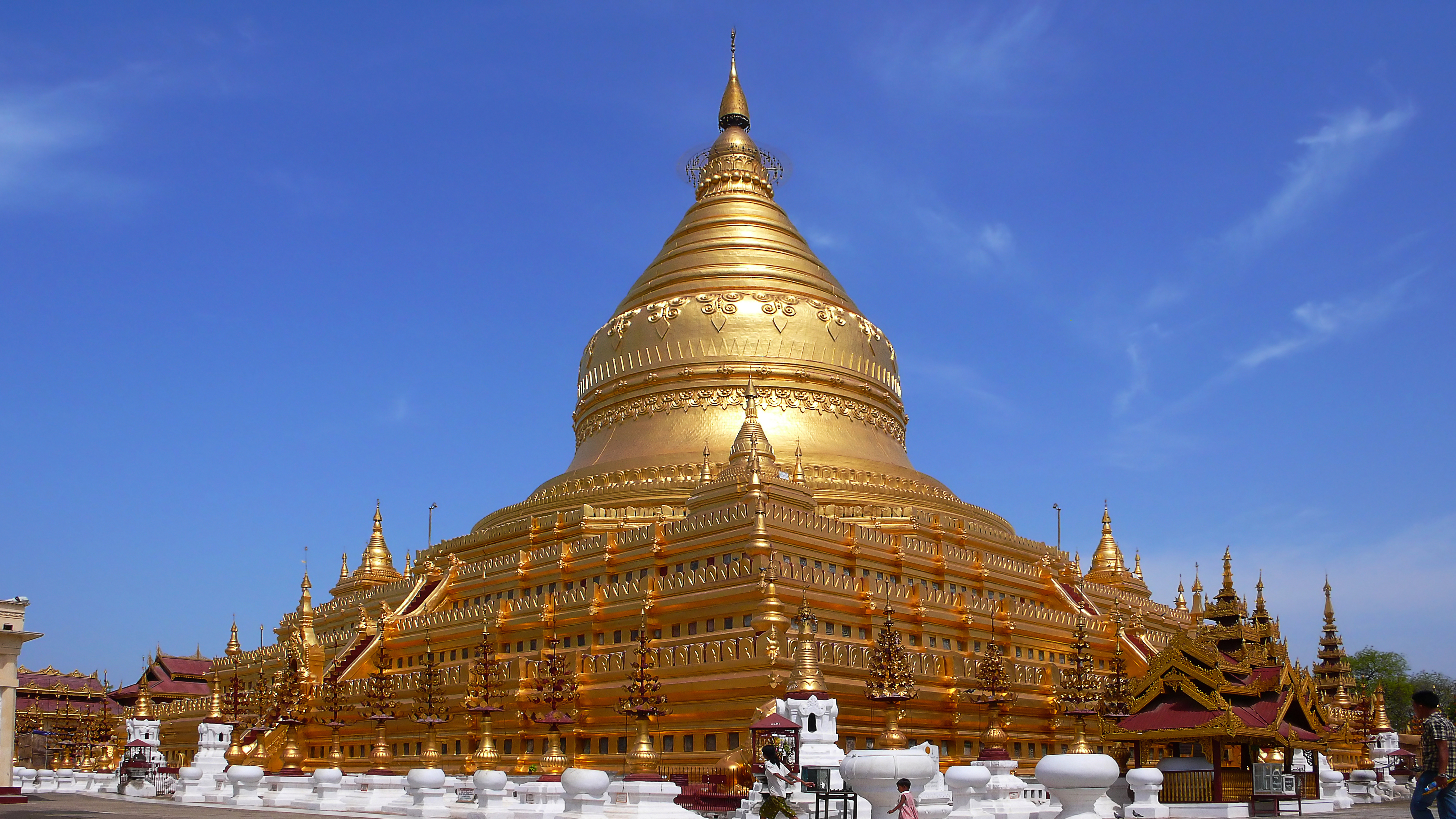
Shwezigon, Bagan, Myanmar — CC BY-SA 3
Travel in Shwezigon Pagoda
Shwezigon Pagoda is reached from the town of Nyaung-U, the busiest town in the Bagan area, in a few minutes by electric bike or horse cart. The pagoda stands on high ground near the east bank of the Irrawaddy, a few kilometres north-east of the Ananda Temple area in Old Bagan, and the road from the town is flat and easy. An archaeological zone ticket is required for the Bagan area, and visitors should check the present fee at the official ticket desk before going, because the fee has changed several times.
The pagoda is best visited in the early morning or the late afternoon, when the gold leaf catches the low sun and the heat is lower. The dry season, from November to February, is the finest time, with daytime temperatures often below 30 degrees and cool mornings, while the hot season from March to May can pass 40 degrees. The rainy season, from June to October, brings showers but a greener plain, and the festival of the pagoda falls at the end of the year, in about October and November.
Inside the enclosing wall, about 750 feet on each side, with four gates, visitors walk from the gates through the compound to the terraces. The three terraces faced with Jataka tiles, the four standing bronze Buddhas before the stairways and the statues of the 37 nats are the details to look for, and the climb to the stupa itself is the heart of the visit. Climbing the stupas is forbidden, and the pagoda should be visited on foot, with shoes removed in the sacred areas, following the custom of Myanmar. The town of Nyaung-U, with its market, bus station and guesthouses, is the base for the visit, and the temples of Old Bagan lie a short ride away.
Notable Places
The bell-shaped stupa is the heart of Shwezigon Pagoda, about 49 metres high on a square base of about 49 metres, covered in gold leaf, with a solid sandstone core and a golden umbrella, the hti, set with jewels on top.
The five terraces carry the stupa, and three of them are faced with about 550 glazed terracotta tiles, of 584 in the beginning, showing the Jataka tales of the former lives of the Buddha.
The 37 nats stand on the terraces in a position facing the Buddha, and they are the first official royal recognition of the worship of the nats, given by King Anawrahta.
The four standing bronze Buddhas stand before the stairways of the pagoda, and they are the figures that greet visitors as they climb towards the stupa.
The bronze bell of Bayinnaung was given on 23 May 1557, weighing 2,100 viss, or 3,423 kilograms, and 165 centimetres high, and it is the great bell of the pagoda.
Bagan — the archaeological zone of Shwezigon Pagoda, listed by UNESCO in 2019.
Myanmar — the country of Bagan, with the Irrawaddy river running through it.
Ananda Temple — the great temple of Old Bagan, a few kilometres from Shwezigon Pagoda.
Dhammayangyi Temple — the largest temple of Bagan, in the plain south-west of Nyaung-U.
Thatbyinnyu Temple — the tallest temple of Bagan, rising above the plain.
Mandalay — the city of the Mandalay Region, north of Bagan on the Irrawaddy.
Frequently Asked Questions
Where is Shwezigon Pagoda?
Shwezigon Pagoda stands in the town of Nyaung-U, at the north-eastern gateway of the Bagan archaeological zone, in the Mandalay Region of central Myanmar, near the east bank of the Irrawaddy river.
When was Shwezigon Pagoda built?
Shwezigon Pagoda was begun in 1059–1060, in the reign of King Anawrahta, and completed in 1102, in the reign of King Kyansittha. Some sources give the year of completion as 1086, so the year is not agreed between all sources.
What is the white elephant legend of Shwezigon Pagoda?
The story says Anawrahta set the relics on a white elephant and let it roam free to choose the site. The elephant halted on a sandbank by the Irrawaddy, and the pagoda rose there, which is why it is called the golden pagoda on the sandbank.
Who are the 37 nats at Shwezigon Pagoda?
The 37 nats are the spirits of Myanmar, given official recognition by King Anawrahta, who placed their statues on the terraces of Shwezigon Pagoda, facing the Buddha. This was the first official royal recognition of the worship of the nats.
Is Shwezigon Pagoda a World Heritage site?
Shwezigon Pagoda is part of the Bagan World Heritage site, listed by UNESCO in 2019, with the reference 1588 and the criteria (iii), (iv) and (vi). The pagoda holds no listing of its own.
When is the Shwezigon Pagoda festival?
The pagoda festival comes in the year-end festival season, about October and November by the Myanmar calendar, when thousands of monks receive alms.
Verified
- The facts in this article were checked on 20 November 2026 against the verified Vietnamese article for Shwezigon Pagoda and the sources it cites.
- Shwezigon Pagoda was begun in 1059–1060, in the reign of King Anawrahta, and completed in 1102, in the reign of King Kyansittha.
- The stupa is about 49 metres high, on a square base of about 49 metres, with a solid sandstone core.
- The enclosing wall is about 750 feet on each side, with four gates.
- Three of the five terraces are faced with about 550 glazed terracotta tiles, of 584 in the beginning, showing the Jataka tales.
- Anawrahta gave official recognition to 37 nats and placed their statues on the terraces, facing the Buddha.
- King Bayinnaung gave a bronze bell on 23 May 1557, weighing 2,100 viss, or 3,423 kilograms, and 165 centimetres high.
- King Hsinbyushin set a new hti on the stupa in 1768.
- The earthquake of 8 July 1975, of magnitude 6.8, damaged the pagoda, and the regilding of 1983–1984 restored its gold.
- Bagan was listed as a World Heritage site in 2019, with the reference 1588, the criteria (iii), (iv) and (vi), and an area of 5,005 hectares.
- More than 2,000 temples, stupas and monasteries from the 11th to the 13th centuries still stand on the plain of Bagan.
- The festival of the pagoda falls at the end of the year, in about October and November by the Myanmar calendar.
- The Wikidata item Q2747222 is classified as a pagoda, with coordinates 21.190277777778/94.894722222222 that match the registry.
- The English keyword group for this article was extracted on 20 November 2026 from the file theterraatlas-gom-nhom-en-asia-gap-2-3362.xlsx: 1 row, with the keyword “shwezigon”.
Sources
- Shwezigon Pagoda, begun in 1059–1060 in the reign of Anawrahta, completed in 1102 in the reign of Kyansittha, the model pagoda of Myanmar, and the legend of the white elephant and the sandbank: Wikipedia, “Shwezigon Pagoda” — https://en.wikipedia.org/wiki/Shwezigon_Pagoda ; Sacred Destinations — https://www.sacred-destinations.com/burma/bagan-shwezigon-paya-pagoda
- The detailed history, Anawrahta building three terraces, Kyansittha reducing the base from 320 to 300 cubits, the 37 nats, Bayinnaung gilding the pagoda and the bronze bell of 23 May 1557 weighing 2,100 viss (3,423 kg) and 165 cm high, Hsinbyushin setting a new hti in 1768, and the earthquake of 1975 and the regilding of 1983–1984: EarGuide — https://www.earguide.app/en/audio-guide-bagan/audio-guide-shwezigon-pagoda-bagan/
- The architecture, the bell-shaped stupa of 160 feet, the square base of 160 feet, the enclosing wall of about 750 feet on each side, and the four gates: Sacred Destinations — https://www.sacred-destinations.com/burma/bagan-shwezigon-paya-pagoda
- The Jataka tiles, about 550 remaining of 584, and the earthquake of 8 July 1975 of magnitude 6.8: Qualla — https://qualla.com/shwezigon-pagoda/
- Bagan as a World Heritage site in 2019, ref 1588, with an area of 5,005 ha: UNESCO — https://whc.unesco.org/en/list/?search=bagan&order=country&mode=table ; https://whc.unesco.org/en/list/1588
- The festival of Shwezigon Pagoda in the festival season at the end of the year, about October–November by the Myanmar calendar, with alms given to thousands of monks: Wonder Bagan — https://wonderbagan.com/en/blog/113-shwezigon-pagoda-festival ; Travelsetu — https://travelsetu.com/guide/shwezigon-pagoda-tourism/best-time-to-visit-shwezigon-pagoda
- The earthquake of 28 March 2025 near Mandalay and Sagaing, with Bagan further from the epicentre: TravelDojo — https://www.traveldojo.com/myanmar/temples/
- The Wikidata item Q2747222 and the coordinates 21.1903/94.8947: Wikidata — https://www.wikidata.org
Unverified
- The exact year of completion of the pagoda: sources range from 1086 to 1102 — this article uses 1102.
- The fee for the Bagan archaeological zone: sources give 25,000 kyat for 5 days and 30,000 kyat for 3 days — this article gives no fee in the body, because the fee has changed several times; check at the official ticket desk before going.
- The exact lunar month of the Shwezigon Pagoda festival: sources differ, with one giving Tazaungmon and another giving Thadingyut — this article gives only about October–November.
- The number of Jataka tiles remaining, about 550 of 584 in the beginning, follows a travel source and was not checked against an official archaeological document.
- The rental price of an electric bike, about 8,000–10,000 kyat a day, follows a compiled travel source; check at the rental point before going.
- The height of the stupa, about 49 metres (160 feet): sources differ on the exact size.
- Myanmar visa rules change from time to time, so check the current entry requirements with the authorities before you go.
Illustrations
- Hero: Shwezigon Pagoda. Free image: https://upload.wikimedia.org/wikipedia/commons/6/6c/Nyaung-U%2C_Bagan%2C_Myanmar%2C_Inner_courts_of_Shwezigon_Pagoda.jpg — CC BY 4.
- In body, Shwezigon Pagoda: Nyaung-U, Bagan, Pagan, Myanmar. Free image: https://upload.wikimedia.org/wikipedia/commons/1/16/Nyaung-U%2C_Bagan%2C_Myanmar%2C_Shwezigon_Pagoda%2C_Golden_stupa_against_the_clear_blue_sky.jpg — CC BY 4.
- In body, Shwezigon Pagoda: Shwezigon, Bagan, Myanmar. Free image: https://upload.wikimedia.org/wikipedia/commons/4/4f/Shwezigon.jpg — CC BY-SA 3.