
Shinjuku Golden Gai: Six Alleys of Tiny Bars in Tokyo
Shinjuku Golden Gai packs about 200 tiny bars into six narrow alleys. Each bar holds a handful of seats, and each one is a world of its own.
Shinjuku Golden Gai sits east of Shinjuku Station, beside Hanazono Shrine and west of Kabukicho, on a plot of land about 200 metres by 50 metres. Six alleys run through it, joined by passages narrower still, and along them stand two-storey wooden and tin buildings, each one a bar with a small sign and a door just wide enough for one person. Most bars seat five to eight people around a single counter, and the owner is the bartender, the host and the conversation all at once.
The quarter was born as a black market in 1945, in the ruins of the war, and by the early 1960s it had become the drinking ground of Tokyo’s writers, filmmakers and artists. It survived the demolition wave of the 1980s because its owners refused to sell, and it survives today because its rules are strict and its regulars are loyal. Shinjuku Golden Gai is not a bar district in the ordinary sense: it is a collection of living rooms that happen to serve drinks.
This article covers the geography of Shinjuku Golden Gai, the history that carried it from a black market to a cultural landmark, and the practical side of an evening among two hundred bars that each seat a handful of people.
Quick Facts About Shinjuku Golden Gai
| Item | Detail |
|---|---|
| Name | Shinjuku Golden Gai, in Japanese Shinjuku Goruden-gai |
| Location | Shinjuku, Tokyo, beside Hanazono Shrine, west of Kabukicho, east of Shinjuku Station |
| Type | Bar quarter, a yokocho of six alleys with about 200 tiny bars |
| Size | Plot about 200 m by 50 m; most bars seat 5 to 8 people |
| Formed | 1945, as a post-war black market; a bar quarter from the early 1960s |
| Wikidata | Q5363705, Shinjuku Golden Gai, a neighbourhood in Tokyo, at 35.6939° N, 139.705° E |
| Hours | Bars usually open in the early evening and run past midnight, about 18:00 to 2:00, varying by bar |
| Highlights | Theme bars for jazz, horror film, literature and shochu; strict unwritten rules |
| Best time | Year-round; weekday evenings are quieter than weekends |
| Cover charge | Usually about 500 to 1,500 yen per person, often with a small snack |
Geography of Shinjuku Golden Gai
Shinjuku Golden Gai occupies a rectangle of land so small that a visitor can walk the whole of it in about ten minutes. The six alleys run in parallel, and the passages between them are narrower than the alleys themselves, so the quarter reads as a maze even though it is only 200 metres long. The buildings are two storeys high, built of wood and corrugated tin, and they lean together over the alleys, with signs, lanterns and air-conditioning units crowded above the doors. The quarter is dark at street level and bright at the windows, and the sound of one bar’s music leaks into the next.
The location is the centre of Shinjuku’s night. Hanazono Shrine stands beside the quarter, and the neon of Kabukicho begins just to the east, while Shinjuku Station, one of the busiest stations in the world, lies a short walk to the west. Shinjuku Golden Gai sits between the shrine and the neon, and that position is its character: a quiet, wooden quarter in the middle of the loudest district in Tokyo. The contrast is the reason the quarter feels like a discovery, even though it is one of the most written-about places in the city.
Each bar in Shinjuku Golden Gai is a single room. The counter runs along one wall, the shelves of bottles run along the other, and the seats number five to eight. The owner stands behind the counter, and the conversation is the evening: the owner talks, the regulars talk, and the visitor is drawn into it.
The size is the point. A bar with eight seats cannot hide a rude guest, and it cannot ignore a polite one, so the quarter runs on manners rather than on rules written on a wall.
The alleys themselves have characters. One alley leans towards jazz, with bars that play vinyl all night; another leans towards film, with posters of horror movies on the walls; another is the writers’ alley, where the regulars are authors and editors; and another is the shochu alley, where the shelves hold bottles that never leave the district. The themes are not signposted, and the visitor finds them by looking through the doors and listening. The quarter rewards the slow walker, and it punishes the hurried one, who will miss the bar that suits them.
The ground of Shinjuku Golden Gai is the ground of post-war Tokyo. The buildings were raised quickly and cheaply in the years after the war, and they were never rebuilt, so the quarter is a surviving fragment of a city that has otherwise been rebuilt three times over. The wooden facades, the narrow stairs and the low ceilings are the architecture of scarcity, and they are also the architecture of intimacy: a room built for eight people cannot be anything but close. The quarter’s geography is therefore a geography of smallness, and its smallness is its defence.
The quarter’s neighbours shape its evenings. Kabukicho brings the crowds, and the crowds bring the noise, but the alleys of Shinjuku Golden Gai stay quiet, because the bars are too small for a crowd and the doors are too narrow for a rush. Hanazono Shrine brings a different neighbour: the shrine’s festivals fill the streets with lanterns, and the quarter becomes the drinking ground of the festival. The station brings the last train, and the bars empty as it approaches, because the quarter runs on the city’s timetable as much as on its own.
The scale of Shinjuku Golden Gai is what makes it fragile. Two hundred bars on a plot 200 metres by 50 metres is a density no developer would build today, and the land is worth far more as a tower than as a quarter. The owners know this, and the regulars know it, and the quarter’s survival depends on the owners continuing to refuse the offers that come with every boom. The geography of the place is therefore also its politics: a small rectangle of old Tokyo holding its ground in the middle of new Tokyo.

The entrance to Hanazono Shrine beside Shinjuku Golden Gai — CC BY-SA 4
History of Shinjuku Golden Gai
The history of Shinjuku Golden Gai begins in 1945, in the ruins of the war. Tokyo had been bombed, Shinjuku had burned, and the area east of the station became a black market, where goods were traded from stalls and shacks. The black market was illegal and necessary, and it drew the people who had nothing else: returning soldiers, the displaced, and the traders who supplied them. The quarter’s first buildings were shacks, and its first business was survival.
By the early 1960s the black market had become a bar quarter. The stalls gave way to tiny bars, and the bars drew the writers, filmmakers, actors and artists of post-war Tokyo. The quarter became the drinking ground of the city’s cultural life, and its regulars included the people who were remaking Japanese literature and film.
The bars were small because the plots were small, and the plots were small because the land had been divided among many owners in the black-market years. The size that looks like a choice was an accident of history, and the accident became the character.
The 1980s brought the threat that has defined Shinjuku Golden Gai ever since. Tokyo’s bubble economy made the land enormously valuable, and developers moved to buy the quarter and replace it with towers. The owners resisted, and the resistance succeeded: the quarter was not demolished, and the bars stayed. The story is told in the quarter as a victory of stubbornness over money, and it is the reason the owners still speak of the 1980s as the decade that proved the quarter could survive.
The resistance also fixed the quarter’s identity: it was no longer only a bar district, but a place that had defended itself.
The decades since have been a slower negotiation with fame. Guidebooks, films and social media brought visitors from around the world, and the quarter’s bars had to decide how to receive them. Some bars welcome first-time visitors, and some admit only regulars and their guests, and the distinction is part of the quarter’s etiquette.
The influx changed the evenings: the alleys grew busier, the cover charges rose, and the owners learned to manage a crowd that the quarter was never built to hold. Shinjuku Golden Gai survived its fame as it survived the developers, by staying small and by keeping its rules.
The rules are the quarter’s unwritten constitution. No smoking in the alleys, no shouting, no drinking brought in from outside, no photographs or video without permission, and no climbing on the buildings. The rules protect the residents and the regulars, and they protect the quarter’s scale: a place of eight-seat bars cannot absorb a crowd that behaves like a crowd.
The rules are enforced by the owners, who will ask a guest to leave, and by the regulars, who will not return to a bar that has lost its manners. The quarter’s history is therefore a history of rules as much as of buildings.
Shinjuku Golden Gai today is a landmark of Tokyo’s night, and it is also a working quarter. The bars open in the early evening and run past midnight, and the regulars still come, and the writers still drink there. The quarter has been written about so often that it risks becoming a picture of itself, yet the evenings inside the bars remain what they were: a small room, a counter, a conversation, and a drink. The history of the quarter is the history of a place that changed its reputation without changing its size, and that is the rarest kind of survival in Tokyo.
The owners still refuse the offers, and the regulars still return, and the alleys still hold their ground, and the quarter’s survival is renewed every evening.
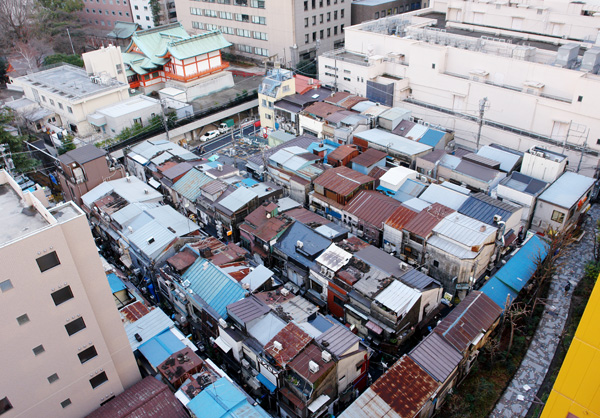
A narrow alley of tiny bars in Shinjuku Golden Gai — CC BY 3
Travel to Shinjuku Golden Gai
An evening in Shinjuku Golden Gai is a matter of choosing one bar, not of touring many. The quarter has about 200 bars, and the visitor who tries to see them all will see none of them. The better plan is to walk the six alleys slowly, look through the doors, listen to the music, and choose the bar whose shelves and whose owner appeal. One bar, one evening, and a conversation is the visit, and the second bar is for the second night.
Choosing a bar is a skill, and the quarter teaches it quickly. A bar with a theme that matches your taste is the first filter: jazz, horror film, literature, shochu, or the owner’s own obsession. A bar with seats free is the second, because a full bar has no room for a stranger.
A bar whose owner greets you is the third, because the greeting is the invitation, and a bar whose owner does not look up is telling you to move on. The alleys reward the visitor who reads these signs, and the evening is better for it.
The cover charge is the practical fact of the quarter. Most bars charge about 500 to 1,500 yen per person for the seat, often with a small snack called otoshi, and drinks run about 700 to 1,500 yen each, so two hours in a bar costs roughly 3,000 to 5,000 yen per person. Ask the charge before you sit down, because each bar sets its own, and the charge is not always written on the door. Most bars take cash only, so carry yen, and pay the charge without argument: it is the price of the room, not a trick.
The unwritten rules decide whether the evening goes well. Do not smoke in the alleys, do not shout, do not bring drinks in from outside, and do not photograph or film anyone without permission. Talk to the owner and to the regulars, and listen more than you speak at first, because the bar is their living room and you are a guest in it. A guest who follows these rules is welcomed back, and a guest who breaks them is asked to leave, and the quarter’s memory is long.
The timing of the visit matters. Weekday evenings are quieter than weekends, and the early evening is quieter than the late night, so a first visit on a weekday, arriving around the time the bars open, is the gentlest introduction. The bars usually open in the early evening and run past midnight, about 18:00 to 2:00, varying by bar, and the last train from Shinjuku Station sets the end of the night for most visitors. Arrive early, choose slowly, and leave before the rush for the trains.
Shinjuku Golden Gai is reached on foot from Shinjuku Station, a short walk east past the station’s east exit towards Hanazono Shrine. The quarter is small enough to find by the shrine, and the alleys are signposted once you are close. Tokyo is the base for the evening, and the quarter pairs with the shrine before dark and with the ramen and the late-night streets after. Shinjuku itself is the district, and the quarter is its quietest corner.
Notable Places at Shinjuku Golden Gai
The Six Alleys
The six alleys are the quarter itself. They run in parallel across the plot, joined by passages narrower still, and each alley has its own character: jazz in one, film in another, literature in a third. Walk them all before choosing a bar, and walk them slowly, because the signs and the sounds are the guide. The alleys are the geography of Shinjuku Golden Gai, and the evening begins with the walk.
Hanazono Shrine
Hanazono Shrine stands beside the quarter, and it is the neighbour that predates it. The shrine is the quiet centre of Shinjuku, and its festivals fill the streets with lanterns. Visit the shrine before the bars open, and the evening has a shape: the shrine at dusk, the alleys after dark. The shrine is also the landmark that finds the quarter, and the walk from the station passes it first.
The Jazz Bars
The jazz bars are the most famous rooms of Shinjuku Golden Gai. They play vinyl all night, and the shelves hold records rather than bottles, and the owners talk about music the way other owners talk about drinks. A jazz bar is the place for a visitor who wants to listen rather than to talk, and the music is the conversation. Choose one, sit, and let the records run.
The Film Bars
The film bars are the quarter’s cinemas in miniature. Their walls are covered with posters, and the regulars are filmmakers, actors and the people who love them. One bar is devoted to horror film, and its walls are a gallery of monsters, and its owner is a collector. A film bar is the place for a visitor who wants the quarter’s cultural history in a single room, and the posters are the archive.
The Writers’ Bars
The writers’ bars are where Tokyo’s literature was drunk. Authors and editors have been regulars since the 1960s, and the conversations in these rooms have fed books and films. The bars are quiet, the talk is long, and the owner knows the regulars by name. A writers’ bar is the place for a visitor who wants the quarter at its most serious, and the evening there is a seminar with drinks.
The Shochu Bars
The shochu bars are the quarter’s specialists. Their shelves hold bottles of the distilled spirit from across Japan, and the owners pour with the care of sommeliers. Shochu is the drink of the quarter’s older regulars, and a shochu bar is the place to learn it, because the owner will ask what you like and pour accordingly. The bar is small, the pour is generous, and the lesson is the evening.
Kabukicho
Kabukicho lies just east of the quarter, and it is the contrast that explains Shinjuku Golden Gai. Kabukicho is neon, crowds and noise, and the quarter is wood, quiet and small. The two sit side by side, and the visitor who walks from one to the other feels the change in a single step.
Kabukicho is the evening’s second half for those who want it, and the quarter is the first half for those who do not. Shibuya lies to the south, and its crossing is the evening’s second half for those who want the crowds.
Frequently Asked Questions About Shinjuku Golden Gai
Where is Shinjuku Golden Gai?
Shinjuku Golden Gai sits east of Shinjuku Station, beside Hanazono Shrine and west of Kabukicho, in Tokyo. The quarter is a short walk from the station’s east exit, and it occupies a plot about 200 metres by 50 metres. The six alleys run through it, and the whole quarter can be walked in about ten minutes.
How many bars are there in Shinjuku Golden Gai?
There are about 200 bars, and the number changes as bars open and close. Most bars seat five to eight people around a single counter, and each bar has its own theme, its own owner and its own rules. The figure of about 200 is the most commonly given, and the exact count varies with the season.
Is there a cover charge in Shinjuku Golden Gai?
Most bars charge a cover of about 500 to 1,500 yen per person, often with a small snack called otoshi, and drinks cost about 700 to 1,500 yen each. Ask the charge before you sit down, because each bar sets its own. Most bars take cash only, so carry yen, and a two-hour evening costs roughly 3,000 to 5,000 yen per person.
Can first-time visitors enter the bars of Shinjuku Golden Gai?
Many bars welcome first-time visitors, and some admit only regulars and their guests. Look for a bar whose owner greets you, and move on from one whose owner does not look up. The greeting is the invitation, and the quarter’s etiquette is to accept it graciously and to follow the house rules once inside.
What are the rules of Shinjuku Golden Gai?
The house rules are simple: no smoking in the alleys, no shouting, no outside drinks, and no photographs or filming without asking first. Talk to the owner and the regulars, and listen more than you speak at first. A guest who follows the rules is welcomed back, and a guest who breaks them is asked to leave.
When is the best time to visit Shinjuku Golden Gai?
The quarter is open year-round, and weekday evenings are quieter than weekends. The bars usually open in the early evening and run past midnight, about 18:00 to 2:00, varying by bar. Arrive early on a weekday for the gentlest first visit, and leave before the rush for the last train from Shinjuku Station.
Verified
- Shinjuku Golden Gai sits east of Shinjuku Station, beside Hanazono Shrine and west of Kabukicho, on a plot about 200 metres by 50 metres, with six alleys and about 200 bars. Checked 21 November 2026.
- Most bars seat five to eight people around a single counter, and the owner is the bartender and the host. Checked 21 November 2026.
- The quarter formed in 1945 as a post-war black market and became a bar quarter in the early 1960s, drawing the writers, filmmakers and artists of Tokyo. Checked 21 November 2026.
- The quarter survived the demolition wave of the 1980s, when its owners resisted developers through the bubble economy. Checked 21 November 2026.
- Cover charges are usually about 500 to 1,500 yen per person, drinks about 700 to 1,500 yen each, and most bars take cash only. Checked 21 November 2026.
- Wikidata Q5363705 was verified through the Wikidata API on 21 November 2026: instance of a neighbourhood, at 35.6939° N, 139.705° E. Checked 21 November 2026.
Sources
- Wikidata, Shinjuku Golden Gai Q5363705 — https://www.wikidata.org/wiki/Q5363705 — for the identity, the type and the coordinates, verified through the Wikidata API on 21 November 2026.
- Japan Guide, Shinjuku Golden Gai — https://www.japan-guide.com/e/e3016.html — for the alleys, the bars and the visiting rules, checked on 21 November 2026.
- Japan National Tourism Organization — https://www.japan.travel/en/ — for visitor information on Tokyo and Shinjuku, checked on 21 November 2026.
- Tokyo Cheapo, Shinjuku Golden Gai guide — https://tokyocheapo.com/ — for the cover charges, the hours and the etiquette, checked on 21 November 2026.
Unverified
- The exact number of bars is given as about 200 here; sources also give 200 to 280, so the count varies with the time of counting.
- The cover charge and drink prices at any single bar were not checked on an official site; each bar sets its own, so ask before sitting down.
- The opening and closing hours of individual bars vary; this article gives the usual range of about 18:00 to 2:00 and does not state hours for any single bar.
- The stories of individual regulars and owners were not verified against a published source; this article gives only the quarter’s general history.
- The rules listed here are the commonly reported ones; individual bars may add their own house rules, so read the signs at the door.
Illustrations
- Hero: View of Shinjuku Golden Gai. Free image: https://upload.wikimedia.org/wikipedia/commons/d/dd/2024-10-20_Shinjuku_Golden_Gai_at_night.jpg — CC BY 4.0.
- In body, view: A narrow alley of tiny bars in Shinjuku Golden Gai. Free image: https://upload.wikimedia.org/wikipedia/commons/d/d6/Shinjuku_Golden_Gai.jpg — CC BY 3.
- In body, shrine: The entrance to Hanazono Shrine beside Shinjuku Golden Gai. Free image: https://upload.wikimedia.org/wikipedia/commons/c/c5/Entrance_to_the_Hanazono_shrine_in_Shinjuku%2C_Tokyo.jpg — CC BY-SA 4.